
The Theory of Social Role Valorisation In relation
- Slides: 12
The Theory of Social Role Valorisation In relation to Citizen Advocacy practice Copyright: North East Citizen Advocacy (NECA) confirms its general permission for anyone to use this material with accurate and appropriate attribution to this material and NECA as its author. JANUARY 2021 Author - Kate Krombach North East Citizen Advocacy Inc.
HISTORY OF SRV THEORY In the 1970’s the Principle of NORMALISATION was developed in America by Professor Wolfensberg. His main interest was in improving the quality of life of people with disabilities. Wolfensberger came up with the term ‘Social Role Valorisation’ to describe the best way to create a positive attitude toward people with a Disability He proposed that the deliberate application of the SRV theory by Governments, Disability Services and general community members would lead to people with disabilities attaining acceptance as normal members of Society. Wolfensberger described the change of attitude and value for people with a disability as giving these people the ability to live a ‘good life’, like everyone else in society.
HISTORICAL SITUATION FOR PEOPLE WITH DISABILITIES NB: The present situation for people with disability is vastly different to what it was in the past, so this is an outline of the reality that Wolfensberg was faced with in the 1960 s. For the last 100 years, the Government took on the responsibility for the care of people with disabilities. Families were instructed to put their child into an institution and have limited contact with them. Many people with disabilities were housed in very large Institutions, where they had no autonomy or ability to interact with the broader society. Because people were segregated from society in these Institutions they became stigmatised, separated from community and family, and were given dehumanising labels. It is well documented that people living in the Human Services System were at a greater risk of experiencing abuse, ill-health and dying earlier that those in the general population. People living in Institutions were unable to make decisions on their lifestyle preferences and were not able to pursue individual interests and hobbies.
NORMATISATION PRINCIPLE • Stated that people with disabilities should have access to the same patterns and routines of everyday living as everyone else in society. • This includes the right to have a say in: • • Housing - to live at family home, independently or in group home • Work- what type of work, how many hours to work, support to employers • Recreation- to join local sports clubs, to have comps at their skill level, access support • Education- integrated into local schools, stimulating curriculums, learning aids • Choice- of who to associate with, lifestyle and interests The application of the Normalisation principle from 1980 onward, had a huge impact on services available to people with disabilities, starting with the closing down of Institutions, and therefore people being rehoused in Group Homes in the community.
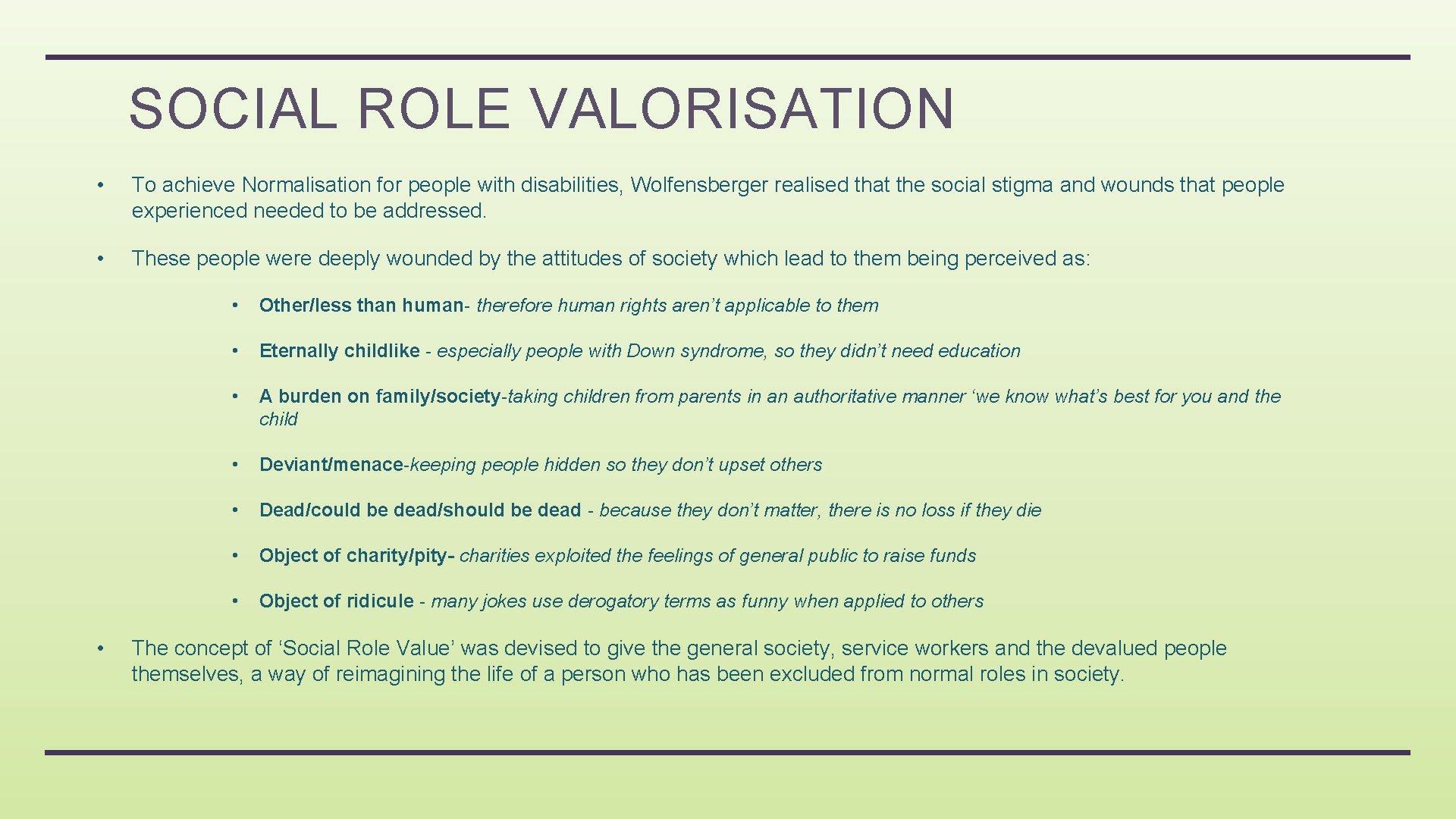
SOCIAL ROLE VALORISATION • To achieve Normalisation for people with disabilities, Wolfensberger realised that the social stigma and wounds that people experienced needed to be addressed. • These people were deeply wounded by the attitudes of society which lead to them being perceived as: • • Other/less than human- therefore human rights aren’t applicable to them • Eternally childlike - especially people with Down syndrome, so they didn’t need education • A burden on family/society-taking children from parents in an authoritative manner ‘we know what’s best for you and the child • Deviant/menace-keeping people hidden so they don’t upset others • Dead/could be dead/should be dead - because they don’t matter, there is no loss if they die • Object of charity/pity- charities exploited the feelings of general public to raise funds • Object of ridicule - many jokes use derogatory terms as funny when applied to others The concept of ‘Social Role Value’ was devised to give the general society, service workers and the devalued people themselves, a way of reimagining the life of a person who has been excluded from normal roles in society.
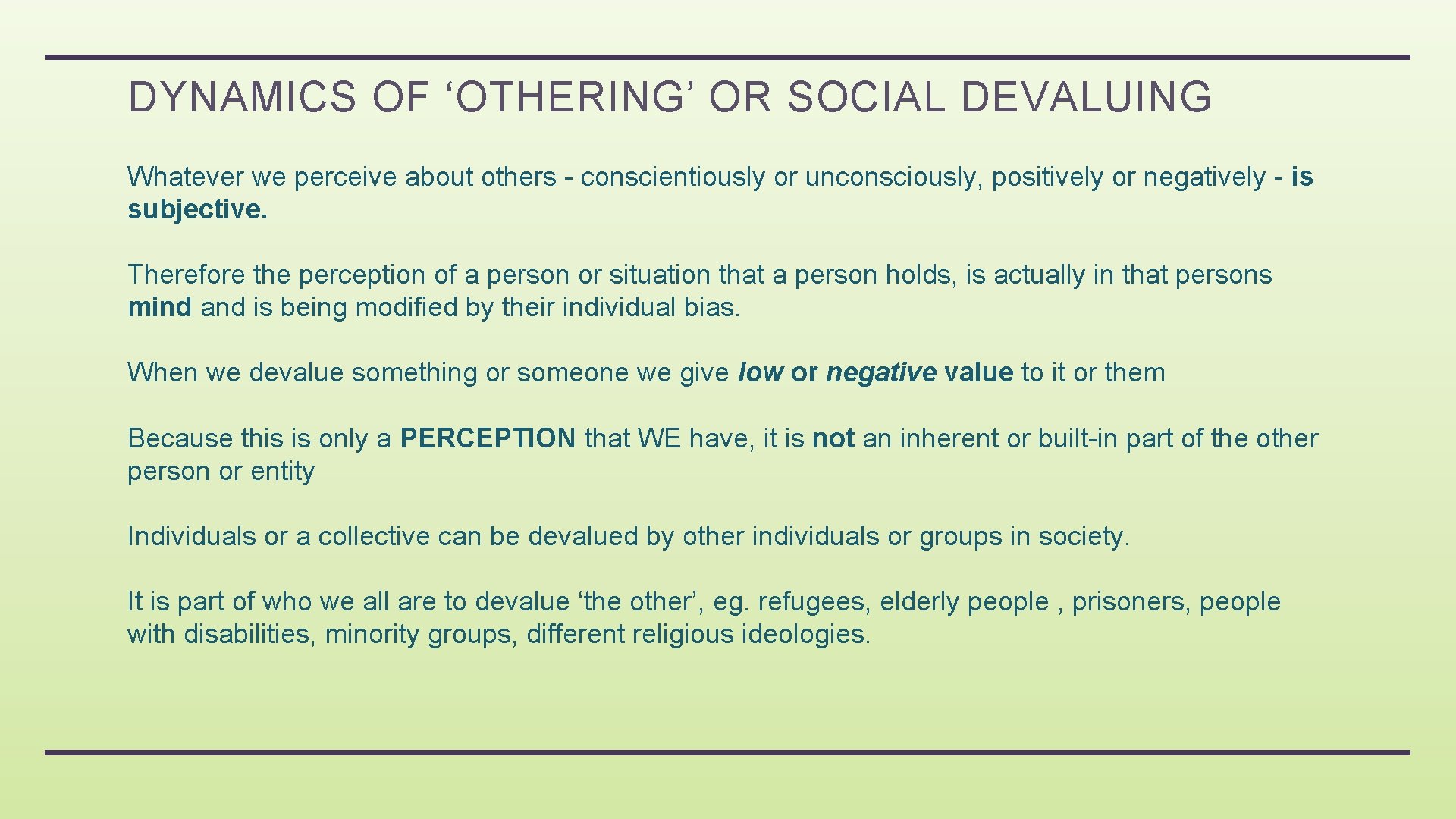
DYNAMICS OF ‘OTHERING’ OR SOCIAL DEVALUING Whatever we perceive about others - conscientiously or unconsciously, positively or negatively - is subjective. Therefore the perception of a person or situation that a person holds, is actually in that persons mind and is being modified by their individual bias. When we devalue something or someone we give low or negative value to it or them Because this is only a PERCEPTION that WE have, it is not an inherent or built-in part of the other person or entity Individuals or a collective can be devalued by other individuals or groups in society. It is part of who we all are to devalue ‘the other’, eg. refugees, elderly people , prisoners, people with disabilities, minority groups, different religious ideologies.
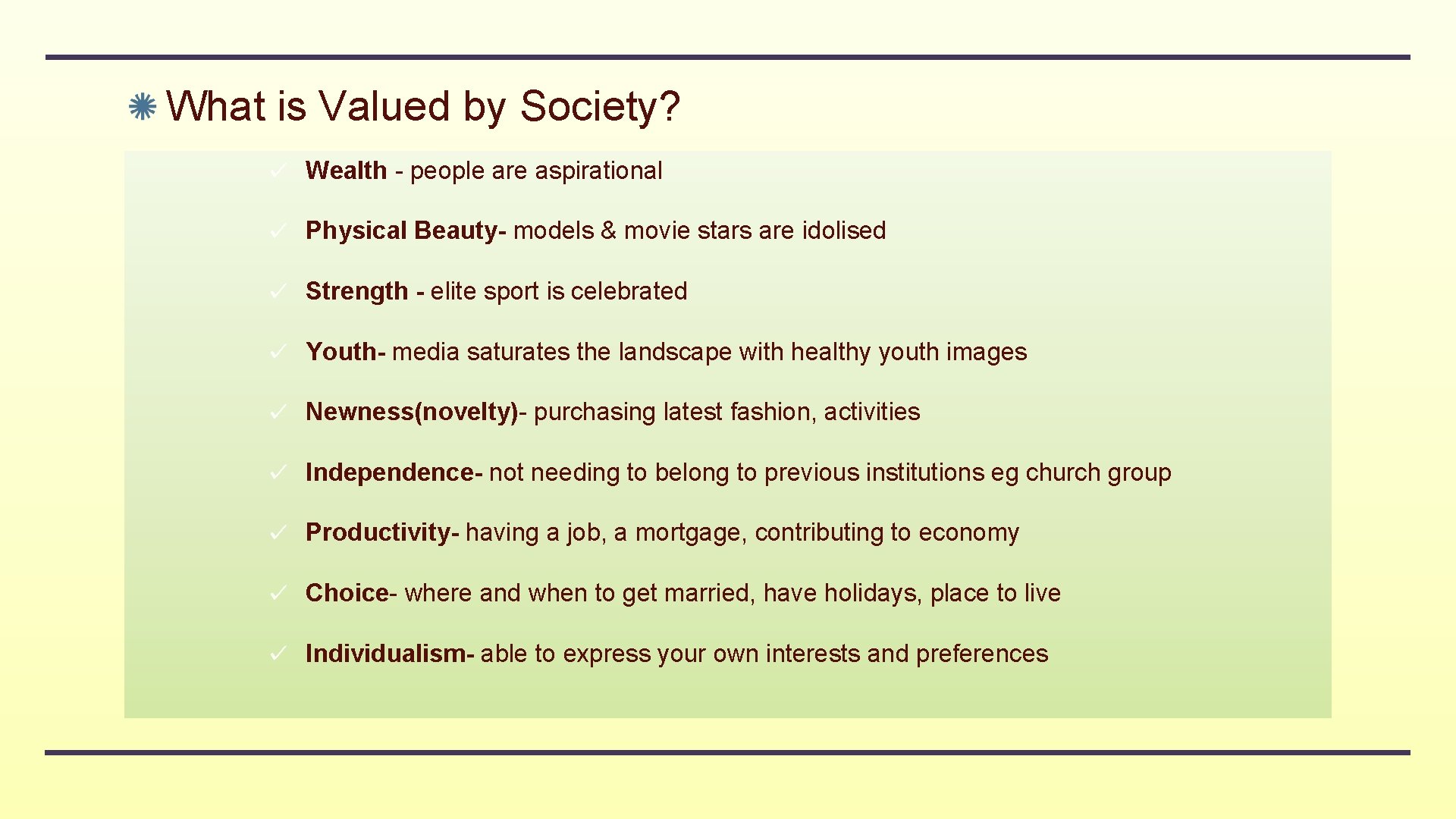
What is Valued by Society? Wealth - people are aspirational Physical Beauty- models & movie stars are idolised Strength - elite sport is celebrated Youth- media saturates the landscape with healthy youth images Newness(novelty)- purchasing latest fashion, activities Independence- not needing to belong to previous institutions eg church group Productivity- having a job, a mortgage, contributing to economy Choice- where and when to get married, have holidays, place to live Individualism- able to express your own interests and preferences
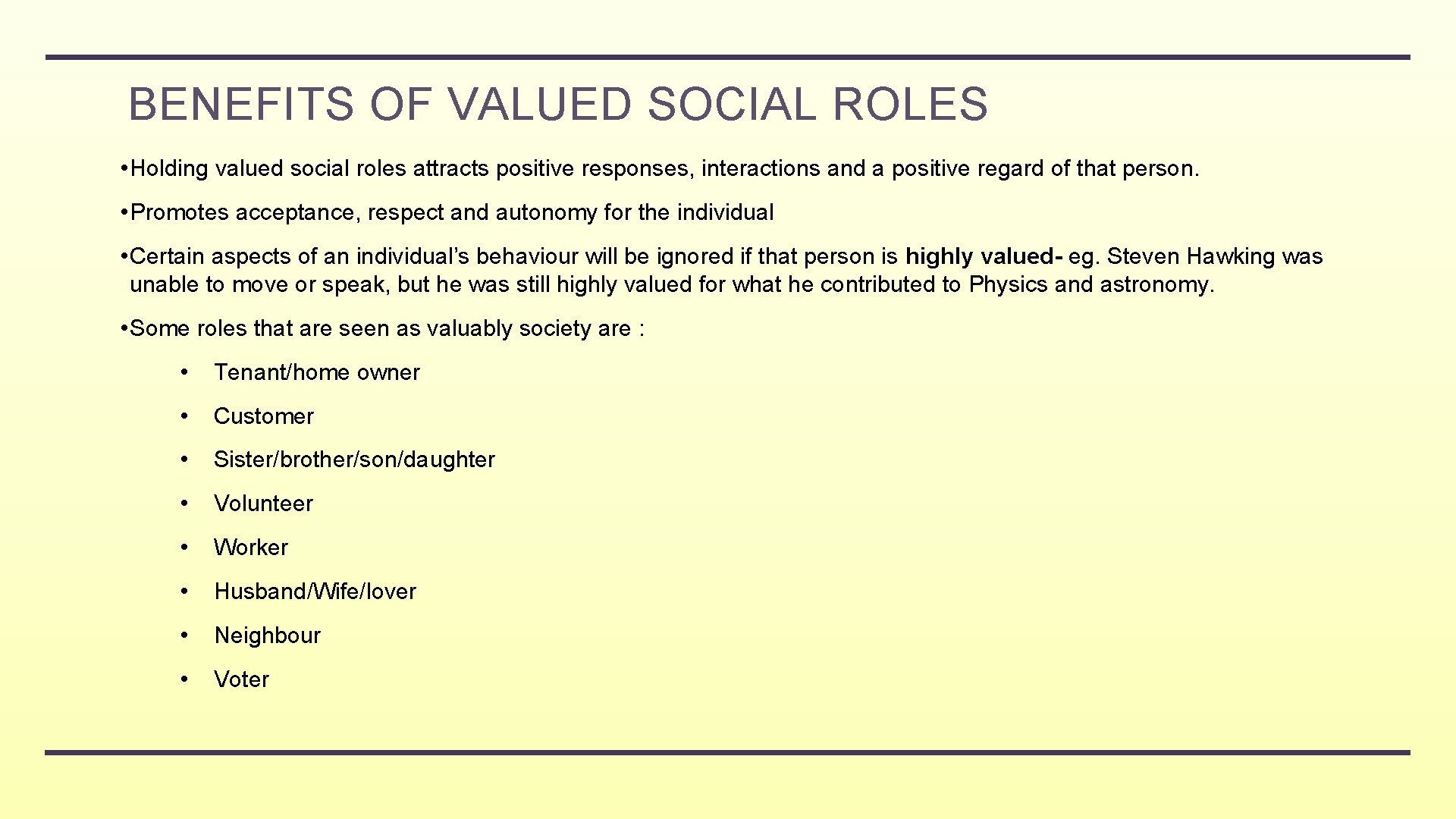
BENEFITS OF VALUED SOCIAL ROLES • Holding valued social roles attracts positive responses, interactions and a positive regard of that person. • Promotes acceptance, respect and autonomy for the individual • Certain aspects of an individual’s behaviour will be ignored if that person is highly valued- eg. Steven Hawking was unable to move or speak, but he was still highly valued for what he contributed to Physics and astronomy. • Some roles that are seen as valuably society are : • Tenant/home owner • Customer • Sister/brother/son/daughter • Volunteer • Worker • Husband/Wife/lover • Neighbour • Voter
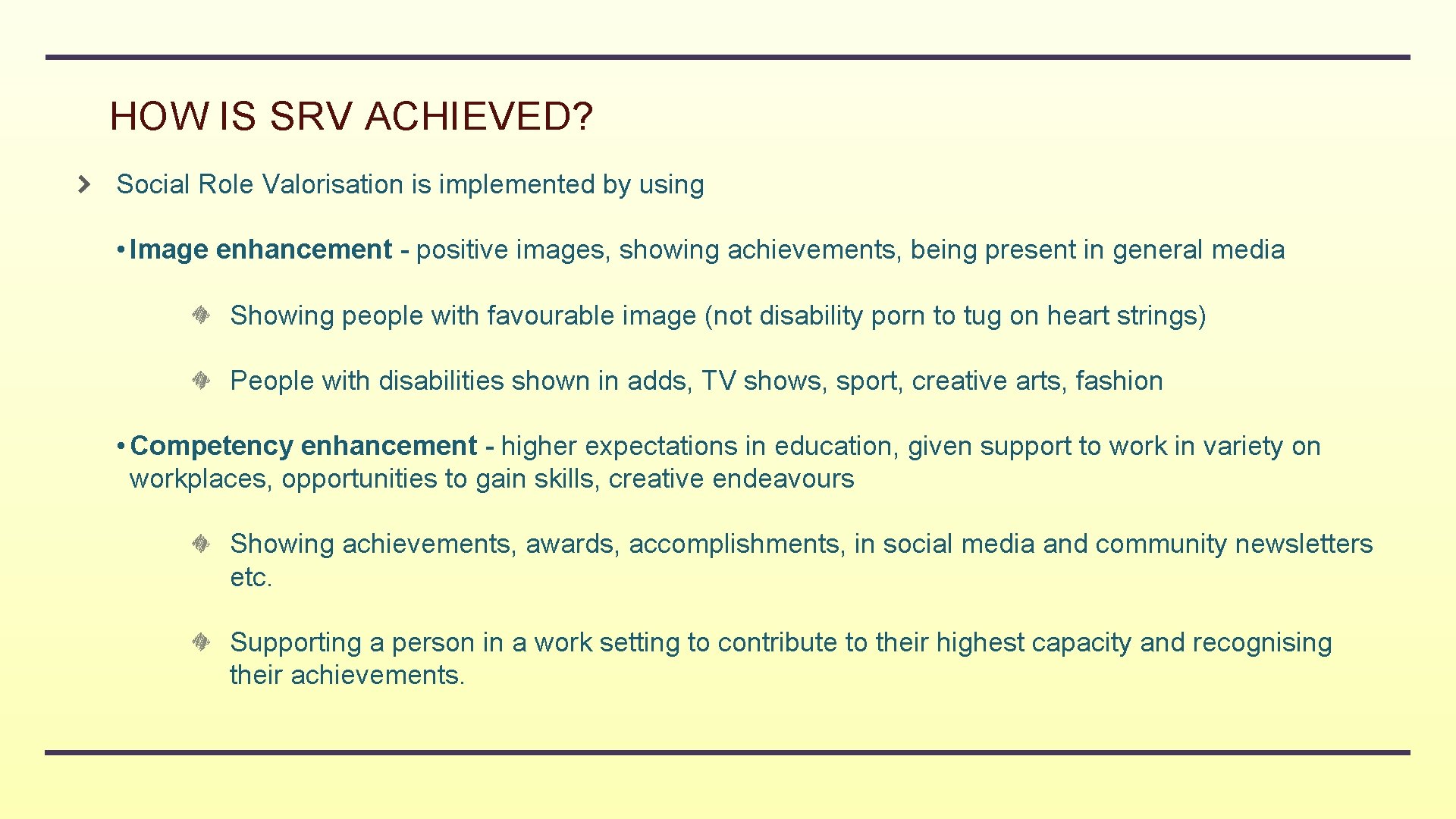
HOW IS SRV ACHIEVED? Social Role Valorisation is implemented by using • Image enhancement - positive images, showing achievements, being present in general media Showing people with favourable image (not disability porn to tug on heart strings) People with disabilities shown in adds, TV shows, sport, creative arts, fashion • Competency enhancement - higher expectations in education, given support to work in variety on workplaces, opportunities to gain skills, creative endeavours Showing achievements, awards, accomplishments, in social media and community newsletters etc. Supporting a person in a work setting to contribute to their highest capacity and recognising their achievements.
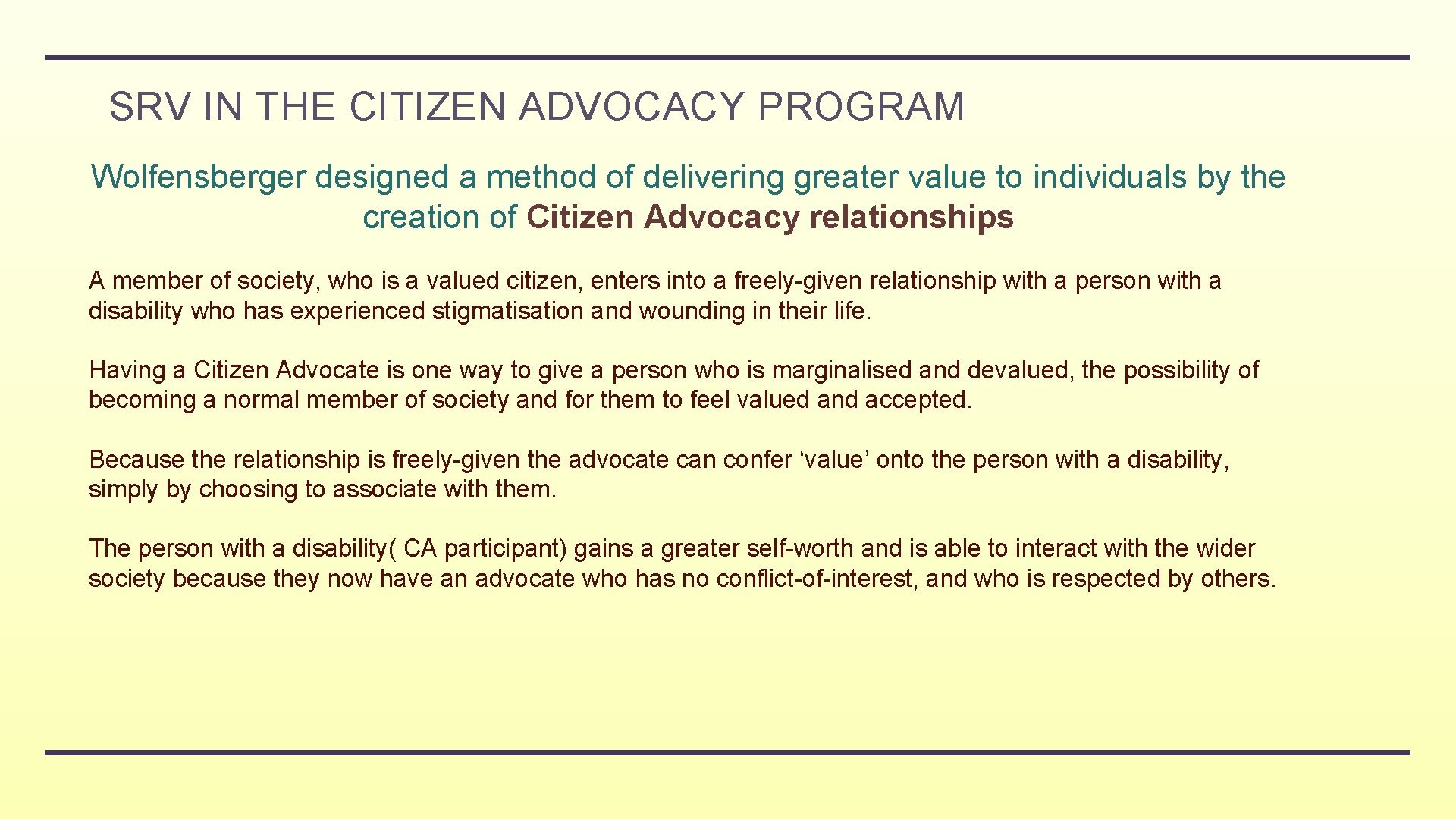
SRV IN THE CITIZEN ADVOCACY PROGRAM Wolfensberger designed a method of delivering greater value to individuals by the creation of Citizen Advocacy relationships A member of society, who is a valued citizen, enters into a freely-given relationship with a person with a disability who has experienced stigmatisation and wounding in their life. Having a Citizen Advocate is one way to give a person who is marginalised and devalued, the possibility of becoming a normal member of society and for them to feel valued and accepted. Because the relationship is freely-given the advocate can confer ‘value’ onto the person with a disability, simply by choosing to associate with them. The person with a disability( CA participant) gains a greater self-worth and is able to interact with the wider society because they now have an advocate who has no conflict-of-interest, and who is respected by others.
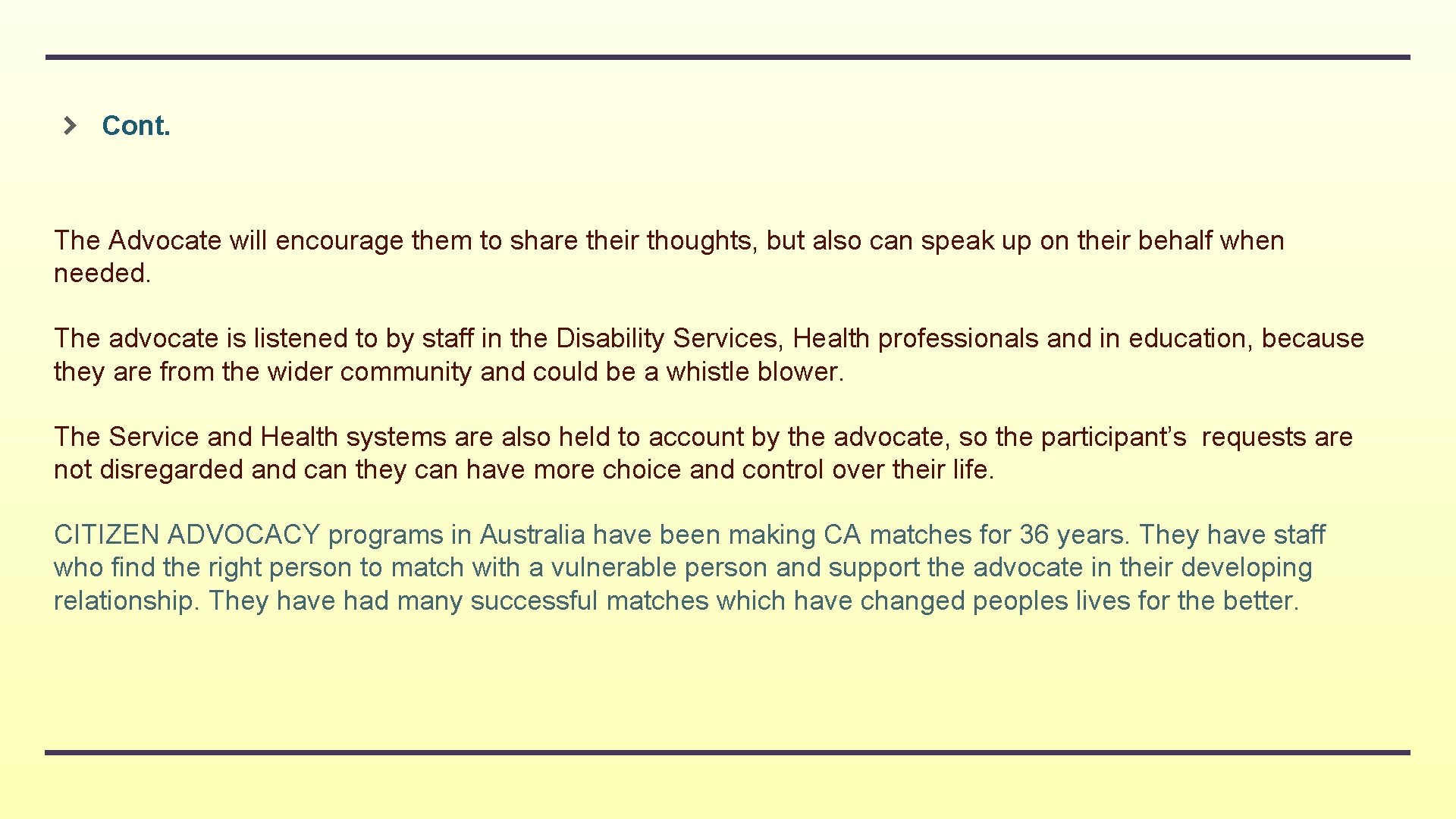
Cont. The Advocate will encourage them to share their thoughts, but also can speak up on their behalf when needed. The advocate is listened to by staff in the Disability Services, Health professionals and in education, because they are from the wider community and could be a whistle blower. The Service and Health systems are also held to account by the advocate, so the participant’s requests are not disregarded and can they can have more choice and control over their life. CITIZEN ADVOCACY programs in Australia have been making CA matches for 36 years. They have staff who find the right person to match with a vulnerable person and support the advocate in their developing relationship. They have had many successful matches which have changed peoples lives for the better.
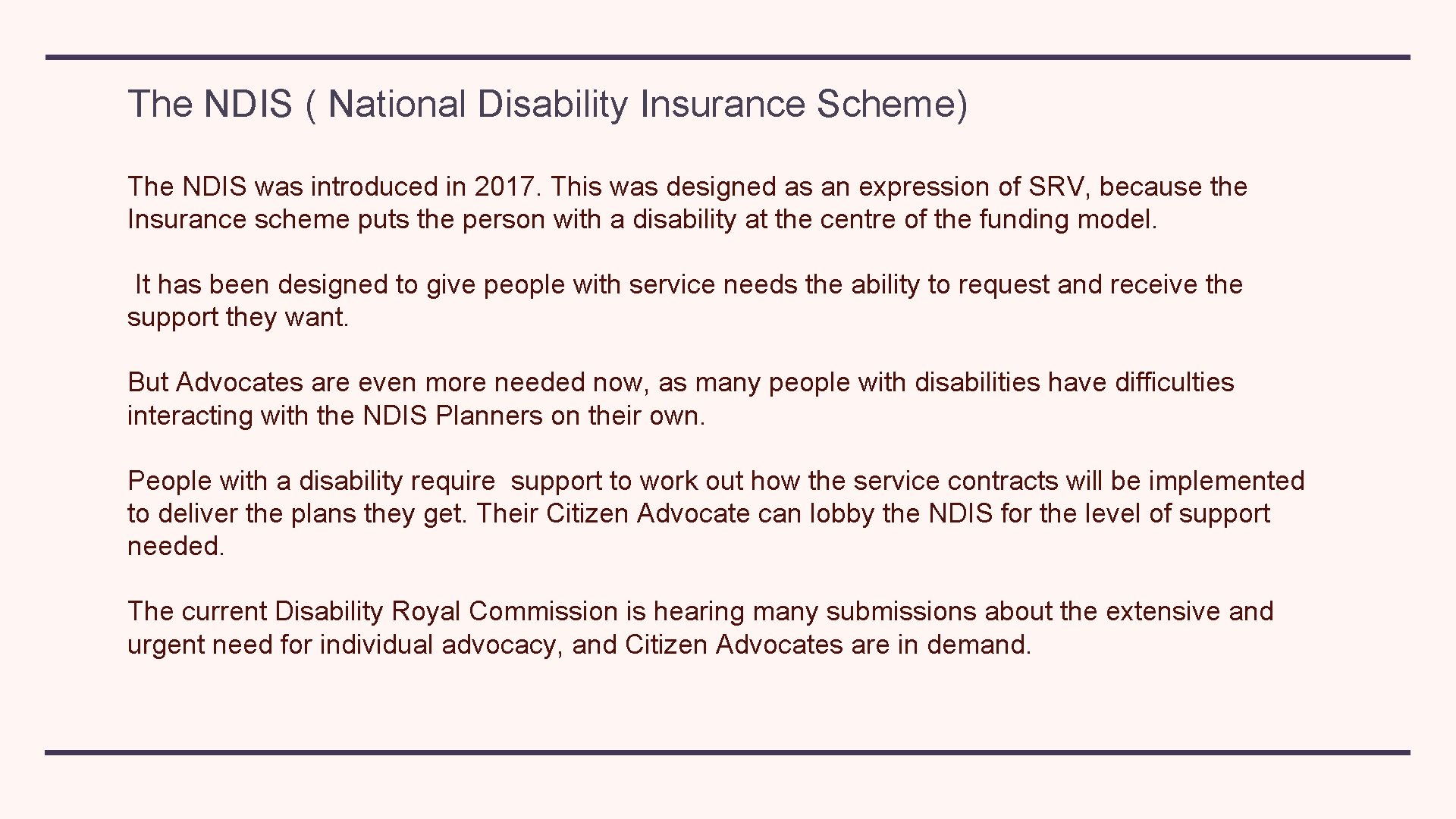
The NDIS ( National Disability Insurance Scheme) The NDIS was introduced in 2017. This was designed as an expression of SRV, because the Insurance scheme puts the person with a disability at the centre of the funding model. It has been designed to give people with service needs the ability to request and receive the support they want. But Advocates are even more needed now, as many people with disabilities have difficulties interacting with the NDIS Planners on their own. People with a disability require support to work out how the service contracts will be implemented to deliver the plans they get. Their Citizen Advocate can lobby the NDIS for the level of support needed. The current Disability Royal Commission is hearing many submissions about the extensive and urgent need for individual advocacy, and Citizen Advocates are in demand.