
The Theory of NPCompleteness Tractable and intractable problems
The Theory of NP-Completeness Tractable and intractable problems NP-complete problems Cutler/Head
The theory of NP-completeness • Tractable and intractable problems • NP-complete problems 3/1/2021 Cutler/Head 2
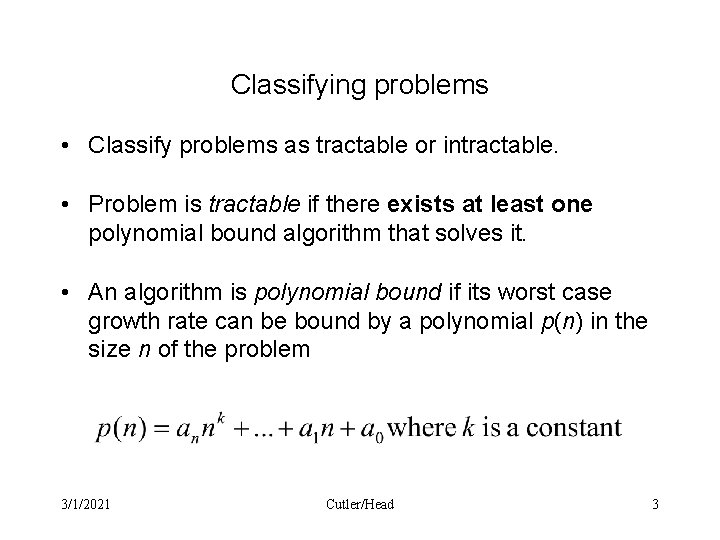
Classifying problems • Classify problems as tractable or intractable. • Problem is tractable if there exists at least one polynomial bound algorithm that solves it. • An algorithm is polynomial bound if its worst case growth rate can be bound by a polynomial p(n) in the size n of the problem 3/1/2021 Cutler/Head 3
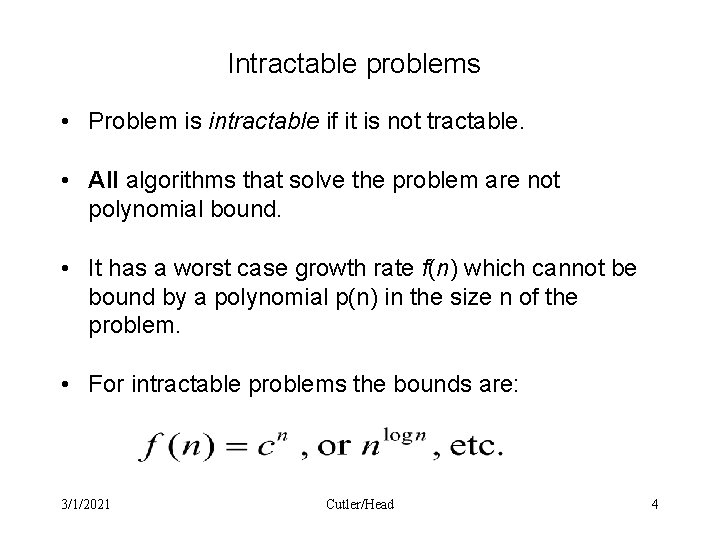
Intractable problems • Problem is intractable if it is not tractable. • All algorithms that solve the problem are not polynomial bound. • It has a worst case growth rate f(n) which cannot be bound by a polynomial p(n) in the size n of the problem. • For intractable problems the bounds are: 3/1/2021 Cutler/Head 4
Why is this classification useful? • If problem is intractable, no point in trying to find an efficient algorithm • All algorithms will be too slow for large inputs. 3/1/2021 Cutler/Head 5
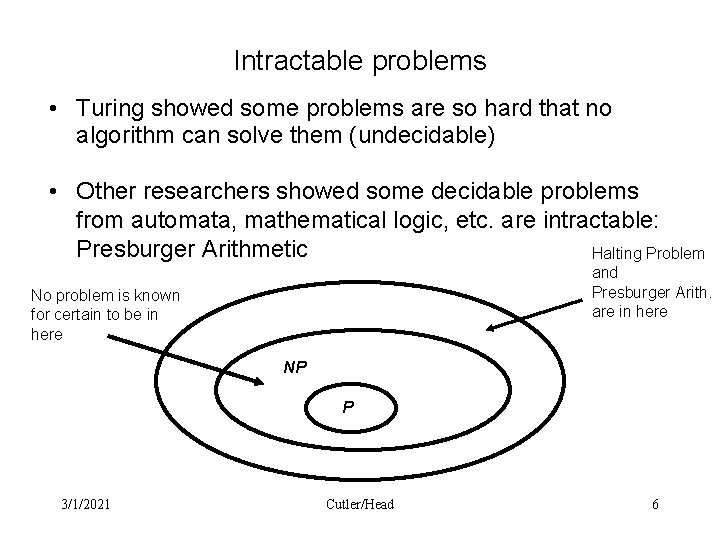
Intractable problems • Turing showed some problems are so hard that no algorithm can solve them (undecidable) • Other researchers showed some decidable problems from automata, mathematical logic, etc. are intractable: Presburger Arithmetic Halting Problem and Presburger Arith. are in here No problem is known for certain to be in here NP P 3/1/2021 Cutler/Head 6
Hard practical problems • There are many practical problems for which no one has yet found a polynomial bound algorithm. • Examples: traveling salesperson, 0/1 knapsack, graph coloring, bin packing etc. • Most design automation problems such as testing and routing. • Many networks, database and graph problems. 3/1/2021 Cutler/Head 7
How are they solved? • A variety of algorithms based on backtracking, branch and bound, dynamic programming, etc. • None can be shown to be polynomial bound 3/1/2021 Cutler/Head 8
The theory of NP completeness • The theory of NP-completeness enables showing that these problems are at least as hard as NP-complete problems • Practical implication of knowing problem is NPcomplete is that it is probably intractable ( whether it is or not has not been proved yet) • So any algorithm that solves it will probably be very slow for large inputs 3/1/2021 Cutler/Head 9
We will need to discuss • Decision problems • Converting optimization problems into decision problems • The relationship between an optimization problem and its decision version • The class P • Verification algorithms • The class NP • The concept of polynomial transformations • The class of NP-complete problems 3/1/2021 Cutler/Head 10
Decision Problems • A decision problem answers yes or no for a given input • Examples: – Given a graph G Is there a path from s to t of length at most k? – Does graph G contain a Hamiltonian cycle? – Given a graph G is it bipartite? 3/1/2021 Cutler/Head 11
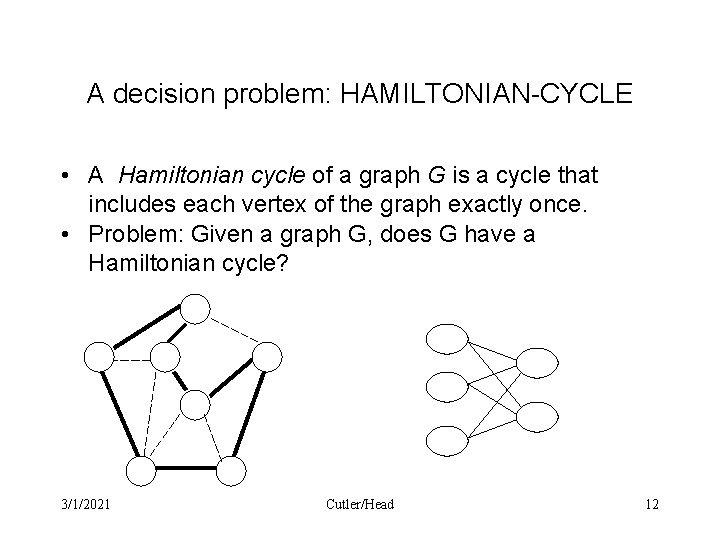
A decision problem: HAMILTONIAN-CYCLE • A Hamiltonian cycle of a graph G is a cycle that includes each vertex of the graph exactly once. • Problem: Given a graph G, does G have a Hamiltonian cycle? 3/1/2021 Cutler/Head 12
Converting to decision problems • Optimization problems can be converted to decision problems (typically) by adding a bound B on the value to optimize, and asking the question: – Is there a solution whose value is at most B? (for a minimization problem) – Is there a solution whose value is at least B? (for a maximization problem) 3/1/2021 Cutler/Head 13
An optimization problem: traveling salesman • Given: – A finite set C={c 1, . . . , cm} of cities, – A distance function d(ci, cj) of nonnegative numbers. • Find the length of the minimum distance tour which includes every city exactly once 3/1/2021 Cutler/Head 14
A decision problem for traveling salesman (TS) • Given a finite set C={c 1, . . . , cm} of cities, a distance function d(ci, cj) of nonnegative numbers and a bound B • Is there a tour of all the cities (in which each city is visited exactly once) with total length at most B? • There is no known polynomial bound algorithm for TS. 3/1/2021 Cutler/Head 15
The relation between • If we have a solution to the optimization problem we can compare the solution to the bound answer “yes” or “no”. • Therefore if the optimization problem is tractable so is the decision problem • If the decision problem is “hard” the optimization problems are also “hard” – If the optimization was easy then the decision problem is easy. 3/1/2021 Cutler/Head 16
The class P • P is the class of decision problems that are polynomial bounded • Is the following problem in P? – Given a weighted graph G, is there a spanning tree of weight at most B? • The decision versions of problems such as shortest distance, and minimum spanning tree belong to P 3/1/2021 Cutler/Head 17
The goal of verification algorithms • The goal of a verification algorithm is to verify a “yes” answer to a decision problem’s input (i. e. , if the answer is “yes” the verification algorithm verify this answer) • The inputs to the verification algorithm are: – the original input (problem instance) and – a certificate (possible solution) 3/1/2021 Cutler/Head 18
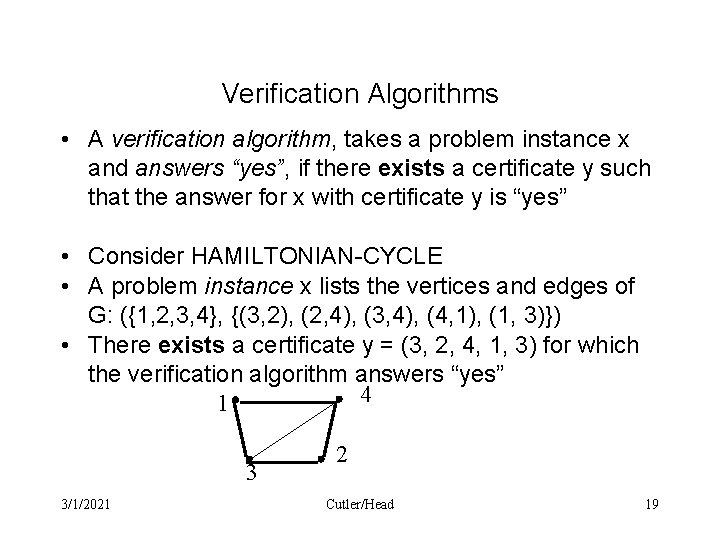
Verification Algorithms • A verification algorithm, takes a problem instance x and answers “yes”, if there exists a certificate y such that the answer for x with certificate y is “yes” • Consider HAMILTONIAN-CYCLE • A problem instance x lists the vertices and edges of G: ({1, 2, 3, 4}, {(3, 2), (2, 4), (3, 4), (4, 1), (1, 3)}) • There exists a certificate y = (3, 2, 4, 1, 3) for which the verification algorithm answers “yes” 4 1 3 3/1/2021 2 Cutler/Head 19
Polynomial bound verification algorithms • Given a decision problem d. • A verification algorithm for d is polynomial bound if given an input x to d, there exists a certificate y, such that |y|=O(|x|c) where c is a constant, and a polynomial bound algorithm A(x, y) that verifies an answer “yes” for d with input x Note: |y| is the size of the certificate, |x| is the size of the input 3/1/2021 Cutler/Head 20
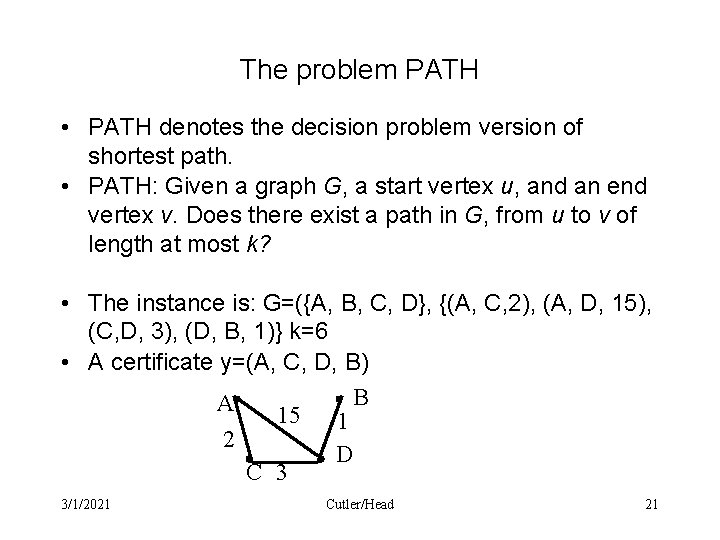
The problem PATH • PATH denotes the decision problem version of shortest path. • PATH: Given a graph G, a start vertex u, and an end vertex v. Does there exist a path in G, from u to v of length at most k? • The instance is: G=({A, B, C, D}, {(A, C, 2), (A, D, 15), (C, D, 3), (D, B, 1)} k=6 • A certificate y=(A, C, D, B) B A 15 1 2 D C 3 3/1/2021 Cutler/Head 21
A verification algorithm for PATH • Verification algorithm: – Given the problem instance x and a certificate y • Check that y is indeed a path from u to v. • Verify that the length of y is at most k • Is the verification algorithm for PATH polynomial bound? • Is the size of y polynomial in the size of x? • Is the verification algorithm polynomial bound? 3/1/2021 Cutler/Head 22
Example: A verification algorithm for TS • Given a problem instance x for TS and a certificate y – Check that y is indeed a cycle that includes every vertex exactly once – Verify that the length of the cycle is at most B • Is the size of y polynomial in the size of x? • Is the verification algorithm polynomial? 3/1/2021 Cutler/Head 23
The class NP • NP is the class of decision problems for which there is a polynomial bounded verification algorithm • It can be shown that: – all decision problems in P, and – decision problems such as traveling salesman, knapsack, bin pack, are also in NP 3/1/2021 Cutler/Head 24
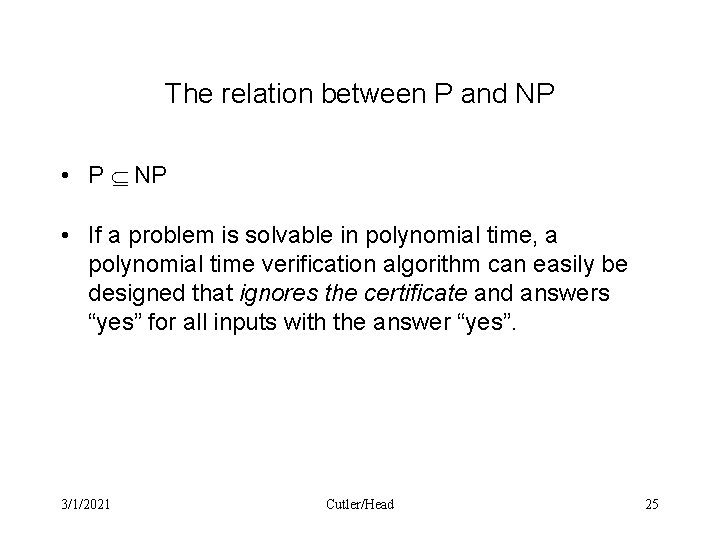
The relation between P and NP • P Í NP • If a problem is solvable in polynomial time, a polynomial time verification algorithm can easily be designed that ignores the certificate and answers “yes” for all inputs with the answer “yes”. 3/1/2021 Cutler/Head 25
The relation between P and NP • It is not known whether P = NP. • Problems in P can be solved “quickly” • Problems in NP can be verified “quickly”. • It is easier to verify a solution than to solve a problem. • Some researchers believe that P and NP are not the same class. 3/1/2021 Cutler/Head 26
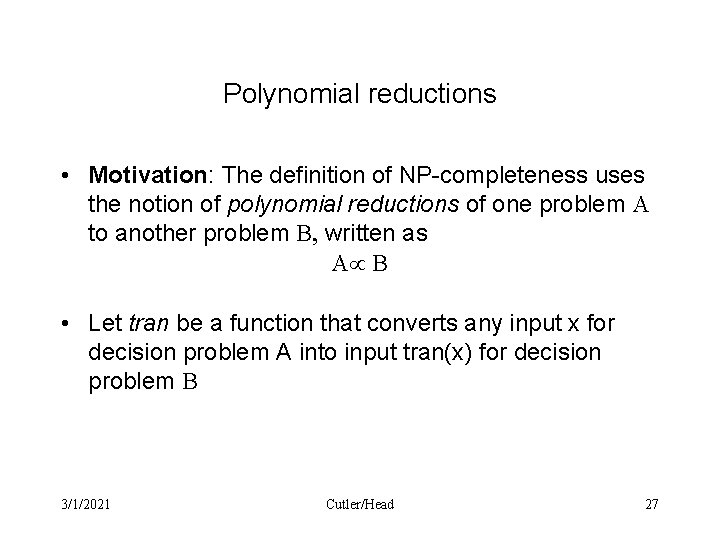
Polynomial reductions • Motivation: The definition of NP-completeness uses the notion of polynomial reductions of one problem A to another problem B, written as Aµ B • Let tran be a function that converts any input x for decision problem A into input tran(x) for decision problem B 3/1/2021 Cutler/Head 27
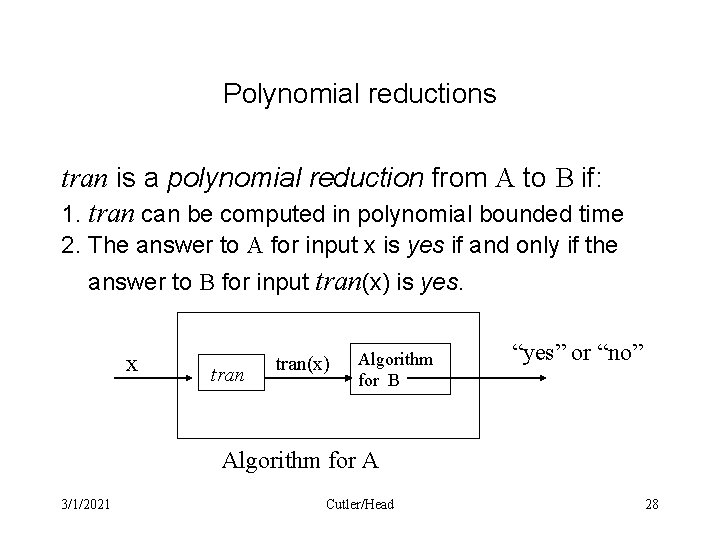
Polynomial reductions tran is a polynomial reduction from A to B if: 1. tran can be computed in polynomial bounded time 2. The answer to A for input x is yes if and only if the answer to B for input tran(x) is yes. x tran(x) Algorithm for B “yes” or “no” Algorithm for A 3/1/2021 Cutler/Head 28
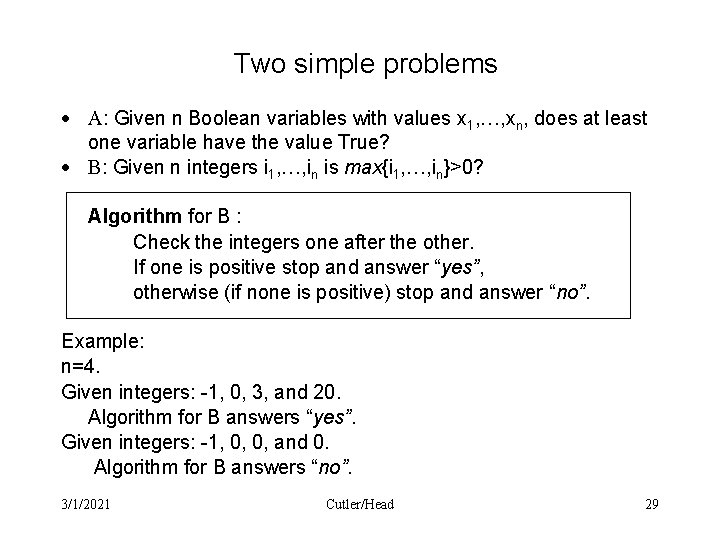
Two simple problems · A: Given n Boolean variables with values x 1, …, xn, does at least one variable have the value True? · B: Given n integers i 1, …, in is max{i 1, …, in}>0? Algorithm for B : Check the integers one after the other. If one is positive stop and answer “yes”, otherwise (if none is positive) stop and answer “no”. Example: n=4. Given integers: -1, 0, 3, and 20. Algorithm for B answers “yes”. Given integers: -1, 0, 0, and 0. Algorithm for B answers “no”. 3/1/2021 Cutler/Head 29
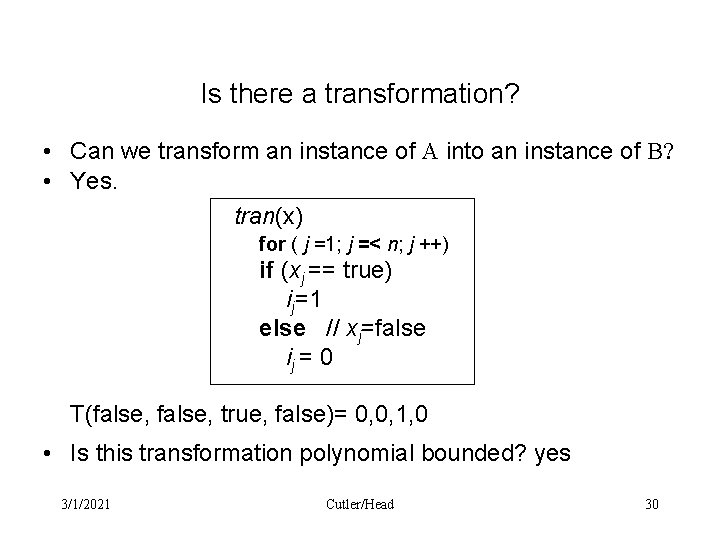
Is there a transformation? • Can we transform an instance of A into an instance of B? • Yes. tran(x) for ( j =1; j =< n; j ++) if (xj == true) ij=1 else // xj=false ij = 0 T(false, true, false)= 0, 0, 1, 0 • Is this transformation polynomial bounded? yes 3/1/2021 Cutler/Head 30
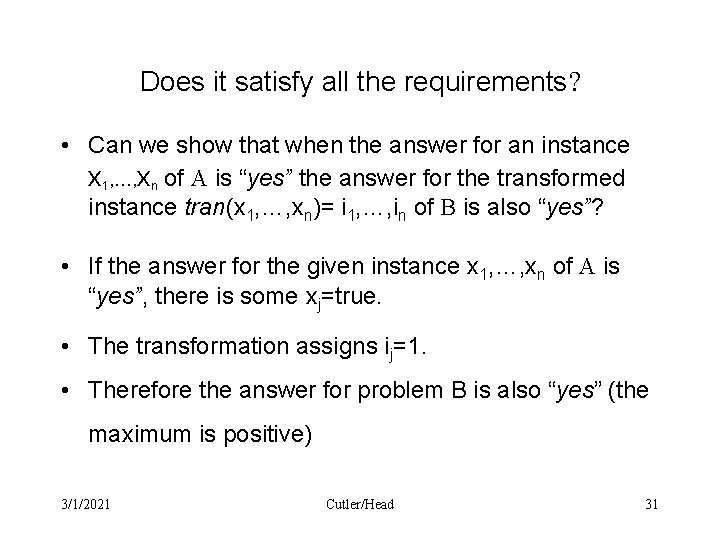
Does it satisfy all the requirements? • Can we show that when the answer for an instance x 1, …, xn of A is “yes” the answer for the transformed instance tran(x 1, …, xn)= i 1, …, in of B is also “yes”? • If the answer for the given instance x 1, …, xn of A is “yes”, there is some xj=true. • The transformation assigns ij=1. • Therefore the answer for problem B is also “yes” (the maximum is positive) 3/1/2021 Cutler/Head 31
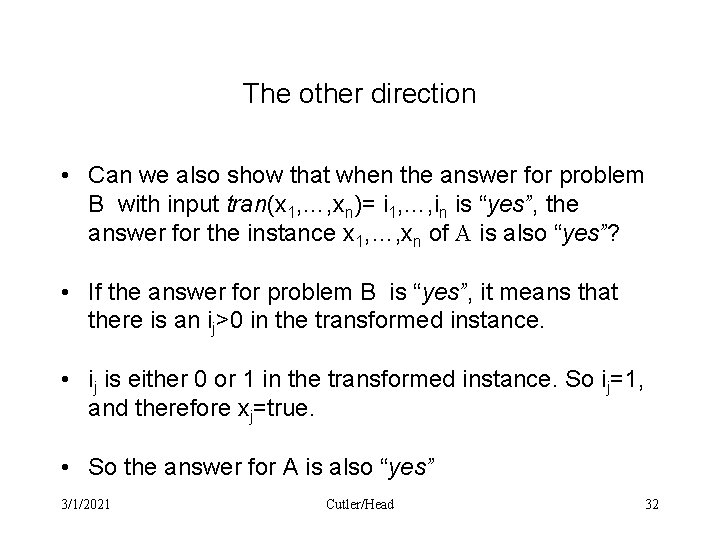
The other direction • Can we also show that when the answer for problem B with input tran(x 1, …, xn)= i 1, …, in is “yes”, the answer for the instance x 1, …, xn of A is also “yes”? • If the answer for problem B is “yes”, it means that there is an ij>0 in the transformed instance. • ij is either 0 or 1 in the transformed instance. So ij=1, and therefore xj=true. • So the answer for A is also “yes” 3/1/2021 Cutler/Head 32
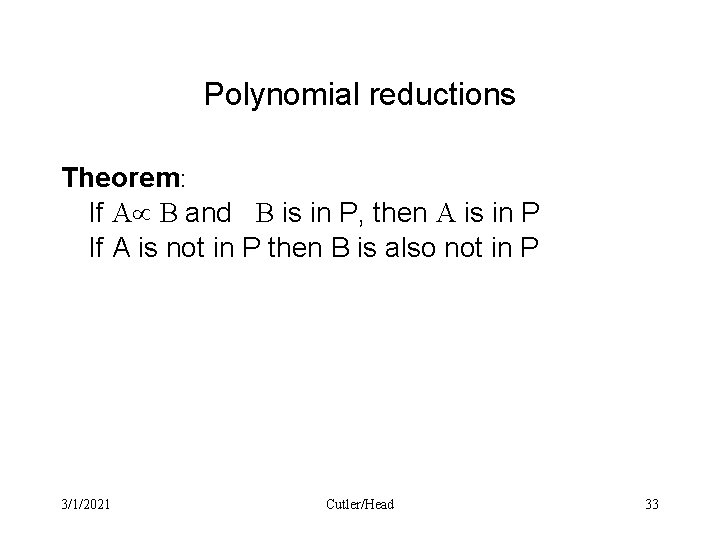
Polynomial reductions Theorem: If Aµ B and B is in P, then A is in P If A is not in P then B is also not in P 3/1/2021 Cutler/Head 33
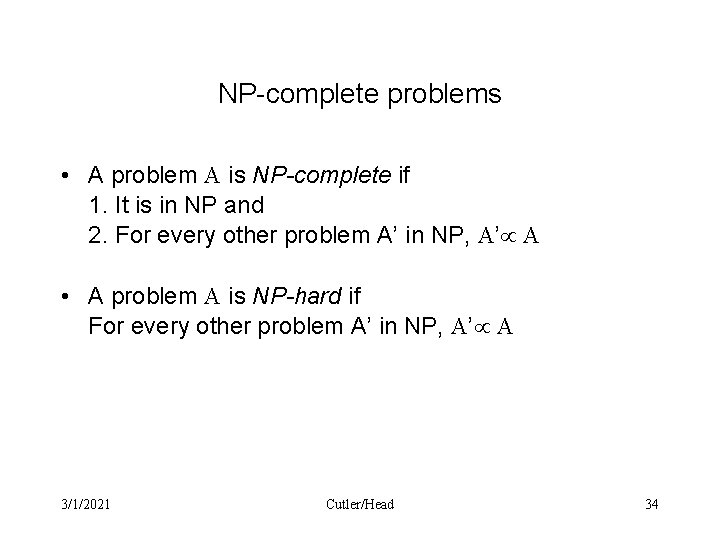
NP-complete problems • A problem A is NP-complete if 1. It is in NP and 2. For every other problem A’ in NP, A’µ A • A problem A is NP-hard if For every other problem A’ in NP, A’µ A 3/1/2021 Cutler/Head 34
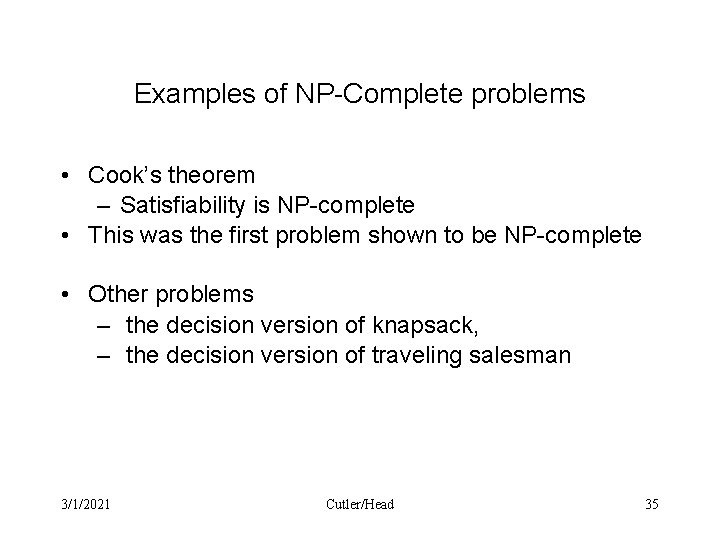
Examples of NP-Complete problems • Cook’s theorem – Satisfiability is NP-complete • This was the first problem shown to be NP-complete • Other problems – the decision version of knapsack, – the decision version of traveling salesman 3/1/2021 Cutler/Head 35
Coping with NP- Complete Problems • To solve use approximations, heuristics, etc. • Sometimes we need to solve only a restricted version of the problem. • If restricted problem tractable design an algorithm for restricted problem 3/1/2021 Cutler/Head 36
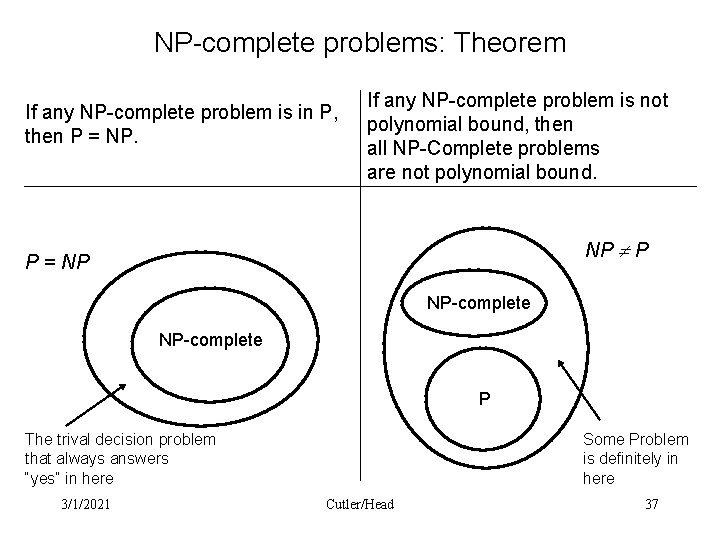
NP-complete problems: Theorem If any NP-complete problem is in P, then P = NP. If any NP-complete problem is not polynomial bound, then all NP-Complete problems are not polynomial bound. NP P P = NP NP-complete P The trival decision problem that always answers “yes” in here 3/1/2021 Some Problem is definitely in here Cutler/Head 37
NP-completeness and Reducibility • The existence of NP-complete problems is leads us suspect that P ¹NP. • If HAMILTONIAN CYCLE could be solved in polynomial time, every problem in NP can be solved in polynomial time. • If HAMILTONIAN CYCLE could not be solved in polynomial time, every NP-complete problem can not be solved in polynomial time. 3/1/2021 Cutler/Head 38

This is it kids! • Good luck in all your exams • Have a great break! 3/1/2021 Cutler/Head 39
The Satisfiability problem • First, Conjunctive Normal Form (CNF) will be defined • Then, the Satisfiability problem will be defined • Finally, we will show a polynomial bounded verification algorithm for the problem 3/1/2021 Cutler/Head 40
Conjunctive Normal Form (CNF) • A logical (Boolean) variable is a variable that may be assigned the value true or false (p, q, r and s are Boolean variables) • A literal is a logical variable or the negation of a logical variable (p and Øq are literals) • A clause is a disjunction of literals ( (pÚqÚs) and (Øq Ú r) are clauses) 3/1/2021 Cutler/Head 41
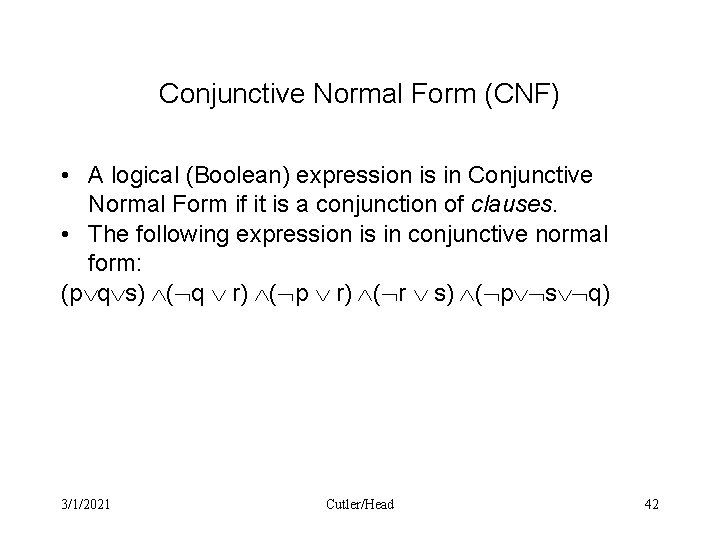
Conjunctive Normal Form (CNF) • A logical (Boolean) expression is in Conjunctive Normal Form if it is a conjunction of clauses. • The following expression is in conjunctive normal form: (pÚqÚs) Ù(Øq Ú r) Ù(Øp Ú r) Ù(Ør Ú s) Ù(ØpÚØsÚØq) 3/1/2021 Cutler/Head 42
The Satisfiability problem • Is there a truth assignment to the n variables of a logical expression in Conjunctive Normal Form which makes the value of the expression true? • For the answer to be “yes”, all clauses must evaluate to true • Otherwise the answer is “no” 3/1/2021 Cutler/Head 43
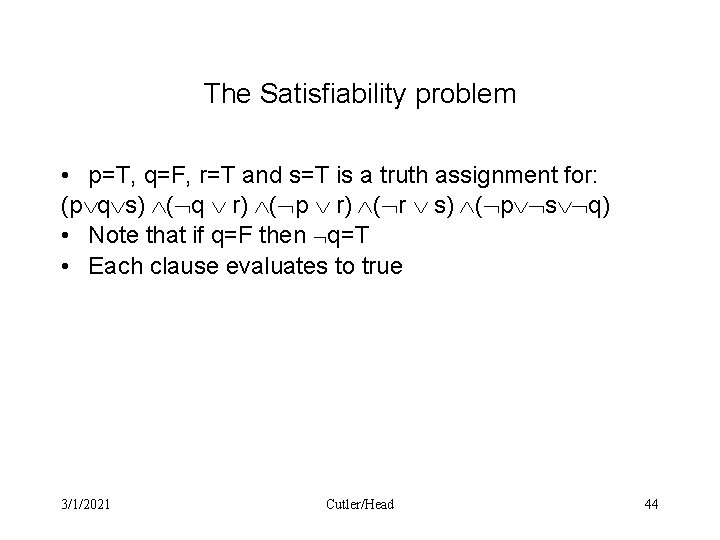
The Satisfiability problem • p=T, q=F, r=T and s=T is a truth assignment for: (pÚqÚs) Ù(Øq Ú r) Ù(Øp Ú r) Ù(Ør Ú s) Ù(ØpÚØsÚØq) • Note that if q=F then Øq=T • Each clause evaluates to true 3/1/2021 Cutler/Head 44
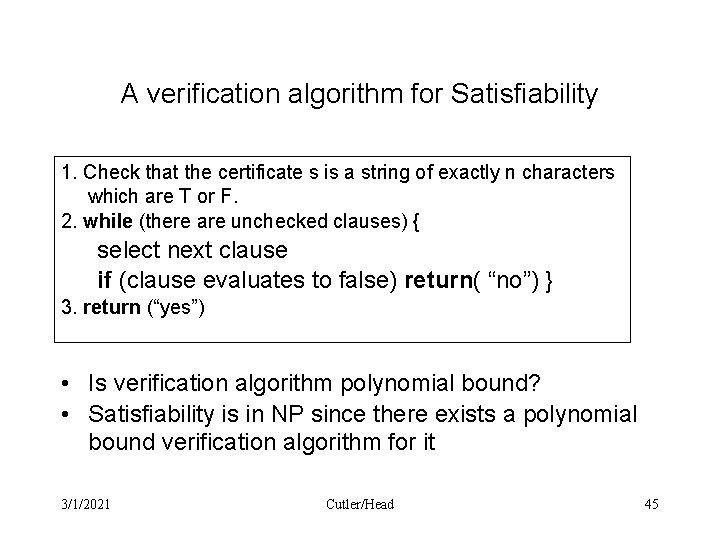
A verification algorithm for Satisfiability 1. Check that the certificate s is a string of exactly n characters which are T or F. 2. while (there are unchecked clauses) { select next clause if (clause evaluates to false) return( “no”) } 3. return (“yes”) • Is verification algorithm polynomial bound? • Satisfiability is in NP since there exists a polynomial bound verification algorithm for it 3/1/2021 Cutler/Head 45
- Slides: 45