
The Theory of EvolutionPart 2 What is Natural
- Slides: 15
The Theory of Evolution-Part 2: What is Natural Selection and what factors contribute to it? SC. 7. L. 15. 2: Explore the scientific theory of evolution by recognizing & explaining ways in which genetic variation and environmental factors contribute to evolution by natural selection and diversity of organisms. 2 Handouts: Theory of Evolution – Part 2 -Natural Selection sheet and “What is Natural Selection” Video Sheet.
Key Ideas/Concepts of Theory of Evolution and Natural Selection • Theory of Evolution suggests ways in which living things have changed over time and evolved into different organisms • Factors in the environment contribute to Natural Selectionthis is a theory that suggests that some organisms are better suited and/or adapted to their environment and have a better chance to survive and reproduce • Genetic Variation impacts the ability of an organism to survive. Some organisms have genes that help them to be better able to adapt, survive and then reproduce.
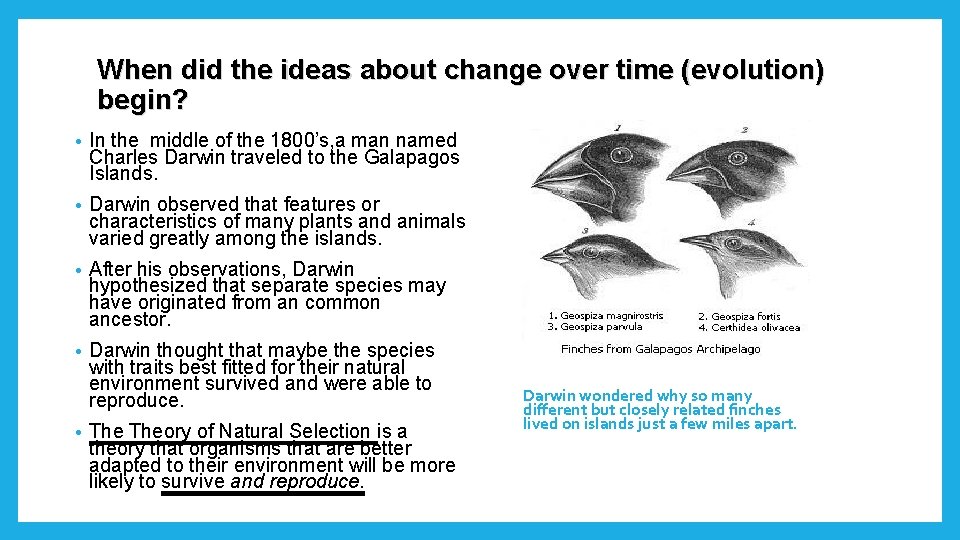
When did the ideas about change over time (evolution) begin? • In the middle of the 1800’s, a man named Charles Darwin traveled to the Galapagos Islands. • Darwin observed that features or characteristics of many plants and animals varied greatly among the islands. • After his observations, Darwin hypothesized that separate species may have originated from an common ancestor. • Darwin thought that maybe the species with traits best fitted for their natural environment survived and were able to reproduce. • Theory of Natural Selection is a theory that organisms that are better adapted to their environment will be more likely to survive and reproduce. Darwin wondered why so many different but closely related finches lived on islands just a few miles apart.
Reproduction produces more “fit” offspring that will survive • Organisms with advantages will adapt and survive and will pass on those advantages to their children. Their children will produce more “fit” offspring. Remember, part of Natural Selection is that the fittest will reproduce! • Darwin proposed that over a long period of time, natural selection will lead to change. Unfavorable traits may disappear over time, if more offspring with advantages exist.
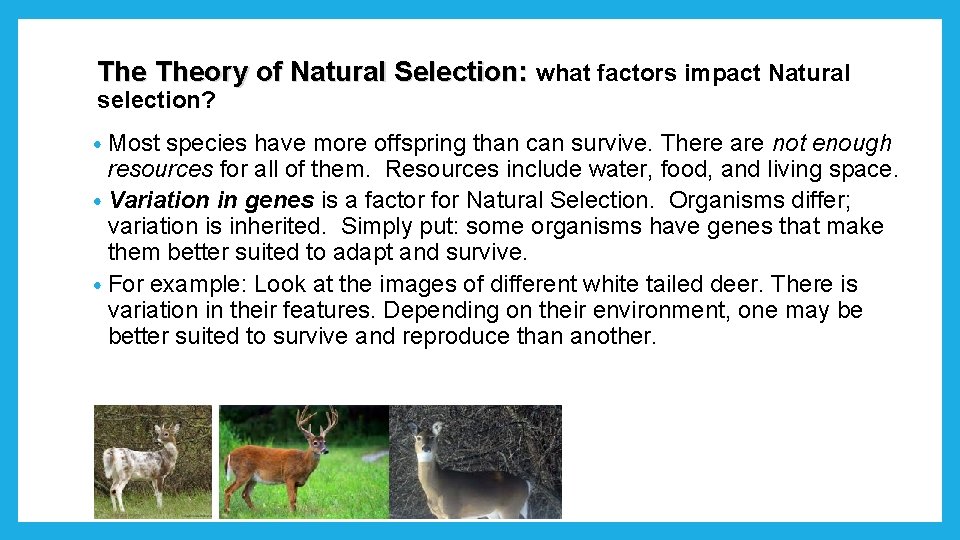
The Theory of Natural Selection: what factors impact Natural selection? • Most species have more offspring than can survive. There are not enough resources for all of them. Resources include water, food, and living space. • Variation in genes is a factor for Natural Selection. Organisms differ; variation is inherited. Simply put: some organisms have genes that make them better suited to adapt and survive. • For example: Look at the images of different white tailed deer. There is variation in their features. Depending on their environment, one may be better suited to survive and reproduce than another.
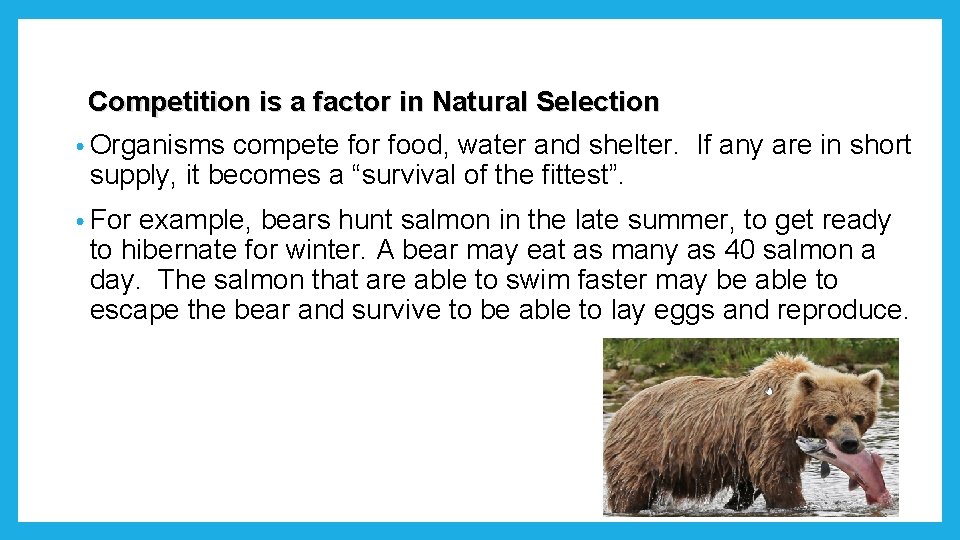
Competition is a factor in Natural Selection • Organisms compete for food, water and shelter. If any are in short supply, it becomes a “survival of the fittest”. • For example, bears hunt salmon in the late summer, to get ready to hibernate for winter. A bear may eat as many as 40 salmon a day. The salmon that are able to swim faster may be able to escape the bear and survive to be able to lay eggs and reproduce.
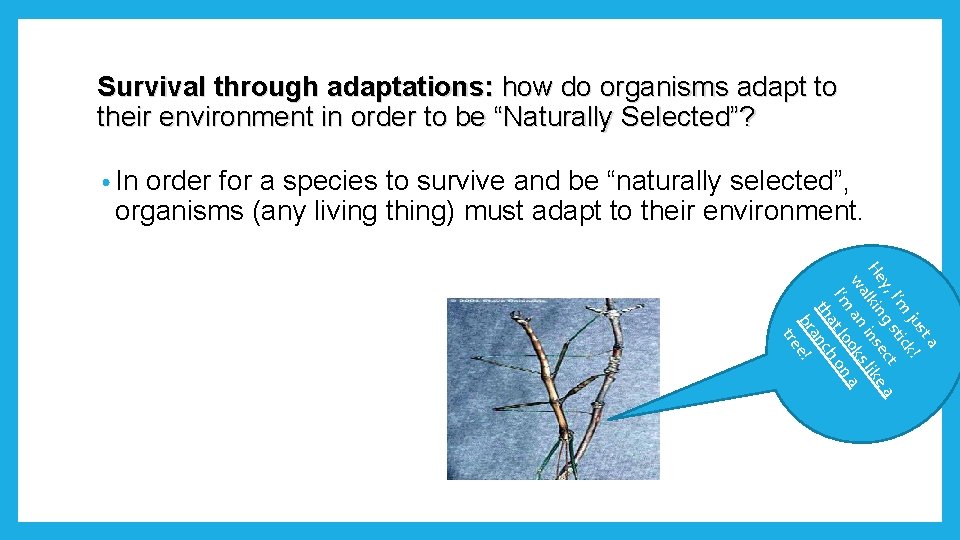
Survival through adaptations: how do organisms adapt to their environment in order to be “Naturally Selected”? • In order for a species to survive and be “naturally selected”, organisms (any living thing) must adapt to their environment. ta jus k! I’m tic y, g s ct a He lkin inse like wa an oks a I’m at lo on th anch br e! tre
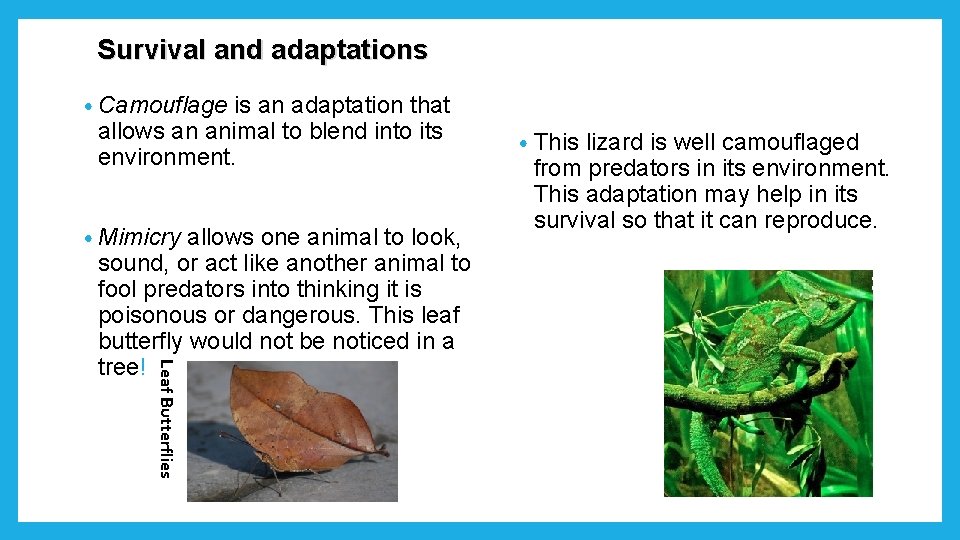
Survival and adaptations • Camouflage is an adaptation that allows an animal to blend into its environment. • Mimicry Leaf Butterflies allows one animal to look, sound, or act like another animal to fool predators into thinking it is poisonous or dangerous. This leaf butterfly would not be noticed in a tree! • This lizard is well camouflaged from predators in its environment. This adaptation may help in its survival so that it can reproduce.
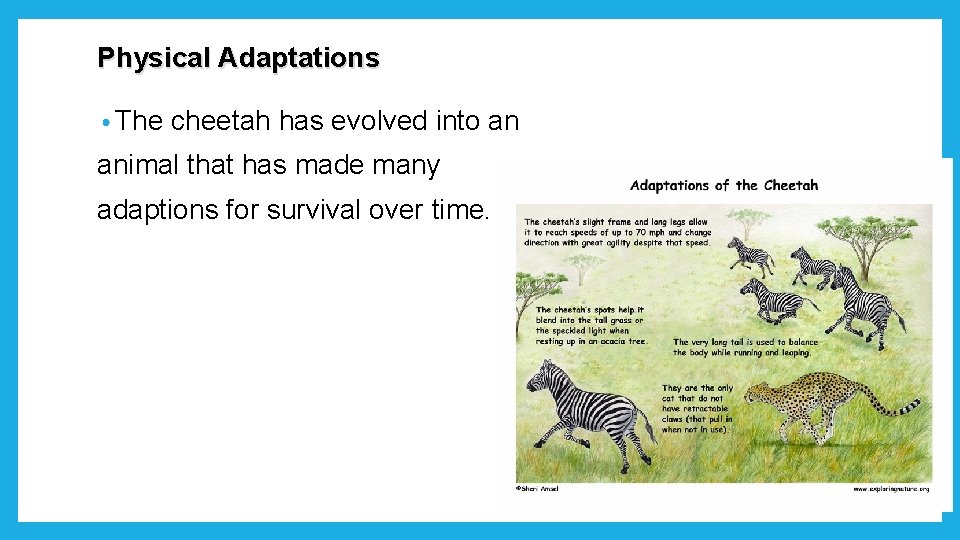
Physical Adaptations • The cheetah has evolved into an animal that has made many adaptions for survival over time.
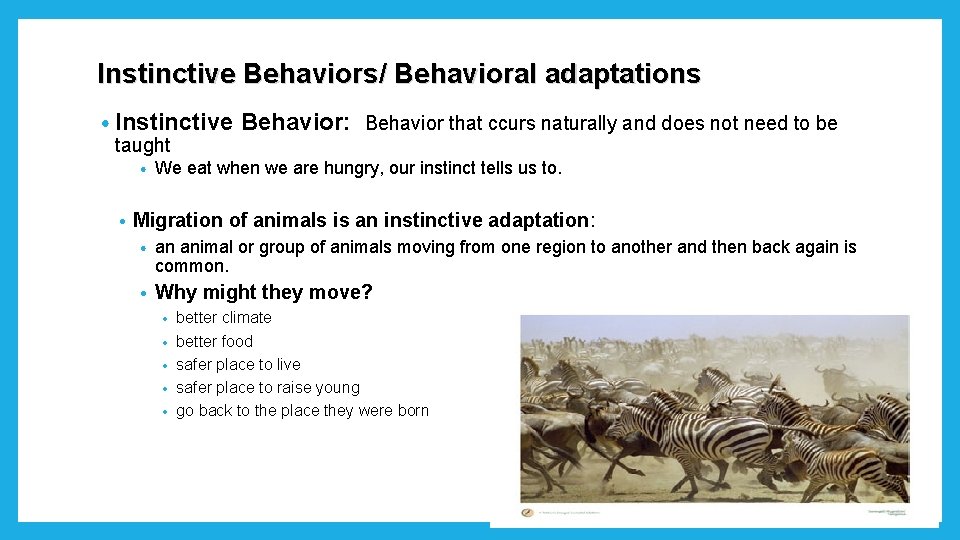
Instinctive Behaviors/ Behavioral adaptations • Instinctive taught • • Behavior: Behavior that ccurs naturally and does not need to be We eat when we are hungry, our instinct tells us to. Migration of animals is an instinctive adaptation: • an animal or group of animals moving from one region to another and then back again is common. • Why might they move? • • • better climate better food safer place to live safer place to raise young go back to the place they were born
Genetic Variation cause changes over time. • Now that you’ve seen examples of natural selection through adaptation to an environment, hopefully you understand that those organisms may reproduce and there will be more “fit” organisms • If there was no variation in the genes or traits that organisms pass on, all organisms would be the same and would have the same chance to survive and reproduce • Genetic variation and our adaptations to an environment contribute to the evolution of our species.
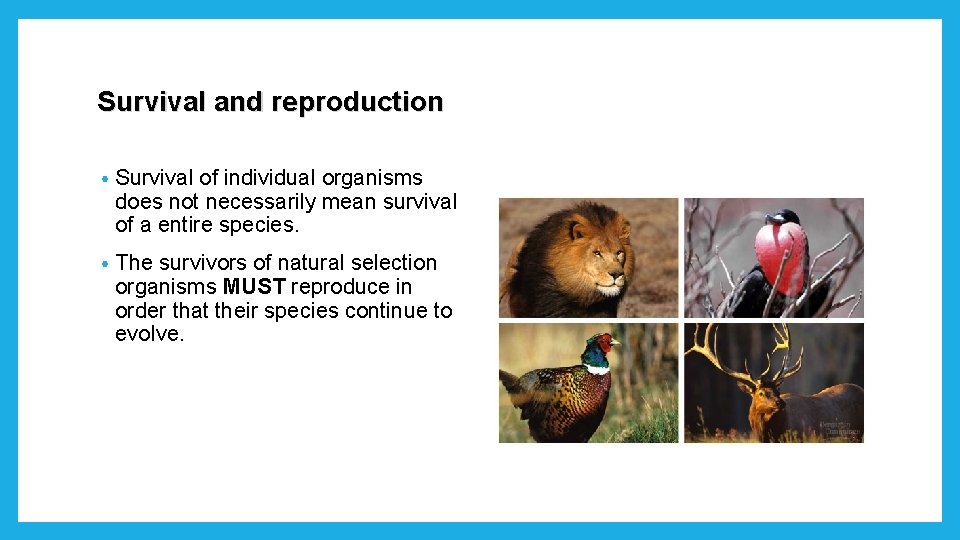
Survival and reproduction • Survival of individual organisms does not necessarily mean survival of a entire species. • The survivors of natural selection organisms MUST reproduce in order that their species continue to evolve.
Extinction: What happens to organisms without favorable traits? • Extinction is the word that explains what happens to a species that is not able to adapt to its environment • All organisms of a species must die in order for us to say that the species is extinct • Extinction suddenly may happen over a long period of time, or, very • Climate change (the ice age) or a natural disaster (a volcano) can cause extinction of a species. • The dinosaurs are an example of a sudden extinction
You need the “What is Natural Selection” Video Sheet • Highlight • You the link and then right click on “Open Hyperlink”. can pause the video when needed. • Natural Selection: Survival of the Fittest https: //www. youtube. com/watch? v=Ji. Su. K_Dvdtg
An example of how adaptation leads to Natural Selection • Highlight • You the link and then right click on “Open Hyperlink”. can pause the video when needed. • Adaptation: The Peppered Moth • https: //www. youtube. com/watch? v=s. VVldxxb. Wig