
The Theory of Child Labour Furio C Rosati
The Theory of Child Labour Furio C. Rosati SALDRU Lectures Cape Town, September 2013
The basic model • Two-period overlapping generations model • Each individual lives two periods (1, 2) and becomes a parent (p) in period 2 • During childhood (c) decisions are taken by parents who also care about children’s future welfare • Assumptions: fertility is exogenous, no leisure, children and adults have similar productivity, adult labour supply is fixed, no domestic production (à la Becker)

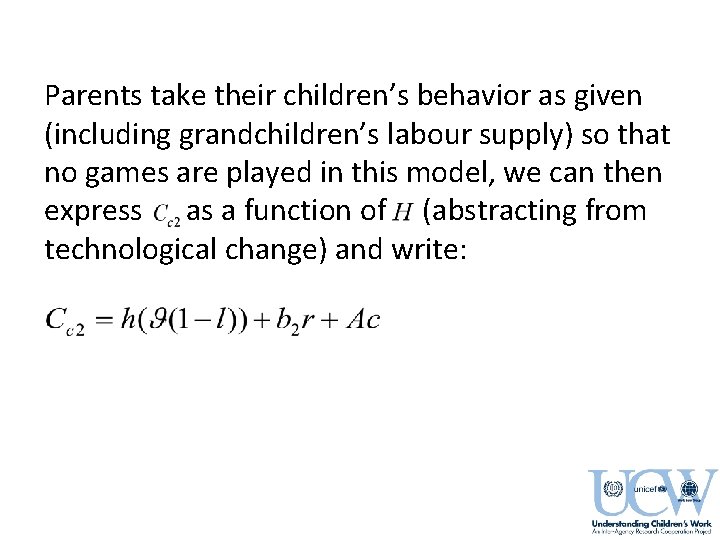
Parents take their children’s behavior as given (including grandchildren’s labour supply) so that no games are played in this model, we can then express as a function of (abstracting from technological change) and write:
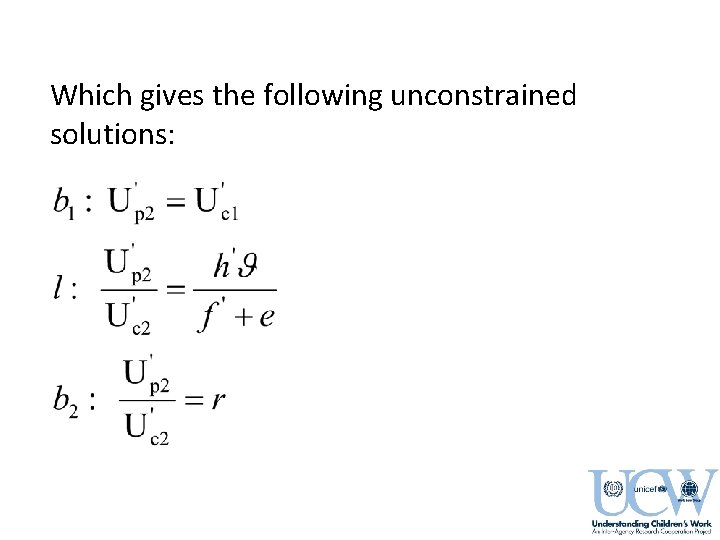
Which gives the following unconstrained solutions:
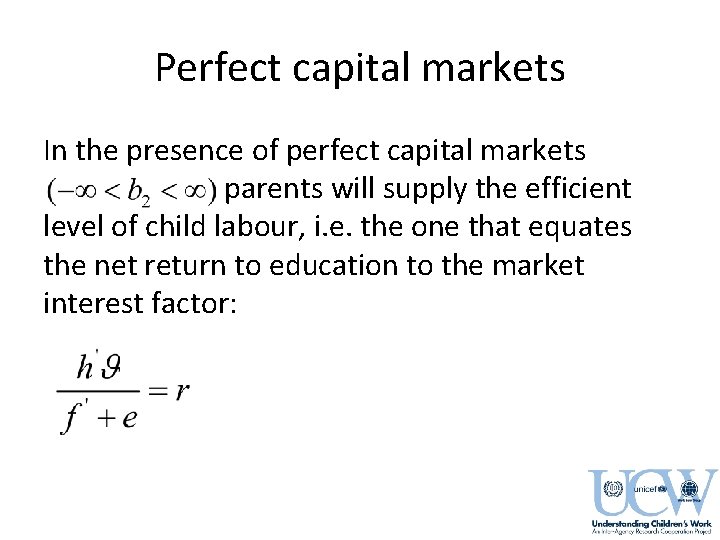
Perfect capital markets In the presence of perfect capital markets parents will supply the efficient level of child labour, i. e. the one that equates the net return to education to the market interest factor:
• Child labour supply is separable from consumption allocation. Households will invest in the human capital of their children up to the efficient level and use the capital market (in this case the intergenerational transfers) to allocate consumption efficiently across time/generations • There is no “income” effect in this model, nor a role for “poverty” unless it influences the relative returns to child labour.
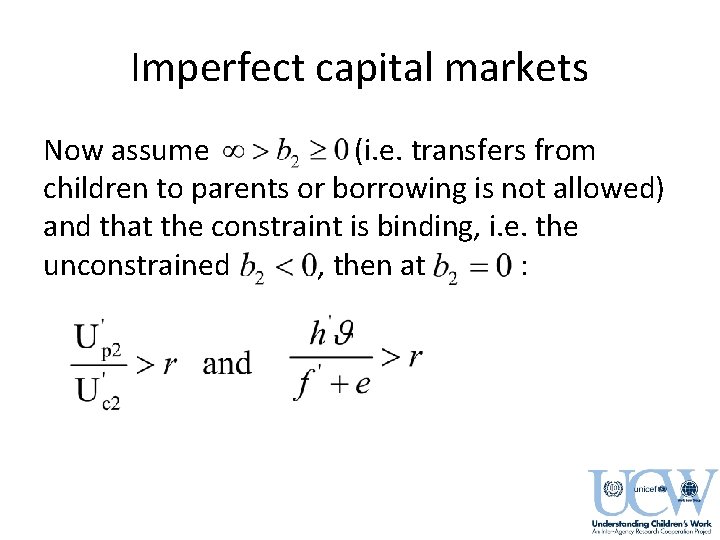
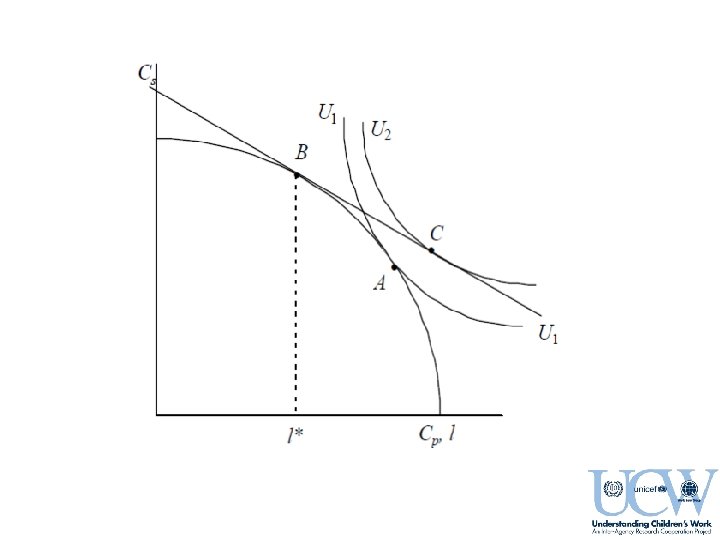
Imperfect capital markets Now assume (i. e. transfers from children to parents or borrowing is not allowed) and that the constraint is binding, i. e. the unconstrained , then at :
The households are supplying an inefficiently high level of child labour. In this case we have a negative income effect, more current income will increase the optimal and hence reduce the supply of child labour.
Relative prices Let us briefly discuss the other channels that are likely to affect child labour decisions, for this let us go back to the equilibrium equation: This clearly indicates the channels we need to look at: education and labour markets conditions. Together with the institutional settings (i. e. legislation and regulation) this clearly points to four main policy channels: social protection, labour market, education, and legislation.
• However, critics of the mainstream economics as well as many social scientists, indicate an important role for social norms etc. and this should be taken into consideration leading to an important role for advocacy and capacity building • As we shall see the analysis of some of effects of policy will require a modification of the simple theoretical model we have outlined. But before this let us briefly discuss about the issue of multiple equilibria
Multiple equilibria: an example • Assume there are two types of technology firms can use: knowledge (or capital) intensive and elementary. • There are two levels of qualification for the labour force: skilled and unskilled. Unskilled labour does not need education and can improve its productivity through learning by doing. Skilled work in knowledge intensive production brings higher salaries and higher profits. However, investment by firms and by households is costly. • For firms it will be profitable to invest in knowledge based technology only if they expect to find a sufficiently large skilled workforce and households will find it profitable to invest in the education of their children only if they expect to find a sufficient numbers of jobs in firms using knowledge based technology. • It is easy to see how the economy can be trapped in a low productivity equilibrium.
Extensions of the basic model • Household production à la Becker…. this has important implication for gender. • Allocation across siblings • Endogenous fertility • Leisure • Non convexity in time use
- Slides: 14