
The theme of lecture Impressions and classification of




- Slides: 32
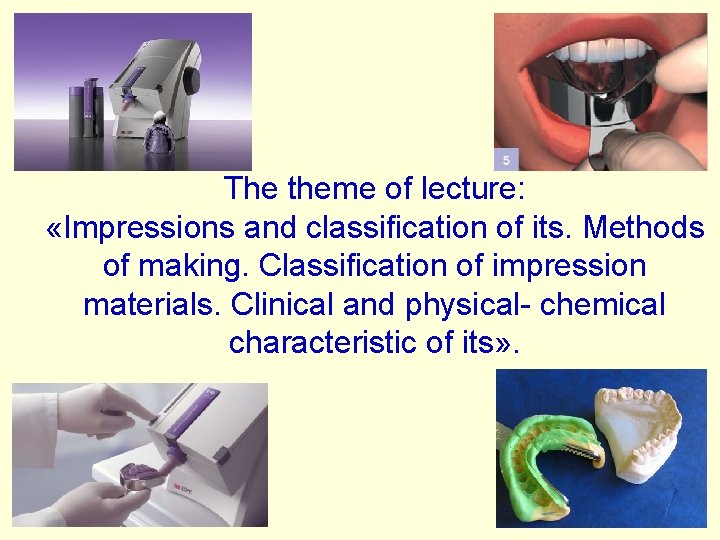
The theme of lecture: «Impressions and classification of its. Methods of making. Classification of impression materials. Clinical and physical- chemical characteristic of its» .
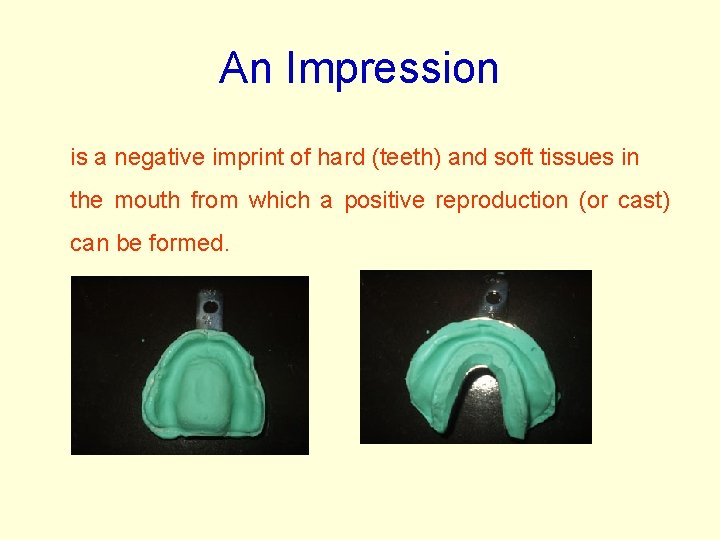
An Impression is a negative imprint of hard (teeth) and soft tissues in the mouth from which a positive reproduction (or cast) can be formed.
A model is an direct image of surface of soft and hard tissues in the mouth
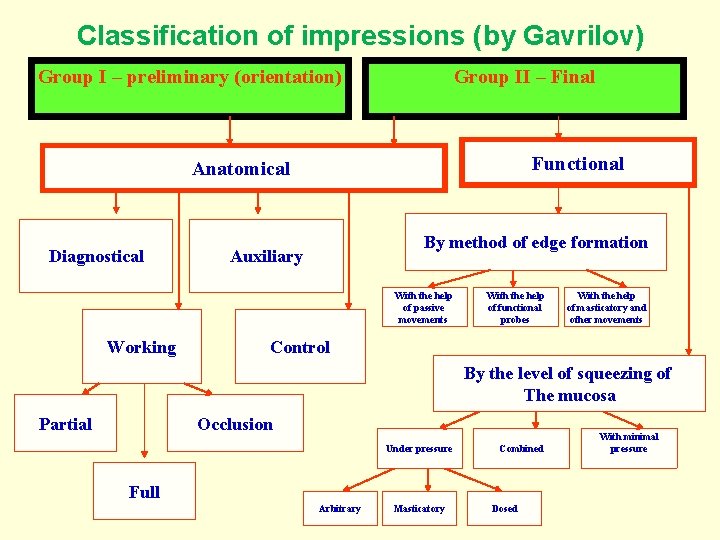
Classification of impressions (by Gavrilov) Group I – preliminary (orientation) Group ІІ – Final Functional Anatomical Diagnostical By method of edge formation Auxiliary With the help of passive movements Working With the help of functional probes With the help of masticatory and other movements Control By the level of squeezing of The mucosa Partial Occlusion Under pressure Combined Full Arbitrary Masticatory Dosed With minimal pressure
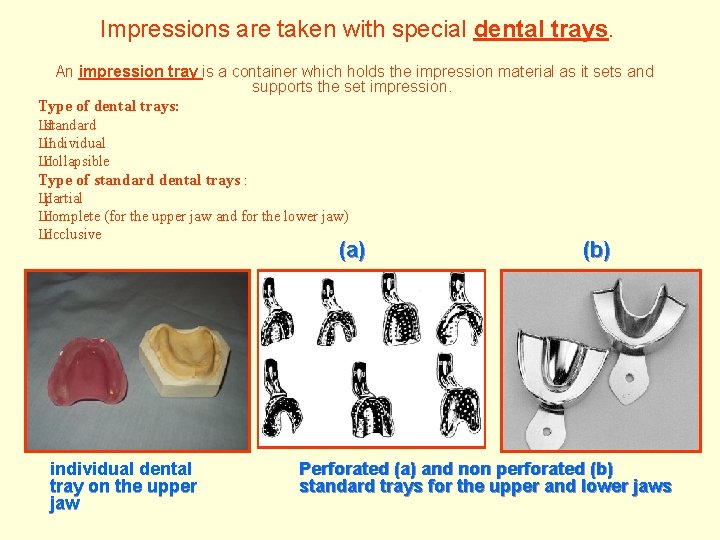
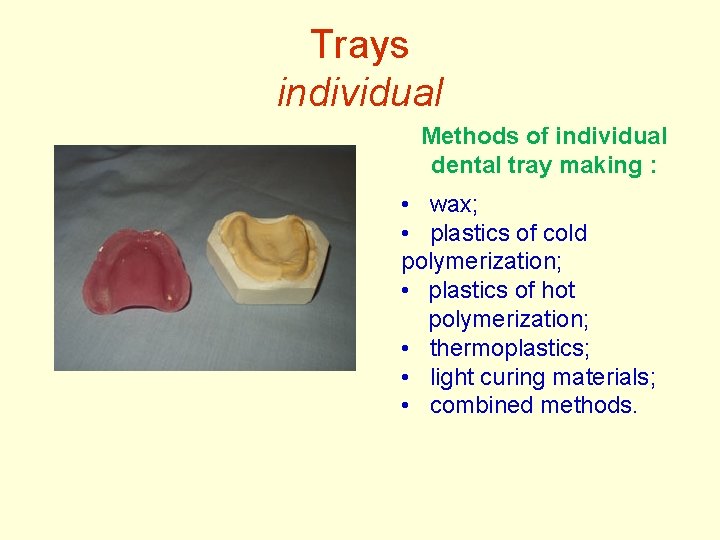
Impressions are taken with special dental trays. An impression tray is a container which holds the impression material as it sets and supports the set impression. Type of dental trays: Ш standard Ш individual Ш collapsible Type of standard dental trays : Ш partial Ш complete (for the upper jaw and for the lower jaw) Ш occlusive (а) individual dental tray on the upper jaw (b ) Perforated (a) and non perforated (b) standard trays for the upper and lower jaws
Trays individual Methods of individual dental tray making : • wax; • plastics of cold polymerization; • plastics of hot polymerization; • thermoplastics; • light curing materials; • combined methods.
Important terms • Elastic/plastic deformations • Strength • Pseudoplastic / thixotropic • Hydrophilic/hydrophobic • Working time • Setting time
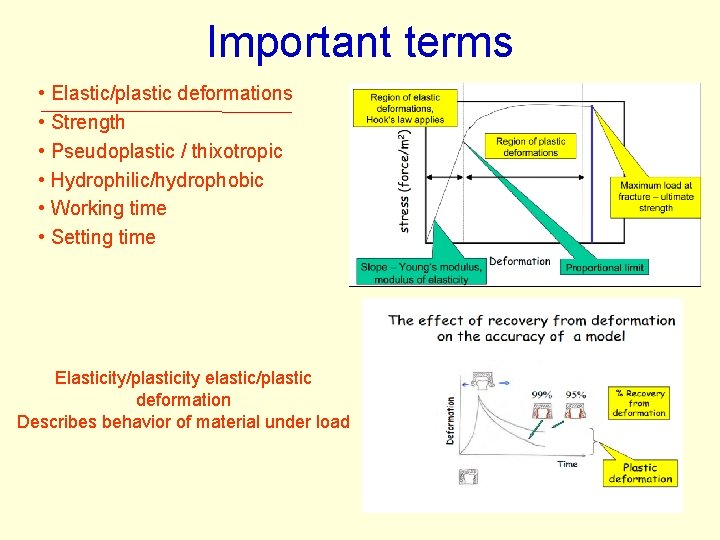
Important terms • Elastic/plastic deformations • Strength • Pseudoplastic / thixotropic • Hydrophilic/hydrophobic • Working time • Setting time Elasticity/plasticity elastic/plastic deformation Describes behavior of material under load
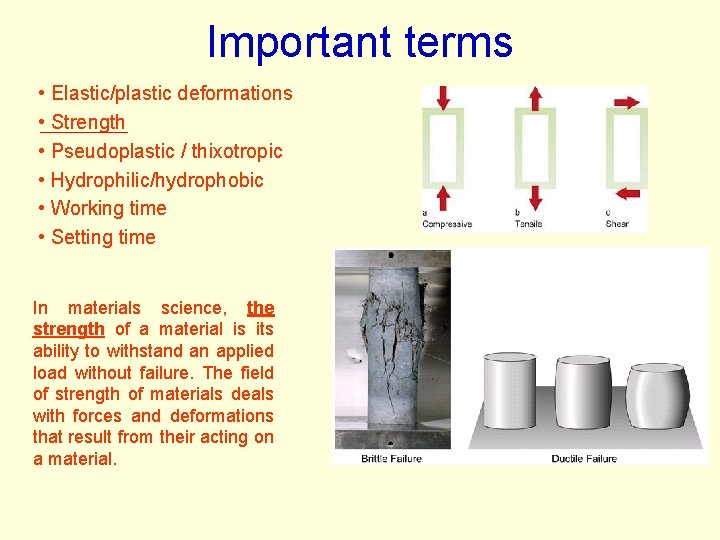
Important terms • Elastic/plastic deformations • Strength • Pseudoplastic / thixotropic • Hydrophilic/hydrophobic • Working time • Setting time In materials science, the strength of a material is its ability to withstand an applied load without failure. The field of strength of materials deals with forces and deformations that result from their acting on a material.
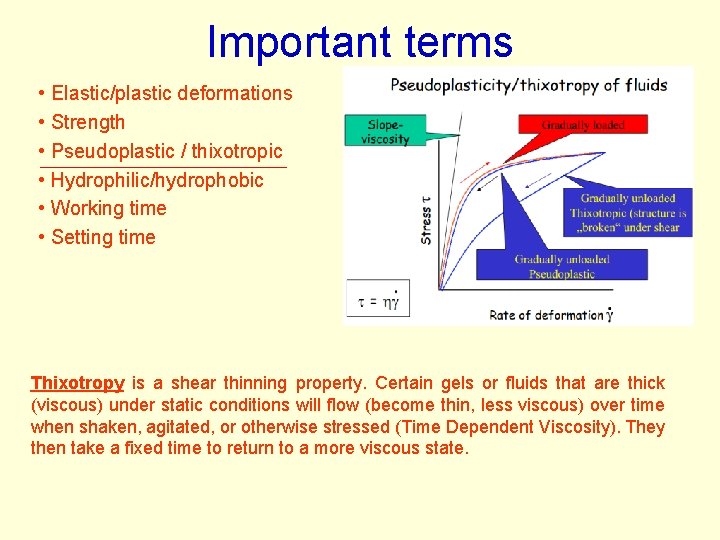
Important terms • Elastic/plastic deformations • Strength • Pseudoplastic / thixotropic • Hydrophilic/hydrophobic • Working time • Setting time Thixotropy is a shear thinning property. Certain gels or fluids that are thick (viscous) under static conditions will flow (become thin, less viscous) over time when shaken, agitated, or otherwise stressed (Time Dependent Viscosity). They then take a fixed time to return to a more viscous state.
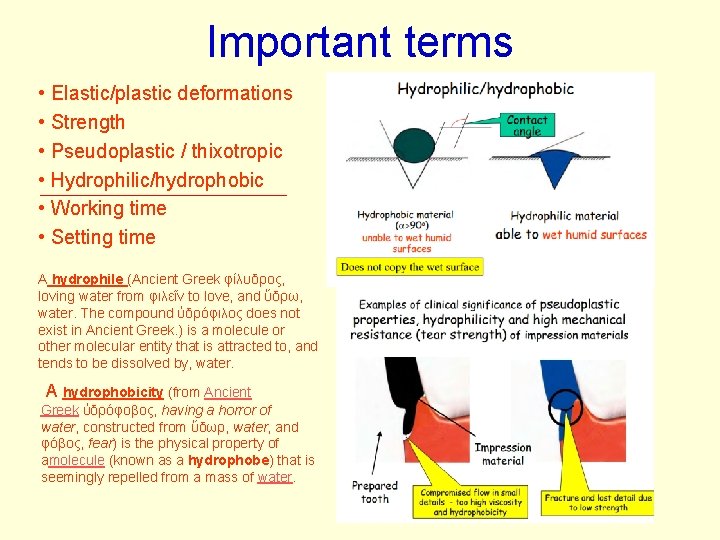
Important terms • Elastic/plastic deformations • Strength • Pseudoplastic / thixotropic • Hydrophilic/hydrophobic • Working time • Setting time A hydrophile (Ancient Greek φίλυδρος, loving water from φιλεῖν to love, and ὕδρω, water. The compound ὑδρόφιλος does not exist in Ancient Greek. ) is a molecule or other molecular entity that is attracted to, and tends to be dissolved by, water. A hydrophobicity (from Ancient Greek ὑδρόφοβος, having a horror of water, constructed from ὕδωρ, water, and φόβος, fear) is the physical property of amolecule (known as a hydrophobe) that is seemingly repelled from a mass of water.
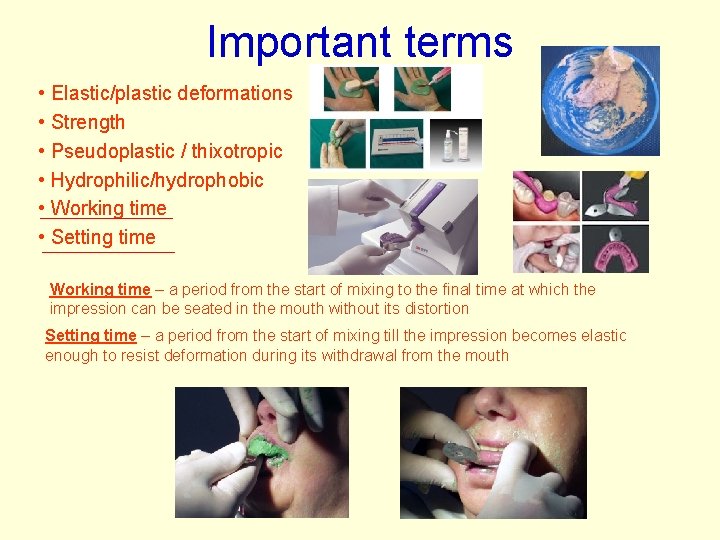
Important terms • Elastic/plastic deformations • Strength • Pseudoplastic / thixotropic • Hydrophilic/hydrophobic • Working time • Setting time Working time – a period from the start of mixing to the final time at which the impression can be seated in the mouth without its distortion Setting time – a period from the start of mixing till the impression becomes elastic enough to resist deformation during its withdrawal from the mouth
Requirements to the impression materials • • • • 1. Capable of plastic to rigid body transformation 2. Acceptable for a patient - non-toxic, non-irritant, tasteless, reasonable setting time up to 5 -7 min 3. Good handling properties – easy to prepare/mix plastic before set, but viscous enough not to flow out of a tray (thixotropic), adequate working and setting times After being set: 4. Accuracy and detail reproduction (25 -50µm), 5. Dimensionally stable 6. Resistant to mechanical stress - elastic and rigid 7. Compatible with model materials 8. Resistant to disinfectant solutions 9. Cost effective
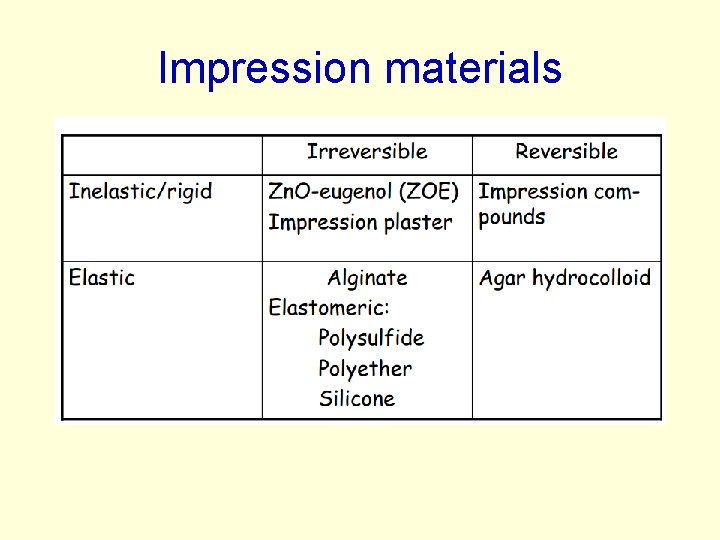
Impression materials
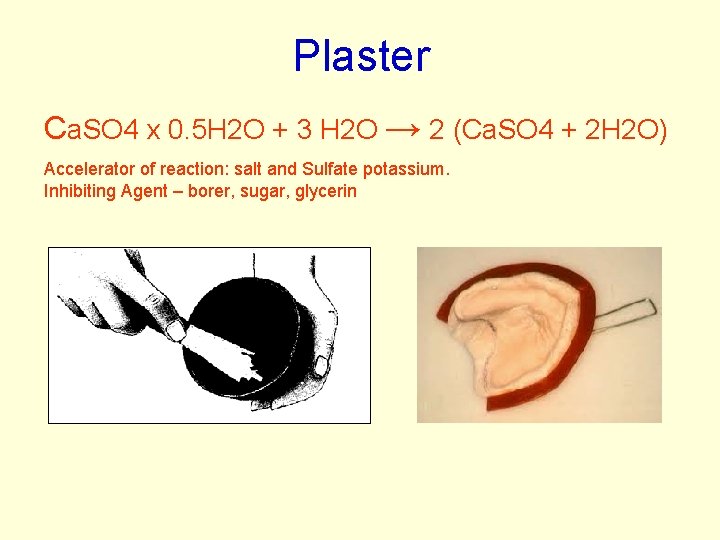
Plaster Ca. SO 4 х 0. 5 H 2 O + 3 H 2 O → 2 (Ca. SO 4 + 2 H 2 O) Accelerator of reaction: salt and Sulfate potassium. Inhibiting Agent – borer, sugar, glycerin
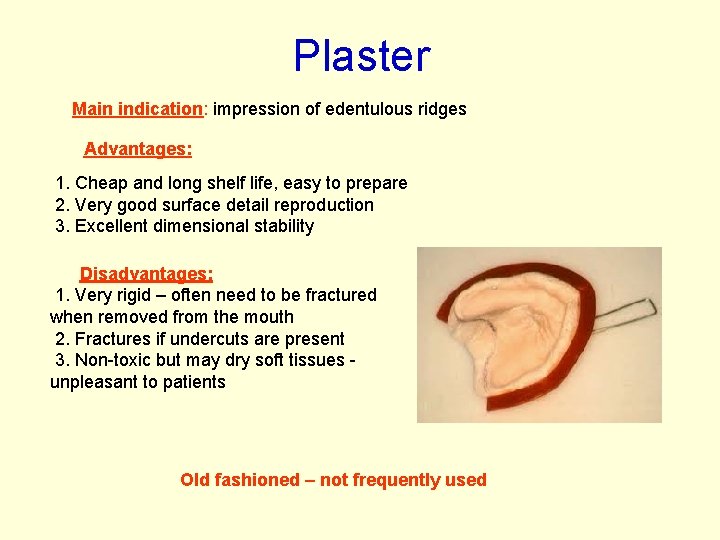
Plaster Main indication: impression of edentulous ridges Advantages: 1. Cheap and long shelf life, easy to prepare 2. Very good surface detail reproduction 3. Excellent dimensional stability Disadvantages: 1. Very rigid – often need to be fractured when removed from the mouth 2. Fractures if undercuts are present 3. Non-toxic but may dry soft tissues unpleasant to patients Old fashioned – not frequently used
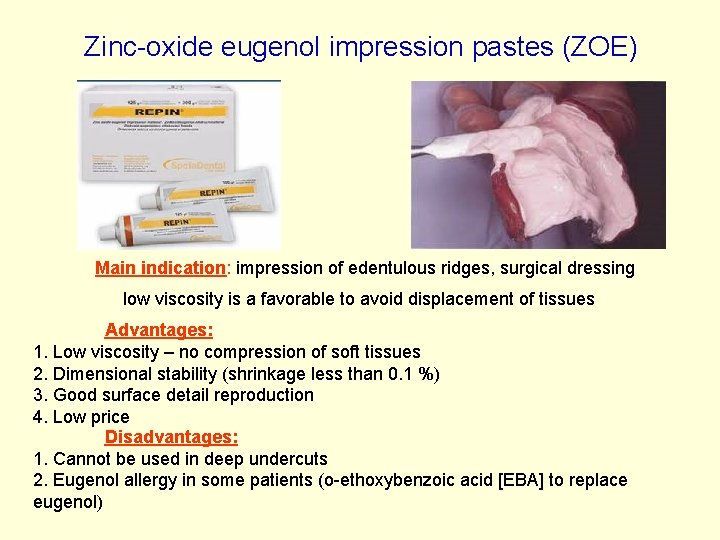
Zinc-oxide eugenol impression pastes (ZOE) Main indication: impression of edentulous ridges, surgical dressing low viscosity is a favorable to avoid displacement of tissues Advantages: 1. Low viscosity – no compression of soft tissues 2. Dimensional stability (shrinkage less than 0. 1 %) 3. Good surface detail reproduction 4. Low price Disadvantages: 1. Cannot be used in deep undercuts 2. Eugenol allergy in some patients (o-ethoxybenzoic acid [EBA] to replace eugenol)
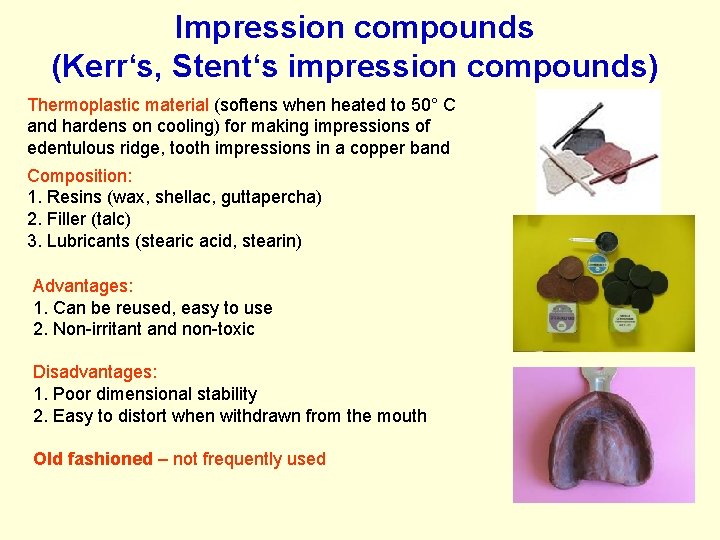
Impression compounds (Kerr‘s, Stent‘s impression compounds) Thermoplastic material (softens when heated to 50° C and hardens on cooling) for making impressions of edentulous ridge, tooth impressions in a copper band Composition: 1. Resins (wax, shellac, guttapercha) 2. Filler (talc) 3. Lubricants (stearic acid, stearin) Advantages: 1. Can be reused, easy to use 2. Non-irritant and non-toxic Disadvantages: 1. Poor dimensional stability 2. Easy to distort when withdrawn from the mouth Old fashioned – not frequently used
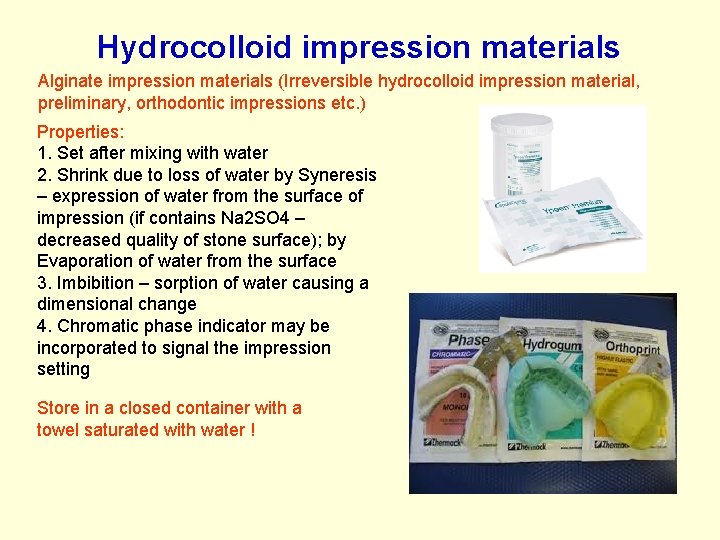
Hydrocolloid impression materials Alginate impression materials (Irreversible hydrocolloid impression material, preliminary, orthodontic impressions etc. ) Properties: 1. Set after mixing with water 2. Shrink due to loss of water by Syneresis – expression of water from the surface of impression (if contains Na 2 SO 4 – decreased quality of stone surface); by Evaporation of water from the surface 3. Imbibition – sorption of water causing a dimensional change 4. Chromatic phase indicator may be incorporated to signal the impression setting Store in a closed container with a towel saturated with water !
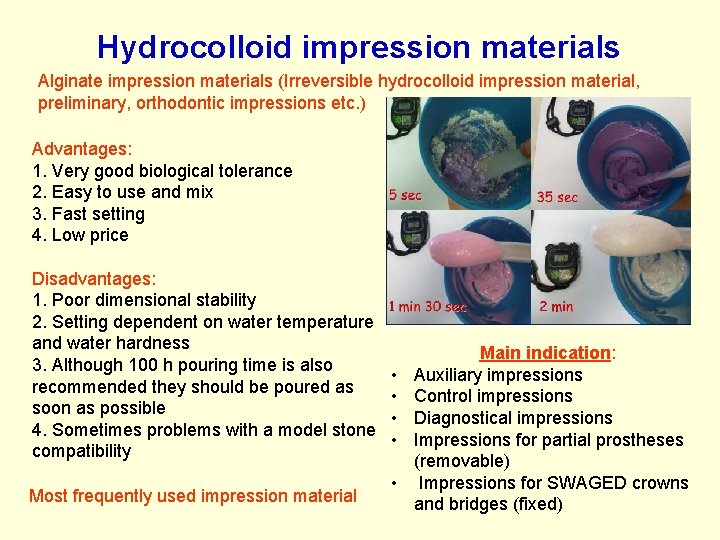
Hydrocolloid impression materials Alginate impression materials (Irreversible hydrocolloid impression material, preliminary, orthodontic impressions etc. ) Advantages: 1. Very good biological tolerance 2. Easy to use and mix 3. Fast setting 4. Low price Disadvantages: 1. Poor dimensional stability 2. Setting dependent on water temperature and water hardness 3. Although 100 h pouring time is also recommended they should be poured as soon as possible 4. Sometimes problems with a model stone compatibility Most frequently used impression material • • • Main indication: Auxiliary impressions Control impressions Diagnostical impressions Impressions for partial prostheses (removable) Impressions for SWAGED crowns and bridges (fixed)
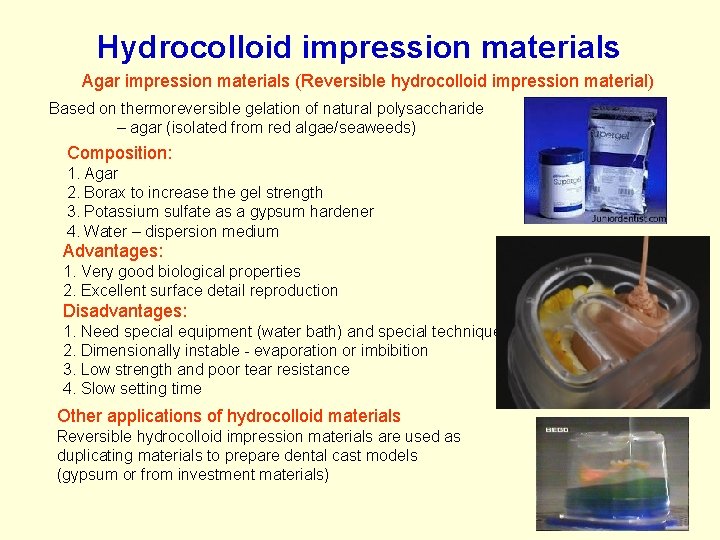
Hydrocolloid impression materials Agar impression materials (Reversible hydrocolloid impression material) Based on thermoreversible gelation of natural polysaccharide – agar (isolated from red algae/seaweeds) Composition: 1. Agar 2. Borax to increase the gel strength 3. Potassium sulfate as a gypsum hardener 4. Water – dispersion medium Advantages: 1. Very good biological properties 2. Excellent surface detail reproduction Disadvantages: 1. Need special equipment (water bath) and special technique 2. Dimensionally instable - evaporation or imbibition 3. Low strength and poor tear resistance 4. Slow setting time Other applications of hydrocolloid materials Reversible hydrocolloid impression materials are used as duplicating materials to prepare dental cast models (gypsum or from investment materials)
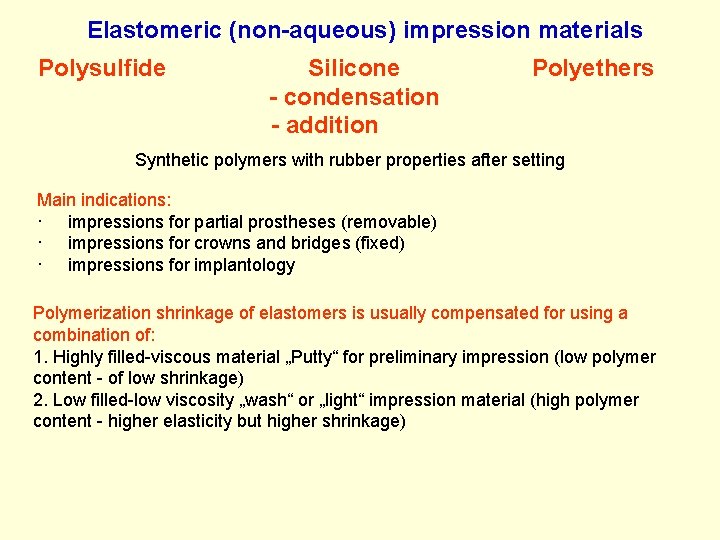
Elastomeric (non-aqueous) impression materials Polysulfide Silicone - condensation - addition Polyethers Synthetic polymers with rubber properties after setting Main indications: · impressions for partial prostheses (removable) · impressions for crowns and bridges (fixed) · impressions for implantology Polymerization shrinkage of elastomers is usually compensated for using a combination of: 1. Highly filled-viscous material „Putty“ for preliminary impression (low polymer content - of low shrinkage) 2. Low filled-low viscosity „wash“ or „light“ impression material (high polymer content - higher elasticity but higher shrinkage)
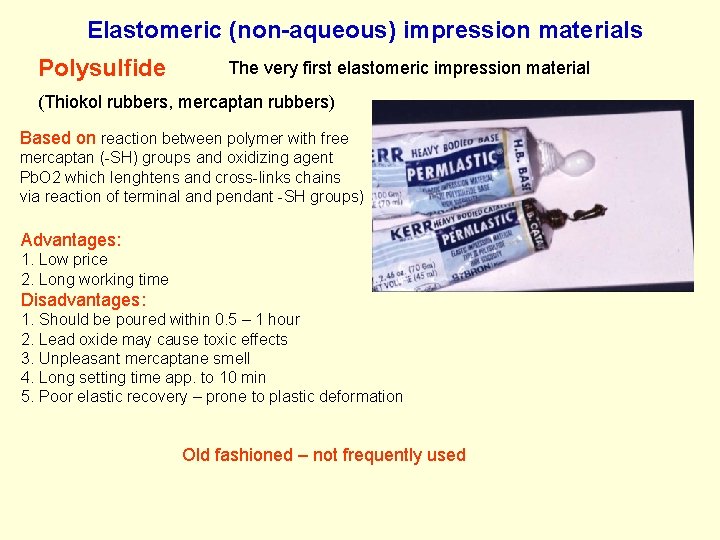
Elastomeric (non-aqueous) impression materials Polysulfide The very first elastomeric impression material (Thiokol rubbers, mercaptan rubbers) Based on reaction between polymer with free mercaptan (-SH) groups and oxidizing agent Pb. O 2 which lenghtens and cross-links chains via reaction of terminal and pendant -SH groups) Advantages: 1. Low price 2. Long working time Disadvantages: 1. Should be poured within 0. 5 – 1 hour 2. Lead oxide may cause toxic effects 3. Unpleasant mercaptane smell 4. Long setting time app. to 10 min 5. Poor elastic recovery – prone to plastic deformation Old fashioned – not frequently used
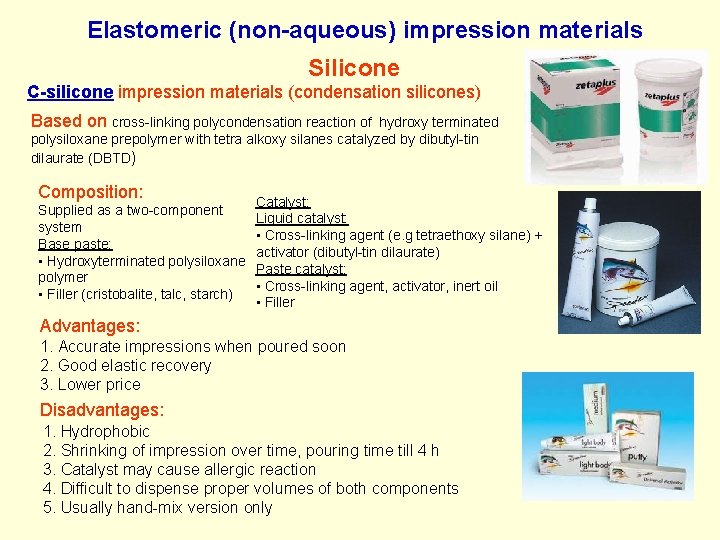
Elastomeric (non-aqueous) impression materials Silicone C-silicone impression materials (condensation silicones) Based on cross-linking polycondensation reaction of hydroxy terminated polysiloxane prepolymer with tetra alkoxy silanes catalyzed by dibutyl-tin dilaurate (DBTD) Composition: Supplied as a two-component system Base paste: • Hydroxyterminated polysiloxane polymer • Filler (cristobalite, talc, starch) Catalyst: Liquid catalyst: • Cross-linking agent (e. g tetraethoxy silane) + activator (dibutyl-tin dilaurate) Paste catalyst: • Cross-linking agent, activator, inert oil • Filler Advantages: 1. Accurate impressions when poured soon 2. Good elastic recovery 3. Lower price Disadvantages: 1. Hydrophobic 2. Shrinking of impression over time, pouring time till 4 h 3. Catalyst may cause allergic reaction 4. Difficult to dispense proper volumes of both components 5. Usually hand-mix version only
Elastomeric (non-aqueous) impression materials Silicone A-silicone impression materials (addition silicones, vinyl siloxane, poly(vinyl siloxane)) Based on cross-linking polyaddition reaction of vinyl terminated polysiloxane polymer with methylhydrogen silicone cross-linking agent in the presence of platinium catalyst Composition: Supplied as a two-component 1: 1 system Base paste: 1. Vinyl terminated polysiloxane polymer 2. Pt catalyst 3. Filler (cristobalite, talc) 4. Surfactant (hydrophilic agent) Catalyst: 1. Vinyl terminated polysiloxane polymer 2. Cross-linking agent 3. Filler, silicone oil (adjust viscosity of duplicating materials) Advantages: 1. Accurate impressions, very low shrinkage 2. Very good surface detail 3. Highly elastic 4. Perfect elastic recovery 5. Dimensionally stable 6. Non-toxic and non-irritant Disadvantages: 1. Hydrophobic – necessary to add a surfactant 2. Setting inhibited by latex gloves or some astringents (sulfur, heavy metals) 3. Hydrogen release – surface bubbles – pouring time 1 h after removal from the mouth 4. High price
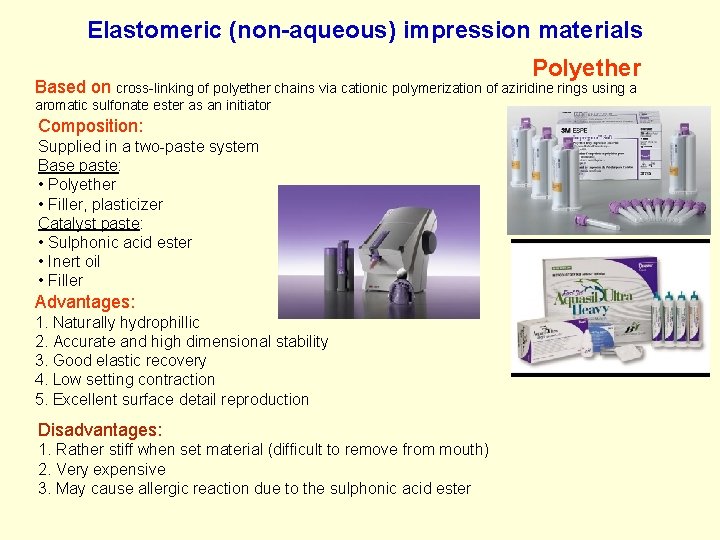
Elastomeric (non-aqueous) impression materials Polyether Based on cross-linking of polyether chains via cationic polymerization of aziridine rings using a aromatic sulfonate ester as an initiator Composition: Supplied in a two-paste system Base paste: • Polyether • Filler, plasticizer Catalyst paste: • Sulphonic acid ester • Inert oil • Filler Advantages: 1. Naturally hydrophillic 2. Accurate and high dimensional stability 3. Good elastic recovery 4. Low setting contraction 5. Excellent surface detail reproduction Disadvantages: 1. Rather stiff when set material (difficult to remove from mouth) 2. Very expensive 3. May cause allergic reaction due to the sulphonic acid ester
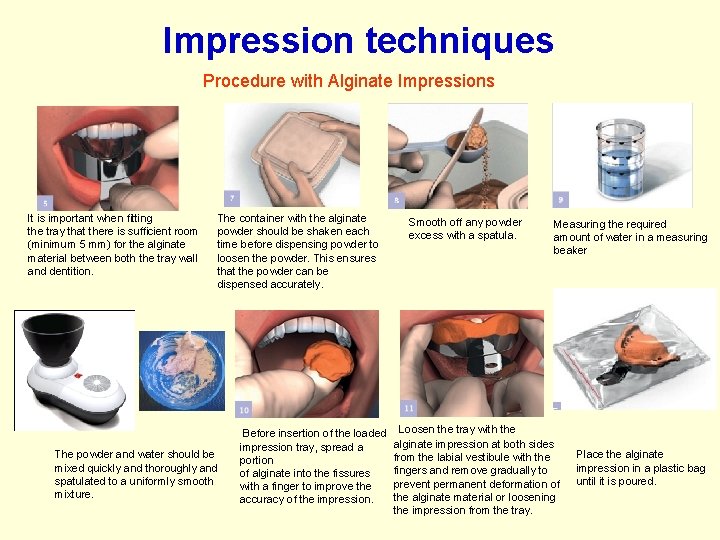
Impression techniques Procedure with Alginate Impressions It is important when fitting the tray that there is sufficient room (minimum 5 mm) for the alginate material between both the tray wall and dentition. The container with the alginate powder should be shaken each time before dispensing powder to loosen the powder. This ensures that the powder can be dispensed accurately. The powder and water should be mixed quickly and thoroughly and spatulated to a uniformly smooth mixture. Before insertion of the loaded impression tray, spread a portion of alginate into the fissures with a finger to improve the accuracy of the impression. Smooth off any powder excess with a spatula. Measuring the required amount of water in a measuring beaker Loosen the tray with the alginate impression at both sides from the labial vestibule with the fingers and remove gradually to prevent permanent deformation of the alginate material or loosening the impression from the tray. Place the alginate impression in a plastic bag until it is poured.
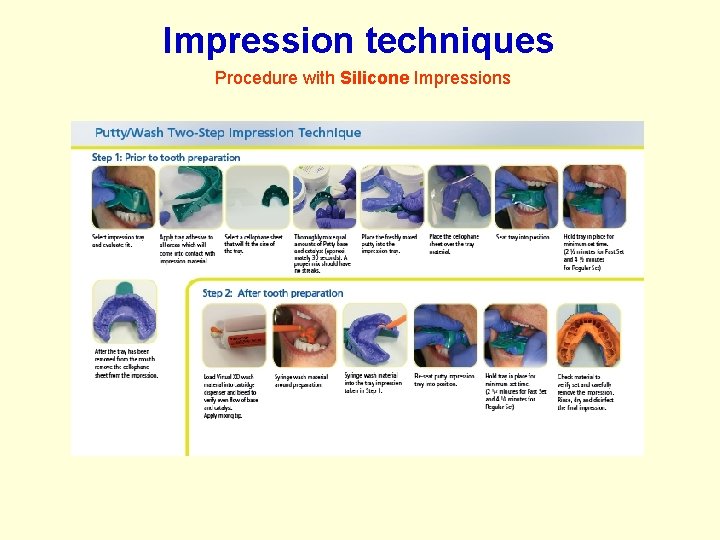
Impression techniques Procedure with Silicone Impressions
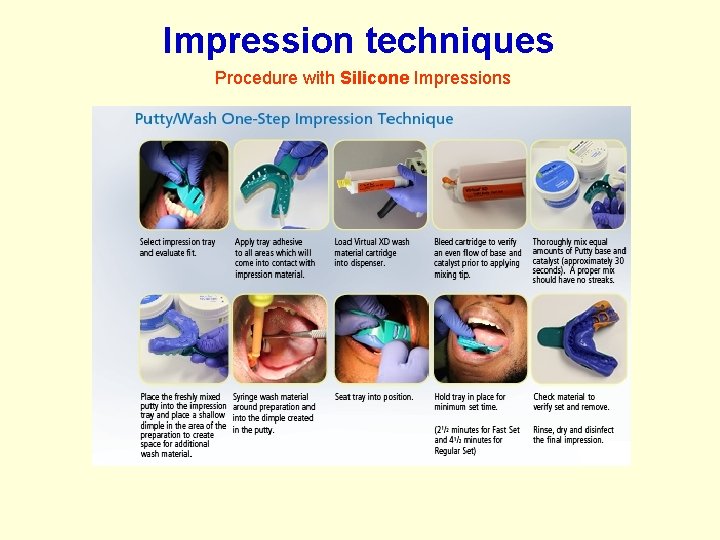
Impression techniques Procedure with Silicone Impressions
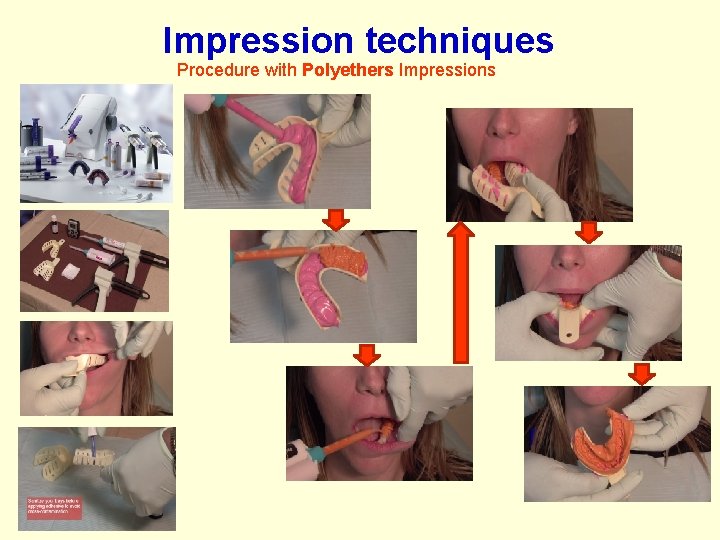
Impression techniques Procedure with Polyethers Impressions
Optical impressions The accurate basis for various kinds of restorations Digital impressions represent cutting-edge technology that allows dentists to create a virtual, computer-generated replica of the hard and soft tissues in the mouth using lasers and other optical scanning devices. The digital technology captures clear and highly accurate impression data in mere minutes, without the need for traditional impression materials that some patients find inconvenient and messy. Many patients find digital impressions an easier and more comfortable procedure because traditional impression materials are avoided. The impression information then is transferred to a computer and used to create restorations, often without the need for stone models.