
The The Basics of a Sonnet A Sonnet

& The
~ The Basics of a Sonnet ~ -A Sonnet Contains 14 lines -A Sonnet is Written in Iambic Pentameter -Various Rhyme Schemes – *Number the lines on “Sonnet 18”*
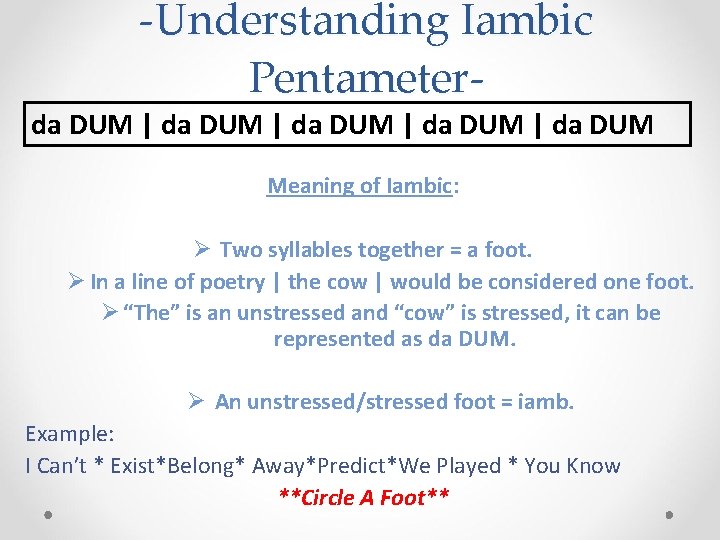
-Understanding Iambic Pentameter- da DUM | da DUM Meaning of Iambic: Ø Two syllables together = a foot. Ø In a line of poetry | the cow | would be considered one foot. Ø “The” is an unstressed and “cow” is stressed, it can be represented as da DUM. Ø An unstressed/stressed foot = iamb. Example: I Can’t * Exist*Belong* Away*Predict*We Played * You Know **Circle A Foot**
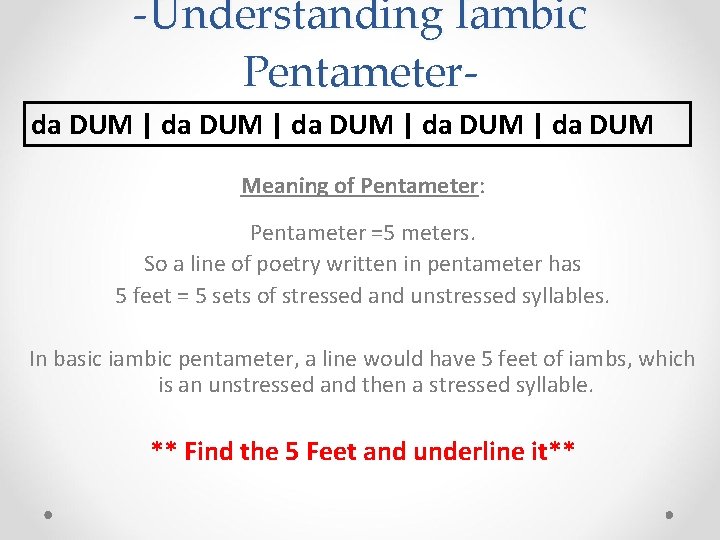
-Understanding Iambic Pentameterda DUM | da DUM Meaning of Pentameter: Pentameter =5 meters. So a line of poetry written in pentameter has 5 feet = 5 sets of stressed and unstressed syllables. In basic iambic pentameter, a line would have 5 feet of iambs, which is an unstressed and then a stressed syllable. ** Find the 5 Feet and underline it**
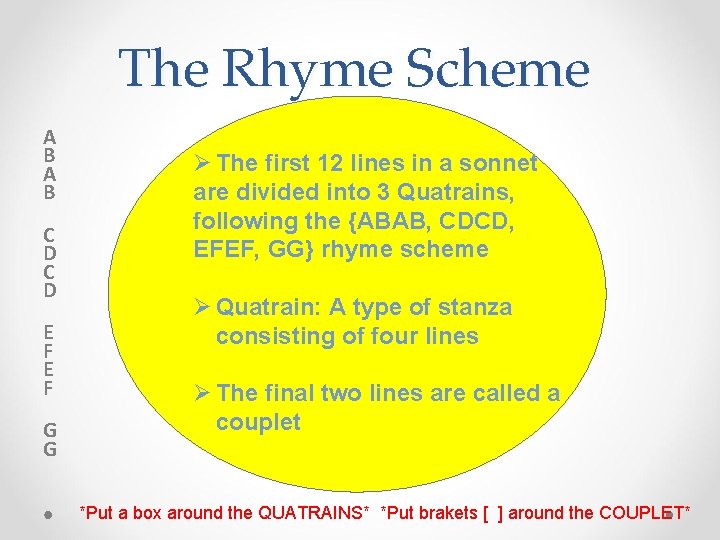
The Rhyme Scheme A B C D E F G G Ø The first 12 lines in a sonnet are divided into 3 Quatrains, following the {ABAB, CDCD, EFEF, GG} rhyme scheme Ø Quatrain: A type of stanza consisting of four lines Ø The final two lines are called a couplet *Put a box around the QUATRAINS* *Put brakets [ ] around the COUPLET*
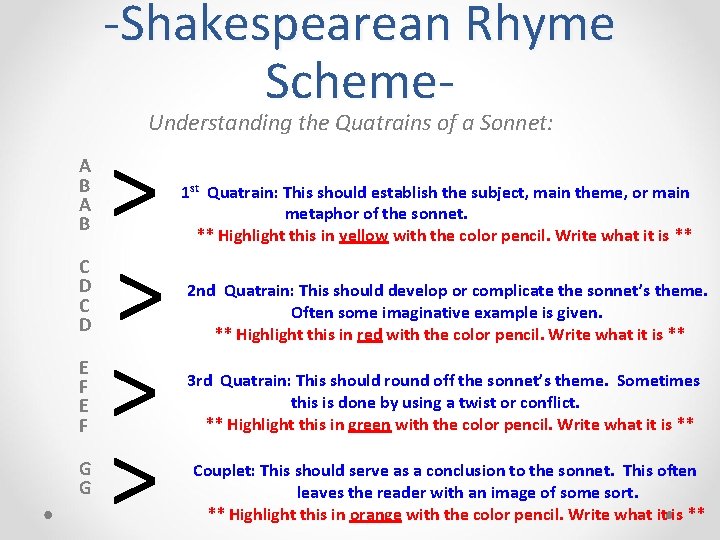
-Shakespearean Rhyme Scheme. Understanding the Quatrains of a Sonnet: A B C D E F G G > > 1 st Quatrain: This should establish the subject, main theme, or main metaphor of the sonnet. ** Highlight this in yellow with the color pencil. Write what it is ** 2 nd Quatrain: This should develop or complicate the sonnet’s theme. Often some imaginative example is given. ** Highlight this in red with the color pencil. Write what it is ** 3 rd Quatrain: This should round off the sonnet’s theme. Sometimes this is done by using a twist or conflict. ** Highlight this in green with the color pencil. Write what it is ** Couplet: This should serve as a conclusion to the sonnet. This often leaves the reader with an image of some sort. ** Highlight this in orange with the color pencil. Write what it is **
Practice • Practice by yourself annotating Sonnet 29, 130 • Now paraphrase a sonnet to demonstrate your understanding/interpretation
- Slides: 7