
The Tension Between High Video Rate and No
The Tension Between High Video Rate and No Rebuffering Te-Yuan (TY) Huang Stanford University IRTF Open Meeting @IETF 87 July 30 th, 2013 Joint work Prof. Nick Mc. Keown and Prof. Ramesh Johari
Outline • How does streaming video work today? – Video streaming over HTTP – Video rate selection over HTTP – The goals of rate selection • The tension between the goals • Initial thoughts on how to break the tension 2
Video is the BIG thing on the Internet • Video is more than 50% of peak traffic in the US • Trend: Streaming over HTTP – Content Distribution Networks (CDNs) • Well-provisioned HTTP servers at the edge of the Internet • Cheap (1 -2 cents per GB in 2013) – Firewall friendliness 3
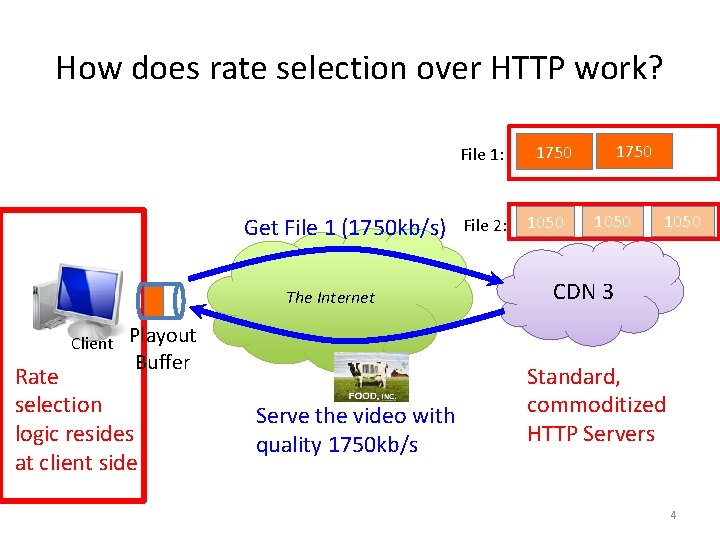
How does rate selection over HTTP work? File 1: Get File 1 (1750 kb/s) The Internet Client Playout Buffer Rate selection logic resides at client side Serve the video with quality 1750 kb/s File 2: 1750 1050 CDN 3 Standard, commoditized HTTP Servers 4
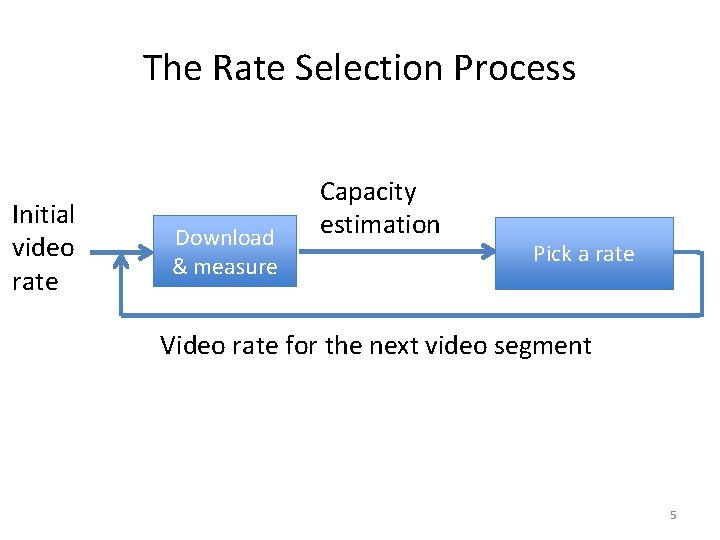
The Rate Selection Process Initial video rate Download & measure Capacity estimation Pick a rate Video rate for the next video segment 5
The Common Goals 1. Achieve the highest possible video rate – Video rate represents video quality 2. Avoid “rebuffer” as much as possible – “Rebuffer” means under-running playout buffer • Unavoidable: Network or Service Outage – Necessary rebuffers • Avoidable: Requesting a video rate that is too high – Unnecessary rebuffers 6
The Tension Between The Goals • The actual capacity is unknown and varies – Accurate estimation is hard • Underestimate the capacity – Picking a rate that is too low – leads to sub-optimal video quality (Fail Goal #1!) • Over-estimate the capacity – Picking a rate that is too high – leads to rebuffering (Fail Goal #2!) 7
8
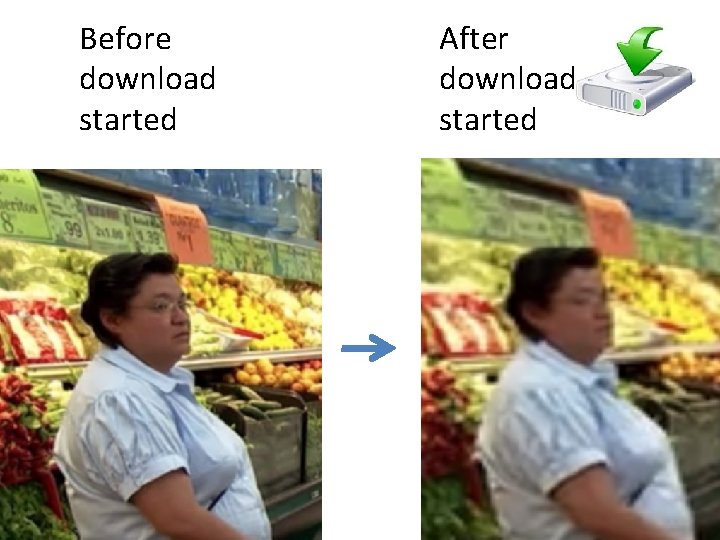
Before download started After download started 9
What happened? • Both the download and video are over HTTP – TCP shares my home link equally among all flows What is the problem? 10
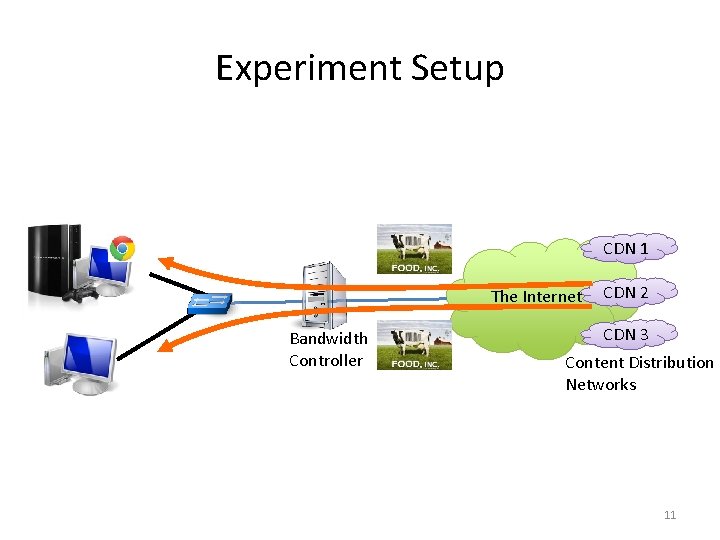
Experiment Setup CDN 1 The Internet Bandwidth Controller CDN 2 CDN 3 Content Distribution Networks 11
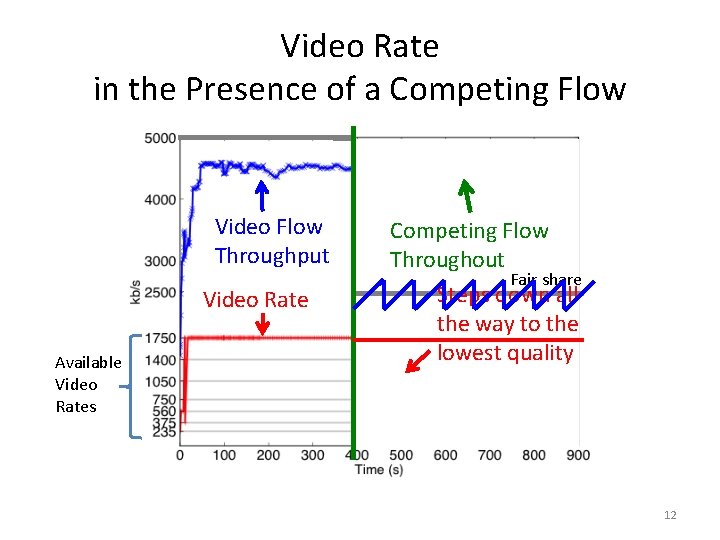
Video Rate in the Presence of a Competing Flow Video Flow Throughput Video Rate Available Video Rates Competing Flow Throughout Fair share Steps down all the way to the lowest quality 12
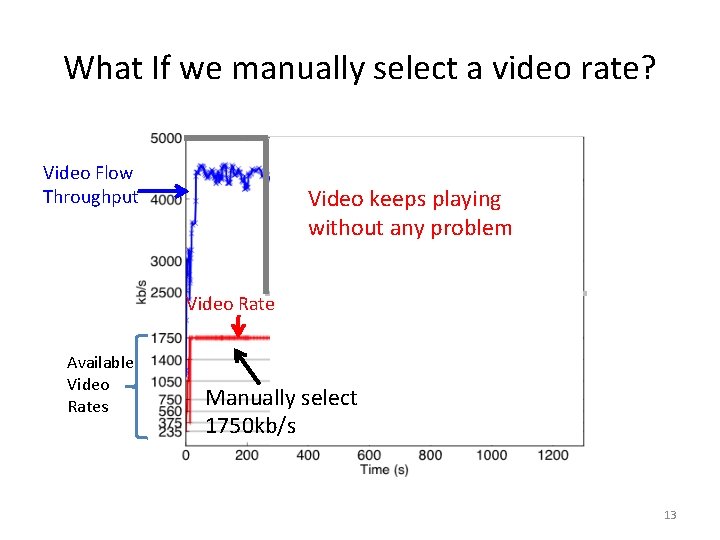
What If we manually select a video rate? Video Flow Throughput Video keeps playing without any problem Video Rate Available Video Rates Manually select 1750 kb/s 13
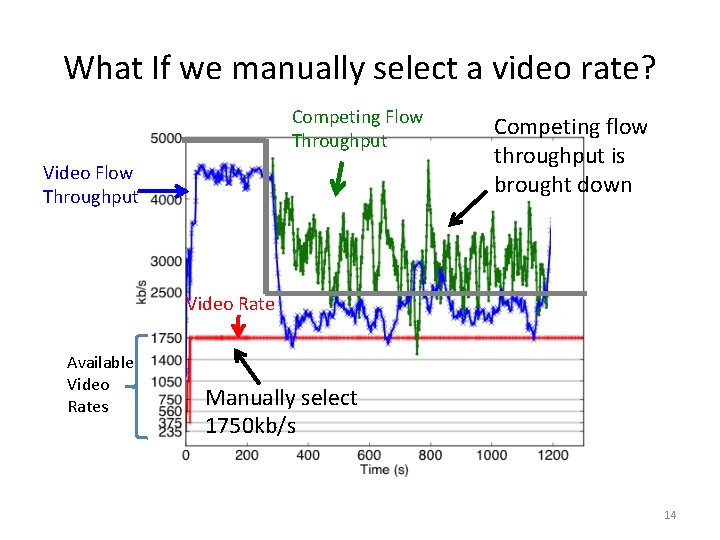
What If we manually select a video rate? Competing Flow Throughput Video Flow Throughput Competing flow throughput is brought down Video Rate Available Video Rates Manually select 1750 kb/s 14
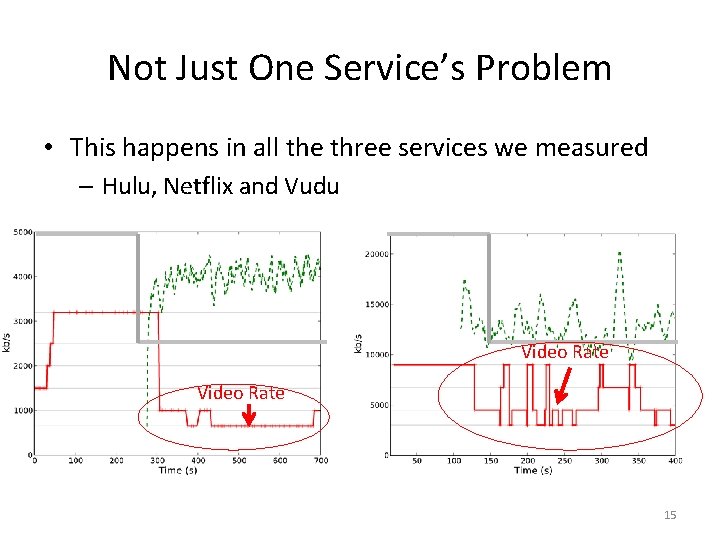
Not Just One Service’s Problem • This happens in all the three services we measured – Hulu, Netflix and Vudu Video Rate 15
The Problem Video client ends up with much less throughput than its fair share It picks a video rate that is much too low Why? 16
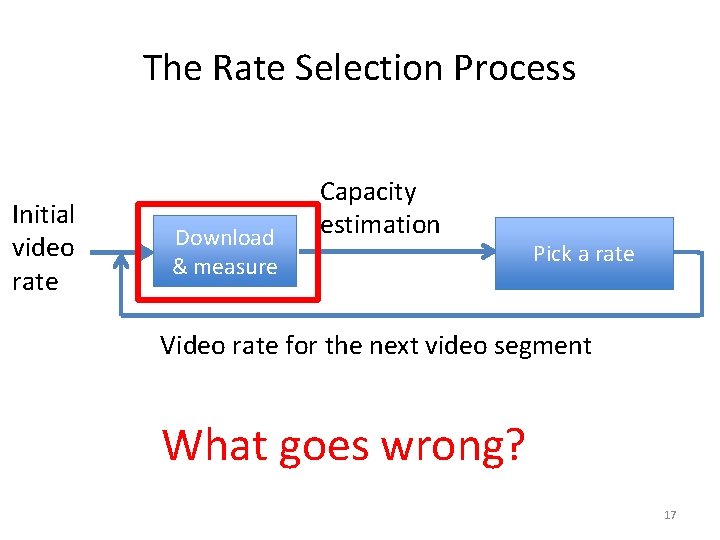
The Rate Selection Process Initial video rate Download & measure Capacity estimation Pick a rate Video rate for the next video segment What goes wrong? 17
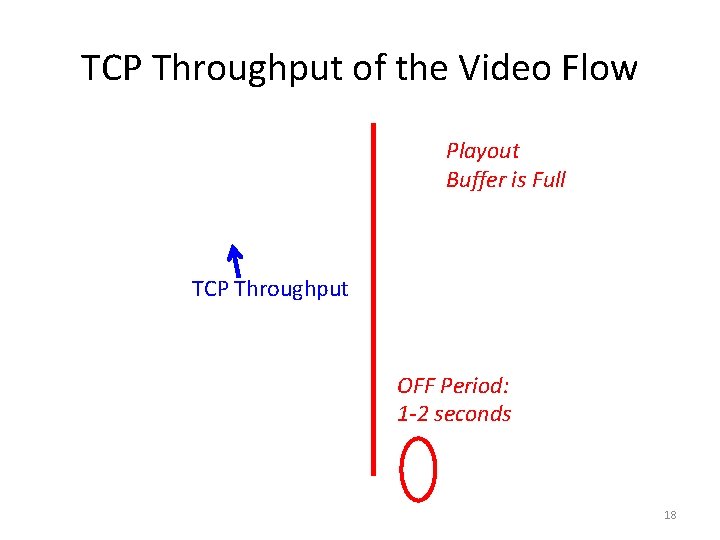
TCP Throughput of the Video Flow Playout Buffer is Full TCP Throughput OFF Period: 1 -2 seconds 18
Impact of OFF period on TCP • TCP sender resets its congestion window – When idle more than one RTO (200 ms) – Slow-start restart, RFC 2581/5681 – Linux 3. x (tcp_output. c, line 163) • Throughput will be affected – Worse with a competing flow • Experience packet loss during slow start 50% of the segments get < 1. 8 Mb/s (Fair Share is 2. 5 Mb/s) 19
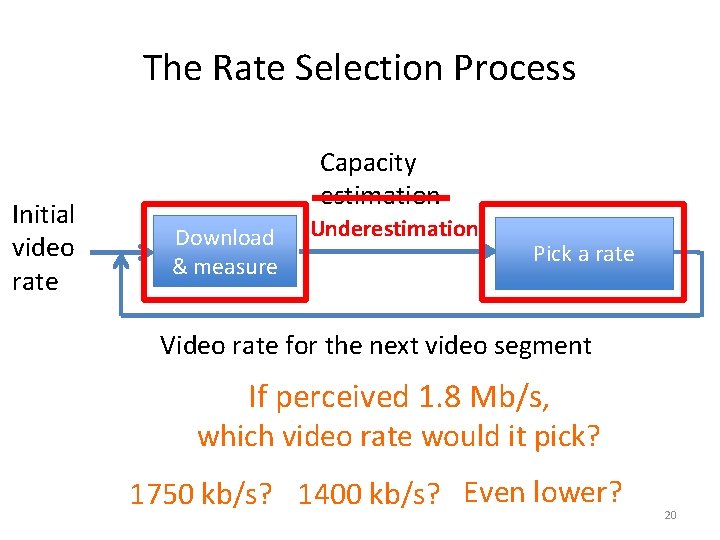
The Rate Selection Process Initial video rate Capacity estimation Download & measure Underestimation Pick a rate Video rate for the next video segment If perceived 1. 8 Mb/s, which video rate would it pick? 1750 kb/s? 1400 kb/s? Even lower? 20
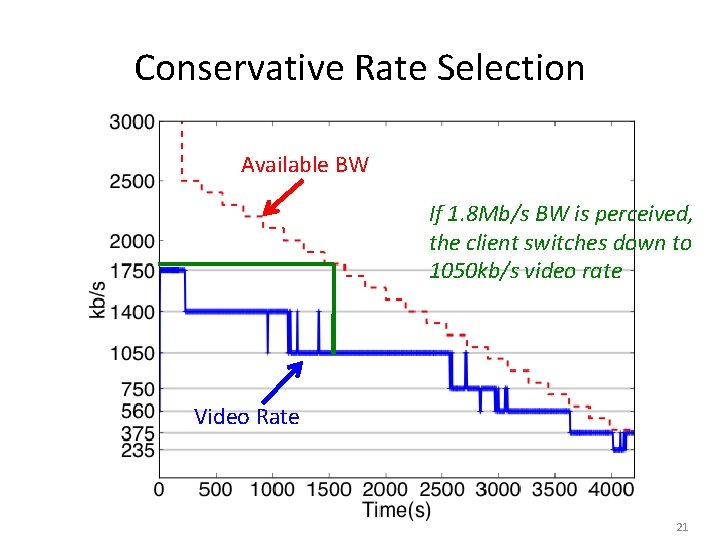
Conservative Rate Selection Available BW If 1. 8 Mb/s BW is perceived, the client switches down to 1050 kb/s video rate Video Rate 21
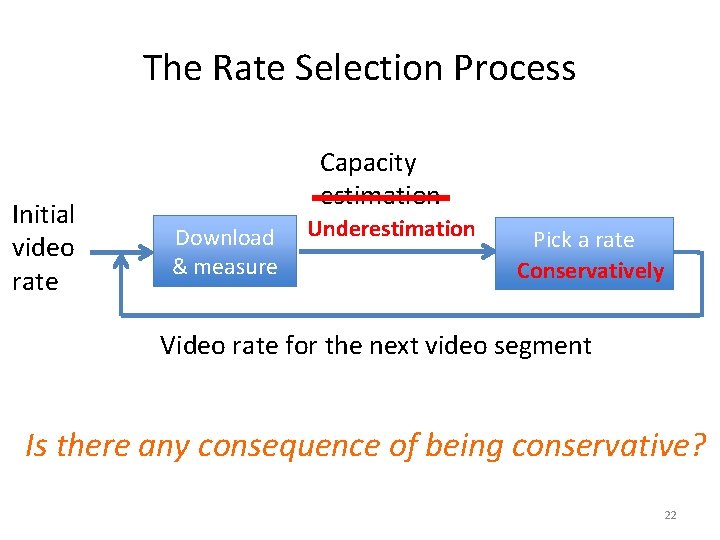
The Rate Selection Process Initial video rate Capacity estimation Download & measure Underestimation Pick a rate Conservatively Video rate for the next video segment Is there any consequence of being conservative? 22
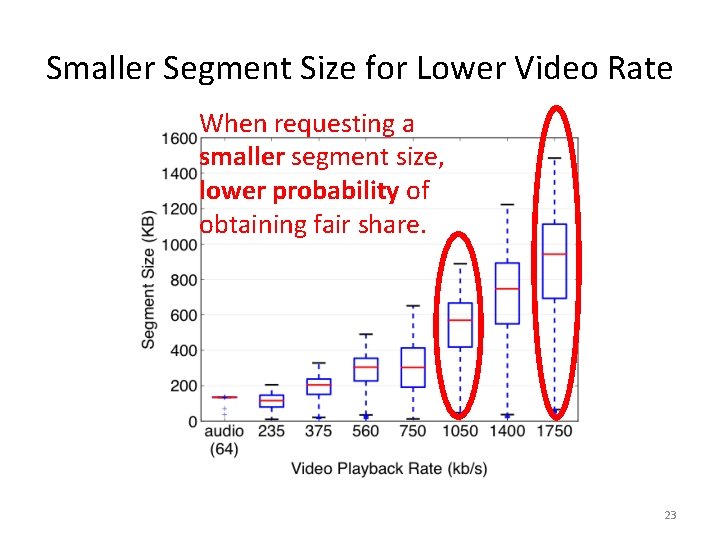
Smaller Segment Size for Lower Video Rate When requesting a smaller segment size, lower probability of obtaining fair share. 23
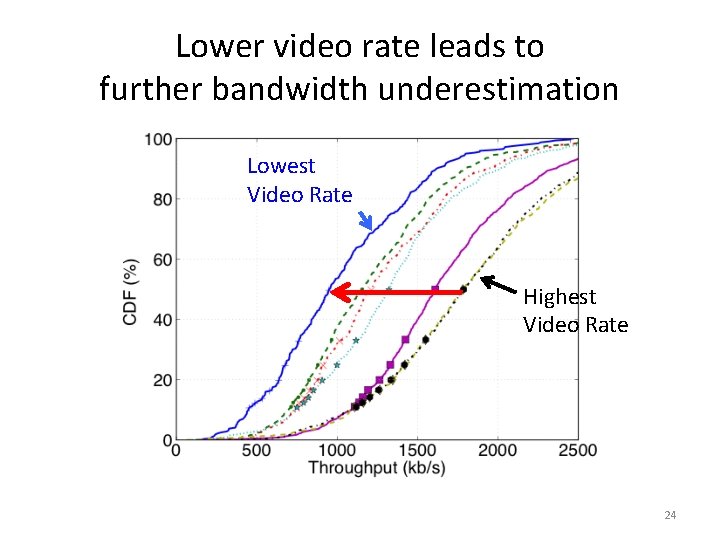
Lower video rate leads to further bandwidth underestimation Lowest Video Rate Highest Video Rate 24
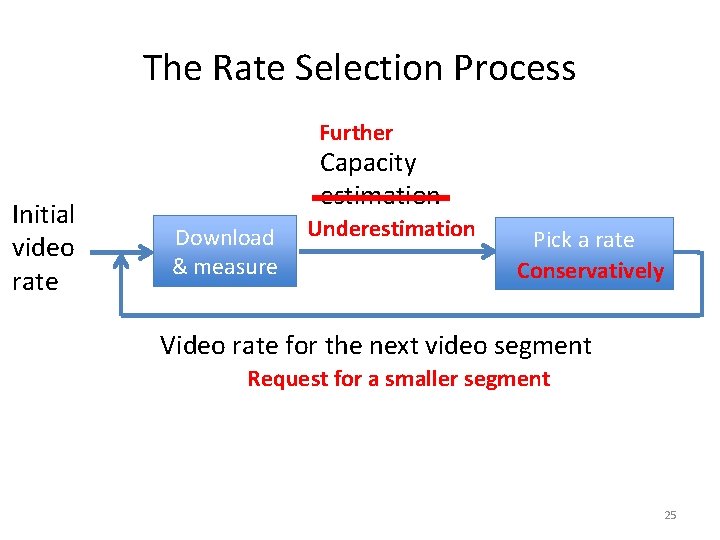
The Rate Selection Process Further Initial video rate Capacity estimation Download & measure Underestimation Pick a rate Conservatively Video rate for the next video segment Request for a smaller segment 25
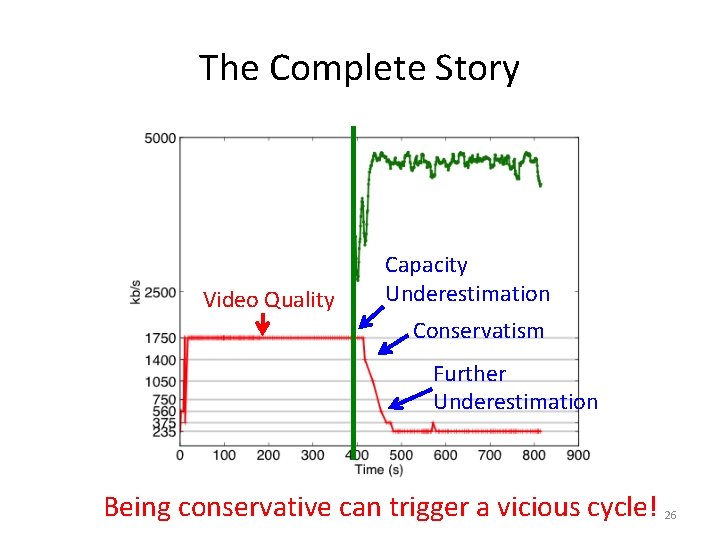
The Complete Story Video Quality Capacity Underestimation Conservatism Further Underestimation Being conservative can trigger a vicious cycle! 26
But the available capacity is unknown & varies, So being conservative is understandable. Although this leads to sub-optimal quality (Fails Goal #1), at least it will avoid rebuffer (Goal #2) … Right? 27
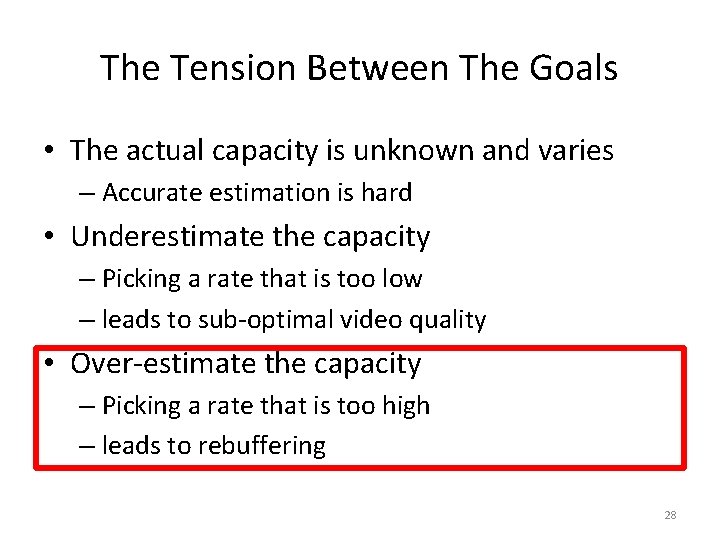
The Tension Between The Goals • The actual capacity is unknown and varies – Accurate estimation is hard • Underestimate the capacity – Picking a rate that is too low – leads to sub-optimal video quality • Over-estimate the capacity – Picking a rate that is too high – leads to rebuffering 28
29
What happened? 30
What happened? Available Video Rates 31
What happened? – Cont. Video Rate Available Video Rates 32
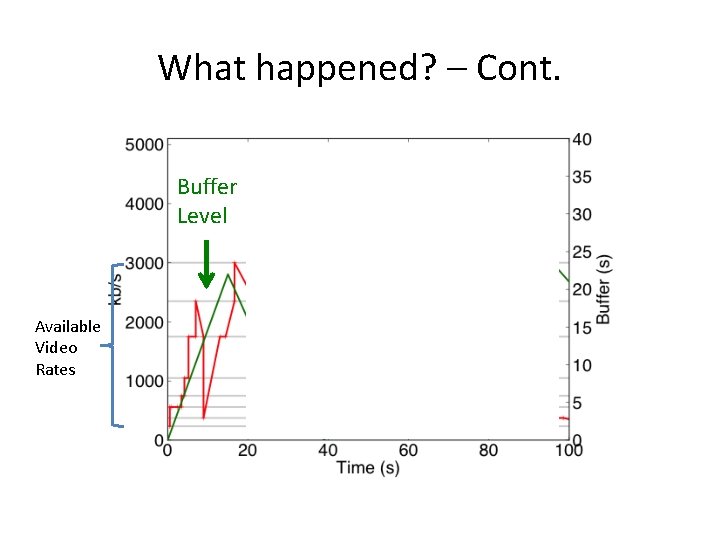
What happened? – Cont. Buffer Level Available Video Rates
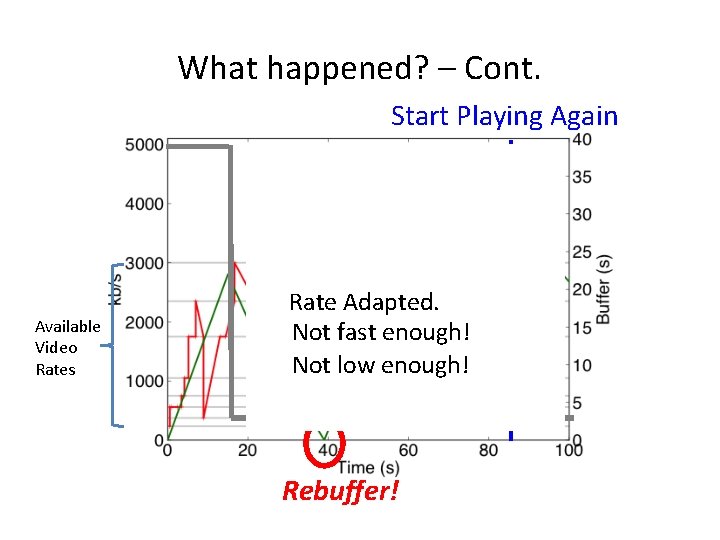
What happened? – Cont. Start Playing Again Buffer Level Video Rate Available Video Rates Rate Adapted. Not fast enough! Not low enough! Rebuffer!
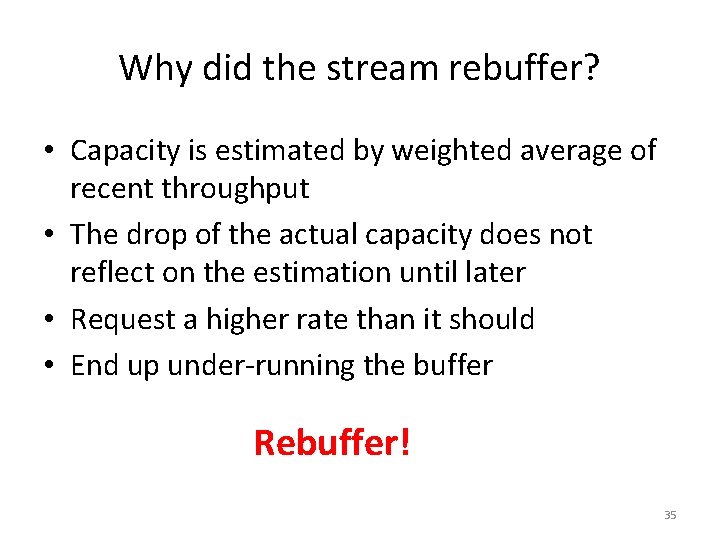
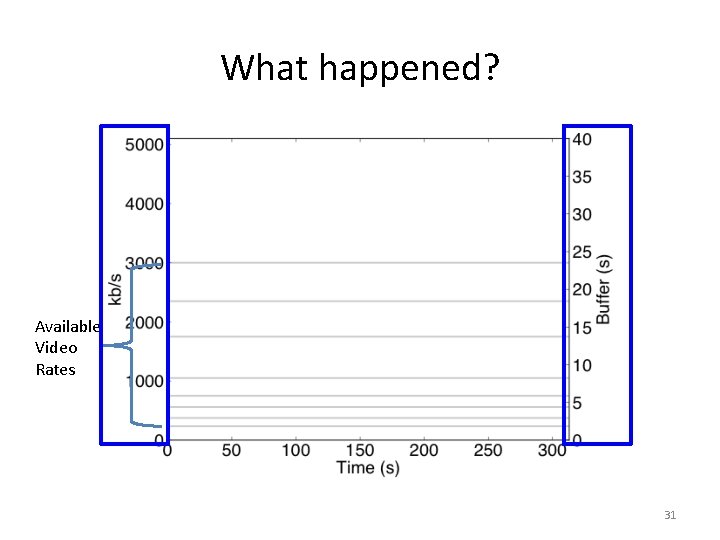
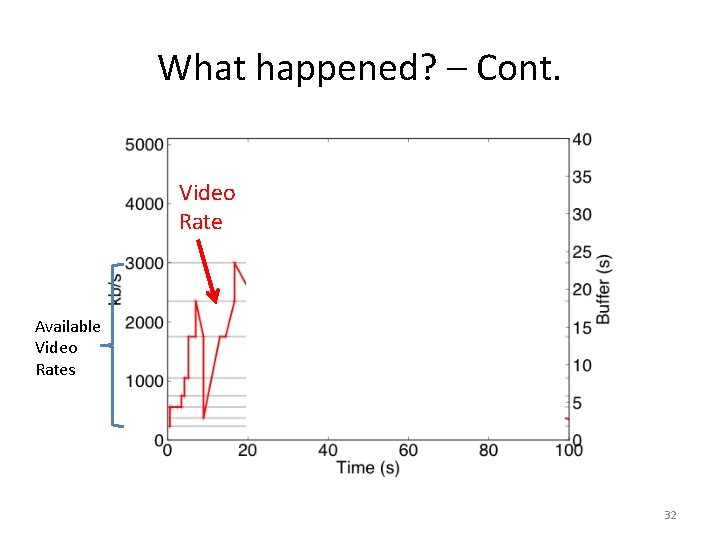
Why did the stream rebuffer? • Capacity is estimated by weighted average of recent throughput • The drop of the actual capacity does not reflect on the estimation until later • Request a higher rate than it should • End up under-running the buffer Rebuffer! 35
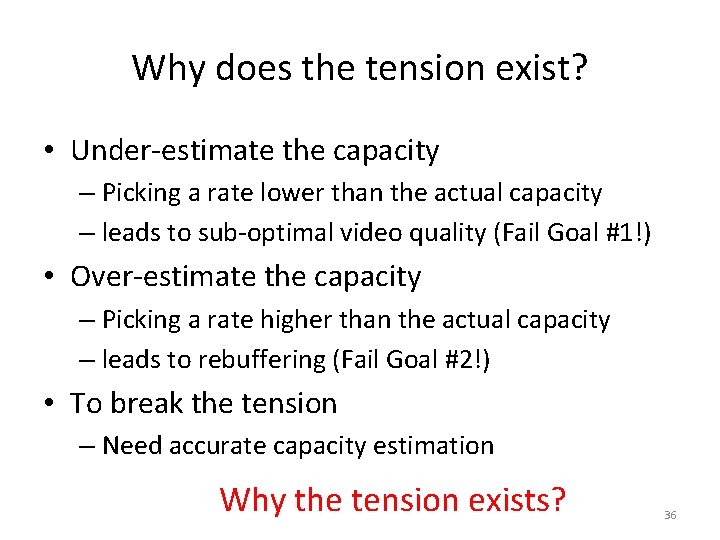
Why does the tension exist? • Under-estimate the capacity – Picking a rate lower than the actual capacity – leads to sub-optimal video quality (Fail Goal #1!) • Over-estimate the capacity – Picking a rate higher than the actual capacity – leads to rebuffering (Fail Goal #2!) • To break the tension – Need accurate capacity estimation Why the tension exists? 36
Why does the tension exist? • Pick video rate based on capacity estimation – The actual capacity is unknown and varies – The estimation never equals to the actual capacity • The same algorithm can both under-estimate and over-estimate the capacity 37
What if…. Pick the video rate based on something we know: The Playout Buffer Can we break the tension?
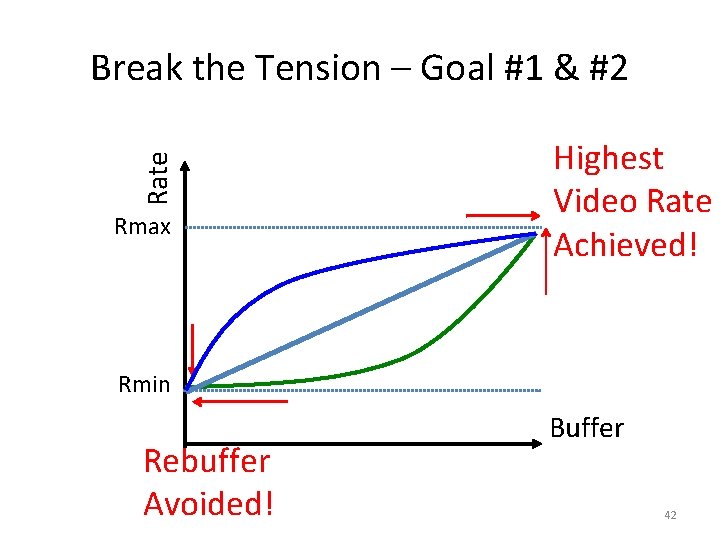
Break the Tension – Goal #1 • To achieve the highest possible video rate: – Need to fully utilize the capacity • Avoid ON/OFF behavior • Unless we have more capacity than we need • Request for the highest video rate before the buffer is full – Playout Buffer will only be full: • When the capacity is larger than the highest video rate • Have more capacity than needed – Fully utilize the bandwidth – Average video rate = Average throughput 39
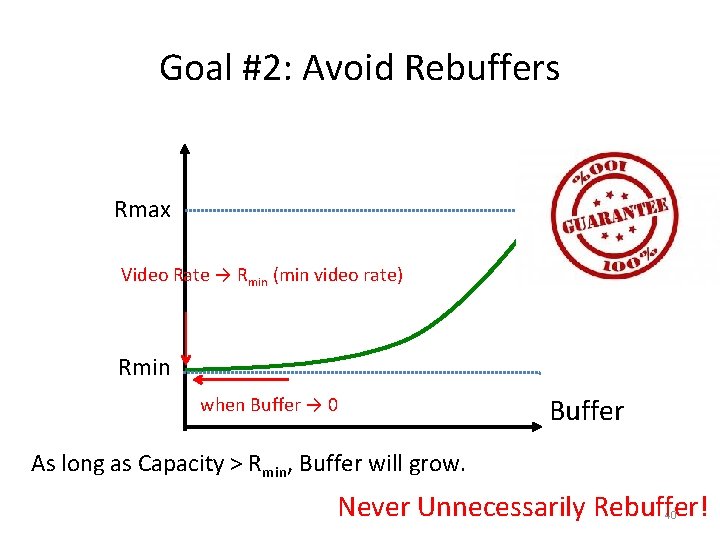
Goal #2: Avoid Rebuffers Rmax Video Rate → Rmin (min video rate) Rmin when Buffer → 0 Buffer As long as Capacity > Rmin, Buffer will grow. Never Unnecessarily Rebuffer! 40
Rate Break the Tension – Goal #1 & #2 Rmax Highest Video Rate Achieved! Rmin Rebuffer Avoided! Buffer 42
Practical Concerns • Discrete segment downloads – Can only pick video rate when requesting a segment • Discrete video rates • Many more… • Buffer-based algorithm provides a framework to address these concerns “Downton Abbey without the Hiccups: Buffer-Based Rate Adaptation for HTTP Video Streaming”. SIGCOMM Fh. MN Workshop, Aug. 16 th, 2013 43
Conclusion • Current practice of rate selection algorithm: – Pick a video rate based on capacity estimation – Two common goals: • Achieve highest possible video rate • Avoid rebuffer as much as possible • The tension between two common goals – Underestimation vs. Overestimation • The tension is caused by the estimation – Let’s take that out from the algorithm • Focus on the one thing we know: The Playout Buffer – The tension will be broken down 44
- Slides: 43