
THE TEMPLE UNIVERSITY HOSPITAL EEG CORPUS A Harati
- Slides: 1
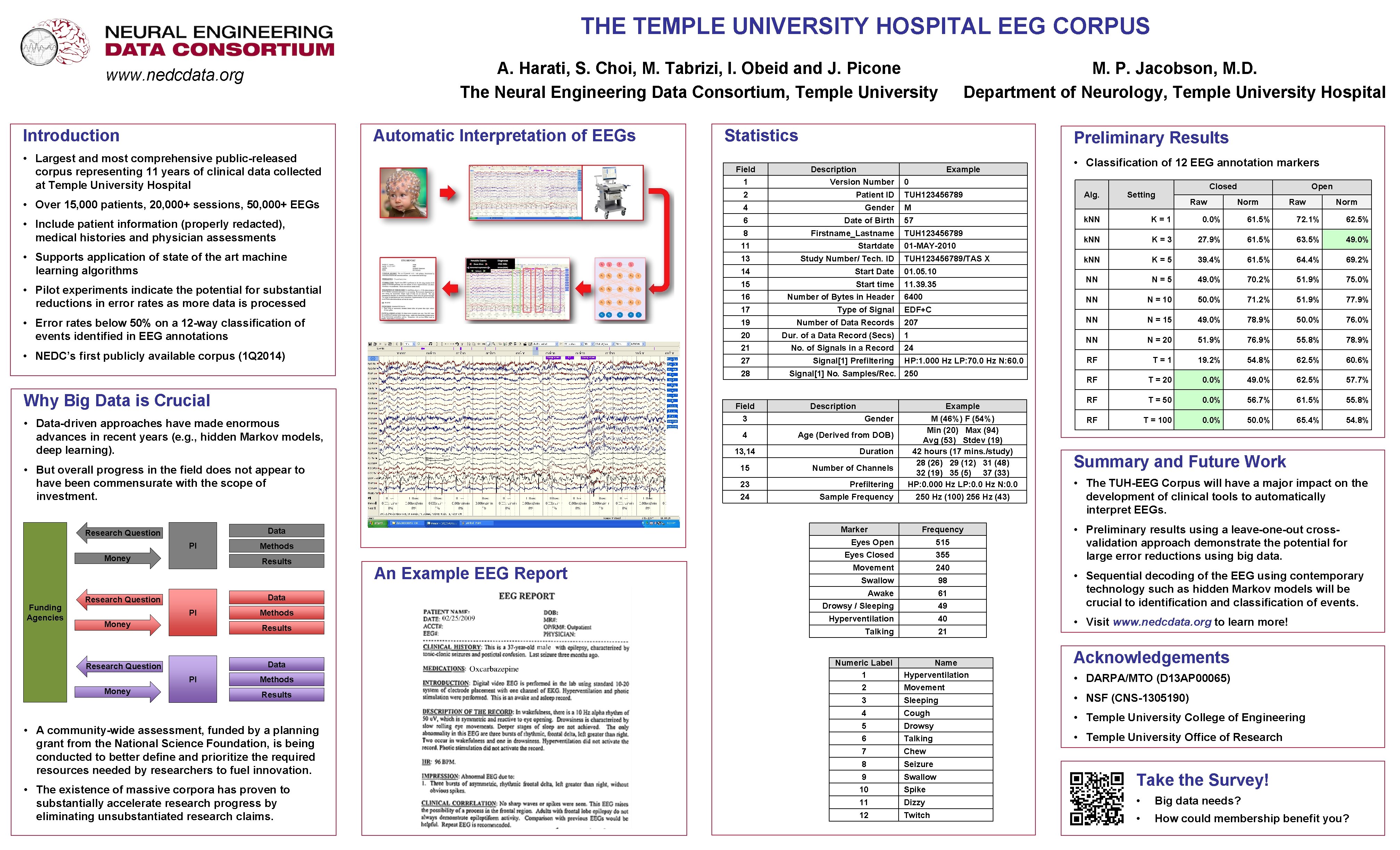
THE TEMPLE UNIVERSITY HOSPITAL EEG CORPUS A. Harati, S. Choi, M. Tabrizi, I. Obeid and J. Picone The Neural Engineering Data Consortium, Temple University www. nedcdata. org Automatic Interpretation of EEGs Introduction • Largest and most comprehensive public-released corpus representing 11 years of clinical data collected at Temple University Hospital Statistics Field Preliminary Results Description Example 1 Version Number 2 Patient ID 4 Gender M 6 Date of Birth 57 8 Firstname_Lastname 11 Startdate • Supports application of state of the art machine learning algorithms 13 Study Number/ Tech. ID 14 Start Date 01. 05. 10 • Pilot experiments indicate the potential for substantial reductions in error rates as more data is processed 15 Start time 11. 39. 35 16 Number of Bytes in Header 17 Type of Signal • Error rates below 50% on a 12 -way classification of events identified in EEG annotations 19 Number of Data Records 20 Dur. of a Data Record (Secs) 21 No. of Signals in a Record 27 Signal[1] Prefiltering 28 Signal[1] No. Samples/Rec. 250 • Over 15, 000 patients, 20, 000+ sessions, 50, 000+ EEGs • Include patient information (properly redacted), medical histories and physician assessments • NEDC’s first publicly available corpus (1 Q 2014) Why Big Data is Crucial Field • Data-driven approaches have made enormous advances in recent years (e. g. , hidden Markov models, deep learning). PI Money Funding Agencies Methods Results Data Research Question PI Money Methods Results Data Research Question PI Methods 4 Age (Derived from DOB) Duration 15 Number of Channels 23 Prefiltering 24 Sample Frequency Marker Data Research Question An Example EEG Report TUH 123456789 01 -MAY-2010 TUH 123456789/TAS X 6400 207 1 24 HP: 1. 000 Hz LP: 70. 0 Hz N: 60. 0 M (46%) F (54%) Min (20) Max (94) Avg (53) Stdev (19) 42 hours (17 mins. /study) 28 (26) 29 (12) 31 (48) 32 (19) 35 (5) 37 (33) HP: 0. 000 Hz LP: 0. 0 Hz N: 0. 0 250 Hz (100) 256 Hz (43) Frequency Eyes Open 515 Eyes Closed 355 Movement 240 Swallow 98 Awake 61 Drowsy / Sleeping 49 Hyperventilation 40 Talking 21 Numeric Label 1 Alg. Setting Closed Raw Open Norm Raw Norm k. NN K=1 0. 0% 61. 5% 72. 1% 62. 5% k. NN K=3 27. 9% 61. 5% 63. 5% 49. 0% k. NN K=5 39. 4% 61. 5% 64. 4% 69. 2% NN N=5 49. 0% 70. 2% 51. 9% 75. 0% NN N = 10 50. 0% 71. 2% 51. 9% 77. 9% NN N = 15 49. 0% 78. 9% 50. 0% 76. 0% NN N = 20 51. 9% 76. 9% 55. 8% 78. 9% RF T=1 19. 2% 54. 8% 62. 5% 60. 6% RF T = 20 0. 0% 49. 0% 62. 5% 57. 7% RF T = 50 0. 0% 56. 7% 61. 5% 55. 8% RF T = 100 0. 0% 50. 0% 65. 4% 54. 8% EDF+C Example Gender • Classification of 12 EEG annotation markers 0 Description 3 13, 14 • But overall progress in the field does not appear to have been commensurate with the scope of investment. M. P. Jacobson, M. D. Department of Neurology, Temple University Hospital Name Hyperventilation Summary and Future Work • The TUH-EEG Corpus will have a major impact on the development of clinical tools to automatically interpret EEGs. • Preliminary results using a leave-one-out crossvalidation approach demonstrate the potential for large error reductions using big data. • Sequential decoding of the EEG using contemporary technology such as hidden Markov models will be crucial to identification and classification of events. • Visit www. nedcdata. org to learn more! Acknowledgements • DARPA/MTO (D 13 AP 00065) 2 Movement 3 Sleeping 4 Cough • A community-wide assessment, funded by a planning grant from the National Science Foundation, is being conducted to better define and prioritize the required resources needed by researchers to fuel innovation. 5 Drowsy 6 Talking 7 Chew 8 Seizure 9 Swallow • The existence of massive corpora has proven to substantially accelerate research progress by eliminating unsubstantiated research claims. 10 Spike 11 Dizzy • Big data needs? 12 Twitch • How could membership benefit you? Money Results • NSF (CNS-1305190) • Temple University College of Engineering • Temple University Office of Research Take the Survey!