
The Templates Using Business Case and Design Thinking
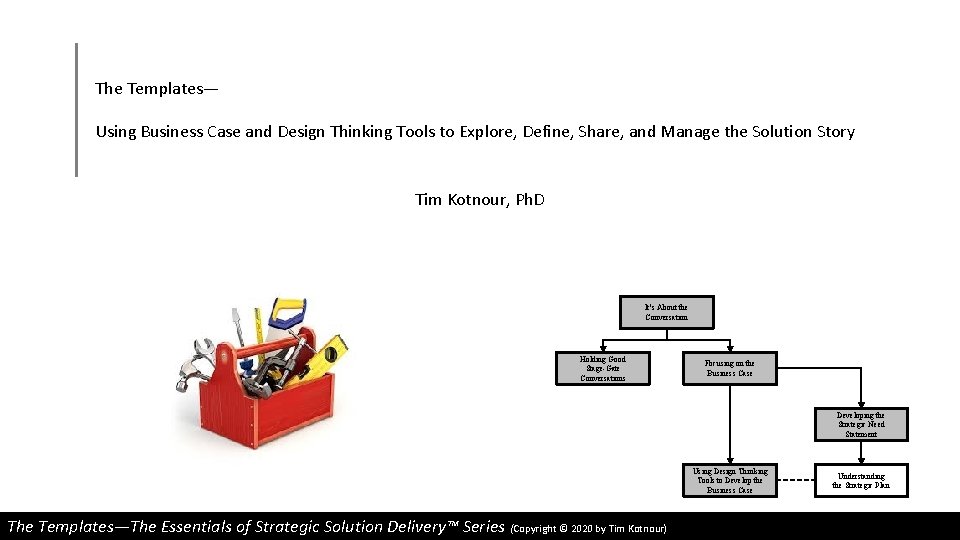
The Templates— Using Business Case and Design Thinking Tools to Explore, Define, Share, and Manage the Solution Story Tim Kotnour, Ph. D It’s About the Conversation Holding Good Stage-Gate Conversations Focusing on the Business Case Developing the Strategic Need Statement Using Design Thinking Tools to Develop the Business Case The Templates—The Essentials of Strategic Solution Delivery™ Series (Copyright © 2020 by Tim Kotnour) Understanding the Strategic Plan
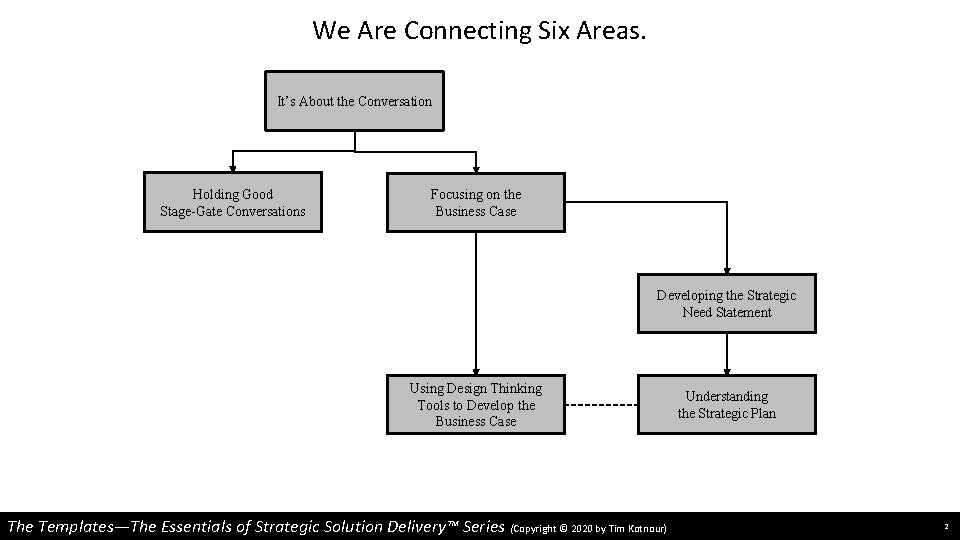
We Are Connecting Six Areas. It’s About the Conversation Holding Good Stage-Gate Conversations Focusing on the Business Case Developing the Strategic Need Statement Using Design Thinking Tools to Develop the Business Case The Templates—The Essentials of Strategic Solution Delivery™ Series (Copyright © 2020 by Tim Kotnour) Understanding the Strategic Plan 2
Important Reminders • • The intent of this workbook is to help project teams define strategic solutions and to share the story of their solution. This workbook contains: – Why: An overview of the context driving the use of these tools – What: A description of the tools with guidance and examples – How: A description of how to use these tools in the context of a “stage-gate” or decision meeting. This process and tools are based on work with industry and general best practices. Further description can be obtained from the author and related references. A cautionary note is needed. • Just because we have a hammer doesn’t mean everything is a nail. Just because we provide a tool or template, doesn’t mean it fits every situation, you need to be wise on when and why you use a tool. • Remember the communication equation provided by Middleman: – Audience + Purpose = Design We need to adapt the message and tool to fit the unique situation and audience. • These tools are a means to tell a story and clarify thinking…filling out a template is not the end. The critical thinking and conversations as a team is the core need. Use the tools to help you organize the conversation and the results of the conversation. The Templates—The Essentials of Strategic Solution Delivery™ Series (Copyright © 2020 by Tim Kotnour) 3
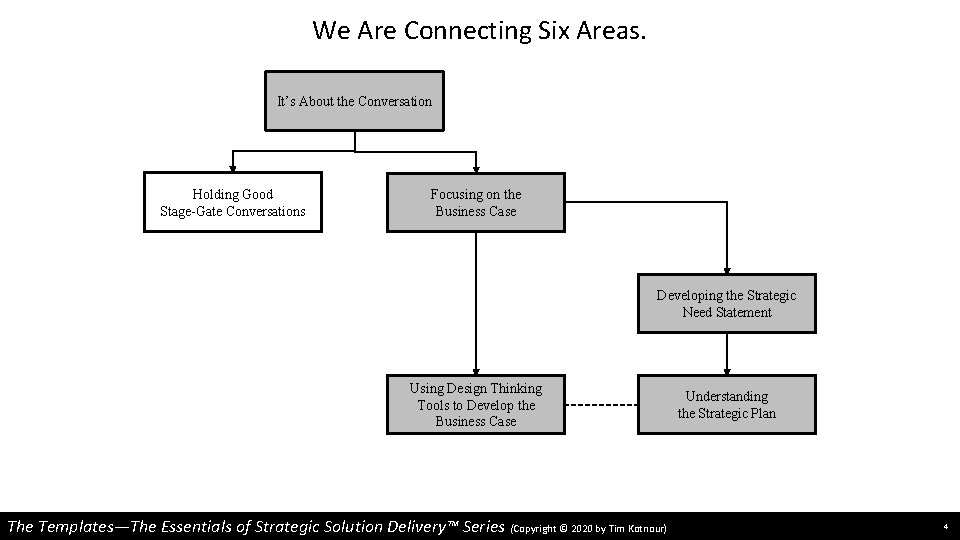
We Are Connecting Six Areas. It’s About the Conversation Holding Good Stage-Gate Conversations Focusing on the Business Case Developing the Strategic Need Statement Using Design Thinking Tools to Develop the Business Case The Templates—The Essentials of Strategic Solution Delivery™ Series (Copyright © 2020 by Tim Kotnour) Understanding the Strategic Plan 4
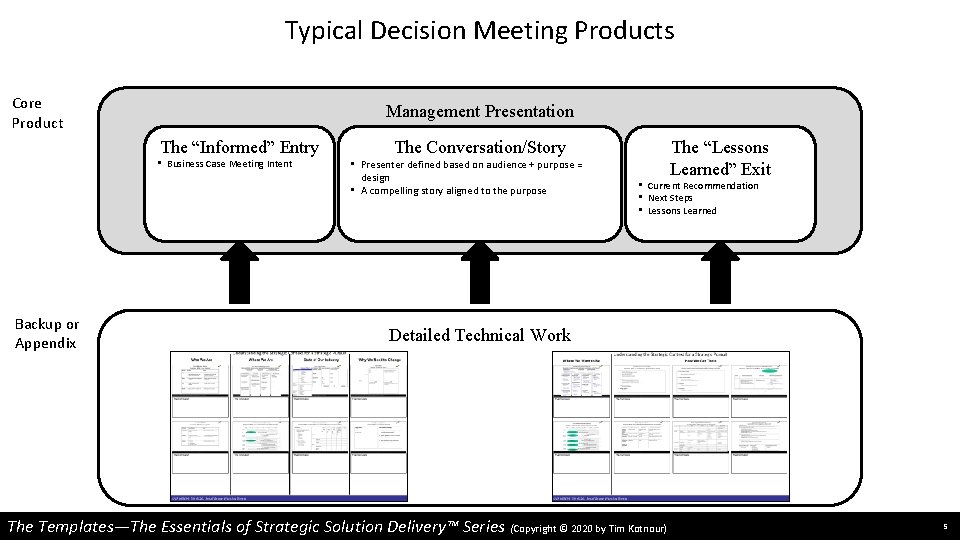
Typical Decision Meeting Products Core Product Management Presentation The “Informed” Entry • Business Case Meeting Intent Backup or Appendix The Conversation/Story • Presenter defined based on audience + purpose = design • A compelling story aligned to the purpose The “Lessons Learned” Exit • Current Recommendation • Next Steps • Lessons Learned Detailed Technical Work The Templates—The Essentials of Strategic Solution Delivery™ Series (Copyright © 2020 by Tim Kotnour) 5

Tool: Business Case Meeting Intent The intent of this tool is to: • Set the specific intent for the stage gate meeting. Typical Questions This tool helps us answer the following: • Why are we holding this meeting? • Where are we in the process? • What have we already decided? Typical Update The tool should be updated as part of the preparation for the stage gate meeting. • • Where We Are in The Process Check In/Gate: q Strategic Need q Size of the Gap or Opportunity q Potential Solutions q “Best” Alternative q Solution/Systems Engineering q Cost Analysis q Solution Delivery Plan q Leadership Plan q Integrated Innovation Plan Purpose of this Meeting Information to Share • ? • Summary of the Opportunity Our Strategic Problem/Opportunity Statement • ? • Who the Customer Is • ? • The Customer’s Problem/Opportunity • ? • The Solution • ? • Delivery Approach • ? What Asking For • ? The Next Steps Are • ? State of the Business Case Status (red = no good; yellow = some Status in 7 Words or Less concerns; green = all good; grey = don’t know, need more info) Strategic Solution What We Have Already Decided • • ? ? Delivery Make Money Win Final Answer The Templates—The Essentials of Strategic Solution Delivery™ Series (Copyright © 2020 by Tim Kotnour) 6

Tool: Current Recommendation Intent The intent of this tool is to: • Summarize why we should and should not pursue this project any further. One reason why we should do the deal One reason why we should not do the deal Typical Questions This tool helps us answer the following: • Why we should continue? • Why we should not continue? Typical Update The tool should be updated as part of every stage gate meeting. The Templates—The Essentials of Strategic Solution Delivery™ Series (Copyright © 2020 by Tim Kotnour) 7

Tool: Next Steps Intent The intent of this tool is to: • Help the team transition to the next phase in an intentional way. Typical Questions This tool helps us answer the following: • What is the team asking for to go to the next phase? • What are the immediate next steps if the team is approved to move forward? What is the team asking for to go to the next stage? ? What are the next steps? ? Typical Update The tool should be updated as part of every stage gate meeting. The Templates—The Essentials of Strategic Solution Delivery™ Series (Copyright © 2020 by Tim Kotnour) 8

Tool: Lessons Learned Intent The intent of this tool is to: • Help the team reflect on their performance and process. Typical Questions This tool helps us answer the following: • What did we learn? • How can we improve our performance and process for the next phase? Typical Update The tool should be updated as part of every stage gate meeting. • ? • ? What did we do well? What challenges did we face? What could we have done better? What will we start in the next phase? What will we stop in the next phase? What will we continue in the next phase? The Templates—The Essentials of Strategic Solution Delivery™ Series (Copyright © 2020 by Tim Kotnour) 9
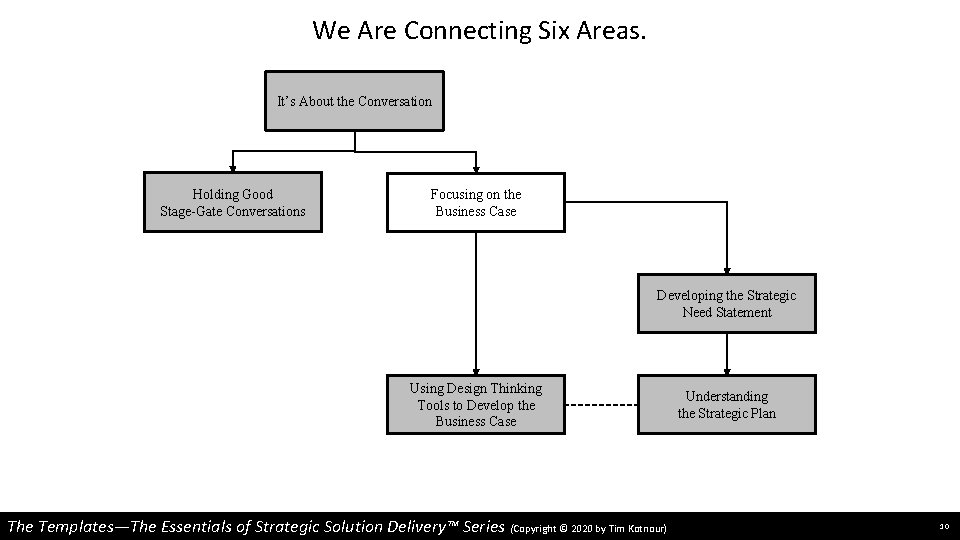
We Are Connecting Six Areas. It’s About the Conversation Holding Good Stage-Gate Conversations Focusing on the Business Case Developing the Strategic Need Statement Using Design Thinking Tools to Develop the Business Case The Templates—The Essentials of Strategic Solution Delivery™ Series (Copyright © 2020 by Tim Kotnour) Understanding the Strategic Plan 10
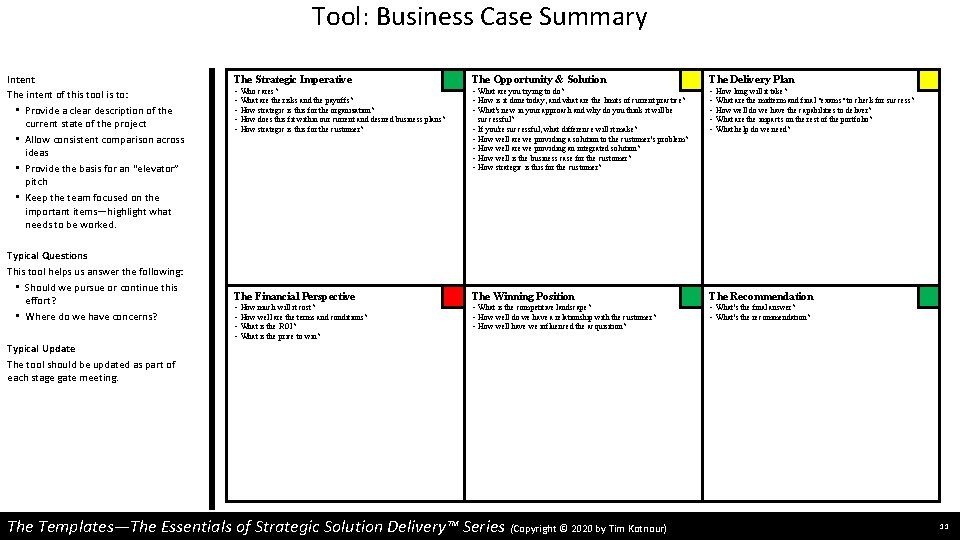
Tool: Business Case Summary Intent The intent of this tool is to: • Provide a clear description of the current state of the project • Allow consistent comparison across ideas • Provide the basis for an “elevator” pitch • Keep the team focused on the important items—highlight what needs to be worked. Typical Questions This tool helps us answer the following: • Should we pursue or continue this effort? • Where do we have concerns? The Strategic Imperative The Opportunity & Solution The Delivery Plan • • • What are you trying to do? • How is it done today, and what are the limits of current practice? • What's new in your approach and why do you think it will be • • • Who cares? What are the risks and the payoffs? How strategic is this for the organization? How does this fit within our current and desired business plans? How strategic is this for the customer? • • • successful? If you're successful, what difference will it make? How well are we providing a solution to the customer’s problem? How well are we providing an integrated solution? How well is the business case for the customer? How strategic is this for the customer? How long will it take? What are the midterm and final "exams" to check for success? How well do we have the capabilities to deliver? What are the impacts on the rest of the portfolio? What help do we need? The Financial Perspective The Winning Position The Recommendation • • • What is the competitive landscape? • How well do we have a relationship with the customer? • How well have we influenced the acquisition? • What’s the final answer? • What’s the recommendation? How much will it cost? How well are the terms and conditions? What is the ROI? What is the price to win? Typical Update The tool should be updated as part of each stage gate meeting. The Templates—The Essentials of Strategic Solution Delivery™ Series (Copyright © 2020 by Tim Kotnour) 11

Tool: Business Case Outcome Scorecard Intent The intent of this tool is to: • Provide a consistent way to evaluate a project • Ensure the team is following the process • Drive discipline in the thought process. Typical Questions This tool helps us answer the following: • Should we pursue or continue this effort? • Where do we have concerns? Major Question How strategic is this? How well are we providing a solution? How well can we deliver? Typical Update The tool should be updated as part of each stage gate meeting. Will we make money? Can we win? What is the final answer? Sub Questions Red Yellow Green 1) How strategic is this for the organization? • Not part of long-term core business • Part of ongoing core business • Aligned to strategic direction • Aligned to growth plan 2) How strategic is this for the customer? • Not part of long-term core business • Part of ongoing core business • Aligned to strategic direction • Aligned to growth plan 3) How well are we providing a solution to the customer’s problem? • Doesn’t really solve the root problem • Meeting minimal requirements • Providing a long-term solution that 4) How well are we providing an integrated solution? • Delivering just a small piece of the • Part of an overall solution • Offering a complete solution with the but delivering what asked for solution addresses root causes of the gap organization at the core 5) How well is the business case for the customer? • The business case is not defined • A qualitative business case is defined • A clear business case and value prop 6) How well can we meet project expectations? • We don’t know the expectations or • There a few issues that we need • We can clearly and safely meet 7) How well do we have the capabilities to deliver? • We are lacking key skills, facilities, • We have most of the skills • We have the necessary skills, 8) What are the impacts on the rest of the portfolio? • Significant impact on other efforts • Impact resources but can manage it • No impacts • Fits within the portfolio 9) How well are the terms and conditions? • Unfavorable terms and conditions • Some areas of concern that can be • Favorable terms and conditions 10) What is the life-cycle cost & ROI? • Low ROI • High investments • Medium ROI • High ROI 11) What is our price to win? • Little insight into both the customer’s • • 12) What is the competitive landscape? • Strong incumbent • No strong incumbent • We are the incumbent 13) How well have we influenced the acquisition? • Responding to RFP on the street • Responded to RFIs • Influenced the RFP • Identified and wrote the need 14) How well is our relationship with the customer? • No relationship with the customer • Emerging relationship with the • Strong, ongoing relationship with 15) What is the final answer? • No compelling reason to do • Potential for short and long-term there is no path to meet them and partners expected price and competitor’s bid for the customer to resolve managed Little insight into the customer’s expected price or competitor’s bid customer • Could do or not do Plan to Move to Green is identified—the clear ROI to the customer is defined project expectations facilities, and partners Insight into both the customer’s expected price and competitor’s bid customer • Customer trusts the team • Strong reason to do the project damage to the organization’s brand The Templates—The Essentials of Strategic Solution Delivery™ Series (Copyright © 2020 by Tim Kotnour) 12
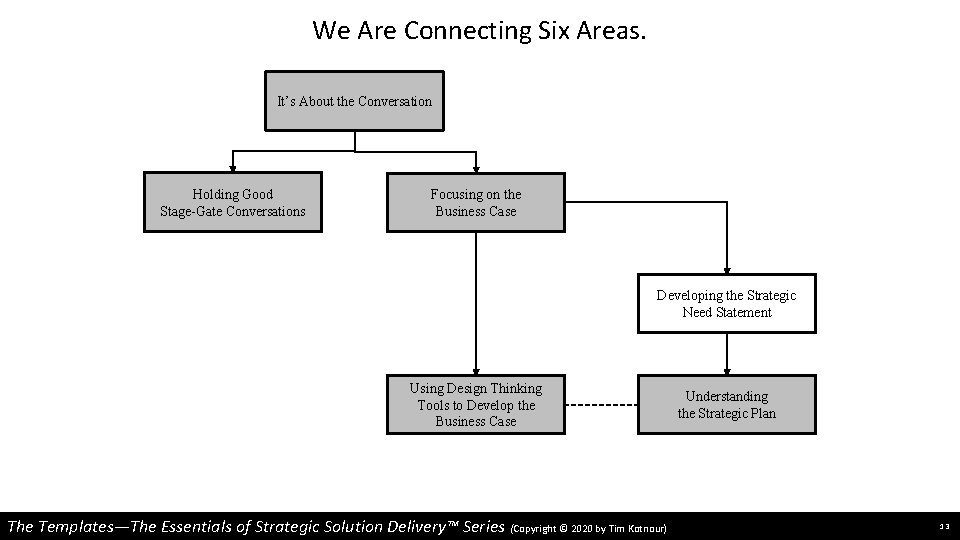
We Are Connecting Six Areas. It’s About the Conversation Holding Good Stage-Gate Conversations Focusing on the Business Case Developing the Strategic Need Statement Using Design Thinking Tools to Develop the Business Case The Templates—The Essentials of Strategic Solution Delivery™ Series (Copyright © 2020 by Tim Kotnour) Understanding the Strategic Plan 13

Tool: One Page Strategic Plan Intent The intent of this tool is to: • Provide a summary of an organization’s strategic plan • Summarize the main points of the strategy that help tell you a strategic story focused on core strategy questions. What is the state of our industry? Typical Questions This tool helps us answer the following: • Who are we? • What is the current state of our industry? • Where are we today? • Why do we need to change? • How do we get to our future? • Where do we want to be? • What is the future state of our industry? Why do we need to change? • Strengths • ? • Weaknesses • ? • Opportunities • ? • Threats • ? • Core problem • ? This tool is a summary tool of the other strategic planning related tools. Typical Update The tool should be updated as part of the “Strategic Opportunity Definition” phase and throughout the effort to ensure the efforts remains aligned to the organization’s overall strategy. Who are we? • Mission = ? • Goals: ? How do we get to our future? • Transformation philosophy • ? Where do we want to be? • Objectives • ? • Strategic initiatives • ? • Roadmap • ? Where are we today? • ? The Templates—The Essentials of Strategic Solution Delivery™ Series (Copyright © 2020 by Tim Kotnour) 14
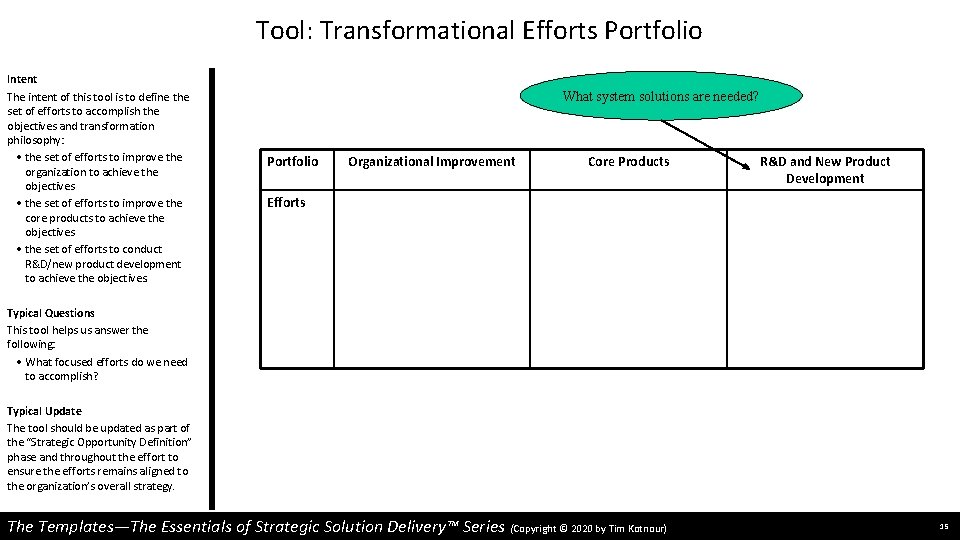
Tool: Transformational Efforts Portfolio Intent The intent of this tool is to define the set of efforts to accomplish the objectives and transformation philosophy: • the set of efforts to improve the organization to achieve the objectives • the set of efforts to improve the core products to achieve the objectives • the set of efforts to conduct R&D/new product development to achieve the objectives. What system solutions are needed? Portfolio Organizational Improvement Core Products R&D and New Product Development Efforts Typical Questions This tool helps us answer the following: • What focused efforts do we need to accomplish? Typical Update The tool should be updated as part of the “Strategic Opportunity Definition” phase and throughout the effort to ensure the efforts remains aligned to the organization’s overall strategy. The Templates—The Essentials of Strategic Solution Delivery™ Series (Copyright © 2020 by Tim Kotnour) 15
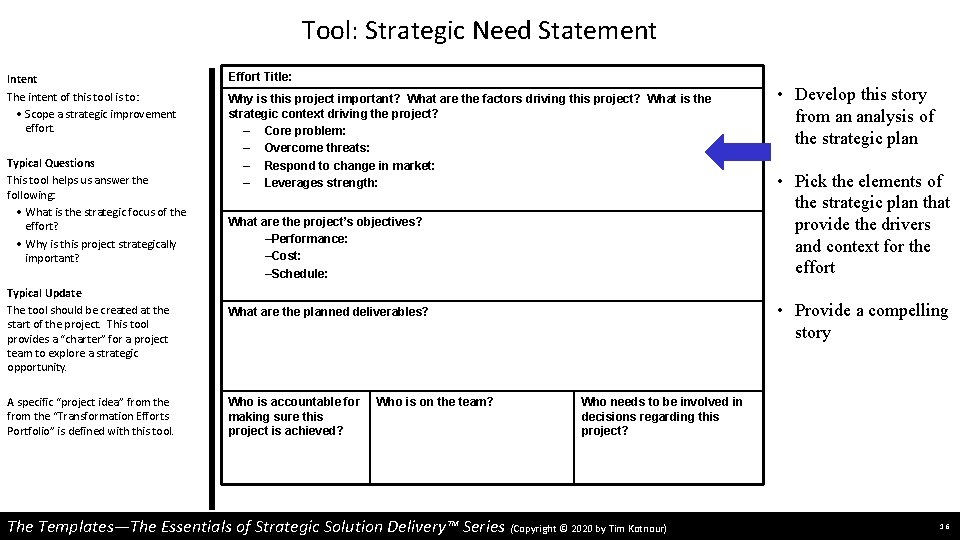
Tool: Strategic Need Statement Intent The intent of this tool is to: • Scope a strategic improvement effort. Typical Questions This tool helps us answer the following: • What is the strategic focus of the effort? • Why is this project strategically important? Typical Update The tool should be created at the start of the project. This tool provides a “charter” for a project team to explore a strategic opportunity. A specific “project idea” from the “Transformation Efforts Portfolio” is defined with this tool. Effort Title: Why is this project important? What are the factors driving this project? What is the strategic context driving the project? – Core problem: – Overcome threats: – Respond to change in market: – Leverages strength: What are the project’s objectives? –Performance: –Cost: –Schedule: Who is on the team? • Pick the elements of the strategic plan that provide the drivers and context for the effort • Provide a compelling story What are the planned deliverables? Who is accountable for making sure this project is achieved? • Develop this story from an analysis of the strategic plan Who needs to be involved in decisions regarding this project? The Templates—The Essentials of Strategic Solution Delivery™ Series (Copyright © 2020 by Tim Kotnour) 16
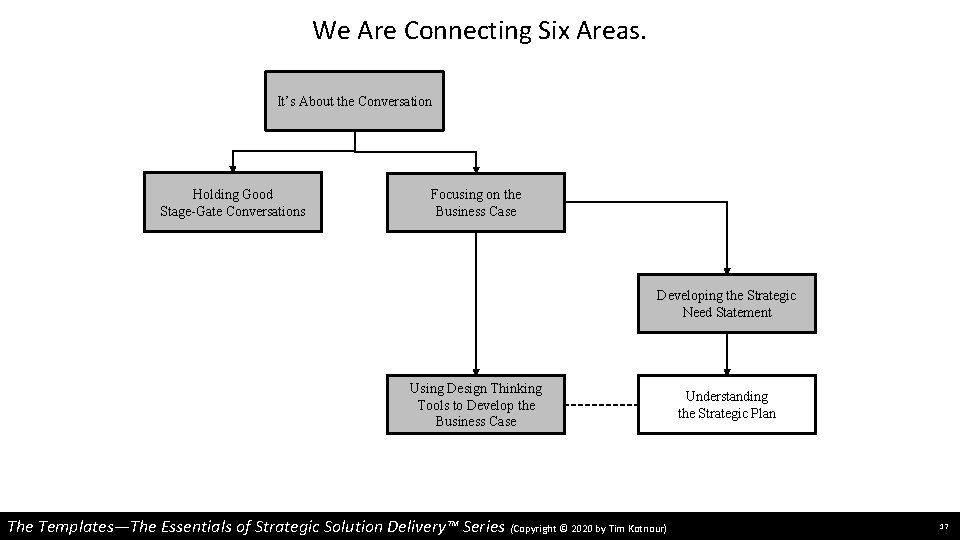
We Are Connecting Six Areas. It’s About the Conversation Holding Good Stage-Gate Conversations Focusing on the Business Case Developing the Strategic Need Statement Using Design Thinking Tools to Develop the Business Case The Templates—The Essentials of Strategic Solution Delivery™ Series (Copyright © 2020 by Tim Kotnour) Understanding the Strategic Plan 17
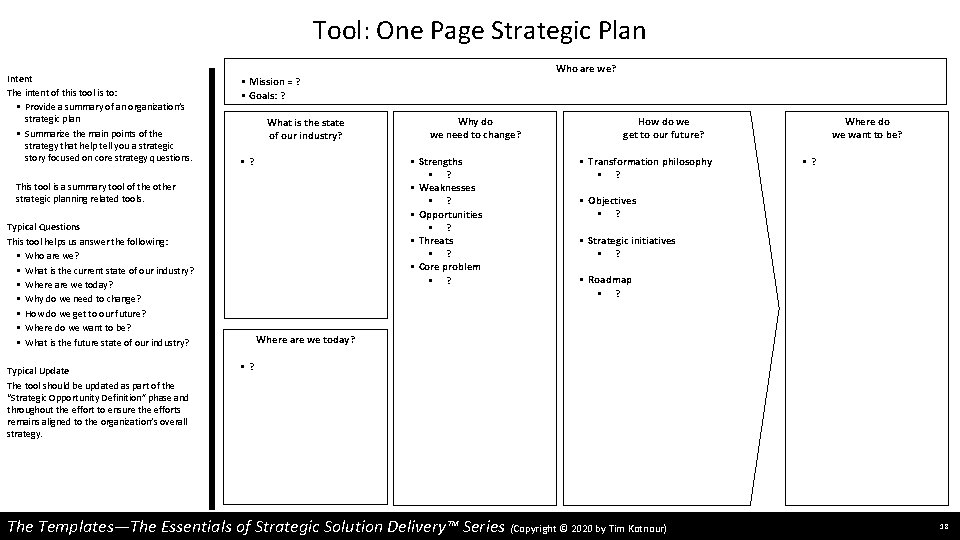
Tool: One Page Strategic Plan Intent The intent of this tool is to: • Provide a summary of an organization’s strategic plan • Summarize the main points of the strategy that help tell you a strategic story focused on core strategy questions. What is the state of our industry? Typical Questions This tool helps us answer the following: • Who are we? • What is the current state of our industry? • Where are we today? • Why do we need to change? • How do we get to our future? • Where do we want to be? • What is the future state of our industry? Why do we need to change? • Strengths • ? • Weaknesses • ? • Opportunities • ? • Threats • ? • Core problem • ? This tool is a summary tool of the other strategic planning related tools. Typical Update The tool should be updated as part of the “Strategic Opportunity Definition” phase and throughout the effort to ensure the efforts remains aligned to the organization’s overall strategy. Who are we? • Mission = ? • Goals: ? How do we get to our future? • Transformation philosophy • ? Where do we want to be? • Objectives • ? • Strategic initiatives • ? • Roadmap • ? Where are we today? • ? The Templates—The Essentials of Strategic Solution Delivery™ Series (Copyright © 2020 by Tim Kotnour) 18
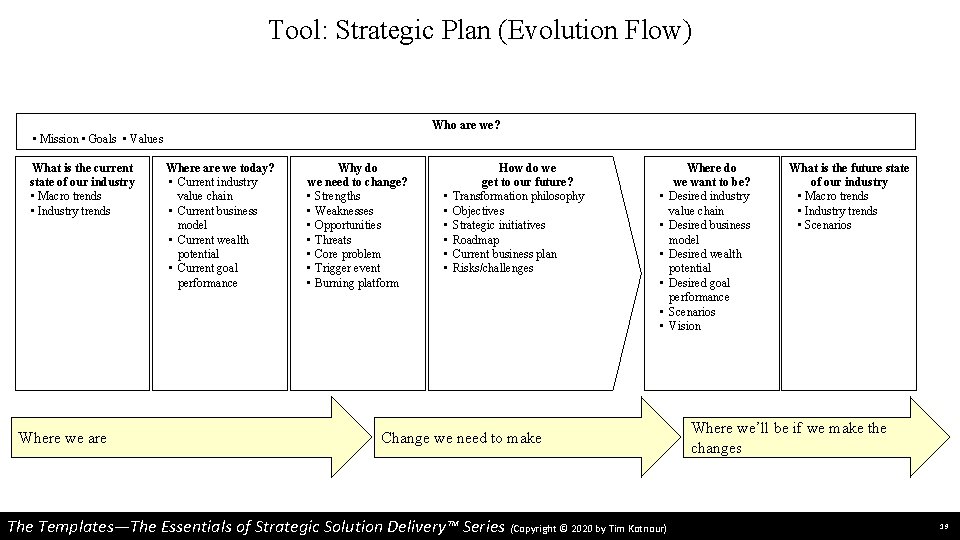
Tool: Strategic Plan (Evolution Flow) Who are we? • Mission • Goals • Values What is the current state of our industry • Macro trends • Industry trends Where are we today? • Current industry value chain • Current business model • Current wealth potential • Current goal performance Why do we need to change? • Strengths • Weaknesses • Opportunities • Threats • Core problem • Trigger event • Burning platform • • • How do we get to our future? Transformation philosophy Objectives Strategic initiatives Roadmap Current business plan Risks/challenges • • • Where we are Change we need to make The Templates—The Essentials of Strategic Solution Delivery™ Series (Copyright © 2020 by Tim Kotnour) Where do we want to be? Desired industry value chain Desired business model Desired wealth potential Desired goal performance Scenarios Vision What is the future state of our industry • Macro trends • Industry trends • Scenarios Where we’ll be if we make the changes 19
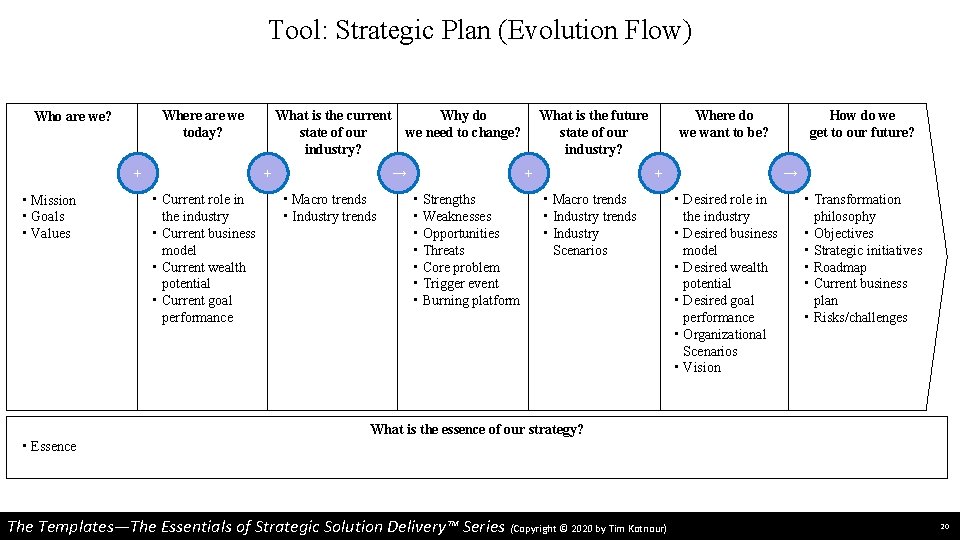
Tool: Strategic Plan (Evolution Flow) Where are we today? Who are we? + • Mission • Goals • Values What is the current state of our industry? + • Current role in the industry • Current business model • Current wealth potential • Current goal performance Why do we need to change? → • Macro trends • Industry trends + • Strengths • Weaknesses • Opportunities • Threats • Core problem • Trigger event • Burning platform Where do we want to be? What is the future state of our industry? + • Macro trends • Industry Scenarios How do we get to our future? → • Desired role in the industry • Desired business model • Desired wealth potential • Desired goal performance • Organizational Scenarios • Vision • Transformation philosophy • Objectives • Strategic initiatives • Roadmap • Current business plan • Risks/challenges What is the essence of our strategy? • Essence The Templates—The Essentials of Strategic Solution Delivery™ Series (Copyright © 2020 by Tim Kotnour) 20

Tool: Strategy Cascade Intent The intent of this tool is to: • Define the market we want to win and what it will take to win. Typical Questions This tool helps us answer the following: • What does it mean to win in our business? • Where do we compete? • What is our competitive advantage? • What specific capabilities support our competitive advantage? • What systems support our capabilities? Typical Update The tool should be updated as part of the “Strategic Opportunity Definition” and “Final Story” phases and throughout the effort to ensure the efforts remains aligned to the organization’s overall strategy. What does it mean to win in our business? The purpose of the enterprise: • Our guiding aspirations Where do we compete? Which customer segments, channels, product categories, and geographies do we serve? The right playing field--Where we will compete: • Geographies: In what countries or regions will we seek to compete? • Product categories: What kinds of products and services will we offer? • Consumer segments: What group of consumers we will we target? In which price tier? Meeting which consumer needs? • Channels: How will we reach our customers? What channels will we use? • Vertical stages of production: In what stages of production will we engage? Where along the value chain? How broadly or narrowly? What is our competitive advantage? Do we compete on low cost or differentiation? The unique right to win: • Our value proposition • Our competitive advantage What specific capabilities support our competitive advantage? What do we need to be really great at doing? The set of capabilities to win • Our reinforcing activities • Our specific configuration The Templates—The Essentials of Strategic Solution Delivery™ Series (Copyright © 2020 by Tim Kotnour) What systems support our capabilities? How do we measure the success of our strategy? The support systems • Systems, structures, and measures required to support our choices 21

Tool: Strategy Cascade: The “Playing to Win” Model From To • ? What is our winning aspiration? • ? Where will we play? • ? How will we win? • ? What capabilities must we have? • ? What management systems do we need? • ? The Templates—The Essentials of Strategic Solution Delivery™ Series (Copyright © 2020 by Tim Kotnour) 22

Tool: Mission Matrix Intent The intent of this tool is to: • Define an organization’s mission • Provide a foundation of the business you are in. Typical Questions This tool helps us answer the following: • What is our mission? • Why do we exist? • What do we do? • How do we do it? Typical Update The tool should be updated as part of the “Strategic Opportunity Definition” phase and throughout the effort to ensure the efforts remains aligned to the organization’s overall strategy. Element Current Future Why What How Mission Statement • This feeds the overall strategic plan summary. • In transformational situations, you may need to define a revised mission statement. The Templates—The Essentials of Strategic Solution Delivery™ Series (Copyright © 2020 by Tim Kotnour) 23

Tool: Goal Matrix Intent The intent of this tool is to: • Define the organization’s goals. Goals are the long-term, global desired outcomes the organization is pursuing. Typical Questions This tool helps us answer the following: • What are our goals? • What are the global outcomes our organization needs to achieve? • Who are primary stakeholders (e. g. , Major customer groups, Stockholders, Employees)? • What outcomes are important to them? Stakeholder Desired Outcome Goal Shareholders Consumers Employees For each of the stakeholders, define the outcomes they are looking for your organization to help them achieve. Why are they coming to your organization? Using the desired outcomes, craft a goal statement. Typical Update The tool should be updated as part of the “Strategic Opportunity Definition” phase and throughout the effort to ensure the efforts remains aligned to the organization’s overall strategy. The Templates—The Essentials of Strategic Solution Delivery™ Series (Copyright © 2020 by Tim Kotnour) 24
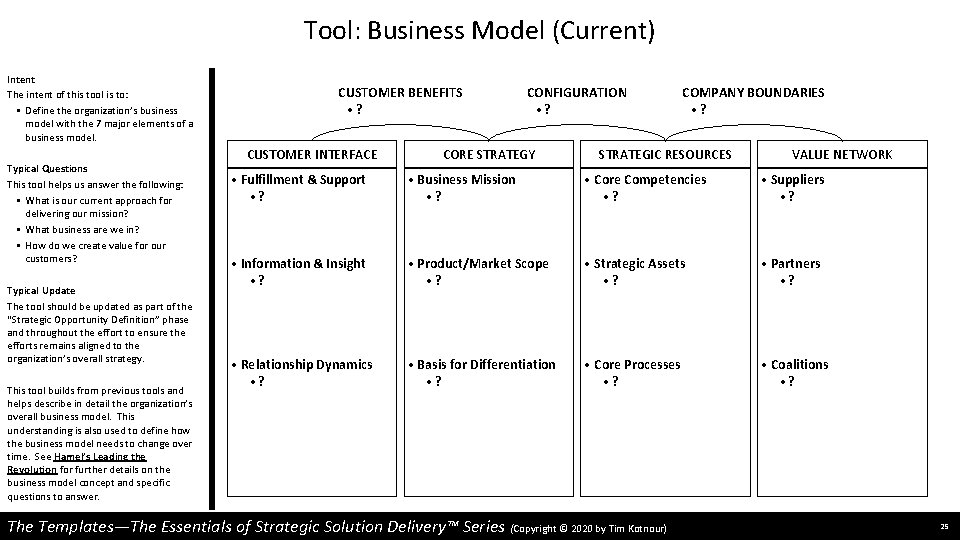
Tool: Business Model (Current) Intent The intent of this tool is to: • Define the organization’s business model with the 7 major elements of a business model. Typical Questions This tool helps us answer the following: • What is our current approach for delivering our mission? • What business are we in? • How do we create value for our customers? Typical Update The tool should be updated as part of the “Strategic Opportunity Definition” phase and throughout the effort to ensure the efforts remains aligned to the organization’s overall strategy. This tool builds from previous tools and helps describe in detail the organization’s overall business model. This understanding is also used to define how the business model needs to change over time. See Hamel’s Leading the Revolution for further details on the business model concept and specific questions to answer. CUSTOMER BENEFITS • ? CUSTOMER INTERFACE CONFIGURATION • ? CORE STRATEGY COMPANY BOUNDARIES • ? STRATEGIC RESOURCES VALUE NETWORK • Fulfillment & Support • ? • Business Mission • ? • Core Competencies • ? • Suppliers • ? • Information & Insight • ? • Product/Market Scope • ? • Strategic Assets • ? • Partners • ? • Relationship Dynamics • ? • Basis for Differentiation • ? • Core Processes • ? • Coalitions • ? The Templates—The Essentials of Strategic Solution Delivery™ Series (Copyright © 2020 by Tim Kotnour) 25
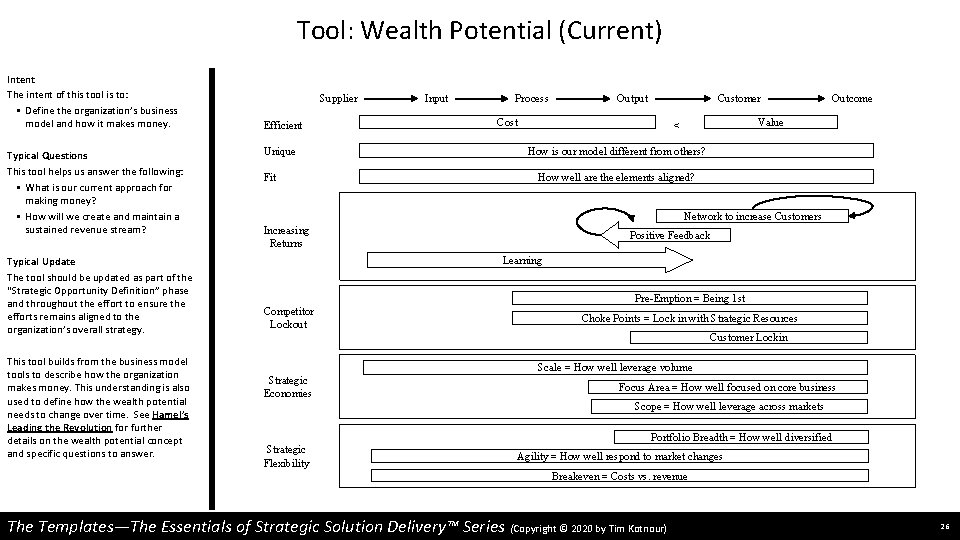
Tool: Wealth Potential (Current) Intent The intent of this tool is to: • Define the organization’s business model and how it makes money. Typical Questions This tool helps us answer the following: • What is our current approach for making money? • How will we create and maintain a sustained revenue stream? Typical Update The tool should be updated as part of the “Strategic Opportunity Definition” phase and throughout the effort to ensure the efforts remains aligned to the organization’s overall strategy. This tool builds from the business model tools to describe how the organization makes money. This understanding is also used to define how the wealth potential needs to change over time. See Hamel’s Leading the Revolution for further details on the wealth potential concept and specific questions to answer. Supplier Efficient Unique Fit Input Process Output Customer Cost Outcome Value < How is our model different from others? How well are the elements aligned? Network to increase Customers Increasing Returns Positive Feedback Learning Pre-Emption = Being 1 st Competitor Lockout Choke Points = Lock in with Strategic Resources Customer Lockin Scale = How well leverage volume Strategic Economies Focus Area = How well focused on core business Scope = How well leverage across markets Portfolio Breadth = How well diversified Strategic Flexibility Agility = How well respond to market changes Breakeven = Costs vs. revenue The Templates—The Essentials of Strategic Solution Delivery™ Series (Copyright © 2020 by Tim Kotnour) 26
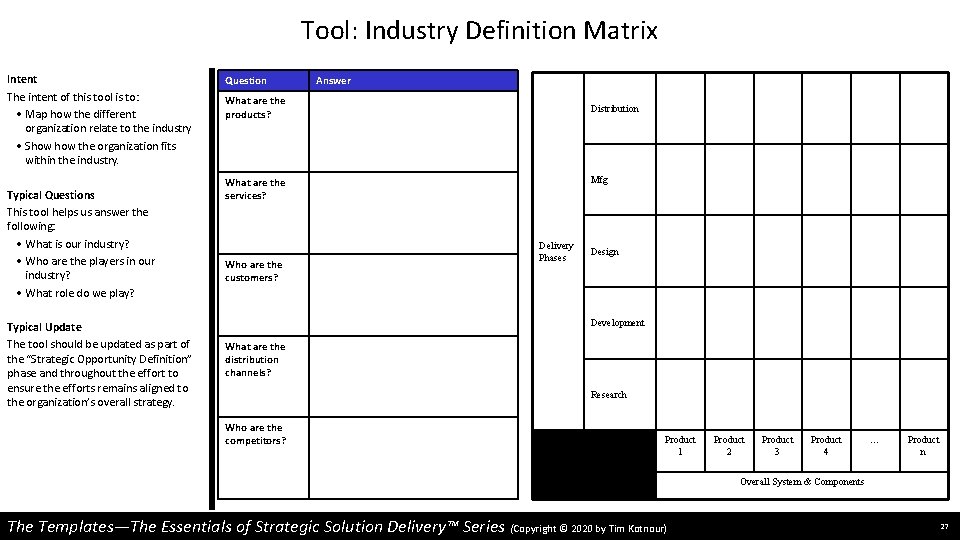
Tool: Industry Definition Matrix Intent The intent of this tool is to: • Map how the different organization relate to the industry • Show the organization fits within the industry. Typical Questions This tool helps us answer the following: • What is our industry? • Who are the players in our industry? • What role do we play? Typical Update The tool should be updated as part of the “Strategic Opportunity Definition” phase and throughout the effort to ensure the efforts remains aligned to the organization’s overall strategy. Question Answer What are the products? Distribution Mfg What are the services? Who are the customers? Delivery Phases Design Development What are the distribution channels? Research Who are the competitors? Product 1 Product 2 Product 3 Product 4 … Product n Overall System & Components The Templates—The Essentials of Strategic Solution Delivery™ Series (Copyright © 2020 by Tim Kotnour) 27
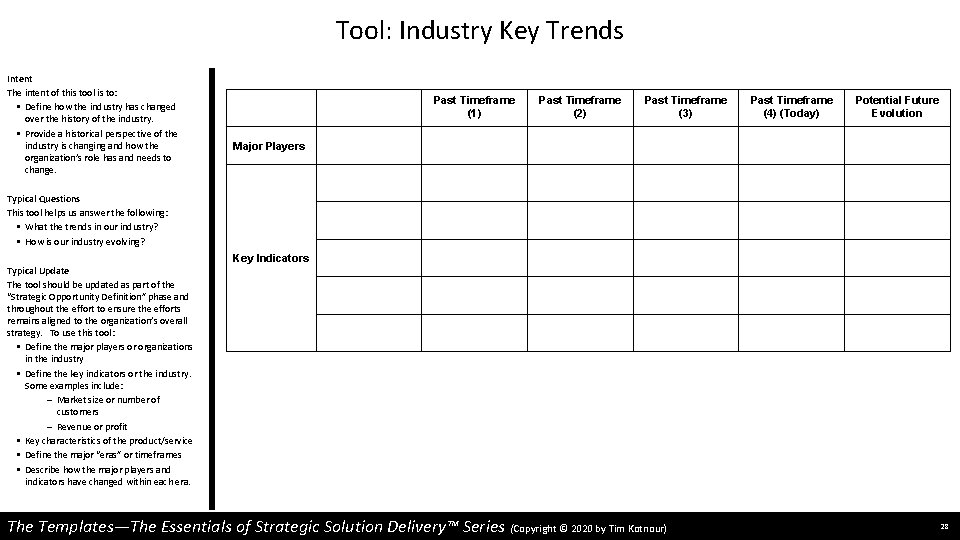
Tool: Industry Key Trends Intent The intent of this tool is to: • Define how the industry has changed over the history of the industry. • Provide a historical perspective of the industry is changing and how the organization’s role has and needs to change. Past Timeframe (1) Past Timeframe (2) Past Timeframe (3) Past Timeframe (4) (Today) Potential Future Evolution Major Players Typical Questions This tool helps us answer the following: • What the trends in our industry? • How is our industry evolving? Typical Update The tool should be updated as part of the “Strategic Opportunity Definition” phase and throughout the effort to ensure the efforts remains aligned to the organization’s overall strategy. To use this tool: • Define the major players or organizations in the industry • Define the key indicators or the industry. Some examples include: – Market size or number of customers – Revenue or profit • Key characteristics of the product/service • Define the major “eras” or timeframes • Describe how the major players and indicators have changed within each era. Key Indicators The Templates—The Essentials of Strategic Solution Delivery™ Series (Copyright © 2020 by Tim Kotnour) 28
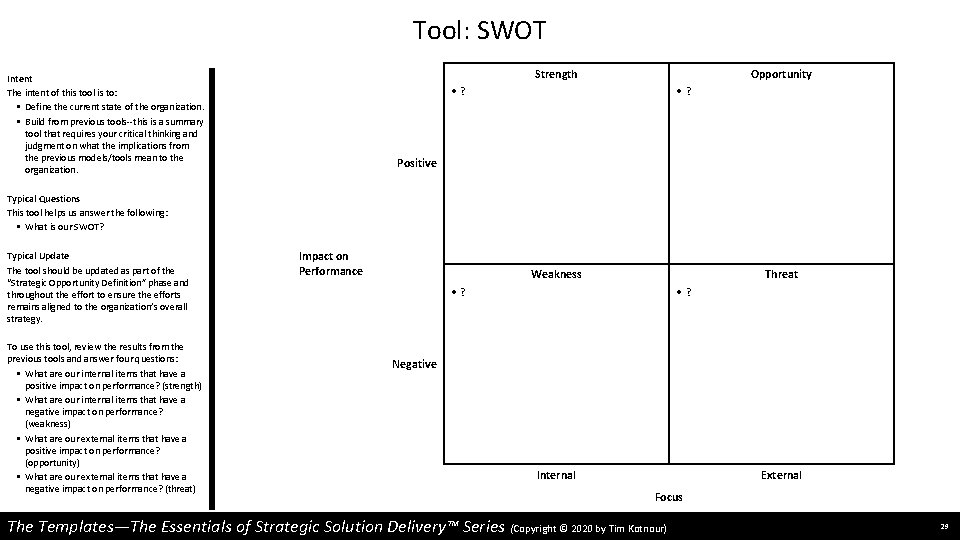
Tool: SWOT Strength Intent The intent of this tool is to: • Define the current state of the organization. • Build from previous tools--this is a summary tool that requires your critical thinking and judgment on what the implications from the previous models/tools mean to the organization. Opportunity • ? Positive Typical Questions This tool helps us answer the following: • What is our SWOT? Typical Update The tool should be updated as part of the “Strategic Opportunity Definition” phase and throughout the effort to ensure the efforts remains aligned to the organization’s overall strategy. To use this tool, review the results from the previous tools and answer four questions: • What are our internal items that have a positive impact on performance? (strength) • What are our internal items that have a negative impact on performance? (weakness) • What are our external items that have a positive impact on performance? (opportunity) • What are our external items that have a negative impact on performance? (threat) Impact on Performance Weakness Threat • ? Negative Internal External Focus The Templates—The Essentials of Strategic Solution Delivery™ Series (Copyright © 2020 by Tim Kotnour) 29
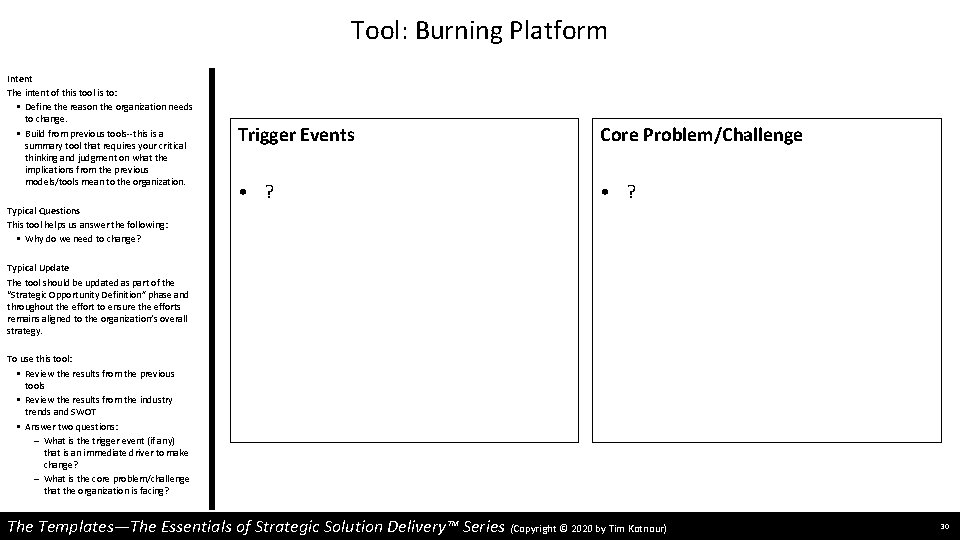
Tool: Burning Platform Intent The intent of this tool is to: • Define the reason the organization needs to change. • Build from previous tools--this is a summary tool that requires your critical thinking and judgment on what the implications from the previous models/tools mean to the organization. Trigger Events Core Problem/Challenge • ? Typical Questions This tool helps us answer the following: • Why do we need to change? Typical Update The tool should be updated as part of the “Strategic Opportunity Definition” phase and throughout the effort to ensure the efforts remains aligned to the organization’s overall strategy. To use this tool: • Review the results from the previous tools • Review the results from the industry trends and SWOT • Answer two questions: – What is the trigger event (if any) that is an immediate driver to make change? – What is the core problem/challenge that the organization is facing? The Templates—The Essentials of Strategic Solution Delivery™ Series (Copyright © 2020 by Tim Kotnour) 30

Tool: Business Model (Future) Intent The intent of this tool is to: • Define the organization’s business model • Describe the 7 major elements of the business model. Typical Questions This tool helps us answer the following: • How do we need to deliver our mission in the future? • What business should we be in? • How should we create value for our customers? • How should we make money? Typical Update The tool should be updated as part of the “Strategic Opportunity Definition” phase and throughout the effort to ensure the efforts remains aligned to the organization’s overall strategy. CUSTOMER BENEFITS • ? CUSTOMER INTERFACE CONFIGURATION • ? CORE STRATEGY COMPANY BOUNDARIES • ? STRATEGIC RESOURCES VALUE NETWORK • Fulfillment & Support • ? • Business Mission • ? • Core Competencies • ? • Suppliers • ? • Information & Insight • ? • Product/Market Scope • ? • Strategic Assets • ? • Partners • ? • Relationship Dynamics • ? • Basis for Differentiation • ? • Core Processes • ? • Coalitions • ? This tool builds from previous tools and helps describe in detail the organization’s overall business model. This understanding is also used to define how the business model needs to change over time. See Hamel’s Leading the Revolution for further details on the business model concept and specific questions to answer. The Templates—The Essentials of Strategic Solution Delivery™ Series (Copyright © 2020 by Tim Kotnour) 31
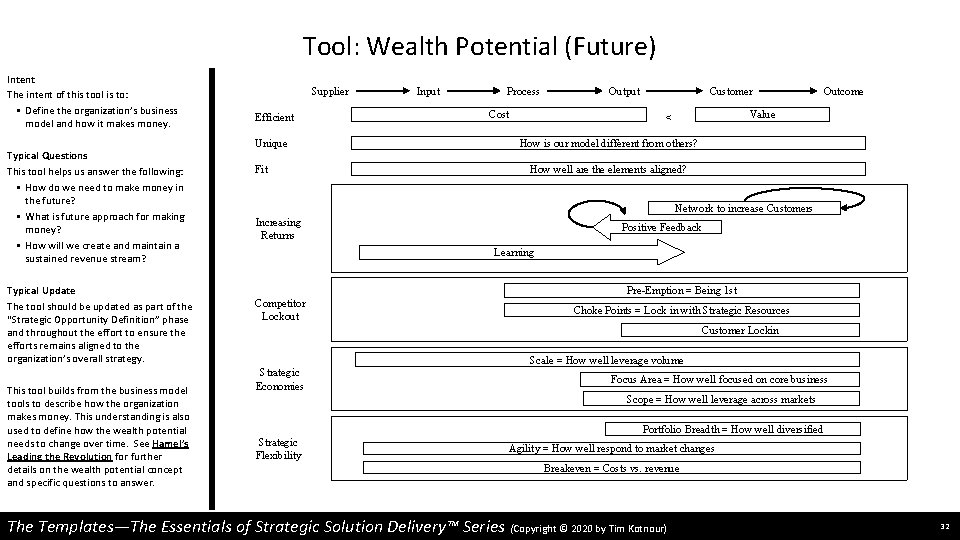
Tool: Wealth Potential (Future) Intent The intent of this tool is to: • Define the organization’s business model and how it makes money. Typical Questions This tool helps us answer the following: • How do we need to make money in the future? • What is future approach for making money? • How will we create and maintain a sustained revenue stream? Typical Update The tool should be updated as part of the “Strategic Opportunity Definition” phase and throughout the effort to ensure the efforts remains aligned to the organization’s overall strategy. This tool builds from the business model tools to describe how the organization makes money. This understanding is also used to define how the wealth potential needs to change over time. See Hamel’s Leading the Revolution for further details on the wealth potential concept and specific questions to answer. Supplier Efficient Unique Fit Input Process Cost Output Customer Outcome Value < How is our model different from others? How well are the elements aligned? Network to increase Customers Increasing Returns Positive Feedback Learning Pre-Emption = Being 1 st Competitor Lockout Choke Points = Lock in with Strategic Resources Customer Lockin Scale = How well leverage volume Strategic Economies Focus Area = How well focused on core business Scope = How well leverage across markets Portfolio Breadth = How well diversified Strategic Flexibility Agility = How well respond to market changes Breakeven = Costs vs. revenue The Templates—The Essentials of Strategic Solution Delivery™ Series (Copyright © 2020 by Tim Kotnour) 32
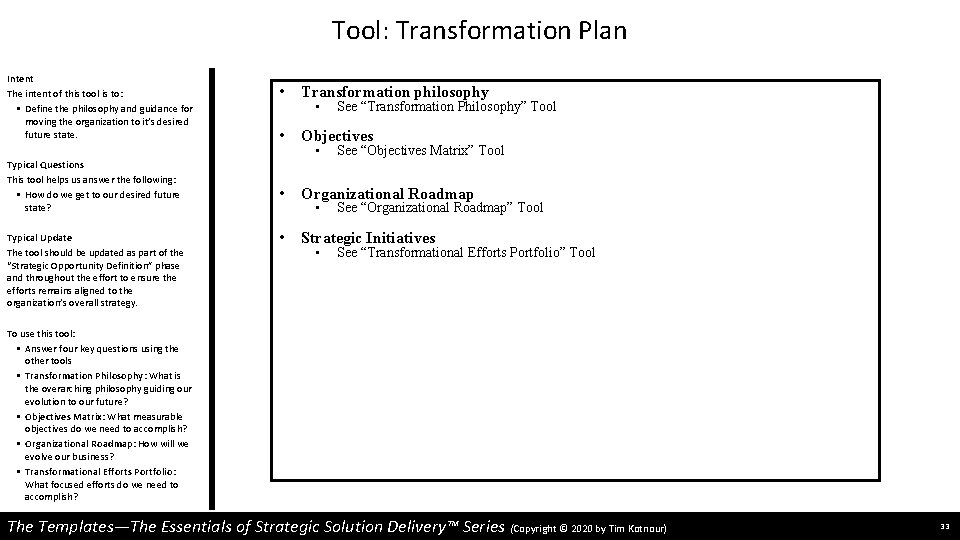
Tool: Transformation Plan Intent The intent of this tool is to: • Define the philosophy and guidance for moving the organization to it’s desired future state. Typical Questions This tool helps us answer the following: • How do we get to our desired future state? Typical Update The tool should be updated as part of the “Strategic Opportunity Definition” phase and throughout the effort to ensure the efforts remains aligned to the organization’s overall strategy. • Transformation philosophy • Objectives • Organizational Roadmap • Strategic Initiatives • • See “Transformation Philosophy” Tool See “Objectives Matrix” Tool See “Organizational Roadmap” Tool See “Transformational Efforts Portfolio” Tool To use this tool: • Answer four key questions using the other tools • Transformation Philosophy: What is the overarching philosophy guiding our evolution to our future? • Objectives Matrix: What measurable objectives do we need to accomplish? • Organizational Roadmap: How will we evolve our business? • Transformational Efforts Portfolio: What focused efforts do we need to accomplish? The Templates—The Essentials of Strategic Solution Delivery™ Series (Copyright © 2020 by Tim Kotnour) 33
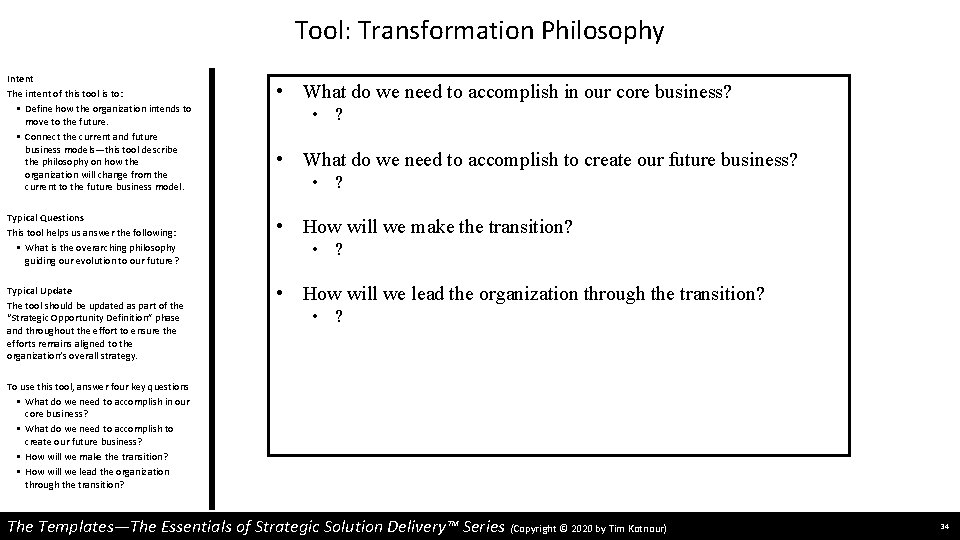
Tool: Transformation Philosophy Intent The intent of this tool is to: • Define how the organization intends to move to the future. • Connect the current and future business models—this tool describe the philosophy on how the organization will change from the current to the future business model. • What do we need to accomplish in our core business? • What do we need to accomplish to create our future business? • ? Typical Questions This tool helps us answer the following: • What is the overarching philosophy guiding our evolution to our future? • How will we make the transition? Typical Update The tool should be updated as part of the “Strategic Opportunity Definition” phase and throughout the effort to ensure the efforts remains aligned to the organization’s overall strategy. • How will we lead the organization through the transition? • ? To use this tool, answer four key questions • What do we need to accomplish in our core business? • What do we need to accomplish to create our future business? • How will we make the transition? • How will we lead the organization through the transition? The Templates—The Essentials of Strategic Solution Delivery™ Series (Copyright © 2020 by Tim Kotnour) 34
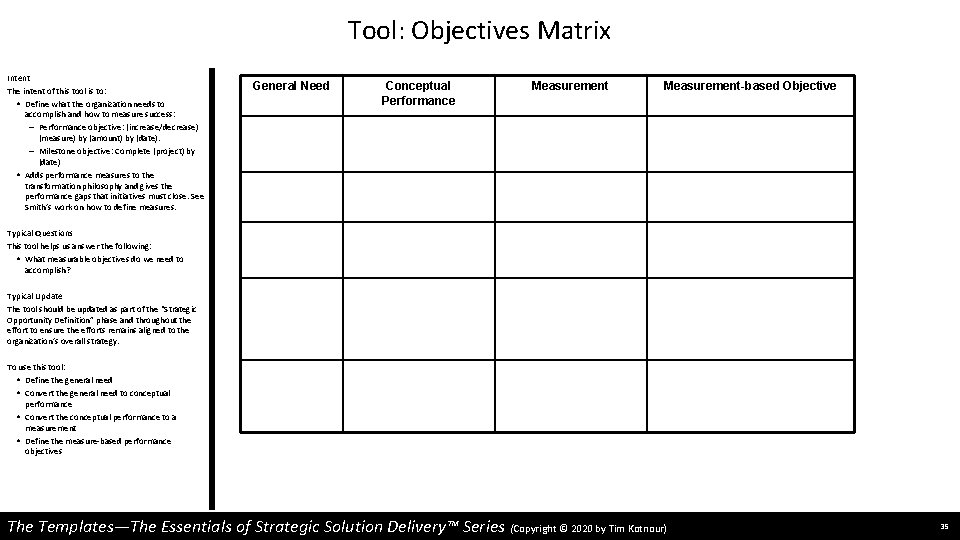
Tool: Objectives Matrix Intent The intent of this tool is to: • Define what the organization needs to accomplish and how to measure success: – Performance objective: (increase/decrease) (measure) by (amount) by (date). – Milestone objective: Complete (project) by (date) • Adds performance measures to the transformation philosophy and gives the performance gaps that initiatives must close. See Smith’s work on how to define measures. General Need Conceptual Performance Measurement-based Objective Typical Questions This tool helps us answer the following: • What measurable objectives do we need to accomplish? Typical Update The tool should be updated as part of the “Strategic Opportunity Definition” phase and throughout the effort to ensure the efforts remains aligned to the organization’s overall strategy. To use this tool: • Define the general need • Convert the general need to conceptual performance • Convert the conceptual performance to a measurement • Define the measure-based performance objectives The Templates—The Essentials of Strategic Solution Delivery™ Series (Copyright © 2020 by Tim Kotnour) 35
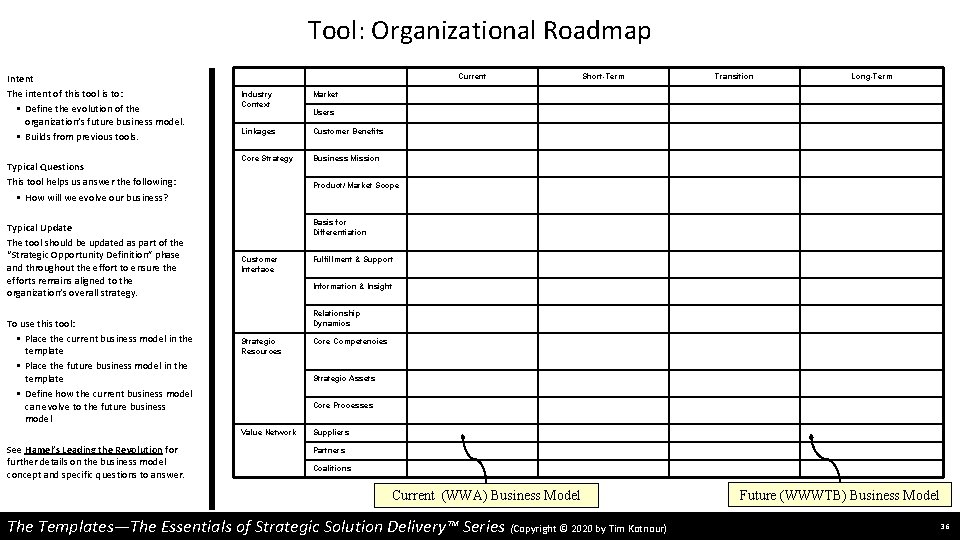
Tool: Organizational Roadmap Intent The intent of this tool is to: • Define the evolution of the organization’s future business model. • Builds from previous tools. Typical Questions This tool helps us answer the following: • How will we evolve our business? Typical Update The tool should be updated as part of the “Strategic Opportunity Definition” phase and throughout the effort to ensure the efforts remains aligned to the organization’s overall strategy. To use this tool: • Place the current business model in the template • Place the future business model in the template • Define how the current business model can evolve to the future business model Current Industry Context Market Linkages Customer Benefits Core Strategy Business Mission Transition Long-Term Users Product/ Market Scope Basis for Differentiation Customer Interface Fulfillment & Support Information & Insight Relationship Dynamics Strategic Resources Core Competencies Strategic Assets Core Processes Value Network See Hamel’s Leading the Revolution for further details on the business model concept and specific questions to answer. Short-Term Suppliers Partners Coalitions Current (WWA) Business Model The Templates—The Essentials of Strategic Solution Delivery™ Series (Copyright © 2020 by Tim Kotnour) Future (WWWTB) Business Model 36
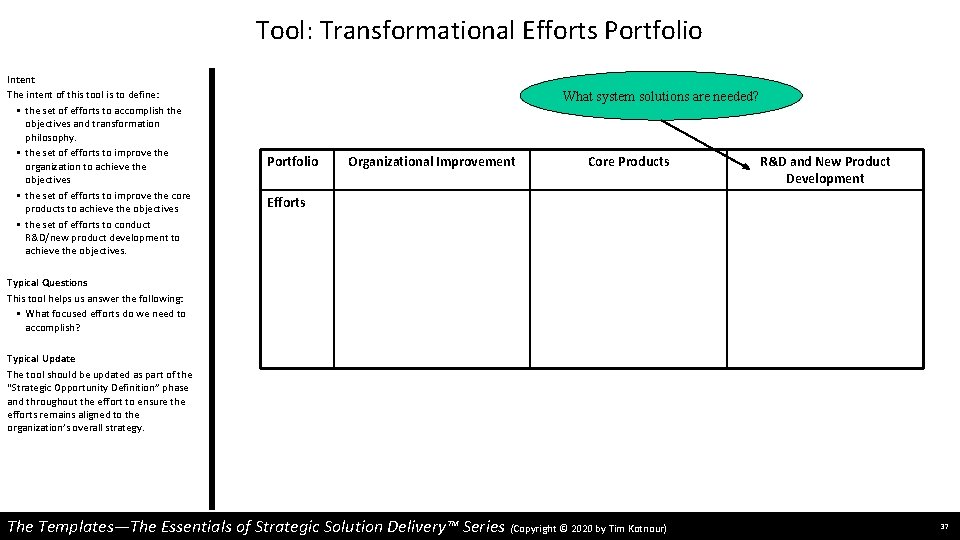
Tool: Transformational Efforts Portfolio Intent The intent of this tool is to define: • the set of efforts to accomplish the objectives and transformation philosophy. • the set of efforts to improve the organization to achieve the objectives • the set of efforts to improve the core products to achieve the objectives • the set of efforts to conduct R&D/new product development to achieve the objectives. What system solutions are needed? Portfolio Organizational Improvement Core Products R&D and New Product Development Efforts Typical Questions This tool helps us answer the following: • What focused efforts do we need to accomplish? Typical Update The tool should be updated as part of the “Strategic Opportunity Definition” phase and throughout the effort to ensure the efforts remains aligned to the organization’s overall strategy. The Templates—The Essentials of Strategic Solution Delivery™ Series (Copyright © 2020 by Tim Kotnour) 37
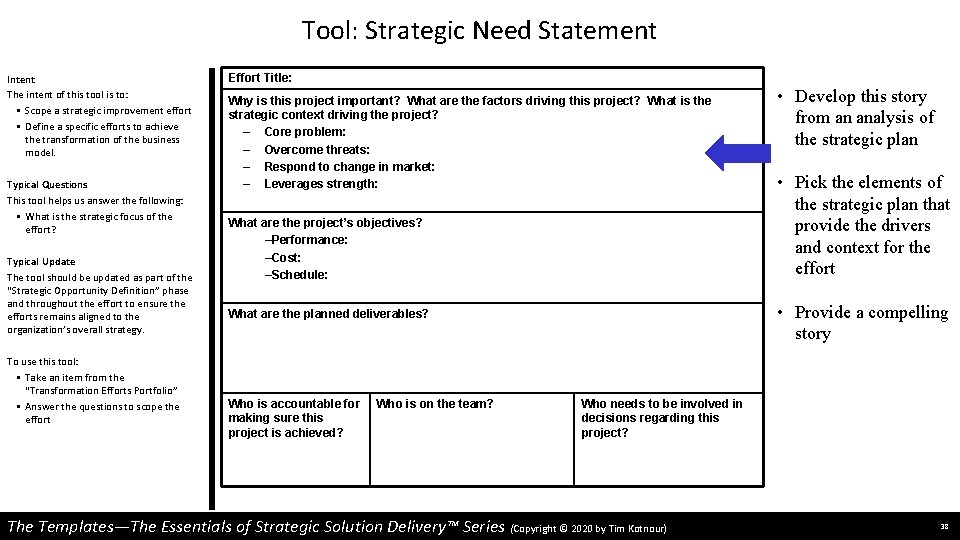
Tool: Strategic Need Statement Intent The intent of this tool is to: • Scope a strategic improvement effort • Define a specific efforts to achieve the transformation of the business model. Typical Questions This tool helps us answer the following: • What is the strategic focus of the effort? Typical Update The tool should be updated as part of the “Strategic Opportunity Definition” phase and throughout the effort to ensure the efforts remains aligned to the organization’s overall strategy. To use this tool: • Take an item from the “Transformation Efforts Portfolio” • Answer the questions to scope the effort Effort Title: Why is this project important? What are the factors driving this project? What is the strategic context driving the project? – Core problem: – Overcome threats: – Respond to change in market: – Leverages strength: What are the project’s objectives? –Performance: –Cost: –Schedule: Who is on the team? • Pick the elements of the strategic plan that provide the drivers and context for the effort • Provide a compelling story What are the planned deliverables? Who is accountable for making sure this project is achieved? • Develop this story from an analysis of the strategic plan Who needs to be involved in decisions regarding this project? The Templates—The Essentials of Strategic Solution Delivery™ Series (Copyright © 2020 by Tim Kotnour) 38
- Slides: 38