
The Template In each section of this template
- Slides: 38
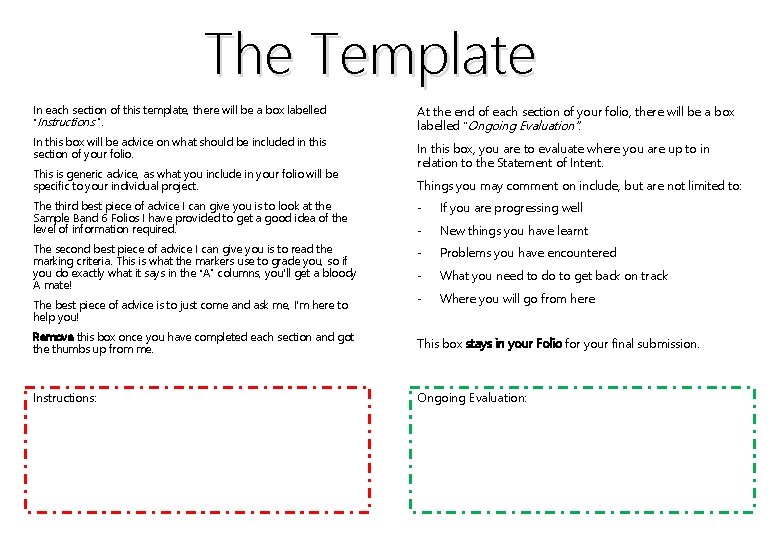
The Template In each section of this template, there will be a box labelled “Instructions ”. In this box will be advice on what should be included in this section of your folio. This is generic advice, as what you include in your folio will be specific to your individual project. At the end of each section of your folio, there will be a box labelled “Ongoing Evaluation”. In this box, you are to evaluate where you are up to in relation to the Statement of Intent. Things you may comment on include, but are not limited to: The third best piece of advice I can give you is to look at the Sample Band 6 Folios I have provided to get a good idea of the level of information required. - If you are progressing well - New things you have learnt The second best piece of advice I can give you is to read the marking criteria. This is what the markers use to grade you, so if you do exactly what it says in the “A” columns, you'll get a bloody A mate! - Problems you have encountered - What you need to do to get back on track - Where you will go from here The best piece of advice is to just come and ask me, I'm here to help you! Remove this box once you have completed each section and got the thumbs up from me. This box stays in your Folio for your final submission. Instructions: Ongoing Evaluation:
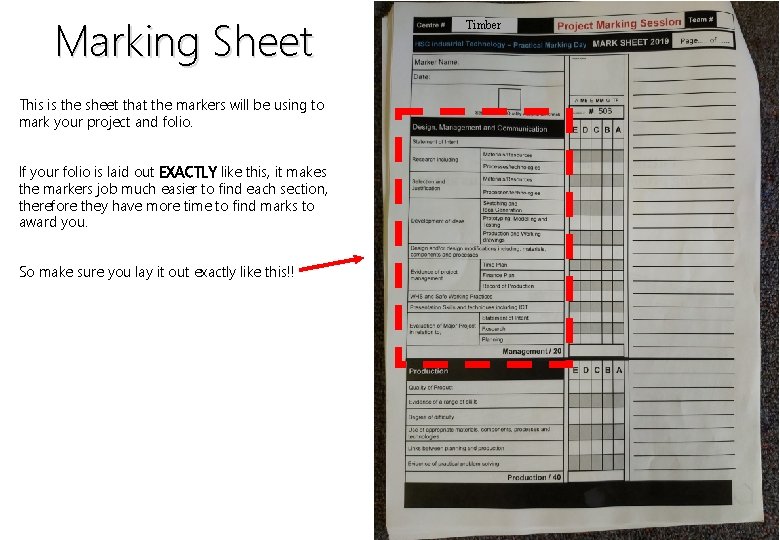
Marking Sheet This is the sheet that the markers will be using to mark your project and folio. If your folio is laid out EXACTLY like this, it makes the markers job much easier to find each section, therefore they have more time to find marks to award you. So make sure you lay it out exactly like this!! Timber
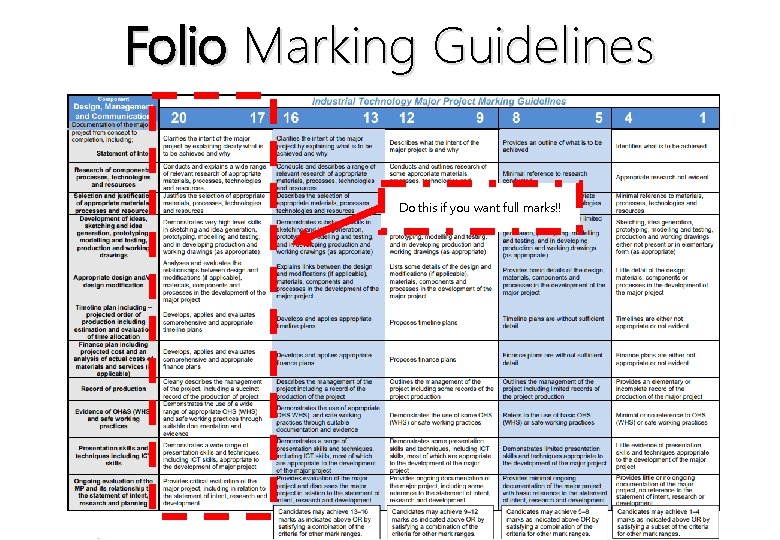
Folio Marking Guidelines Do this if you want full marks!!
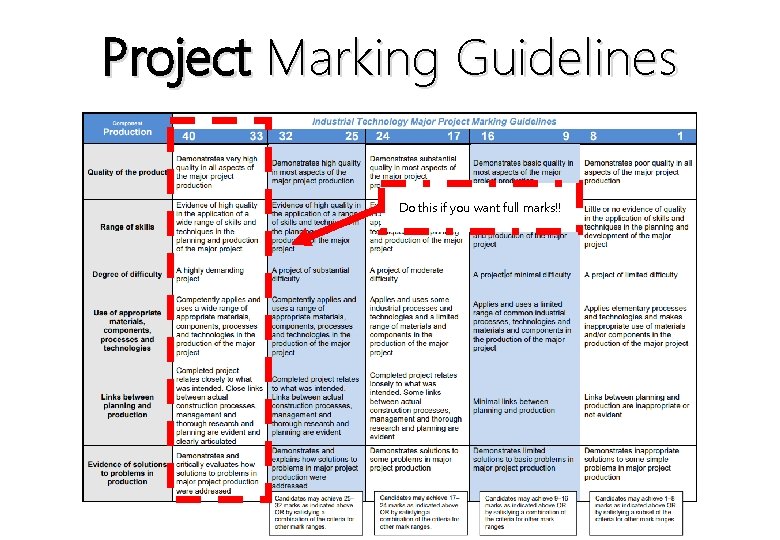
Project Marking Guidelines Do this if you want full marks!!
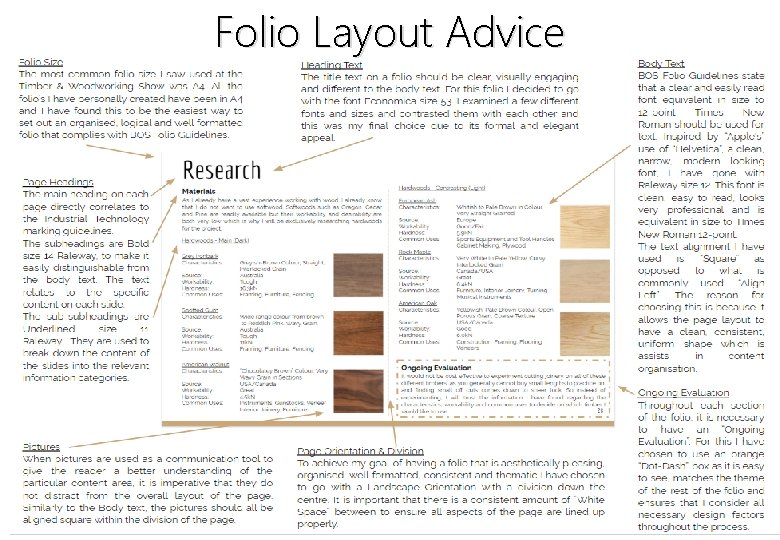
Folio Layout Advice
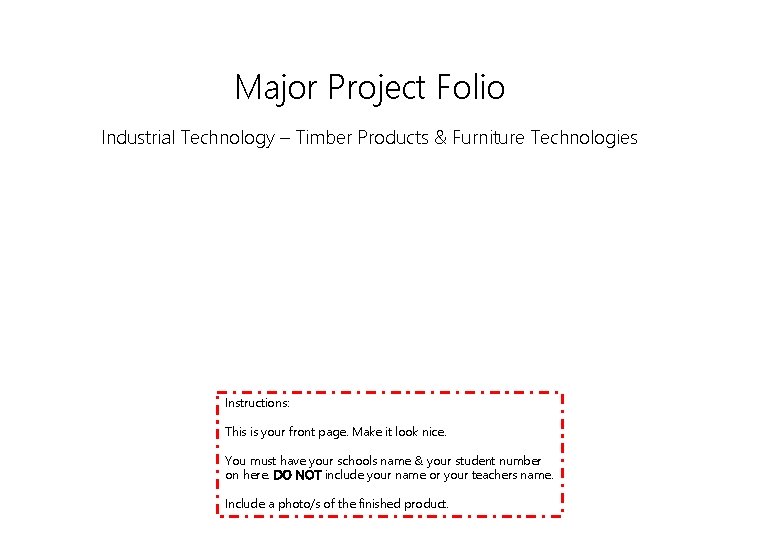
Major Project Folio Industrial Technology – Timber Products & Furniture Technologies Instructions: This is your front page. Make it look nice. You must have your schools name & your student number on here. DO NOT include your name or your teachers name. Include a photo/s of the finished product.
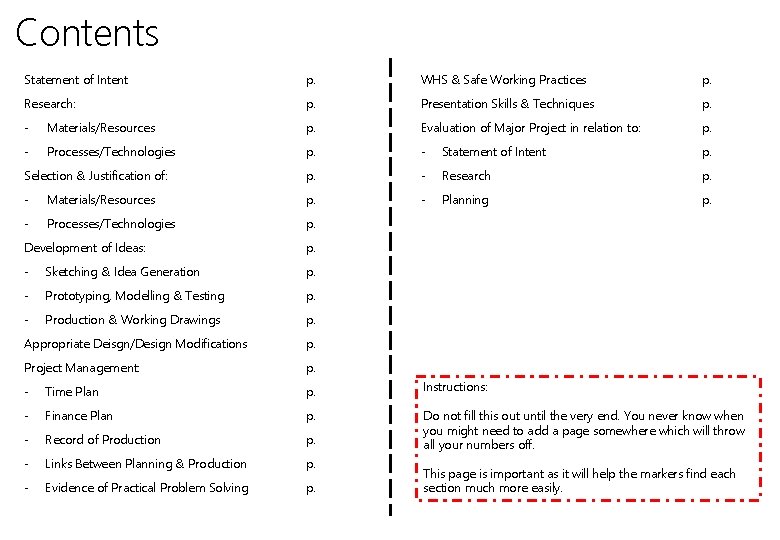
Contents Statement of Intent p. WHS & Safe Working Practices p. Research: p. Presentation Skills & Techniques p. - Materials/Resources p. Evaluation of Major Project in relation to: p. - Processes/Technologies p. - Statement of Intent p. Selection & Justification of: p. - Research p. - Materials/Resources p. - Planning p. - Processes/Technologies p. Development of Ideas: p. - Sketching & Idea Generation p. - Prototyping, Modelling & Testing p. - Production & Working Drawings p. Appropriate Deisgn/Design Modifications p. Project Management: p. - Time Plan p. Instructions: - Finance Plan p. - Record of Production p. Do not fill this out until the very end. You never know when you might need to add a page somewhere which will throw all your numbers off. - Links Between Planning & Production p. - Evidence of Practical Problem Solving p. This page is important as it will help the markers find each section much more easily.
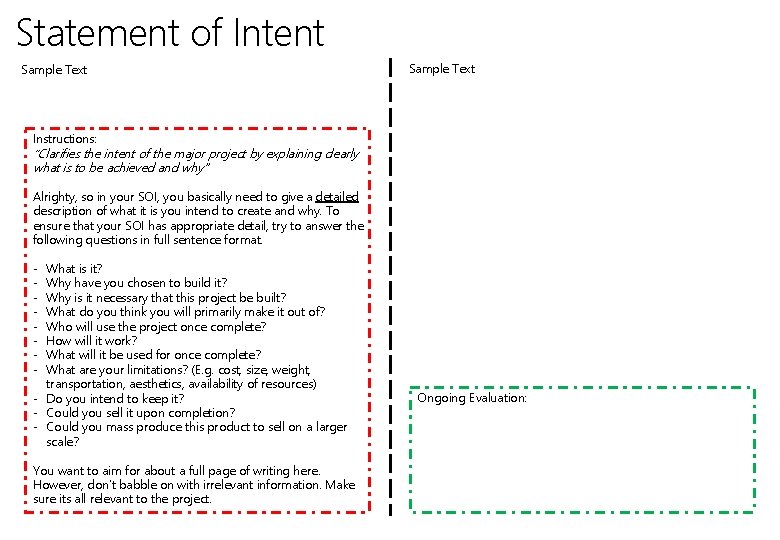
Statement of Intent Sample Text Instructions: “Clarifies the intent of the major project by explaining clearly what is to be achieved and why” Alrighty, so in your SOI, you basically need to give a detailed description of what it is you intend to create and why. To ensure that your SOI has appropriate detail, try to answer the following questions in full sentence format. - What is it? Why have you chosen to build it? Why is it necessary that this project be built? What do you think you will primarily make it out of? Who will use the project once complete? How will it work? What will it be used for once complete? What are your limitations? (E. g. cost, size, weight, transportation, aesthetics, availability of resources) - Do you intend to keep it? - Could you sell it upon completion? - Could you mass produce this product to sell on a larger scale? You want to aim for about a full page of writing here. However, don’t babble on with irrelevant information. Make sure its all relevant to the project. Ongoing Evaluation:
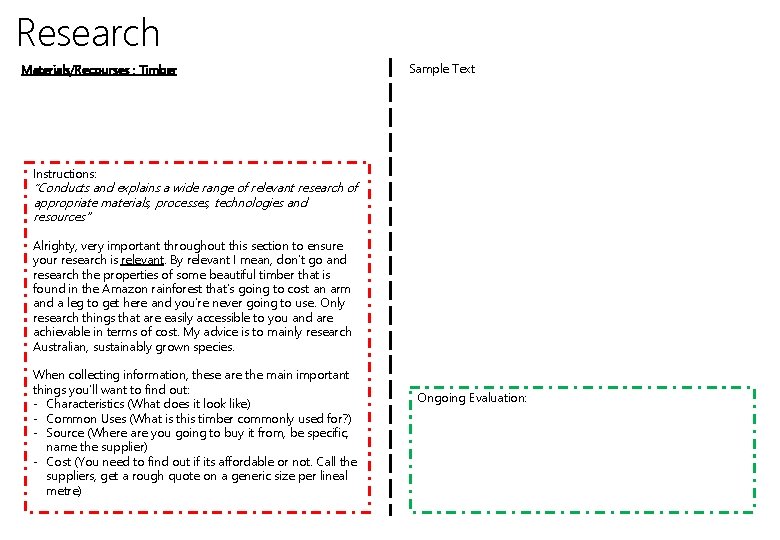
Research Materials/Recourses : Timber Sample Text Instructions: “Conducts and explains a wide range of relevant research of appropriate materials, processes, technologies and resources” Alrighty, very important throughout this section to ensure your research is relevant. By relevant I mean, don’t go and research the properties of some beautiful timber that is found in the Amazon rainforest that’s going to cost an arm and a leg to get here and you’re never going to use. Only research things that are easily accessible to you and are achievable in terms of cost. My advice is to mainly research Australian, sustainably grown species. When collecting information, these are the main important things you’ll want to find out: - Characteristics (What does it look like) - Common Uses (What is this timber commonly used for? ) - Source (Where are you going to buy it from, be specific, name the supplier) - Cost (You need to find out if its affordable or not. Call the suppliers, get a rough quote on a generic size per lineal metre) Ongoing Evaluation:
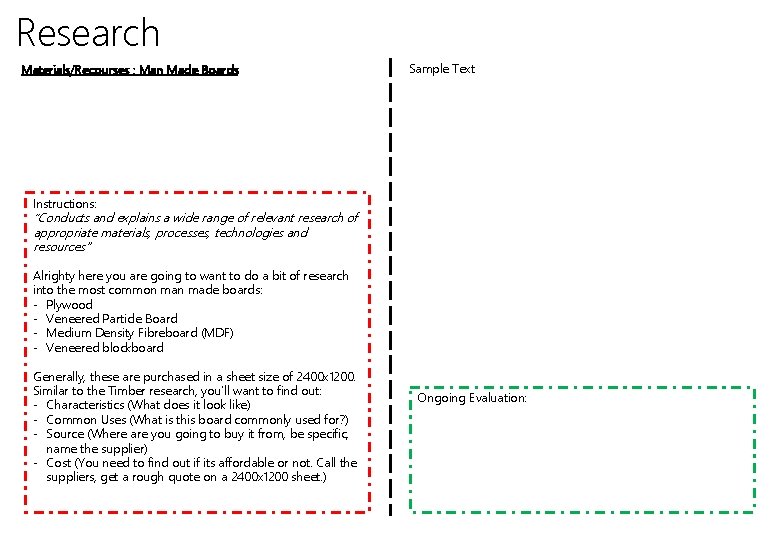
Research Materials/Recourses : Man Made Boards Sample Text Instructions: “Conducts and explains a wide range of relevant research of appropriate materials, processes, technologies and resources” Alrighty here you are going to want to do a bit of research into the most common made boards: - Plywood - Veneered Particle Board - Medium Density Fibreboard (MDF) - Veneered blockboard Generally, these are purchased in a sheet size of 2400 x 1200. Similar to the Timber research, you’ll want to find out: - Characteristics (What does it look like) - Common Uses (What is this board commonly used for? ) - Source (Where are you going to buy it from, be specific, name the supplier) - Cost (You need to find out if its affordable or not. Call the suppliers, get a rough quote on a 2400 x 1200 sheet. ) Ongoing Evaluation:
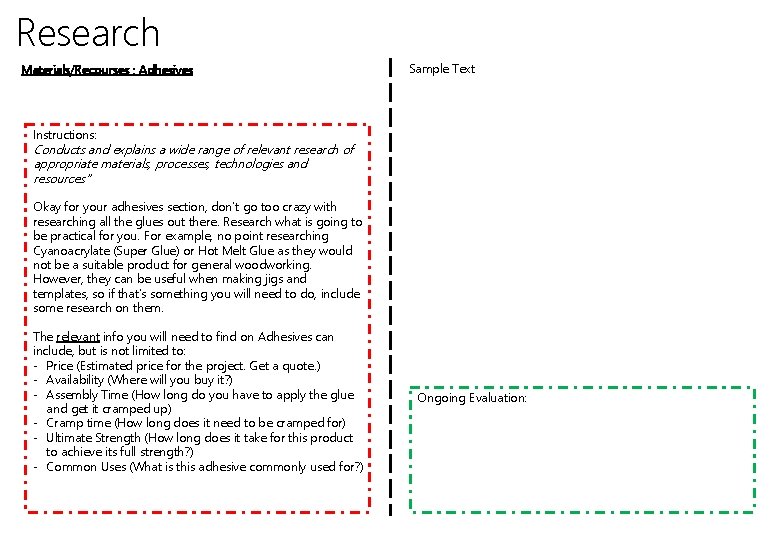
Research Materials/Recourses : Adhesives Sample Text Instructions: Conducts and explains a wide range of relevant research of appropriate materials, processes, technologies and resources” Okay for your adhesives section, don’t go too crazy with researching all the glues out there. Research what is going to be practical for you. For example, no point researching Cyanoacrylate (Super Glue) or Hot Melt Glue as they would not be a suitable product for general woodworking. However, they can be useful when making jigs and templates, so if that’s something you will need to do, include some research on them. The relevant info you will need to find on Adhesives can include, but is not limited to: - Price (Estimated price for the project. Get a quote. ) - Availability (Where will you buy it? ) - Assembly Time (How long do you have to apply the glue and get it cramped up) - Cramp time (How long does it need to be cramped for) - Ultimate Strength (How long does it take for this product to achieve its full strength? ) - Common Uses (What is this adhesive commonly used for? ) Ongoing Evaluation:
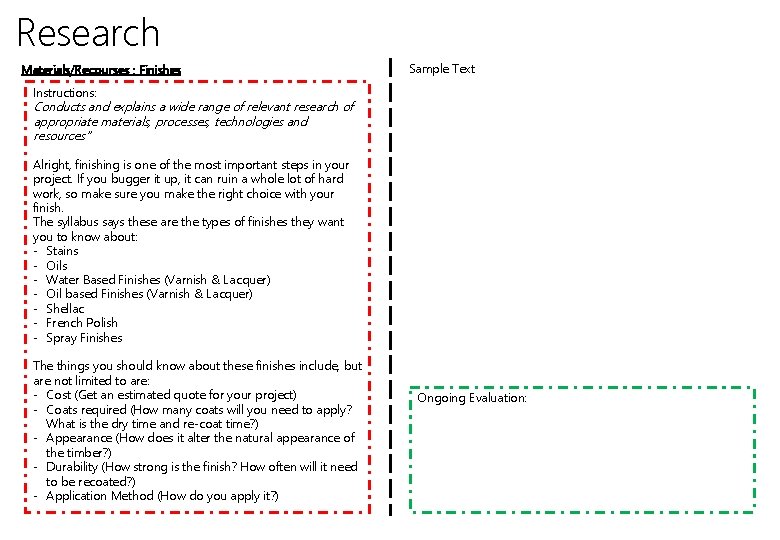
Research Materials/Recourses : Finishes Sample Text Instructions: Conducts and explains a wide range of relevant research of appropriate materials, processes, technologies and resources” Alright, finishing is one of the most important steps in your project. If you bugger it up, it can ruin a whole lot of hard work, so make sure you make the right choice with your finish. The syllabus says these are the types of finishes they want you to know about: - Stains - Oils - Water Based Finishes (Varnish & Lacquer) - Oil based Finishes (Varnish & Lacquer) - Shellac - French Polish - Spray Finishes The things you should know about these finishes include, but are not limited to are: - Cost (Get an estimated quote for your project) - Coats required (How many coats will you need to apply? What is the dry time and re-coat time? ) - Appearance (How does it alter the natural appearance of the timber? ) - Durability (How strong is the finish? How often will it need to be recoated? ) - Application Method (How do you apply it? ) Ongoing Evaluation:
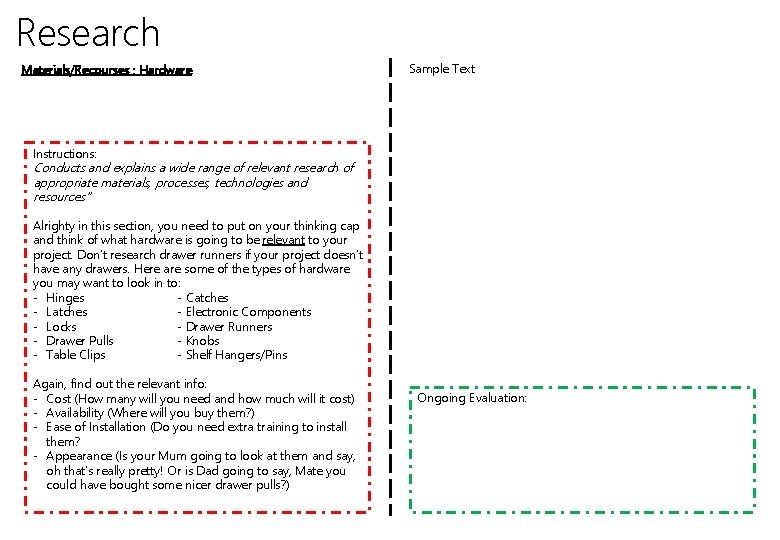
Research Materials/Recourses : Hardware Sample Text Instructions: Conducts and explains a wide range of relevant research of appropriate materials, processes, technologies and resources” Alrighty in this section, you need to put on your thinking cap and think of what hardware is going to be relevant to your project. Don’t research drawer runners if your project doesn’t have any drawers. Here are some of the types of hardware you may want to look in to: - Hinges - Catches - Latches - Electronic Components - Locks - Drawer Runners - Drawer Pulls - Knobs - Table Clips - Shelf Hangers/Pins Again, find out the relevant info: - Cost (How many will you need and how much will it cost) - Availability (Where will you buy them? ) - Ease of Installation (Do you need extra training to install them? - Appearance (Is your Mum going to look at them and say, oh that’s really pretty! Or is Dad going to say, Mate you could have bought some nicer drawer pulls? ) Ongoing Evaluation:
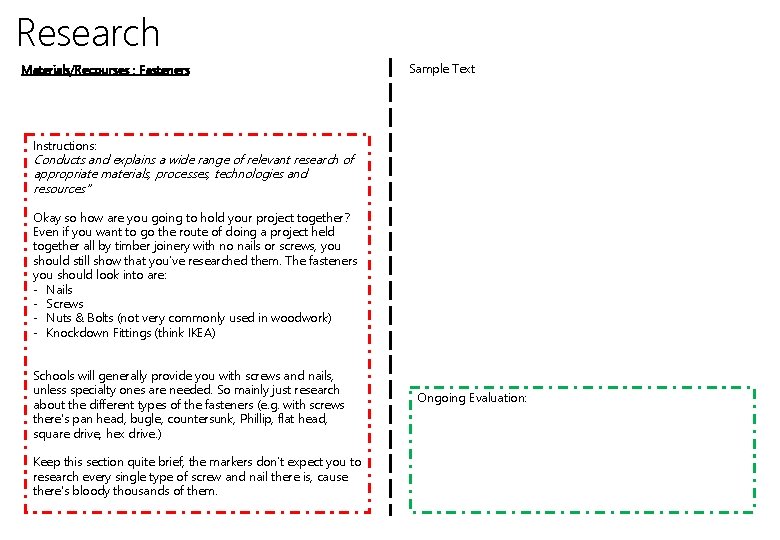
Research Materials/Recourses : Fasteners Sample Text Instructions: Conducts and explains a wide range of relevant research of appropriate materials, processes, technologies and resources” Okay so how are you going to hold your project together? Even if you want to go the route of doing a project held together all by timber joinery with no nails or screws, you should still show that you’ve researched them. The fasteners you should look into are: - Nails - Screws - Nuts & Bolts (not very commonly used in woodwork) - Knockdown Fittings (think IKEA) Schools will generally provide you with screws and nails, unless specialty ones are needed. So mainly just research about the different types of the fasteners (e. g. with screws there's pan head, bugle, countersunk, Phillip, flat head, square drive, hex drive. ) Keep this section quite brief, the markers don’t expect you to research every single type of screw and nail there is, cause there's bloody thousands of them. Ongoing Evaluation:
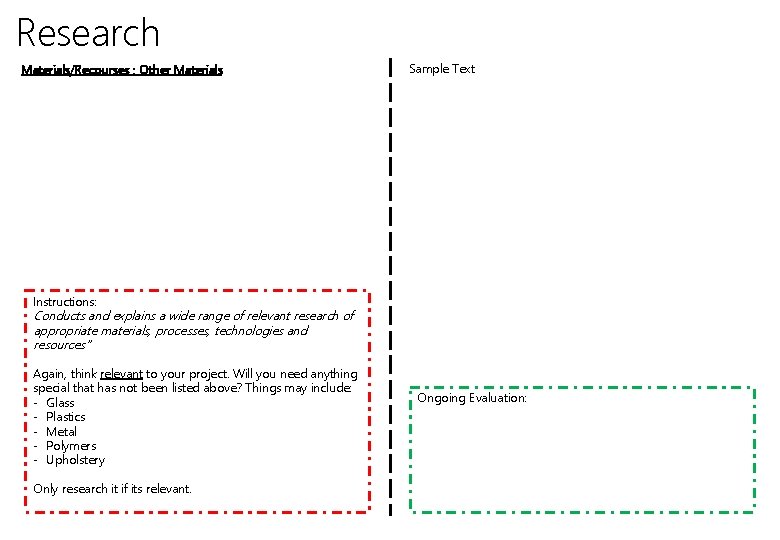
Research Materials/Recourses : Other Materials Sample Text Instructions: Conducts and explains a wide range of relevant research of appropriate materials, processes, technologies and resources” Again, think relevant to your project. Will you need anything special that has not been listed above? Things may include: - Glass - Plastics - Metal - Polymers - Upholstery Only research it if its relevant. Ongoing Evaluation:
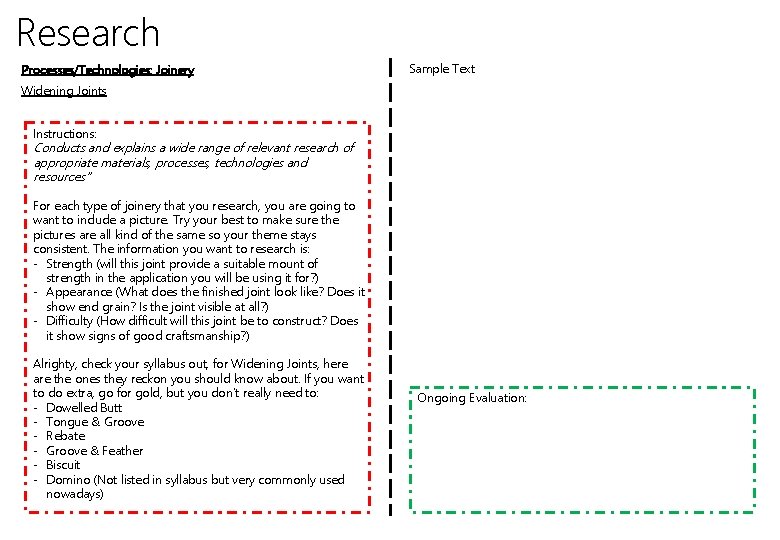
Research Processes/Technologies: Joinery Sample Text Widening Joints Instructions: Conducts and explains a wide range of relevant research of appropriate materials, processes, technologies and resources” For each type of joinery that you research, you are going to want to include a picture. Try your best to make sure the pictures are all kind of the same so your theme stays consistent. The information you want to research is: - Strength (will this joint provide a suitable mount of strength in the application you will be using it for? ) - Appearance (What does the finished joint look like? Does it show end grain? Is the joint visible at all? ) - Difficulty (How difficult will this joint be to construct? Does it show signs of good craftsmanship? ) Alrighty, check your syllabus out, for Widening Joints, here are the ones they reckon you should know about. If you want to do extra, go for gold, but you don’t really need to: - Dowelled Butt - Tongue & Groove - Rebate - Groove & Feather - Biscuit - Domino (Not listed in syllabus but very commonly used nowadays) Ongoing Evaluation:
Research Processes/Technologies: Joinery Sample Text Framing Instructions: Conducts and explains a wide range of relevant research of appropriate materials, processes, technologies and resources” For each type of joinery that you research, you are going to want to include a picture. Try your best to make sure the pictures are all kind of the same so your theme stays consistent. The information you want to research is: - Strength (will this joint provide a suitable mount of strength in the application you will be using it for? ) - Appearance (What does the finished joint look like? Does it show end grain? Is the joint visible at all? ) - Difficulty (How difficult will this joint be to construct? Does it show signs of good craftsmanship? ) Alrighty, check your syllabus out, for Framing Joints, here are the ones they reckon you should know about. If you want to do extra, go for gold, but you don’t really need to: - Mitre - Halving - Dowelled - Box Pin - Mortise & Tenon - Bridle Ongoing Evaluation:
Research Processes/Technologies: Joinery Sample Text Carcase Joints Instructions: Conducts and explains a wide range of relevant research of appropriate materials, processes, technologies and resources” For each type of joinery that you research, you are going to want to include a picture. Try your best to make sure the pictures are all kind of the same so your theme stays consistent. The information you want to research is: - Strength (will this joint provide a suitable mount of strength in the application you will be using it for? ) - Appearance (What does the finished joint look like? Does it show end grain? Is the joint visible at all? ) - Difficulty (How difficult will this joint be to construct? Does it show signs of good craftsmanship? ) Alrighty, check your syllabus out, for Carcase Joints, here are the ones they reckon you should know about. If you want to do extra, go for gold, but you don’t really need to: - Rebate - Scribed - Dovetail - Housing Ongoing Evaluation:
Research Processes/Technologies: Digital Sample Text Instructions: Conducts and explains a wide range of relevant research of appropriate materials, processes, technologies and resources” What digital technologies are going to help you complete your project? By digital technologies, they mainly mean what different types of computer software will you use. Examples can include, but are not limited to: - CAD Software (Sketch. Up, Vector works, Creo, Fusion 360) - Microsoft Office (Word, Power. Point, Excel) - Google Apps (Docs, Slides, Sheets) - CNC Software (VCarve Pro) Ongoing Evaluation:
Research Processes/Technologies: Tools & Machinery Sample Text Instructions: Conducts and explains a wide range of relevant research of appropriate materials, processes, technologies and resources” Okay in this section, don’t go too crazy on the detail. The markers aren’t expecting half a page written up about the Bandsaw or a Wooden Mallet. Keep it concise, relevant and to the point. Go for a walk through your workshop, list the major tools and machinery you’ll be using and research the following: - Name - Common Uses - Further Training Required? - Where it could be applicable on your project. Ongoing Evaluation:
Selection & Justification Materials/Resources Sample Text Instructions: “Justifies the selection of appropriate materials, processes, technologies and resources” Alright this section you’ve got to go through all the things you researched in the last section and pick the things you are going to actually use in your project. When you are justifying something, go into detail as to why you chose that particular thing. Don’t just say “I chose this one because its cheap”. The more valid reasons you can give, the better. Have a heading for each component you researched, then a picture of the component you and a small paragraph justifying why you chose what you chose. Ongoing Evaluation:
Selection & Justification Processes/Technologies Sample Text Instructions: “Justifies the selection of appropriate materials, processes, technologies and resources” Alright this section you’ve got to go through all the things you researched in the last section and pick the things you are going to actually use in your project. When you are justifying something, go into detail as to why you chose that particular thing. Don’t just say “I chose this one because its cheap”. The more valid reasons you can give, the better. Have a heading for each component you researched, then a picture of the component you and a small paragraph justifying why you chose what you chose. Ongoing Evaluation:
Development of Ideas Sketching & Idea Generation Sample Text Instructions: “Demonstrates very high level skills in sketching and idea generation, prototyping, modelling and testing, and in developing production and working drawings (as appropriate) “ This section should be filled with annotated, preliminary sketches. They don’t need to be pretty. Basically you need to scan all the initial sketches you did before commencing you project. Then have arrows pointing at important parts of the sketches and annotate why they are important/significant. You can also include hand drawn mind maps on here, rough materials lists, cutting lists, time plans and finance plans. For the Idea Generation component, aim for about 1/2 slides. This should look similar to your research section. Find some existing designs similar to what you intend to make and critically evaluate them. This means a small paragraph for each design where you comment on the positives and negatives of each. Don’t fill up too many pages in this section, remember you only have 80 pages for the folio. If you need to fit more in, scale them down and put 2/3 per slide. Ongoing Evaluation:
Development of Ideas Prototyping, Modelling & Testing Sample Text Instructions: “Demonstrates very high level skills in sketching and idea generation, prototyping, modelling and testing, and in developing production and working drawings (as appropriate) “ Alright this section is where a lot of students lose marks, so here's a chance for you to stand out from the crowd by smashing this section. My recommendation is to spend some time in the workshop practicing all the different joinery you are going to use on your project with some scrap wood/offcuts. Practice cutting each type of joint by hand then by machine. Photograph them, evaluate the differences. You can also submit these prototype/test pieces with your final submission so they can see your skill progression. The markers love that. You can also do this with wood finishes. Get into your teachers secret cupboard where they keep all their nice finishes, not the garbage they give to year 7’s. Ask if you can borrow a tiny sample and apply a number of different finishes to some offcuts of the timber you are going to use on your project. You can then evaluate the differences between these. Again, you can submit these with your final submission. Ongoing Evaluation:
Development of Ideas Production & Working Drawings Sample Text Instructions: “Demonstrates very high level skills in sketching and idea generation, prototyping, modelling and testing, and in developing production and working drawings (as appropriate) “ Now, here its important that you remember this isn’t Design & Tech. This is Industrial Technology. You don’t need to completely design a brand new piece of furniture from scratch. No one is expecting you to do that. If you want to, that’s bloody tops mate, go your hardest. It is completely fine to find some existing plans (Australian Woodworker magazines are a great place to find plans) and use that for your project. However, you will need to slightly modify the design, which is what the next section is about. In this section, insert your orthographic drawings and isometric projections. Ensure these plans and drawings are easy to read. If you have detailed sections, ensure they are shown on separate, detailed drawings. Ongoing Evaluation:
Appropriate Design/Design Modifications Sample Text Instructions: “Analyses and evaluates the relationships between design and modifications (if applicable), materials, components and processes in the development of the major project” Alright, this section is where you either: - Describe why the project you have designed is appropriate for the purpose you are building it. Explain how its going to fit in the area its going to go. Explain why the materials, resources, processes and technologies are appropriate for your design. OR - Describe what parts of the existing design you have changed to suit your individual needs. Show updated/modified drawings with annotations describing what you have changed and why. Go into detail. For example, if you have decided to make a door with an infill panel as opposed to a solid timber door, tell the markers why you’ve decided to do this and show a new drawing of what you intend to make. Ongoing Evaluation:
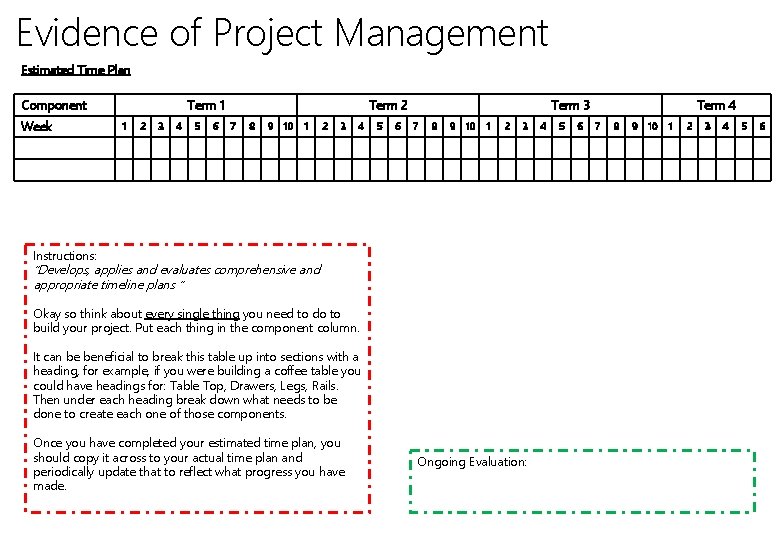
Evidence of Project Management Estimated Time Plan Component Week Term 1 1 2 3 4 5 6 Term 2 7 8 9 10 1 2 3 4 5 6 Term 3 7 8 9 10 1 2 3 Instructions: “Develops, applies and evaluates comprehensive and appropriate timeline plans “ Okay so think about every single thing you need to do to build your project. Put each thing in the component column. It can be beneficial to break this table up into sections with a heading, for example, if you were building a coffee table you could have headings for: Table Top, Drawers, Legs, Rails. Then under each heading break down what needs to be done to create each one of those components. Once you have completed your estimated time plan, you should copy it across to your actual time plan and periodically update that to reflect what progress you have made. Ongoing Evaluation: 4 5 6 Term 4 7 8 9 10 1 2 3 4 5 6
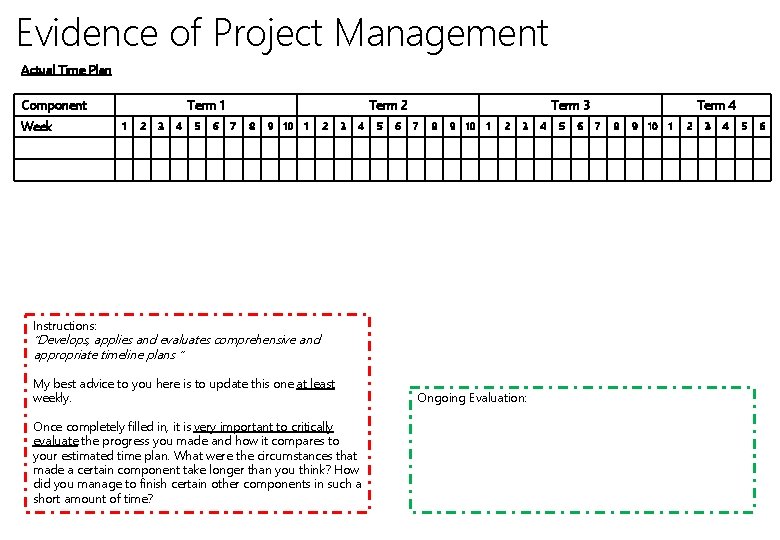
Evidence of Project Management Actual Time Plan Component Week Term 1 1 2 3 4 5 6 Term 2 7 8 9 10 1 2 3 4 5 6 Term 3 7 8 9 10 1 2 3 Instructions: “Develops, applies and evaluates comprehensive and appropriate timeline plans “ My best advice to you here is to update this one at least weekly. Once completely filled in, it is very important to critically evaluate the progress you made and how it compares to your estimated time plan. What were the circumstances that made a certain component take longer than you think? How did you manage to finish certain other components in such a short amount of time? Ongoing Evaluation: 4 5 6 Term 4 7 8 9 10 1 2 3 4 5 6
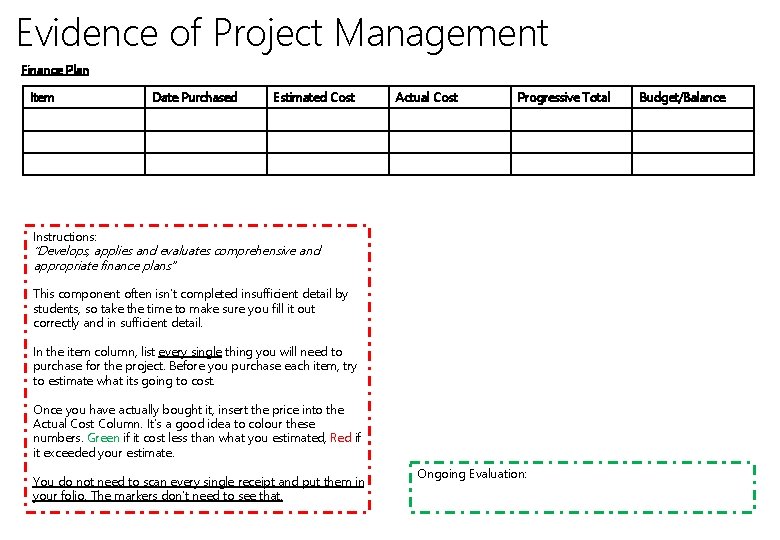
Evidence of Project Management Finance Plan Item Date Purchased Estimated Cost Actual Cost Progressive Total Instructions: “Develops, applies and evaluates comprehensive and appropriate finance plans” This component often isn’t completed insufficient detail by students, so take the time to make sure you fill it out correctly and in sufficient detail. In the item column, list every single thing you will need to purchase for the project. Before you purchase each item, try to estimate what its going to cost. Once you have actually bought it, insert the price into the Actual Cost Column. It’s a good idea to colour these numbers. Green if it cost less than what you estimated, Red if it exceeded your estimate. You do not need to scan every single receipt and put them in your folio. The markers don’t need to see that. Ongoing Evaluation: Budget/Balance
Evidence of Project Management Record of Production Sample Text Instructions: “Clearly describes the management of the project, including a succinct record of the production of project” Alright this is the big one. This is where you record every step of the process of actually making the project. Try break it up with headings for each component of the project. TAKE AS MANY PHOTOS AS YOU CAN. You don’t need to use them all, but its better to have them and not need them, than to need them and not have them. I recommend setting your camera to the “Square” photo setting when you take your pics. It will save a lot of cropping later on and helps keep the layout of your slides nice and organised. Ongoing Evaluation:
Evidence of Project Management Links Between Planning & Production Sample Text Instructions: “Completed project relates closely to what was intended. Close links between actual construction processes, management and thorough research and planning are evident and clearly articulated” The idea of this section is to show the marker how your completed project relates to what you originally intended. The use of pictures and graphics here is recommended. Use a side by side comparison of your initial drawings/sketches to a photo of your completed project so they can see the similarities. If something changed along the way, document it and justify why you had to change it. Ongoing Evaluation:
Evidence of Project Management Evidence of Practical Problem Solving Sample Text Instructions: “Demonstrates and critically evaluates how solutions to problems in major project production were addressed” Lets be real, every single one of you is going to bugger something up along the way when making your project. But that’s all good! Mistakes happen, that’s how we learn! In this section, you need to document those mistakes with photos and a description of: - What went wrong - Why it went wrong - What you did to fix it - How you could avoid this problem in the future Ongoing Evaluation:
WHS & Safe Working Practices Sample Text Instructions: “Demonstrates the use of a wide range of appropriate OHS (WHS) and safe working practices through suitable documentation and evidence” Alright in this section you may need to do a bit of modelling. You need to show some photos of you ensuring that you know how to work in a safe manner in the workshop. This includes: - Wearing your PPE (Glasses, Leather Shoes, Apron & Any other PPE necessary for certain applications) - Checking Guards on machinery - Setting up machinery safely. Ongoing Evaluation:
Presentation Skills & Techniques Sample Text Instructions: “Demonstrates a wide range of presentation skills and techniques, including ICT skills, appropriate to the development of major project” This section isn’t necessarily necessary, as the markers are going to be looking at the layout of your entire folio to see how well the document is presented and how good your ICT skills are. However it doesn’t hurt to show them that you have put some genuine thought and effort into the way you have laid out your folio. Have a look at Slide 5 “Folio Layout Advice” at the top of this document. Something similar to that would be a good idea. Ongoing Evaluation:
Evaluation of Major Project Statement of Intent Instructions: “Provides critical evaluation of the major project, including in relation to the statement of intent, research and development” Okay, go and have a look back at your Statement of Intent. You should have addressed these things, and maybe more: - What is it? - Why have you chosen to build it? - Why is it necessary that this project be built? - What do you think you will primarily make it out of? - Who will use the project once complete? - How will it work? - What will it be used for once complete? - What are your limitations? (E. g. cost, size, weight, transportation, aesthetics, availability of resources) - Do you intend to keep it? - Could you sell it upon completion? - Could you mass produce this product to sell on a larger scale? Now you have to address these things again, but in terms of if you successfully achieved what you set out to do. If things turned out slightly differently, that's okay, you just need to evaluate and justify why. Also make sure all of your Ongoing Evaluations are complete Sample Text
Evaluation of Major Project Research Instructions: “Provides critical evaluation of the major project, including in relation to the statement of intent, research and development” Now you have to refer back to the research you undertook and evaluate how closely your completed project relates to what you originally researched. Look at the similar designs that you researched and compare your final product to it. Look at the other materials/resources you researched and evaluate whether you think you should have chosen something else and justify why, or state that you are happy with your choice and justify why. Sample Text
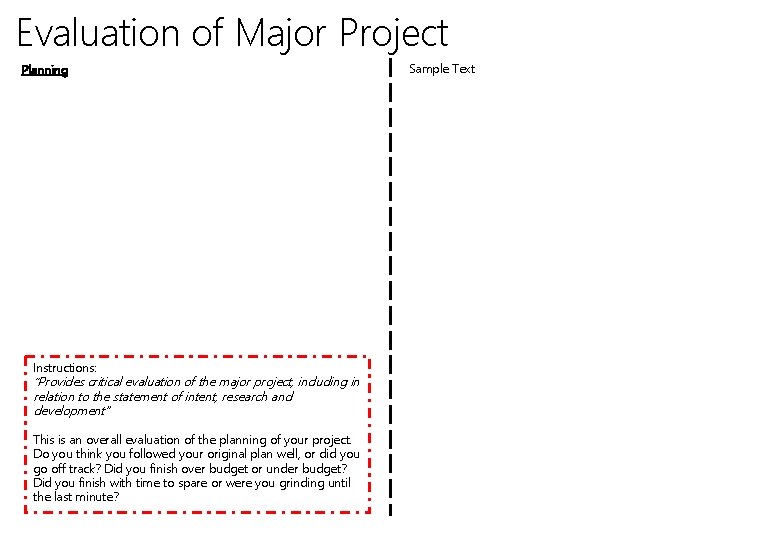
Evaluation of Major Project Planning Instructions: “Provides critical evaluation of the major project, including in relation to the statement of intent, research and development” This is an overall evaluation of the planning of your project. Do you think you followed your original plan well, or did you go off track? Did you finish over budget or under budget? Did you finish with time to spare or were you grinding until the last minute? Sample Text
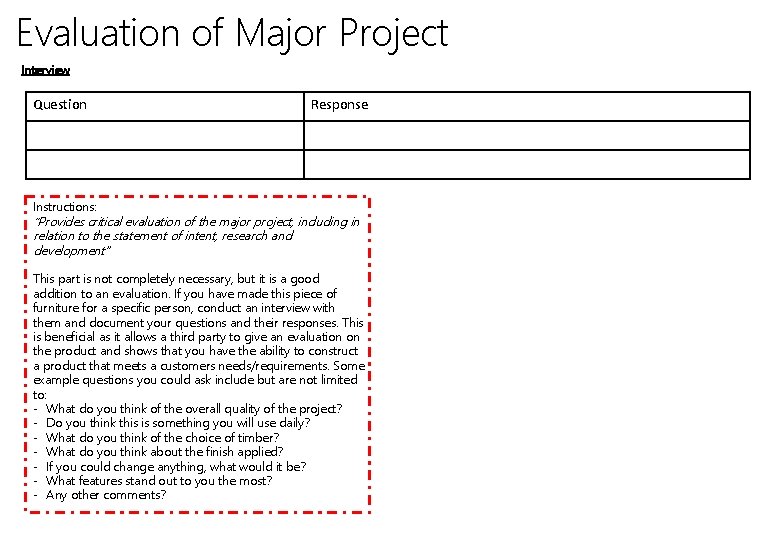
Evaluation of Major Project Interview Question Response Instructions: “Provides critical evaluation of the major project, including in relation to the statement of intent, research and development” This part is not completely necessary, but it is a good addition to an evaluation. If you have made this piece of furniture for a specific person, conduct an interview with them and document your questions and their responses. This is beneficial as it allows a third party to give an evaluation on the product and shows that you have the ability to construct a product that meets a customers needs/requirements. Some example questions you could ask include but are not limited to: - What do you think of the overall quality of the project? - Do you think this is something you will use daily? - What do you think of the choice of timber? - What do you think about the finish applied? - If you could change anything, what would it be? - What features stand out to you the most? - Any other comments?