
The Tempest Year 8 The Tempest Big Lecture
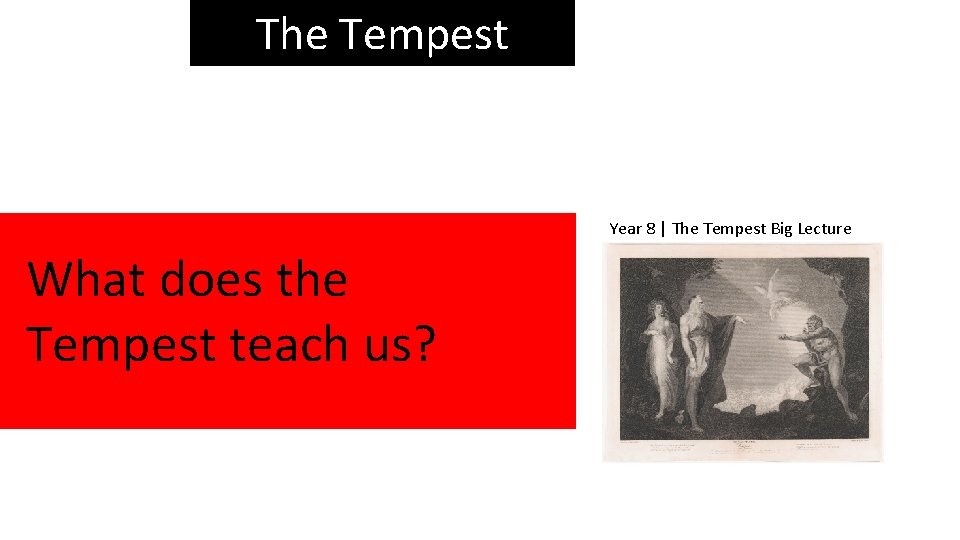
The Tempest Year 8 | The Tempest Big Lecture What does the Tempest teach us?
What if you lived in an enchanted world, where you had all the power?
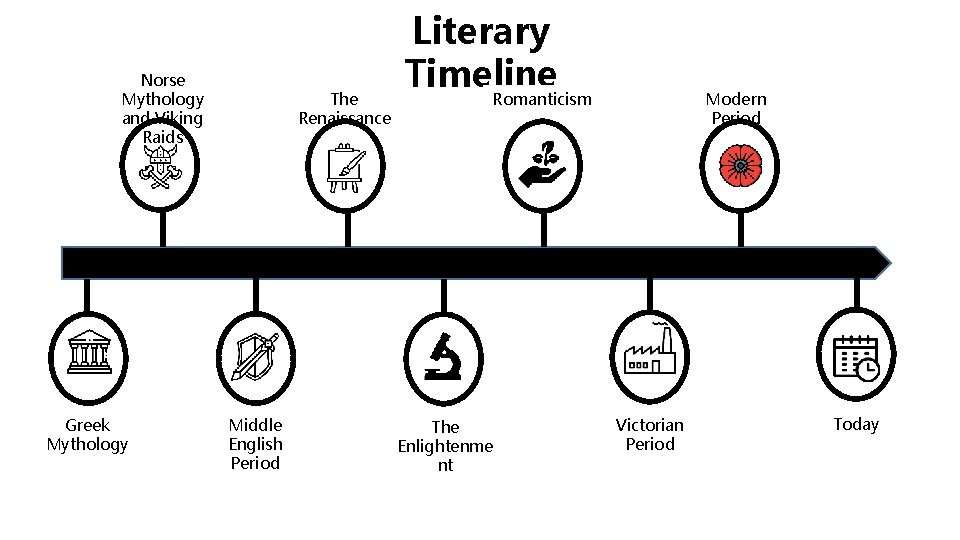
Norse Mythology and Viking Raids Greek Mythology The Renaissance Middle English Period Literary Timeline Romanticism The Enlightenme nt Modern Period Victorian Period Today
Glossary Colonisation The action of taking over or taking control over the indigenous people of an area. Betrayal To break a promise or be unfaithful to someone; to expose someone to danger through providing information to an enemy. Oppressive a situation or circumstance that is cruel, brutal or ruthless. Tragedy An event causing suffering, destruction or distress.
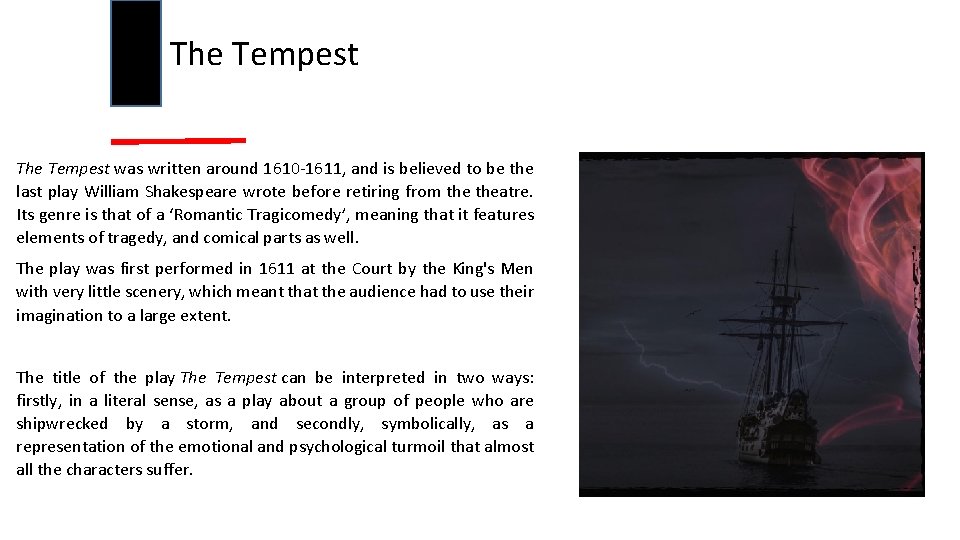
The Tempest was written around 1610 -1611, and is believed to be the last play William Shakespeare wrote before retiring from theatre. Its genre is that of a ‘Romantic Tragicomedy’, meaning that it features elements of tragedy, and comical parts as well. The play was first performed in 1611 at the Court by the King's Men with very little scenery, which meant that the audience had to use their imagination to a large extent. The title of the play The Tempest can be interpreted in two ways: firstly, in a literal sense, as a play about a group of people who are shipwrecked by a storm, and secondly, symbolically, as a representation of the emotional and psychological turmoil that almost all the characters suffer.
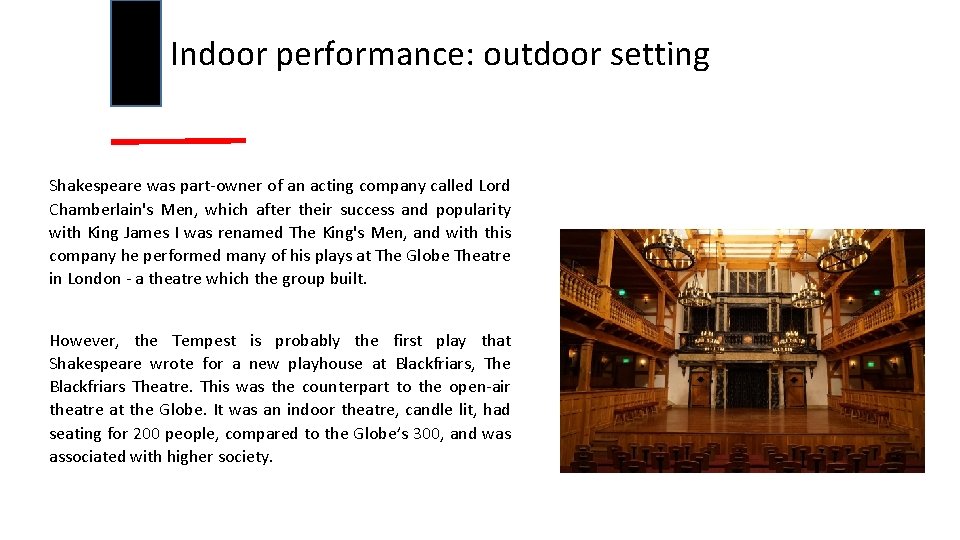
Indoor performance: outdoor setting Shakespeare was part-owner of an acting company called Lord Chamberlain's Men, which after their success and popularity with King James I was renamed The King's Men, and with this company he performed many of his plays at The Globe Theatre in London - a theatre which the group built. However, the Tempest is probably the first play that Shakespeare wrote for a new playhouse at Blackfriars, The Blackfriars Theatre. This was the counterpart to the open-air theatre at the Globe. It was an indoor theatre, candle lit, had seating for 200 people, compared to the Globe’s 300, and was associated with higher society.
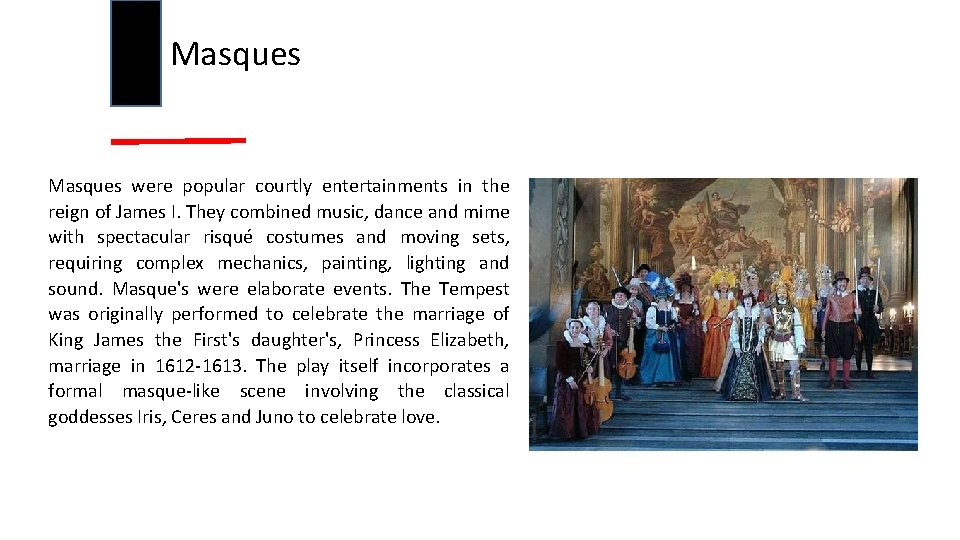
Masques were popular courtly entertainments in the reign of James I. They combined music, dance and mime with spectacular risqué costumes and moving sets, requiring complex mechanics, painting, lighting and sound. Masque's were elaborate events. The Tempest was originally performed to celebrate the marriage of King James the First's daughter's, Princess Elizabeth, marriage in 1612 -1613. The play itself incorporates a formal masque-like scene involving the classical goddesses Iris, Ceres and Juno to celebrate love.
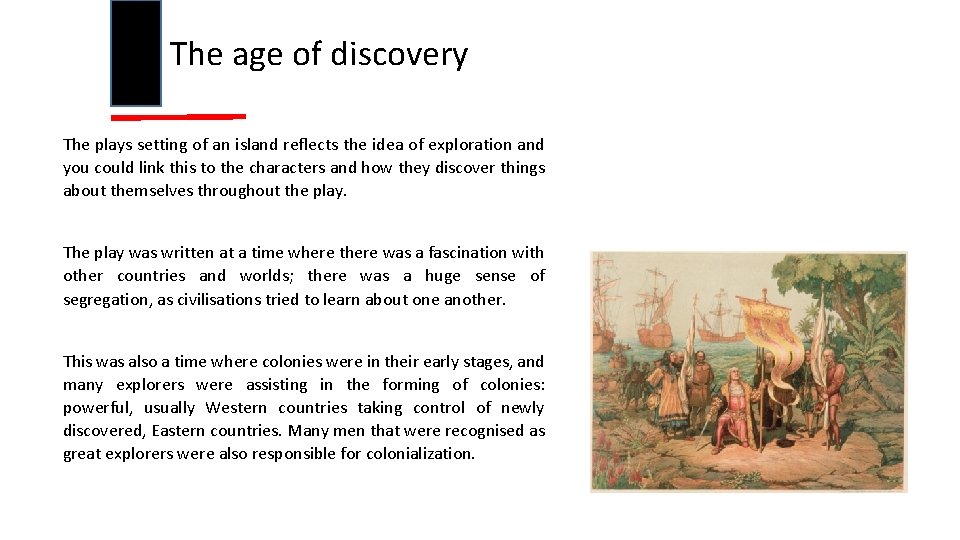
The age of discovery The plays setting of an island reflects the idea of exploration and you could link this to the characters and how they discover things about themselves throughout the play. The play was written at a time where there was a fascination with other countries and worlds; there was a huge sense of segregation, as civilisations tried to learn about one another. This was also a time where colonies were in their early stages, and many explorers were assisting in the forming of colonies: powerful, usually Western countries taking control of newly discovered, Eastern countries. Many men that were recognised as great explorers were also responsible for colonialization.
In the Tempest: What does tempest mean? Was the play performed indoors or outdoors? What is colonialization?
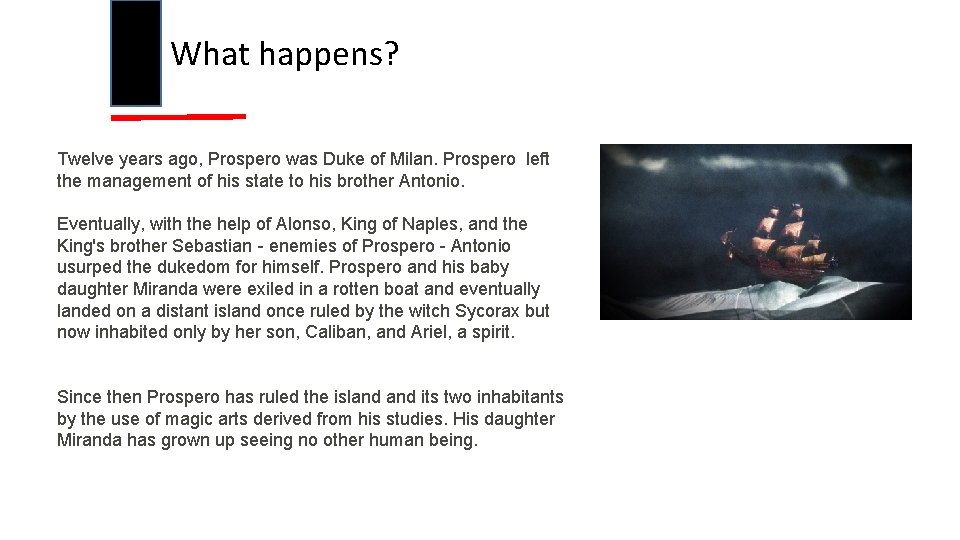
What happens? Twelve years ago, Prospero was Duke of Milan. Prospero left the management of his state to his brother Antonio. Eventually, with the help of Alonso, King of Naples, and the King's brother Sebastian - enemies of Prospero - Antonio usurped the dukedom for himself. Prospero and his baby daughter Miranda were exiled in a rotten boat and eventually landed on a distant island once ruled by the witch Sycorax but now inhabited only by her son, Caliban, and Ariel, a spirit. Since then Prospero has ruled the island its two inhabitants by the use of magic arts derived from his studies. His daughter Miranda has grown up seeing no other human being.
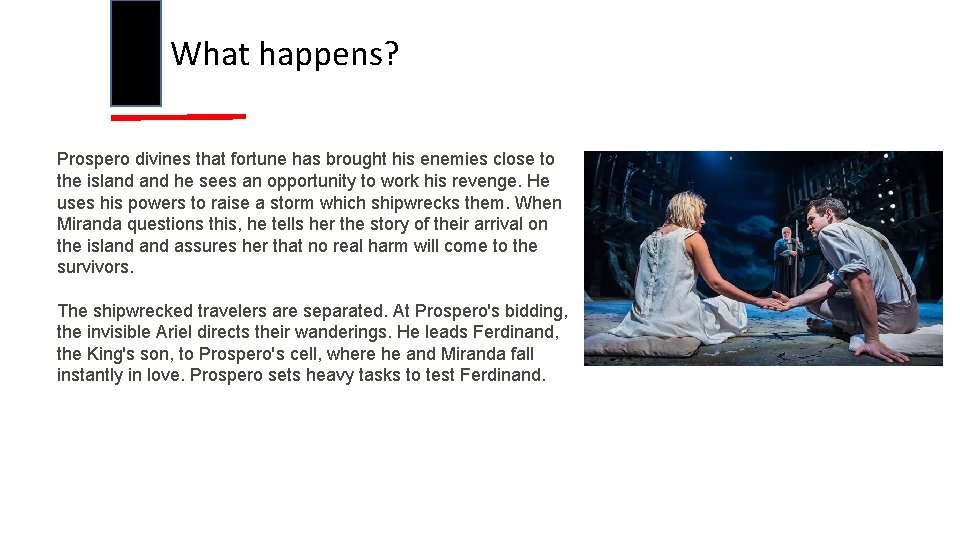
What happens? Prospero divines that fortune has brought his enemies close to the island he sees an opportunity to work his revenge. He uses his powers to raise a storm which shipwrecks them. When Miranda questions this, he tells her the story of their arrival on the island assures her that no real harm will come to the survivors. The shipwrecked travelers are separated. At Prospero's bidding, the invisible Ariel directs their wanderings. He leads Ferdinand, the King's son, to Prospero's cell, where he and Miranda fall instantly in love. Prospero sets heavy tasks to test Ferdinand.
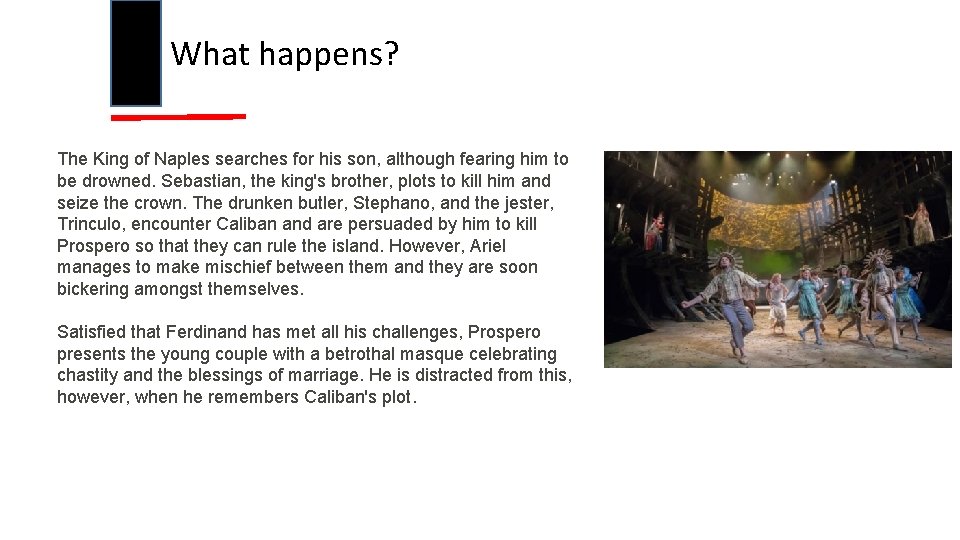
What happens? The King of Naples searches for his son, although fearing him to be drowned. Sebastian, the king's brother, plots to kill him and seize the crown. The drunken butler, Stephano, and the jester, Trinculo, encounter Caliban and are persuaded by him to kill Prospero so that they can rule the island. However, Ariel manages to make mischief between them and they are soon bickering amongst themselves. Satisfied that Ferdinand has met all his challenges, Prospero presents the young couple with a betrothal masque celebrating chastity and the blessings of marriage. He is distracted from this, however, when he remembers Caliban's plot.
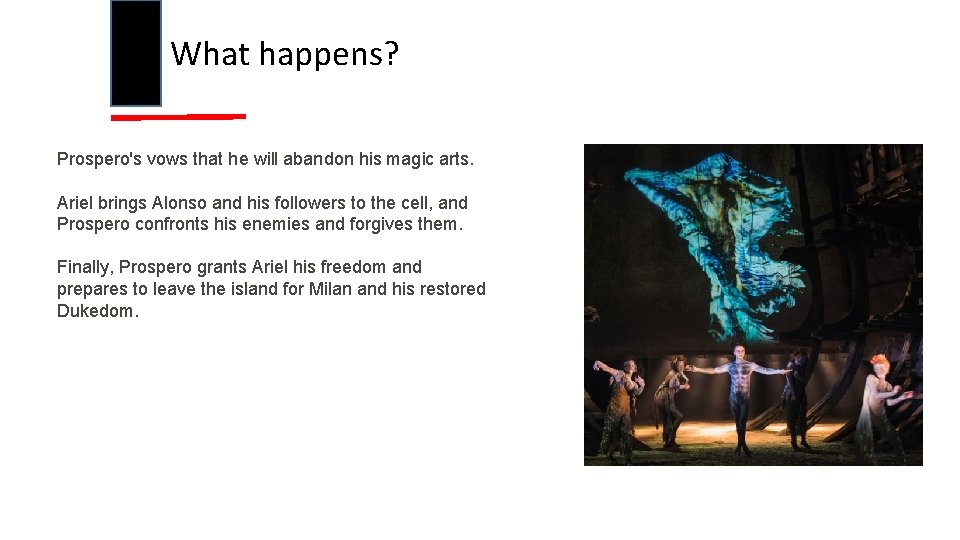
What happens? Prospero's vows that he will abandon his magic arts. Ariel brings Alonso and his followers to the cell, and Prospero confronts his enemies and forgives them. Finally, Prospero grants Ariel his freedom and prepares to leave the island for Milan and his restored Dukedom.
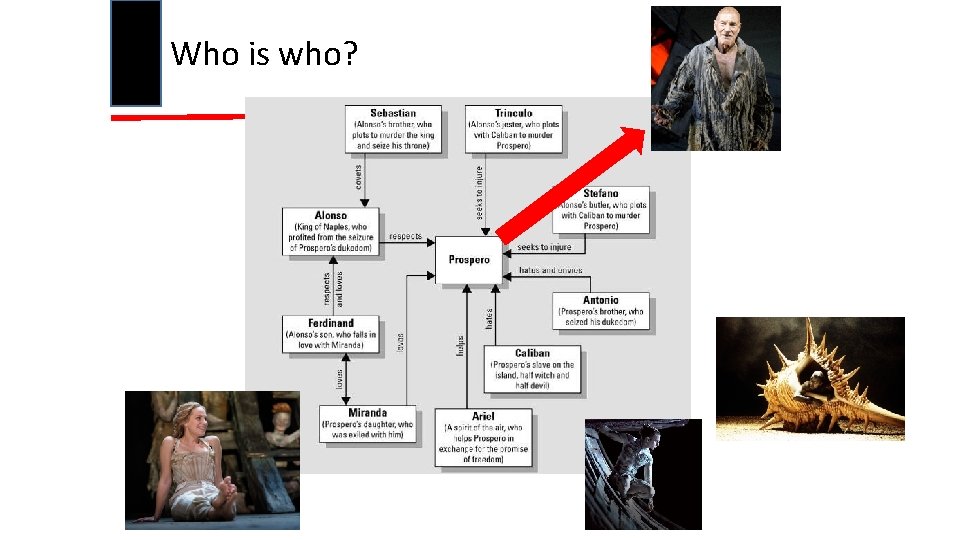
Who is who?
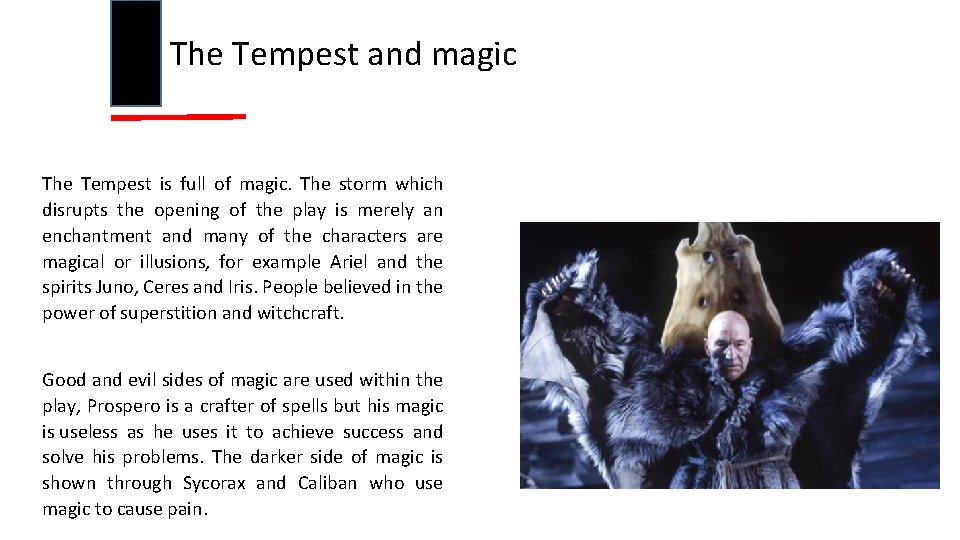
The Tempest and magic The Tempest is full of magic. The storm which disrupts the opening of the play is merely an enchantment and many of the characters are magical or illusions, for example Ariel and the spirits Juno, Ceres and Iris. People believed in the power of superstition and witchcraft. Good and evil sides of magic are used within the play, Prospero is a crafter of spells but his magic is useless as he uses it to achieve success and solve his problems. The darker side of magic is shown through Sycorax and Caliban who use magic to cause pain.
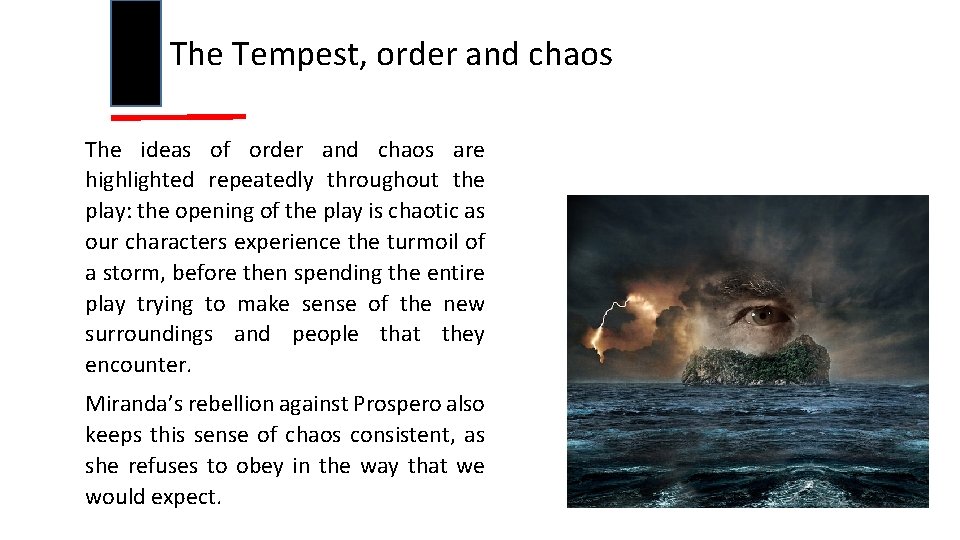
The Tempest, order and chaos The ideas of order and chaos are highlighted repeatedly throughout the play: the opening of the play is chaotic as our characters experience the turmoil of a storm, before then spending the entire play trying to make sense of the new surroundings and people that they encounter. Miranda’s rebellion against Prospero also keeps this sense of chaos consistent, as she refuses to obey in the way that we would expect.
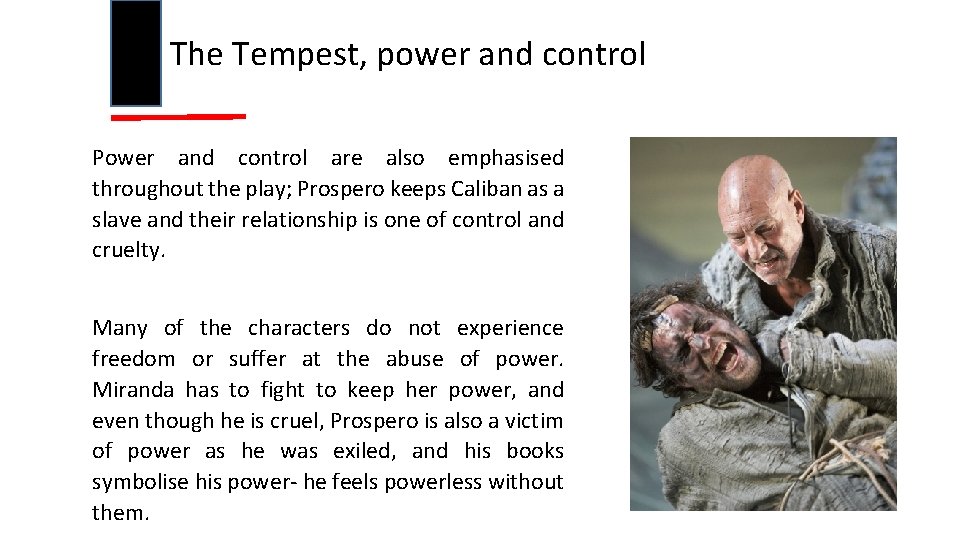
The Tempest, power and control Power and control are also emphasised throughout the play; Prospero keeps Caliban as a slave and their relationship is one of control and cruelty. Many of the characters do not experience freedom or suffer at the abuse of power. Miranda has to fight to keep her power, and even though he is cruel, Prospero is also a victim of power as he was exiled, and his books symbolise his power- he feels powerless without them.
In the Tempest: Who has the most power? Who has the least freedom? What represents order or chaos within the play?
The Tempest Year 8 | The Tempest Big Lecture What does the Tempest teach us?
- Slides: 19