
The Temperature Problem An area has known temperatures
The Temperature Problem An area has known temperatures along each of its edges. Find the temperature distribution within. Slides for Parallel Programming Techniques & Applications Using Networked Workstations & Parallel Computers 2 nd ed. , by B. Wilkinson & M. Allen, @ 2004 Pearson Education Inc. All rights reserved. 6. 41
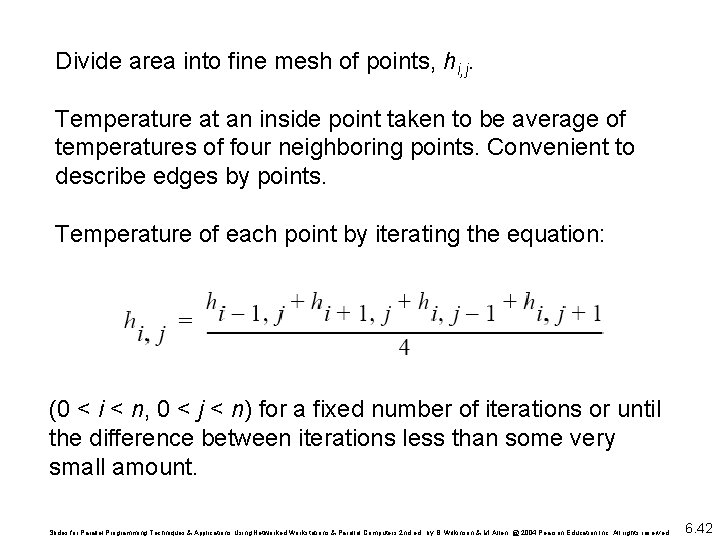
Divide area into fine mesh of points, hi, j. Temperature at an inside point taken to be average of temperatures of four neighboring points. Convenient to describe edges by points. Temperature of each point by iterating the equation: (0 < i < n, 0 < j < n) for a fixed number of iterations or until the difference between iterations less than some very small amount. Slides for Parallel Programming Techniques & Applications Using Networked Workstations & Parallel Computers 2 nd ed. , by B. Wilkinson & M. Allen, @ 2004 Pearson Education Inc. All rights reserved. 6. 42
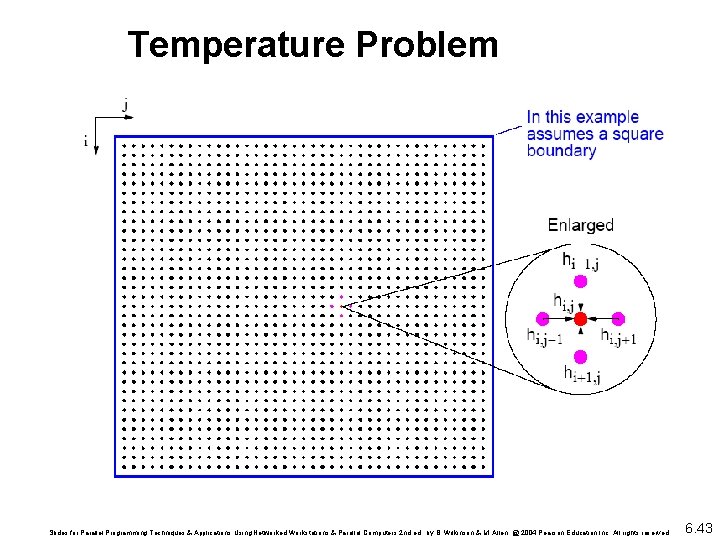
Temperature Problem Slides for Parallel Programming Techniques & Applications Using Networked Workstations & Parallel Computers 2 nd ed. , by B. Wilkinson & M. Allen, @ 2004 Pearson Education Inc. All rights reserved. 6. 43
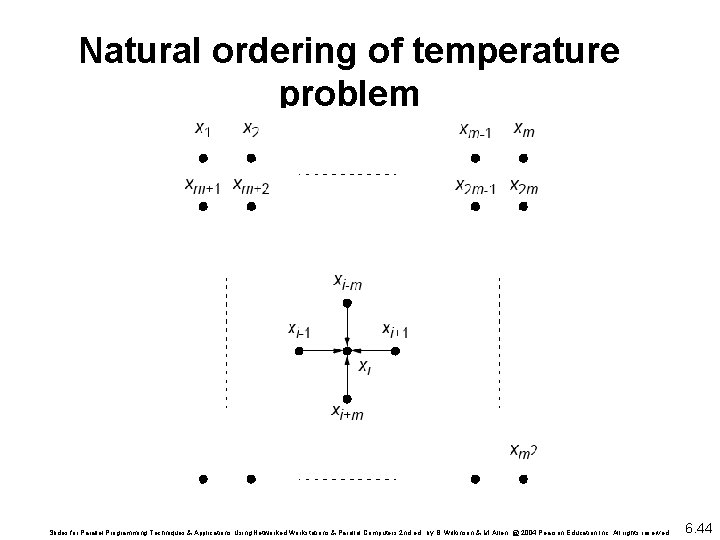
Natural ordering of temperature problem Slides for Parallel Programming Techniques & Applications Using Networked Workstations & Parallel Computers 2 nd ed. , by B. Wilkinson & M. Allen, @ 2004 Pearson Education Inc. All rights reserved. 6. 44
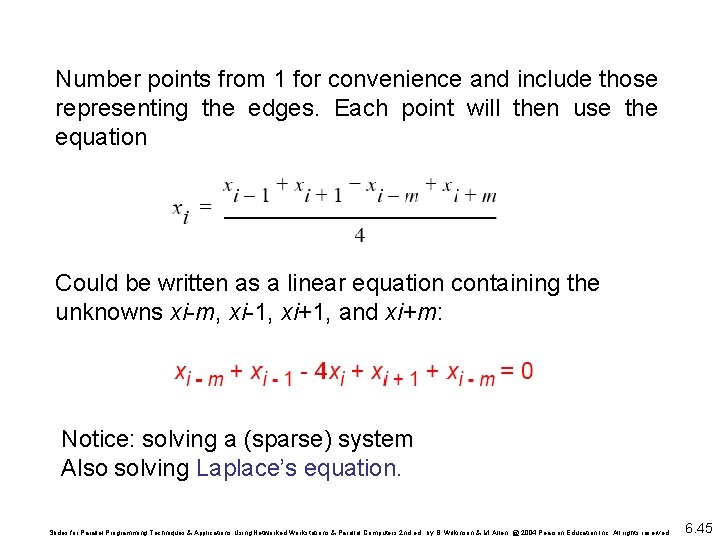
Number points from 1 for convenience and include those representing the edges. Each point will then use the equation Could be written as a linear equation containing the unknowns xi-m, xi-1, xi+1, and xi+m: Notice: solving a (sparse) system Also solving Laplace’s equation. Slides for Parallel Programming Techniques & Applications Using Networked Workstations & Parallel Computers 2 nd ed. , by B. Wilkinson & M. Allen, @ 2004 Pearson Education Inc. All rights reserved. 6. 45
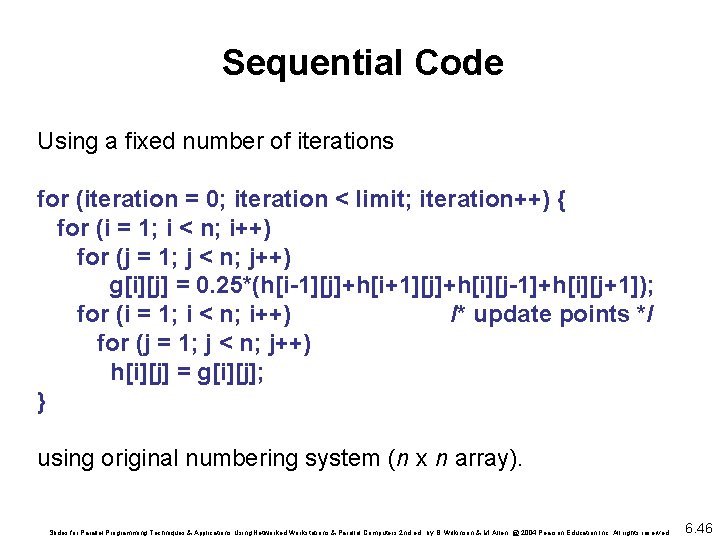
Sequential Code Using a fixed number of iterations for (iteration = 0; iteration < limit; iteration++) { for (i = 1; i < n; i++) for (j = 1; j < n; j++) g[i][j] = 0. 25*(h[i-1][j]+h[i+1][j]+h[i][j-1]+h[i][j+1]); for (i = 1; i < n; i++) /* update points */ for (j = 1; j < n; j++) h[i][j] = g[i][j]; } using original numbering system (n x n array). Slides for Parallel Programming Techniques & Applications Using Networked Workstations & Parallel Computers 2 nd ed. , by B. Wilkinson & M. Allen, @ 2004 Pearson Education Inc. All rights reserved. 6. 46
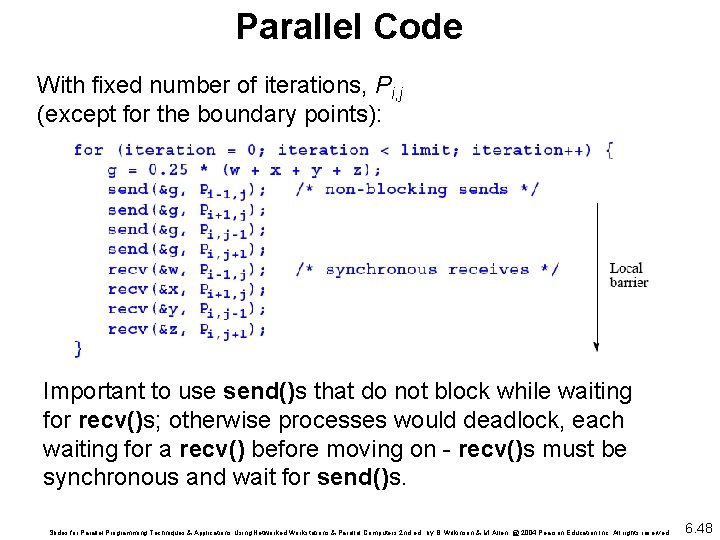
Parallel Code With fixed number of iterations, Pi, j (except for the boundary points): Important to use send()s that do not block while waiting for recv()s; otherwise processes would deadlock, each waiting for a recv() before moving on - recv()s must be synchronous and wait for send()s. Slides for Parallel Programming Techniques & Applications Using Networked Workstations & Parallel Computers 2 nd ed. , by B. Wilkinson & M. Allen, @ 2004 Pearson Education Inc. All rights reserved. 6. 48
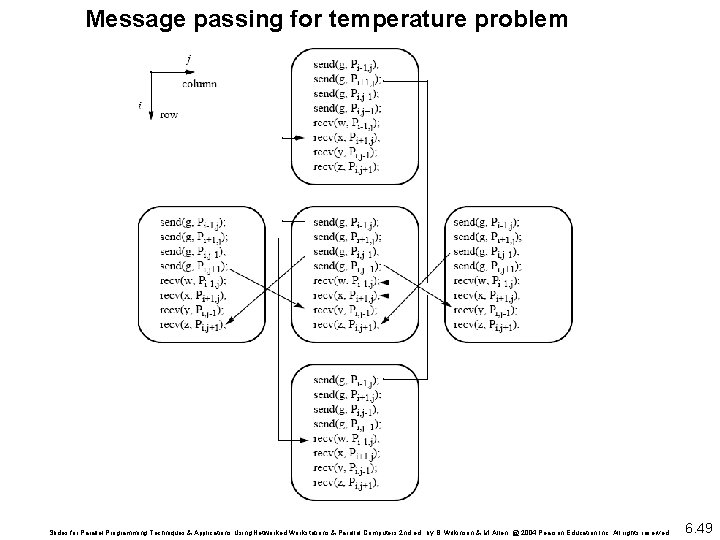
Message passing for temperature problem Slides for Parallel Programming Techniques & Applications Using Networked Workstations & Parallel Computers 2 nd ed. , by B. Wilkinson & M. Allen, @ 2004 Pearson Education Inc. All rights reserved. 6. 49
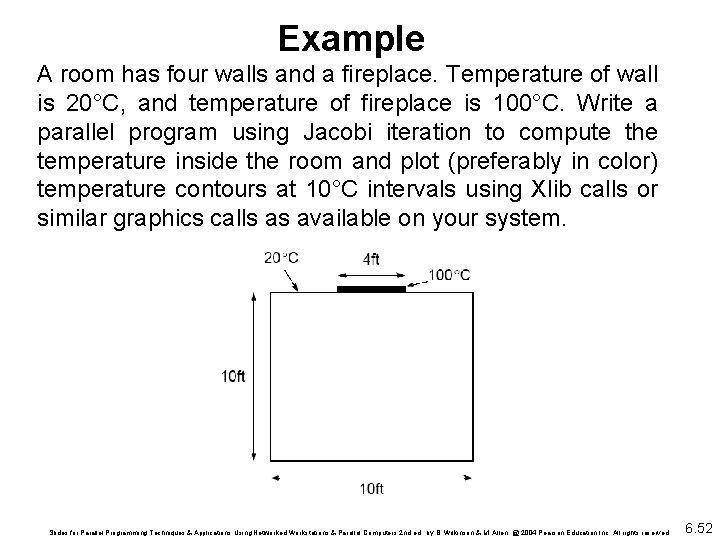
Example A room has four walls and a fireplace. Temperature of wall is 20°C, and temperature of fireplace is 100°C. Write a parallel program using Jacobi iteration to compute the temperature inside the room and plot (preferably in color) temperature contours at 10°C intervals using Xlib calls or similar graphics calls as available on your system. Slides for Parallel Programming Techniques & Applications Using Networked Workstations & Parallel Computers 2 nd ed. , by B. Wilkinson & M. Allen, @ 2004 Pearson Education Inc. All rights reserved. 6. 52
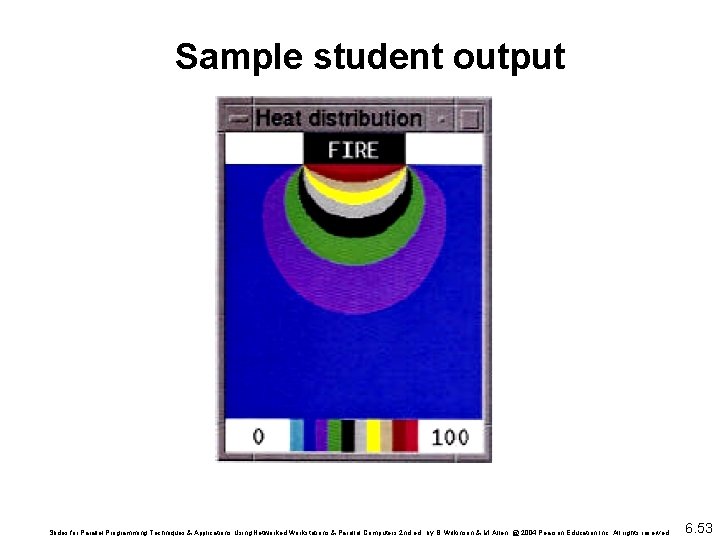
Sample student output Slides for Parallel Programming Techniques & Applications Using Networked Workstations & Parallel Computers 2 nd ed. , by B. Wilkinson & M. Allen, @ 2004 Pearson Education Inc. All rights reserved. 6. 53
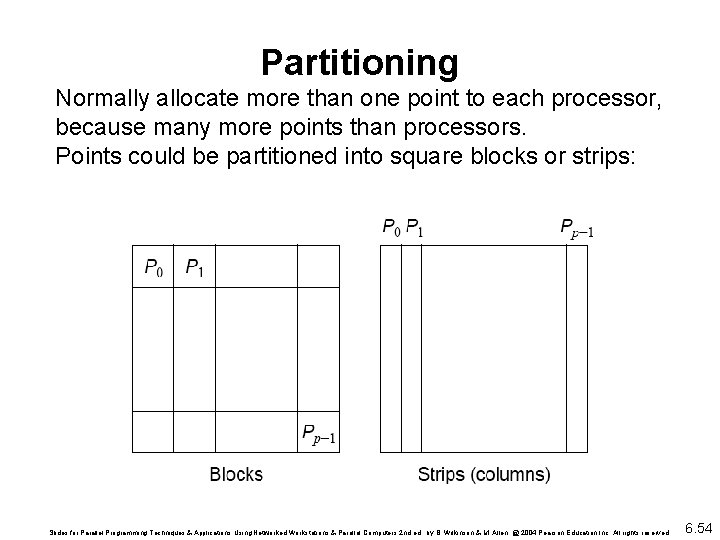
Partitioning Normally allocate more than one point to each processor, because many more points than processors. Points could be partitioned into square blocks or strips: Slides for Parallel Programming Techniques & Applications Using Networked Workstations & Parallel Computers 2 nd ed. , by B. Wilkinson & M. Allen, @ 2004 Pearson Education Inc. All rights reserved. 6. 54
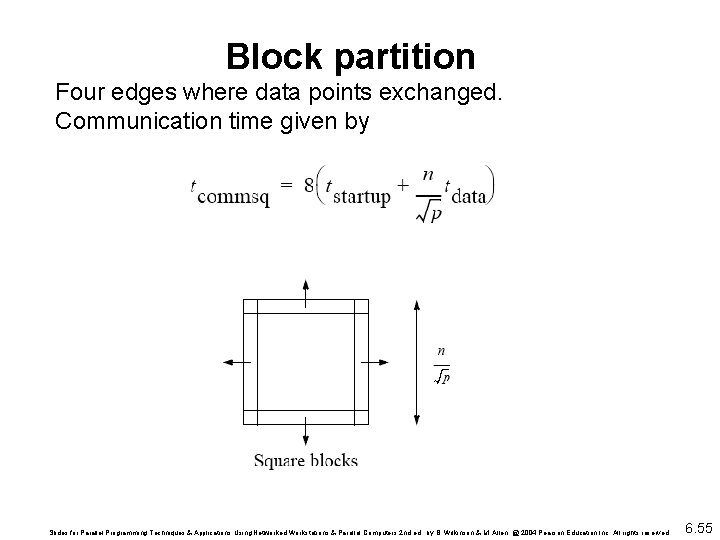
Block partition Four edges where data points exchanged. Communication time given by Slides for Parallel Programming Techniques & Applications Using Networked Workstations & Parallel Computers 2 nd ed. , by B. Wilkinson & M. Allen, @ 2004 Pearson Education Inc. All rights reserved. 6. 55
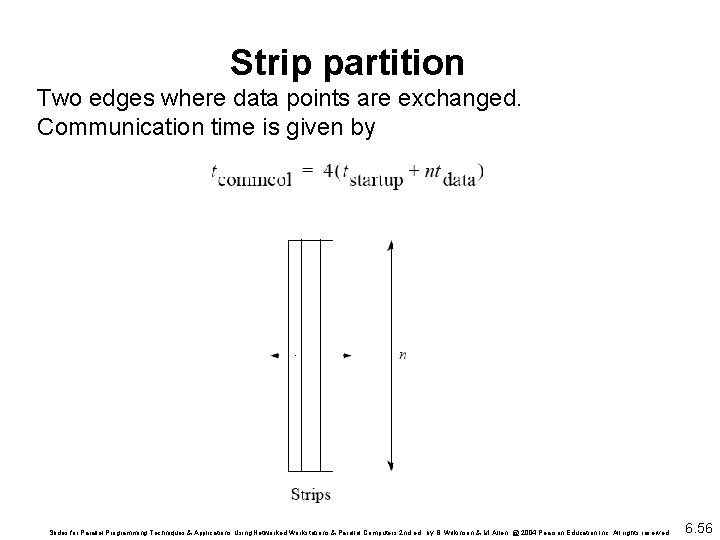
Strip partition Two edges where data points are exchanged. Communication time is given by Slides for Parallel Programming Techniques & Applications Using Networked Workstations & Parallel Computers 2 nd ed. , by B. Wilkinson & M. Allen, @ 2004 Pearson Education Inc. All rights reserved. 6. 56
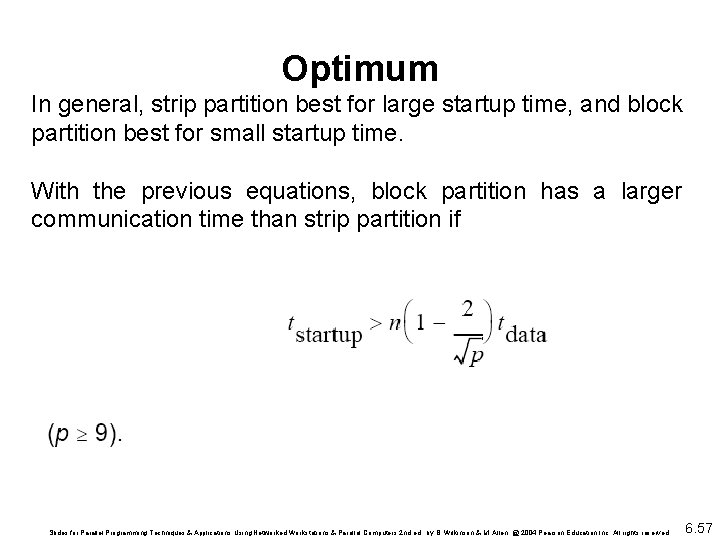
Optimum In general, strip partition best for large startup time, and block partition best for small startup time. With the previous equations, block partition has a larger communication time than strip partition if Slides for Parallel Programming Techniques & Applications Using Networked Workstations & Parallel Computers 2 nd ed. , by B. Wilkinson & M. Allen, @ 2004 Pearson Education Inc. All rights reserved. 6. 57
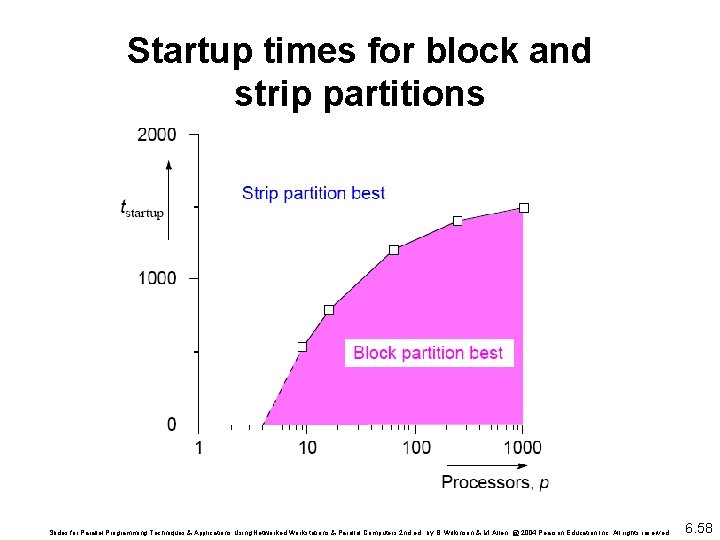
Startup times for block and strip partitions Slides for Parallel Programming Techniques & Applications Using Networked Workstations & Parallel Computers 2 nd ed. , by B. Wilkinson & M. Allen, @ 2004 Pearson Education Inc. All rights reserved. 6. 58
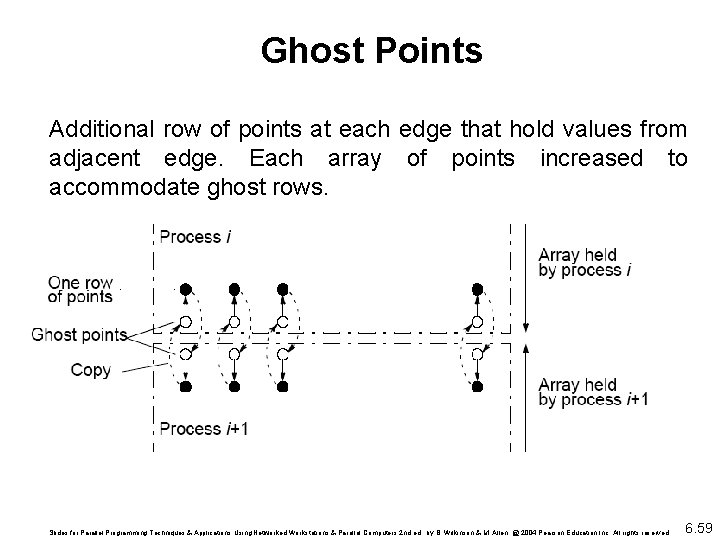
Ghost Points Additional row of points at each edge that hold values from adjacent edge. Each array of points increased to accommodate ghost rows. Slides for Parallel Programming Techniques & Applications Using Networked Workstations & Parallel Computers 2 nd ed. , by B. Wilkinson & M. Allen, @ 2004 Pearson Education Inc. All rights reserved. 6. 59
Relationship of Matrices to Linear Equations A system of linear equations can be written in matrix form: Ax = b Matrix A holds the a constants x is a vector of the unknowns b is a vector of the b constants. Slides for Parallel Programming Techniques & Applications Using Networked Workstations & Parallel Computers 2 nd ed. , by B. Wilkinson & M. Allen, @ 2004 Pearson Education Inc. All rights reserved.
Slides for Parallel Programming Techniques & Applications Using Networked Workstations & Parallel Computers 2 nd ed. , by B. Wilkinson & M. Allen, @ 2004 Pearson Education Inc. All rights reserved.
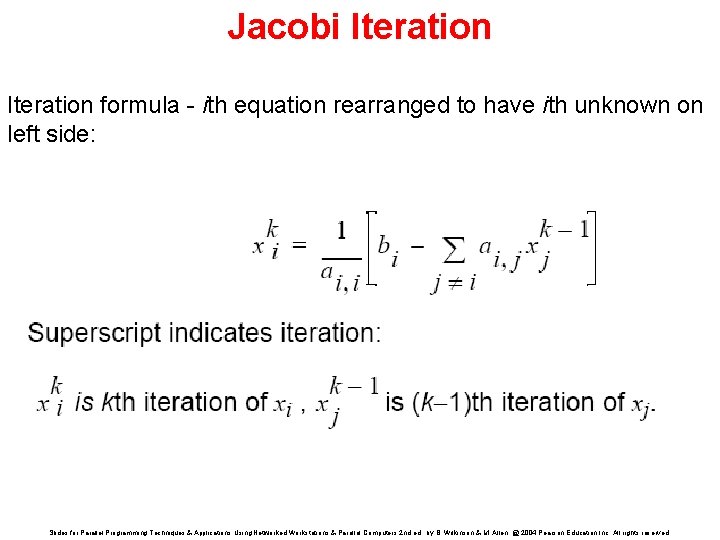
Jacobi Iteration formula - ith equation rearranged to have ith unknown on left side: Slides for Parallel Programming Techniques & Applications Using Networked Workstations & Parallel Computers 2 nd ed. , by B. Wilkinson & M. Allen, @ 2004 Pearson Education Inc. All rights reserved.
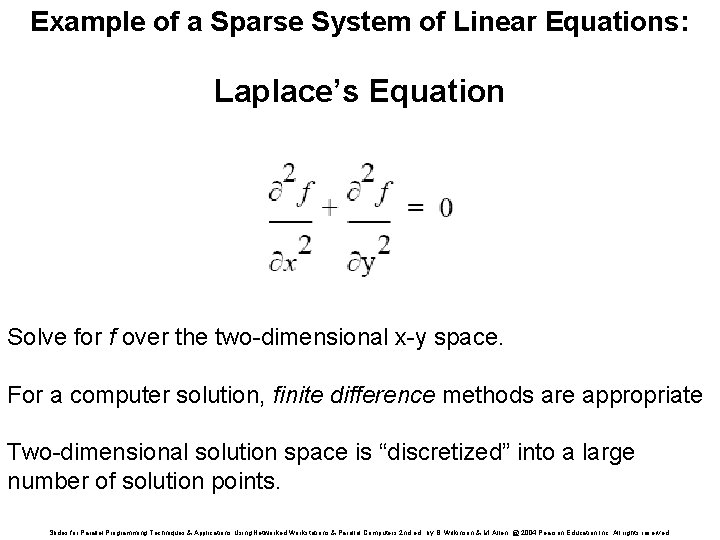
Example of a Sparse System of Linear Equations: Laplace’s Equation Solve for f over the two-dimensional x-y space. For a computer solution, finite difference methods are appropriate Two-dimensional solution space is “discretized” into a large number of solution points. Slides for Parallel Programming Techniques & Applications Using Networked Workstations & Parallel Computers 2 nd ed. , by B. Wilkinson & M. Allen, @ 2004 Pearson Education Inc. All rights reserved.
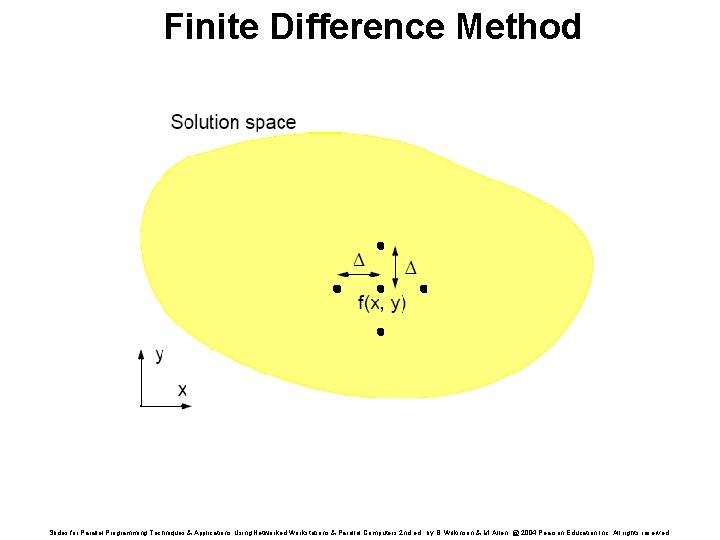
Finite Difference Method Slides for Parallel Programming Techniques & Applications Using Networked Workstations & Parallel Computers 2 nd ed. , by B. Wilkinson & M. Allen, @ 2004 Pearson Education Inc. All rights reserved.
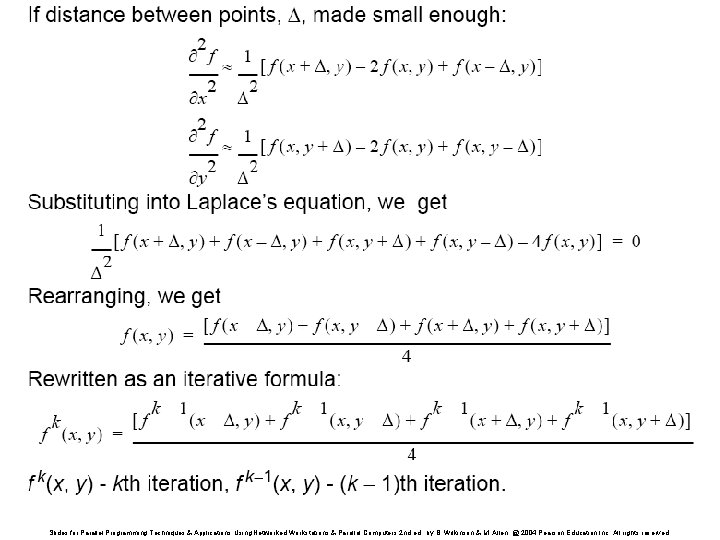
Slides for Parallel Programming Techniques & Applications Using Networked Workstations & Parallel Computers 2 nd ed. , by B. Wilkinson & M. Allen, @ 2004 Pearson Education Inc. All rights reserved.
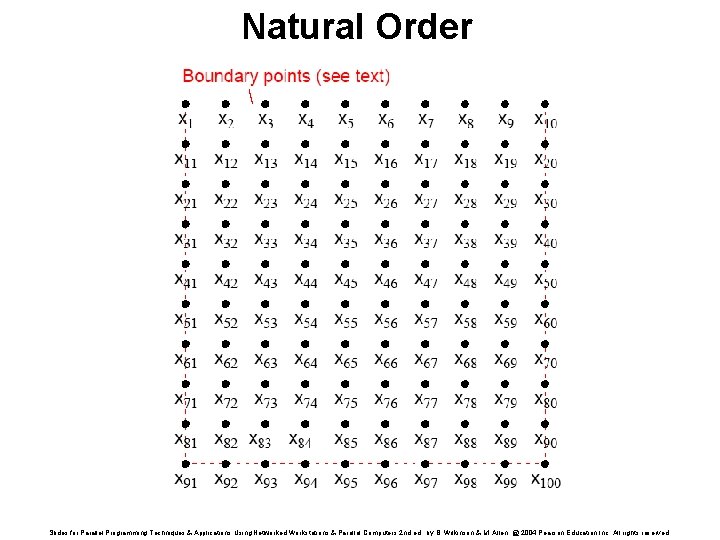
Natural Order Slides for Parallel Programming Techniques & Applications Using Networked Workstations & Parallel Computers 2 nd ed. , by B. Wilkinson & M. Allen, @ 2004 Pearson Education Inc. All rights reserved.
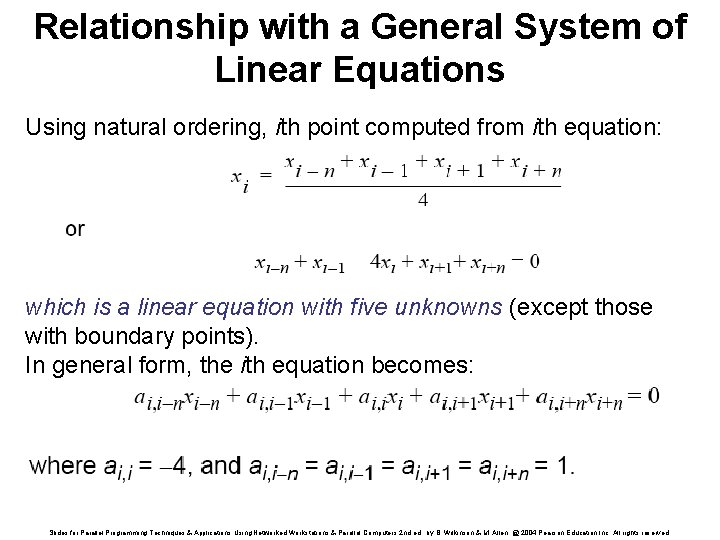
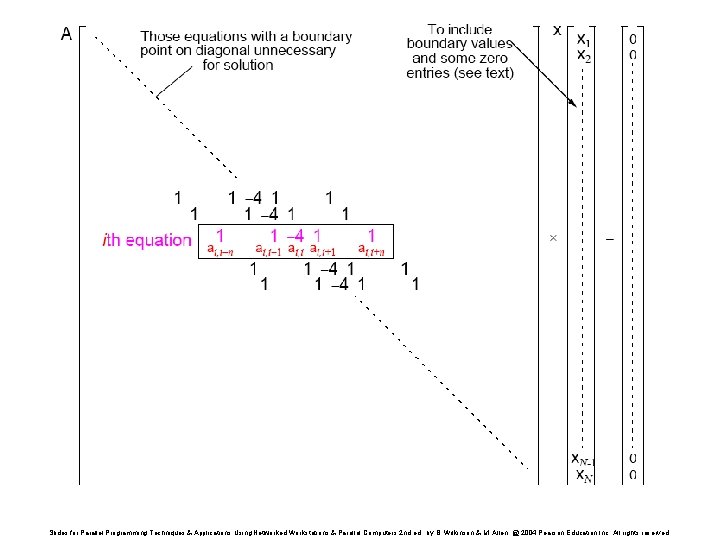
Relationship with a General System of Linear Equations Using natural ordering, ith point computed from ith equation: which is a linear equation with five unknowns (except those with boundary points). In general form, the ith equation becomes: Slides for Parallel Programming Techniques & Applications Using Networked Workstations & Parallel Computers 2 nd ed. , by B. Wilkinson & M. Allen, @ 2004 Pearson Education Inc. All rights reserved.
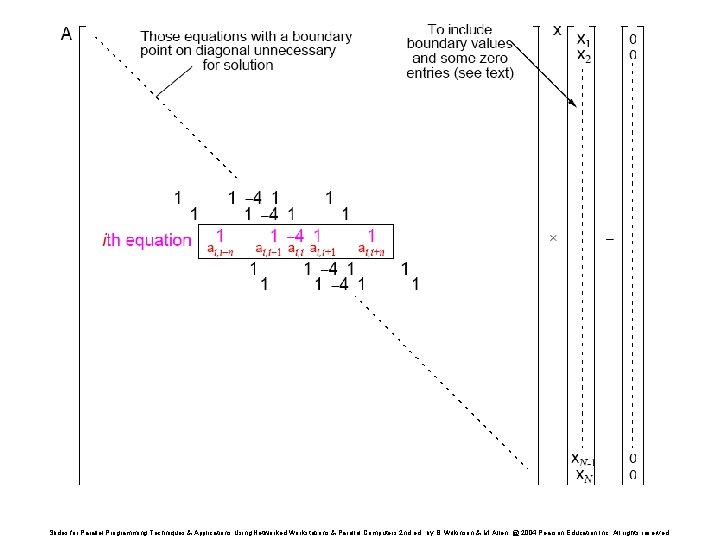
Slides for Parallel Programming Techniques & Applications Using Networked Workstations & Parallel Computers 2 nd ed. , by B. Wilkinson & M. Allen, @ 2004 Pearson Education Inc. All rights reserved.
- Slides: 25