
The Technical University of Braunschweig TUBS magnetometer experiment
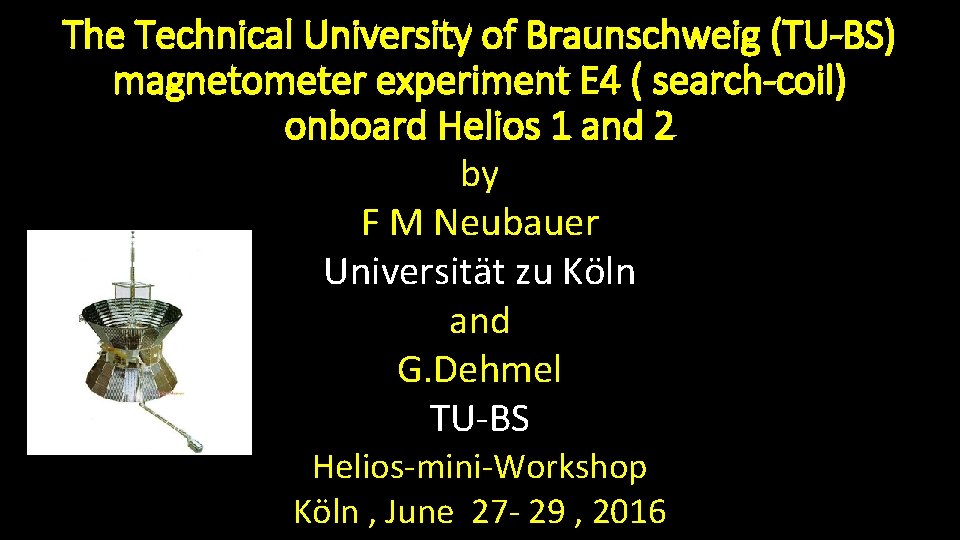
The Technical University of Braunschweig (TU-BS) magnetometer experiment E 4 ( search-coil) onboard Helios 1 and 2 by F M Neubauer Universität zu Köln and G. Dehmel TU-BS Helios-mini-Workshop Köln , June 27 - 29 , 2016
Helios fluxgate magnetometer E 4 (cont‘d) - The objective of this presentation is to provide information for use of Helios search-coil magnetometer E 4 data in preparing for the Solar Orbiter (SO) and Solar Probe Plus (SPP) missions. - No magnetic field measurements up to 2. 2 k. Hz since Helios. However channels #1 and #2 partly covered by MVM 73 and MESSENGER magnetometers. - Written information unfortunately partly incomplete because of accidental losses of printed documentation. Thus some of the information is available in print and some from memory only: Space Archaeology problem!
Helios search-coil magnetometer E 4 (cont‘d) Plan of Presentation • Boundary conditions • Experiment design • Experiment performance • Routine data processing • Examples of science results • Final remarks
Helios search-coil magnetometer E 4 (cont‘d) Boundary conditions - Financing of project E 4 essentially finished before 1982 when I moved to Cologne to work on new projects. - Spectral data only were shipped to NSSDC at GSFC in 1981 - Budget application for data saving activities in the nineties was not accepted. - Since all the data had to be dumped , only the NSSDC-data with relatively low repetition rate are available for this experiment.
Helios fluxgate magnetometer E 4 (cont‘d) Experiment design: • The magnetometer consists of a triaxial, orthogonal search-coil sensor triad with two sensors in the spin plane and one parallel to the spin axis mounted on a boom at 4. 6 m distance from the axis -Sensor type: search-coil like on OGO-5 etc but higher resonance frequency - Similar sensors on Galileo atmospheric entry probe lightning detector (1995). - Developers started company Metronix in Exploration Geophysics later sold to US company. Selling on all continents in increasing market (“Magnetotellurics“ equipment)!

Helios fluxgate magnetometer E 4 (cont‘d) Experiment design: Helios E 4 sensor and preamplifier
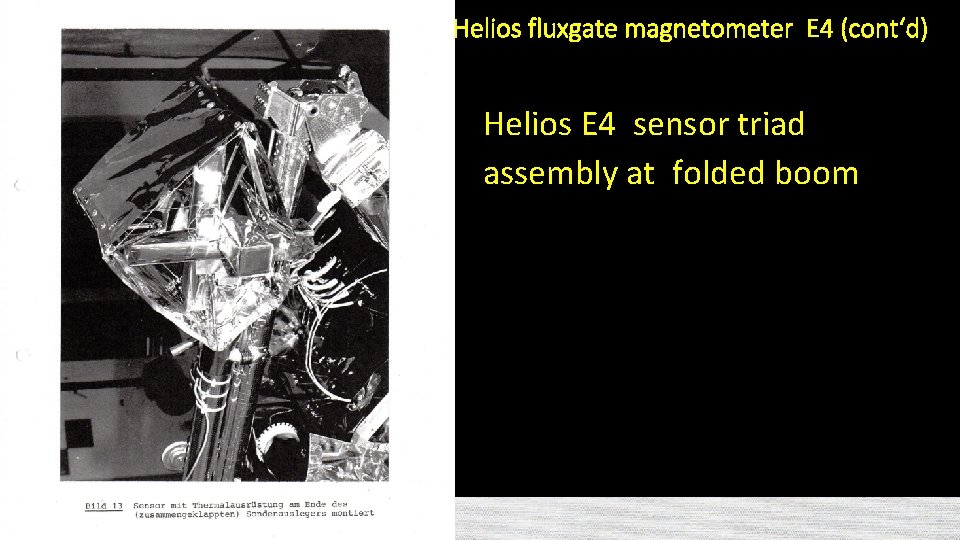
Helios fluxgate magnetometer E 4 (cont‘d) Experiment design: Helios E 4 sensor triad assembly at folded boom
Helios fluxgate magnetometer E 4 (cont‘d) Experiment design: • Analog electronics - preamplifiers - amplifiers for range adjustment, integrators for waveform channels on Helios 1 , omitted partly on Helios 2 - active bandpass filters for spectral analyzer • Digital electronics -AD-conversion , nonlinear - spectral analyzer mean square value computer yielding mean squares and peak values for averaging interval • Note that all this hardware was based on late 1960 technology , i. e. ~ 50 years ago. Development started in 1966.
Helios searchcoil magnetometer E 4 (cont‘d) •
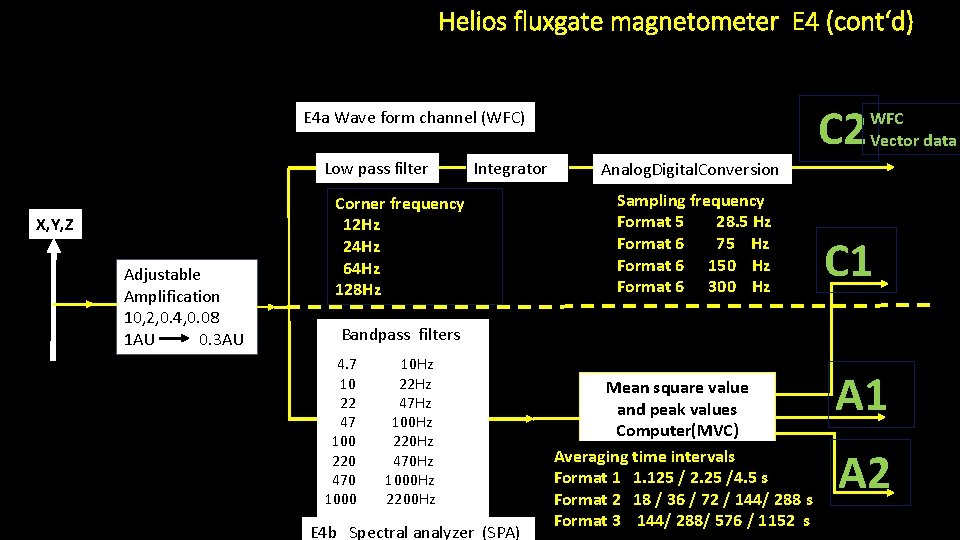
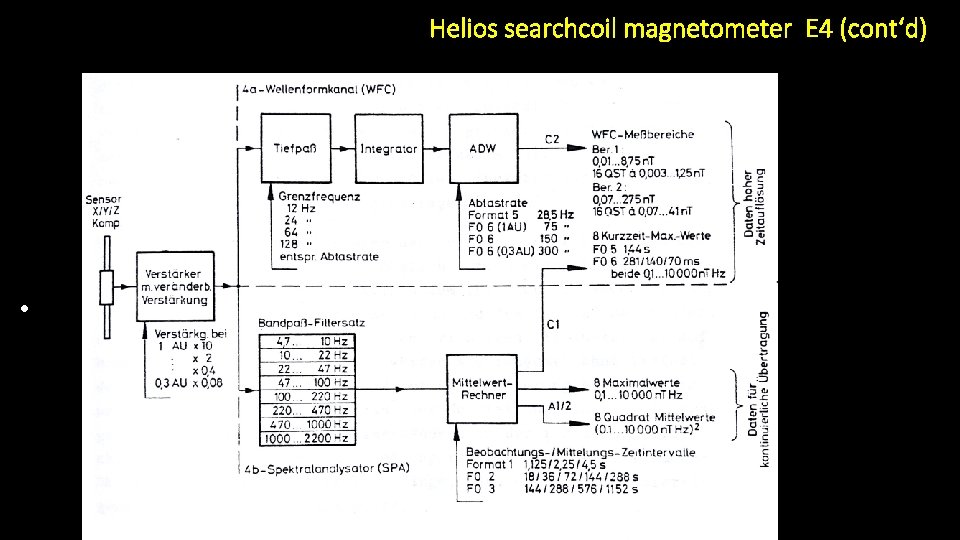
Helios fluxgate magnetometer E 4 (cont‘d) C 2 E 4 a Wave form channel (WFC) Low pass filter X, Y, Z Adjustable Amplification 10, 2, 0. 4, 0. 08 1 AU 4. 74 0. 3 AU Integrator Corner frequency 12 Hz 24 Hz 64 Hz 128 Hz WFC Vector data Analog. Digital. Conversion SSampling frequency Format 5 28. 5 Hz Format 6 75 Hz Format 6 150 Hz Format 6 300 Hz C 1 Bandpass filters 4. 7 10 22 47 100 220 470 1000 10 Hz 22 Hz 47 Hz 100 Hz 220 Hz 470 Hz 1000 Hz 2200 Hz E 4 b Spectral analyzer (SPA) Mean square value and peak values Computer(MVC) Averaging time intervals Format 1 1. 125 / 2. 25 /4. 5 s Format 2 18 / 36 / 72 / 144/ 288 s Format 3 144/ 288/ 576 / 1152 s A 1 A 2
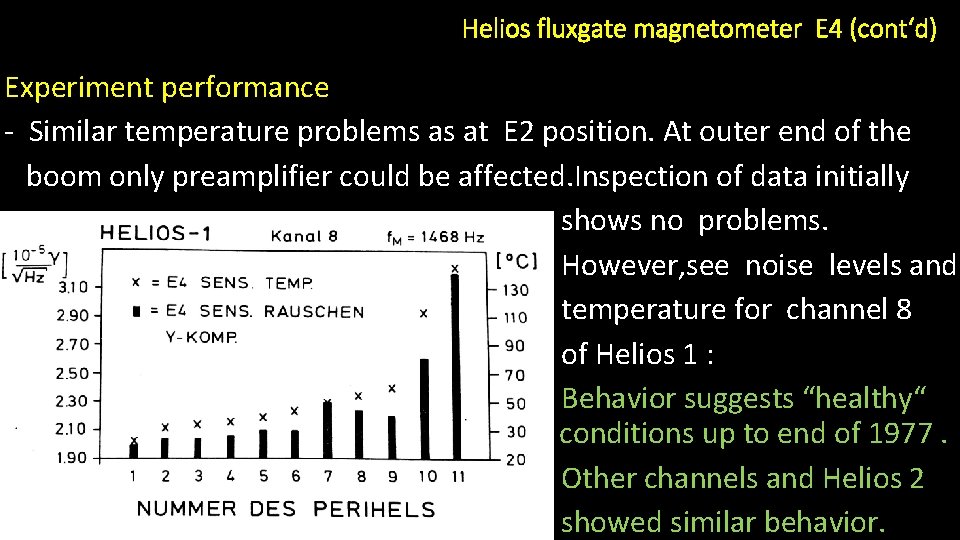
Helios fluxgate magnetometer E 4 (cont‘d) Experiment performance - Similar temperature problems as at E 2 position. At outer end of the boom only preamplifier could be affected. Inspection of data initially shows no problems. However, see noise levels and temperature for channel 8 of Helios 1 : Behavior suggests “healthy“ conditions up to end of 1977. Other channels and Helios 2 showed similar behavior.
Helios fluxgate magnetometer E 4 (cont‘d) Experiment performance(cont'd) • Some smaller interference problems could be solved by reconfigurations of the experiment by command.
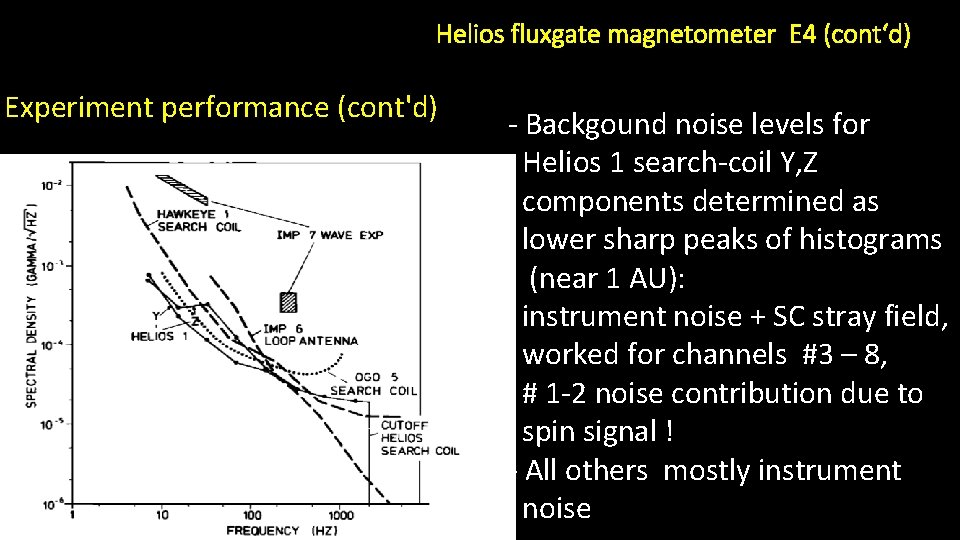
Helios fluxgate magnetometer E 4 (cont‘d) Experiment performance (cont'd) - Backgound noise levels for Helios 1 search-coil Y, Z components determined as lower sharp peaks of histograms (near 1 AU): instrument noise + SC stray field, worked for channels #3 – 8, # 1 -2 noise contribution due to spin signal ! - All others mostly instrument noise
Helios fluxgate magnetometer E 4 (cont‘d) Routine data processing - Straightforward decalibration - Digital spectral analyzer data given in n. T/(Hz)1/2 for peaks and averages
Helios fluxgate magnetometer E 4 (cont‘d) 3. Selection of scientific results Selection according to usefulness for data validation ( E 2, E 4) 1. Radial variation of interplanetary magnetic field (E 2) 2. Macroscopic picture of shock interactions (E 2) 3. Alfvén waves in the solar wind (E 2) 4. EM-waves from 4. 7 Hz to 2. 2 k. Hz and their radial variation (E 4) 5. Shock structure (E 2, E 4) 6. Directional discontinuity structure (E 2, E 4) 7. Broadband spectrum of magnetic field variations(E 2, E 4)
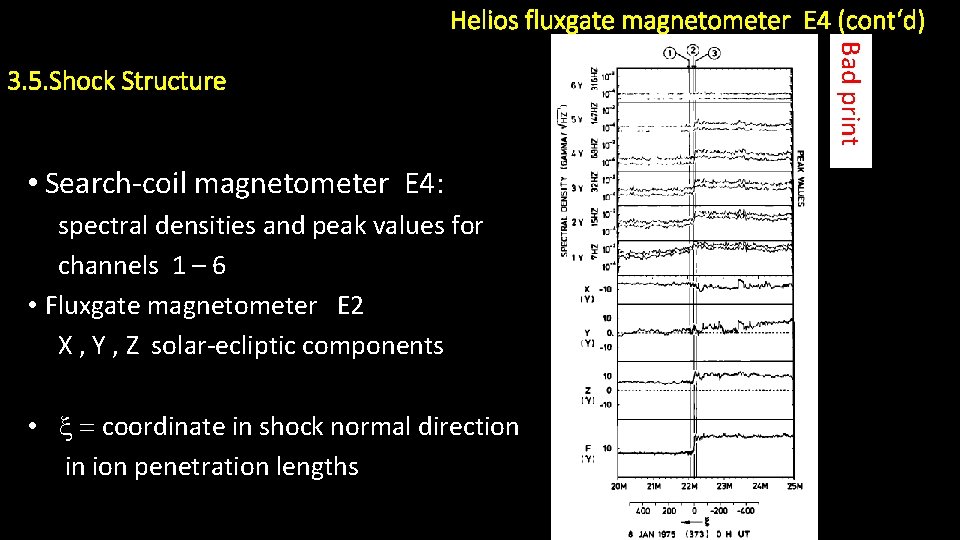
Helios fluxgate magnetometer E 4 (cont‘d) • Search-coil magnetometer E 4: spectral densities and peak values for channels 1 – 6 • Fluxgate magnetometer E 2 X , Y , Z solar-ecliptic components • x = coordinate in shock normal direction in ion penetration lengths Bad print 3. 5. Shock Structure
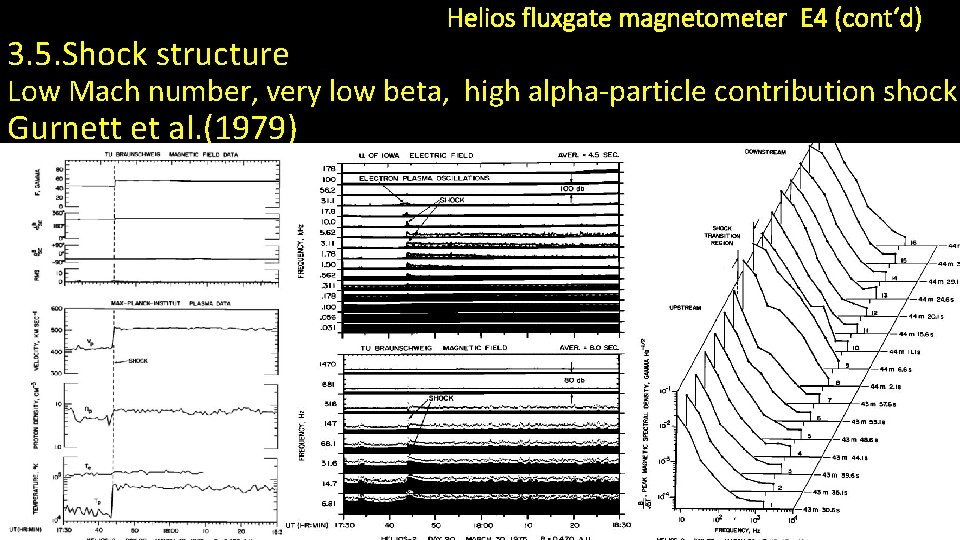
3. 5. Shock structure Helios fluxgate magnetometer E 4 (cont‘d) Low Mach number, very low beta, high alpha-particle contribution shock Gurnett et al. (1979)
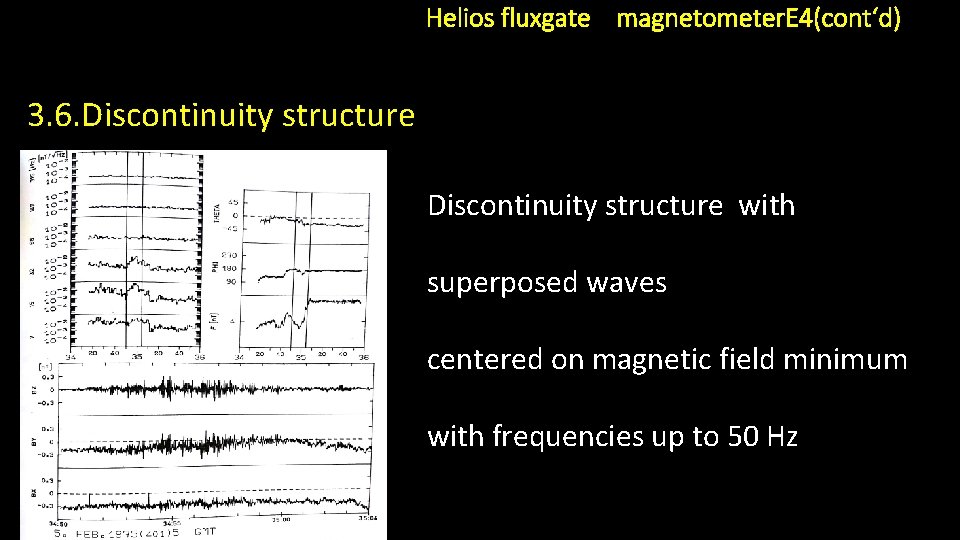
Helios fluxgate magnetometer. E 4(cont‘d) 3. 6. Discontinuity structure with superposed waves centered on magnetic field minimum with frequencies up to 50 Hz
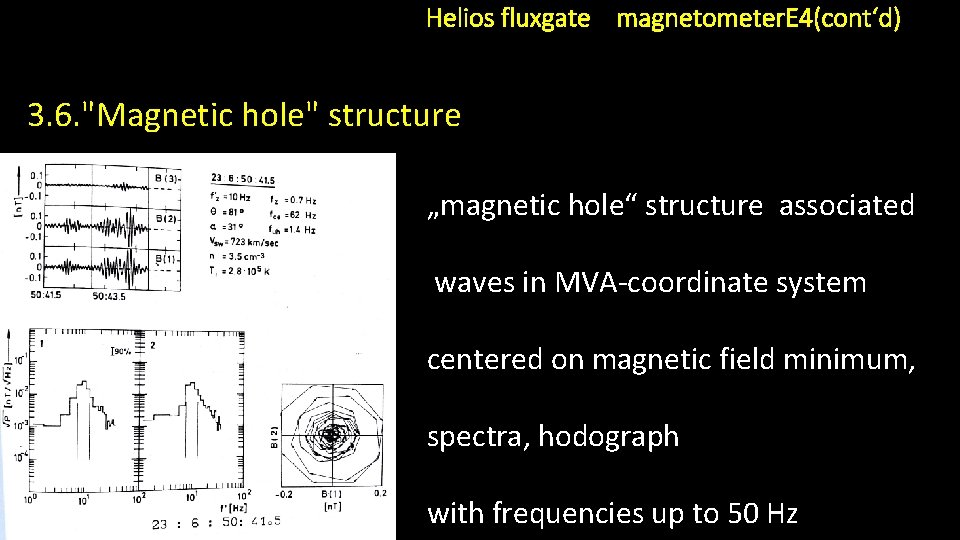
Helios fluxgate magnetometer. E 4(cont‘d) 3. 6. "Magnetic hole" structure „magnetic hole“ structure associated waves in MVA-coordinate system centered on magnetic field minimum, spectra, hodograph with frequencies up to 50 Hz
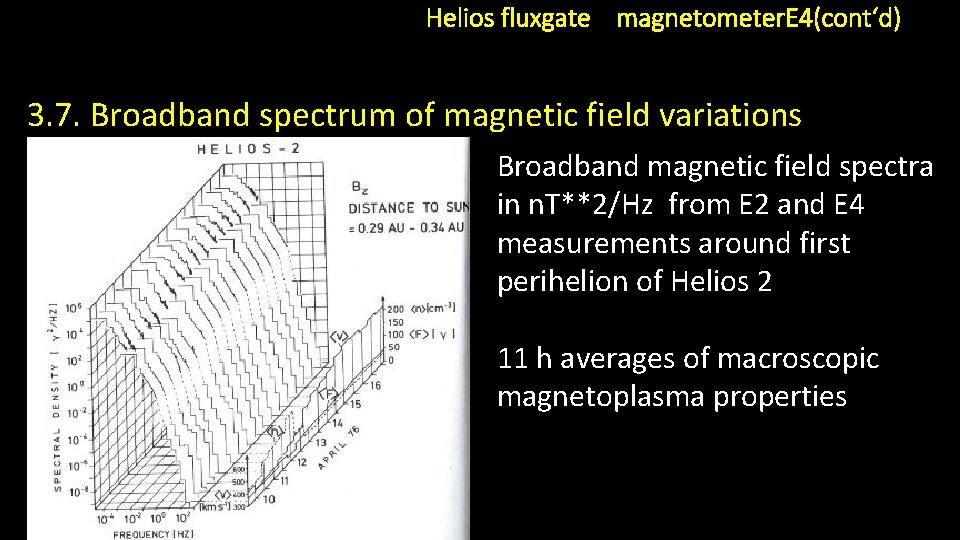
Helios fluxgate magnetometer. E 4(cont‘d) 3. 7. Broadband spectrum of magnetic field variations Broadband magnetic field spectra in n. T**2/Hz from E 2 and E 4 measurements around first perihelion of Helios 2 11 h averages of macroscopic magnetoplasma properties
Helios fluxgate magnetometer E 4 (cont‘d) Final Remarks • Helios search-coil magnetometer E 4 provided magnetic field data at frequencies as high as 2. 2 k. Hz under good magnetic cleanliness conditions • Data were provided as waveform data and spectral analyzer data (8 logarithmically spaced spectral channels) in real-time modes and memory modes including an event mode referred to as shock mode • The experiment provided data from launch until the early eighties on Helios 1 and until 1980 on Helios 2 • Because of increasing severe thermal problems at the sensor location data were considered reliable until end of 1977 at least. • Because of archiving problems spectral data only are available for the first nine months of each mission including also the 2. perihelion for each!
Helios fluxgate magnetometer E 4 (cont‘d) Acknowledgements The contributions of the following individuals were essential for the success of this experiment (alphabetical order): Hardware phase TU Braunschweig: F. Gliem, R. Karmann, R. P. Kugel, D. Lukoschus, G. Schirenbeck, J. Wawretzko Data processing TU Braunschweig: H. Barnstorf, H. -J. Beinroth, K. U. Denskat, E. Lammers, H. Ruprecht, P. Volkmer Data processing Cologne: W. Heibey, H. Marschall, A. Söding, K. Sperveslage, R. v. Stein, A. Wennmacher
- Slides: 22