
THE TEAM Patrcia Rosado Pinto Coordinator Elsa Caetano
- Slides: 10
THE TEAM Patrícia Rosado Pinto (Coordinator) Elsa Caetano Isabel Nunes Joana Marques João Sevilhano Rita Falcão Roberto Henriques PERSONAL DEVELOPMENT AND INTELLECTUAL HONESTY
MODULE 3 – INSTITUTIONAL AND PERSONAL DEVELOPMENT Universidade NOVA de Lisboa
INSTITUTIONAL AND PERSONAL DEVELOPMENT © UNIVERSIDADE NOVA DE LISBOA 2018
INSTITUTIONAL ETHICAL CODE At Institutional Level Creating an Institutional Ethical Code Academic integrity is more than our classes. It derives from the institution and should be aligned with institutional priorities © UNIVERSIDADE NOVA DE LISBOA 2018
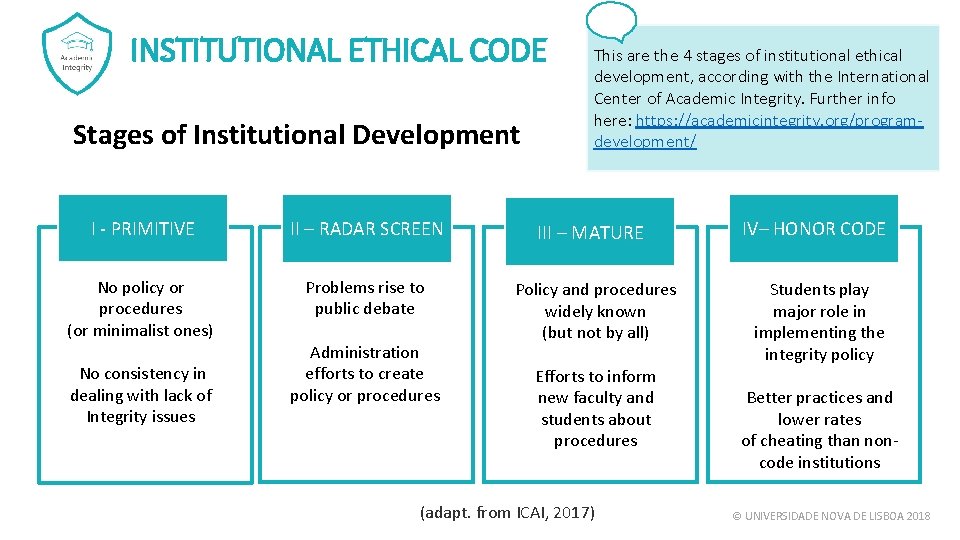
INSTITUTIONAL ETHICAL CODE Stages of Institutional Development I - PRIMITIVE II – RADAR SCREEN No policy or procedures (or minimalist ones) Problems rise to public debate No consistency in dealing with lack of Integrity issues Administration efforts to create policy or procedures This are the 4 stages of institutional ethical development, according with the International Center of Academic Integrity. Further info here: https: //academicintegrity. org/programdevelopment/ III – MATURE Policy and procedures widely known (but not by all) Efforts to inform new faculty and students about procedures (adapt. from ICAI, 2017) IV– HONOR CODE Students play major role in implementing the integrity policy Better practices and lower rates of cheating than noncode institutions © UNIVERSIDADE NOVA DE LISBOA 2018
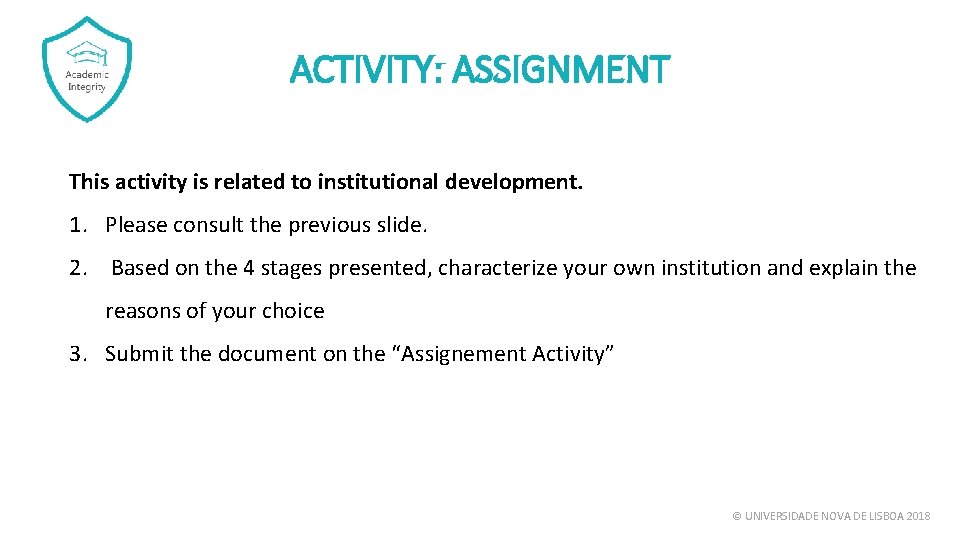
ACTIVITY: ASSIGNMENT This activity is related to institutional development. 1. Please consult the previous slide. 2. Based on the 4 stages presented, characterize your own institution and explain the reasons of your choice 3. Submit the document on the “Assignement Activity” © UNIVERSIDADE NOVA DE LISBOA 2018
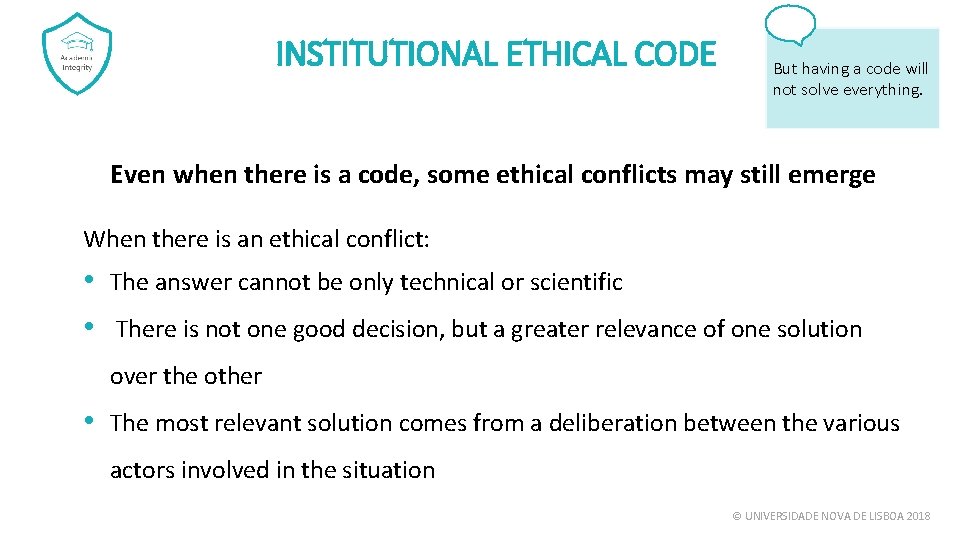
INSTITUTIONAL ETHICAL CODE But having a code will not solve everything. Even when there is a code, some ethical conflicts may still emerge When there is an ethical conflict: • The answer cannot be only technical or scientific • There is not one good decision, but a greater relevance of one solution over the other • The most relevant solution comes from a deliberation between the various actors involved in the situation © UNIVERSIDADE NOVA DE LISBOA 2018
ETHICAL ISSUES IN THE INSTITUTIONS An “unfinished business” A major role in Academia There’s always space for development © UNIVERSIDADE NOVA DE LISBOA 2018
INSTITUTIONAL AND PERSONAL DEVELOPMENT Institutional and personal development agendas should be aligned. They are intertwined and influence each other. © UNIVERSIDADE NOVA DE LISBOA 2018
PERSONAL DEVELOPMENT Personal Development – the concept within the institutional context • A deeply context-related concept (Ashmore and Robinson, 2015) • Emerging most of the times from a tension between institutional and personal needs (Orr et al. , 2015) • Obeying to specific conditions: - Alignment with institutional goals and values (Blackwell and Blackmore, 2003) - Validation by top leadership (Senge, 2001) © UNIVERSIDADE NOVA DE LISBOA 2018