
The Task Predicts Performance The main point is
- Slides: 12
The Task Predicts Performance The main point is that simple, low-level assignments won't equip students for complex, demanding, high-level work (on tests or later in life). - Susan Weston
Key Elements • What predicts performance is what the students are actually doing • Memorization is recall and does not show evidence of understanding • Evidence based learning (Observers must observe/evaluate the students’ performance rather than the performance of the teacher)
Experts • Walter Doyle • Thomas Schelling • Susan Weston • Eleanor Dougherty • Anita Archer & Charles Hughes • John Hollingsworth & Silvia Ybarra
Research behind common core • Davis and Mc. Knight (1976) met with strong resistance from high school students when they attempted to shift information-processing demands in a mathematics class from routine or procedural tasks to understanding tasks. The students refused to cooperate and argued that they had a right to be told what to do. • From Walter Doyle article Academic work. Review of Educational Research, Summer 1983, Vol. 53, No. 2, Pp. 159 -199
Susan Weston • Finally, the idea that "task predicts performance" practically radiates out of the Gates Foundation strategies for supporting the Common Core Standards in literacy and mathematics. In the math effort, the center is student engagement with tasks that demand active struggle to find the mathematical connections and apply mathematical practices. In the literacy approach, the center is student tasks combining demanding reading with significant writing on important academic content. In both approaches, the students themselves are called on to do the heavy lifting and develop the important intellectual muscles they'll need to meet the expectations of higher education, good jobs, and effective civic participation.
Eleanor Dougherty When assignments are not taught or are not taught explicitly, students lose out on the academic and intellectual experiences that assignments offer. According to Harvard researchers who have studied classroom dynamics, the "task predicts performance" (City, Elmore, Fieman, & Teitel, 2009, p. 30). If assignments are not of high quality and are not relevant to the curriculum, then learning will also be of low quality and loosely connected to the curriculum, if at all. Teaching and learning constitute a reciprocal process. Ineffective instruction is often distinguished by a loosely regulated plan, and students spend classroom time going through the motions of learning but not producing solid evidence of that learning. In these classrooms, the purpose for doing activities is lost, and learning loses energy and meaning. In contrast, a well-crafted assignment ensures that instruction will provide students with a goal and the power to get there, enabling them to engage in rigorous and interesting academic contexts as they acquire the content and skills necessary to participate in academic coursework. Most important, assignments create teaching and learning opportunities to think and learn about ideas, topics, events, and questions— about specific content in the curriculum. This is why a quality assignment is the hallmark of effective instruction.
Elements of a good Task predicts Performance Model (City, Elmore, Fiarman, & Teitel) • Made connections to previous days work • Discussed version of what needed to be done before they begin assignment • Understanding of the importance of the task • Routine established • Elements of explicit teaching **The following are detailed frameworks that include these elements. **
EDI Lesson Design Components John Hollingsworth and Silvia Ybarra • Learning Objective: A statement describing what students will be able to do by the end of the lesson. It must match the Independent Practice. • Activate Prior Knowledge: Purposefully moving something connected to the new lesson from students' long-term memories into their working memories so they can build upon existing knowledge. • Concept Development: Teaching students the concepts contained in the Learning Objective. • Skill Development: Teaching students the steps or processes used to execute the skills in the Learning Objective. • Lesson Importance: Teaching students why the content in the lesson is important for them to learn. • Guided Practice: Working problems with students at the same time, step-bystep, while checking that they execute each step correctly • Lesson Closure: Having students work problems or answer questions to prove that they have learned the concepts and skills in the Learning Objective before they are released to work on their own. • Independent Practice: Having students successfully practice exactly what they were just taught
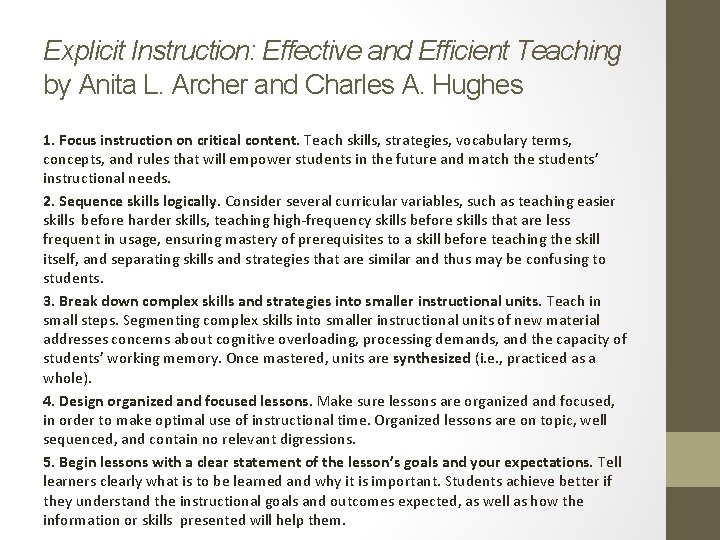
Explicit Instruction: Effective and Efficient Teaching by Anita L. Archer and Charles A. Hughes 1. Focus instruction on critical content. Teach skills, strategies, vocabulary terms, concepts, and rules that will empower students in the future and match the students’ instructional needs. 2. Sequence skills logically. Consider several curricular variables, such as teaching easier skills before harder skills, teaching high-frequency skills before skills that are less frequent in usage, ensuring mastery of prerequisites to a skill before teaching the skill itself, and separating skills and strategies that are similar and thus may be confusing to students. 3. Break down complex skills and strategies into smaller instructional units. Teach in small steps. Segmenting complex skills into smaller instructional units of new material addresses concerns about cognitive overloading, processing demands, and the capacity of students’ working memory. Once mastered, units are synthesized (i. e. , practiced as a whole). 4. Design organized and focused lessons. Make sure lessons are organized and focused, in order to make optimal use of instructional time. Organized lessons are on topic, well sequenced, and contain no relevant digressions. 5. Begin lessons with a clear statement of the lesson’s goals and your expectations. Tell learners clearly what is to be learned and why it is important. Students achieve better if they understand the instructional goals and outcomes expected, as well as how the information or skills presented will help them.
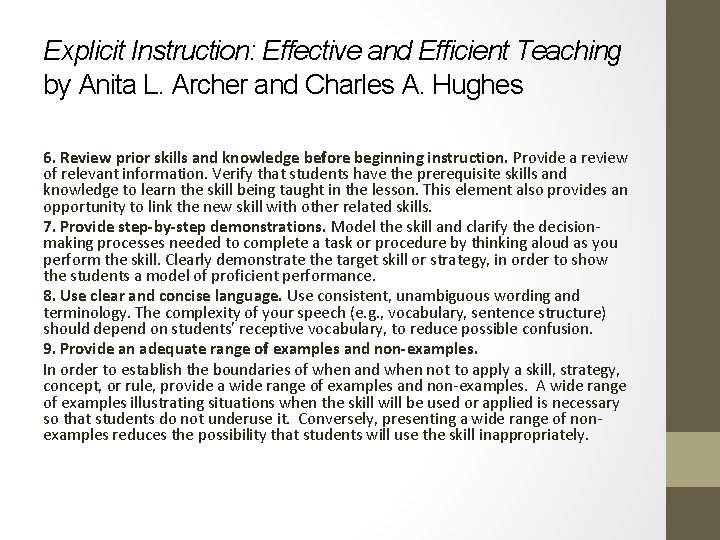
Explicit Instruction: Effective and Efficient Teaching by Anita L. Archer and Charles A. Hughes 6. Review prior skills and knowledge before beginning instruction. Provide a review of relevant information. Verify that students have the prerequisite skills and knowledge to learn the skill being taught in the lesson. This element also provides an opportunity to link the new skill with other related skills. 7. Provide step-by-step demonstrations. Model the skill and clarify the decisionmaking processes needed to complete a task or procedure by thinking aloud as you perform the skill. Clearly demonstrate the target skill or strategy, in order to show the students a model of proficient performance. 8. Use clear and concise language. Use consistent, unambiguous wording and terminology. The complexity of your speech (e. g. , vocabulary, sentence structure) should depend on students’ receptive vocabulary, to reduce possible confusion. 9. Provide an adequate range of examples and non-examples. In order to establish the boundaries of when and when not to apply a skill, strategy, concept, or rule, provide a wide range of examples and non-examples. A wide range of examples illustrating situations when the skill will be used or applied is necessary so that students do not underuse it. Conversely, presenting a wide range of nonexamples reduces the possibility that students will use the skill inappropriately.
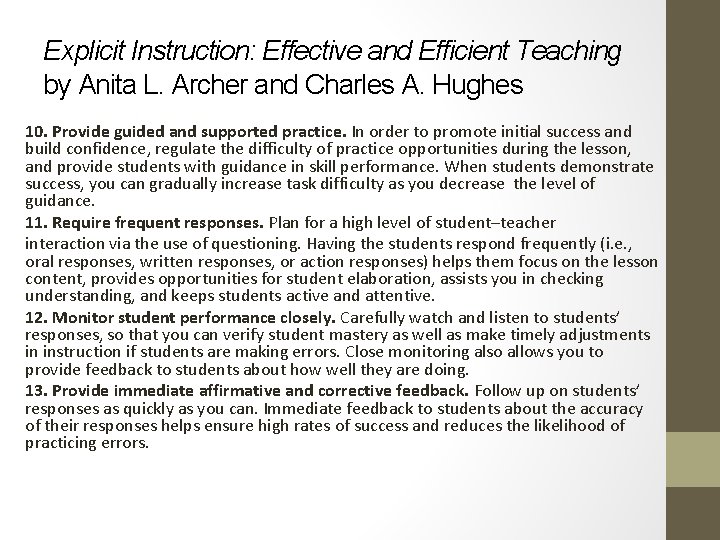
Explicit Instruction: Effective and Efficient Teaching by Anita L. Archer and Charles A. Hughes 10. Provide guided and supported practice. In order to promote initial success and build confidence, regulate the difficulty of practice opportunities during the lesson, and provide students with guidance in skill performance. When students demonstrate success, you can gradually increase task difficulty as you decrease the level of guidance. 11. Require frequent responses. Plan for a high level of student–teacher interaction via the use of questioning. Having the students respond frequently (i. e. , oral responses, written responses, or action responses) helps them focus on the lesson content, provides opportunities for student elaboration, assists you in checking understanding, and keeps students active and attentive. 12. Monitor student performance closely. Carefully watch and listen to students’ responses, so that you can verify student mastery as well as make timely adjustments in instruction if students are making errors. Close monitoring also allows you to provide feedback to students about how well they are doing. 13. Provide immediate affirmative and corrective feedback. Follow up on students’ responses as quickly as you can. Immediate feedback to students about the accuracy of their responses helps ensure high rates of success and reduces the likelihood of practicing errors.
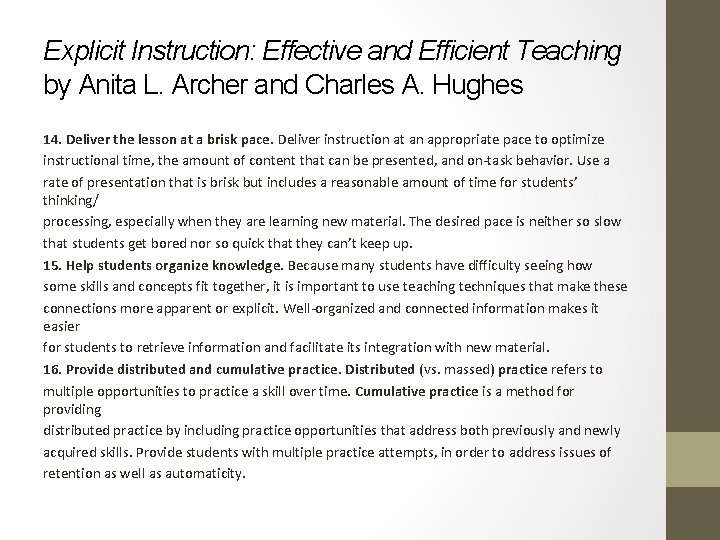
Explicit Instruction: Effective and Efficient Teaching by Anita L. Archer and Charles A. Hughes 14. Deliver the lesson at a brisk pace. Deliver instruction at an appropriate pace to optimize instructional time, the amount of content that can be presented, and on-task behavior. Use a rate of presentation that is brisk but includes a reasonable amount of time for students’ thinking/ processing, especially when they are learning new material. The desired pace is neither so slow that students get bored nor so quick that they can’t keep up. 15. Help students organize knowledge. Because many students have difficulty seeing how some skills and concepts fit together, it is important to use teaching techniques that make these connections more apparent or explicit. Well-organized and connected information makes it easier for students to retrieve information and facilitate its integration with new material. 16. Provide distributed and cumulative practice. Distributed (vs. massed) practice refers to multiple opportunities to practice a skill over time. Cumulative practice is a method for providing distributed practice by including practice opportunities that address both previously and newly acquired skills. Provide students with multiple practice attempts, in order to address issues of retention as well as automaticity.