
The tano meaning good people LocationSettlement of the
- Slides: 53
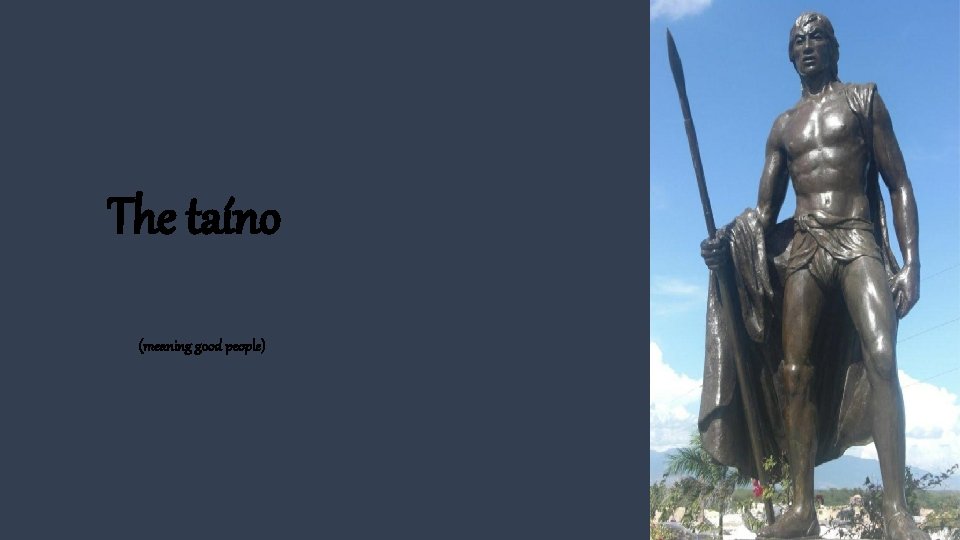
The taíno (meaning good people)
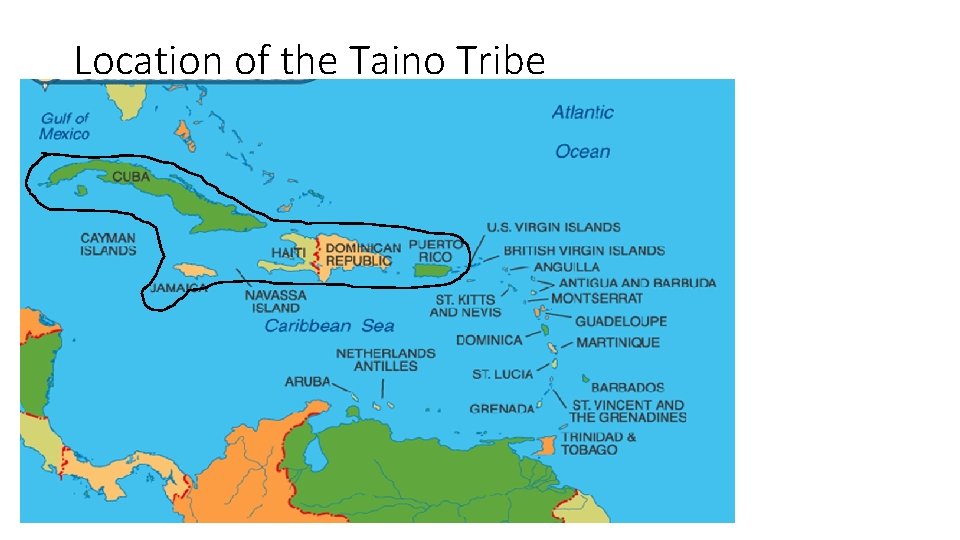
Location/Settlement of the Taino by Nshaun Ambrose • The Taino were known as the Arawak people who were the indigenous people of the Caribbean. They were peaceful. • At the time of the arrival of the Europeans: Christopher Columbus, the Taino were the principal inhabitants of most of the Greater Antilles: Cuba, Jamaica, Hispaniola and Puerto Rico. • The Taino were the first New World people to be encountered by Columbus during his 1492 voyage. They spoke the Taino language, an Arawakan language.
Location of the Taino Tribe
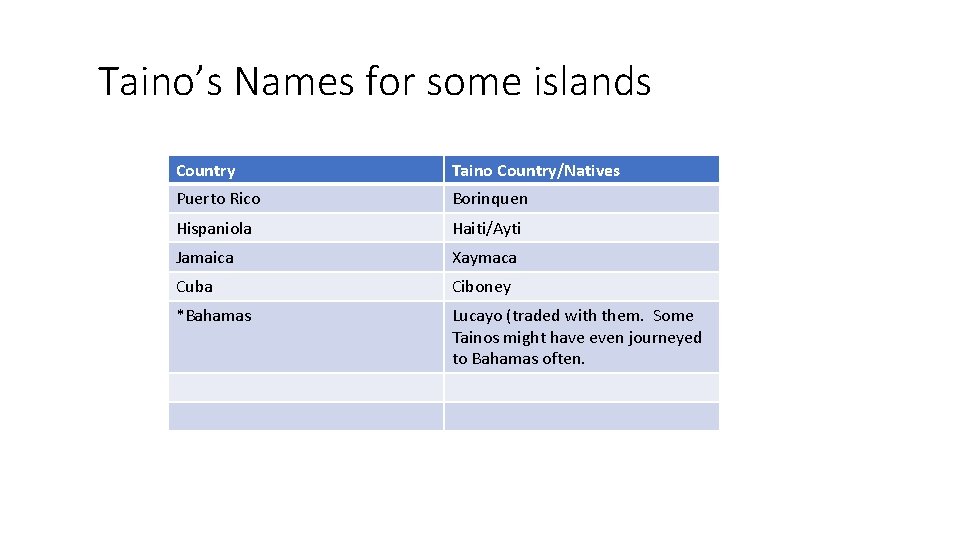
Taino’s Names for some islands Country Taino Country/Natives Puerto Rico Borinquen Hispaniola Haiti/Ayti Jamaica Xaymaca Cuba Ciboney *Bahamas Lucayo (traded with them. Some Tainos might have even journeyed to Bahamas often.
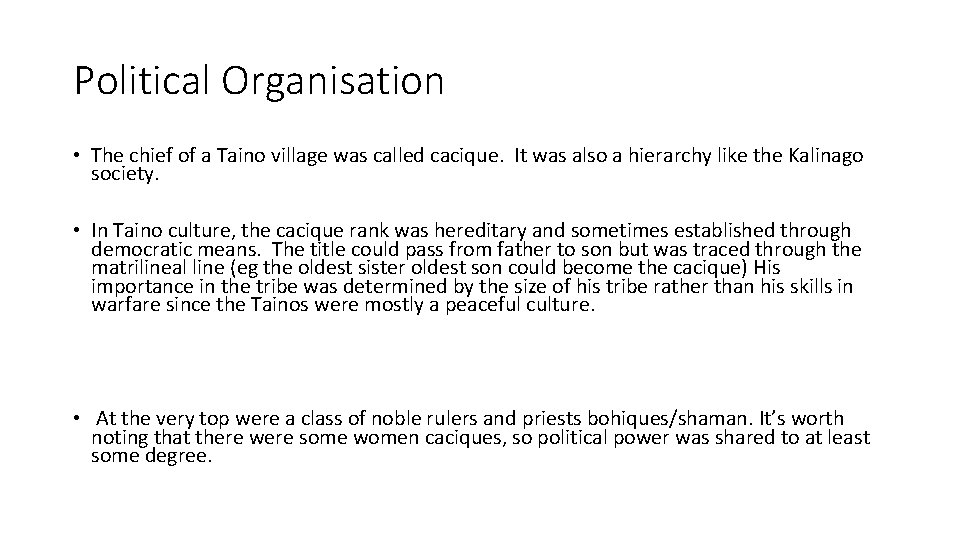
Political Organisation • The chief of a Taino village was called cacique. It was also a hierarchy like the Kalinago society. • In Taino culture, the cacique rank was hereditary and sometimes established through democratic means. The title could pass from father to son but was traced through the matrilineal line (eg the oldest sister oldest son could become the cacique) His importance in the tribe was determined by the size of his tribe rather than his skills in warfare since the Tainos were mostly a peaceful culture. • At the very top were a class of noble rulers and priests bohiques/shaman. It’s worth noting that there were some women caciques, so political power was shared to at least some degree.
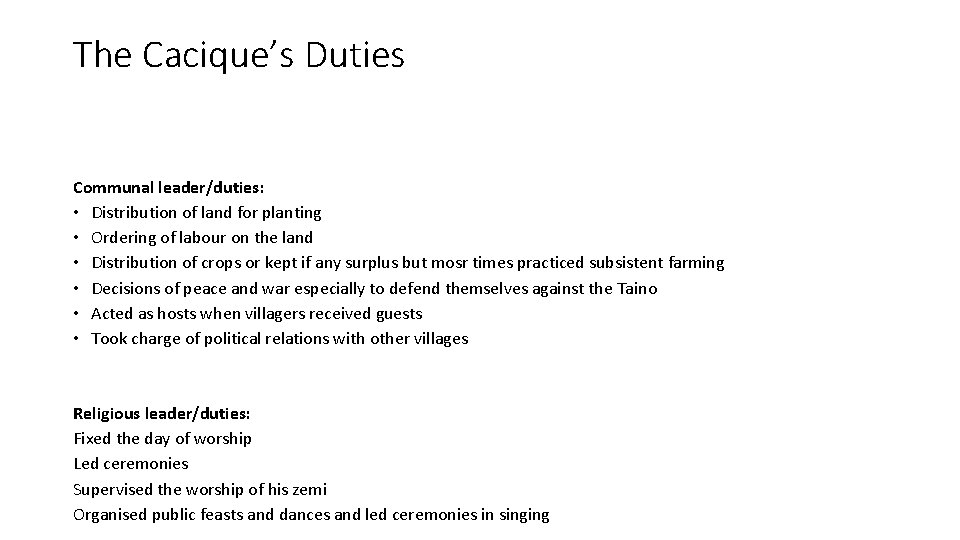
The Cacique’s Duties Communal leader/duties: • Distribution of land for planting • Ordering of labour on the land • Distribution of crops or kept if any surplus but mosr times practiced subsistent farming • Decisions of peace and war especially to defend themselves against the Taino • Acted as hosts when villagers received guests • Took charge of political relations with other villages Religious leader/duties: Fixed the day of worship Led ceremonies Supervised the worship of his zemi Organised public feasts and dances and led ceremonies in singing
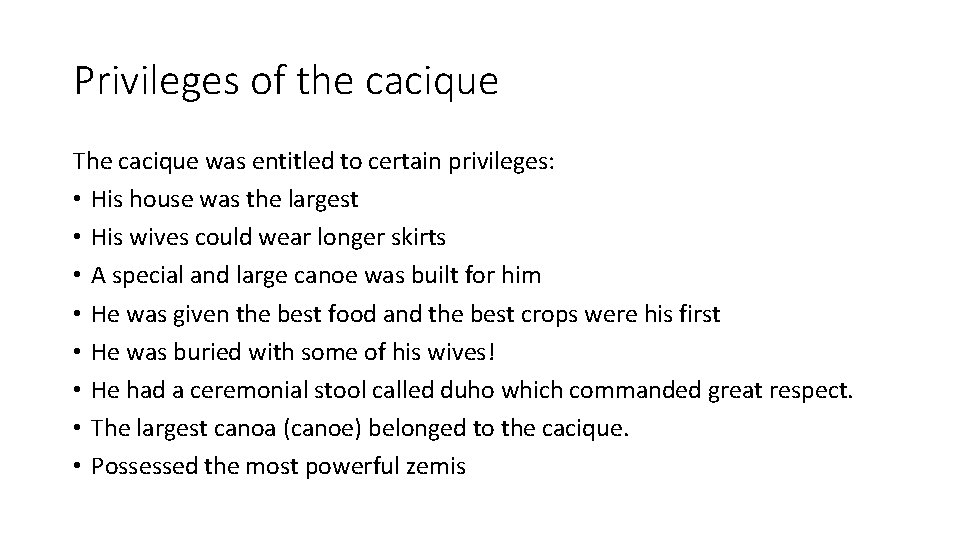
Privileges of the cacique The cacique was entitled to certain privileges: • His house was the largest • His wives could wear longer skirts • A special and large canoe was built for him • He was given the best food and the best crops were his first • He was buried with some of his wives! • He had a ceremonial stool called duho which commanded great respect. • The largest canoa (canoe) belonged to the cacique. • Possessed the most powerful zemis
Some popular caciques who fought off Columbus (Spanish) • Agüeybaná –Fought Spanish in Puerto Rico • Guarionex-Ruled parts of Hispaniola • Anacoana-female cacique Hispaniola • Hatuey-fought and burnt at stake -Cuba 1511
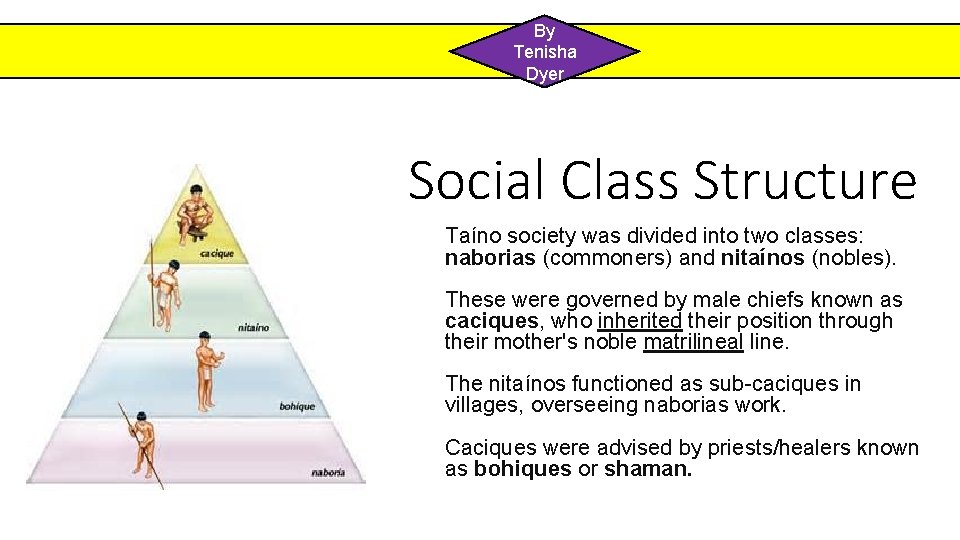
Te By Tenisha Dyer Social Class Structure Taíno society was divided into two classes: naborias (commoners) and nitaínos (nobles). These were governed by male chiefs known as caciques, who inherited their position through their mother's noble matrilineal line. The nitaínos functioned as sub-caciques in villages, overseeing naborias work. Caciques were advised by priests/healers known as bohiques or shaman.
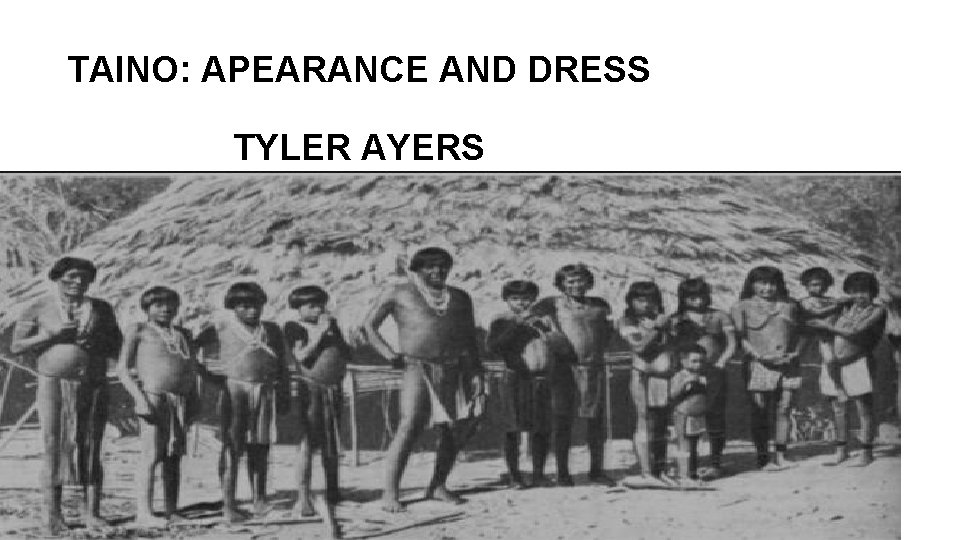
TAINO: APEARANCE AND DRESS TYLER AYERS
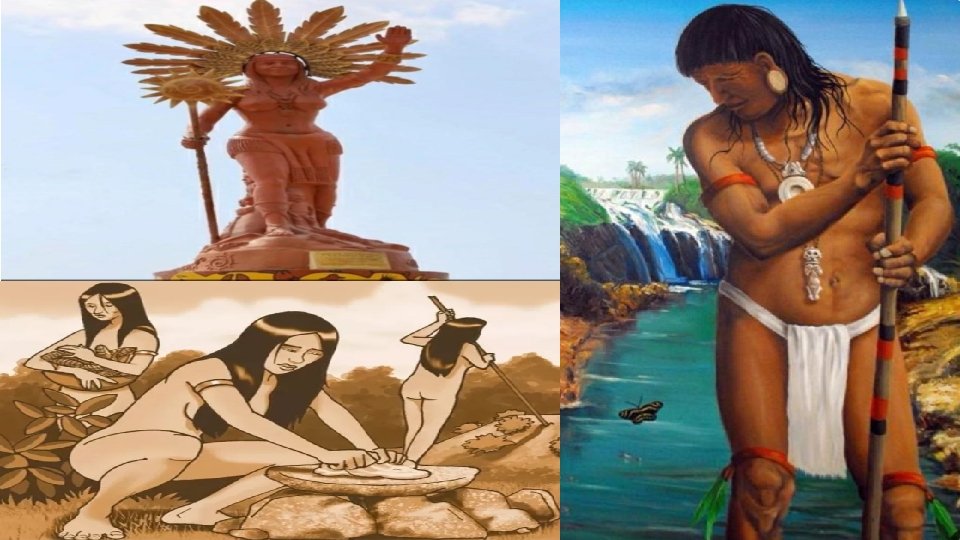
APPEARANCE In appearance the Taino were short and muscular and had a brown olive complexion and straight hair. They wore little clothes but decorated their bodies with dyes. Their general physical appearance was consistent with the appearance of other Indians of the Americas. They were rarely taller than five feet six inches, which would make them rather small to modern North American eyes. They painted their bodies with earth dyes and adorned themselves with shells and metals.
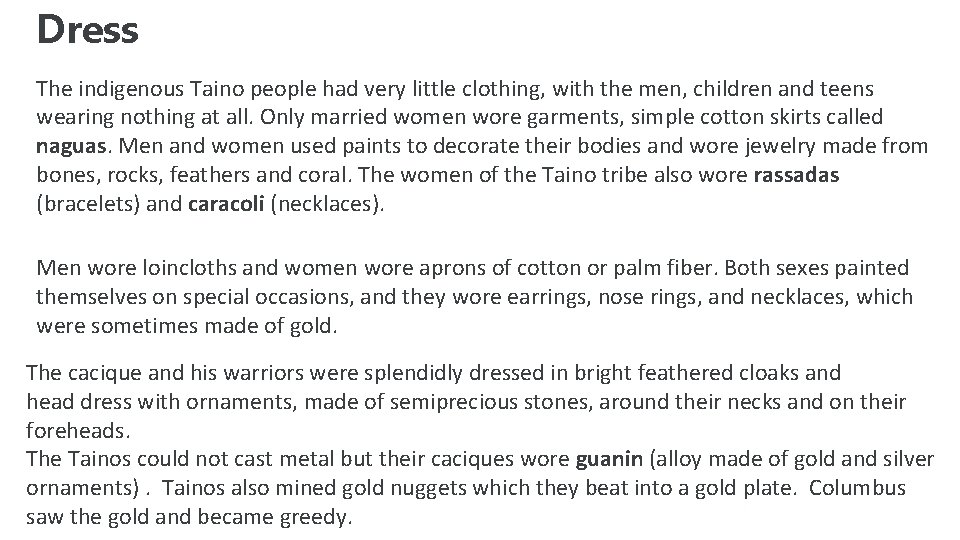
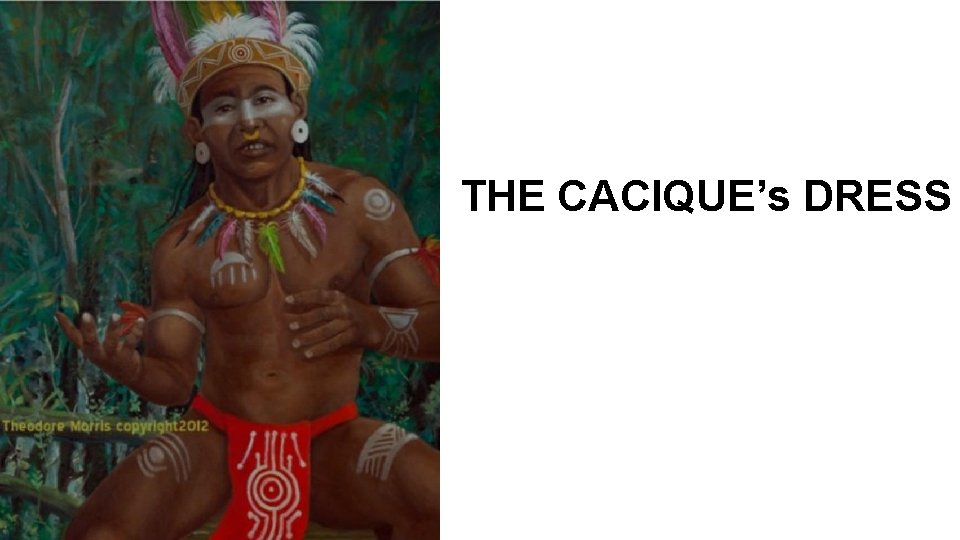
Dress The indigenous Taino people had very little clothing, with the men, children and teens wearing nothing at all. Only married women wore garments, simple cotton skirts called naguas. Men and women used paints to decorate their bodies and wore jewelry made from bones, rocks, feathers and coral. The women of the Taino tribe also wore rassadas (bracelets) and caracoli (necklaces). Men wore loincloths and women wore aprons of cotton or palm fiber. Both sexes painted themselves on special occasions, and they wore earrings, nose rings, and necklaces, which were sometimes made of gold. The cacique and his warriors were splendidly dressed in bright feathered cloaks and head dress with ornaments, made of semiprecious stones, around their necks and on their foreheads. The Tainos could not cast metal but their caciques wore guanin (alloy made of gold and silver ornaments). Tainos also mined gold nuggets which they beat into a gold plate. Columbus saw the gold and became greedy.
THE CACIQUE’s DRESS
Taino‘s Religion Aniyah Blackman
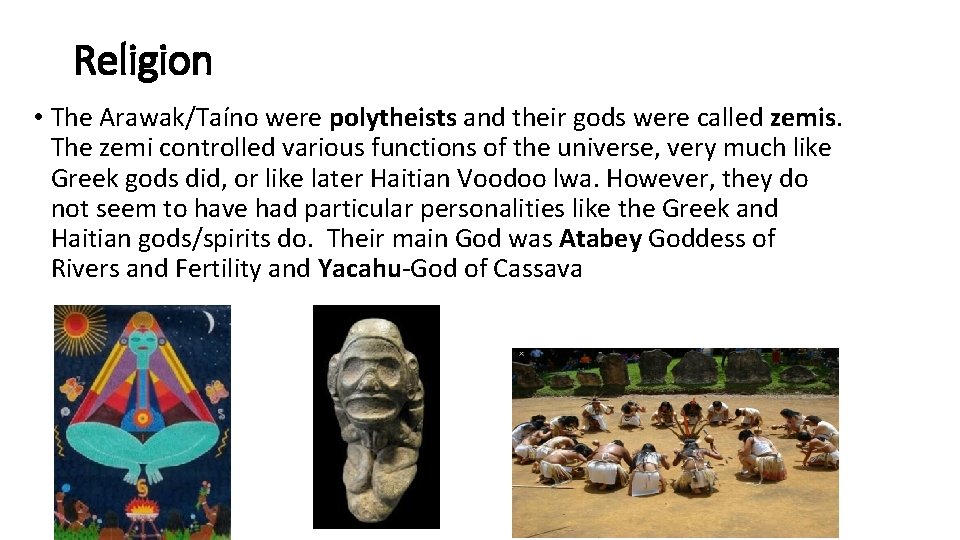
Religion • The Arawak/Taíno were polytheists and their gods were called zemis. The zemi controlled various functions of the universe, very much like Greek gods did, or like later Haitian Voodoo lwa. However, they do not seem to have had particular personalities like the Greek and Haitian gods/spirits do. Their main God was Atabey Goddess of Rivers and Fertility and Yacahu-God of Cassava
• There were three primary religious practices: • 1. Religious worship and obeisance (respect) to the zemi themselves. • 2. Dancing in the village court during special festivals of thanksgiving or petition. • 3. Medicine men, or priests-shamans- consulting the zemi for advice and healing. This was done in public ceremonies with song and dance.
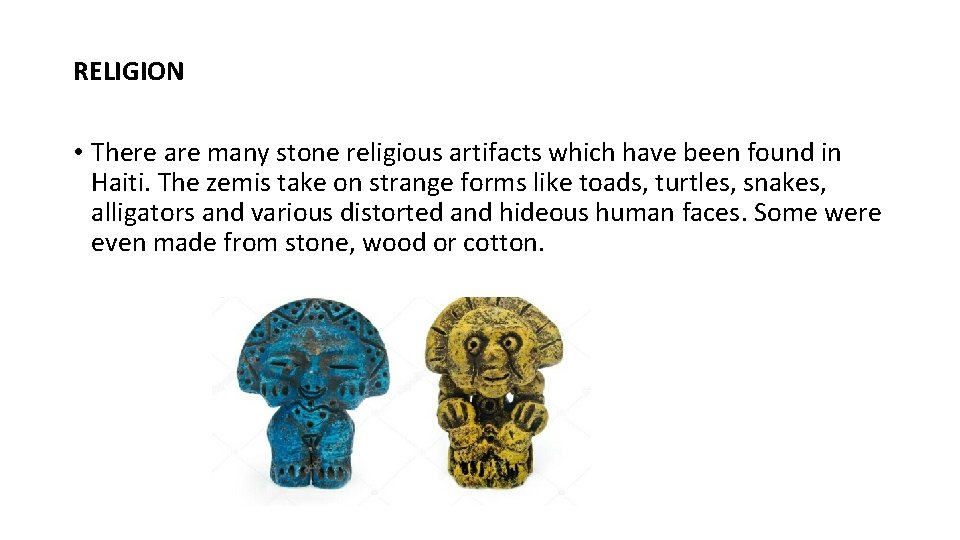
RELIGION • There are many stone religious artifacts which have been found in Haiti. The zemis take on strange forms like toads, turtles, snakes, alligators and various distorted and hideous human faces. Some were even made from stone, wood or cotton.
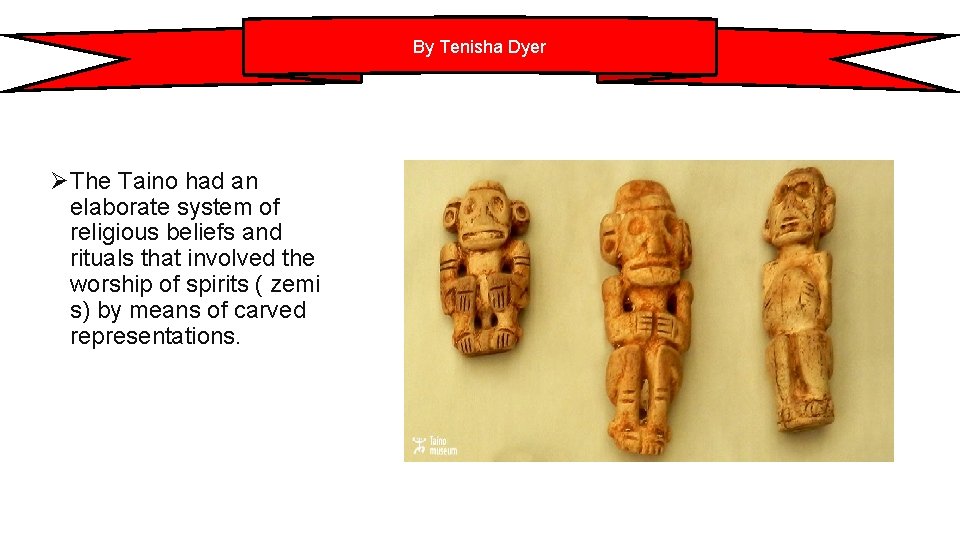
By Tenisha Dyer ØThe Taino had an elaborate system of religious beliefs and rituals that involved the worship of spirits ( zemi s) by means of carved representations.
RELIGION • People had special dress for the ceremonies which included paint and feathers. From their knees on down they would be covered in shells. The shaman (medicine man or priests) presented the carved figures of the zemi. The cacique sat on wooden stool, a place of honor. (There are many surviving stone carvings of the cacique on his stool called the duho). There was a ceremonial beating of drums.
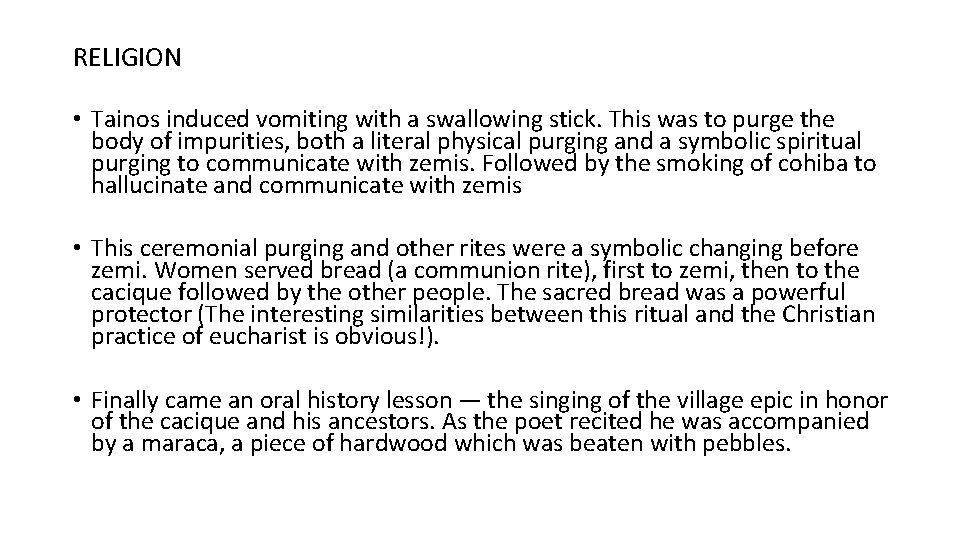
RELIGION • Tainos induced vomiting with a swallowing stick. This was to purge the body of impurities, both a literal physical purging and a symbolic spiritual purging to communicate with zemis. Followed by the smoking of cohiba to hallucinate and communicate with zemis • This ceremonial purging and other rites were a symbolic changing before zemi. Women served bread (a communion rite), first to zemi, then to the cacique followed by the other people. The sacred bread was a powerful protector (The interesting similarities between this ritual and the Christian practice of eucharist is obvious!). • Finally came an oral history lesson — the singing of the village epic in honor of the cacique and his ancestors. As the poet recited he was accompanied by a maraca, a piece of hardwood which was beaten with pebbles.
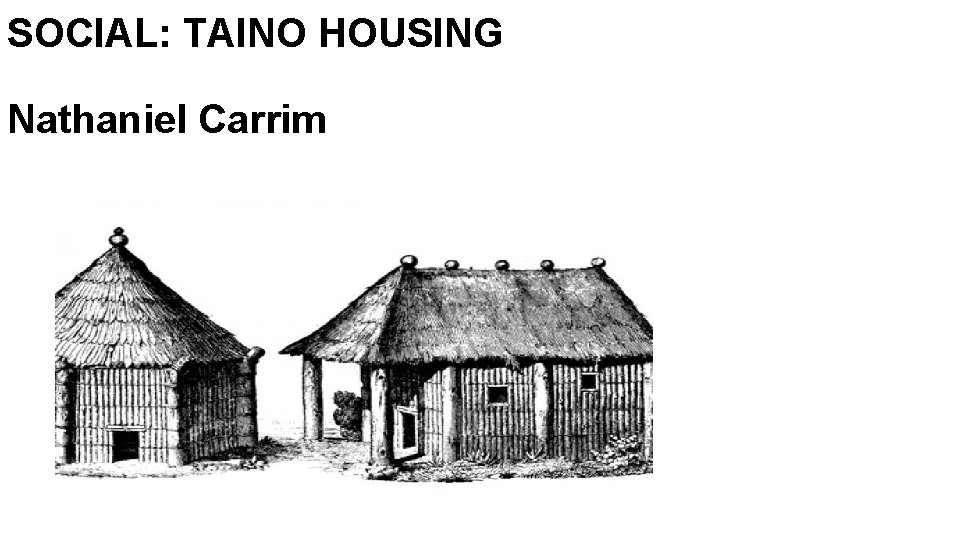
SOCIAL: TAINO HOUSING Nathaniel Carrim
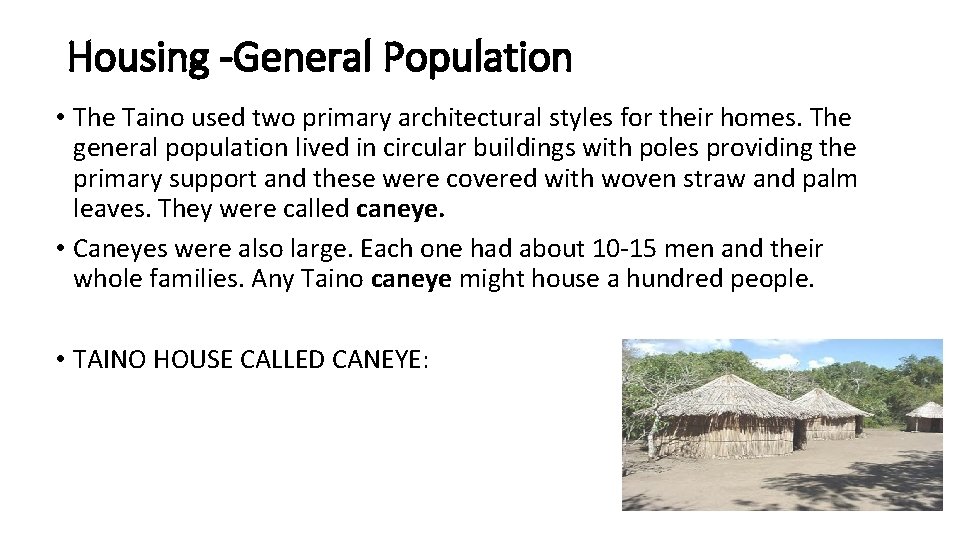
Housing -General Population • The Taino used two primary architectural styles for their homes. The general population lived in circular buildings with poles providing the primary support and these were covered with woven straw and palm leaves. They were called caneye. • Caneyes were also large. Each one had about 10 -15 men and their whole families. Any Taino caneye might house a hundred people. • TAINO HOUSE CALLED CANEYE:
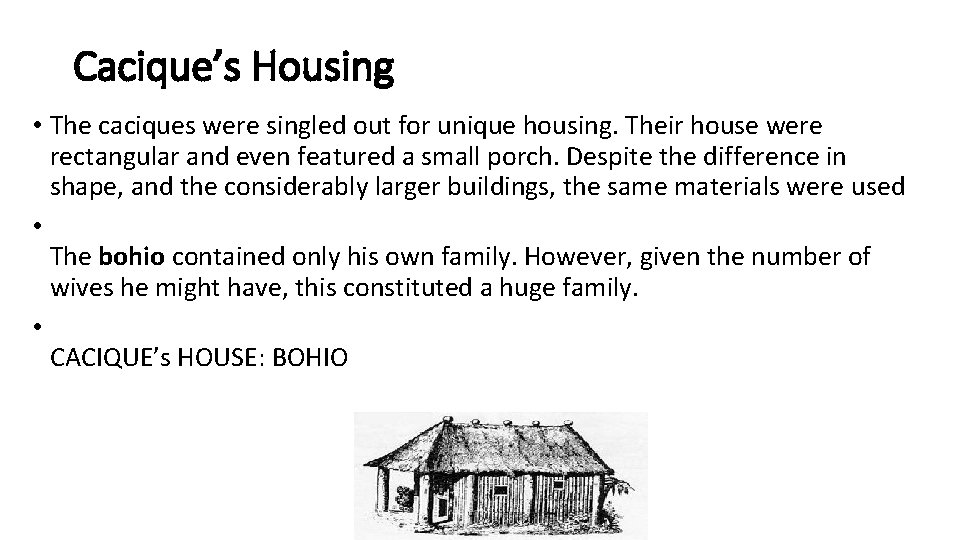
Cacique’s Housing • The caciques were singled out for unique housing. Their house were rectangular and even featured a small porch. Despite the difference in shape, and the considerably larger buildings, the same materials were used • The bohio contained only his own family. However, given the number of wives he might have, this constituted a huge family. • CACIQUE’s HOUSE: BOHIO
Housing Conditions • The houses did not contain much furniture. People slept in cotton hammocks or simply on mats of banana leaves. they also made wooden chairs with woven seats, couches and built cradles for their children. • In addition to houses a typical Taino village contained a flat court in the center of the village which was used for ball games and various festivals, both religious and secular. Houses were around this court. Stone making was especially developed among the Taino, but they seem not to have used it at all in building houses. It was primarily used for tools and especially religious artifacts.
History Social – Diet/Favourite Dish/ Do Not Eat Name: Omega Chow Teacher: Ms. Modeste Group 1: Taíno people Class: 4. 3
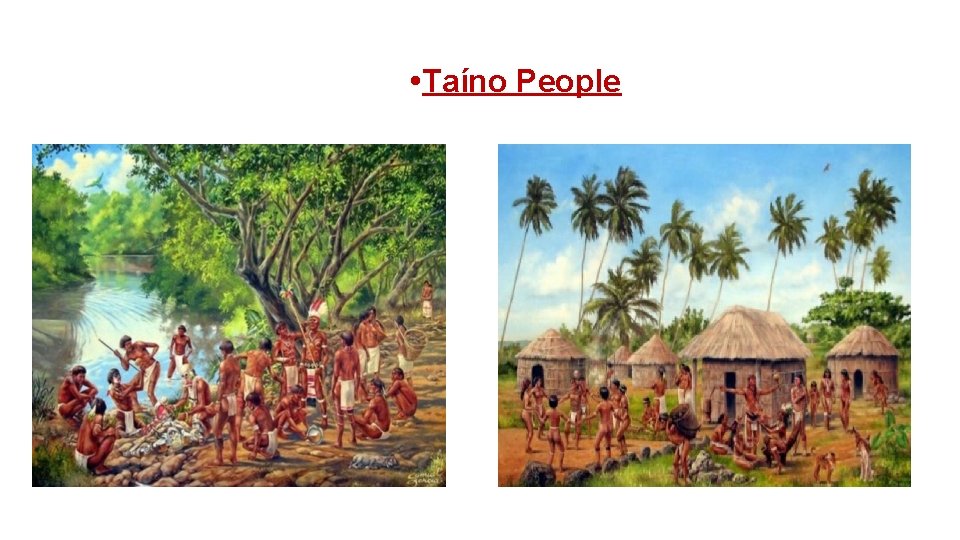
• Taíno People
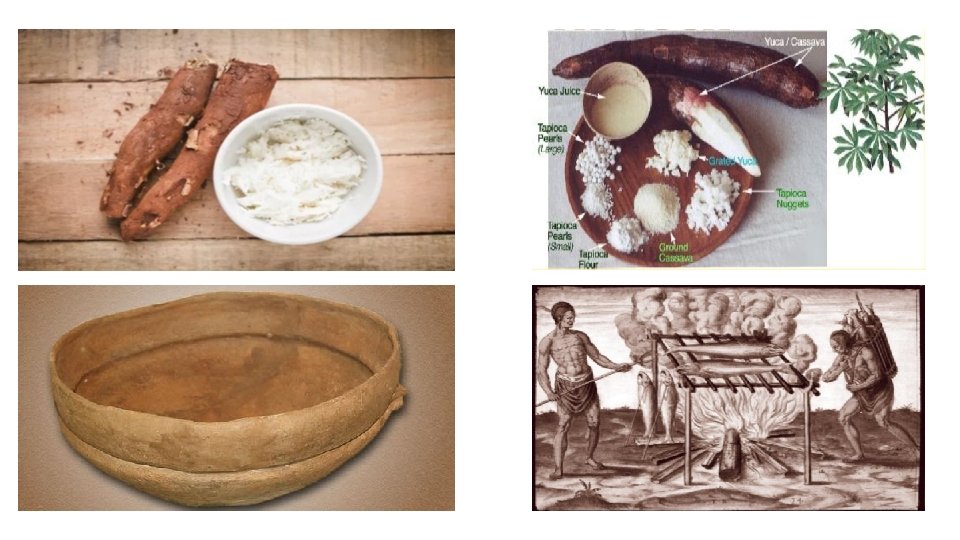
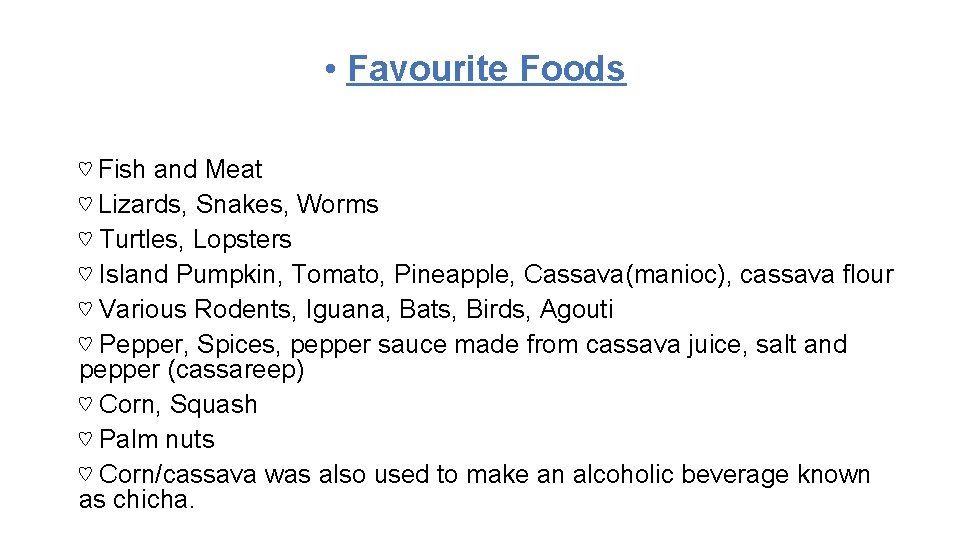
• Diet The Taíno people diet centered around meat and fish as the primary source of protein. Vegetables and fruits such as papaya, yams, guavas, cassava, manioc/ yuca, sweet potato or batata, and a variety of beans and peanuts. There were never many wild animals to hunt on Hispaniola, however there were some small mammals utia which were hunted and enjoyed. Barkless dogs called alcos were used to assist them in hunting. Generally, they ate any living thing found. They hunted ducks and turtles in the lakes and seas. The coastal natives relied heavily on fishing, which they ate raw or partially cooked. They knew about baking, stewing and roasting as well One of the primary crops cultivated by the Taíno people was cassava//manioc/yuca, which they ate as a flat bread ( bammy in Jamaica today). The natives of the interior relied more on agriculture and deemphasized meat or fish in their diet. The Taíno people began the process of
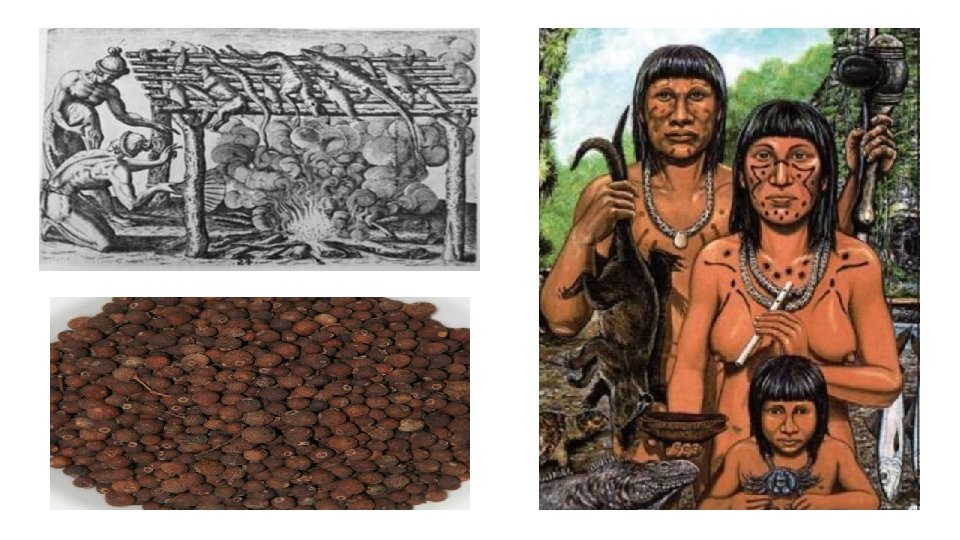
• Favourite Foods ♡ Fish and Meat ♡ Lizards, Snakes, Worms ♡ Turtles, Lopsters ♡ Island Pumpkin, Tomato, Pineapple, Cassava(manioc), cassava flour ♡ Various Rodents, Iguana, Bats, Birds, Agouti ♡ Pepper, Spices, pepper sauce made from cassava juice, salt and pepper (cassareep) ♡ Corn, Squash ♡ Palm nuts ♡ Corn/cassava was also used to make an alcoholic beverage known as chicha.
• Did Not Eat The Taíno people did not eat the fruit mammy apple. They believed that once death occurred, the soul roamed for days whilst feeding on mammy apple trees at nights before going to coyaba (heaven)
Celine Depoosingh Form 4. 3 Taínos – Greater Antilles Topic ECONOMIC - Fishing, agriculture crops grown
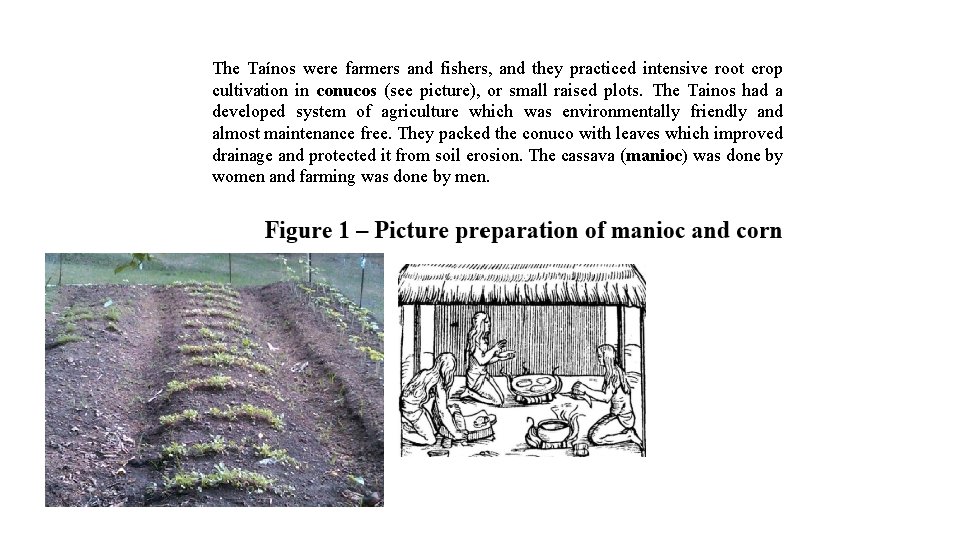
The Taínos were farmers and fishers, and they practiced intensive root crop cultivation in conucos (see picture), or small raised plots. The Tainos had a developed system of agriculture which was environmentally friendly and almost maintenance free. They packed the conuco with leaves which improved drainage and protected it from soil erosion. The cassava (manioc) was done by women and farming was done by men.
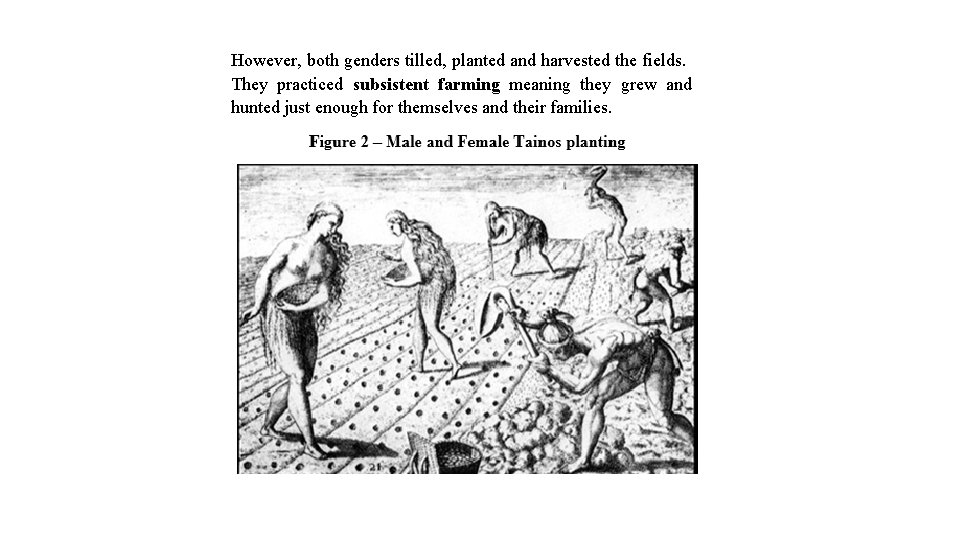
However, both genders tilled, planted and harvested the fields. They practiced subsistent farming meaning they grew and hunted just enough for themselves and their families.
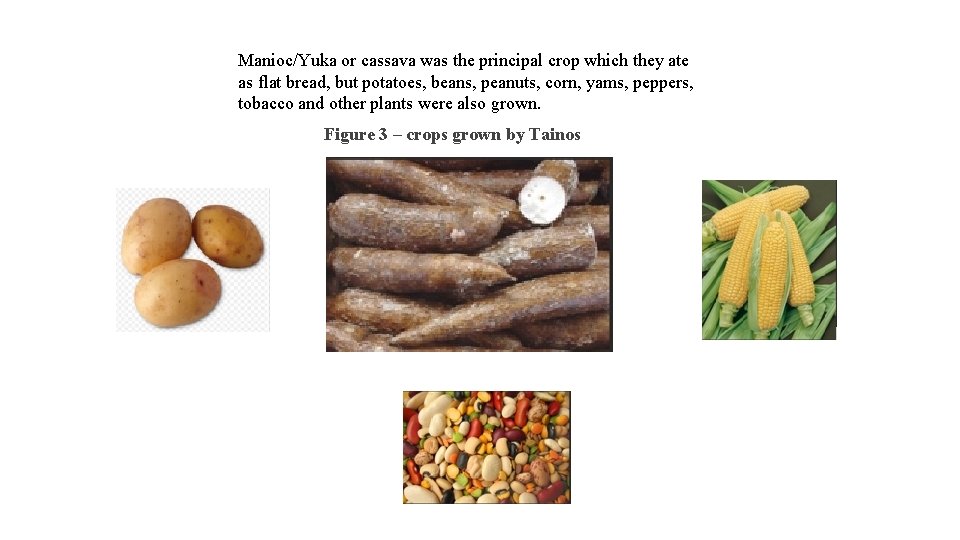
Manioc/Yuka or cassava was the principal crop which they ate as flat bread, but potatoes, beans, peanuts, corn, yams, peppers, tobacco and other plants were also grown. Figure 3 – crops grown by Tainos
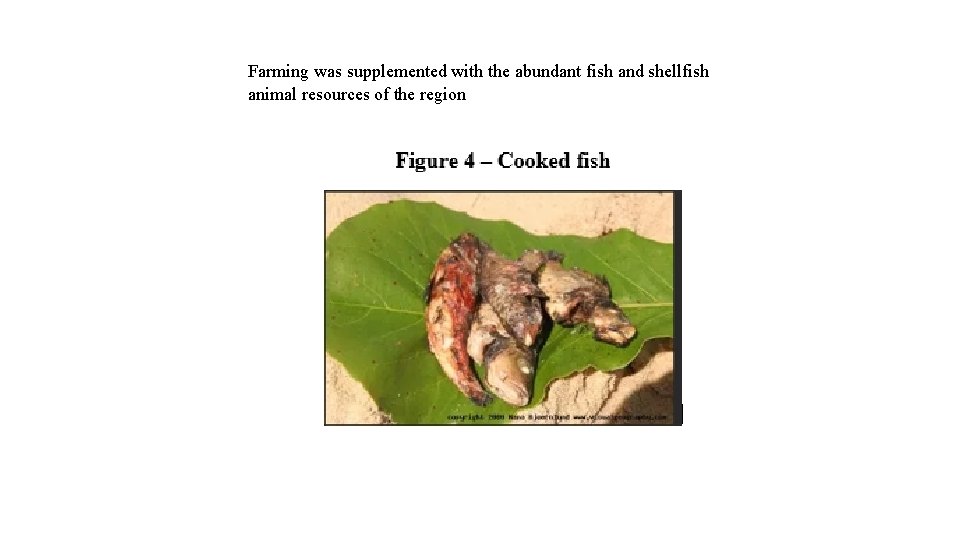
Farming was supplemented with the abundant fish and shellfish animal resources of the region
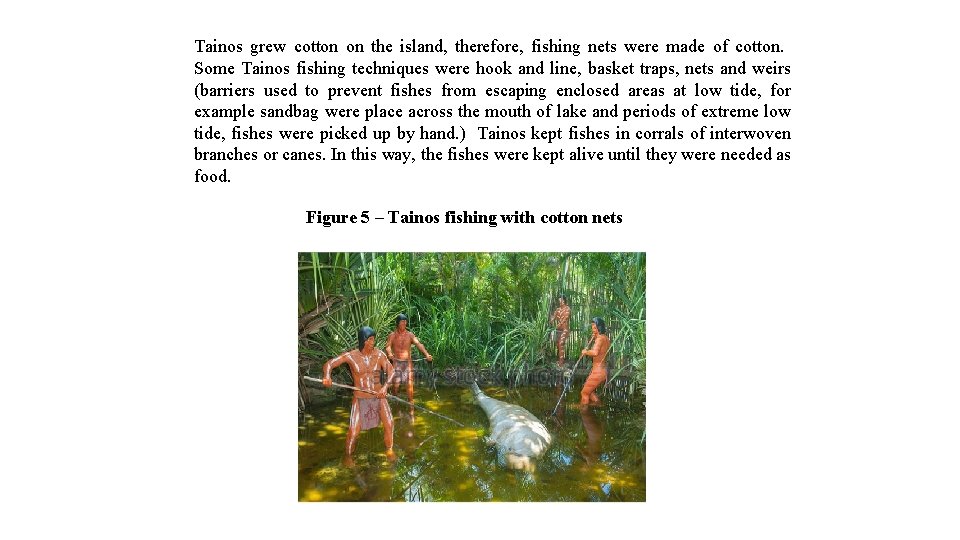
Tainos grew cotton on the island, therefore, fishing nets were made of cotton. Some Tainos fishing techniques were hook and line, basket traps, nets and weirs (barriers used to prevent fishes from escaping enclosed areas at low tide, for example sandbag were place across the mouth of lake and periods of extreme low tide, fishes were picked up by hand. ) Tainos kept fishes in corrals of interwoven branches or canes. In this way, the fishes were kept alive until they were needed as food. Figure 5 – Tainos fishing with cotton nets
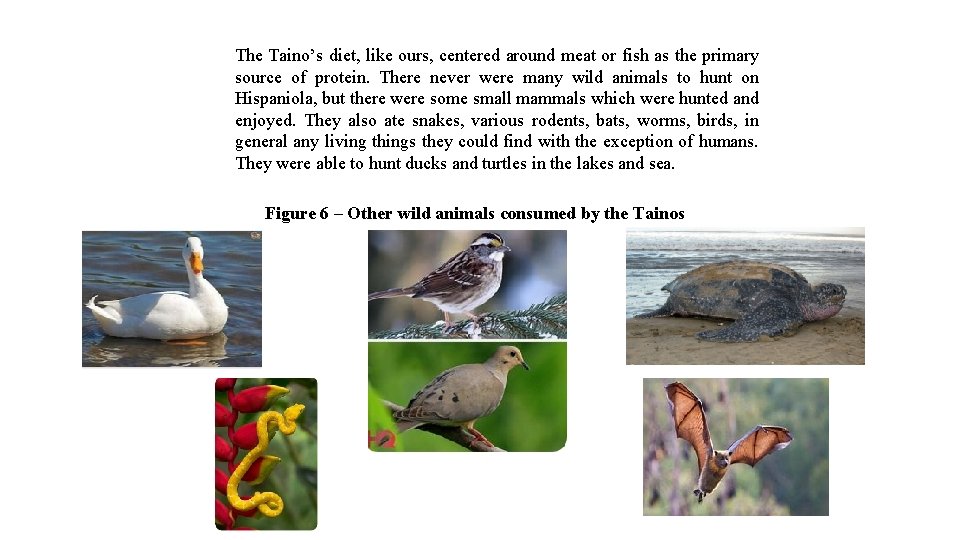
The Taino’s diet, like ours, centered around meat or fish as the primary source of protein. There never were many wild animals to hunt on Hispaniola, but there were some small mammals which were hunted and enjoyed. They also ate snakes, various rodents, bats, worms, birds, in general any living things they could find with the exception of humans. They were able to hunt ducks and turtles in the lakes and sea. Figure 6 – Other wild animals consumed by the Tainos
FISHING The Tainos had two innovative ways of fishing • Catching Ducks-Tainos would float gourds (calabashes) down the river until they got accustomed seeing the calabashes for some days. Tainos would then put the gourd over their heads, with holes for their eyes and drift down the rivers quietly approaching the ducks, pulling them by their legs underwater and drowning the ducks. • Catching turtles-they attached the remora fish(sucker fish) to a long line to a canoe. The remora would attach itself to the back of turtle with its sucker. The turtle would then be pulled into the canoe by the fishermen.
Zuriel Durham 4: 3 Group project taino
Technology Tainos might not have been technologically advanced in terms of smart phones, but they were creative, innovative and ingenious: Cooking-Technology: • They would have baked fish in stone lined pits (much like the modern “clam bakes”) and fried fish on flat clay griddles. Fish was the main dish of Taino diet … in this way, the fishes were kept alive until they were needed as food. • Fishing-Technology: Using spears, weaving cotton nets
• Weaponry-Technology • The Taino tribe crafted weapons that they used in their defence. They used the formidable bow and arrow, and had developed some poisons for their arrow tips. They had cotton ropes for defensive purposes and some spears with fish hooks on the end. Since there were hardwoods on the island, they did have a war club made macana. • (Add any other you remember)
• Skill-Technology: • Every Taino villager had a certain job to do. Some pottery and baskets were made from stone, marble and wood were worked skillfully to store food or used in religious ceremonies. • Pottery –Technology: and weaving baskets to hold food, water or for religious ceremonies.
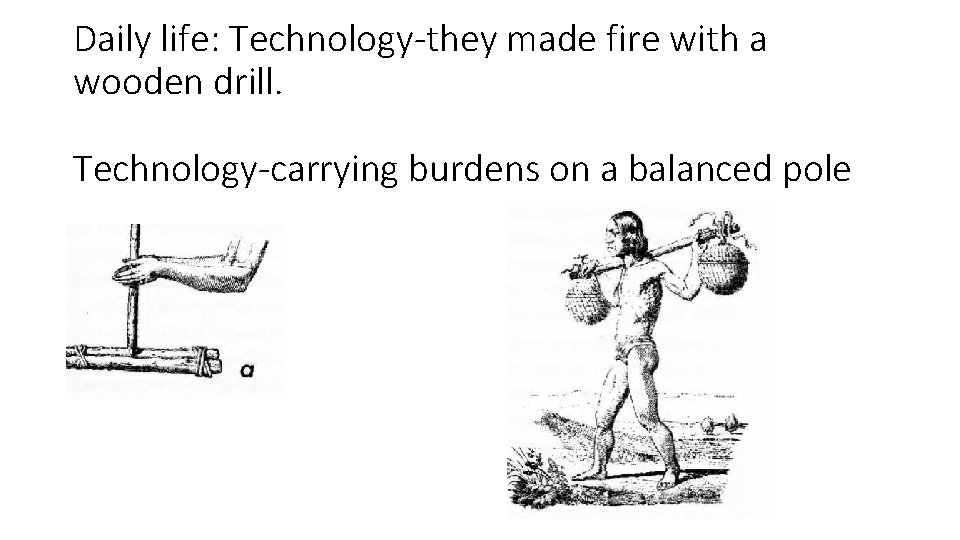
Daily life: Technology-they made fire with a wooden drill. Technology-carrying burdens on a balanced pole
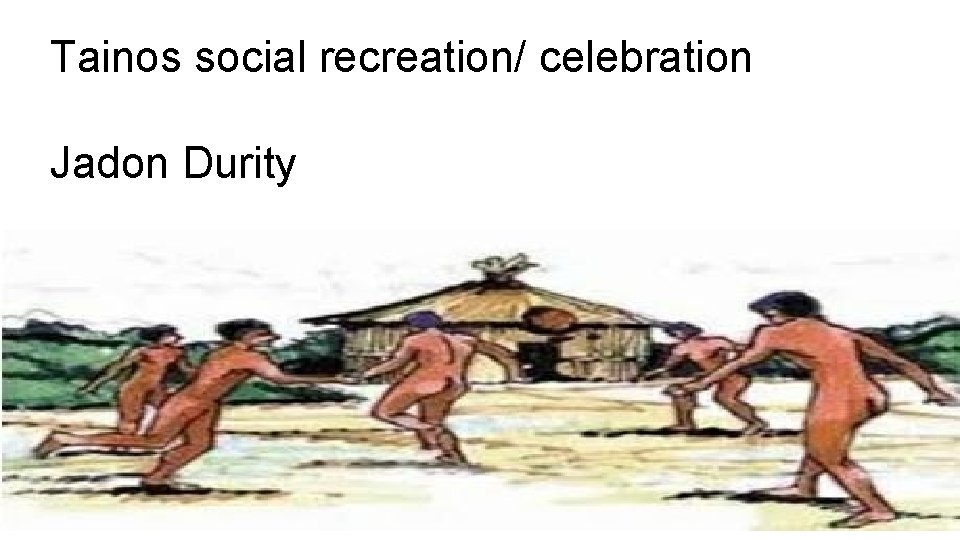
Tainos social recreation/ celebration Jadon Durity
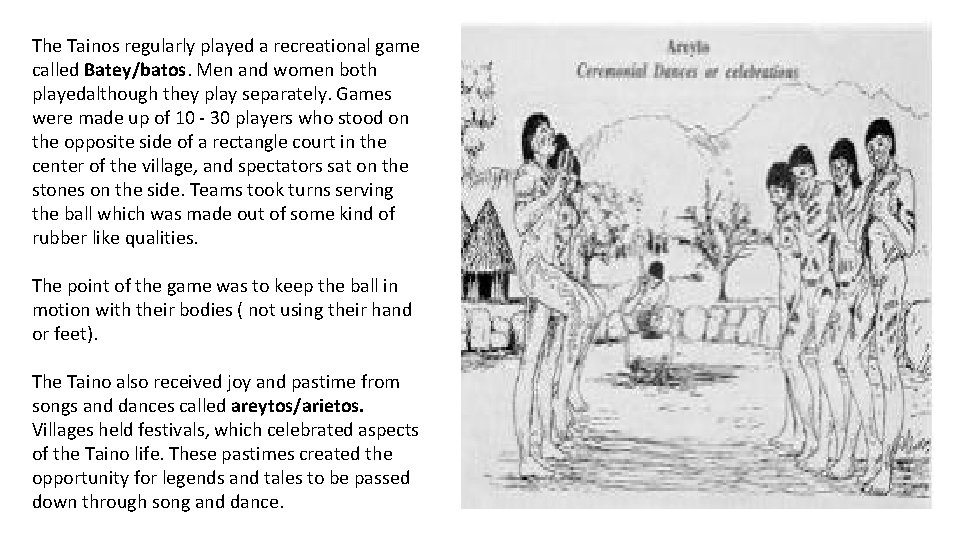
The Tainos regularly played a recreational game called Batey/batos. Men and women both playedalthough they play separately. Games were made up of 10 - 30 players who stood on the opposite side of a rectangle court in the center of the village, and spectators sat on the stones on the side. Teams took turns serving the ball which was made out of some kind of rubber like qualities. The point of the game was to keep the ball in motion with their bodies ( not using their hand or feet). The Taino also received joy and pastime from songs and dances called areytos/arietos. Villages held festivals, which celebrated aspects of the Taino life. These pastimes created the opportunity for legends and tales to be passed down through song and dance.
Taino People Jenine Edmund Social. Culture/Artifacts/Pottery/Weaving
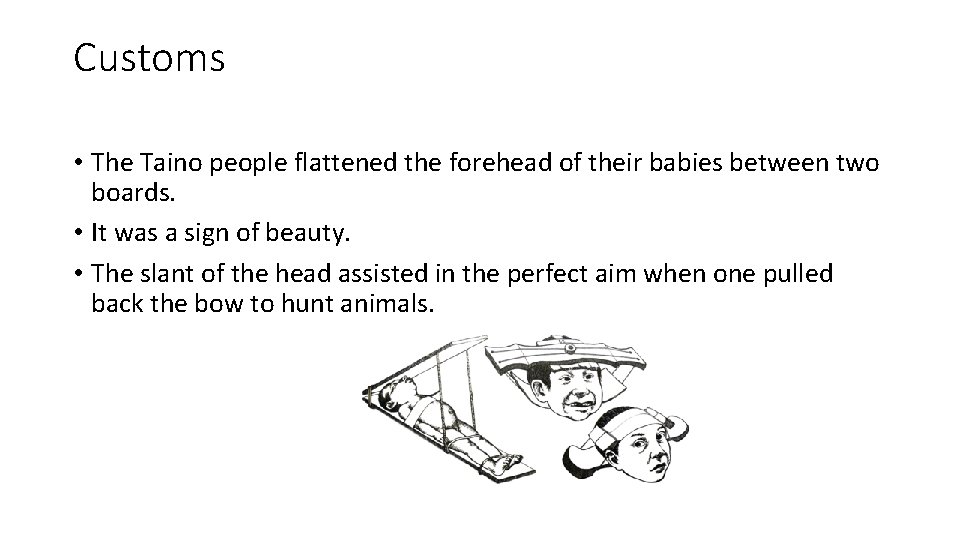
Customs • The Taino people flattened the forehead of their babies between two boards. • It was a sign of beauty. • The slant of the head assisted in the perfect aim when one pulled back the bow to hunt animals.
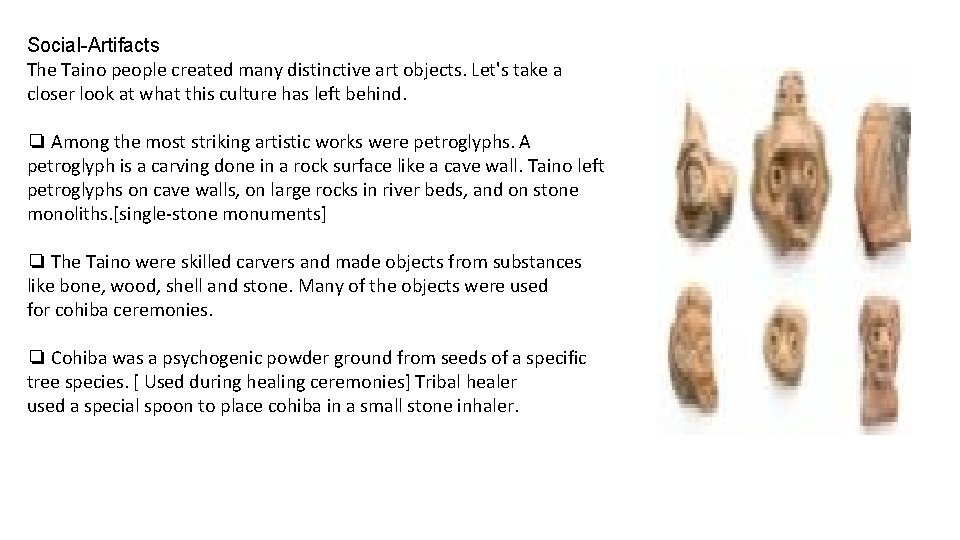
Social-Artifacts The Taino people created many distinctive art objects. Let's take a closer look at what this culture has left behind. ❏ Among the most striking artistic works were petroglyphs. A petroglyph is a carving done in a rock surface like a cave wall. Taino left petroglyphs on cave walls, on large rocks in river beds, and on stone monoliths. [single-stone monuments] ❏ The Taino were skilled carvers and made objects from substances like bone, wood, shell and stone. Many of the objects were used for cohiba ceremonies. ❏ Cohiba was a psychogenic powder ground from seeds of a specific tree species. [ Used during healing ceremonies] Tribal healer used a special spoon to place cohiba in a small stone inhaler.
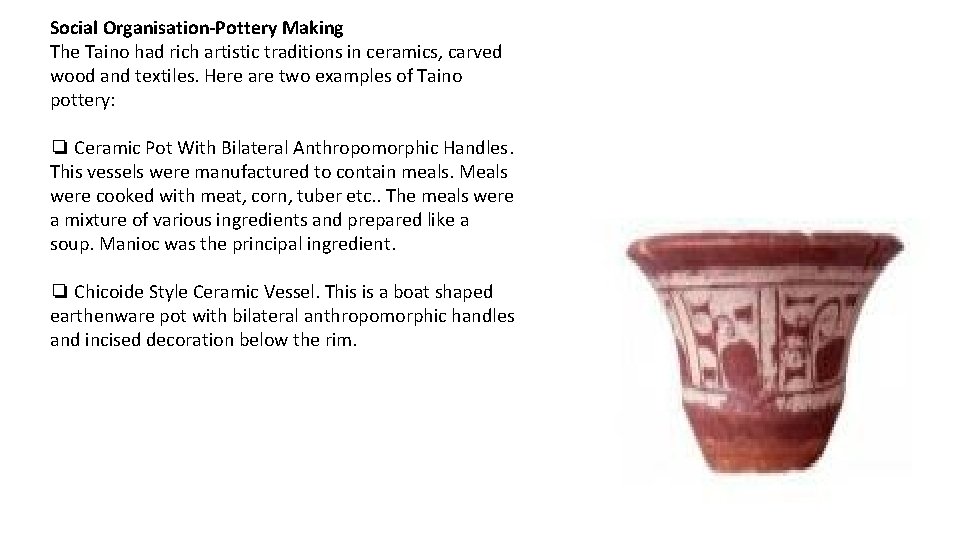
Social Organisation-Pottery Making The Taino had rich artistic traditions in ceramics, carved wood and textiles. Here are two examples of Taino pottery: ❏ Ceramic Pot With Bilateral Anthropomorphic Handles. This vessels were manufactured to contain meals. Meals were cooked with meat, corn, tuber etc. . The meals were a mixture of various ingredients and prepared like a soup. Manioc was the principal ingredient. ❏ Chicoide Style Ceramic Vessel. This is a boat shaped earthenware pot with bilateral anthropomorphic handles and incised decoration below the rim.
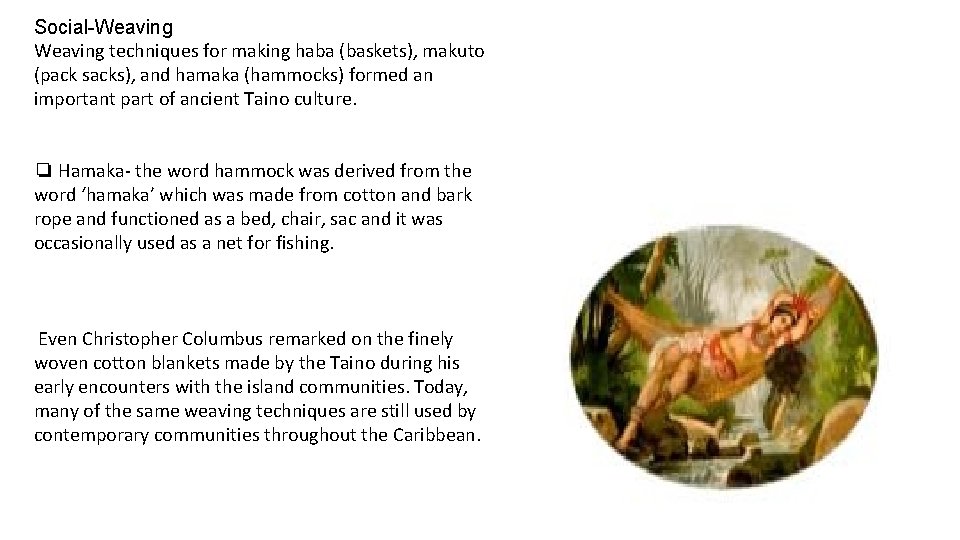
Social-Weaving techniques for making haba (baskets), makuto (pack sacks), and hamaka (hammocks) formed an important part of ancient Taino culture. ❏ Hamaka- the word hammock was derived from the word ‘hamaka’ which was made from cotton and bark rope and functioned as a bed, chair, sac and it was occasionally used as a net for fishing. Even Christopher Columbus remarked on the finely woven cotton blankets made by the Taino during his early encounters with the island communities. Today, many of the same weaving techniques are still used by contemporary communities throughout the Caribbean.
Summary • The Taino culture was at its height in the Caribbean from roughly 1000 to 1500 AD. Largely agricultural, they farmed crops such as yams, • Corn, cassava, and squash. The Taino were also excellent hunters and fishermen and often traveled amid the islands. Most Taino lived in • Family compounds led by a chief called a cacique. They had their own system of gods and deities, and protective spirits called zemis that came from deceased ancestors. • ❏ Taínos can be traced to Arawakan-speaking people living along the Orinoco River in South America. • ❏ The Taino had an elaborate system of religious beliefs and rituals that involved the worship of spirits (zemis) b means of carved representations. • ❏ They continue traditions such as the preparation of cassava bread, traditional weaving, instrument making and other creations, canoe crafting, and the observance of important ceremonies