
The Taming of the Shrew William Shakespeare Remembering
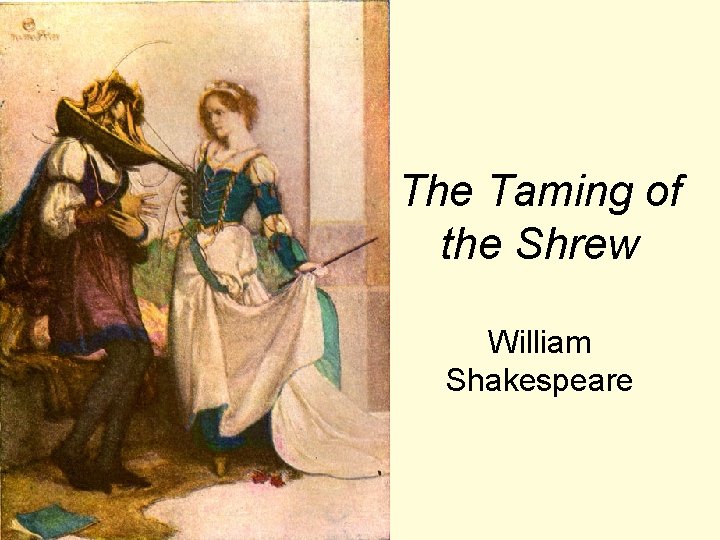
The Taming of the Shrew William Shakespeare
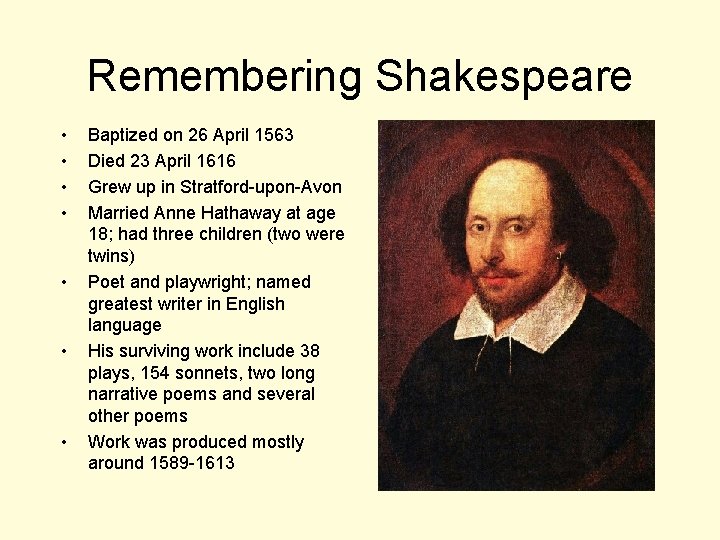
Remembering Shakespeare • • Baptized on 26 April 1563 Died 23 April 1616 Grew up in Stratford-upon-Avon Married Anne Hathaway at age 18; had three children (two were twins) Poet and playwright; named greatest writer in English language His surviving work include 38 plays, 154 sonnets, two long narrative poems and several other poems Work was produced mostly around 1589 -1613
Shakespeare’s Comedies • Comedies (or Elizabethan comedies) include – Happy ending – Marriage occurs between unmarried characters – Light-hearted tone and style • Also – Separation & reunification – Mistaken identities – A clever servant – Heightened tensions, often within a couple – One, intertwining plot – Frequent punning
Shakespearean Devices • • • Play-within-a-play Use of disguises Love at first sight Fluid action = fast-paced action Asides = when the character speaks only for the audience to hear • Soliloquy = an act of speaking one’s thought either alone or with others present • Monologue = a long speech by a character
Understanding Puns • Puns are – A play on words that purposely brings about ambiguity between similarsounding words that have different meanings for the sake of humor – Double meanings • Examples of puns – “The pun is mightier than the word. ” – Don't sweat the petty things, and don't pet the sweaty things.

Puns from His Plays • Claudius: “. . . But now, my cousin Hamlet, and my son. . . ” Hamlet [aside]: “A little more than kin, and less than kind. ” – (Hamlet, 1. 2. 64 -65). – Context: Hamlet is upset that his uncle Claudius has married his mother. • Hint: Think of “kind” as also short for “kindred. ”
A Very Famous One • "No, 'tis not so deep as a well, nor so wide as a church-door, but 'tis enough, 'twill serve: ask for me tomorrow, and you shall find me a grave man. " – (Romeo and Juliet, Act III, scene 1) • Hint: Grave=serious, dead, sad.
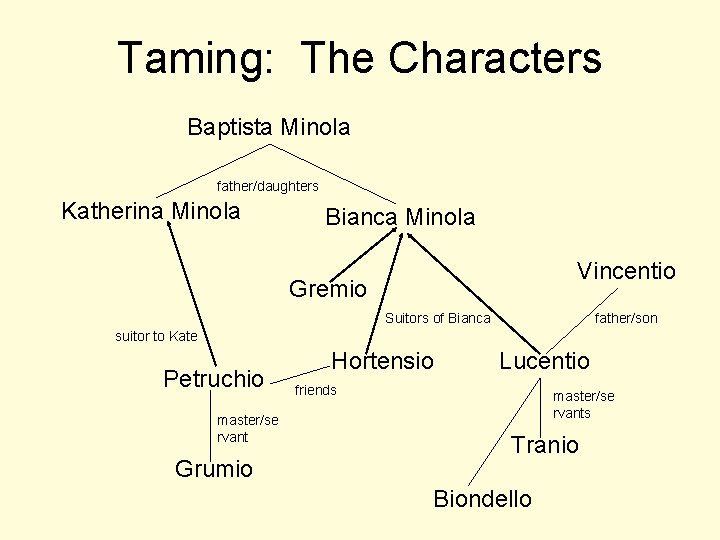
Taming: The Characters Baptista Minola father/daughters Katherina Minola Bianca Minola Vincentio Gremio Suitors of Bianca father/son suitor to Kate Petruchio master/se rvant Grumio Hortensio Lucentio friends master/se rvants Tranio Biondello
Taming: The Plot • Baptista Minola has two daughters: a gentle, beautiful, younger one (Bianca) who has many suitors and an older one (Katherina) who is considered a shrew. • Bianca cannot marry until Katherina does. • Bianca’s suitors conspire to find a suitor for Katherina, but there are very few choices. • Just by luck, Hortensio’s friend, Petruchio, comes to town to find a wife! • Petruchio claims he does not mind Kate’s shrewish behavior, because he plans to tame her.
Terms to Know • • Shrew = a vexatious, scolding, brawling woman Tame = to change from a wild state; to domesticate Domesticated = to convert to home life; tame Dowry = property or money brought by a wife to her husband on their marriage • Patriarchy = a system or society of government in which the father or eldest male is head of the family, and descent is traced through the male line • Gender roles = the rules in which men and women are supposed to live by according to their society
Katherina’s Character “She’s too rough for me. ” (Gremio) “No mates for you Unless you were of gentler, milder mould. ” (Hortensio) “…this fiend from hell” (Gremio) “Her elder sister is so curst and shrewd That, till her father rid his hands of her, Master, your love [Bianca] must live a maid at home. ” (Tranio)
More of Kate’s Character “Will you woo this wildcat? ” (Gremio) She’s “…famous for a scolding tongue. ” (Tranio) “I know she is an irksome, brawling scold. ” (Petruchio) “Her name is Katherina Minola, Renowned in Padua for her scolding tongue. ” (Hortensio)
Gender Roles Petruchio states this about his wife: “I will be master of what is mine own, She is my goods, my chattels; she is my house, My household-stuff, my field, my barn, My horse, my ox, my ass, my anything, And here she stands. ”
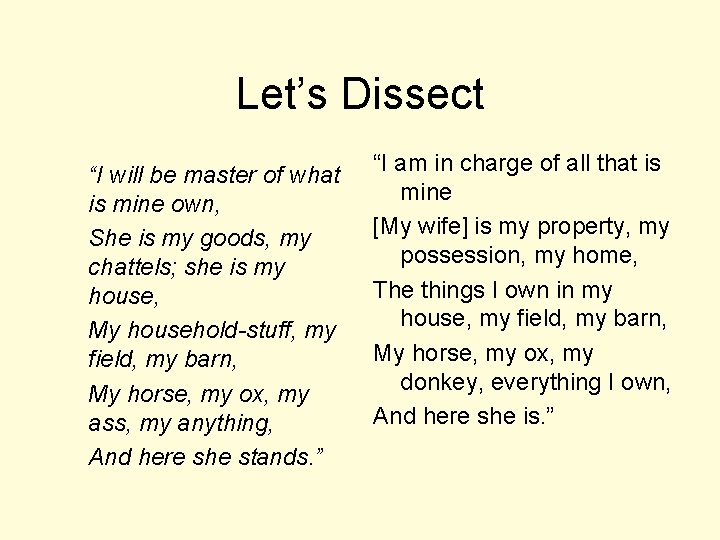
Let’s Dissect “I will be master of what is mine own, She is my goods, my chattels; she is my house, My household-stuff, my field, my barn, My horse, my ox, my ass, my anything, And here she stands. ” “I am in charge of all that is mine [My wife] is my property, my possession, my home, The things I own in my house, my field, my barn, My horse, my ox, my donkey, everything I own, And here she is. ”
Chauvinism or Patriarchy? Chauvinism = excessive patriotism for one’s own cause Is Petruchio simply a male chauvinistic pig? Patriarchy = patri = father archy = government Or is he merely performing his patriarchal duty?
Relationships & Marriage What do you think?
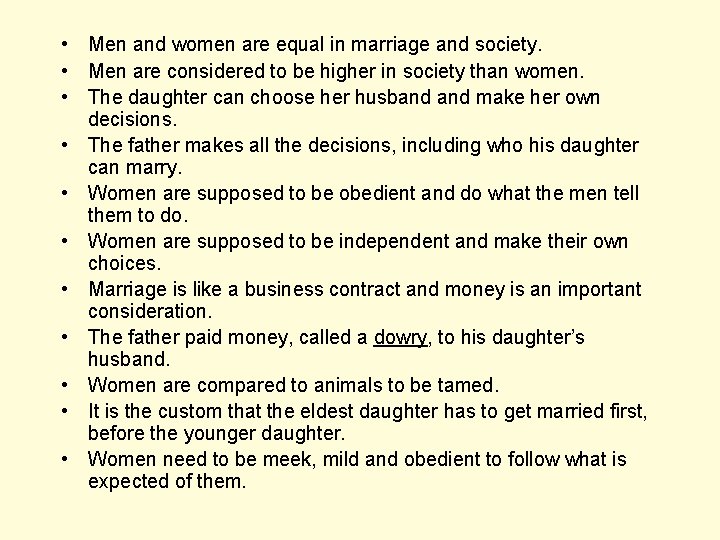
• Men and women are equal in marriage and society. • Men are considered to be higher in society than women. • The daughter can choose her husband make her own decisions. • The father makes all the decisions, including who his daughter can marry. • Women are supposed to be obedient and do what the men tell them to do. • Women are supposed to be independent and make their own choices. • Marriage is like a business contract and money is an important consideration. • The father paid money, called a dowry, to his daughter’s husband. • Women are compared to animals to be tamed. • It is the custom that the eldest daughter has to get married first, before the younger daughter. • Women need to be meek, mild and obedient to follow what is expected of them.
- Slides: 17