
THE TAKINGS CLAUSE POLS 4130 American Constitutional Law
- Slides: 14
THE TAKINGS CLAUSE POLS 4130: American Constitutional Law B. Fairbanks 7/24/2017
MAJOR POINTS FOR TODAY’S CLASS • Discussion of the concept of takings and eminent domain • Analyze and discuss the assigned cases on these topics
EMINENT DOMAIN • The power of a government to take private property for public use. • Similar to expropriation • Since 1215, it was generally accepted that governments must compensate • The Takings Clause (Amendment V) • the federal and state governments have the power of eminent domain as long as “just compensation” is provided.
EARLY TAKINGS CLAUSE CASES • Barron v. Baltimore (1833) — Takings Clause requirements of “just compensation” in cases of eminent domain do not extend to the states. • Chicago, Burlington, & Quincy Railroad Co. v. City of Chicago (1897) — overturned Barron and incorporated the Takings Clause to the states under the Due Process Clause of the 14 th Amendment.
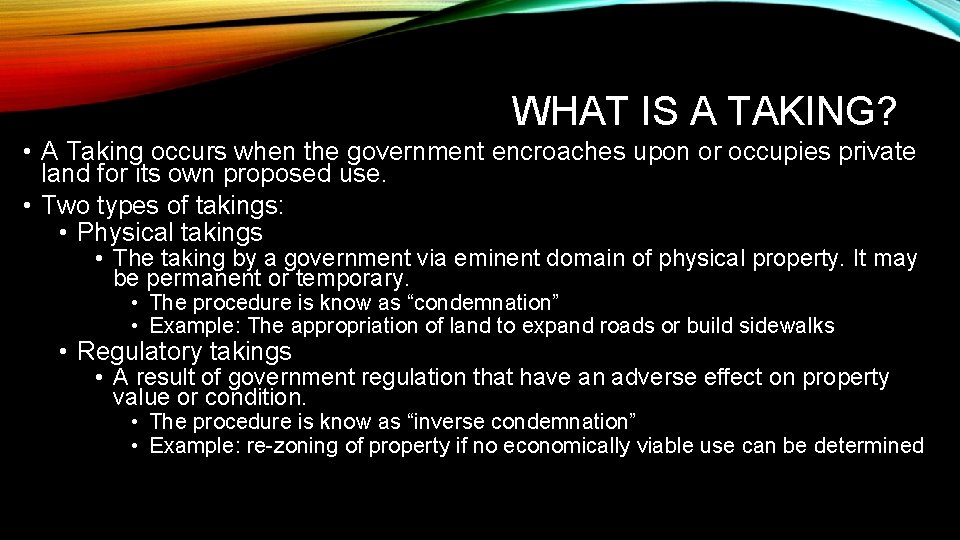
WHAT IS A TAKING? • A Taking occurs when the government encroaches upon or occupies private land for its own proposed use. • Two types of takings: • Physical takings • The taking by a government via eminent domain of physical property. It may be permanent or temporary. • The procedure is know as “condemnation” • Example: The appropriation of land to expand roads or build sidewalks • Regulatory takings • A result of government regulation that have an adverse effect on property value or condition. • The procedure is know as “inverse condemnation” • Example: re-zoning of property if no economically viable use can be determined
U. S. V. CAUSBY (1946) • What is the background (facts)? • What is the legal issue(s)? • How does the Court rule? • What is its rationale/reasoning? • Were there any dissents/concurrences? What did they say?
PENN CENTRAL TRANSPORTATION COMPANY V. CITY OF NEW YORK (1978) • What is the background (facts)? • What is the legal issue(s)? • How does the Court rule? • What is its rationale/reasoning? • Were there any dissents/concurrences? What did they say?
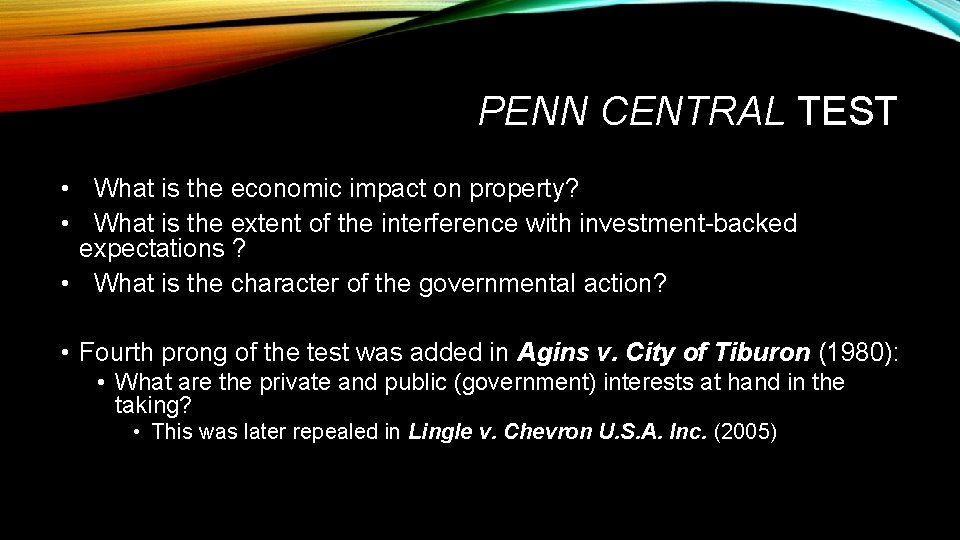
PENN CENTRAL TEST • What is the economic impact on property? • What is the extent of the interference with investment-backed expectations ? • What is the character of the governmental action? • Fourth prong of the test was added in Agins v. City of Tiburon (1980): • What are the private and public (government) interests at hand in the taking? • This was later repealed in Lingle v. Chevron U. S. A. Inc. (2005)
LUCAS V. SOUTH CAROLINA COASTAL COUNCIL (1992) • What is the background (facts)? • What is the legal issue(s)? • How does the Court rule? • What is its rationale/reasoning? • Were there any dissents/concurrences? What did they say?
REGULATION AND TAKINGS • Government regulations are not takings unless they do more than “incidentally infringe” on owner’s use of the property • It is okay to regulate noxious or dangerous uses • Loretto v. Teleprompter Manhattan CATV Corp (1982) – a regulation is a “taking” if it forces a permanent physical occupation of a person’s property (ex. Installation of cable lines) • Nollan v. California Coastal Commission (1987) — a regulation does not constitute a taking if it is found to advance state interest and if the owner is justly compensated for the economic viability of the land.
DEFINING JUST COMPENSATION • Olson v. United States (1934) — just compensation includes all the elements of value on/within the property, but cannot exceed market value. Market value is the value of the property at the time of the taking paid in money. • United States v. Commodities Trading Corp. (1950) — “just compensation” during times of war qualifies as the ceiling price of a item/commodity when rations or price controls are in place. • United States v. 50 Acres of Land (1984) — deviation from market value of a taking can only occur when the value is too difficult to find or it would result in an injustice to the owner or the public at large.
PUBLIC USE • For the government to exercise the power of eminent domain, the taking must be classified for “public use” • What does the term “public use” mean? • Gilmer v. A Certain Tract of Land (Cali. 1861) — The taking must be of a use that benefits the whole community, but not to the degree that its use affects or is used by each individual in the same way. • Berman v. Parker (1954) — The taking of private property for public purpose, (i. e. removing blight/causes of blight from a community) rather than simply public use was justified under the Takings Clause, as long as the just compensation requirement was met.
HAWAII HOUSING AUTHORITY V. MIDKIFF (1984) • What is the background (facts)? • What is the legal issue(s)? • How does the Court rule? • What is its rationale/reasoning? • Were there any dissents/concurrences? What did they say?
KELO V. CITY OF NEW LONDON (2005) • What is the background (facts)? • What is the legal issue(s)? • How does the Court rule? • What is its rationale/reasoning? • Were there any dissents/concurrences? What did they say?