
The Systems Biology Graphical Notation a standardised representation
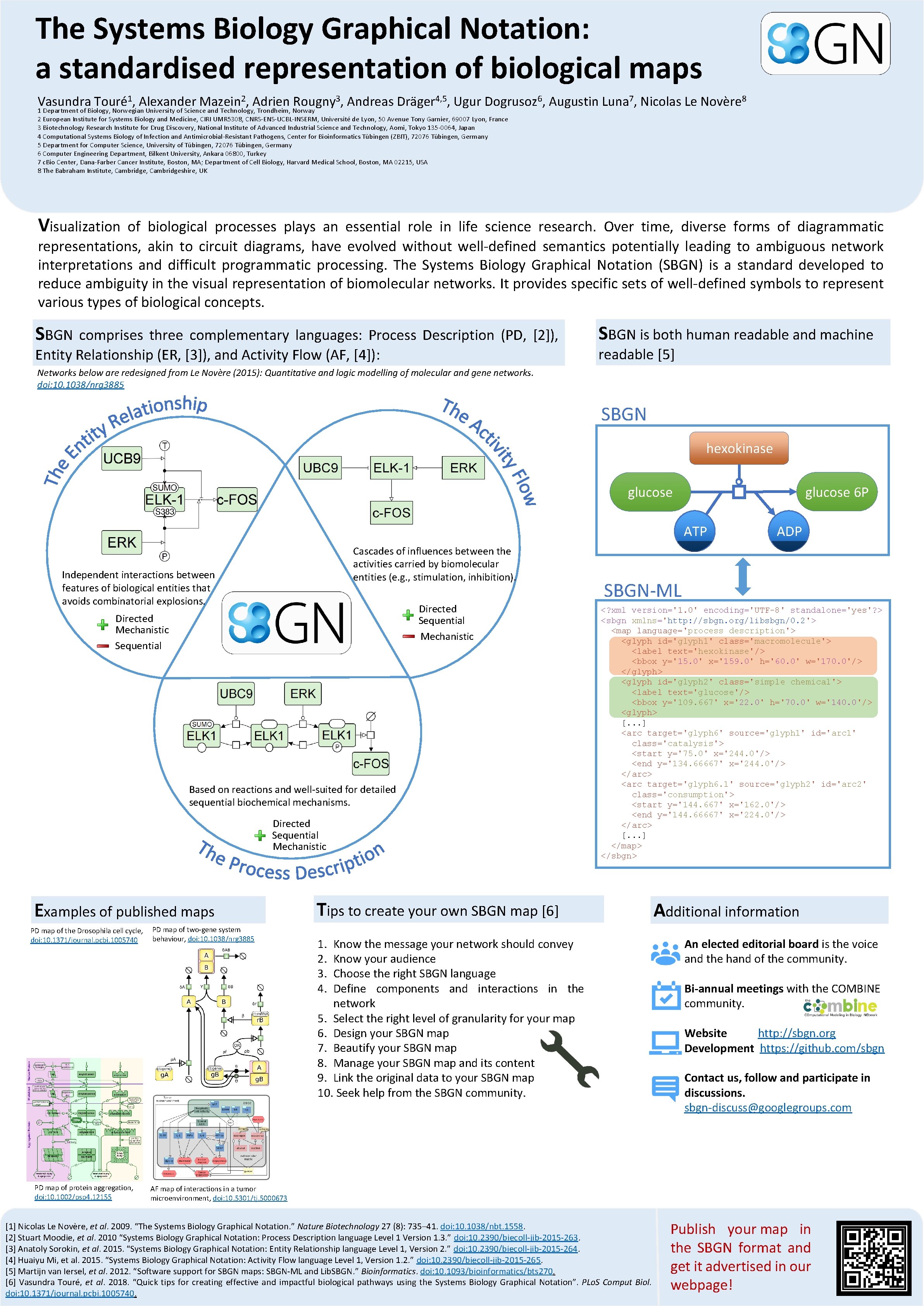
The Systems Biology Graphical Notation: a standardised representation of biological maps Vasundra Touré 1, Alexander Mazein 2, Adrien Rougny 3, Andreas Dräger 4, 5, Ugur Dogrusoz 6, Augustin Luna 7, Nicolas Le Novère 8 1 Department of Biology, Norwegian University of Science and Technology, Trondheim, Norway 2 European Institute for Systems Biology and Medicine, CIRI UMR 5308, CNRS-ENS-UCBL-INSERM, Université de Lyon, 50 Avenue Tony Garnier, 69007 Lyon, France 3 Biotechnology Research Institute for Drug Discovery, National Institute of Advanced Industrial Science and Technology, Aomi, Tokyo 135 -0064, Japan 4 Computational Systems Biology of Infection and Antimicrobial-Resistant Pathogens, Center for Bioinformatics Tübingen (ZBIT), 72076 Tübingen, Germany 5 Department for Computer Science, University of Tübingen, 72076 Tübingen, Germany 6 Computer Engineering Department, Bilkent University, Ankara 06800, Turkey 7 c. Bio Center, Dana-Farber Cancer Institute, Boston, MA; Department of Cell Biology, Harvard Medical School, Boston, MA 02215, USA 8 The Babraham Institute, Cambridgeshire, UK Visualization of biological processes plays an essential role in life science research. Over time, diverse forms of diagrammatic representations, akin to circuit diagrams, have evolved without well-defined semantics potentially leading to ambiguous network interpretations and difficult programmatic processing. The Systems Biology Graphical Notation (SBGN) is a standard developed to reduce ambiguity in the visual representation of biomolecular networks. It provides specific sets of well-defined symbols to represent various types of biological concepts. SBGN comprises three complementary languages: Process Description (PD, [2]), Entity Relationship (ER, [3]), and Activity Flow (AF, [4]): SBGN is both human readable and machine readable [5] Networks below are redesigned from Le Novère (2015): Quantitative and logic modelling of molecular and gene networks. doi: 10. 1038/nrg 3885 SBGN hexokinase glucose 6 P ATP Cascades of influences between the activities carried by biomolecular entities (e. g. , stimulation, inhibition). Independent interactions between features of biological entities that avoids combinatorial explosions. Directed Sequential Mechanistic Directed Mechanistic Sequential Based on reactions and well-suited for detailed sequential biochemical mechanisms. Directed Sequential Mechanistic Examples of published maps PD map of the Drosophila cell cycle, PD map of two-gene system behaviour, doi: 10. 1038/nrg 3885 doi: 10. 1371/journal. pcbi. 1005740 PD map of protein aggregation, doi: 10. 1002/psp 4. 12155 Tips to create your own SBGN map [6] ADP SBGN-ML <? xml version='1. 0' encoding='UTF-8' standalone='yes'? > <sbgn xmlns='http: //sbgn. org/libsbgn/0. 2'> <map language='process description'> <glyph id='glyph 1' class='macromolecule'> <label text='hexokinase'/> <bbox y='15. 0' x='159. 0' h='60. 0' w='170. 0'/> </glyph> <glyph id='glyph 2' class='simple chemical'> <label text='glucose'/> <bbox y='109. 667' x='22. 0' h='70. 0' w='140. 0'/> <glyph> [. . . ] <arc target='glyph 6' source='glyph 1' id='arc 1' class='catalysis'> <start y='75. 0' x='244. 0'/> <end y='134. 66667' x='244. 0'/> </arc> <arc target='glyph 6. 1' source='glyph 2' id='arc 2' class='consumption'> <start y='144. 667' x='162. 0'/> <end y='144. 66667' x='224. 0'/> </arc> [. . . ] </map> </sbgn> Additional information 1. 2. 3. 4. Know the message your network should convey Know your audience Choose the right SBGN language Define components and interactions in the network 5. Select the right level of granularity for your map 6. Design your SBGN map 7. Beautify your SBGN map 8. Manage your SBGN map and its content 9. Link the original data to your SBGN map 10. Seek help from the SBGN community. An elected editorial board is the voice and the hand of the community. Bi-annual meetings with the COMBINE community. Website http: //sbgn. org Development https: //github. com/sbgn Contact us, follow and participate in discussions. sbgn-discuss@googlegroups. com AF map of interactions in a tumor microenvironment, doi: 10. 5301/tj. 5000673 [1] Nicolas Le Novère, et al. 2009. “The Systems Biology Graphical Notation. ” Nature Biotechnology 27 (8): 735– 41. doi: 10. 1038/nbt. 1558. [2] Stuart Moodie, et al. 2010 “Systems Biology Graphical Notation: Process Description language Level 1 Version 1. 3. ” doi: 10. 2390/biecoll-jib-2015 -263. [3] Anatoly Sorokin, et al. 2015. “Systems Biology Graphical Notation: Entity Relationship language Level 1, Version 2. ” doi: 10. 2390/biecoll-jib-2015 -264. [4] Huaiyu Mi, et al. 2015. “Systems Biology Graphical Notation: Activity Flow language Level 1, Version 1. 2. ” doi: 10. 2390/biecoll-jib-2015 -265. [5] Martijn van Iersel, et al. 2012. “Software support for SBGN maps: SBGN-ML and Lib. SBGN. ” Bioinformatics. doi: 10. 1093/bioinformatics/bts 270. [6] Vasundra Touré, et al. 2018. “Quick tips for creating effective and impactful biological pathways using the Systems Biology Graphical Notation”. PLo. S Comput Biol. doi: 10. 1371/journal. pcbi. 1005740. Publish your map in the SBGN format and get it advertised in our webpage!
- Slides: 1