
The System Approach to Spin Stall Parachute Recovery

- Slides: 37
The System Approach to Spin Stall Parachute Recovery – An Update at 10+ Years Anthony P. (Tony) Taylor Technical Director Airborne Systems Inc
Outline What is a Spin Stall Parachute Recovery System (SSPRS) ? § History of the System Approach to SSPRS at Irvin § The Challenge § The Result - An Outline of a Basic SSPRS System § Aircraft Installed Equipment § Ground Support Equipment and Integrated Testing § Well Developed Installation and Operation Manuals § Interlaced Throughout – Initiatives to Address the Requirements of the VLJ Market, and Recent Work on the Lightning II § Lessons Learned § The Evolution of Systems Since the ‘First System Approach’ § Examples of Operational Incidents, Major and Minor, Positive and Negative § Major Events, safety related § Minor Events, maintenance level but also safety related § Some Operational Tests – Your Personal Fam Flight!
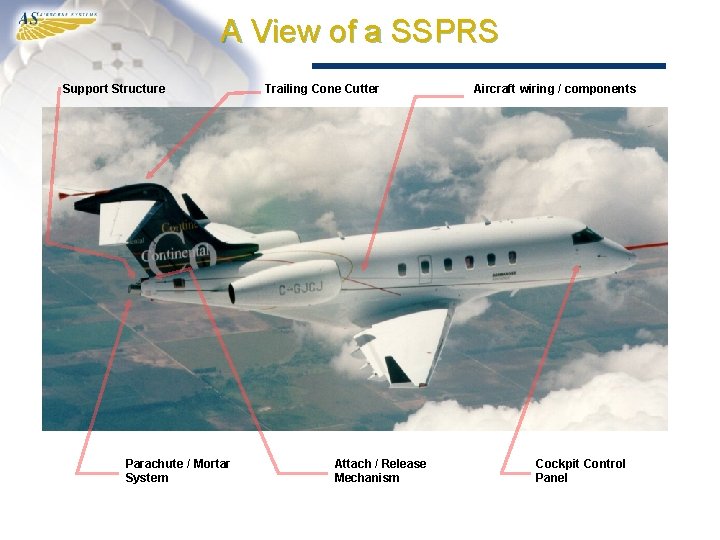
A View of a SSPRS Support Structure Parachute / Mortar System Trailing Cone Cutter Attach / Release Mechanism Aircraft wiring / components Cockpit Control Panel
What is A SSPRS § Simply put, a parachute attached to the aircraft tail that lowers the AOA and thus restricts the Spin or Stall § Great Example in next Video § For Fairness, Other Approaches Exist § Rockets – Wing Tip or Tail Mounted § Mass transfer – Forward in some cases, Aft in other cases § Deployable Fins at the Aircraft Tail § While these have been studied and used occasionally, the Parachute method is the Aerospace industry standard § One other significant note, many Business Jet Mfg also use another parachute for high speed drag augmentation. § Mach Tuck and Deceleration out of Flutter points, as well as Attitude Control § Similar approach as discussed herein however details of the situation can be significantly different
Next Slide, a Video of an Actual Recovery § § This is one of my favorite videos – you will see why ! Aircraft: F-5 E – First Spin Test Location: EAFB – Ground to Air Video with Long Lens Pilot: Dick Thomas § Actually got to ask Dick about this test § Summary: Tried all the Adverse combinations (Stick and Rudder) and all the Proverse Combinations and all in between – Finally, and Dick reported pretty late, went to the parachute.
F-5 E Flight Test Video
History of the System Approach at Irvin § Circa late 1995, Bombardier Flight Test Center (BFTC) invites Irvin to a meeting to review system requirements for the Global Express aircraft § At that time, Irvin provides only the Parachute and Mortar § Irvin is providing equipment for Canadair Aircraft only § Lear Jet Aircraft are provided by another company § BFTC has recently been created to Flight Test all Bombardier Aircraft § Canadair has suffered in the past two (2) significant system failures § CRJ Incident § Challenger Incident § Both caused loss of aircraft and some/all of flight crew § The Challenge: § BFTC Challenges Irvin to become System Level provider of all the SSPRS Equipment § Pete Reynolds outlines the basic system challenges § BFTC and Irvin Engineers Define the Basic Requirements, and Recognize a Significant, but interesting Challenge
The Basic Requirements § Original Requirements As Outlined with BFTC: § Dual Power Source § Quad Electrical Circuits – Where Possible § Dual for Pyro Lock § Reversible Parachute Lock § Fast Acting Additional Parachute Lock § Large Deploy Handle § Rotate to Lock § Pull to Deploy Parachute § Fast Acting Lock – Immediate § Trailing Cone Cutter – Immediate § Parachute Deploy – 0. 5 Second Time Delay
The Basic Requirements (continued) § Smaller Jettison Handle § Covered by Deploy Handle § Electrical Interlock § Simple Lights § Green Parachute Locked and Passing BIT § White Parachute Unlocked – All position Switches Agree § Green Light Repeater on Glare Shield § Built In Test § Power § Pyro Circuits § Reversible Lock Switch Position § Irvin Response at the meeting: ‘This is going to be hard, but it is going to be darn neat when it is finished!’
The Result § The result, both in the initial response and with years of maturation has been (what most consider) a marked improvement in the reliability, safety and testing of SSPRS systems § Significant Results § 1 Aircraft Recovery § Several Aircraft ‘Events’ which were ‘Non-Events’ § Tens of BIT detected faults which were real issues, resolved both before and during flight § Several Service Related Incidents – Including One Very Recent – Which Result in Safety Notices and Procedure/Equipment Updates
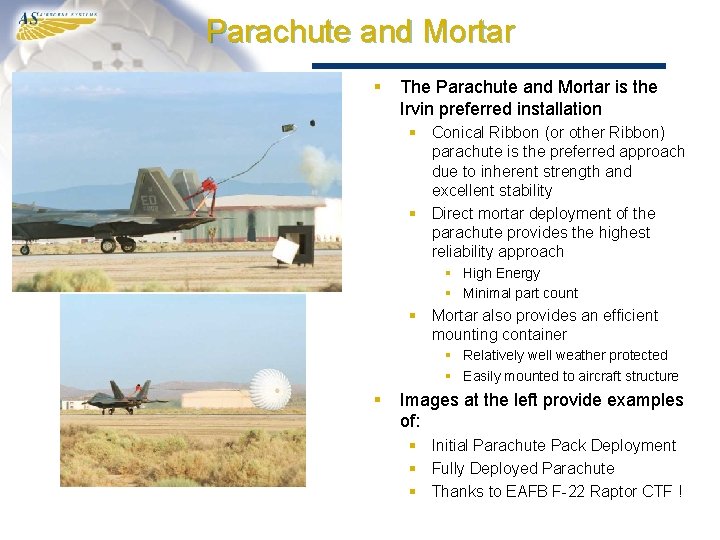
Parachute and Mortar § The Parachute and Mortar is the Irvin preferred installation § Conical Ribbon (or other Ribbon) parachute is the preferred approach due to inherent strength and excellent stability § Direct mortar deployment of the parachute provides the highest reliability approach § High Energy § Minimal part count § Mortar also provides an efficient mounting container § Relatively well weather protected § Easily mounted to aircraft structure § Images at the left provide examples of: § Initial Parachute Pack Deployment § Fully Deployed Parachute § Thanks to EAFB F-22 Raptor CTF !
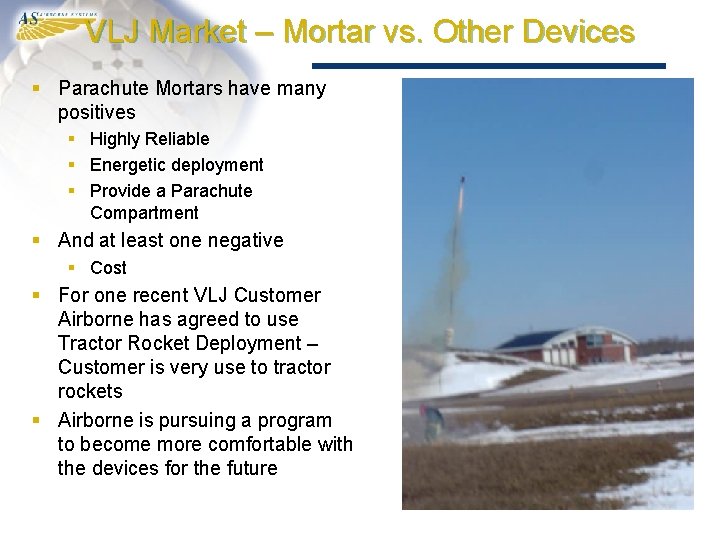
VLJ Market – Mortar vs. Other Devices § Parachute Mortars have many positives § Highly Reliable § Energetic deployment § Provide a Parachute Compartment § And at least one negative § Cost § For one recent VLJ Customer Airborne has agreed to use Tractor Rocket Deployment – Customer is very use to tractor rockets § Airborne is pursuing a program to become more comfortable with the devices for the future
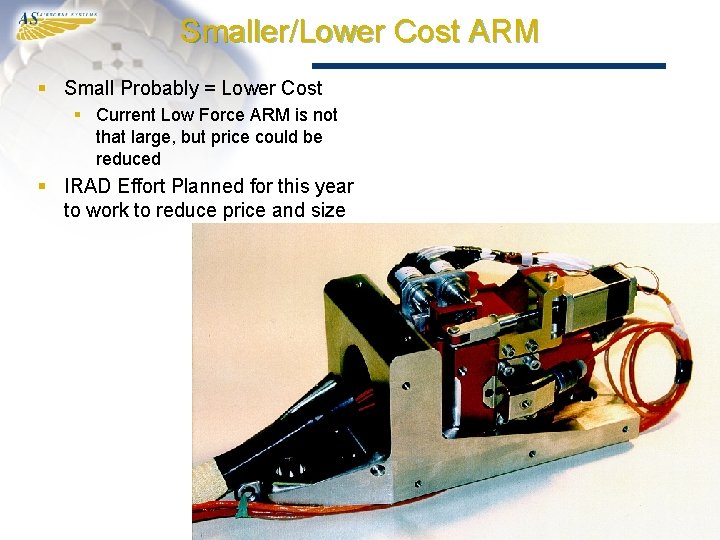
Attach/Release Mechanism (ARM) ATTACH RELEASE MECHANISM § § Two designs exist that cover aircraft from relatively light business jet through F-22/F-35 Functional features are the same for all variants, these include: § Reversible lock through a servo motor § Parachute retention through a low force shear pin that will release the parachute if not ‘Locked’ to the aircraft § Position switches for feedback of reversible lock position § Pyro locking pin for fast acting (and redundant) lock when Recovery Parachute is deployed § Redundant pyrotechnic cutters for parachute release § These are much more reliable than any mechanical based release § Full value of this approach is realized when reviewed with the control technique (next chart)
Smaller/Lower Cost ARM § Small Probably = Lower Cost § Current Low Force ARM is not that large, but price could be reduced § IRAD Effort Planned for this year to work to reduce price and size
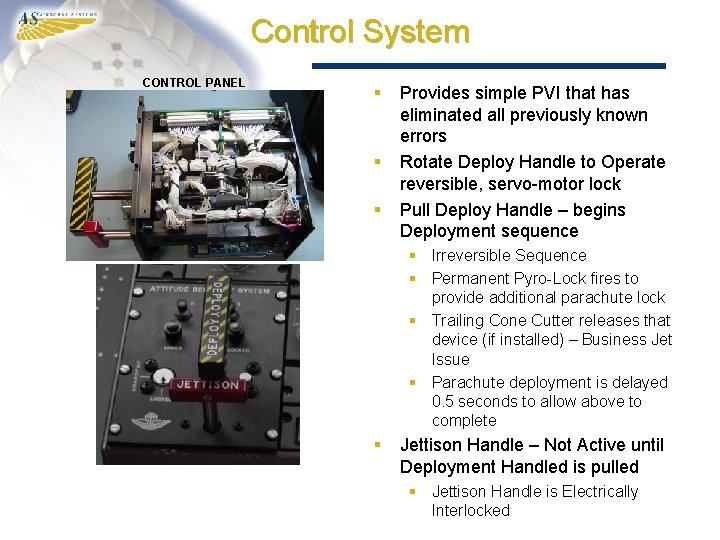
Control System CONTROL PANEL § § § Provides simple PVI that has eliminated all previously known errors Rotate Deploy Handle to Operate reversible, servo-motor lock Pull Deploy Handle – begins Deployment sequence § Irreversible Sequence § Permanent Pyro-Lock fires to provide additional parachute lock § Trailing Cone Cutter releases that device (if installed) – Business Jet Issue § Parachute deployment is delayed 0. 5 seconds to allow above to complete § Jettison Handle – Not Active until Deployment Handled is pulled § Jettison Handle is Electrically Interlocked
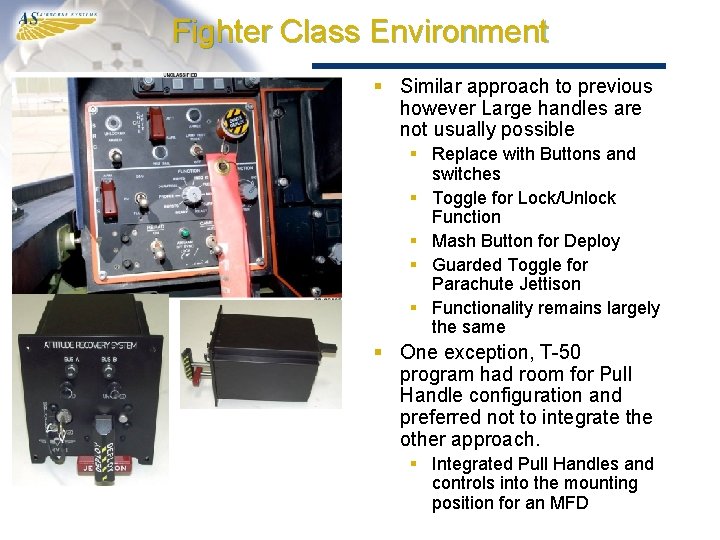
Fighter Class Environment § Similar approach to previous however Large handles are not usually possible § Replace with Buttons and switches § Toggle for Lock/Unlock Function § Mash Button for Deploy § Guarded Toggle for Parachute Jettison § Functionality remains largely the same § One exception, T-50 program had room for Pull Handle configuration and preferred not to integrate the other approach. § Integrated Pull Handles and controls into the mounting position for an MFD
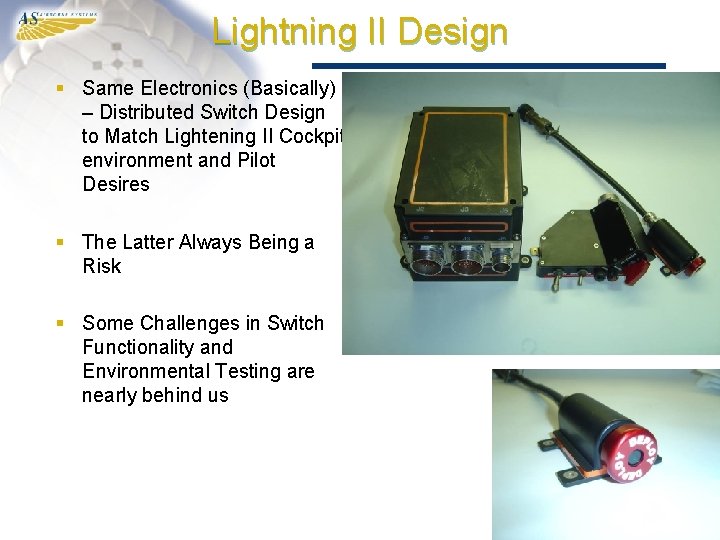
Lightning II Design § Same Electronics (Basically) – Distributed Switch Design to Match Lightening II Cockpit environment and Pilot Desires § The Latter Always Being a Risk § Some Challenges in Switch Functionality and Environmental Testing are nearly behind us
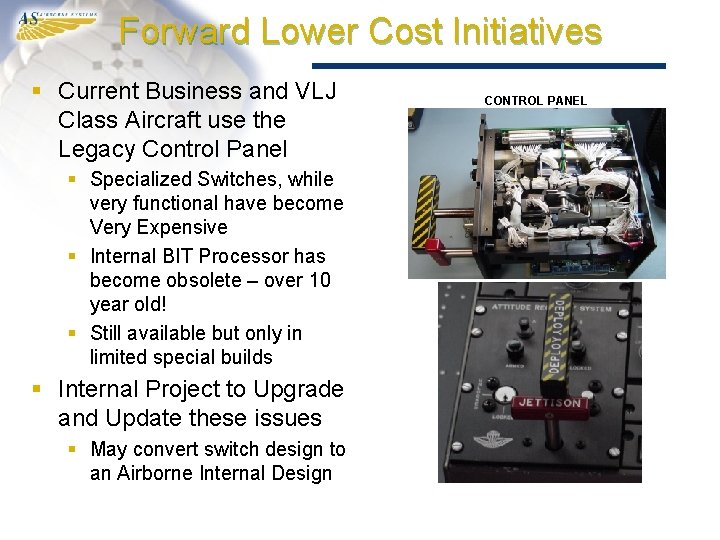
Forward Lower Cost Initiatives § Current Business and VLJ Class Aircraft use the Legacy Control Panel § Specialized Switches, while very functional have become Very Expensive § Internal BIT Processor has become obsolete – over 10 year old! § Still available but only in limited special builds § Internal Project to Upgrade and Update these issues § May convert switch design to an Airborne Internal Design CONTROL PANEL
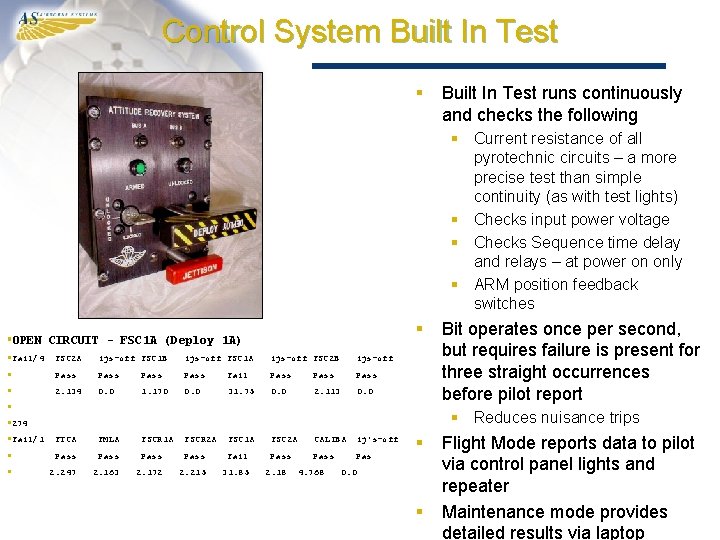
Control System Built In Test § Built In Test runs continuously and checks the following § Current resistance of all pyrotechnic circuits – a more precise test than simple continuity (as with test lights) § Checks input power voltage § Checks Sequence time delay and relays – at power on only § ARM position feedback switches §OPEN CIRCUIT - FSC 1 A (Deploy 1 A) § §Fail/4 FSC 2 A ijs-off FSC 1 B ijs-off FSC 1 A ijs-off FSC 2 B ijs-off § Pass Fail Pass § 2. 134 0. 0 1. 170 0. 0 31. 75 0. 0 2. 113 0. 0 § § Reduces nuisance trips § 274 §Fail/1 FTCA FMLA FSCR 1 A FSCR 2 A FSC 1 A FSC 2 A CALIBA ij's-off § Pass Fail Pass Pas Bit operates once per second, but requires failure is present for three straight occurrences before pilot report § § 2. 247 2. 163 2. 172 2. 215 31. 85 2. 18 4. 768 0. 0 § Flight Mode reports data to pilot via control panel lights and repeater Maintenance mode provides detailed results via laptop
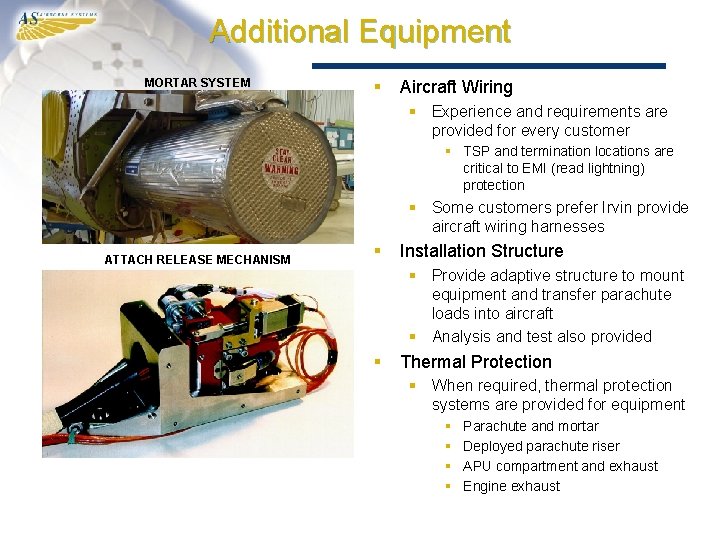
Additional Equipment MORTAR SYSTEM § Aircraft Wiring § Experience and requirements are provided for every customer § TSP and termination locations are critical to EMI (read lightning) protection § Some customers prefer Irvin provide aircraft wiring harnesses ATTACH RELEASE MECHANISM § Installation Structure § Provide adaptive structure to mount equipment and transfer parachute loads into aircraft § Analysis and test also provided § Thermal Protection § When required, thermal protection systems are provided for equipment § § Parachute and mortar Deployed parachute riser APU compartment and exhaust Engine exhaust
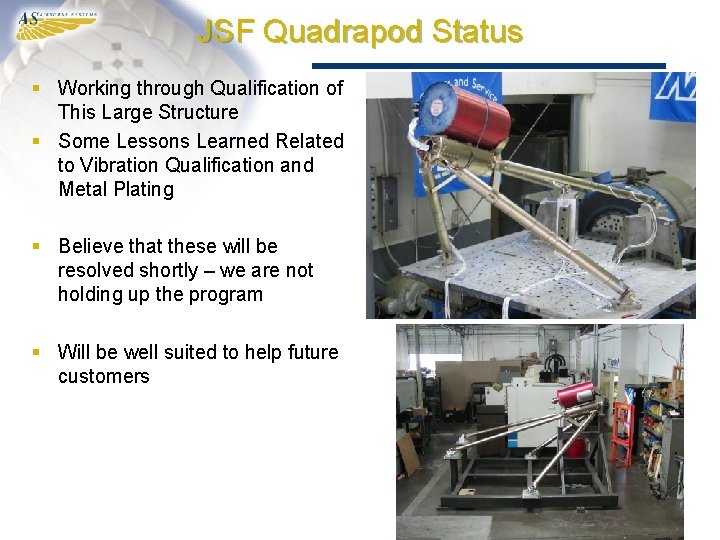
JSF Quadrapod Status § Working through Qualification of This Large Structure § Some Lessons Learned Related to Vibration Qualification and Metal Plating § Believe that these will be resolved shortly – we are not holding up the program § Will be well suited to help future customers
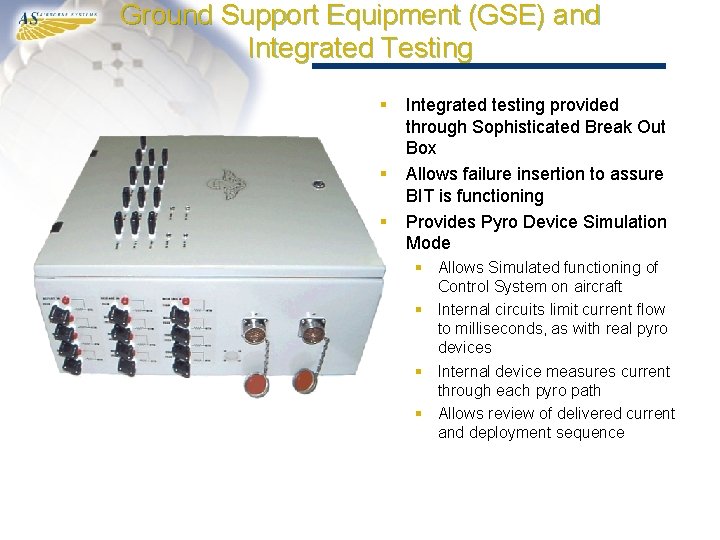
Ground Support Equipment (GSE) and Integrated Testing § § § Integrated testing provided through Sophisticated Break Out Box Allows failure insertion to assure BIT is functioning Provides Pyro Device Simulation Mode § Allows Simulated functioning of Control System on aircraft § Internal circuits limit current flow to milliseconds, as with real pyro devices § Internal device measures current through each pyro path § Allows review of delivered current and deployment sequence
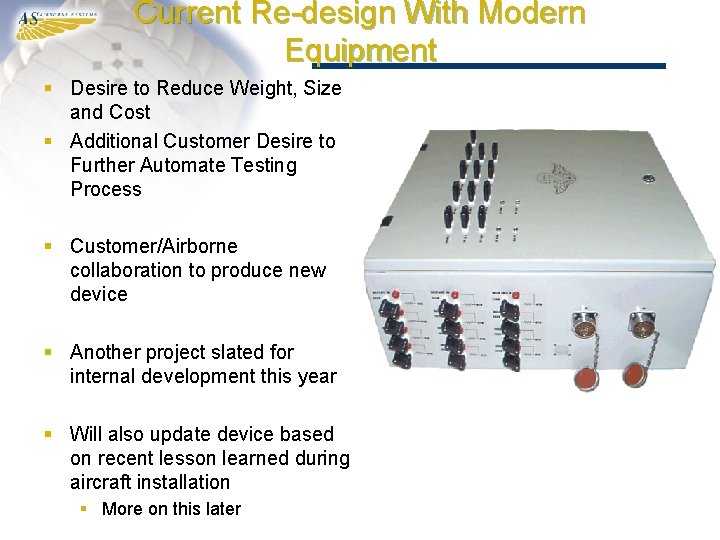
Current Re-design With Modern Equipment § Desire to Reduce Weight, Size and Cost § Additional Customer Desire to Further Automate Testing Process § Customer/Airborne collaboration to produce new device § Another project slated for internal development this year § Will also update device based on recent lesson learned during aircraft installation § More on this later
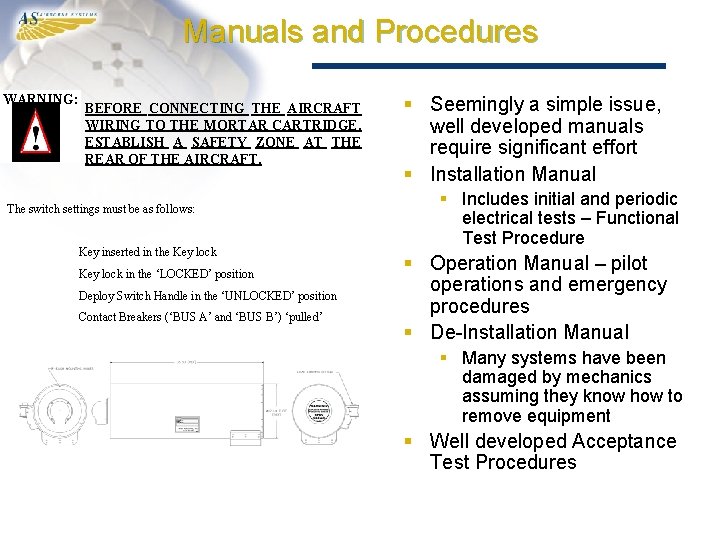
WARNING: Manuals and Procedures BEFORE CONNECTING THE AIRCRAFT WIRING TO THE MORTAR CARTRIDGE, ESTABLISH A SAFETY ZONE AT THE REAR OF THE AIRCRAFT. The switch settings must be as follows: Key inserted in the Key lock in the ‘LOCKED’ position Deploy Switch Handle in the ‘UNLOCKED’ position Contact Breakers (‘BUS A’ and ‘BUS B’) ‘pulled’ § Seemingly a simple issue, well developed manuals require significant effort § Installation Manual § Includes initial and periodic electrical tests – Functional Test Procedure § Operation Manual – pilot operations and emergency procedures § De-Installation Manual § Many systems have been damaged by mechanics assuming they know how to remove equipment § Well developed Acceptance Test Procedures
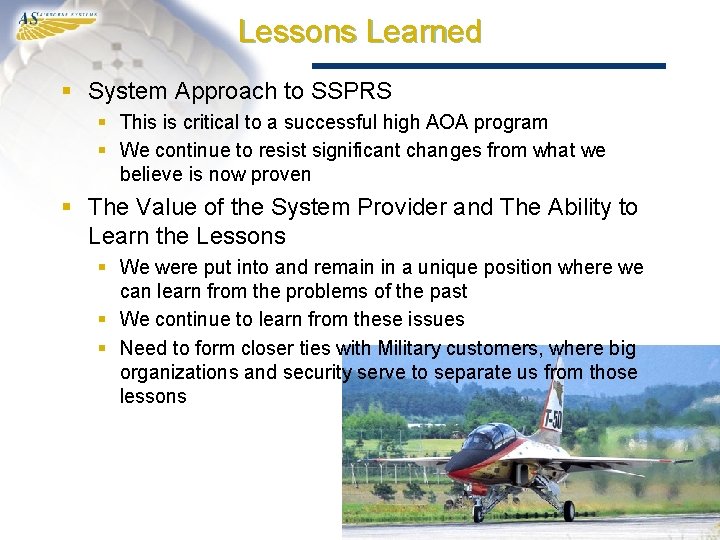
Lessons Learned § System Approach to SSPRS § This is critical to a successful high AOA program § We continue to resist significant changes from what we believe is now proven § The Value of the System Provider and The Ability to Learn the Lessons § We were put into and remain in a unique position where we can learn from the problems of the past § We continue to learn from these issues § Need to form closer ties with Military customers, where big organizations and security serve to separate us from those lessons
Lessons Learned The Evolution Since the ‘First System Approach’ § ARM Changes and Enhancements § Servo Motor, Original Motor was too difficult to procure to support most programs § Lock witness switches, original design had an issue with simultaneity of multiple arms in a single switch § Fasteners, Original design incorporated commercial grade fasteners § Parachute and Mortar § Parachute Riser, customer interaction during entire program allows improved surveillance of installed equipment and enhanced designs for future installations § UV, Thermal and Moisture Protection § Load Limit Fitting, a Fuse link type device that some customers request to limit force that the parachute can apply to the aircraft § After fielding one particular design, Irvin identified an unfavorable potential loading condition
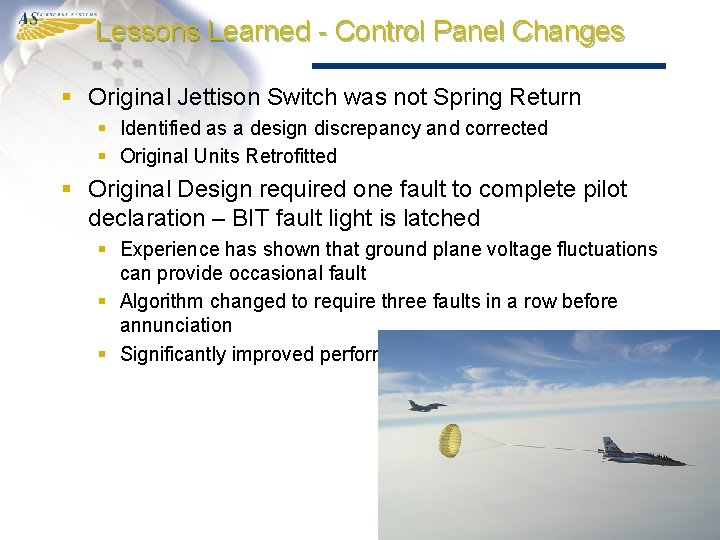
Lessons Learned - Control Panel Changes § Original Jettison Switch was not Spring Return § Identified as a design discrepancy and corrected § Original Units Retrofitted § Original Design required one fault to complete pilot declaration – BIT fault light is latched § Experience has shown that ground plane voltage fluctuations can provide occasional fault § Algorithm changed to require three faults in a row before annunciation § Significantly improved performance
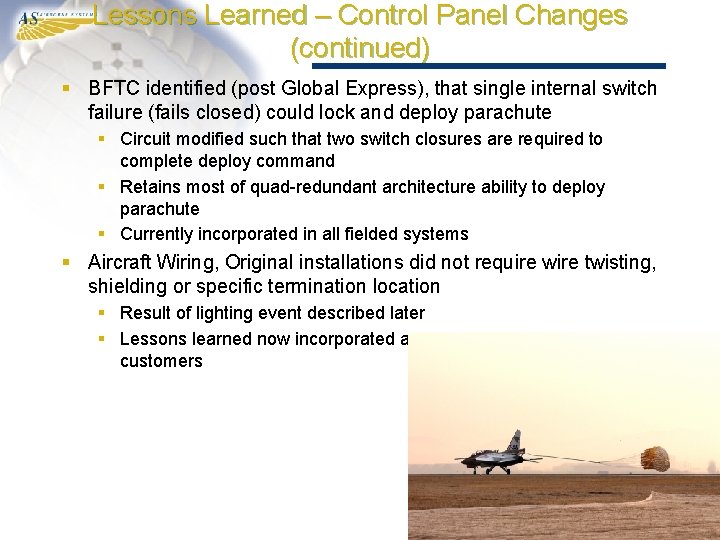
Lessons Learned – Control Panel Changes (continued) § BFTC identified (post Global Express), that single internal switch failure (fails closed) could lock and deploy parachute § Circuit modified such that two switch closures are required to complete deploy command § Retains most of quad-redundant architecture ability to deploy parachute § Currently incorporated in all fielded systems § Aircraft Wiring, Original installations did not require wire twisting, shielding or specific termination location § Result of lighting event described later § Lessons learned now incorporated and recommended to all customers
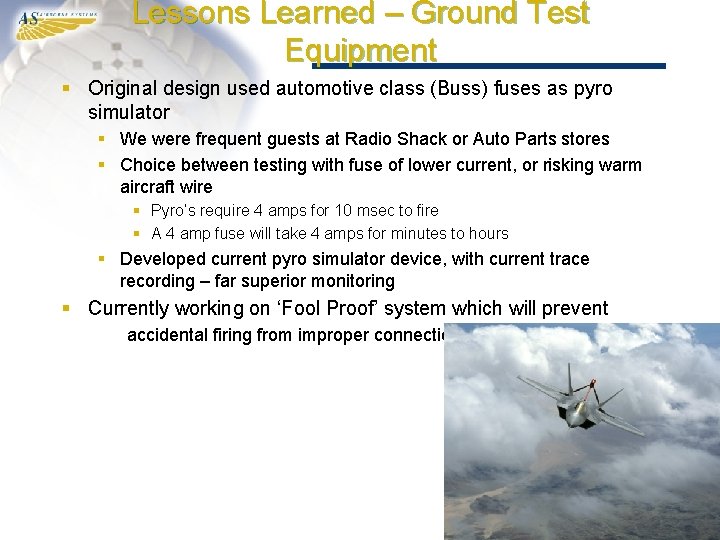
Lessons Learned – Ground Test Equipment § Original design used automotive class (Buss) fuses as pyro simulator § We were frequent guests at Radio Shack or Auto Parts stores § Choice between testing with fuse of lower current, or risking warm aircraft wire § Pyro’s require 4 amps for 10 msec to fire § A 4 amp fuse will take 4 amps for minutes to hours § Developed current pyro simulator device, with current trace recording – far superior monitoring § Currently working on ‘Fool Proof’ system which will prevent accidental firing from improper connection
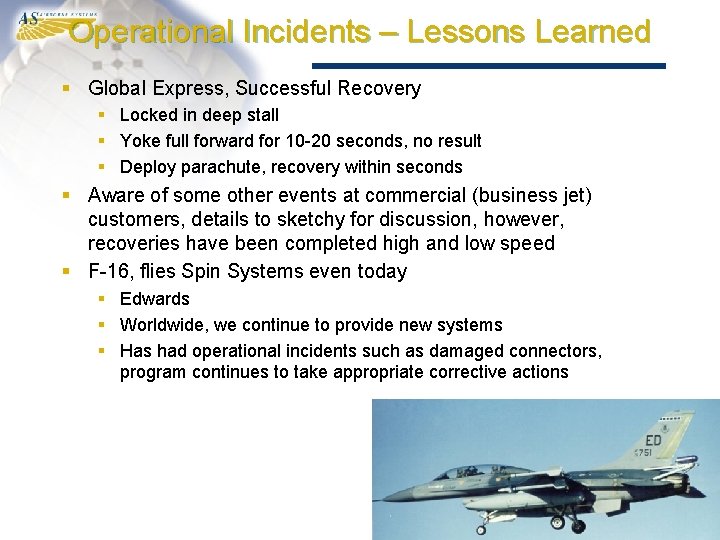
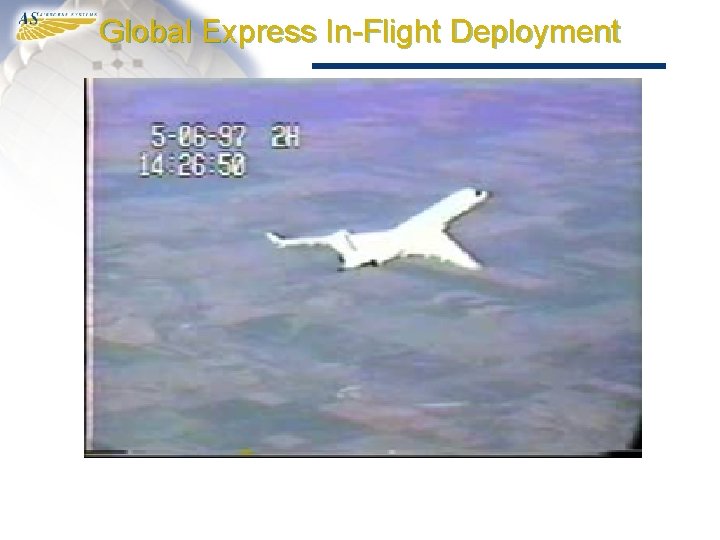
Operational Incidents – Lessons Learned § Global Express, Successful Recovery § Locked in deep stall § Yoke full forward for 10 -20 seconds, no result § Deploy parachute, recovery within seconds § Aware of some other events at commercial (business jet) customers, details to sketchy for discussion, however, recoveries have been completed high and low speed § F-16, flies Spin Systems even today § Edwards § Worldwide, we continue to provide new systems § Has had operational incidents such as damaged connectors, program continues to take appropriate corrective actions
Operational Incidents – Maintenance Related Learning Lessons § Have detected many real world failures § Bad power, Open breakers, etc § Poor ground connections in flight § Was a serious issue as this related to all pyros in the system – essentially the ground system was a single point failure § Connectors not properly connected § Bent connector pins § More than one occurrence § Ask my about my incident if we have time for questions ! § Still suffer occasional hanger firing event § Never with Irvin personnel present § No injuries or significant equipment damage to date § Of course the spin system needs some work § Always traced to not following procedures § Working on a ‘fool proof’ system without disturbing excellent reliability of the flight system
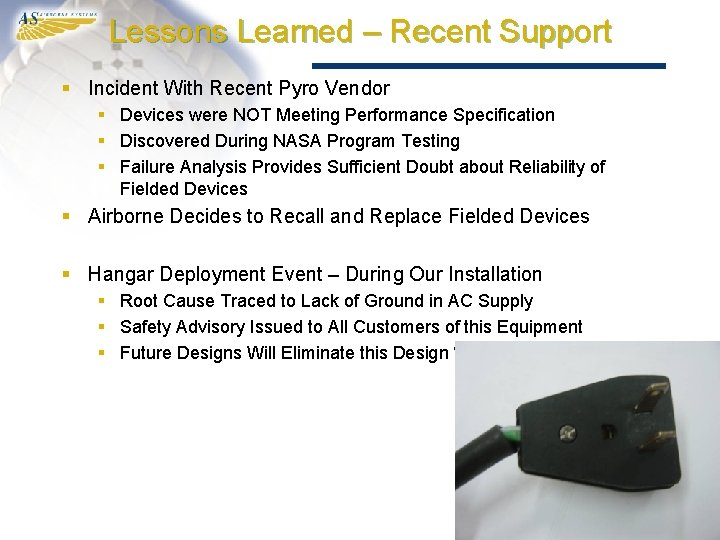
Lessons Learned – Recent Support § Incident With Recent Pyro Vendor § Devices were NOT Meeting Performance Specification § Discovered During NASA Program Testing § Failure Analysis Provides Sufficient Doubt about Reliability of Fielded Devices § Airborne Decides to Recall and Replace Fielded Devices § Hangar Deployment Event – During Our Installation § Root Cause Traced to Lack of Ground in AC Supply § Safety Advisory Issued to All Customers of this Equipment § Future Designs Will Eliminate this Design ‘Feature’
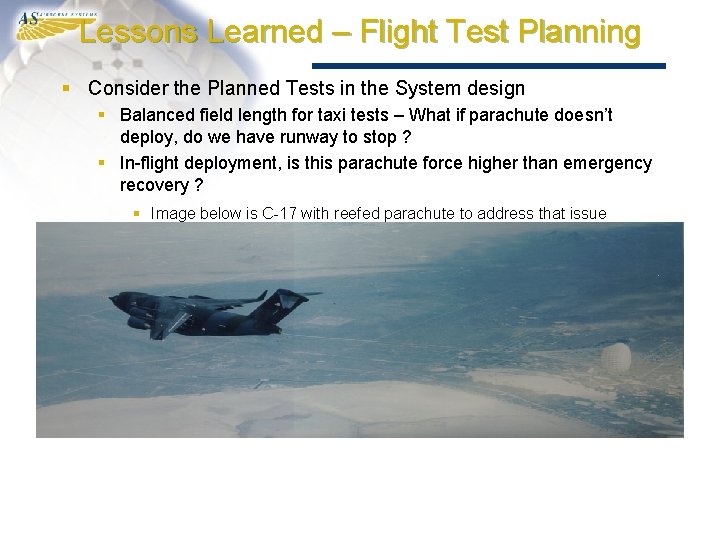
Lessons Learned – Flight Test Planning § Consider the Planned Tests in the System design § Balanced field length for taxi tests – What if parachute doesn’t deploy, do we have runway to stop ? § In-flight deployment, is this parachute force higher than emergency recovery ? § Image below is C-17 with reefed parachute to address that issue
Global Express In-Flight Deployment
T-50 Golden Eagle – Taxi Deployment Test Courtesy KAI and ROKAF
T-50 Golden Eagle – In Flight Deployment Courtesy KAI and ROKAF
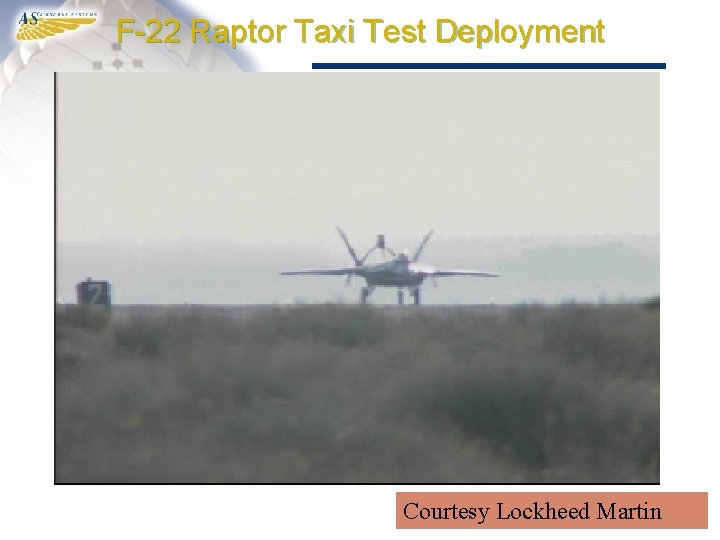
F-22 Raptor Taxi Test Deployment Courtesy Lockheed Martin