
The Synergy between Percutaneous Coronary Intervention with TAXUS
The Synergy between Percutaneous Coronary Intervention with TAXUS and Cardiac Surgery: The SYNTAX Study Primary Endpoint Results at One Year in the Randomized Cohort Patrick W. Serruys MD Ph. D Friedrich W. Mohr MD Ph. D On behalf of the SYNTAX investigators Conflicts of Interest: None
Background: I During the present decade, major developments in CABG (e. g. off-pump technique, less invasive approach, increased arterial revascularization and optimal perioperative care). In PCI (e. g. improved technique, stent design, guide wires, anti-platelet therapy, and drugeluting stents) have made it important to reassess the respective values of the two revascularization techniques in an all-comers population as seen by the surgeon and the interventional cardiologist in their daily practice.
Background: II At the time of the trial design (in 2003 -2004), a retrospective website survey of 104 medical centers over a period of 3 months showed that 12, 072 patients (1/3 LM, 2/3 3 VD) were revascularized by surgery (2/3) or by PCI (1/3). The SYNTAX randomized trial is an attempt to provide an evidence-base to determine whether this approach, which is already currently practiced, is valid. Kappetein et al, Eur J Cardiothorac Surg. 2006; 29: 486 -491
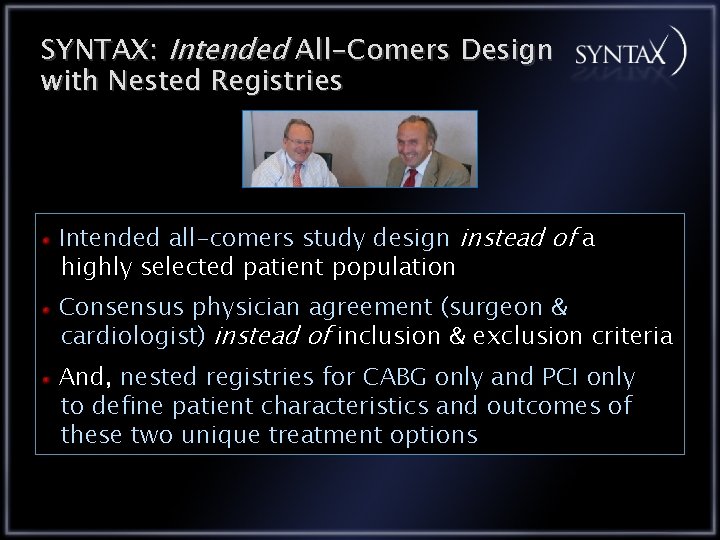
SYNTAX: Intended All-Comers Design with Nested Registries Intended all-comers study design instead of a highly selected patient population Consensus physician agreement (surgeon & cardiologist) instead of inclusion & exclusion criteria And, nested registries for CABG only and PCI only to define patient characteristics and outcomes of these two unique treatment options
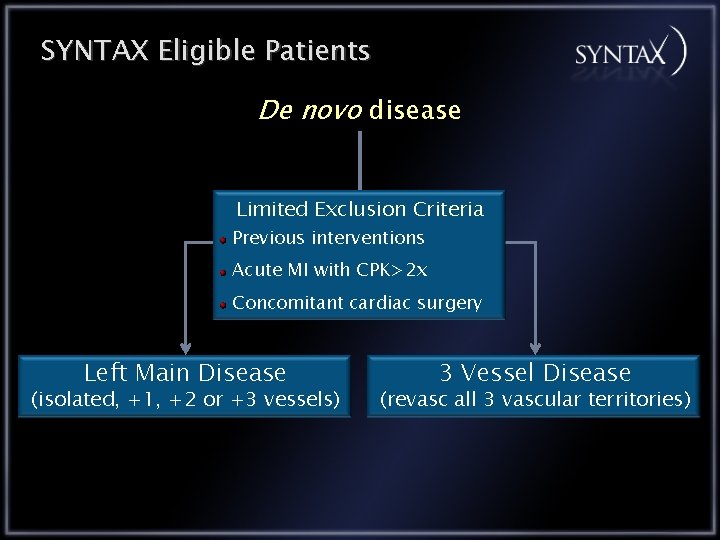
SYNTAX Eligible Patients De novo disease Limited Exclusion Criteria Previous interventions Acute MI with CPK>2 x Concomitant cardiac surgery Left Main Disease (isolated, +1, +2 or +3 vessels) 3 Vessel Disease (revasc all 3 vascular territories)
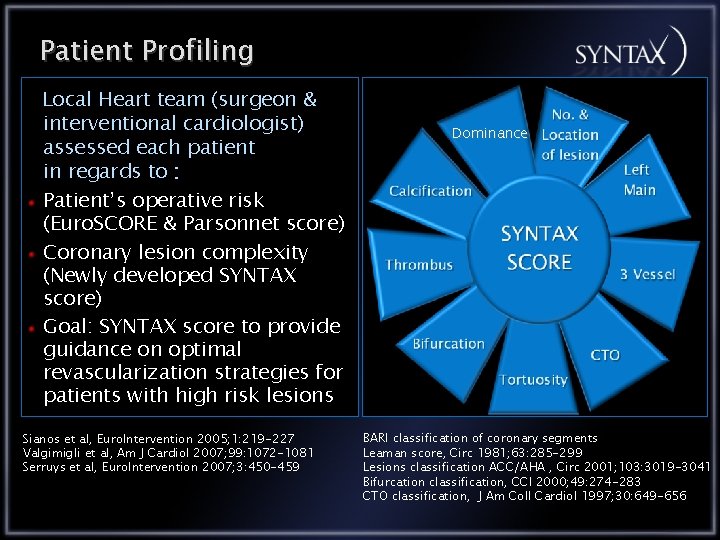
Patient Profiling Local Heart team (surgeon & interventional cardiologist) assessed each patient in regards to : Patient’s operative risk (Euro. SCORE & Parsonnet score) Coronary lesion complexity (Newly developed SYNTAX score) Goal: SYNTAX score to provide guidance on optimal revascularization strategies for patients with high risk lesions Sianos et al, Euro. Intervention 2005; 1: 219 -227 Valgimigli et al, Am J Cardiol 2007; 99: 1072 -1081 Serruys et al, Euro. Intervention 2007; 3: 450 -459 Dominance BARI classification of coronary segments Leaman score, Circ 1981; 63: 285 -299 Lesions classification ACC/AHA , Circ 2001; 103: 3019 -3041 Bifurcation classification, CCI 2000; 49: 274 -283 CTO classification, J Am Coll Cardiol 1997; 30: 649 -656
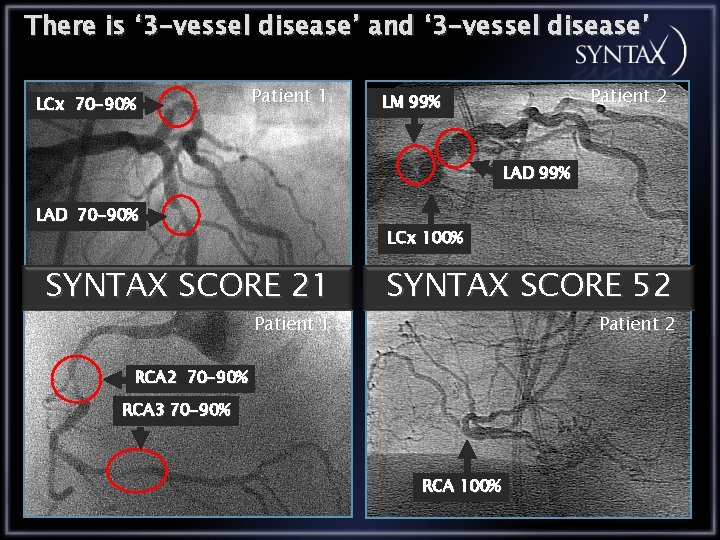
There is ‘ 3 -vessel disease’ and ‘ 3 -vessel disease’ LCx 70 -90% Patient 1 Patient 2 LM 99% LAD 70 -90% LCx 100% SYNTAX SCORE 21 Patient 1 SYNTAX SCORE 52 Patient 2 RCA 2 70 -90% RCA 3 70 -90% RCA 100%
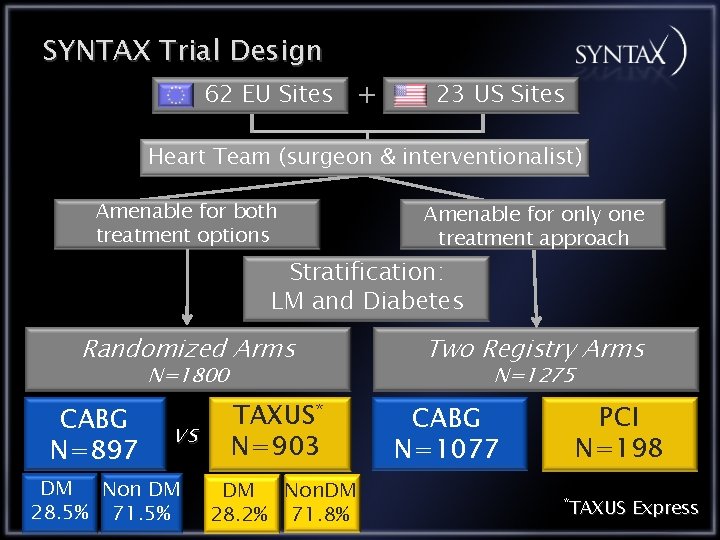
SYNTAX Trial Design 62 EU Sites + 23 US Sites Heart Team interventionalist) All Pts(surgeon with de&novo 3 VD Total enrollment and/or LM disease N=3075 (N=4, 337) Amenable for both Amenable for only one treatment options approach Treatment preference treatment (9. 4%) Stratification: Referring MD or pts. refused Stratification: LM and Diabetes informed consent (7. 0%) LM and Diabetes Inclusion/exclusion (4. 7%) Randomized. Withdrew Arms before consent Two(4. 3%) Registry Arms N=1800 Other (1. 8%) N=1275 Randomized Arms * Two Registry Arms Medical treatment (1. 2%) TAXUS CABG PCI CABG n=1800 TAXUS vs 2500 N=903 N=1077 N=897 n=1077 n=897 n=903 750 w/ f/u 71% 5 yr f/u no f/u LMDMvs 3 VD DM Non LM enrolled DM Non. DM 66. 3% 28. 5% 33. 7% 71. 5% 65. 4% 28. 2% n=649 n=428 (N=3, 075) 34. 6% 71. 8% PCI all N=198 captured w/ n=198 follow up TAXUS Express *
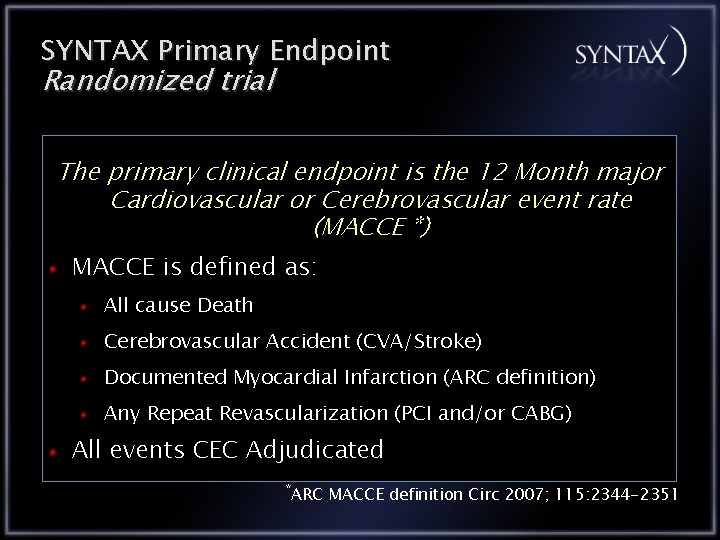
SYNTAX Primary Endpoint Randomized trial The primary clinical endpoint is the 12 Month major Cardiovascular or Cerebrovascular event rate (MACCE *) MACCE is defined as: All cause Death Cerebrovascular Accident (CVA/Stroke) Documented Myocardial Infarction (ARC definition) Any Repeat Revascularization (PCI and/or CABG) All events CEC Adjudicated * ARC MACCE definition Circ 2007; 115: 2344 -2351
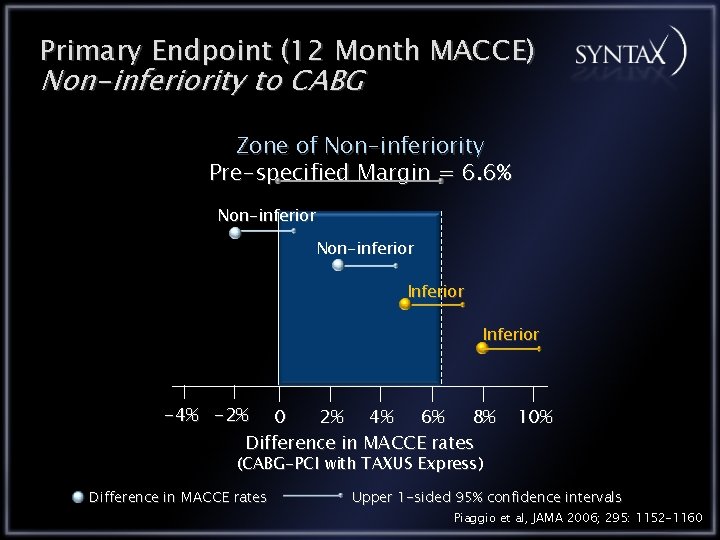
Primary Endpoint (12 Month MACCE) Non-inferiority to CABG Zone of Non-inferiority Pre-specified Margin = 6. 6% Non-inferior Inferior -4% -2% 0 2% 4% 6% 8% Difference in MACCE rates 10% (CABG-PCI with TAXUS Express) Difference in MACCE rates Upper 1 -sided 95% confidence intervals Piaggio et al, JAMA 2006; 295: 1152 -1160
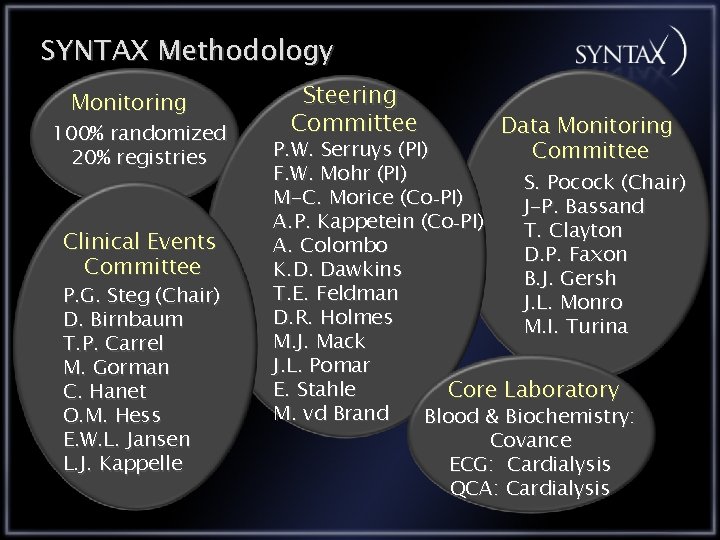
SYNTAX Methodology Monitoring 100% randomized 20% registries Clinical Events Committee P. G. Steg (Chair) D. Birnbaum T. P. Carrel M. Gorman C. Hanet O. M. Hess E. W. L. Jansen L. J. Kappelle Steering Committee Data Monitoring Committee P. W. Serruys (PI) F. W. Mohr (PI) S. Pocock (Chair) M-C. Morice (Co-PI) J-P. Bassand A. P. Kappetein (Co-PI) T. Clayton A. Colombo D. P. Faxon K. D. Dawkins B. J. Gersh T. E. Feldman J. L. Monro D. R. Holmes M. I. Turina M. J. Mack J. L. Pomar E. Stahle Core Laboratory M. vd Brand Blood & Biochemistry: Covance ECG: Cardialysis QCA: Cardialysis
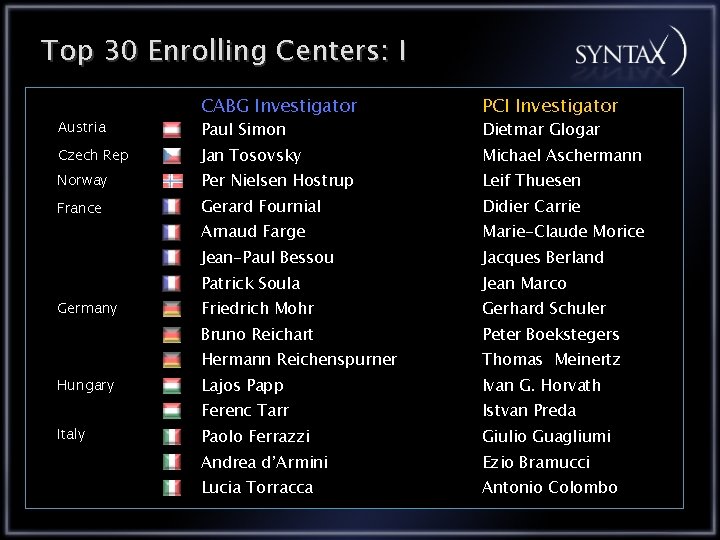
Top 30 Enrolling Centers: I CABG Investigator PCI Investigator Czech Rep Jan Tosovsky Michael Aschermann Norway Per Nielsen Hostrup Leif Thuesen France Gerard Fournial Didier Carrie Arnaud Farge Marie-Claude Morice Jean-Paul Bessou Jacques Berland Patrick Soula Jean Marco Friedrich Mohr Gerhard Schuler Bruno Reichart Peter Boekstegers Hermann Reichenspurner Thomas Meinertz Lajos Papp Ivan G. Horvath Ferenc Tarr Istvan Preda Paolo Ferrazzi Giulio Guagliumi Andrea d’Armini Ezio Bramucci Lucia Torracca Antonio Colombo Austria Germany Hungary Italy Paul Simon Dietmar Glogar
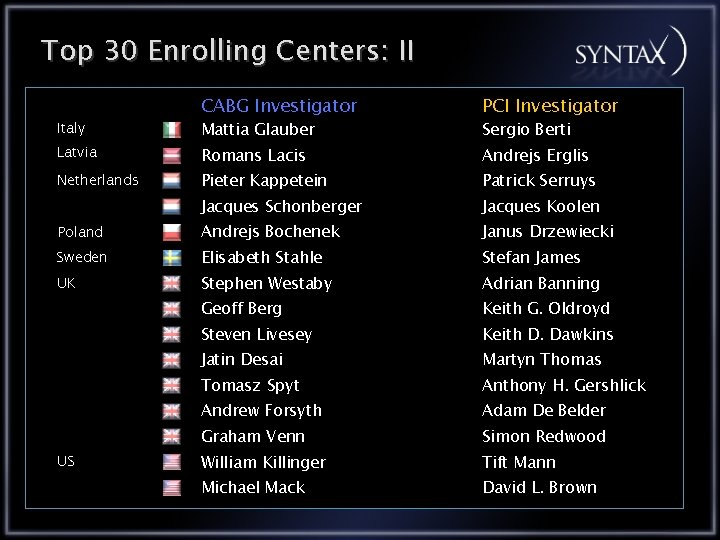
Top 30 Enrolling Centers: II CABG Investigator PCI Investigator Romans Lacis Andrejs Erglis Pieter Kappetein Patrick Serruys Jacques Schonberger Jacques Koolen Poland Andrejs Bochenek Janus Drzewiecki Sweden Elisabeth Stahle Stefan James UK Stephen Westaby Adrian Banning Geoff Berg Keith G. Oldroyd Steven Livesey Keith D. Dawkins Jatin Desai Martyn Thomas Tomasz Spyt Anthony H. Gershlick Andrew Forsyth Adam De Belder Graham Venn Simon Redwood William Killinger Tift Mann Michael Mack David L. Brown Italy Latvia Netherlands US Mattia Glauber Sergio Berti
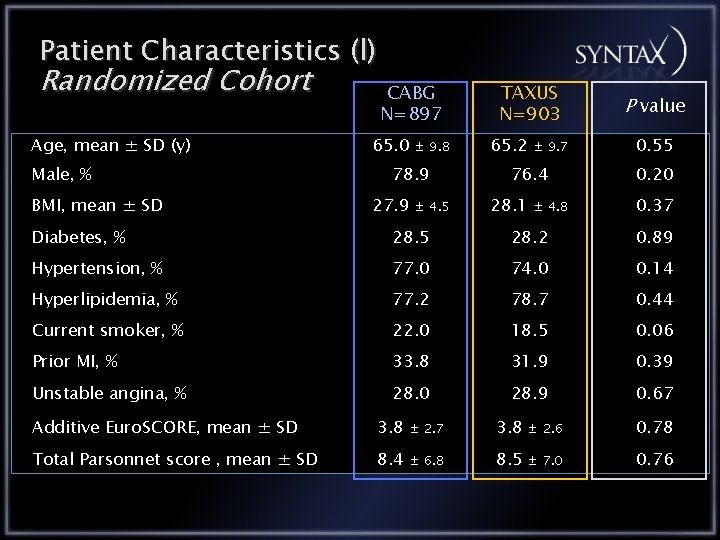
Patient Characteristics (l) Randomized Cohort Age, mean ± SD (y) Male, % BMI, mean ± SD CABG N=897 65. 0 ± 9. 8 78. 9 27. 9 ± 4. 5 TAXUS N=903 65. 2 ± 9. 7 76. 4 28. 1 ± 4. 8 P value 0. 55 0. 20 0. 37 Diabetes, % 28. 5 28. 2 0. 89 Hypertension, % 77. 0 74. 0 0. 14 Hyperlipidemia, % 77. 2 78. 7 0. 44 Current smoker, % 22. 0 18. 5 0. 06 Prior MI, % 33. 8 31. 9 0. 39 Unstable angina, % 28. 0 28. 9 0. 67 Additive Euro. SCORE, mean ± SD 3. 8 ± 2. 7 3. 8 ± 2. 6 0. 78 Total Parsonnet score , mean ± SD 8. 4 ± 6. 8 8. 5 ± 7. 0 0. 76
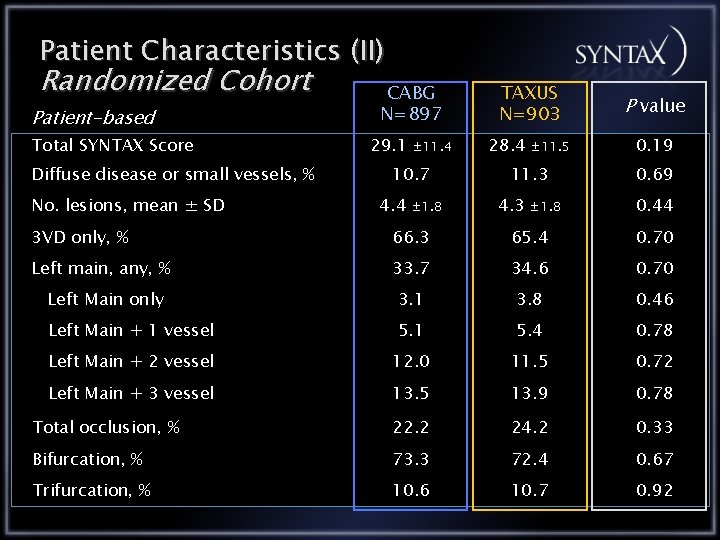
Patient Characteristics (II) Randomized Cohort Patient-based Total SYNTAX Score Diffuse disease or small vessels, % No. lesions, mean ± SD CABG N=897 29. 1 ± 11. 4 10. 7 4. 4 ± 1. 8 TAXUS N=903 28. 4 ± 11. 5 11. 3 4. 3 ± 1. 8 P value 0. 19 0. 69 0. 44 3 VD only, % 66. 3 65. 4 0. 70 Left main, any, % 33. 7 34. 6 0. 70 Left Main only 3. 1 3. 8 0. 46 Left Main + 1 vessel 5. 1 5. 4 0. 78 Left Main + 2 vessel 12. 0 11. 5 0. 72 Left Main + 3 vessel 13. 5 13. 9 0. 78 Total occlusion, % 22. 2 24. 2 0. 33 Bifurcation, % 73. 3 72. 4 0. 67 Trifurcation, % 10. 6 10. 7 0. 92
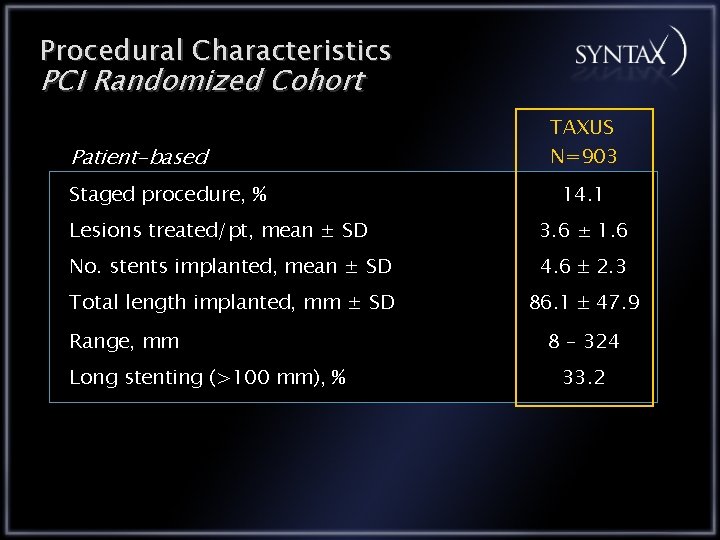
Procedural Characteristics PCI Randomized Cohort Patient-based Staged procedure, % TAXUS N=903 14. 1 Lesions treated/pt, mean ± SD 3. 6 ± 1. 6 No. stents implanted, mean ± SD 4. 6 2. 3 Total length implanted, mm ± SD 86. 1 47. 9 Range, mm Long stenting (>100 mm), % 8 – 324 33. 2
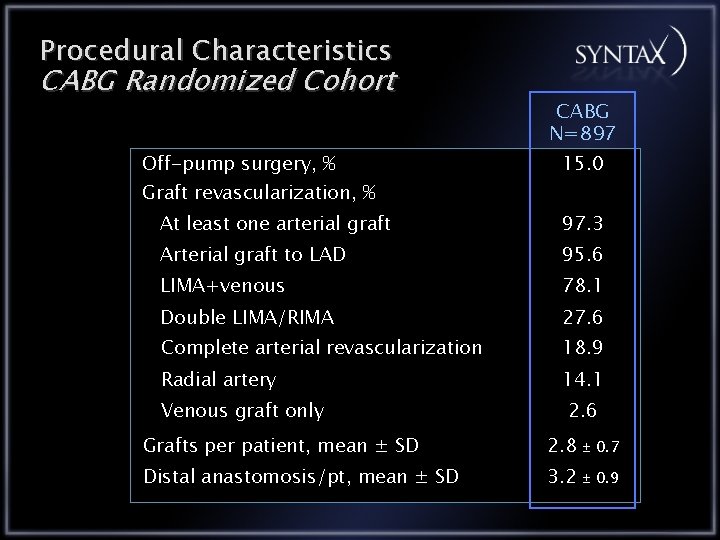
Procedural Characteristics CABG Randomized Cohort Off-pump surgery, % Graft revascularization, % CABG N=897 15. 0 At least one arterial graft 97. 3 Arterial graft to LAD 95. 6 LIMA+venous 78. 1 Double LIMA/RIMA 27. 6 Complete arterial revascularization 18. 9 Radial artery 14. 1 Venous graft only 2. 6 Grafts per patient, mean ± SD 2. 8 0. 7 Distal anastomosis/pt, mean ± SD 3. 2 0. 9
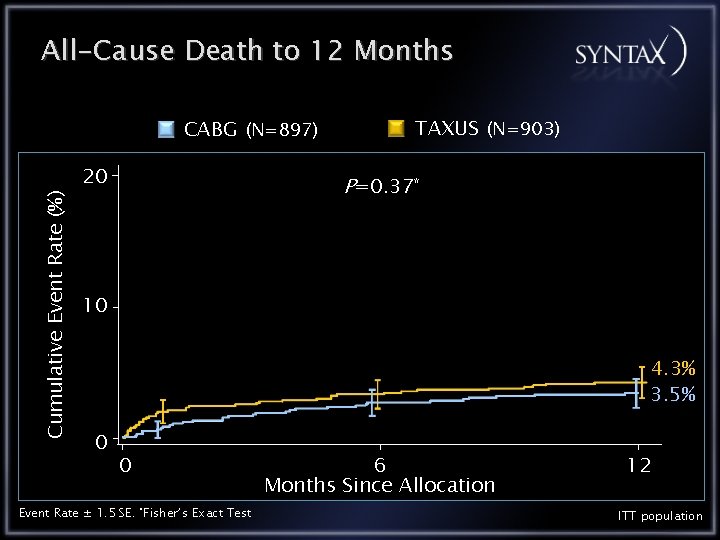
All-Cause Death to 12 Months Cumulative Event Rate (%) CABG (N=897) 20 TAXUS (N=903) P=0. 37* 10 4. 3% 3. 5% 0 0 Event Rate ± 1. 5 SE. *Fisher’s Exact Test 6 Months Since Allocation 12 ITT population
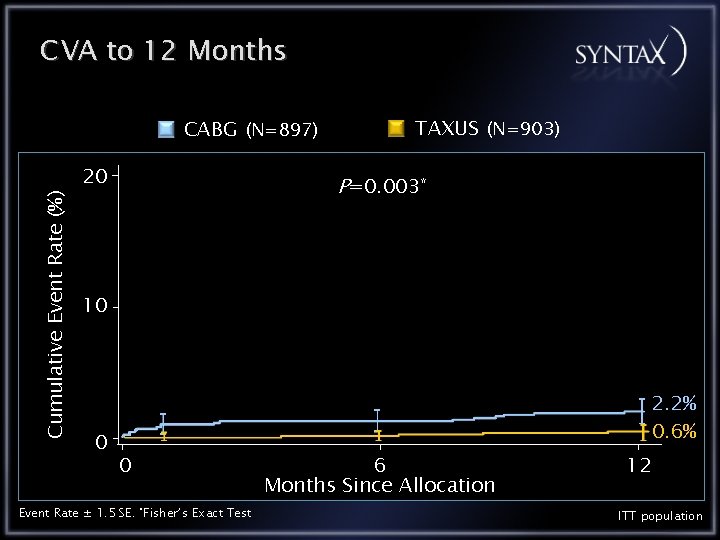
CVA to 12 Months Cumulative Event Rate (%) CABG (N=897) 20 TAXUS (N=903) P=0. 003* 10 0 2. 2% 0. 6% 0 Event Rate ± 1. 5 SE. *Fisher’s Exact Test 6 Months Since Allocation 12 ITT population
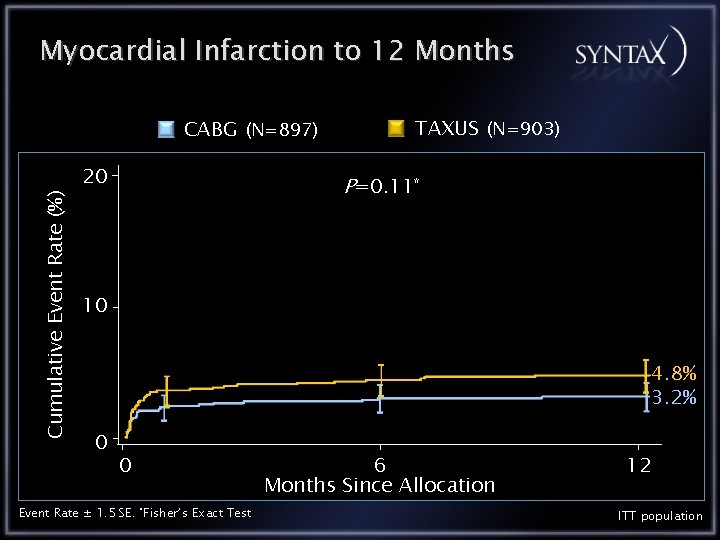
Myocardial Infarction to 12 Months Cumulative Event Rate (%) CABG (N=897) 20 TAXUS (N=903) P=0. 11* 10 4. 8% 3. 2% 0 0 Event Rate ± 1. 5 SE. *Fisher’s Exact Test 6 Months Since Allocation 12 ITT population
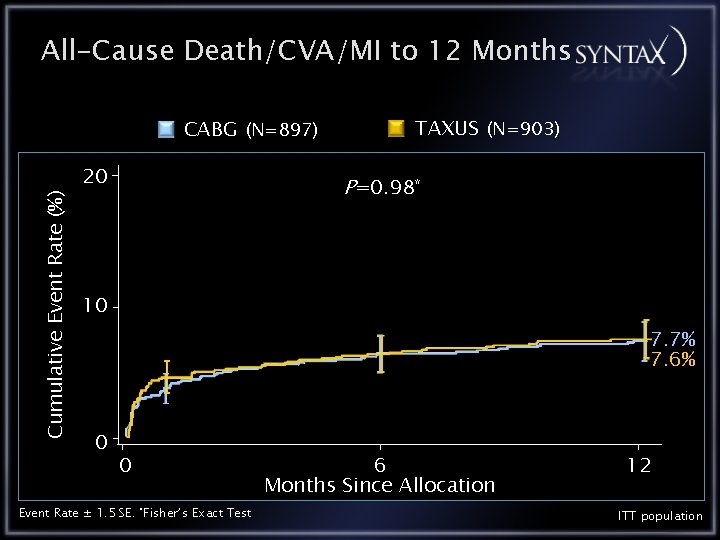
All-Cause Death/CVA/MI to 12 Months Cumulative Event Rate (%) CABG (N=897) 20 TAXUS (N=903) P=0. 98* 10 7. 7% 7. 6% 0 0 Event Rate ± 1. 5 SE. *Fisher’s Exact Test 6 Months Since Allocation 12 ITT population
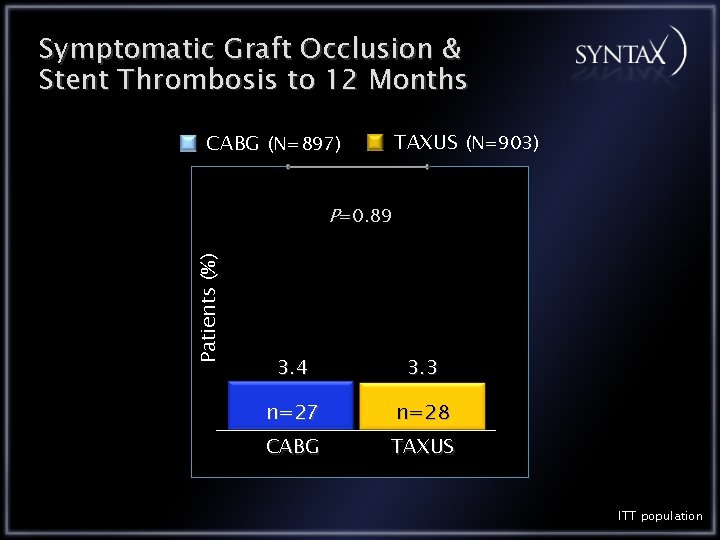
Symptomatic Graft Occlusion & Stent Thrombosis to 12 Months TAXUS (N=903) CABG (N=897) Patients (%) P=0. 89 3. 4 3. 3 n=27 n=28 CABG TAXUS ITT population
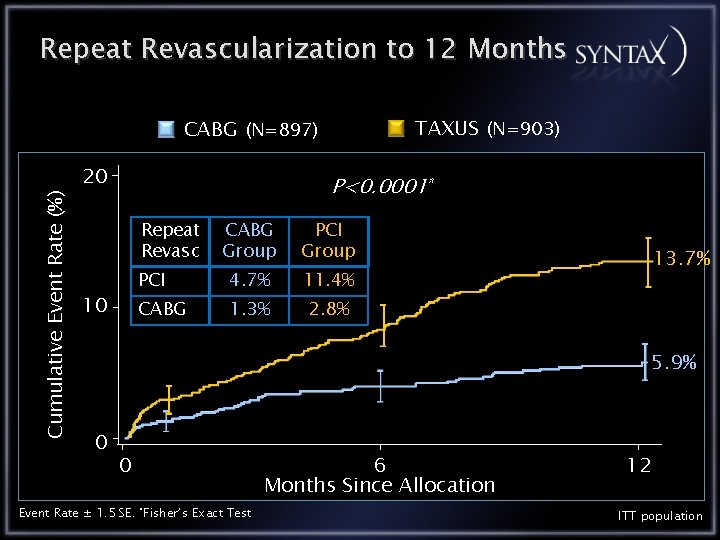
Repeat Revascularization to 12 Months TAXUS (N=903) Cumulative Event Rate (%) CABG (N=897) 20 P<0. 0001* Repeat Revasc 10 CABG Group PCI 4. 7% 11. 4% CABG 1. 3% 2. 8% 13. 7% 5. 9% 0 0 Event Rate ± 1. 5 SE. *Fisher’s Exact Test 6 Months Since Allocation 12 ITT population
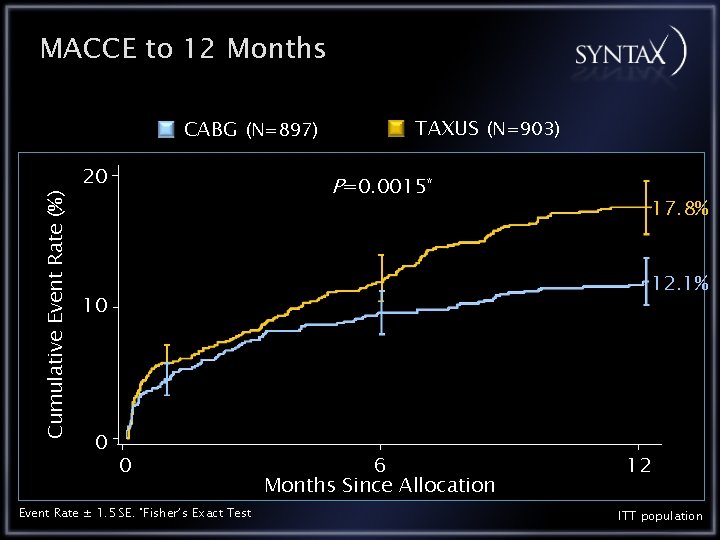
MACCE to 12 Months Cumulative Event Rate (%) CABG (N=897) 20 TAXUS (N=903) P=0. 0015* 12. 1% 10 0 17. 8% 0 Event Rate ± 1. 5 SE. *Fisher’s Exact Test 6 Months Since Allocation 12 ITT population
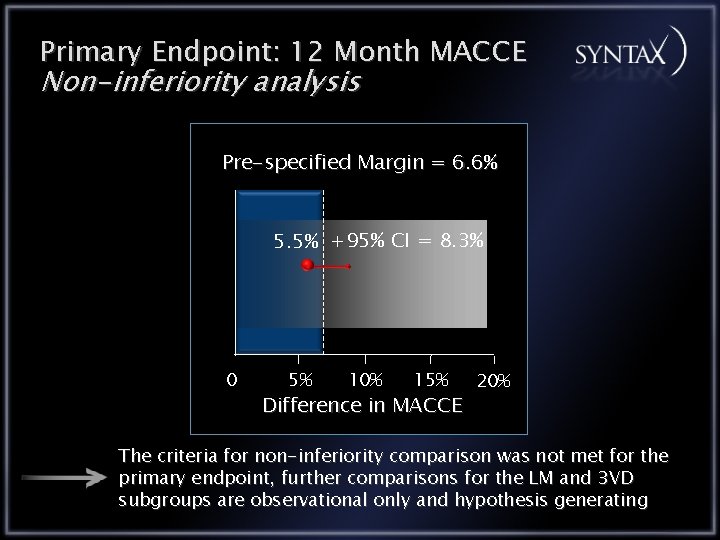
Primary Endpoint: 12 Month MACCE Non-inferiority analysis Pre-specified Margin = 6. 6% 5. 5% +95% CI = 8. 3% 0 5% 10% 15% Difference in MACCE 20% The criteria for non-inferiority comparison was not met for the primary endpoint, further comparisons for the LM and 3 VD subgroups are observational only and hypothesis generating
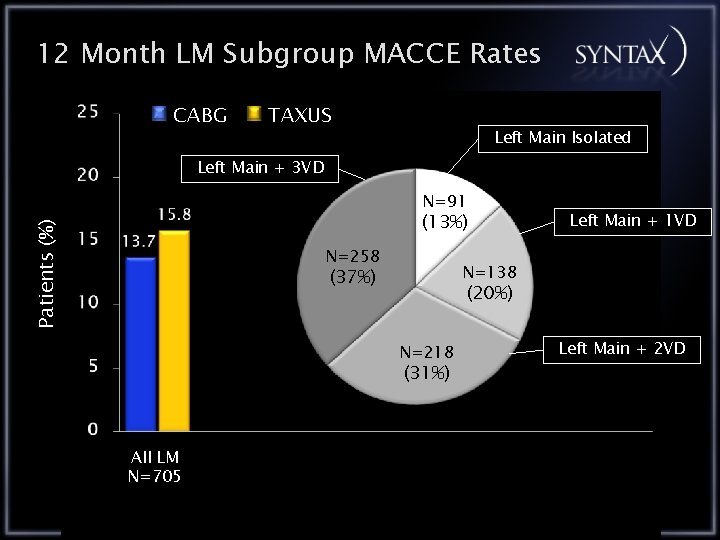
12 Month LM Subgroup MACCE Rates CABG TAXUS Left Main Isolated Left Main + 3 VD N=91 Patients (%) (13%) N=258 N=138 (37%) (20%) N=218 (31%) All LM N=705 Left Main + 1 VD Left Main + 2 VD
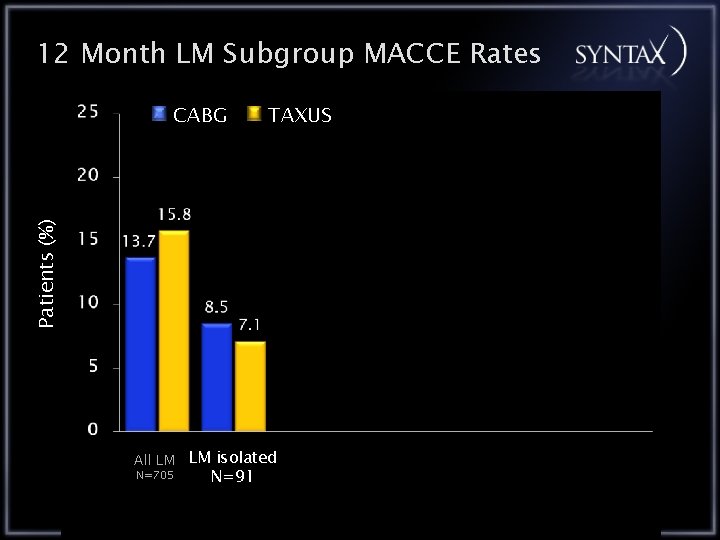
12 Month LM Subgroup MACCE Rates TAXUS Patients (%) CABG All LM LM isolated N=705 N=91
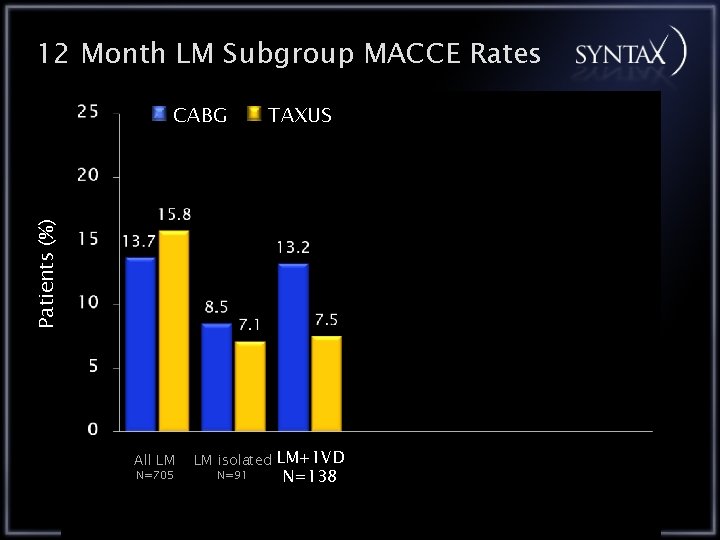
12 Month LM Subgroup MACCE Rates TAXUS Patients (%) CABG All LM N=705 LM isolated LM+1 VD N=91 N=138
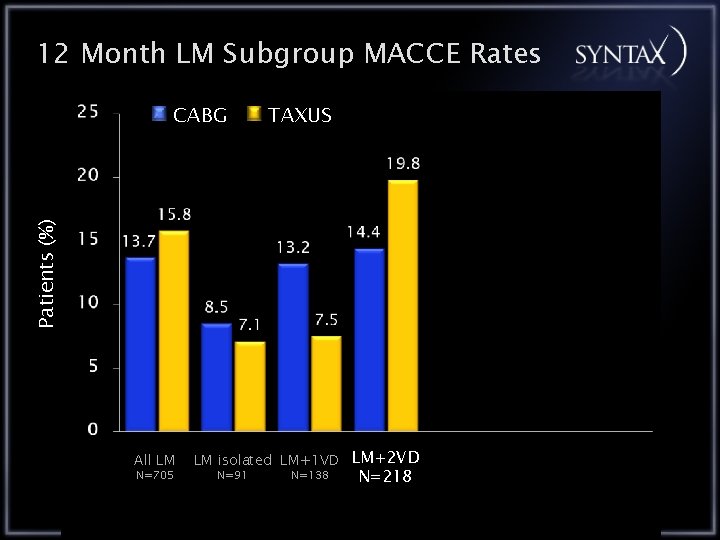
12 Month LM Subgroup MACCE Rates TAXUS Patients (%) CABG All LM N=705 LM isolated LM+1 VD LM+2 VD N=91 N=138 N=218
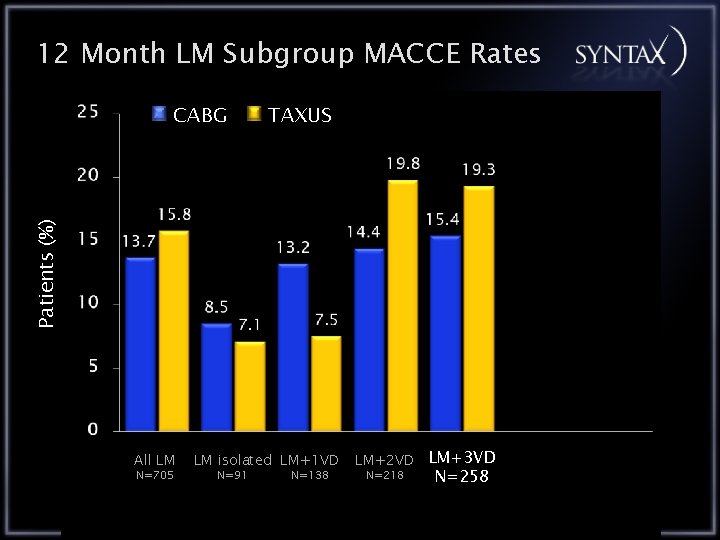
12 Month LM Subgroup MACCE Rates TAXUS Patients (%) CABG All LM N=705 LM isolated LM+1 VD N=91 N=138 LM+2 VD LM+3 VD N=218 N=258
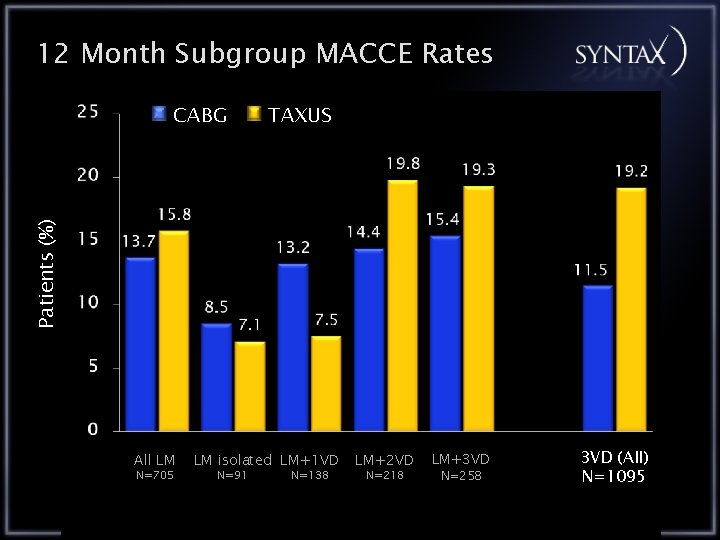
12 Month Subgroup MACCE Rates TAXUS Patients (%) CABG All LM N=705 LM isolated LM+1 VD N=91 N=138 LM+2 VD N=218 LM+3 VD N=258 3 VD (All) N=1095
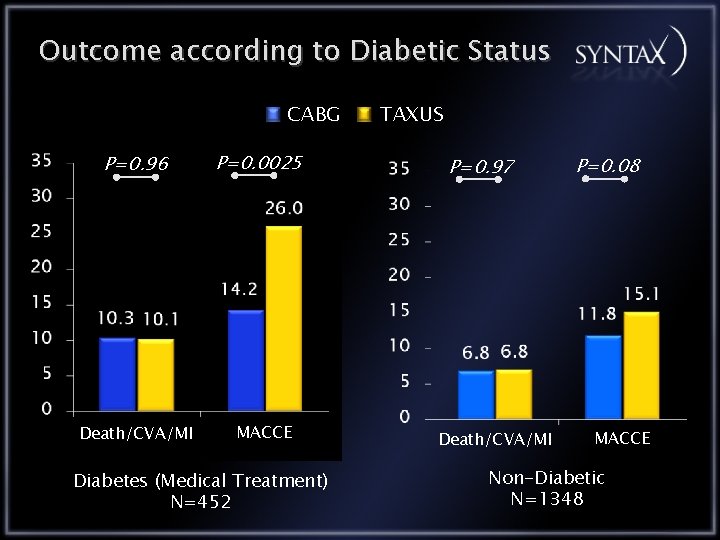
Outcome according to Diabetic Status CABG P=0. 96 Death/CVA/MI P=0. 0025 MACCE Diabetes (Medical Treatment) N=452 TAXUS P=0. 97 Death/CVA/MI P=0. 08 MACCE Non-Diabetic N=1348
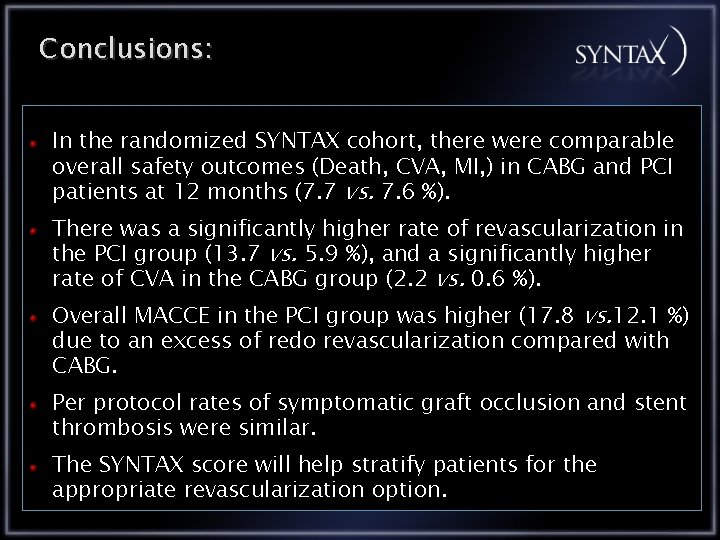
Conclusions: In the randomized SYNTAX cohort, there were comparable overall safety outcomes (Death, CVA, MI, ) in CABG and PCI patients at 12 months (7. 7 vs. 7. 6 %). There was a significantly higher rate of revascularization in the PCI group (13. 7 vs. 5. 9 %), and a significantly higher rate of CVA in the CABG group (2. 2 vs. 0. 6 %). Overall MACCE in the PCI group was higher (17. 8 vs. 12. 1 %) due to an excess of redo revascularization compared with CABG. Per protocol rates of symptomatic graft occlusion and stent thrombosis were similar. The SYNTAX score will help stratify patients for the appropriate revascularization option.
- Slides: 33