
The Symbolic System of the Five Elements in
The Symbolic System of the Five Elements in the Chinese Feng-Shui Architectural Tradition En-Yu Huang Assistant Professor, Chinese Culture University, Taipei, Taiwan 2 nd International Conference on Art and Humanities 2015 20 -22 July 2015, Colombo, Sri Lanka
Chinese Feng-Shui as an Architectural Tradition Chinese Feng-Shui as an age-old architectural tradition in which a variety of theories have been developed to explained the natural and built environments and to establish theories for the location, orientation, arrangement and construction of buildings and man-made surroundings. Although the term Feng-Shui (風水), which literally means wind and water, was first introduced between the 3 rd and 4 th centuries CE, many similar descriptions can be found in ancient texts as early as the 3 rd century BCE.
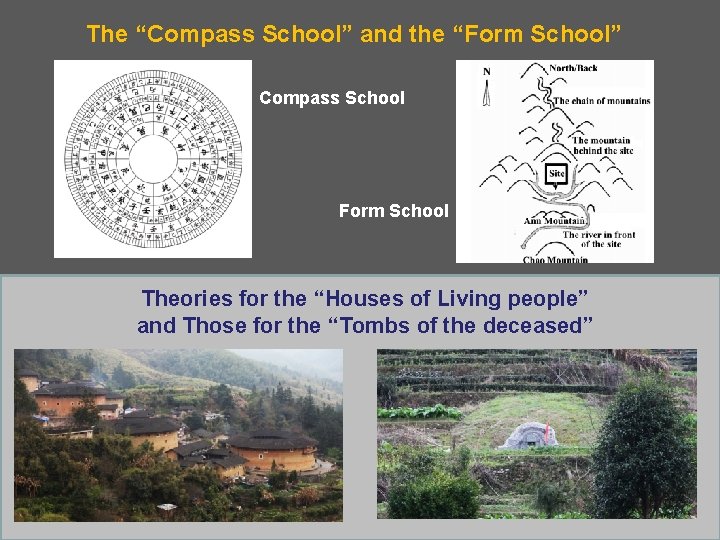
The “Compass School” and the “Form School” Compass School Form School Theories for the “Houses of Living people” and Those for the “Tombs of the deceased”
The Beginning of the Formation of the System of the Five Elements in Ancient Times Early descriptions of the system of the Five Elements, which is known as Wu. Xing (五行), can be found in several texts compiled before the 5 th century BCE. Although the order of the Five Element is not fixed in these texts, it seems that Water is usually highlighted as the first element: “The virtue (of the ruler) is seen in (his) good governance for the nourishing of the people. There are Water, Fire, Metal, Wood, Earth, and grain - these must be duly regulated”. (Book of Yu, Shangshu, 8 th-5 th C. BCE) “Wu-Xing: The first is called Water; the second, Fire; the third, Wood; the fourth, Metal; the fifth, Earth” (Book of Zhou, Shangshu, 8 th-5 th C. BCE)
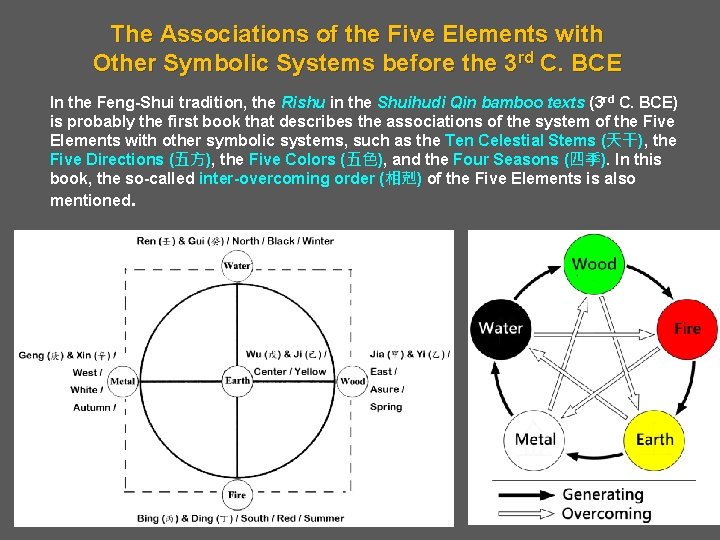
The Associations of the Five Elements with Other Symbolic Systems before the 3 rd C. BCE In the Feng-Shui tradition, the Rishu in the Shuihudi Qin bamboo texts (3 rd C. BCE) is probably the first book that describes the associations of the system of the Five Elements with other symbolic systems, such as the Ten Celestial Stems (天干), the Five Directions (五方), the Five Colors (五色), and the Four Seasons (四季). In this book, the so-called inter-overcoming order (相剋) of the Five Elements is also mentioned.
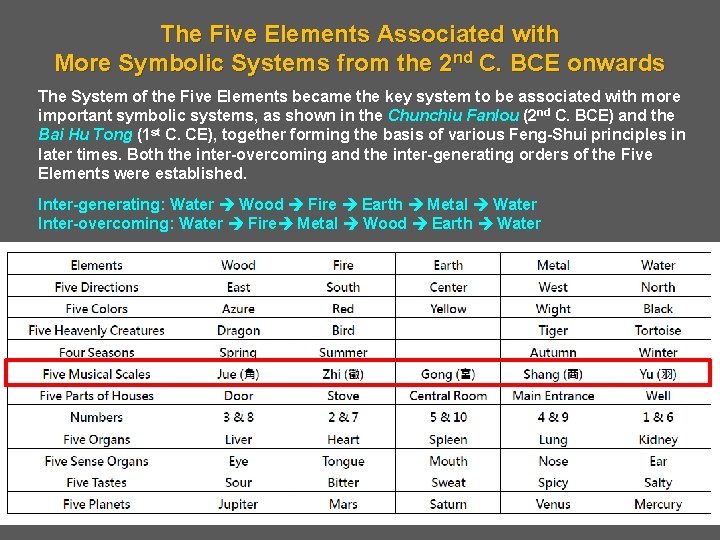
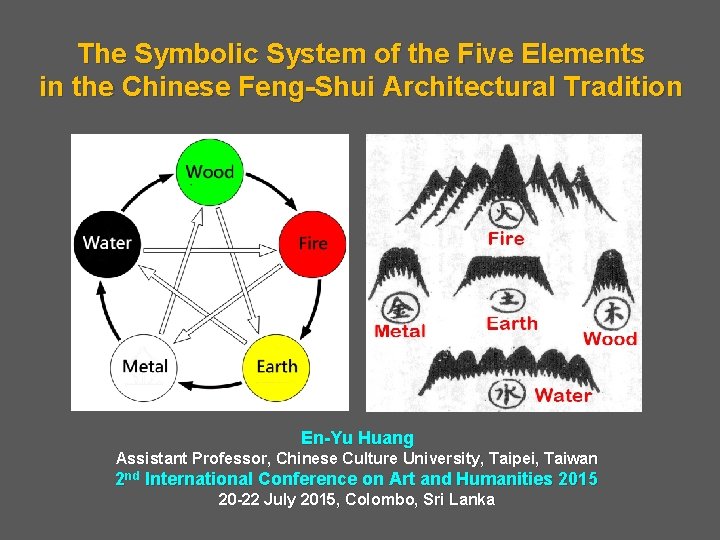
The Five Elements Associated with More Symbolic Systems from the 2 nd C. BCE onwards The System of the Five Elements became the key system to be associated with more important symbolic systems, as shown in the Chunchiu Fanlou (2 nd C. BCE) and the Bai Hu Tong (1 st C. CE), together forming the basis of various Feng-Shui principles in later times. Both the inter-overcoming and the inter-generating orders of the Five Elements were established. Inter-generating: Water Wood Fire Earth Metal Water Inter-overcoming: Water Fire Metal Wood Earth Water
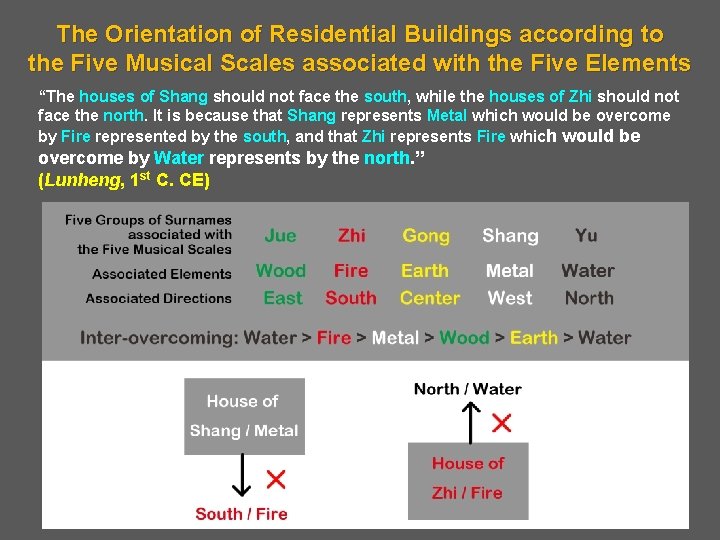
The Orientation of Residential Buildings according to the Five Musical Scales associated with the Five Elements “The houses of Shang should not face the south, while the houses of Zhi should not face the north. It is because that Shang represents Metal which would be overcome by Fire represented by the south, and that Zhi represents Fire which would be overcome by Water represents by the north. ” (Lunheng, 1 st C. CE)
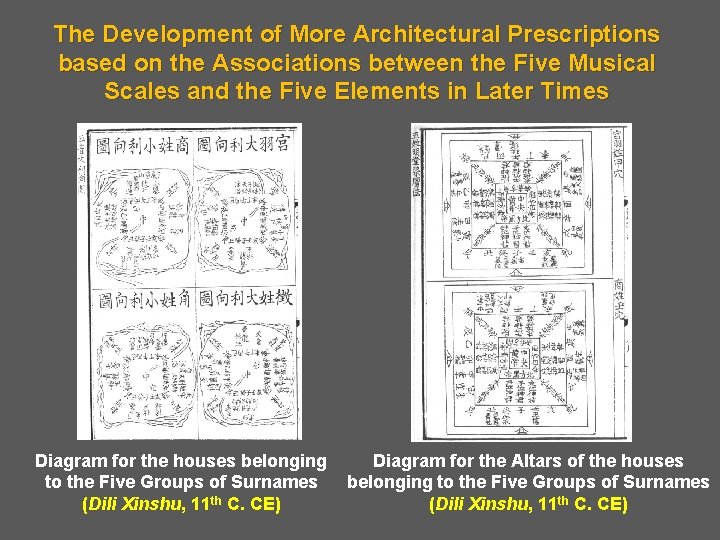
The Development of More Architectural Prescriptions based on the Associations between the Five Musical Scales and the Five Elements in Later Times Diagram for the houses belonging to the Five Groups of Surnames (Dili Xinshu, 11 th C. CE) Diagram for the Altars of the houses belonging to the Five Groups of Surnames (Dili Xinshu, 11 th C. CE)
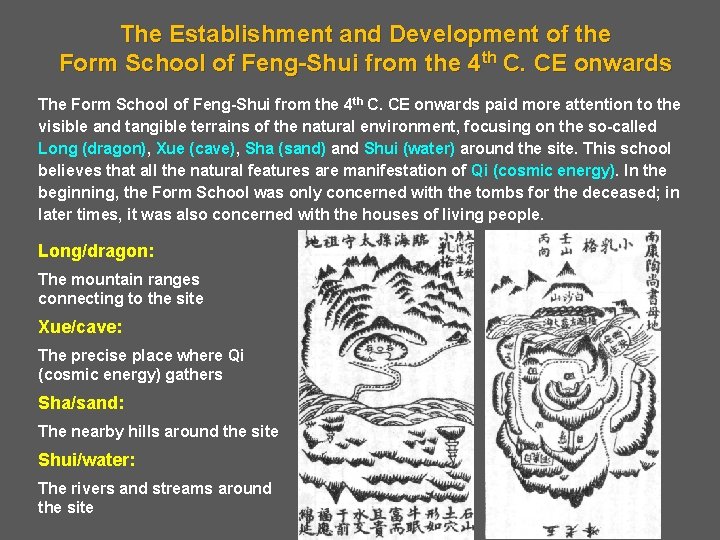
The Establishment and Development of the Form School of Feng-Shui from the 4 th C. CE onwards The Form School of Feng-Shui from the 4 th C. CE onwards paid more attention to the visible and tangible terrains of the natural environment, focusing on the so-called Long (dragon), Xue (cave), Sha (sand) and Shui (water) around the site. This school believes that all the natural features are manifestation of Qi (cosmic energy). In the beginning, the Form School was only concerned with the tombs for the deceased; in later times, it was also concerned with the houses of living people. Long/dragon: The mountain ranges connecting to the site Xue/cave: The precise place where Qi (cosmic energy) gathers Sha/sand: The nearby hills around the site Shui/water: The rivers and streams around the site
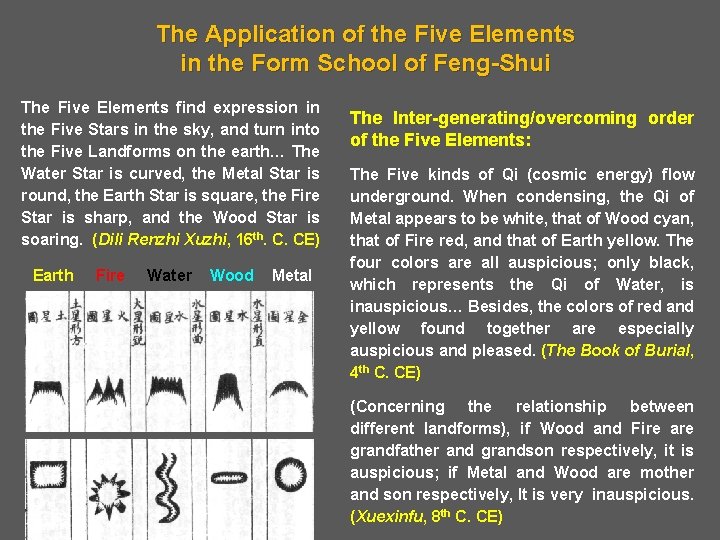
The Application of the Five Elements in the Form School of Feng-Shui The Five Elements find expression in the Five Stars in the sky, and turn into the Five Landforms on the earth… The Water Star is curved, the Metal Star is round, the Earth Star is square, the Fire Star is sharp, and the Wood Star is soaring. (Dili Renzhi Xuzhi, 16 th. C. CE) Earth Fire Water Wood Metal The Inter-generating/overcoming order of the Five Elements: The Five kinds of Qi (cosmic energy) flow underground. When condensing, the Qi of Metal appears to be white, that of Wood cyan, that of Fire red, and that of Earth yellow. The four colors are all auspicious; only black, which represents the Qi of Water, is inauspicious… Besides, the colors of red and yellow found together are especially auspicious and pleased. (The Book of Burial, 4 th C. CE) (Concerning the relationship between different landforms), if Wood and Fire are grandfather and grandson respectively, it is auspicious; if Metal and Wood are mother and son respectively, It is very inauspicious. (Xuexinfu, 8 th C. CE)
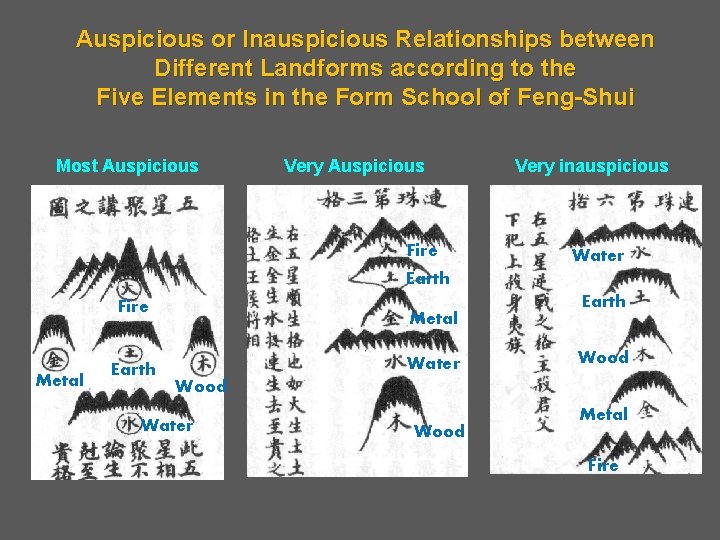
Auspicious or Inauspicious Relationships between Different Landforms according to the Five Elements in the Form School of Feng-Shui Most Auspicious Very Auspicious Fire Very inauspicious Water Earth Fire Metal Earth Metal Water Earth Wood Water Wood Metal Fire
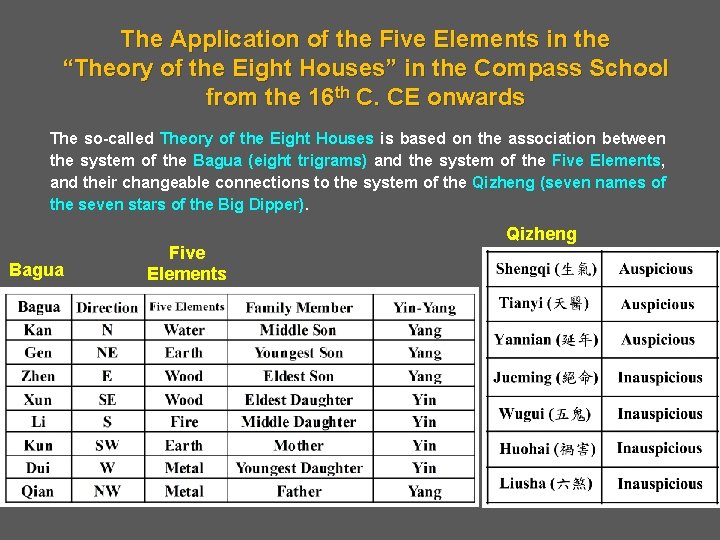
The Application of the Five Elements in the “Theory of the Eight Houses” in the Compass School from the 16 th C. CE onwards The so-called Theory of the Eight Houses is based on the association between the system of the Bagua (eight trigrams) and the system of the Five Elements, and their changeable connections to the system of the Qizheng (seven names of the seven stars of the Big Dipper). Bagua Five Elements Qizheng
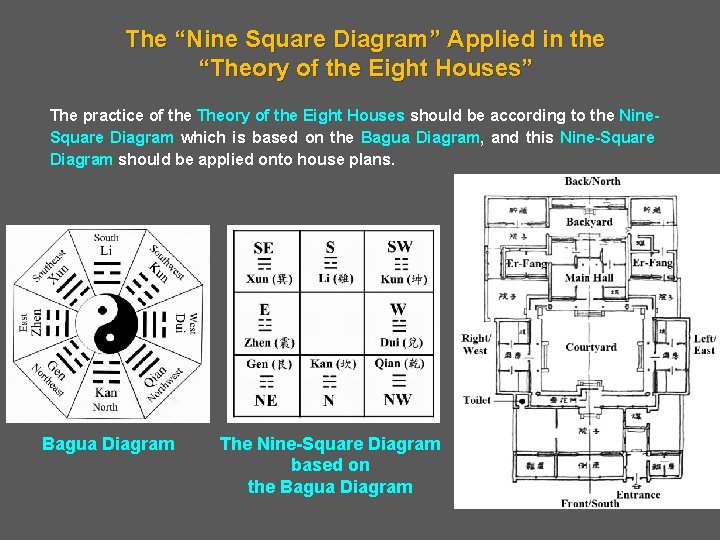
The “Nine Square Diagram” Applied in the “Theory of the Eight Houses” The practice of the Theory of the Eight Houses should be according to the Nine. Square Diagram which is based on the Bagua Diagram, and this Nine-Square Diagram should be applied onto house plans. Bagua Diagram The Nine-Square Diagram based on the Bagua Diagram
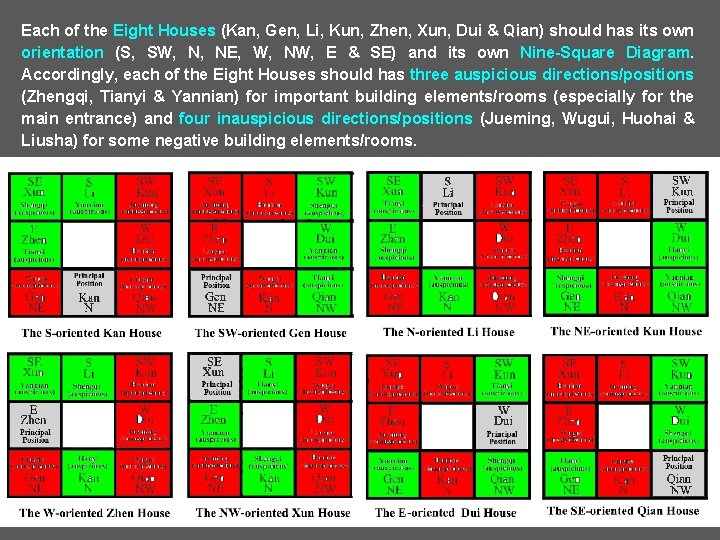
Each of the Eight Houses (Kan, Gen, Li, Kun, Zhen, Xun, Dui & Qian) should has its own orientation (S, SW, N, NE, W, NW, E & SE) and its own Nine-Square Diagram. Accordingly, each of the Eight Houses should has three auspicious directions/positions (Zhengqi, Tianyi & Yannian) for important building elements/rooms (especially for the main entrance) and four inauspicious directions/positions (Jueming, Wugui, Huohai & Liusha) for some negative building elements/rooms.
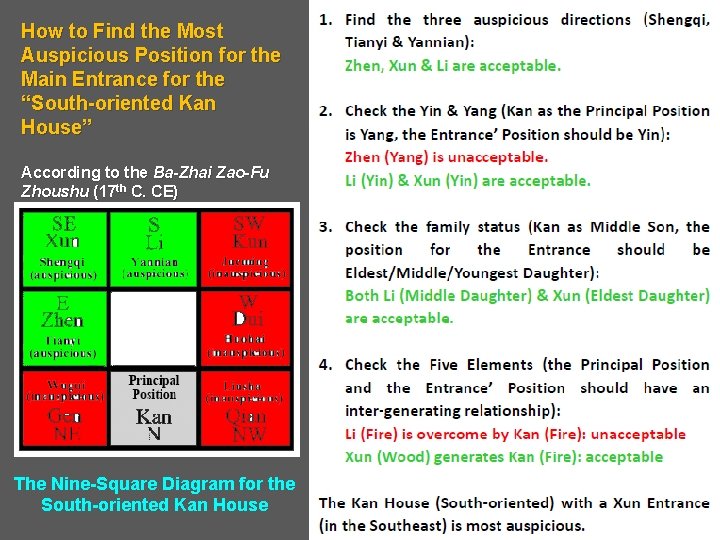
How to Find the Most Auspicious Position for the Main Entrance for the “South-oriented Kan House” According to the Ba-Zhai Zao-Fu Zhoushu (17 th C. CE) The Nine-Square Diagram for the South-oriented Kan House
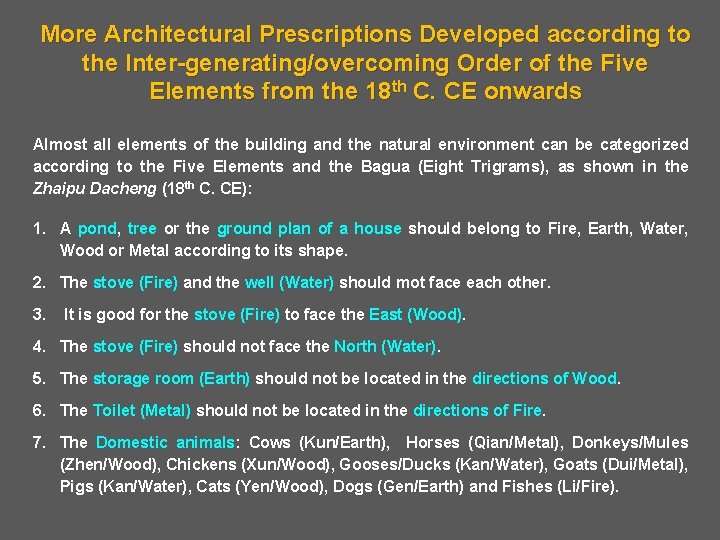
More Architectural Prescriptions Developed according to the Inter-generating/overcoming Order of the Five Elements from the 18 th C. CE onwards Almost all elements of the building and the natural environment can be categorized according to the Five Elements and the Bagua (Eight Trigrams), as shown in the Zhaipu Dacheng (18 th C. CE): 1. A pond, tree or the ground plan of a house should belong to Fire, Earth, Water, Wood or Metal according to its shape. 2. The stove (Fire) and the well (Water) should mot face each other. 3. It is good for the stove (Fire) to face the East (Wood). 4. The stove (Fire) should not face the North (Water). 5. The storage room (Earth) should not be located in the directions of Wood. 6. The Toilet (Metal) should not be located in the directions of Fire. 7. The Domestic animals: Cows (Kun/Earth), Horses (Qian/Metal), Donkeys/Mules (Zhen/Wood), Chickens (Xun/Wood), Gooses/Ducks (Kan/Water), Goats (Dui/Metal), Pigs (Kan/Water), Cats (Yen/Wood), Dogs (Gen/Earth) and Fishes (Li/Fire).
More and More Prescriptions Developed according to the Five Elements In the Feng-Shui Practice of Today In the Feng-Shui practice of today, as we can find in most Feng-Shui manuals, the socalled “Feng-Shui masters” usually tend to develop their own theories and establish architectural prescriptions according to the System of the Five Elements. 1. The birth year to be associated with the Five Elements 2. The numbers of floors/fishes/plants/lamps/furniture to be associated with the Five Elements 3. The colors of plants/doors/furniture/carpets/lamps/decorations to be associated with the Five Elements. 4. The shapes of windows/doors/furniture/buildings/roofs to be associated with the Five Elements. 5. The directions of some outside inauspicious and harmful objects, such as corners, eaves, poles, sharp roofs, construction sites. 6. Especially concerned about the relationship between the kitchen (Five) and the toilet (Water) inside houses. 7. Developing Feng-Shui tools according to the inter-generating/overcoming order of the Five Elements.

Thank You for Your Attention
- Slides: 18