
THE SWEDISH REGULATORY MODEL Efficiency and Network Utility

![MODELL (SR) ENERGY LC OP. COST EX LOSS COST ENERGY HC DISTRIBUTOR [SHORT RUN]](https://slidetodoc.com/presentation_image_h2/b935f8040e9107240d2a403552484bb5/image-31.jpg "MODELL (SR) ENERGY LC OP. COST EX LOSS COST ENERGY HC DISTRIBUTOR [SHORT RUN]")
![MODELL (LR) ENERGY LC OP. COST TR. LOSSES TR CAPITAL DISTRIBUTOR [LONG RUN] ENERGY](https://slidetodoc.com/presentation_image_h2/b935f8040e9107240d2a403552484bb5/image-32.jpg "MODELL (LR) ENERGY LC OP. COST TR. LOSSES TR CAPITAL DISTRIBUTOR [LONG RUN] ENERGY")

- Slides: 36
THE SWEDISH REGULATORY MODEL: Efficiency and Network Utility Per AGRELL Peter BOGETOFT KVL, Economics Denmark
OUTLINE YARD-STICK COMPETITION REGULATORY FRAMEWORK DEA – Examples, TE, SE, CE – Modelling principles NETWORK UTILITY DEA MODELS (SR, LR) INCENTIVE SYSTEM (c) AGRELL, KVL 2
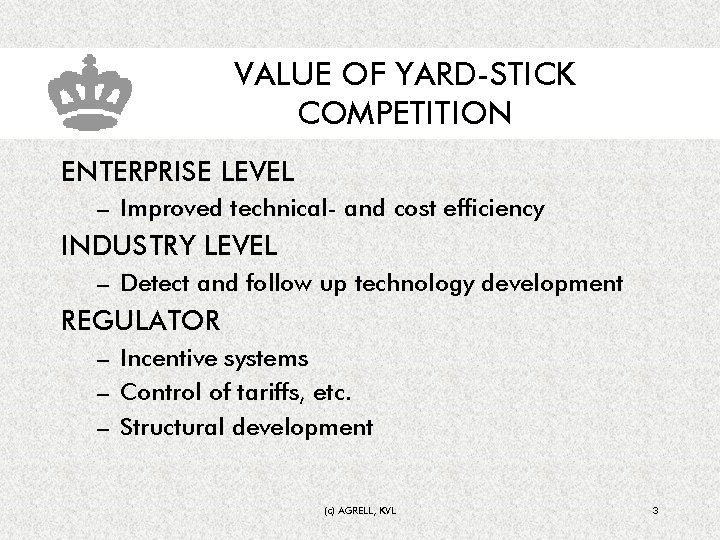
VALUE OF YARD-STICK COMPETITION ENTERPRISE LEVEL – Improved technical- and cost efficiency INDUSTRY LEVEL – Detect and follow up technology development REGULATOR – Incentive systems – Control of tariffs, etc. – Structural development (c) AGRELL, KVL 3
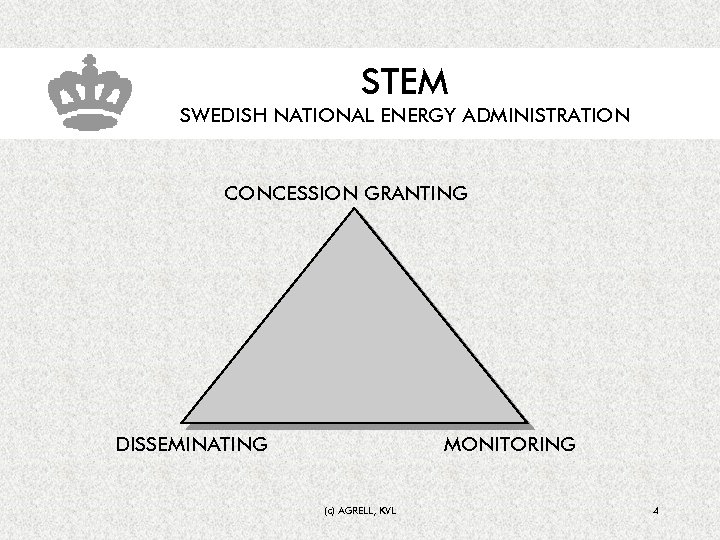
STEM SWEDISH NATIONAL ENERGY ADMINISTRATION CONCESSION GRANTING DISSEMINATING MONITORING (c) AGRELL, KVL 4
REGULATORY FRAMEWORK ELECTRICITY ACT (1992) – Ch 4, § 1 “Fair and objective tariffs” “Reasonable rate of return” – Ch 4, § 3 Differentiation between concessions No differentiation within concession REGULATIONS [e. g. , Prop 1993/94: 162) – Comparative evaluation of tariffs (c) AGRELL, KVL 5
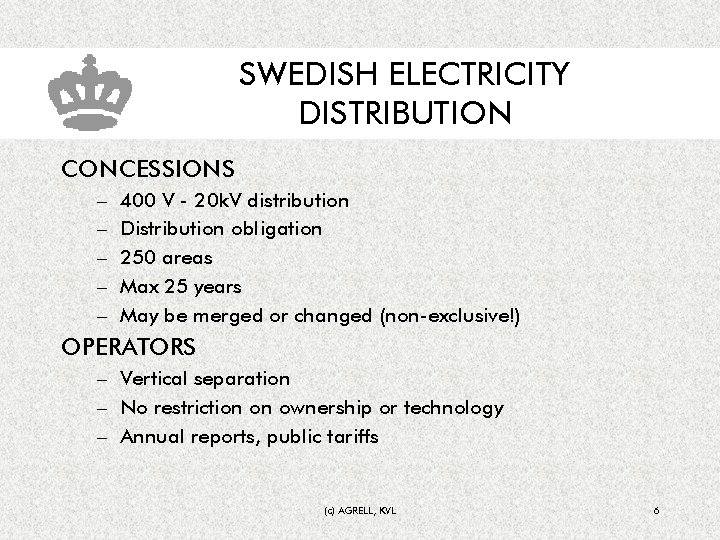
SWEDISH ELECTRICITY DISTRIBUTION CONCESSIONS – – – 400 V - 20 k. V distribution Distribution obligation 250 areas Max 25 years May be merged or changed (non-exclusive!) OPERATORS – Vertical separation – No restriction on ownership or technology – Annual reports, public tariffs (c) AGRELL, KVL 6
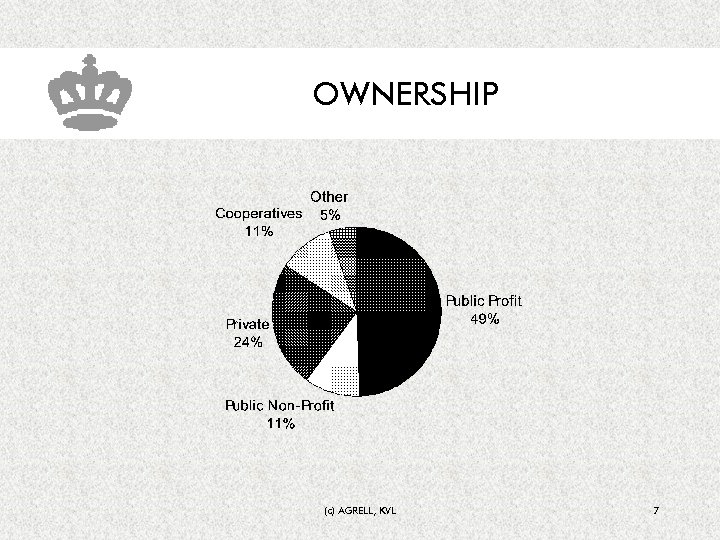
OWNERSHIP (c) AGRELL, KVL 7
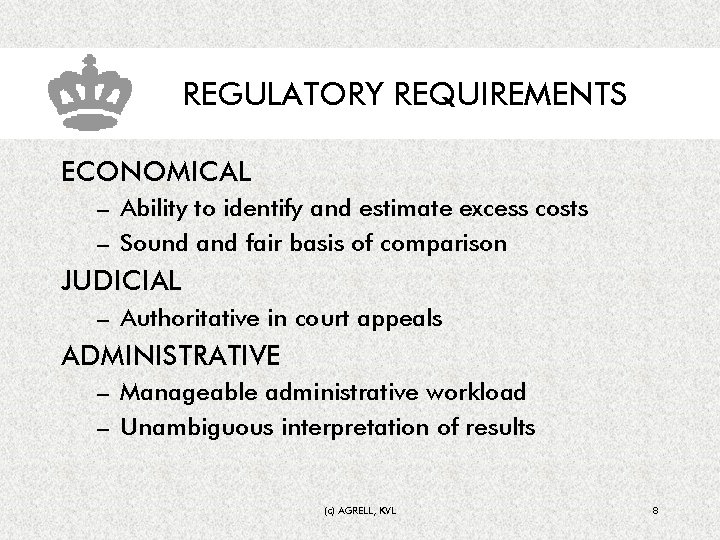
REGULATORY REQUIREMENTS ECONOMICAL – Ability to identify and estimate excess costs – Sound and fair basis of comparison JUDICIAL – Authoritative in court appeals ADMINISTRATIVE – Manageable administrative workload – Unambiguous interpretation of results (c) AGRELL, KVL 8
Why DEA? DATA ENVELOPMENT ANALYSIS Charnes, Cooper och Rhodes (1978) Established method to estimate optimal production and lowest cost by best-practice observations. – PRODUCTIVE EFFICIENCY – OBSERVED DATA (c) AGRELL, KVL 9
DEA PROJECT GROUP Per AGRELL Peter BOGETOFT associate professor Birgitta SJÖBERG Roger HUSBLAD Lars ERIKSSON STEM Reference group SVEL, et al. (c) AGRELL, KVL 10
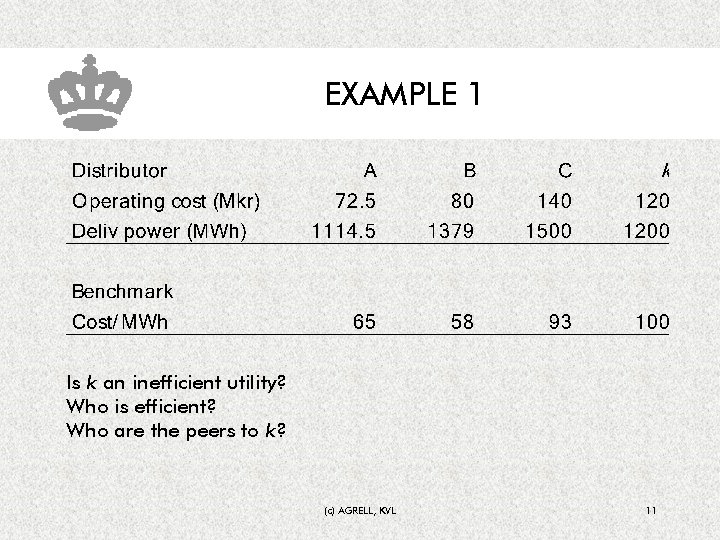
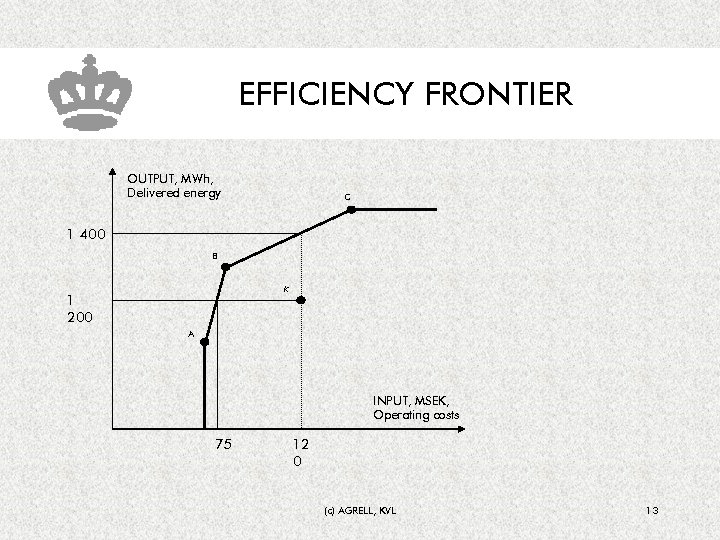
EXAMPLE 1 Is k an inefficient utility? Who is efficient? Who are the peers to k? (c) AGRELL, KVL 11
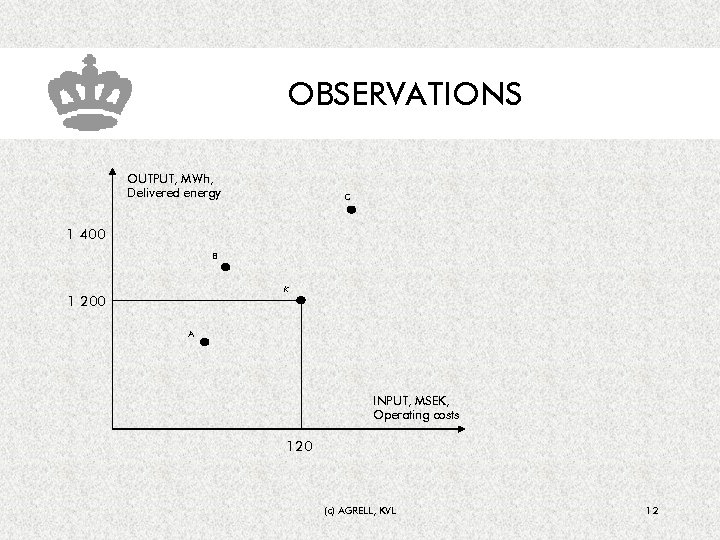
OBSERVATIONS OUTPUT, MWh, Delivered energy C 1 400 B k 1 200 A INPUT, MSEK, Operating costs 120 (c) AGRELL, KVL 12
EFFICIENCY FRONTIER OUTPUT, MWh, Delivered energy C 1 400 B k 1 200 A INPUT, MSEK, Operating costs 75 12 0 (c) AGRELL, KVL 13
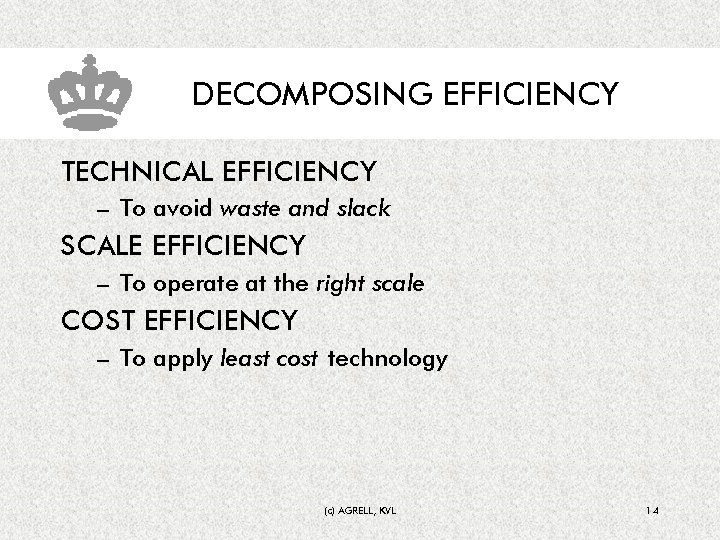
DECOMPOSING EFFICIENCY TECHNICAL EFFICIENCY – To avoid waste and slack SCALE EFFICIENCY – To operate at the right scale COST EFFICIENCY – To apply least cost technology (c) AGRELL, KVL 14
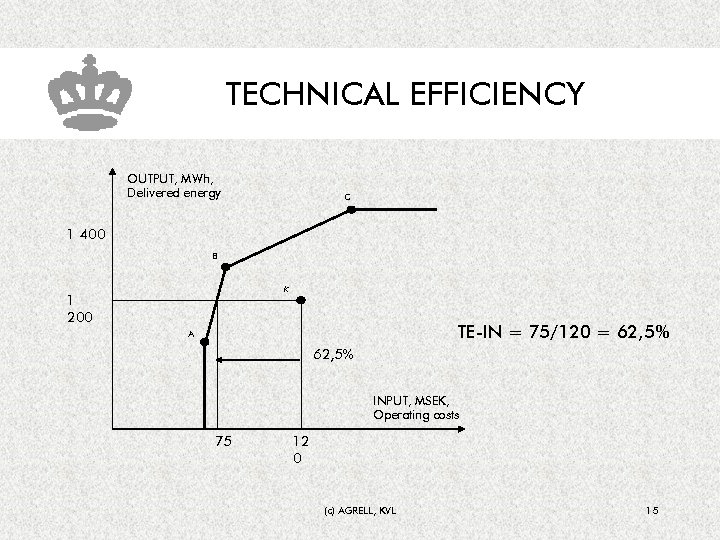
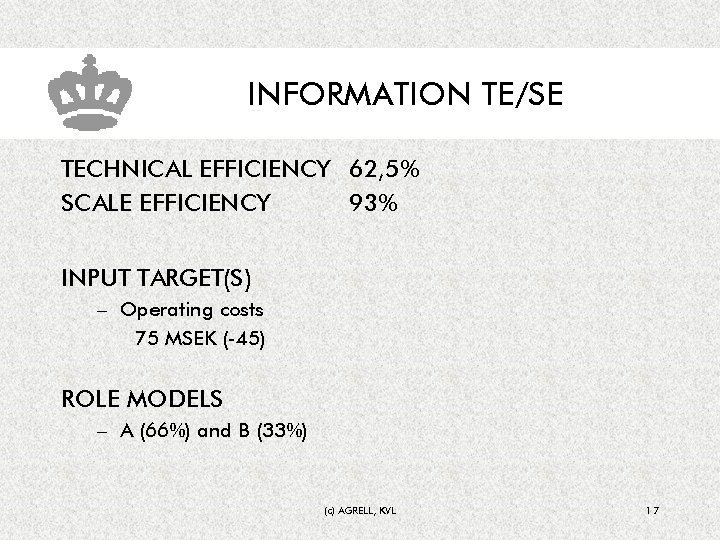
TECHNICAL EFFICIENCY OUTPUT, MWh, Delivered energy C 1 400 B k 1 200 TE-IN = 75/120 = 62, 5% A 62, 5% INPUT, MSEK, Operating costs 75 12 0 (c) AGRELL, KVL 15
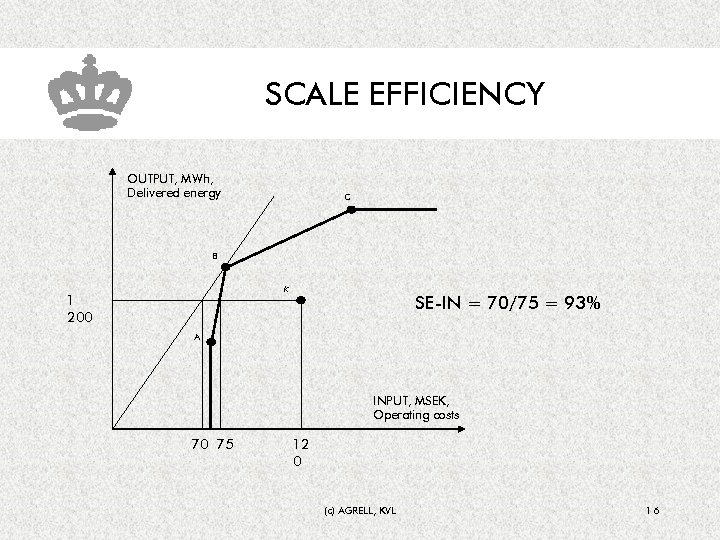
SCALE EFFICIENCY OUTPUT, MWh, Delivered energy C B k 1 200 SE-IN = 70/75 = 93% A INPUT, MSEK, Operating costs 70 75 12 0 (c) AGRELL, KVL 16
INFORMATION TE/SE TECHNICAL EFFICIENCY 62, 5% SCALE EFFICIENCY 93% INPUT TARGET(S) – Operating costs 75 MSEK (-45) ROLE MODELS – A (66%) and B (33%) (c) AGRELL, KVL 17
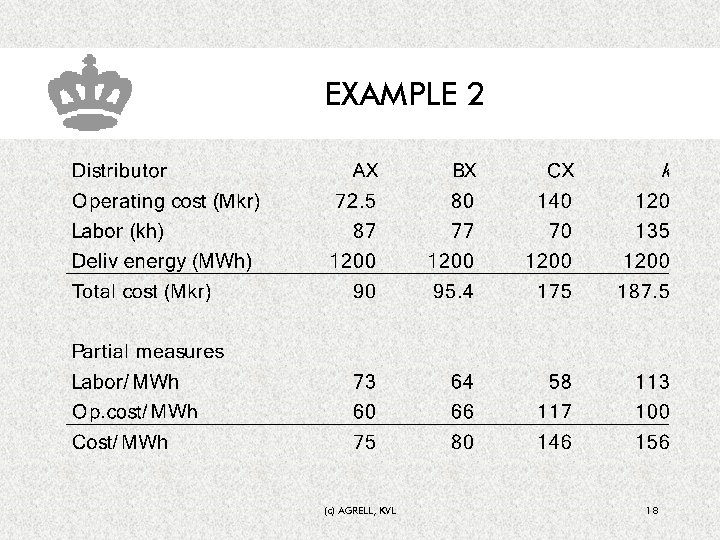
EXAMPLE 2 (c) AGRELL, KVL 18
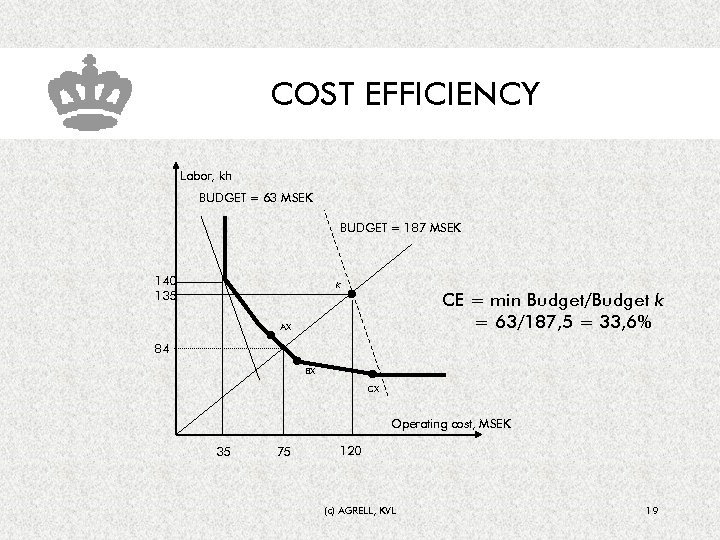
COST EFFICIENCY Labor, kh BUDGET = 63 MSEK BUDGET = 187 MSEK 140 135 k CE = min Budget/Budget k = 63/187, 5 = 33, 6% AX 84 BX CX Operating cost, MSEK 35 75 120 (c) AGRELL, KVL 19
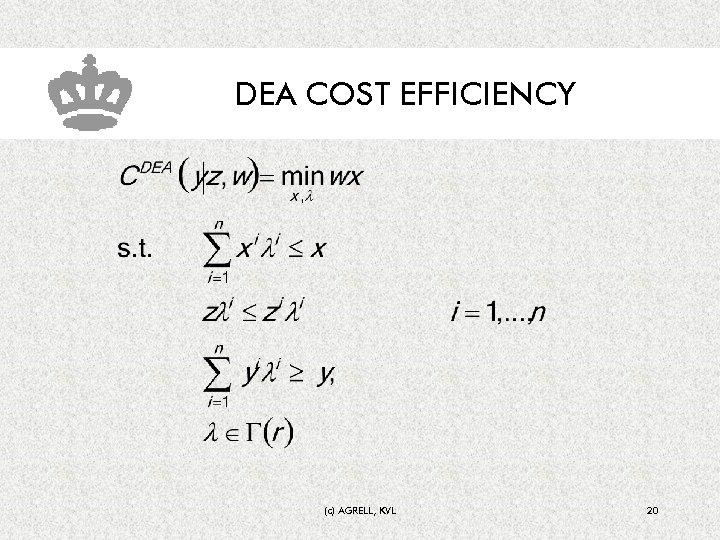
DEA COST EFFICIENCY (c) AGRELL, KVL 20
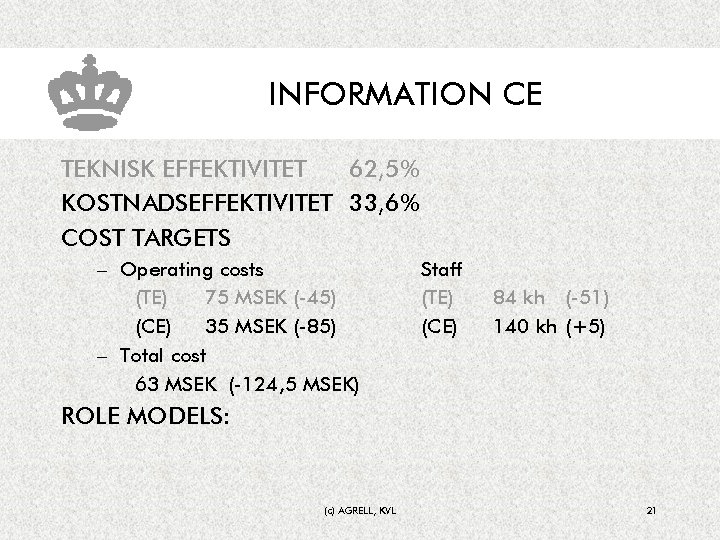
INFORMATION CE TEKNISK EFFEKTIVITET 62, 5% KOSTNADSEFFEKTIVITET 33, 6% COST TARGETS – Operating costs (TE) 75 MSEK (-45) (CE) 35 MSEK (-85) – Total cost 63 MSEK (-124, 5 MSEK) Staff (TE) (CE) 84 kh (-51) 140 kh (+5) ROLE MODELS: (c) AGRELL, KVL 21
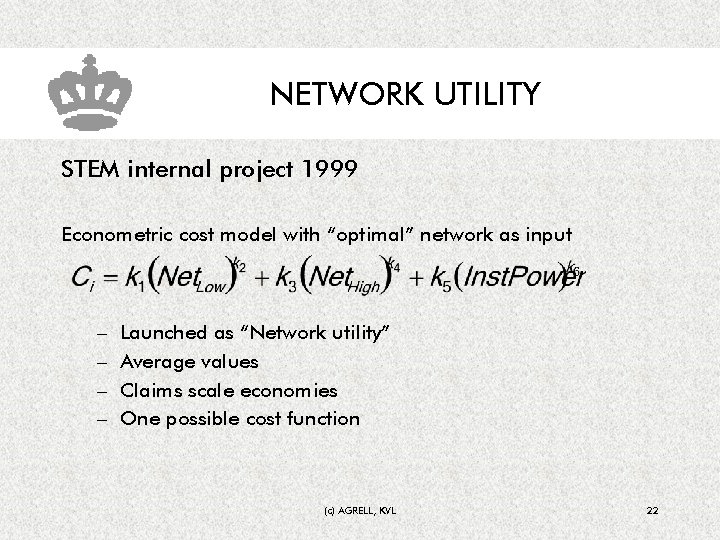
NETWORK UTILITY STEM internal project 1999 Econometric cost model with “optimal” network as input – – Launched as “Network utility” Average values Claims scale economies One possible cost function (c) AGRELL, KVL 22
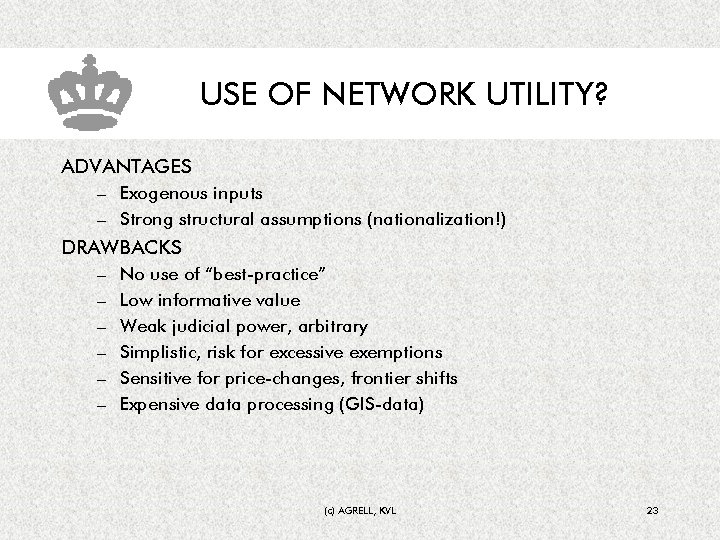
USE OF NETWORK UTILITY? ADVANTAGES – Exogenous inputs – Strong structural assumptions (nationalization!) DRAWBACKS – – – No use of “best-practice” Low informative value Weak judicial power, arbitrary Simplistic, risk for excessive exemptions Sensitive for price-changes, frontier shifts Expensive data processing (GIS-data) (c) AGRELL, KVL 23
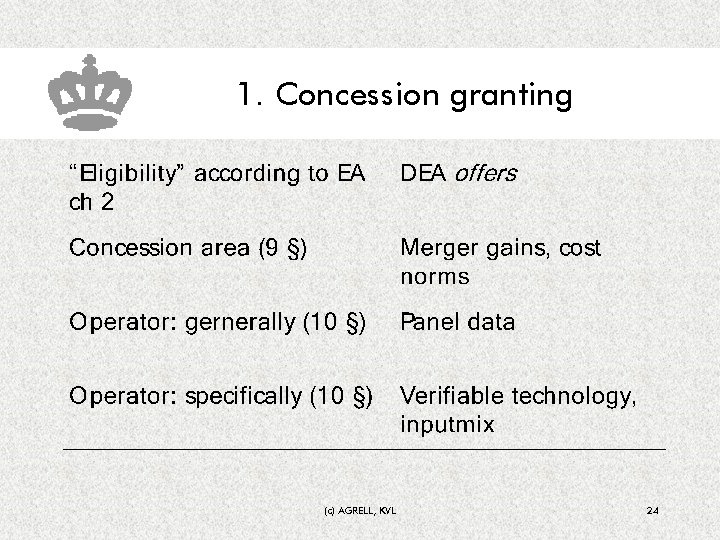
1. Concession granting (c) AGRELL, KVL 24
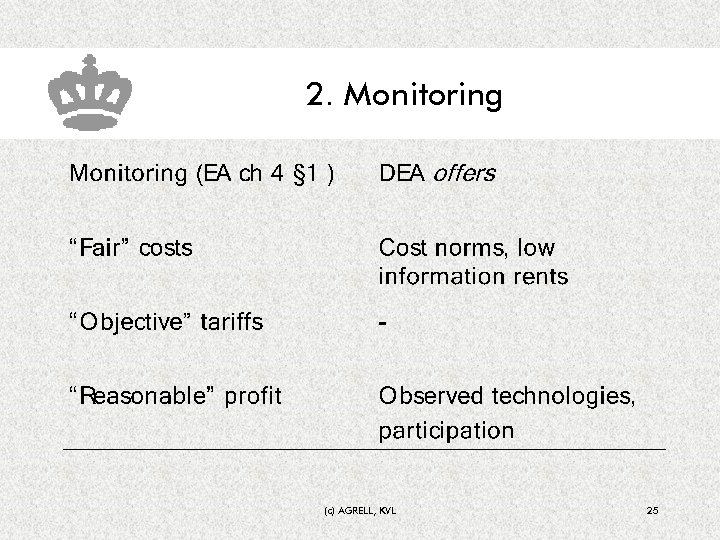
2. Monitoring (c) AGRELL, KVL 25
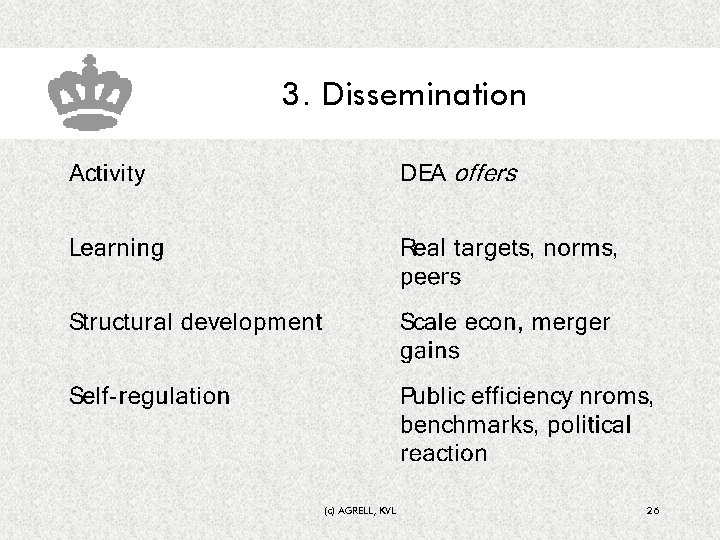
3. Dissemination (c) AGRELL, KVL 26
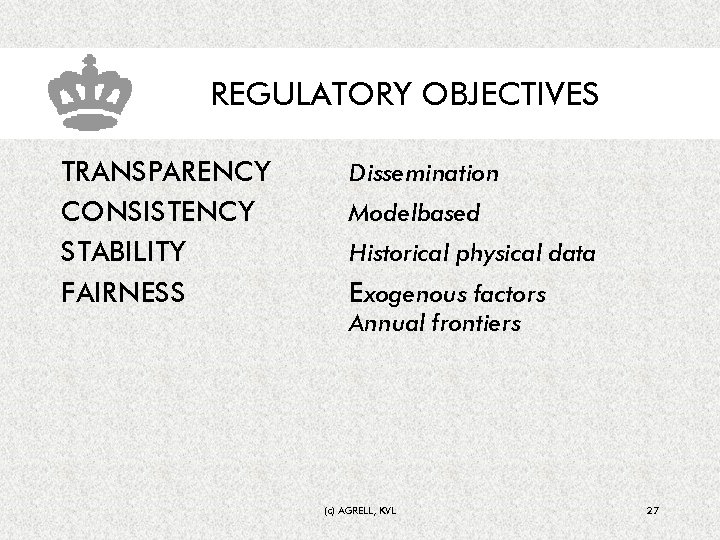
REGULATORY OBJECTIVES TRANSPARENCY CONSISTENCY STABILITY FAIRNESS Dissemination Modelbased Historical physical data Exogenous factors Annual frontiers (c) AGRELL, KVL 27
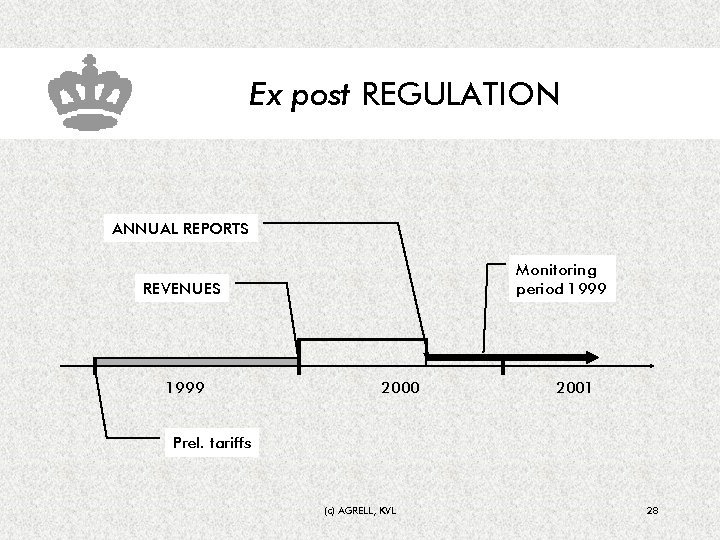
Ex post REGULATION ANNUAL REPORTS Monitoring period 1999 REVENUES 1999 2000 2001 Prel. tariffs (c) AGRELL, KVL 28
MODELLING PRINCIPLE: controllability! SHORT RUN OUTPUT FIXED INPUT VARIABLE INPUT LONG RUN EXOGENOUS INPUT (c) AGRELL, KVL 29
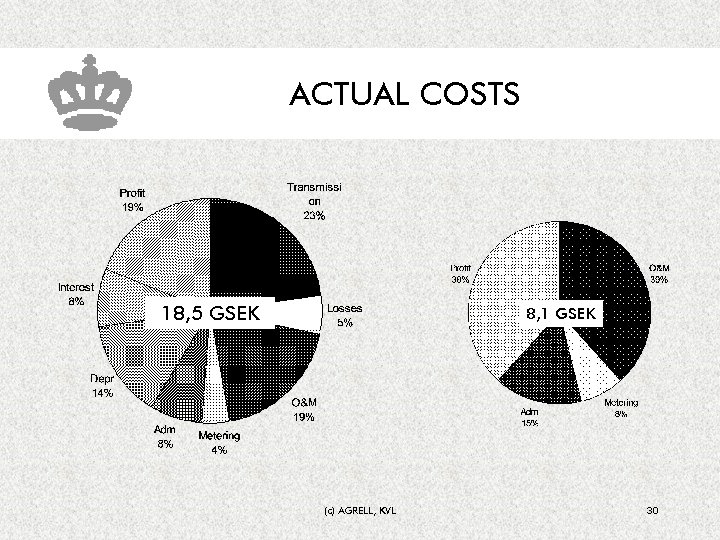
ACTUAL COSTS 18, 5 GSEK 8, 1 GSEK (c) AGRELL, KVL 30
MODELL (SR) ENERGY LC OP. COST EX LOSS COST ENERGY HC DISTRIBUTOR [SHORT RUN] CUSTOMERS LC CUSTOMERS HC DEL. POWER (MW) NET LENGTH (TOTAL) INSTALLED TRANSFORMERS (MVA) MVA per DISTRIBUTION STATION CLIMATE ZONE (c) AGRELL, KVL 31
MODELL (LR) ENERGY LC OP. COST TR. LOSSES TR CAPITAL DISTRIBUTOR [LONG RUN] ENERGY HC CUSTOMERS LC CUSTOMERS HC OTHER CAPITAL DEL. POWER (MW) OPTIMAL NETLENGTH(TOTAL) CLIMATE ZONE (c) AGRELL, KVL 32
INCENTIVE SYSTEM “Reasonable” profit – 135% of risk-free rate (Edin-Svahn) Participation – No net operative losses Non-controllable costs – Passed on to consumers Tariff structure – “Light-handed regulation”, no regulation (c) AGRELL, KVL 33
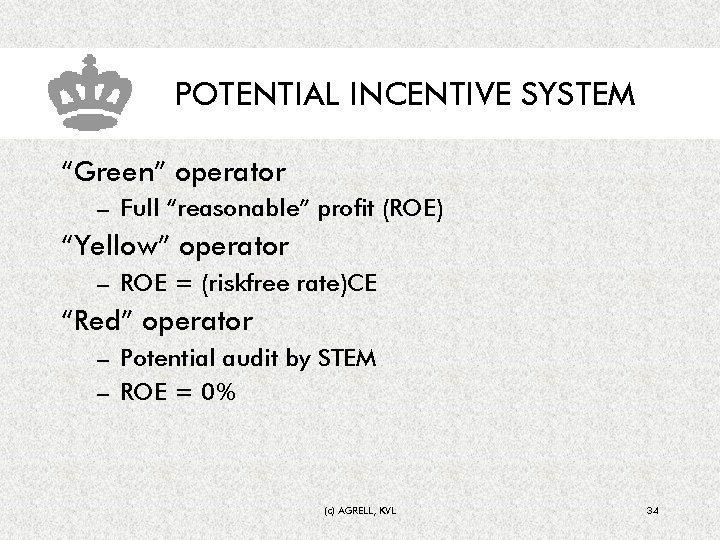
POTENTIAL INCENTIVE SYSTEM “Green” operator – Full “reasonable” profit (ROE) “Yellow” operator – ROE = (riskfree rate)CE “Red” operator – Potential audit by STEM – ROE = 0% (c) AGRELL, KVL 34
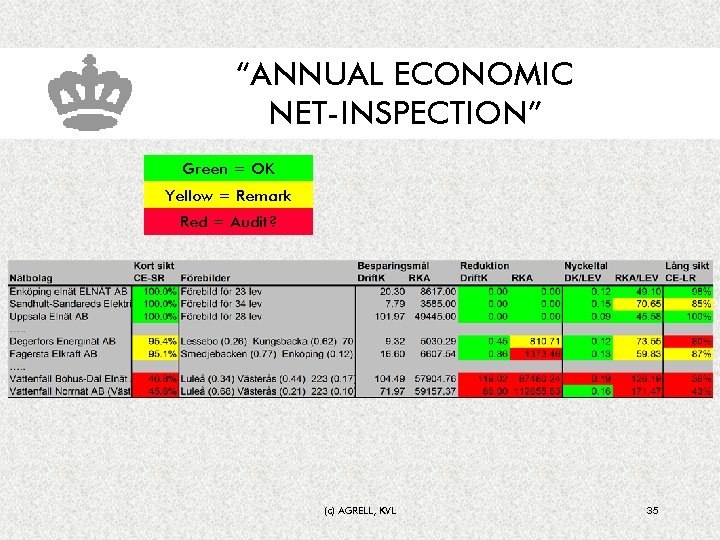
“ANNUAL ECONOMIC NET-INSPECTION” Green = OK Yellow = Remark Red = Audit? (c) AGRELL, KVL 35
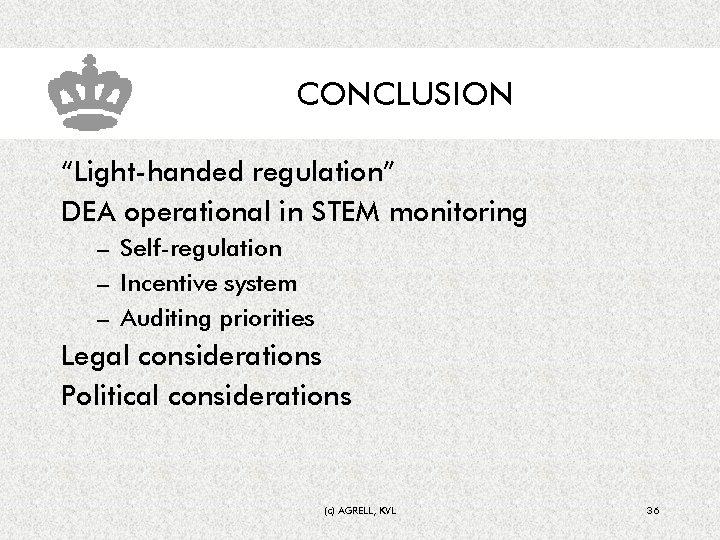
CONCLUSION “Light-handed regulation” DEA operational in STEM monitoring – Self-regulation – Incentive system – Auditing priorities Legal considerations Political considerations (c) AGRELL, KVL 36