
The surface of the earth is constantly changing

- Slides: 13
The surface of the earth is constantly changing. The same process that changed the earth millions of years ago: weathering, erosion, volcanic and earthquake activity, plate movements, deposition are at work changing it today. This constant cycle of building up and tearing down due to these processes is called UNIFORMITARIANISM Uniform = same
UNIFORMITARIANISM Uniform……as in “same” When you wear your school uniform, you look the same as everyone else.
Life on Earth has a history of change called evolution. Evolution is the process by which species of organisms change over time. The Geologic Time Scale is a calendar of Earth’s history based on fossil evidence found in rocks and ice cores. THE DIFFERENT TIME FRAMES ARE DIVIDED BY MAJOR EVENTS, NOT RANDOM DATES Divisions in the scale are distinguished by the organisms that lived during each time period. Fossils provide the evidence.
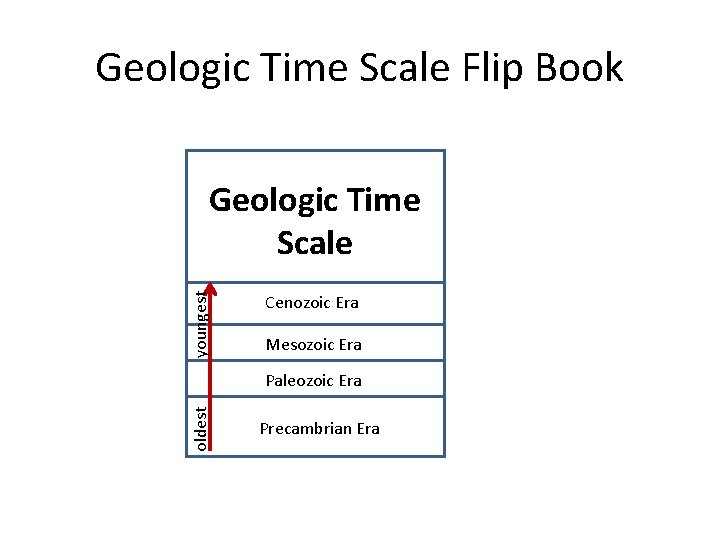
Geologic Time Scale Flip Book youngest Geologic Time Scale Cenozoic Era Mesozoic Era oldest Paleozoic Era Precambrian Era
Under the flap titled Geologic Time Scale…. The geologic time scale shows that an enormous diversity of organisms has existed on Earth. The dividing lines for the eras came about due to the fossil evidence of mass extinctions of old forms of life and mass radiations of new forms of life. These major events mark the beginning and ending of eras. Include the definition of uniformitarianism and the definition of evolution
For each era: • 3 facts about that era (include events that mark the beginning or end of the era) • illustration of two organisms from that era (use google) • 1 interesting fact (use google) • Each era’s page must be “decorated” to represent the climate/environment of the earth at that time You will use: this powerpoint textbook pages A 61 -A 67 google
What were some defining events of Precambrian time? • Precambrian time began with the formation of Earth about 4. 6 billion years ago. • Massive supercontinents, the first oceans, and the early atmosphere formed during this time. • Toward the end of Precambrian time, much of Earth’s land surfaces were located near the poles and covered in ice. Copyright © Houghton Mifflin Harcourt Publishing Company
What were some defining events of the Paleozoic Era? • The Paleozoic Era began about 540 million years ago. The supercontinent Pannotia was breaking up and the supercontinent Pangaea began forming. • Life diversified quickly and dramatically during the Cambrian Explosion, during which most major groups of organisms first evolved. • The era ended about 250 million years ago with a huge mass extinction event. Copyright © Houghton Mifflin Harcourt Publishing Company
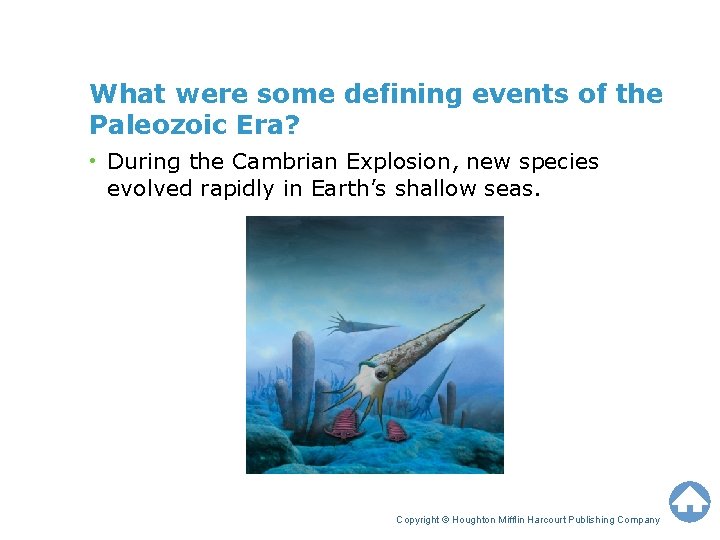
What were some defining events of the Paleozoic Era? • During the Cambrian Explosion, new species evolved rapidly in Earth’s shallow seas. Copyright © Houghton Mifflin Harcourt Publishing Company
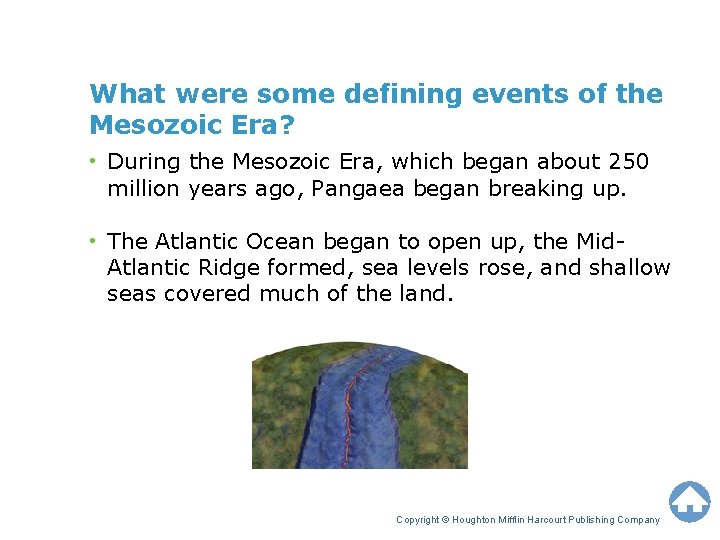
What were some defining events of the Mesozoic Era? • During the Mesozoic Era, which began about 250 million years ago, Pangaea began breaking up. • The Atlantic Ocean began to open up, the Mid. Atlantic Ridge formed, sea levels rose, and shallow seas covered much of the land. Copyright © Houghton Mifflin Harcourt Publishing Company
What were some defining events of the Mesozoic Era? • Along the western edge of North America, tectonic activity began to fold Earth’s crust, forming mountains. The climate was likely warm, as periods of heavy volcanism added carbon dioxide to the atmosphere. • Life during the Mesozoic was dominated by dinosaurs. The few mammals were very small. • A mass extinction event about 65 million years ago marked the end of the era, and the end of dinosaurs. Copyright © Houghton Mifflin Harcourt Publishing Company
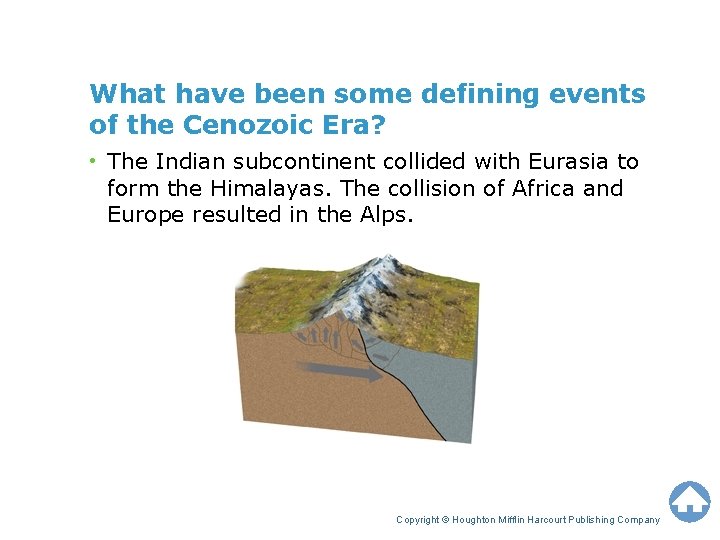
What have been some defining events of the Cenozoic Era? • The Indian subcontinent collided with Eurasia to form the Himalayas. The collision of Africa and Europe resulted in the Alps. Copyright © Houghton Mifflin Harcourt Publishing Company
What have been some defining events of the Cenozoic Era? • The Cenozoic Era is divided into two periods: the Tertiary and the Quaternary. The latter stretches from about 2. 6 million years ago to the present. • The Quaternary has been characterized by an ice age, with much of Europe, North America, and Asia having been covered in thick sheets of ice. • The evolution of modern humans occurred during the late Quaternary. Copyright © Houghton Mifflin Harcourt Publishing Company