
The surest way to corrupt a youth is

- Slides: 32
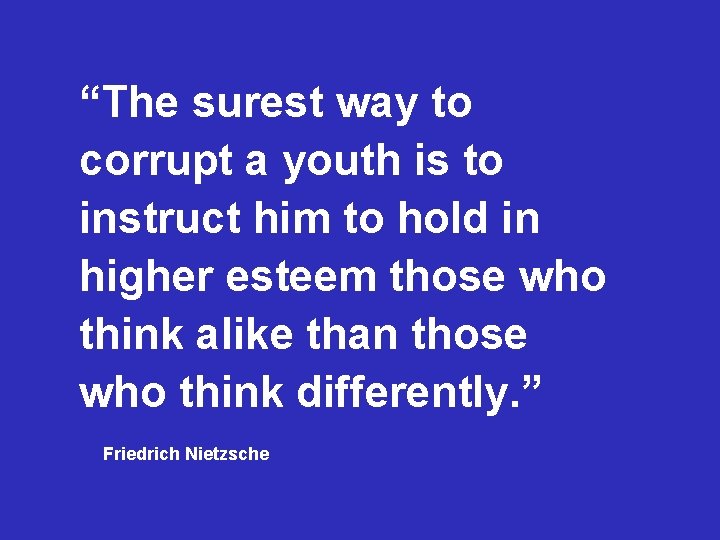
“The surest way to corrupt a youth is to instruct him to hold in higher esteem those who think alike than those who think differently. ” Friedrich Nietzsche
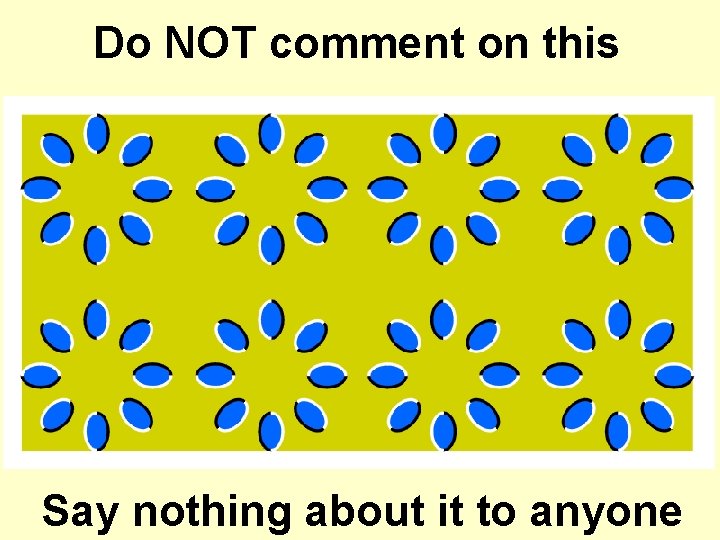
Do NOT comment on this Say nothing about it to anyone
Business and Management BAM 124 Thinking, Knowing and Arguing Session 2
Agenda A change of plan – not library databases • What you’ve done since last time • Lateral thinking • Thinking errors
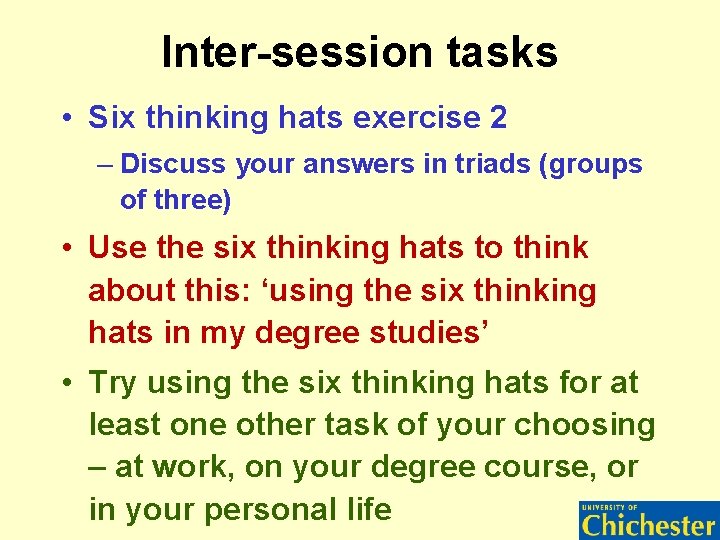
Inter-session tasks • Six thinking hats exercise 2 – Discuss your answers in triads (groups of three) • Use the six thinking hats to think about this: ‘using the six thinking hats in my degree studies’ • Try using the six thinking hats for at least one other task of your choosing – at work, on your degree course, or in your personal life
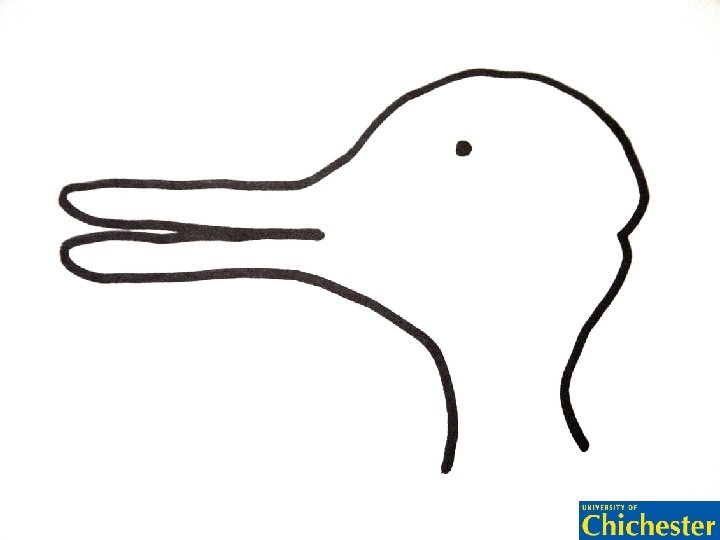
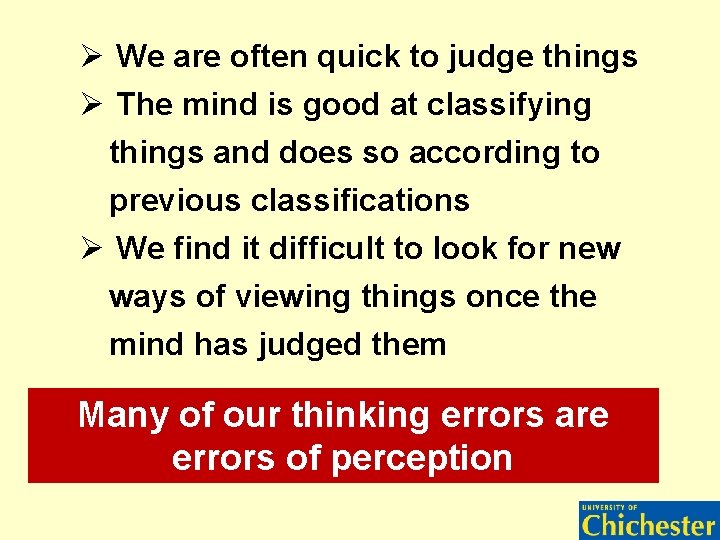
Ø We are often quick to judge things Ø The mind is good at classifying things and does so according to previous classifications Ø We find it difficult to look for new ways of viewing things once the mind has judged them Many of our thinking errors are errors of perception
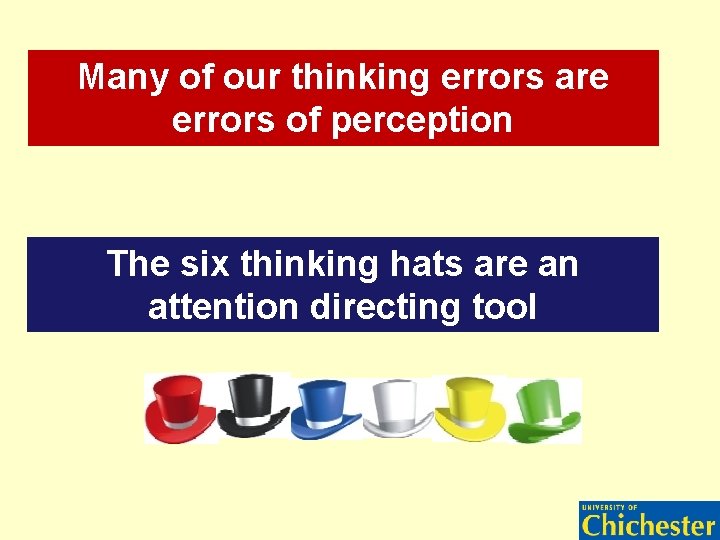
Many of our thinking errors are errors of perception The six thinking hats are an attention directing tool
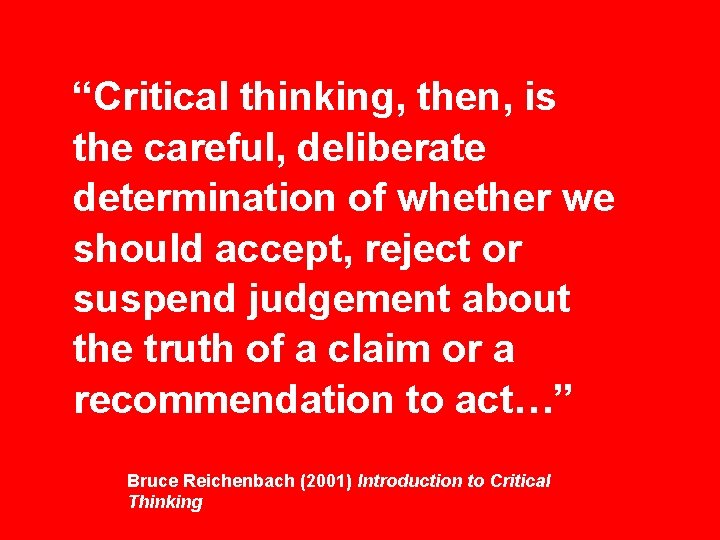
“Critical thinking, then, is the careful, deliberate determination of whether we should accept, reject or suspend judgement about the truth of a claim or a recommendation to act…” Bruce Reichenbach (2001) Introduction to Critical Thinking
The six thinking hats could help us to be better critical thinkers – careful, deliberate and focused. An alternative attention directing tool is provided by Gerald Nosich. (See reading list)
The same tendency for our thinking to follow previous patterns inhibits creative thinking – the generation of new ideas. Thinking that follows existing patterns is called vertical thinking by de Bono.
Lateral thinking and creativity • Creativity is highly valued – It’s a positive attribute • But it’s an attribute often ascribed to a limited number of people • To get away from vertical thinking we need to think laterally – We can all think laterally de Bono (1982) de Bono’s Thinking Course (p 55)
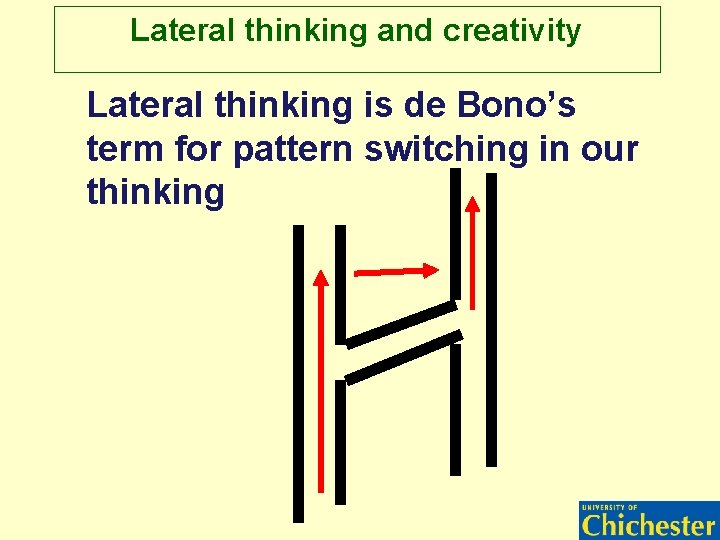
Lateral thinking and creativity Lateral thinking is de Bono’s term for pattern switching in our thinking
Lateral thinking and creativity • Children may seem creative – They are not constrained by the same established patterns as adults • But they may be rigid • Rigidity may be a feature of many ‘creative’ people – They have a different perception – They may not be good lateral thinkers
Lateral thinking and creativity • Granny is knitting and little Ella is playing with her ball of wool • Father suggests putting Ella in the playpen • Mother suggests it might be better to put Granny in the playpen instead • Quite different but logical in hindsight • Creative thinking is not always about the wacky and new de Bono (1982) de Bono’s Thinking Course (p 55)
Improving our lateral thinking • Lateral thinking is an attitude of mind – A willingness to try to look at things in different ways • Lateral thinking is also a set of methods/techniques de Bono (1982) de Bono’s Thinking Course (p 56)
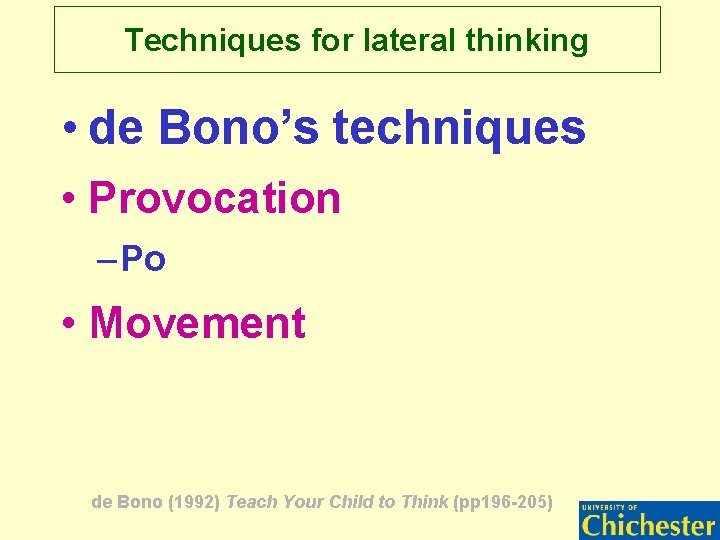
Techniques for lateral thinking • de Bono’s techniques • Provocation – Po • Movement de Bono (1992) Teach Your Child to Think (pp 196 -205)
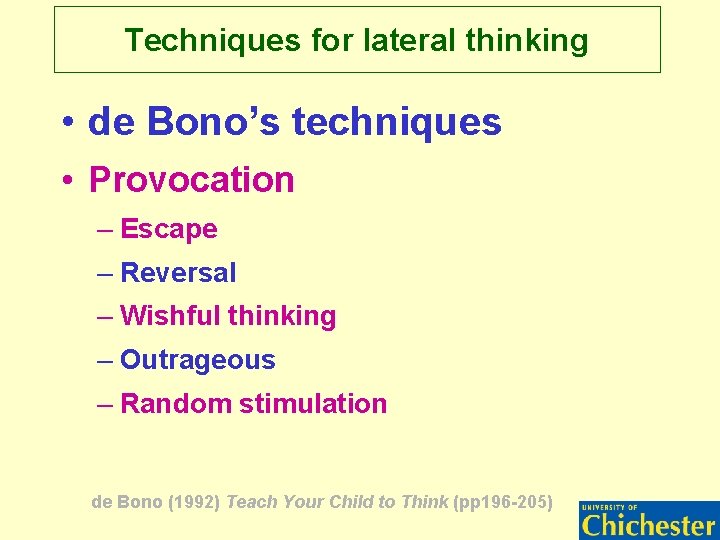
Techniques for lateral thinking • de Bono’s techniques • Provocation – Escape – Reversal – Wishful thinking – Outrageous – Random stimulation de Bono (1992) Teach Your Child to Think (pp 196 -205)
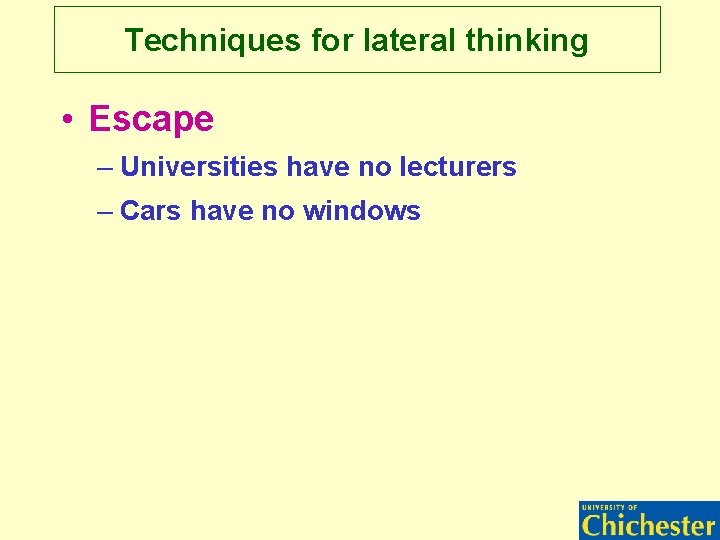
Techniques for lateral thinking • Escape – Universities have no lecturers – Cars have no windows
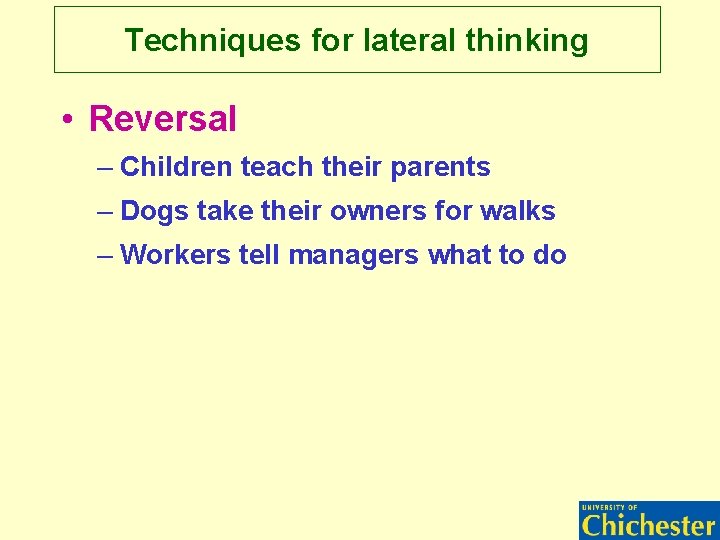
Techniques for lateral thinking • Reversal – Children teach their parents – Dogs take their owners for walks – Workers tell managers what to do
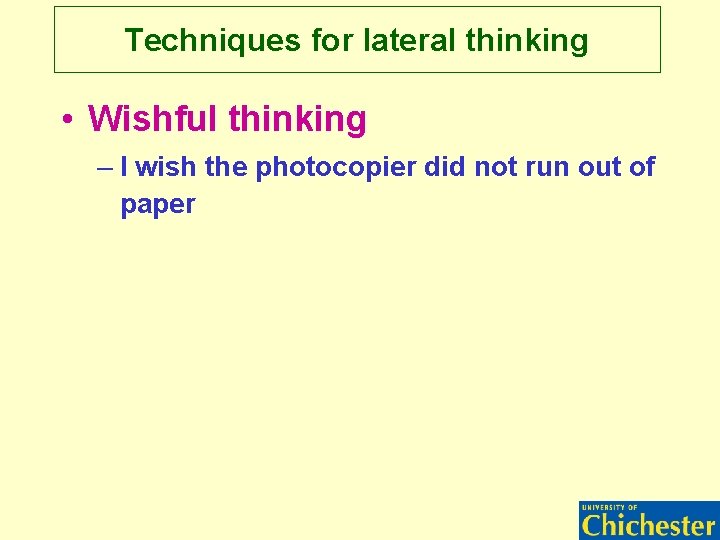
Techniques for lateral thinking • Wishful thinking – I wish the photocopier did not run out of paper
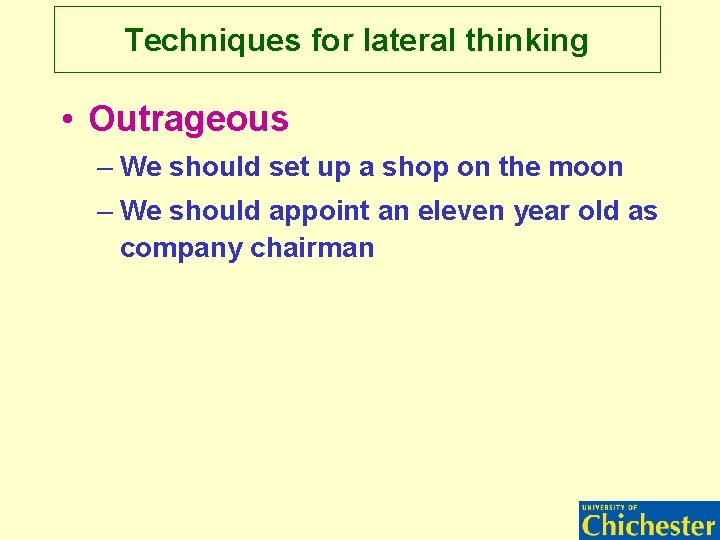
Techniques for lateral thinking • Outrageous – We should set up a shop on the moon – We should appoint an eleven year old as company chairman
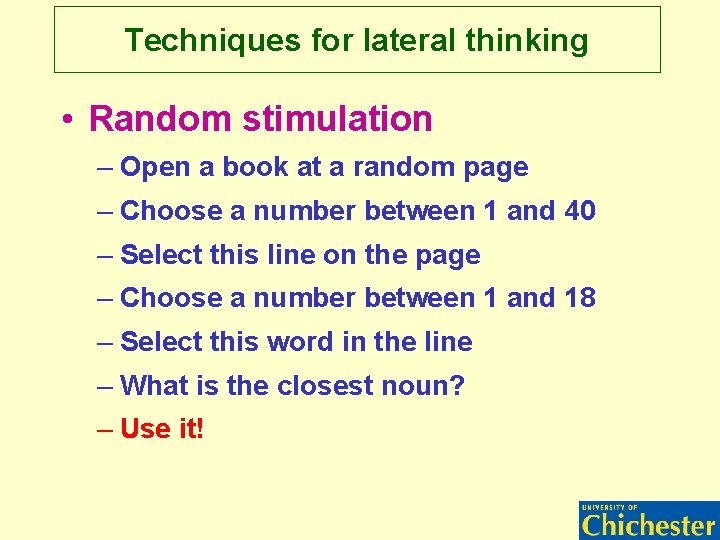
Techniques for lateral thinking • Random stimulation – Open a book at a random page – Choose a number between 1 and 40 – Select this line on the page – Choose a number between 1 and 18 – Select this word in the line – What is the closest noun? – Use it!
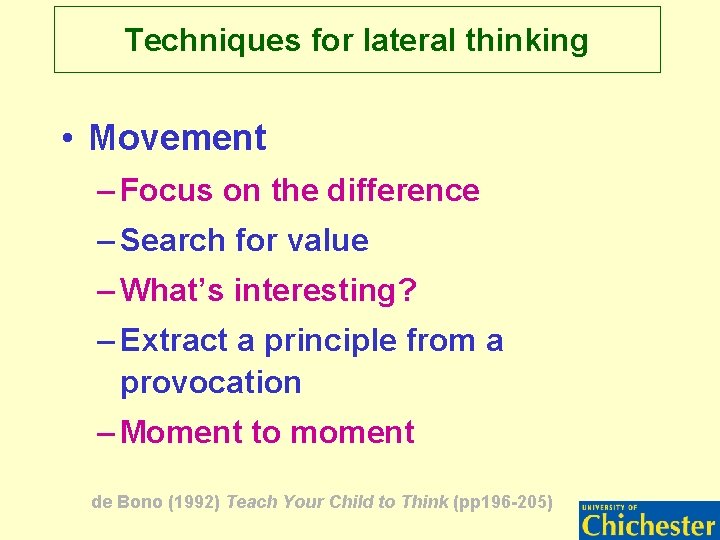
Techniques for lateral thinking • Movement – Focus on the difference – Search for value – What’s interesting? – Extract a principle from a provocation – Moment to moment de Bono (1992) Teach Your Child to Think (pp 196 -205)
Techniques for lateral thinking • Focus on the difference – With no lecturers university students would… – be more dependent on libraries – could study what interested them – would have to assess each other
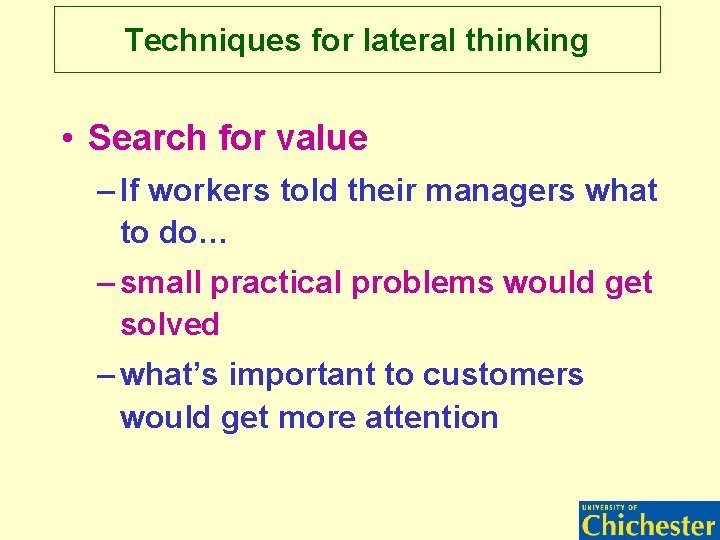
Techniques for lateral thinking • Search for value – If workers told their managers what to do… – small practical problems would get solved – what’s important to customers would get more attention
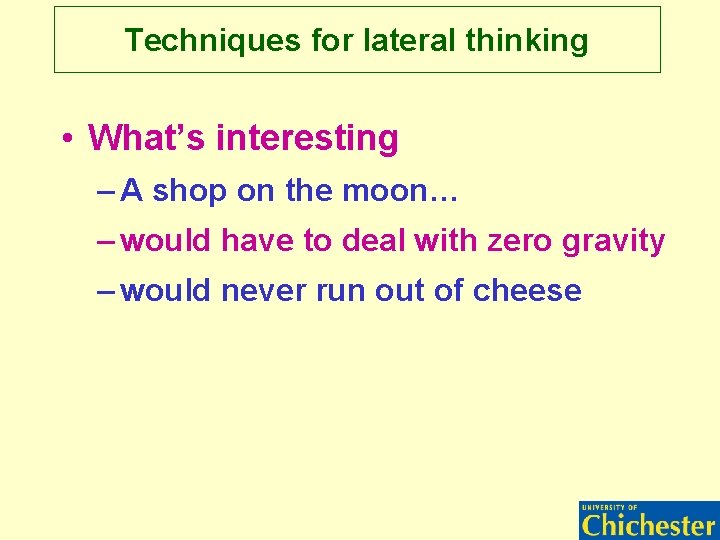
Techniques for lateral thinking • What’s interesting – A shop on the moon… – would have to deal with zero gravity – would never run out of cheese
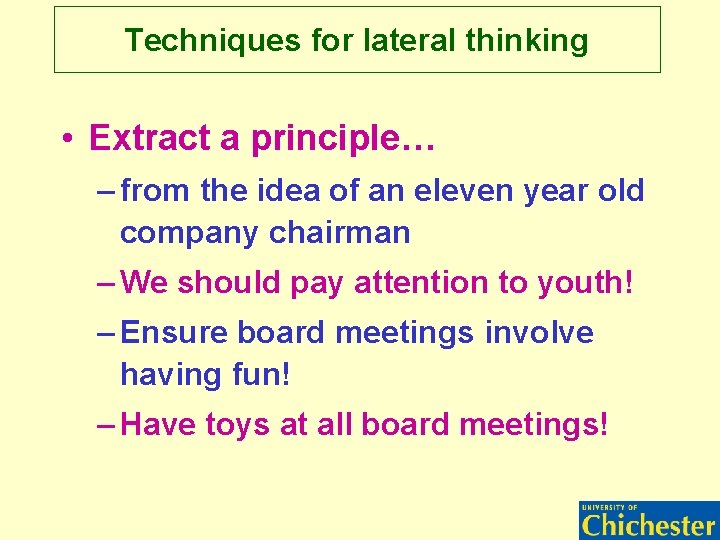
Techniques for lateral thinking • Extract a principle… – from the idea of an eleven year old company chairman – We should pay attention to youth! – Ensure board meetings involve having fun! – Have toys at all board meetings!
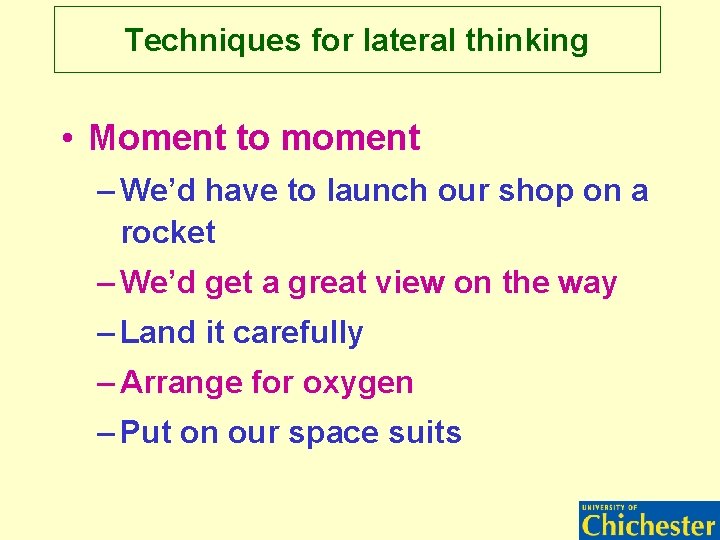
Techniques for lateral thinking • Moment to moment – We’d have to launch our shop on a rocket – We’d get a great view on the way – Land it carefully – Arrange for oxygen – Put on our space suits
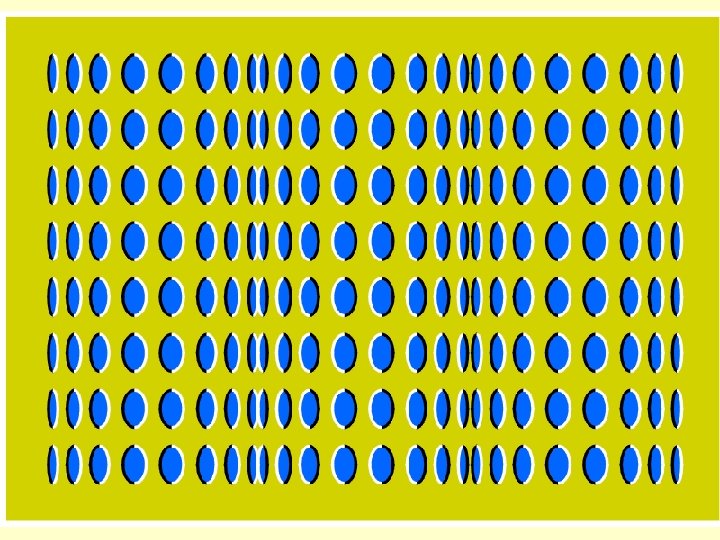
Lateral thinking exercise 1
Inter-session tasks • Read pages 5 -21 of Thomson (2002) and do the exercises (there are copies on short loan and reference only in the library) • Practise using the six thinking hats and the lateral thinking techniques as much as you can • Reflect on what we have done so far • See the website for more