
The Supreme Court Cases Federal State Obligations to

The Supreme Court Cases
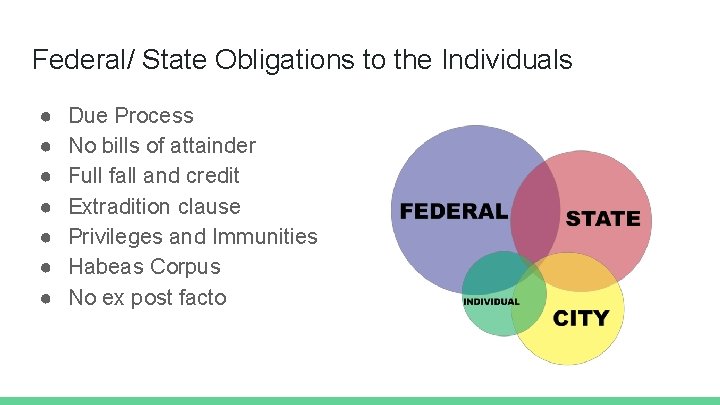
Federal/ State Obligations to the Individuals ● ● ● ● Due Process No bills of attainder Full fall and credit Extradition clause Privileges and Immunities Habeas Corpus No ex post facto
Landmark Case Court case that is studied because it has historical and legal significance. The most significant cases are those that have had a lasting effect on the application of a certain law, often concerning your individual rights and liberties.

Do Now: https: //www. youtube. com/watch? v=T 45 a. F 1 NLMy. M
Miranda Laws don’t always apply There are two very basic prerequisites before the police must issue a Miranda warning to a suspect: ● The suspect is in police custody ● The suspect is under interrogation If you aren't formally in police custody, and you aren't being interrogated, the police don't have to give you a Miranda warning. The police can use anything you say until those two requirements are fulfilled as evidence against you!
Prophylactic Law A prophylactic rule is a judicially crafted rule that overprotects a constitutional right, and gives more protection than such right actually deserves or requires. This is done in order to safeguard that particular constitutional right or to improve detection of violations of that right. Why are the Miranda rights considered a prophylactic law?
DISCUSS! Why did the Court overturn Miranda’s conviction?
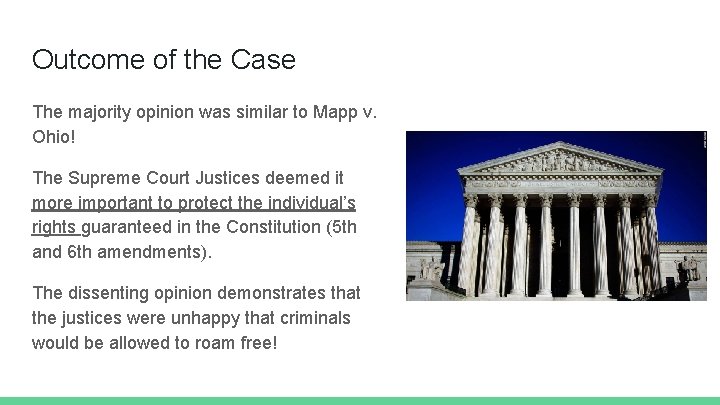
Outcome of the Case The majority opinion was similar to Mapp v. Ohio! The Supreme Court Justices deemed it more important to protect the individual’s rights guaranteed in the Constitution (5 th and 6 th amendments). The dissenting opinion demonstrates that the justices were unhappy that criminals would be allowed to roam free!
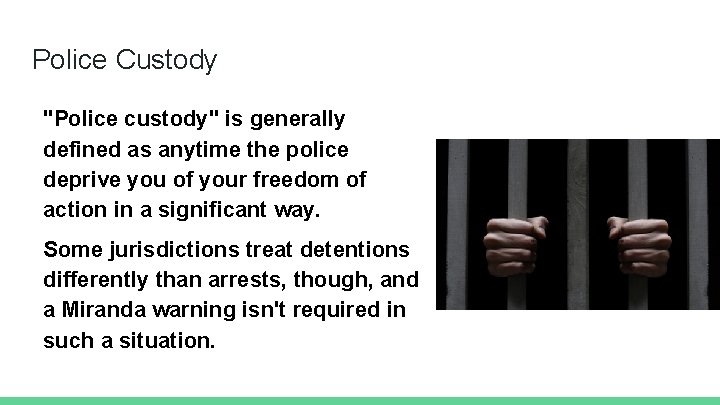
Police Custody "Police custody" is generally defined as anytime the police deprive you of your freedom of action in a significant way. Some jurisdictions treat detentions differently than arrests, though, and a Miranda warning isn't required in such a situation.
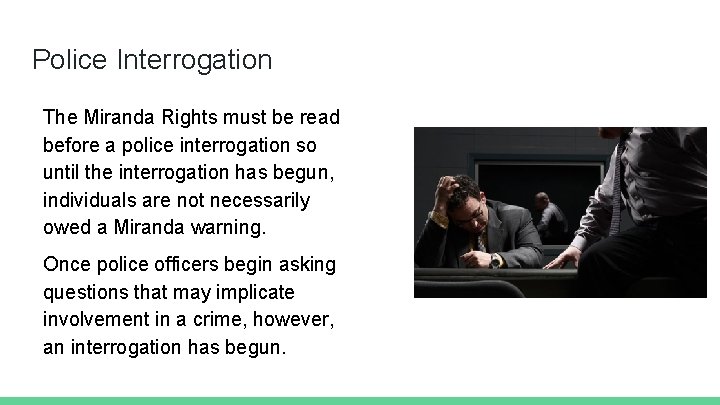
Police Interrogation The Miranda Rights must be read before a police interrogation so until the interrogation has begun, individuals are not necessarily owed a Miranda warning. Once police officers begin asking questions that may implicate involvement in a crime, however, an interrogation has begun.
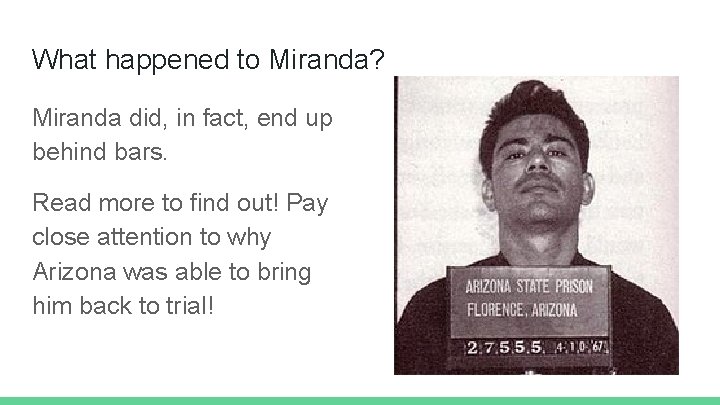
What happened to Miranda? Miranda did, in fact, end up behind bars. Read more to find out! Pay close attention to why Arizona was able to bring him back to trial!
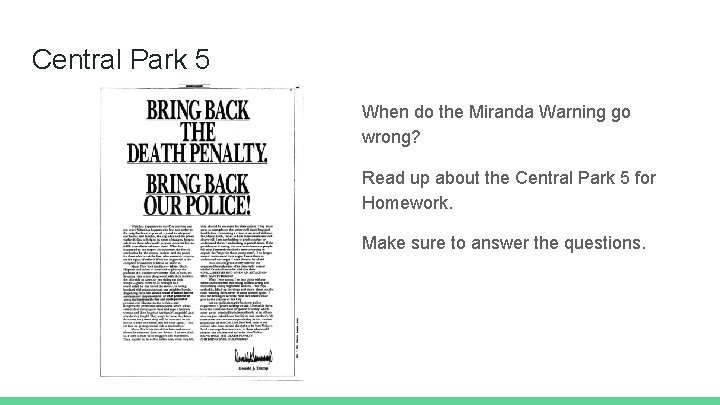
Central Park 5 When do the Miranda Warning go wrong? Read up about the Central Park 5 for Homework. Make sure to answer the questions.
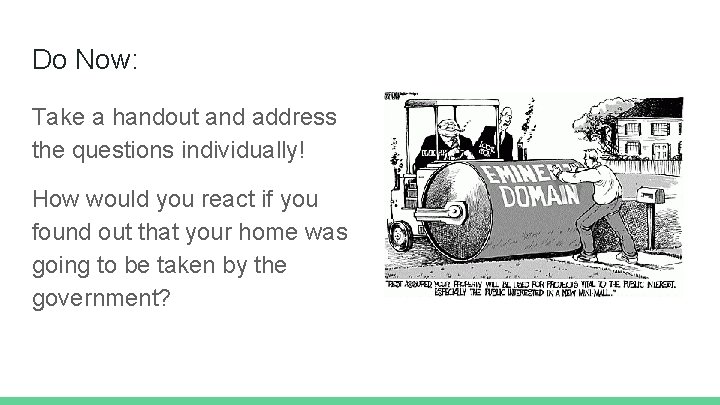
Do Now: Take a handout and address the questions individually! How would you react if you found out that your home was going to be taken by the government?
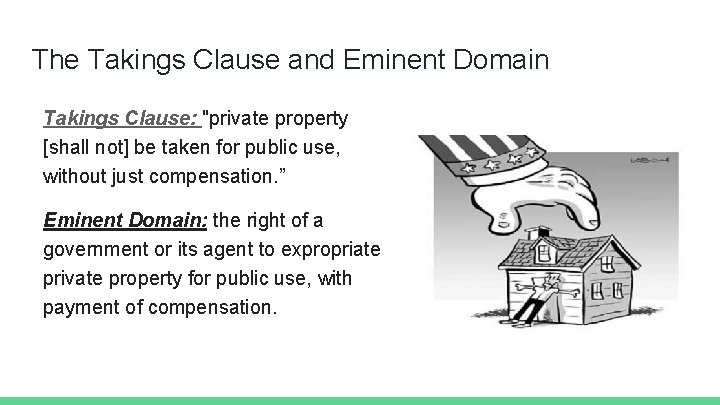
The Takings Clause and Eminent Domain Takings Clause: "private property [shall not] be taken for public use, without just compensation. ” Eminent Domain: the right of a government or its agent to expropriate private property for public use, with payment of compensation.
What’s Public Use? ? Public Use: the only purpose for which private property can be taken (condemned) by the government under its power of eminent domain. Public use includes: schools, streets, highways, hospitals, government buildings, parks, water reservoirs, flood control, slum clearance and redevelopment, public housing, public theaters and stadiums, safety facilities, harbors, bridges, railroads, airports, terminals, prisons, jails, public utilities, canals, and numerous other purposes designated as beneficial to the public.
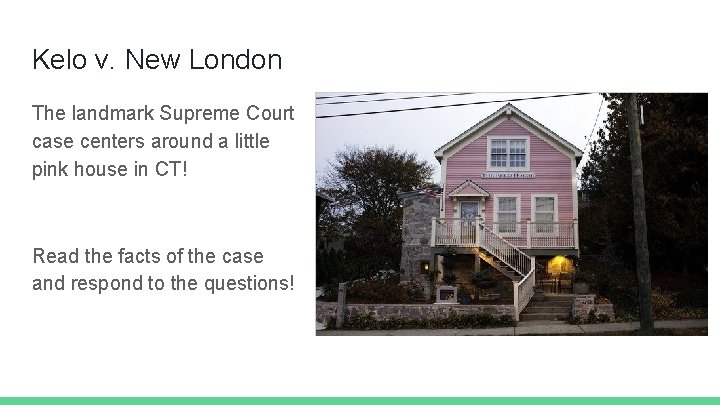
Kelo v. New London The landmark Supreme Court case centers around a little pink house in CT! Read the facts of the case and respond to the questions!
Reactions to the Case https: //www. youtube. com/watch? v=4 N 1 svad. JQ 40 While watching the clip, please respond to the following questions. 1) Why is the most universally despised Supreme Court decision? 2) How does the state define economic development? Is this fair?
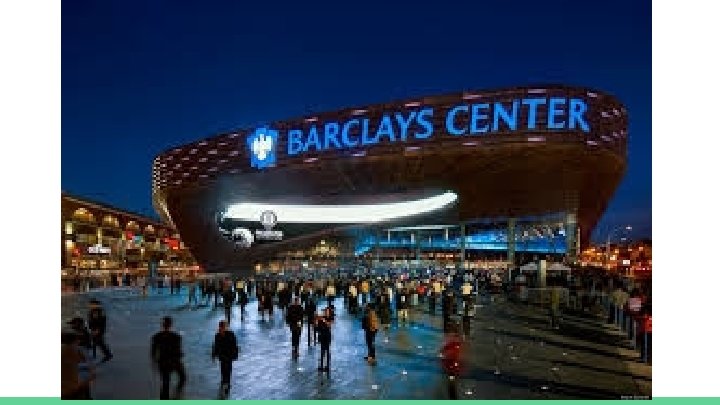
Barclays Center Controversy Watch: https: //www. youtube. com/watch? v=2 Gfs-em. Txh 8 What are the costs and benefits of the construction of the Barclays Center in Brooklyn?
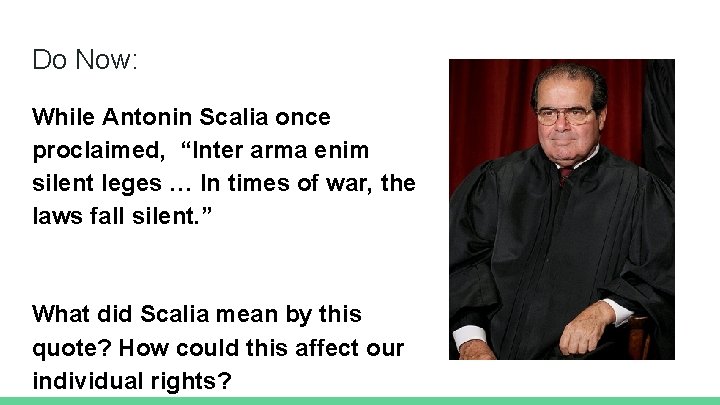
Do Now: While Antonin Scalia once proclaimed, “Inter arma enim silent leges … In times of war, the laws fall silent. ” What did Scalia mean by this quote? How could this affect our individual rights?
Timeline of Events ● 1869 First known Japanese immigrants to U. S. settle near Sacramento. ● 1913 Alien Land Law prohibits Japanese aliens from owning land in California and imposes a three-year limit on leasing of land. ● 1924 Immigration Exclusion Act halts Japanese immigration to U. S. ● 1941 U. S. enters World War II after Pearl Harbor attack Dec. 7. ● 1942 Executive Order 9066 of Feb. 19 authorizes relocation and/or interment of anyone who might threaten the U. S. war effort. ● 1944 Supreme Court upholds constitutionality of evacuation based solely on national ancestry while separately ruling that loyal citizens cannot be held against their will. ● 1945 World War II ends with Japan’s surrender Aug. 14. ● 1988 U. S. Civil Liberties Act grants a $20, 000 payment and an apology to 82, 000 former internees.
Record your observations Reflect on the following images and record your observations based on the question below: How do the images reveal the zeitgeist of the country during this time in history? (Consider the sentiments of the Japanese and the average American citizens)
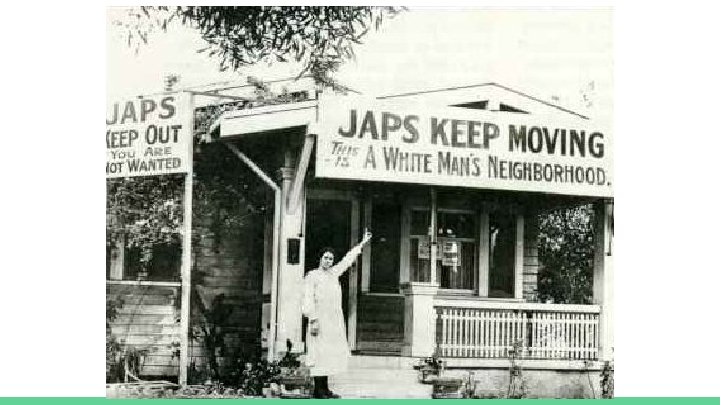
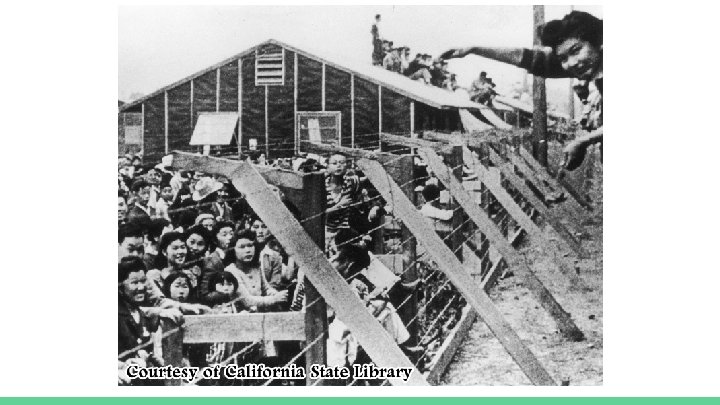
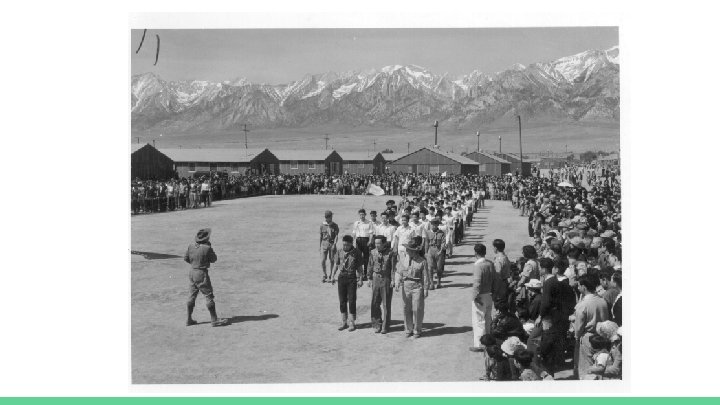
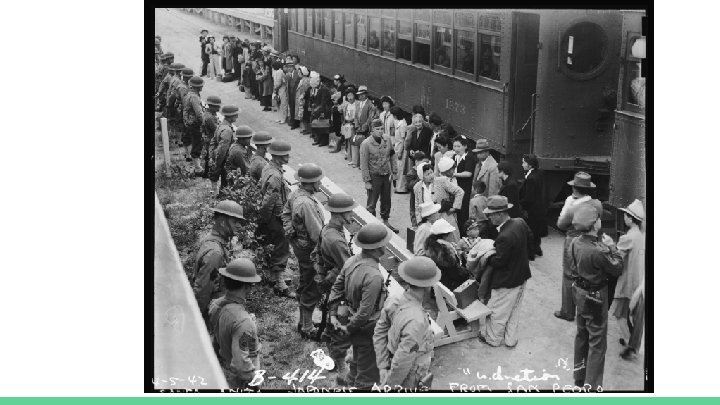
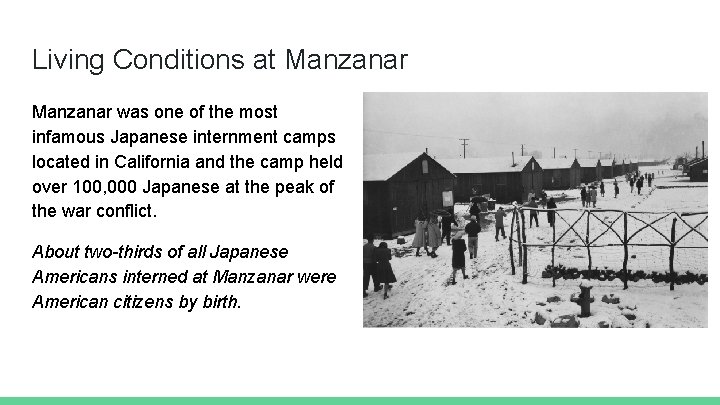
Living Conditions at Manzanar was one of the most infamous Japanese internment camps located in California and the camp held over 100, 000 Japanese at the peak of the war conflict. About two-thirds of all Japanese Americans interned at Manzanar were American citizens by birth.
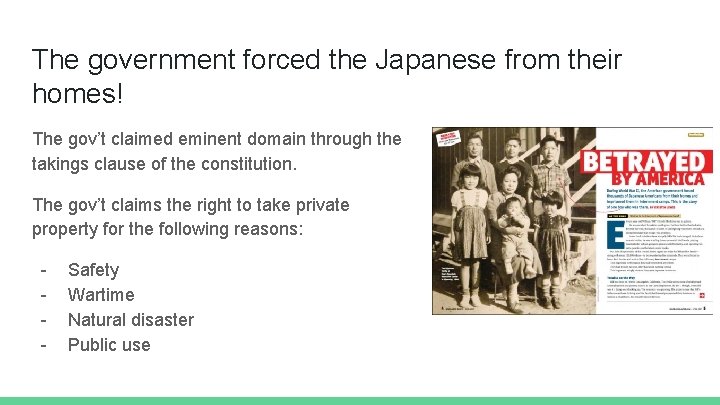
The government forced the Japanese from their homes! The gov’t claimed eminent domain through the takings clause of the constitution. The gov’t claims the right to take private property for the following reasons: - Safety Wartime Natural disaster Public use
DISCUSS! How does Japanese internment compare to current American policies towards certain ethnic groups?
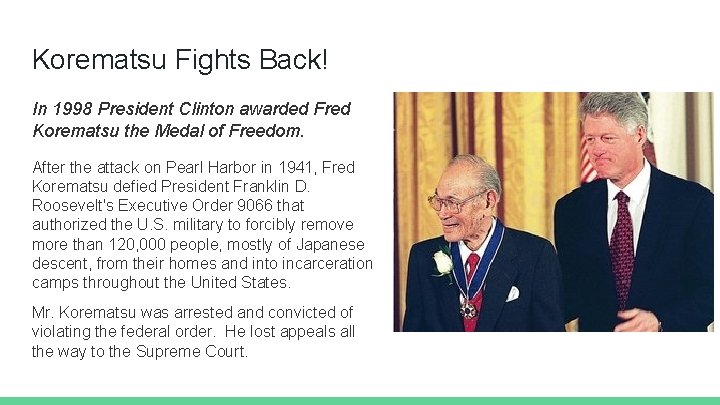
Korematsu Fights Back! In 1998 President Clinton awarded Fred Korematsu the Medal of Freedom. After the attack on Pearl Harbor in 1941, Fred Korematsu defied President Franklin D. Roosevelt's Executive Order 9066 that authorized the U. S. military to forcibly remove more than 120, 000 people, mostly of Japanese descent, from their homes and into incarceration camps throughout the United States. Mr. Korematsu was arrested and convicted of violating the federal order. He lost appeals all the way to the Supreme Court.
DISCUSS! Predict the outcome of the case! How do you believe that the Supreme Court justices ruled on this case? (Make sure to consider the amendments being violated and the powers of the federal government)
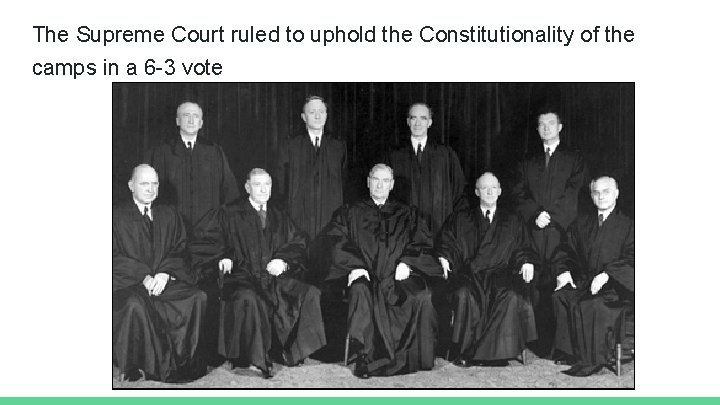
The Supreme Court ruled to uphold the Constitutionality of the camps in a 6 -3 vote
DISCUSS! Why was the Supreme Court so divided over this case?
Do Now: Take out the Supreme Court decisions from yesterday and address the following question in your groups: Why were certain Supreme Court justices so divided on the outcome of the case?
Supreme Court’s Opinions Majority Opinion: - - The country must be protected (especially the west coast) The US is at war with the Japanese Empire and must shield our nation against potential spies and saboteurs The federal government must have the power to secure our nation/ social contract Minority Opinion: - The court’s decision is overtly racist (why not have mass internment of Germans and Italians) Violates the Constitution because all residents are kin in some way by blood or culture to a foreign land The SCOTUS should never had heard the case (resolved in the lower court so it doesn’t become a precedent)
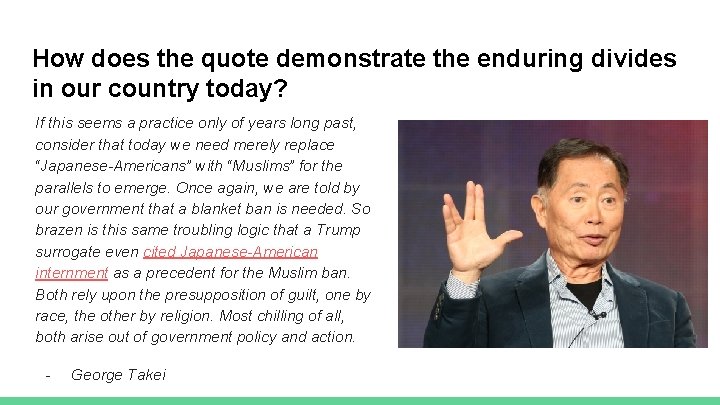
How does the quote demonstrate the enduring divides in our country today? If this seems a practice only of years long past, consider that today we need merely replace “Japanese-Americans” with “Muslims” for the parallels to emerge. Once again, we are told by our government that a blanket ban is needed. So brazen is this same troubling logic that a Trump surrogate even cited Japanese-American internment as a precedent for the Muslim ban. Both rely upon the presupposition of guilt, one by race, the other by religion. Most chilling of all, both arise out of government policy and action. - George Takei
Timeline ● ● ● ● Sept 2001 - 9/11 attack on the United States Oct 2001 - Patriot Act which greatly expands domestic law enforcement capacity to conduct surveillance and wiretaps Jan 2002 - Bush Administration opens Guantanamo Bay and does not extend due process to detainees Feb 2003 - Bush administration expands surveillance and wiretaps passing Patriot Act II June 2004 - The Supreme Court rules that detainees being held at Guantanamo Bay have the right to challenge their detention in federal court June 2005 Time magazine reports that Mohammed al-Qahtani, the so-called 20 th Sept. 11 hijacker, was tortured during his time at Guantanamo Bay Dec 2005 - President Bush secretly authorized the National Security Agency to conduct surveillance on U. S. citizens ● PRESENT DAY: 41 detainees remain at Guantanamo Bay

Vice News https: //www. youtube. com/watch? v=CHMQvp 9 p 944
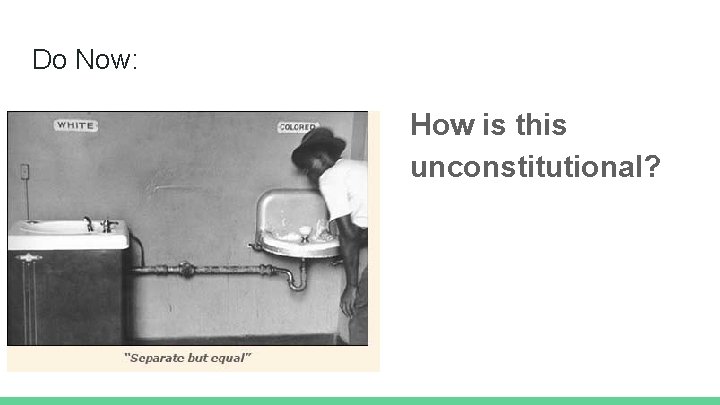
Do Now: How is this unconstitutional?
Jim Crow Laws "All railroad companies and corporations, and all persons running or operating cars or coaches by steam on any railroad line or track in the State of Maryland, for the transportation of passengers, are hereby required to provide separate cars or coaches for the travel and transportation of the white and colored passengers. "
Key Terms Majority Opinion: the term given to the decision of more than half of the judges trying a case, stand as precedents: announces decision & sets out the reasoning Dissenting Opinion: the opinion in which a judge announces his dissent from the conclusions held by the majority of the court, and expounds his own views. Concurring Opinion: an opinion that is given by another authority that is in agreeance and upholds the opinion of the first authority.
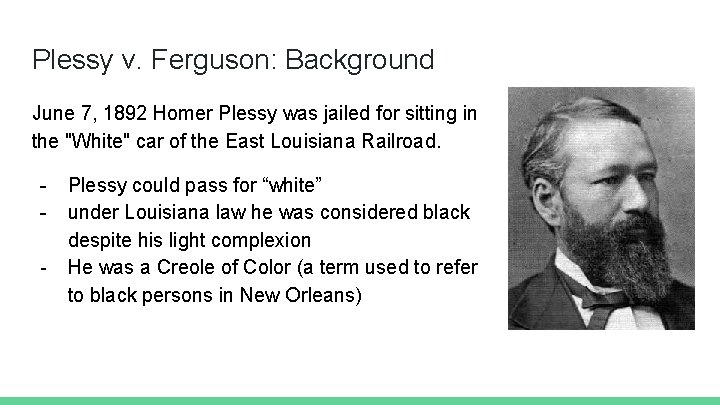
Plessy v. Ferguson: Background June 7, 1892 Homer Plessy was jailed for sitting in the "White" car of the East Louisiana Railroad. - Plessy could pass for “white” under Louisiana law he was considered black despite his light complexion He was a Creole of Color (a term used to refer to black persons in New Orleans)
Separate Car Act When Louisiana passed the Separate Car Act, legally segregating common carriers in 1892, a black civil rights organization decided to challenge the law in the courts. ● Plessy deliberately sat in the white section and identified himself as black. ● He was arrested and the case went all the way to the United States Supreme Court. ● Plessy's lawyer argued that the Separate Car Act violated the Thirteenth and Fourteenth Amendments
A drop of blood? https: //www. youtube. com/watch? v=Lu 7 mr. Vaa. JXc https: //www. youtube. com/watch? v=t. R 3 Sw 085 Bhg Why would southern states want this policy enforced?
Outcome ● U. S. Supreme Court ruled on May 18, 1896, by a seven -to-one majority (one justice abstained) in favor of Ferguson ● Advanced the controversial “separate but equal” doctrine for assessing the constitutionality of racial segregation laws. ● When would this law finally be overturned?
Questions: What arguments is JMH making? What does JMH compare this case to? How does JMH justify his argument?
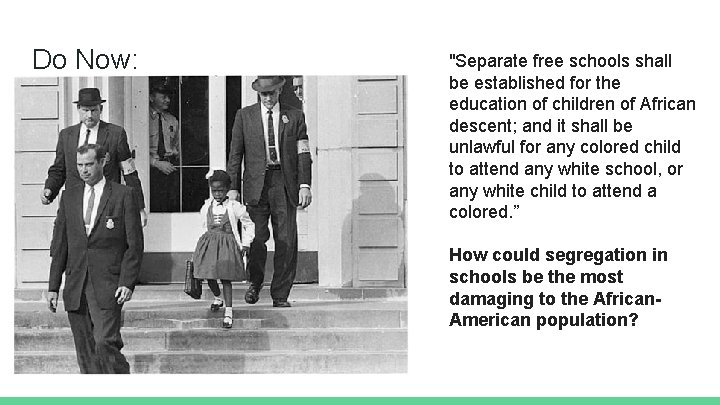
Do Now: "Separate free schools shall be established for the education of children of African descent; and it shall be unlawful for any colored child to attend any white school, or any white child to attend a colored. ” How could segregation in schools be the most damaging to the African. American population?
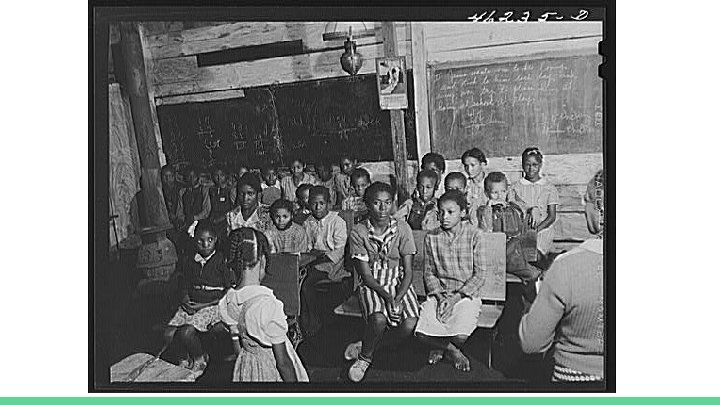
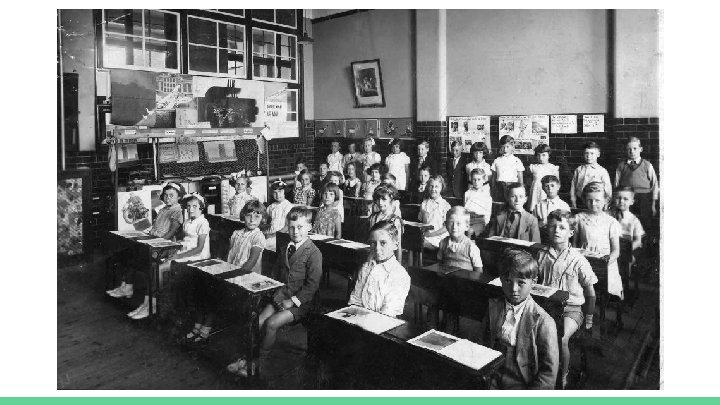
The fight for justice was waged in the schools across the country!
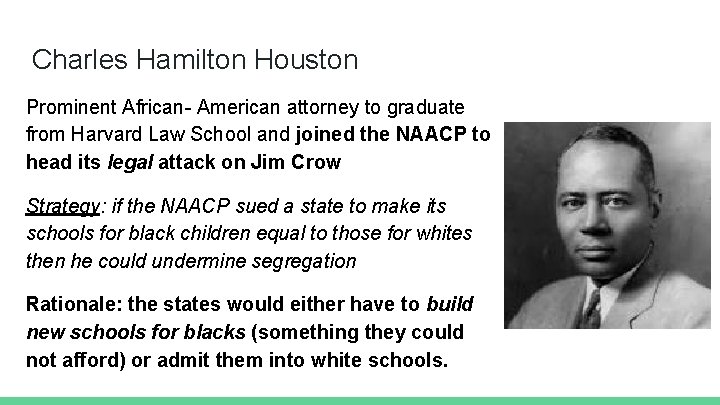
Charles Hamilton Houston Prominent African- American attorney to graduate from Harvard Law School and joined the NAACP to head its legal attack on Jim Crow Strategy: if the NAACP sued a state to make its schools for black children equal to those for whites then he could undermine segregation Rationale: the states would either have to build new schools for blacks (something they could not afford) or admit them into white schools.
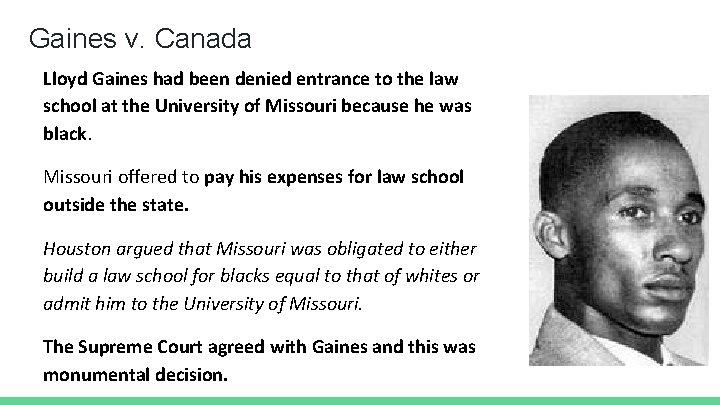
Gaines v. Canada Lloyd Gaines had been denied entrance to the law school at the University of Missouri because he was black. Missouri offered to pay his expenses for law school outside the state. Houston argued that Missouri was obligated to either build a law school for blacks equal to that of whites or admit him to the University of Missouri. The Supreme Court agreed with Gaines and this was monumental decision.
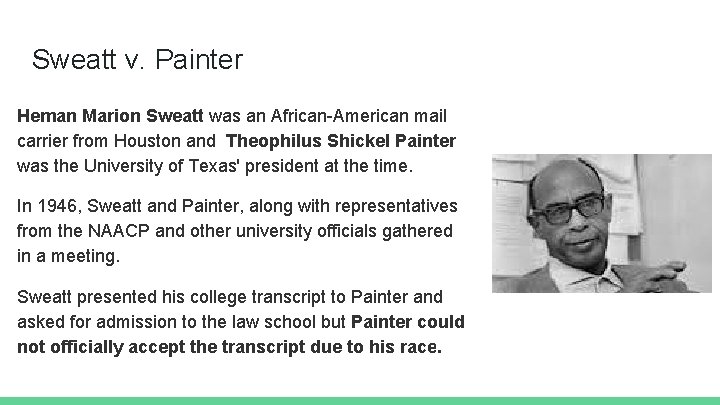
Sweatt v. Painter Heman Marion Sweatt was an African-American mail carrier from Houston and Theophilus Shickel Painter was the University of Texas' president at the time. In 1946, Sweatt and Painter, along with representatives from the NAACP and other university officials gathered in a meeting. Sweatt presented his college transcript to Painter and asked for admission to the law school but Painter could not officially accept the transcript due to his race.
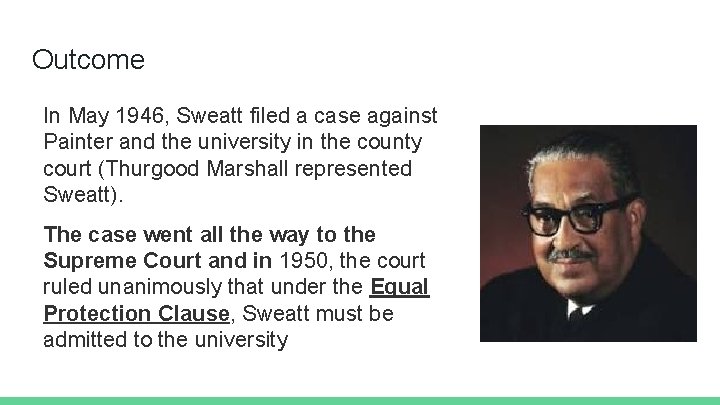
Outcome In May 1946, Sweatt filed a case against Painter and the university in the county court (Thurgood Marshall represented Sweatt). The case went all the way to the Supreme Court and in 1950, the court ruled unanimously that under the Equal Protection Clause, Sweatt must be admitted to the university
Equal Protection Clause The Equal Protection Clause is part of the Fourteenth Amendment to the United States Constitution. The clause, which took effect in 1868, provides that no state shall deny to any person within its jurisdiction "the equal protection of the laws. "
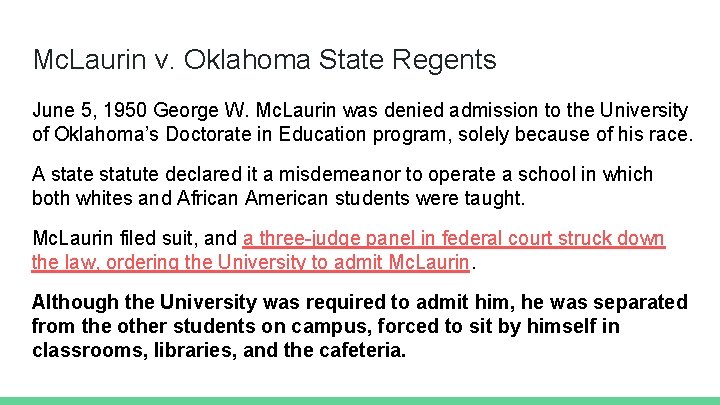
Mc. Laurin v. Oklahoma State Regents June 5, 1950 George W. Mc. Laurin was denied admission to the University of Oklahoma’s Doctorate in Education program, solely because of his race. A state statute declared it a misdemeanor to operate a school in which both whites and African American students were taught. Mc. Laurin filed suit, and a three-judge panel in federal court struck down the law, ordering the University to admit Mc. Laurin. Although the University was required to admit him, he was separated from the other students on campus, forced to sit by himself in classrooms, libraries, and the cafeteria.
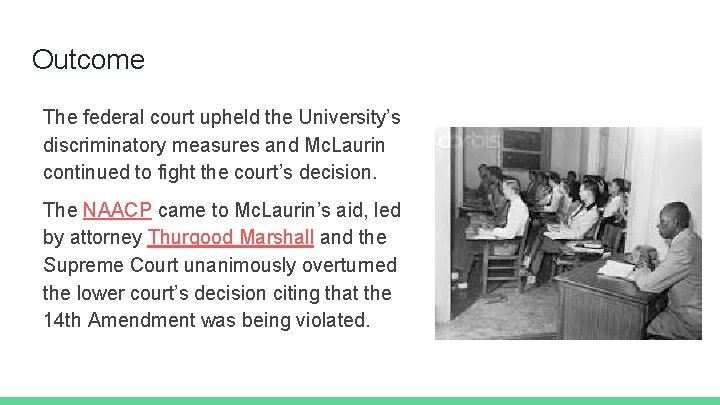
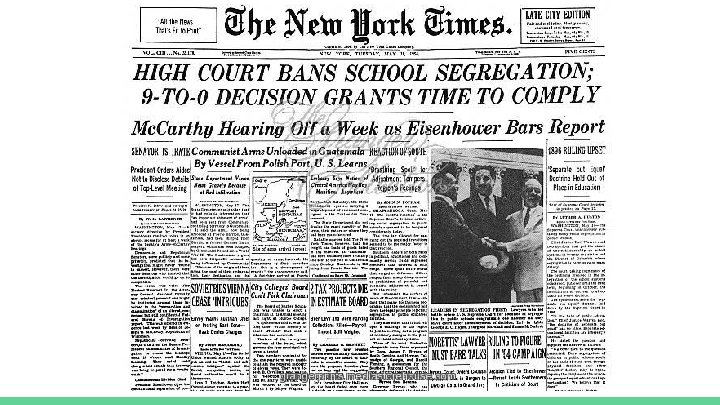
Outcome The federal court upheld the University’s discriminatory measures and Mc. Laurin continued to fight the court’s decision. The NAACP came to Mc. Laurin’s aid, led by attorney Thurgood Marshall and the Supreme Court unanimously overturned the lower court’s decision citing that the 14 th Amendment was being violated.
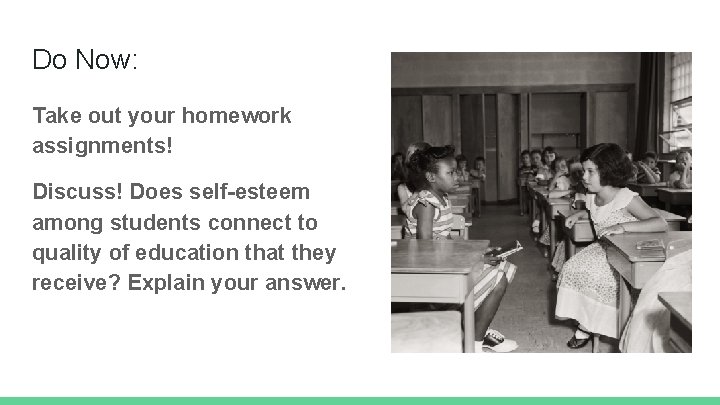
Do Now: Take out your homework assignments! Discuss! Does self-esteem among students connect to quality of education that they receive? Explain your answer.
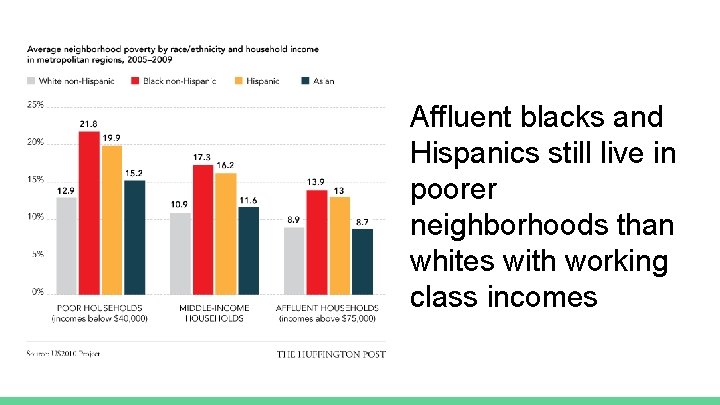
Affluent blacks and Hispanics still live in poorer neighborhoods than whites with working class incomes
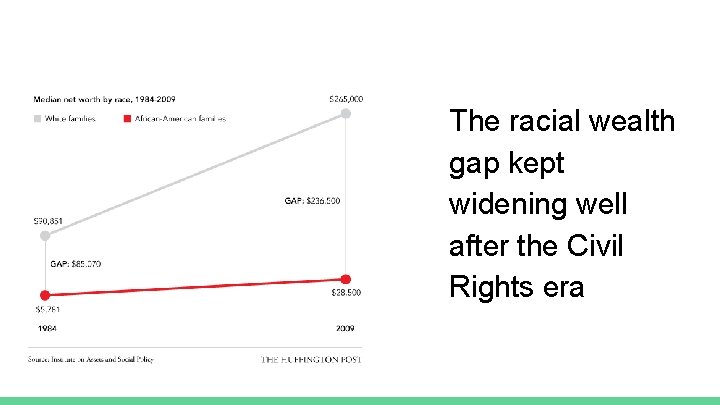
The racial wealth gap kept widening well after the Civil Rights era
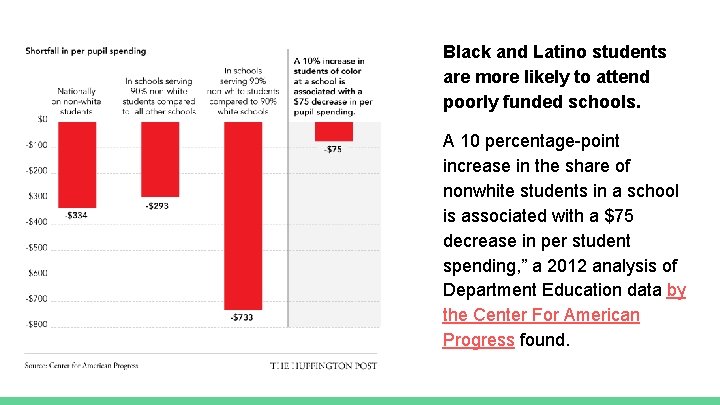
Black and Latino students are more likely to attend poorly funded schools. A 10 percentage-point increase in the share of nonwhite students in a school is associated with a $75 decrease in per student spending, ” a 2012 analysis of Department Education data by the Center For American Progress found.
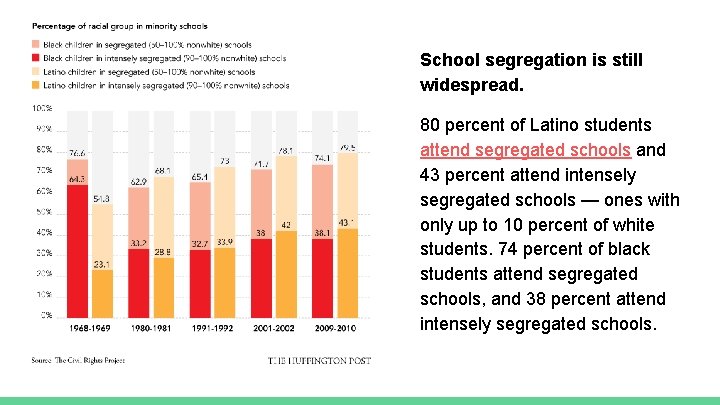
School segregation is still widespread. 80 percent of Latino students attend segregated schools and 43 percent attend intensely segregated schools — ones with only up to 10 percent of white students. 74 percent of black students attend segregated schools, and 38 percent attend intensely segregated schools.
Brown v. Board of Education Topeka https: //www. youtube. com/watch? v=j. Lcac 0 KIQHo 14: 35
- Slides: 64