
The Superpave Gyratory Compactor How do we use



- Slides: 20
The Superpave Gyratory Compactor How do we use it. John D’Angelo Office of Pavement Technology US Federal Highway Administration
Background • SHRP A-001 Contract – Development of Superpave Mix Design Procedure • Gyratory Compactor Experiments – Conducted at Asphalt Institute – Included rotational speed, Ndesign, sensitivity experiments – Comparison between prototype and production SGC v Led to discovery of angle sensitivity v Tolerance of ± 0. 02 degrees
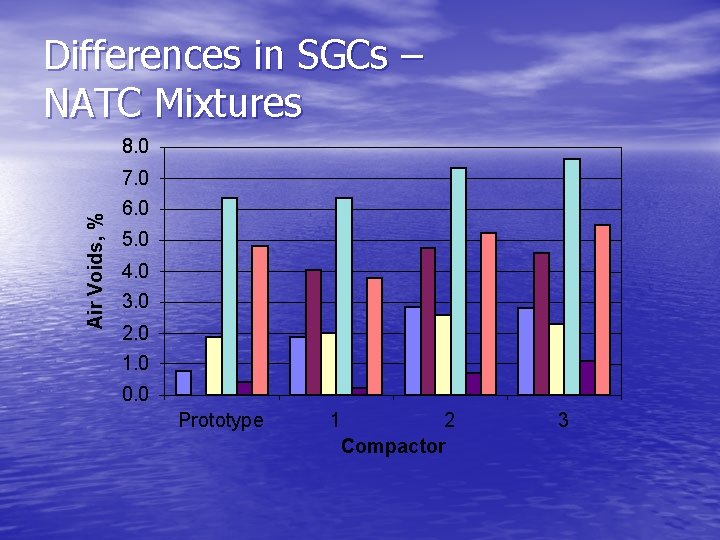
Differences in SGCs – NATC Mixtures 8. 0 Air Voids, % 7. 0 6. 0 5. 0 4. 0 3. 0 2. 0 1. 0 0. 0 Prototype 1 2 Compactor 3
Measurement of the Internal Angle of Gyration • Significant Differences in Air Voids – Difference in Design AC Could be as Much as 0. 8% Asphalt Content • Angle of Gyration – All Compactors set to 1. 25° Externally – What is the Internal Angle of Gyration? • Frame compliance?
4. APPARATUS 4. 1 Superpave Gyratory Compactor – … The compactor shall tilt the specimen molds at an external angle of 1. 25°+0. 02° or an average internal angle of 1. 16°+ 0. 02° in accordance with AASHTO T 312. The compactor shall gyrate the specimens mold at a rate of 30. 0 + 0. 5 gyrations per minute…
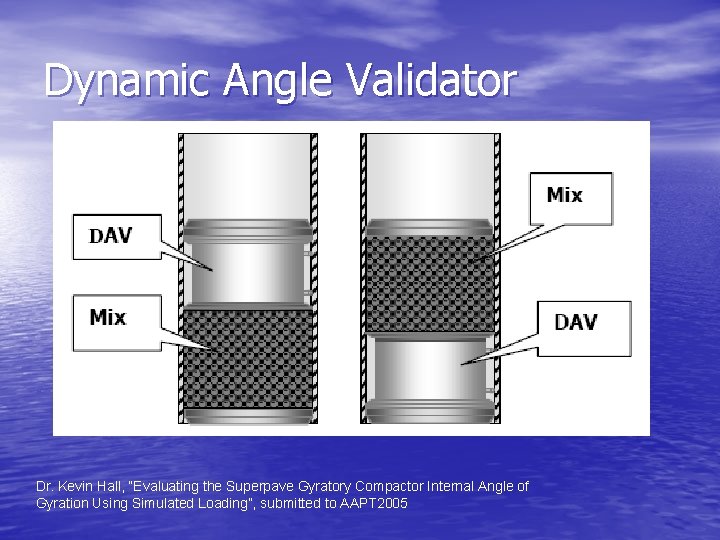
Internal Angle of Gyration • Internal Angle of Gyration – Development of the Dynamic Angle Validator (DAV) or Angle Validation Kit (AVK) • Wireless Unit • Drop into mold either before or after adding mix
Dynamic Angle Validator Dr. Kevin Hall, “Evaluating the Superpave Gyratory Compactor Internal Angle of Gyration Using Simulated Loading”, submitted to AAPT 2005
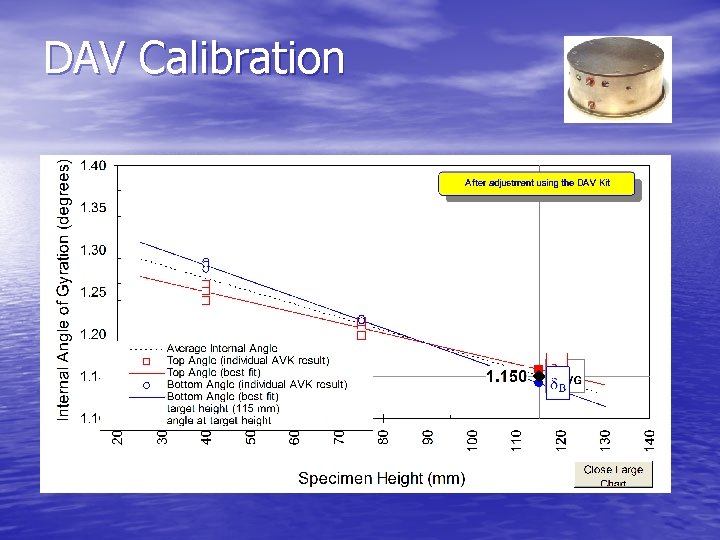
DAV Calibration
Internal Angle of Gyration • DAV – Validate Differences in SGCs • Demonstrated that internal angle of gyration could be different even though external angle was the same. – Calibration • Potentially time-intensive – Up to 1 day for a calibration • Affected by mixture stiffness? – Requiring recalibration for different mix types
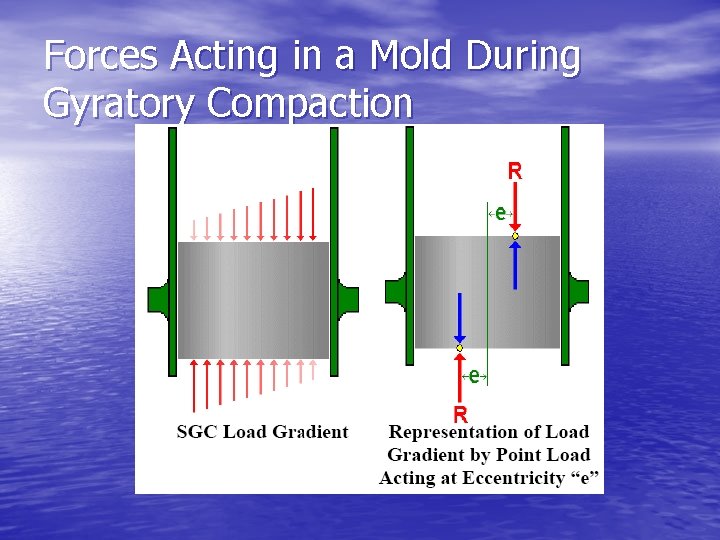
Forces Acting in a Mold During Gyratory Compaction
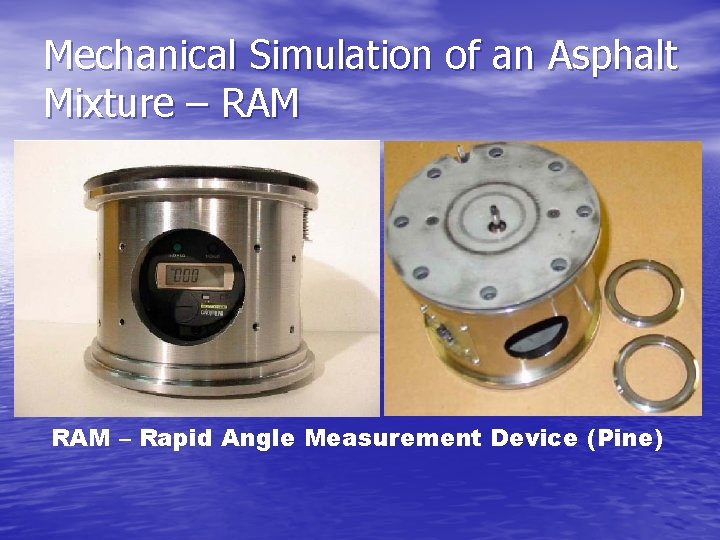
Mechanical Simulation of an Asphalt Mixture – RAM – Rapid Angle Measurement Device (Pine)
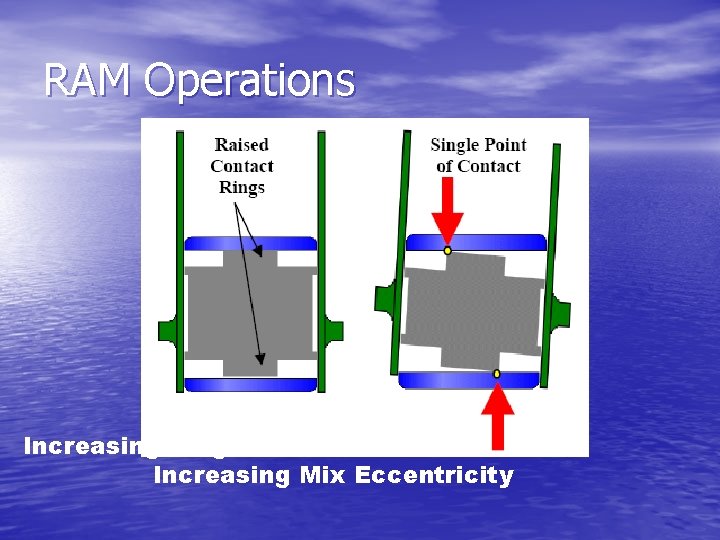
RAM Operations Increasing Ring Diameter = Increasing Mix Eccentricity
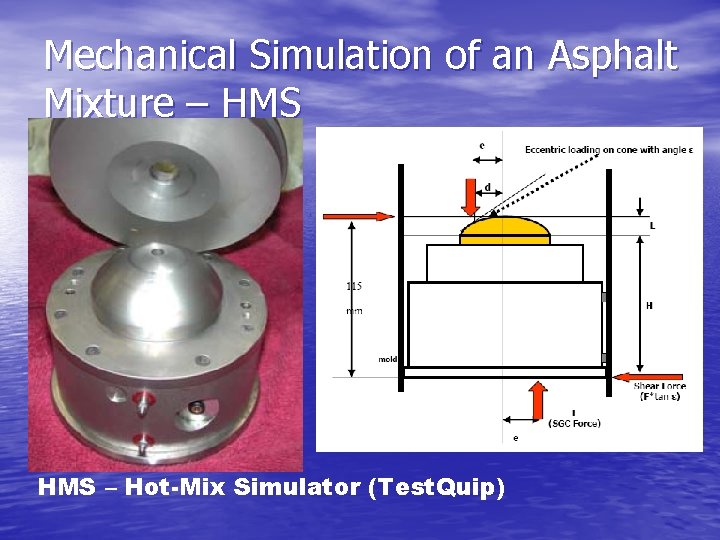
Mechanical Simulation of an Asphalt Mixture – HMS – Hot-Mix Simulator (Test. Quip)
Purpose of Research • Objectives – Improve the determination and calibration of the dynamic internal angle of gyration for the Superpave gyratory compactor using mechanical mixture simulation devices • Reduce time for calibration • Improve reproducibility between different labs • Recommend revisions to AASHTO T 312
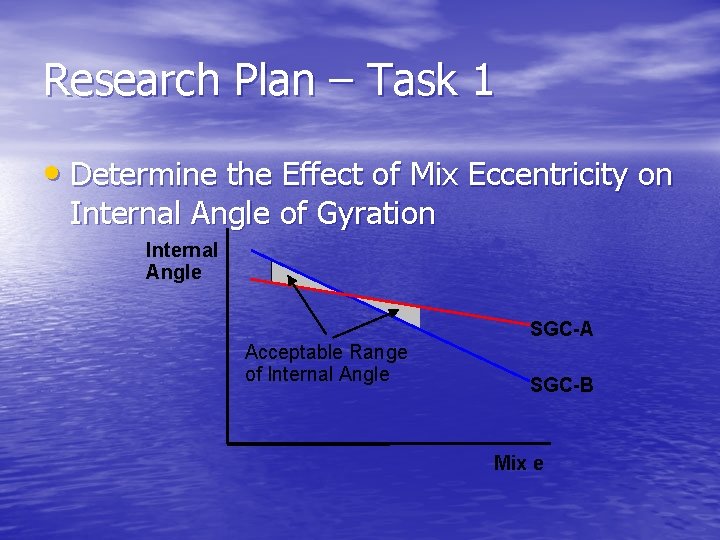
Research Plan – Task 1 • Determine the Effect of Mix Eccentricity on Internal Angle of Gyration Internal Angle SGC-A Acceptable Range of Internal Angle SGC-B Mix e
Research Plan – Task 2 • Using a Wide Variety of Mixtures… – What is the relationship between mixture eccentricity and stiffness? – What is an “average” or representative mixture eccentricity? – Is there a standard mixture eccentricity that can be used to minimize variation in the percentage of air voids in specimens produced by different SGCs?
Research Plan – Task 3 • Using Mechanical Simulation Devices in the Calibration Process – Issues • Necessity of heated molds?
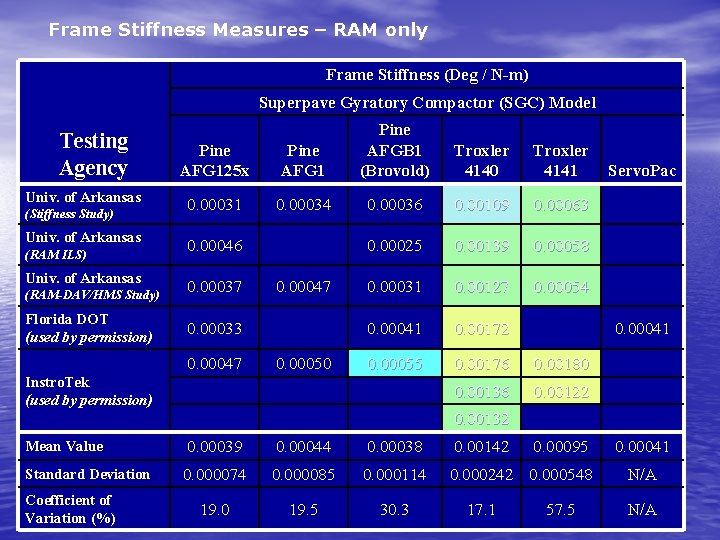
Frame Stiffness Measures – RAM only Frame Stiffness (Deg / N-m) Superpave Gyratory Compactor (SGC) Model Testing Agency Univ. of Arkansas (Stiffness Study) Univ. of Arkansas (RAM ILS) Univ. of Arkansas (RAM-DAV/HMS Study) Florida DOT (used by permission) Pine AFG 125 x Pine AFG 1 Pine AFGB 1 (Brovold) 0. 00031 0. 00034 0. 00036 0. 00109 0. 00063 0. 00025 0. 00139 0. 00058 0. 00031 0. 00127 0. 00054 0. 00041 0. 00172 0. 00055 0. 00176 0. 00180 0. 00136 0. 00122 0. 00046 0. 00037 0. 00047 0. 00033 0. 00047 0. 00050 Instro. Tek (used by permission) Troxler 4140 Troxler 4141 Servo. Pac 0. 00041 0. 00132 Mean Value 0. 00039 0. 00044 0. 00038 0. 00142 Standard Deviation 0. 000074 0. 000085 0. 000114 0. 000242 0. 000548 19. 0 19. 5 30. 3 Coefficient of Variation (%) 17. 1 0. 00095 57. 5 0. 00041 N/A
Thanks!