
The Supernova Acceleration Probe SNAP Presentation to the
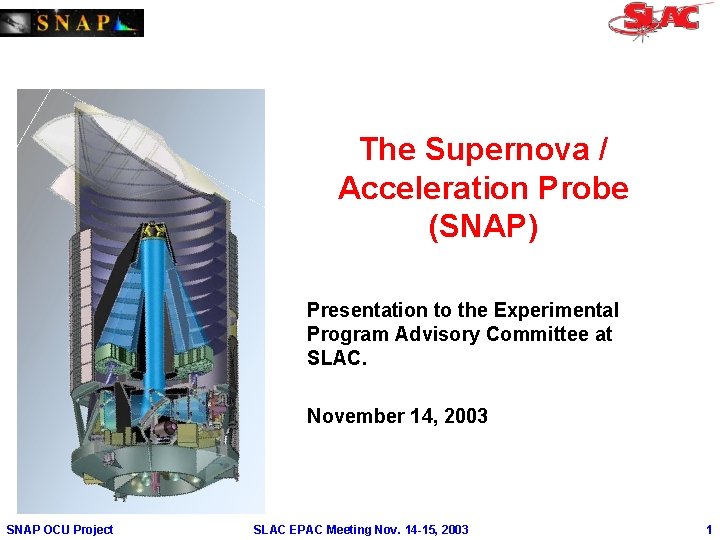
The Supernova / Acceleration Probe (SNAP) Presentation to the Experimental Program Advisory Committee at SLAC. November 14, 2003 SNAP OCU Project SLAC EPAC Meeting Nov. 14 -15, 2003 1
SLAC Involvement in SNAP • With the creation of the Kavli Institute for Particle Astrophysics and Cosmology (KIPAC), experiments addressing issues at the interface between particle physics and astrophysics will play an increasingly prominent role in the SLAC research program. • Of particular interest will be the “dark sector”, the nature of dark energy and dark matter, and the roles they play in the evolution of the Universe. • Technology development in connection with the SNAP mission has been a cornerstone of the DOE-OS program addressing the mystery of dark energy. • We believe that SLAC can and should play a prominent and important role in this mission if it goes forward as currently planned. SNAP OCU Project SLAC EPAC Meeting Nov. 14 -15, 2003 2
SLAC Involvement in SNAP • The first discussions about SLAC involvement with the leadership of the SNAP collaboration (S. Perlmutter, M. Levi) were held in February 2003. • At that time, a potential hardware role in the mission associated with the design and development of the Observatory Control Unit (OCU) was identified. • We also highlighted our science interest in the use of SNAP data for strong lensing investigations. • A letter of application for institutional membership in the SNAP collaboration on behalf of Stanford and SLAC was submitted in August 2003. That application is currently still under discussion, but the preliminary responses have been very positive. SNAP OCU Project SLAC EPAC Meeting Nov. 14 -15, 2003 3
Outline of Presentations • The Science of Dark Energy and the Design of the SNAP Mission – E. Linder • Strong Lensing Investigations with SNAP – R. Blandford • The Observatory Control Unit – M. Huffer • Concluding Comments – S. Kahn SNAP OCU Project SLAC EPAC Meeting Nov. 14 -15, 2003 4
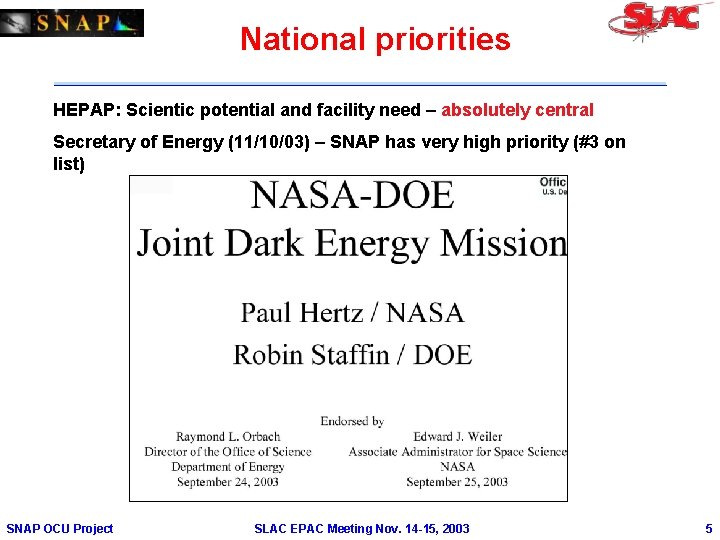
National priorities HEPAP: Scientic potential and facility need – absolutely central Secretary of Energy (11/10/03) – SNAP has very high priority (#3 on list) SNAP OCU Project SLAC EPAC Meeting Nov. 14 -15, 2003 5
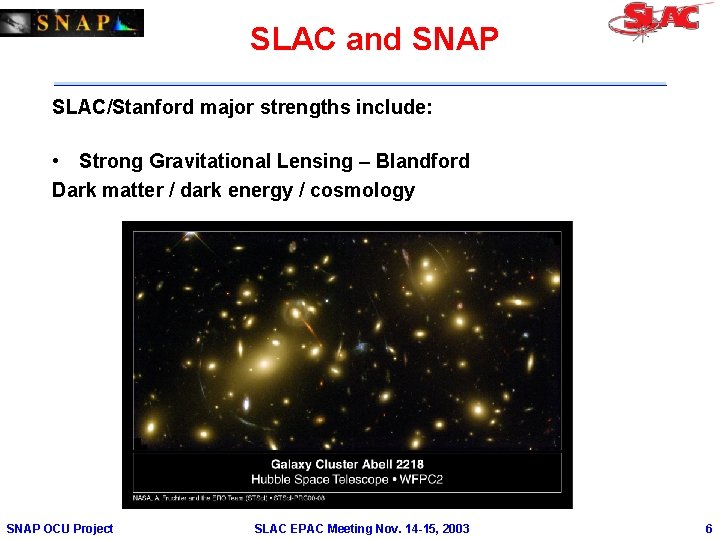
SLAC and SNAP SLAC/Stanford major strengths include: • Strong Gravitational Lensing – Blandford Dark matter / dark energy / cosmology SNAP OCU Project SLAC EPAC Meeting Nov. 14 -15, 2003 6
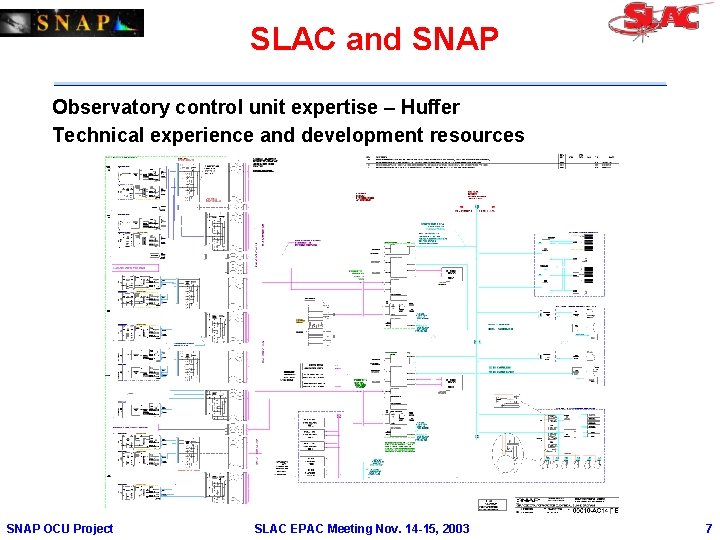
SLAC and SNAP Observatory control unit expertise – Huffer Technical experience and development resources SNAP OCU Project SLAC EPAC Meeting Nov. 14 -15, 2003 7
SLAC and SNAP SLAC/Stanford major strengths include: • Space mission experience – Kahn Extensive design and implementation Knowledge of NASA culture • Experience with joint NASA-DOE projects from GLAST Collaborative agency working relationships • Dark Energy and High Energy Physics – Existing and ongoing SNAP theory collaboration by Kallosh & Linde SNAP OCU Project SLAC EPAC Meeting Nov. 14 -15, 2003 8
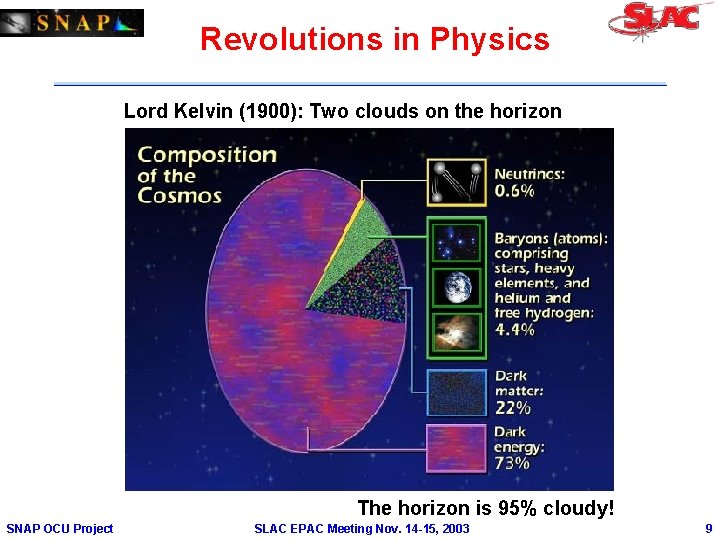
Revolutions in Physics Lord Kelvin (1900): Two clouds on the horizon The horizon is 95% cloudy! SNAP OCU Project SLAC EPAC Meeting Nov. 14 -15, 2003 9
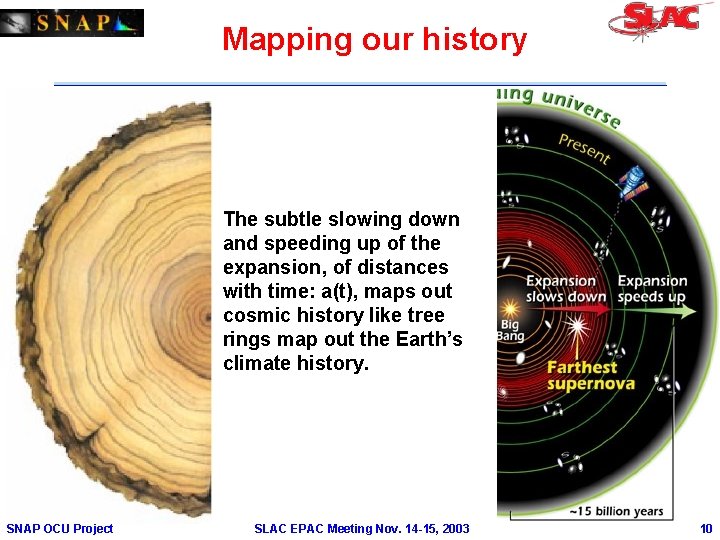
Mapping our history The subtle slowing down and speeding up of the expansion, of distances with time: a(t), maps out cosmic history like tree rings map out the Earth’s climate history. SNAP OCU Project SLAC EPAC Meeting Nov. 14 -15, 2003 10
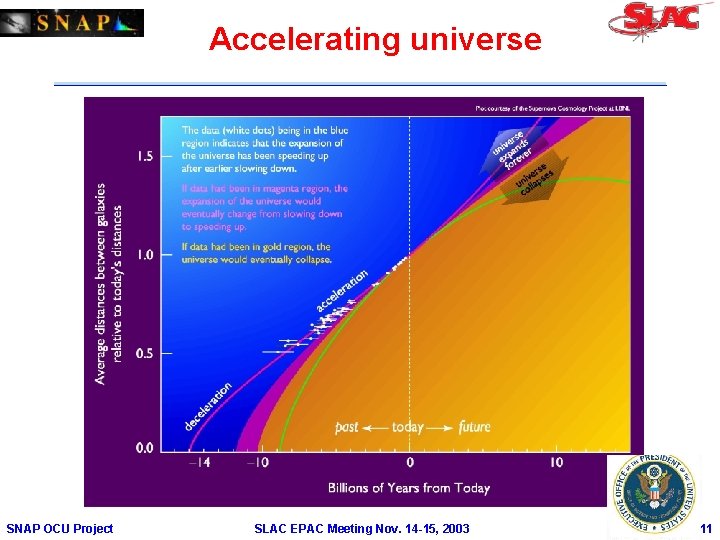
Accelerating universe SNAP OCU Project SLAC EPAC Meeting Nov. 14 -15, 2003 11
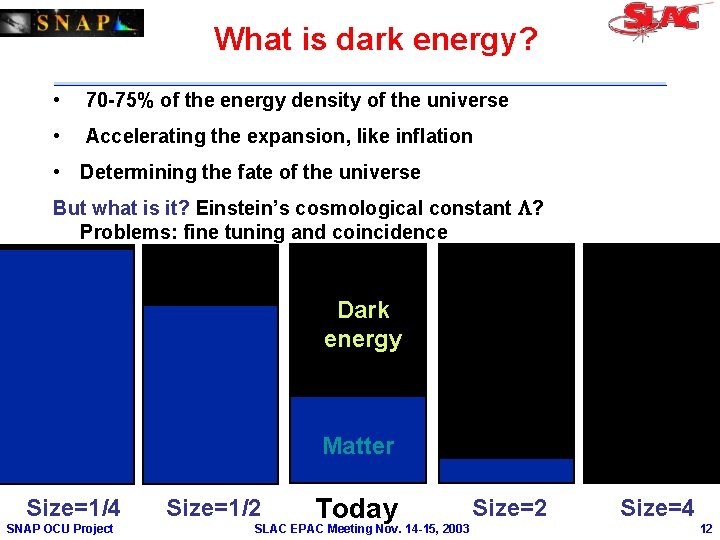
What is dark energy? • 70 -75% of the energy density of the universe • Accelerating the expansion, like inflation • Determining the fate of the universe But what is it? Einstein’s cosmological constant ? Problems: fine tuning and coincidence Dark energy Matter Size=1/4 SNAP OCU Project Size=1/2 Today SLAC EPAC Meeting Nov. 14 -15, 2003 Size=2 Size=4 12
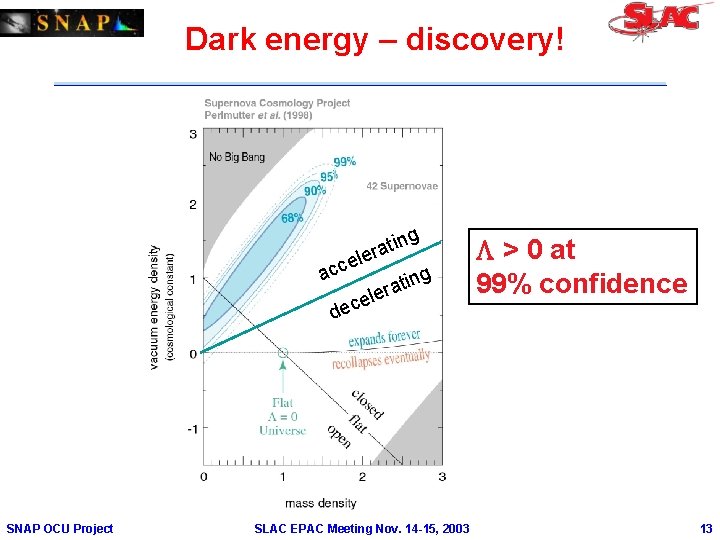
Dark energy – discovery! g tin a r le cce a g tin a r le e c e d SNAP OCU Project SLAC EPAC Meeting Nov. 14 -15, 2003 > 0 at 99% confidence 13
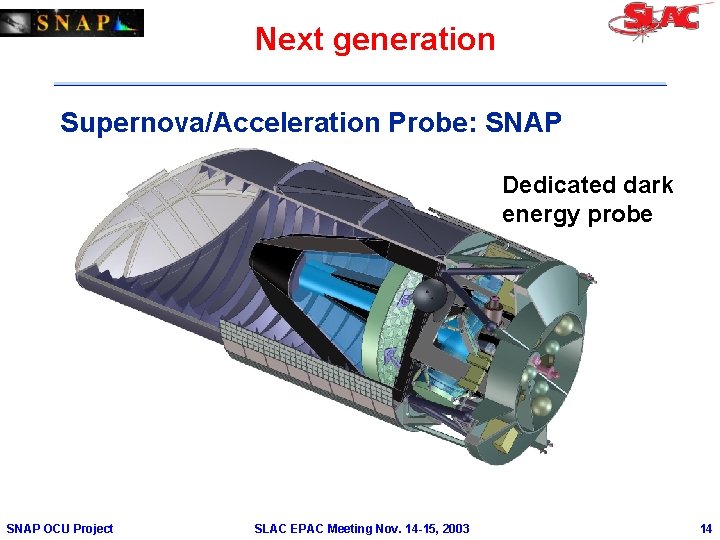
Next generation Supernova/Acceleration Probe: SNAP Dedicated dark energy probe SNAP OCU Project SLAC EPAC Meeting Nov. 14 -15, 2003 14
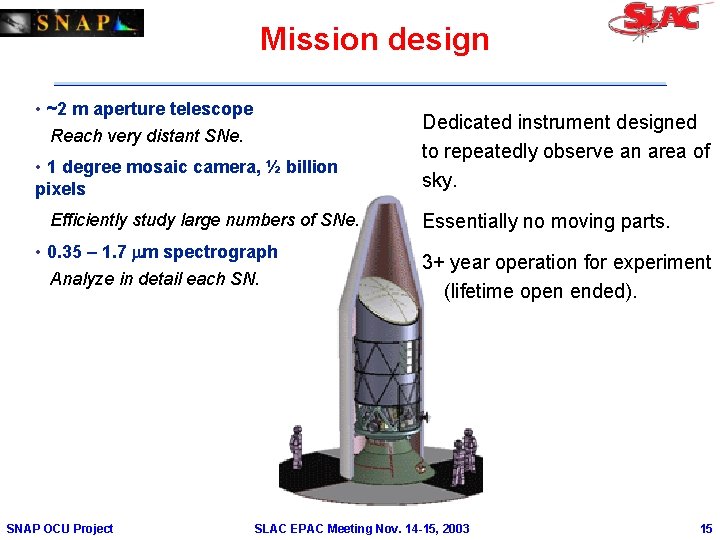
Mission design • ~2 m aperture telescope Reach very distant SNe. • 1 degree mosaic camera, ½ billion pixels Efficiently study large numbers of SNe. • 0. 35 – 1. 7 m spectrograph Analyze in detail each SN. SNAP OCU Project Dedicated instrument designed to repeatedly observe an area of sky. Essentially no moving parts. 3+ year operation for experiment (lifetime open ended). SLAC EPAC Meeting Nov. 14 -15, 2003 15
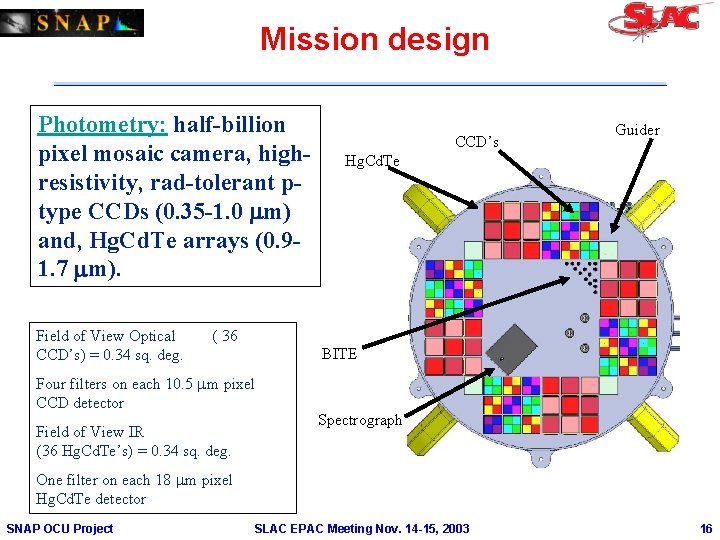
Mission design Photometry: half-billion pixel mosaic camera, highresistivity, rad-tolerant ptype CCDs (0. 35 -1. 0 m) and, Hg. Cd. Te arrays (0. 91. 7 m). Field of View Optical CCD’s) = 0. 34 sq. deg. CCD’s Guider Hg. Cd. Te ( 36 BITE Four filters on each 10. 5 mm pixel CCD detector Field of View IR (36 Hg. Cd. Te’s) = 0. 34 sq. deg. Spectrograph One filter on each 18 mm pixel Hg. Cd. Te detector SNAP OCU Project SLAC EPAC Meeting Nov. 14 -15, 2003 16
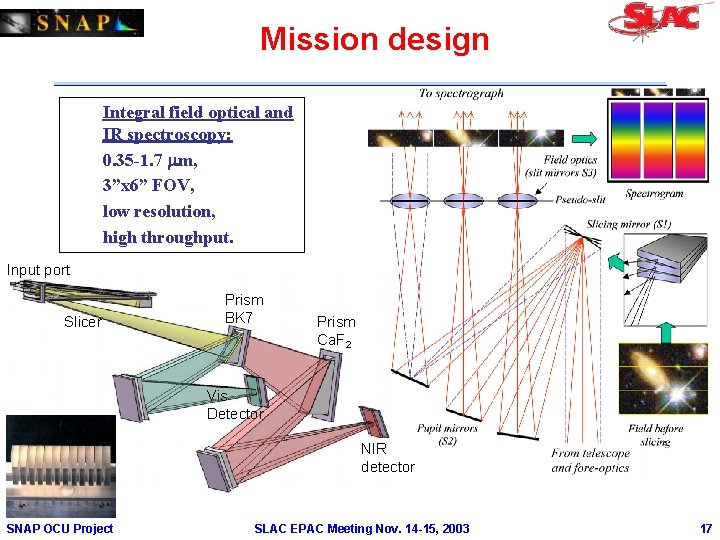
Mission design Integral field optical and IR spectroscopy: 0. 35 -1. 7 m, 3”x 6” FOV, low resolution, high throughput. Input port Slicer Prism BK 7 Prism Ca. F 2 Vis Detector NIR detector SNAP OCU Project SLAC EPAC Meeting Nov. 14 -15, 2003 17
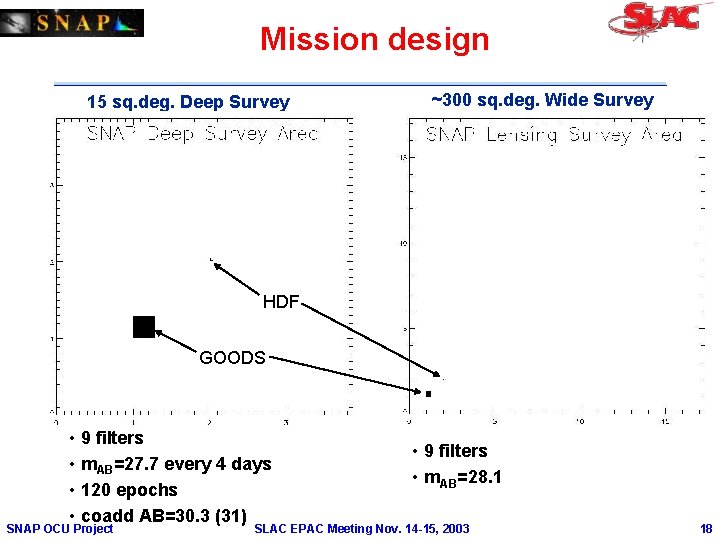
Mission design 15 sq. deg. Deep Survey ~300 sq. deg. Wide Survey HDF GOODS • 9 filters • m. AB=27. 7 every 4 days • 120 epochs • coadd AB=30. 3 (31) SNAP OCU Project • 9 filters • m. AB=28. 1 SLAC EPAC Meeting Nov. 14 -15, 2003 18
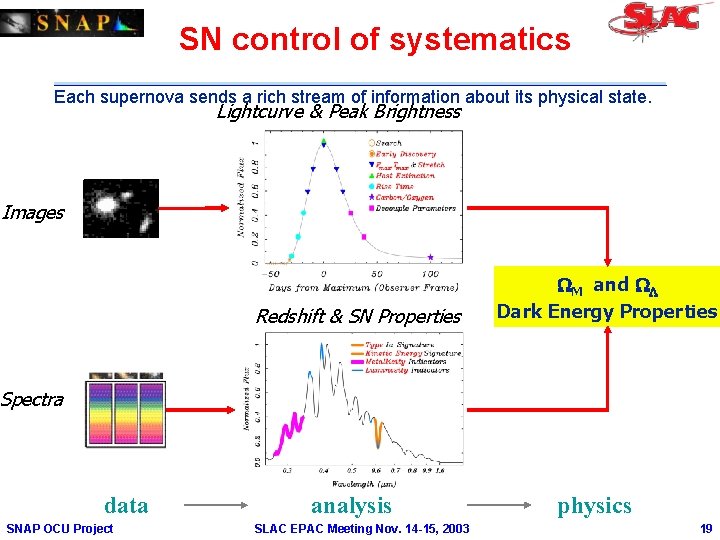
SN control of systematics Each supernova sends a rich stream of information about its physical state. Lightcurve & Peak Brightness Images Redshift & SN Properties M and Dark Energy Properties Spectra data SNAP OCU Project analysis SLAC EPAC Meeting Nov. 14 -15, 2003 physics 19
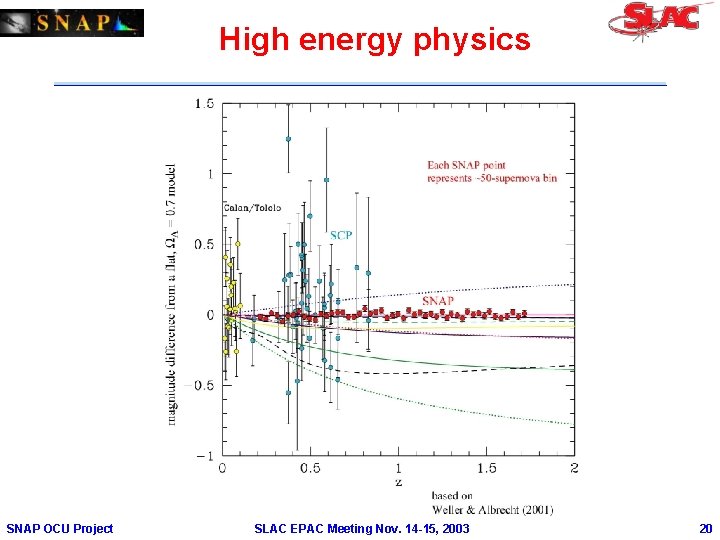
High energy physics SNAP OCU Project SLAC EPAC Meeting Nov. 14 -15, 2003 20
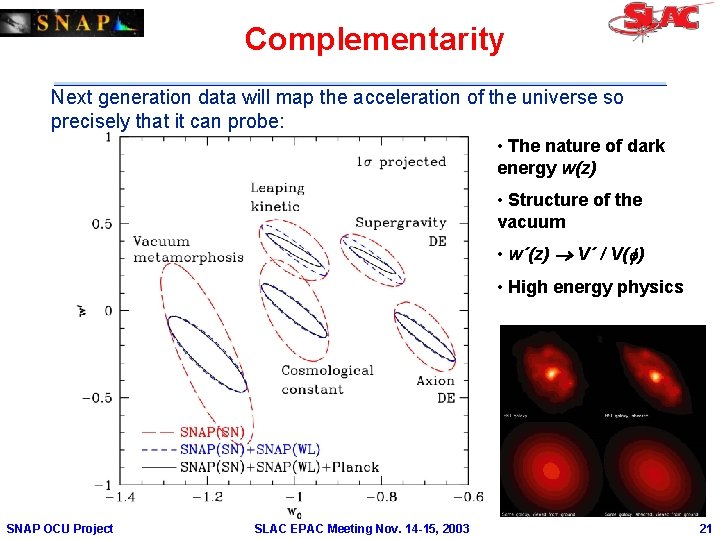
Complementarity Next generation data will map the acceleration of the universe so precisely that it can probe: • The nature of dark energy w(z) • Structure of the vacuum • w´(z) V´ / V( ) • High energy physics SNAP OCU Project SLAC EPAC Meeting Nov. 14 -15, 2003 21
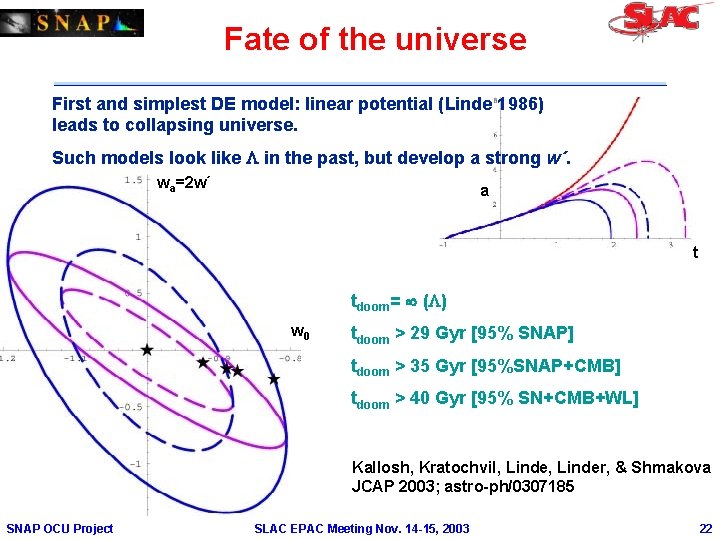
Fate of the universe First and simplest DE model: linear potential (Linde 1986) leads to collapsing universe. Such models look like in the past, but develop a strong w´. wa=2 w´ a t tdoom= ( ) w 0 tdoom > 29 Gyr [95% SNAP] tdoom > 35 Gyr [95%SNAP+CMB] tdoom > 40 Gyr [95% SN+CMB+WL] Kallosh, Kratochvil, Linder, & Shmakova JCAP 2003; astro-ph/0307185 SNAP OCU Project SLAC EPAC Meeting Nov. 14 -15, 2003 22
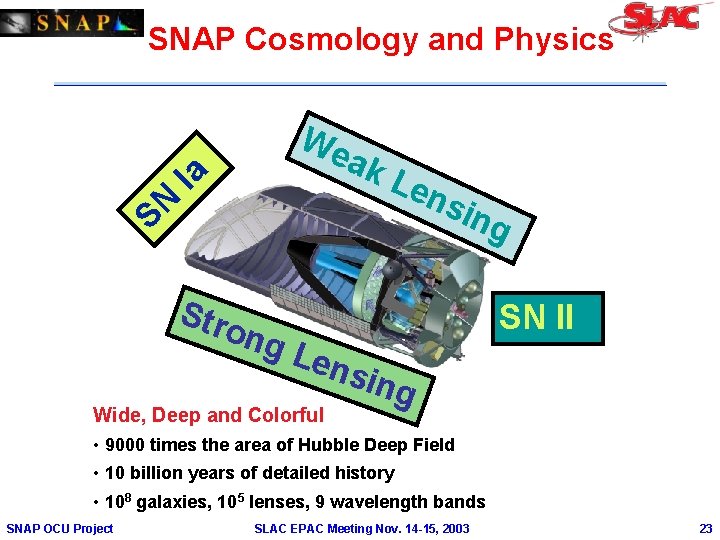
SNAP Cosmology and Physics We ens SN Ia ak L Stro ng ing SN II Len s Wide, Deep and Colorful ing • 9000 times the area of Hubble Deep Field • 10 billion years of detailed history • 108 galaxies, 105 lenses, 9 wavelength bands SNAP OCU Project SLAC EPAC Meeting Nov. 14 -15, 2003 23
Strong Lensing Program • Multiple imaging by galaxies, groups and clusters • Ancillary program - complementary to: – Supernova cosmography – Weak lensing study of large scale structure – Galaxy-galaxy lensing study of galaxy halos • Telescope nearly ideal for strong lensing because of – 9 filters – 0. 1(0. 05)” pixels – 4 day cadence – Deep (15 sq deg) and Wide (300 sq deg) surveys • Lensing rate 0. 001 -0. 002 => ~300, 000 “events” – Quantitative, identification pipeline (cf CLASS) – Emphasize standard elliptical galaxy “scattering” with 0. 5<z<1 • Complementary to LSST and Square Kilometer Array SNAP OCU Project SLAC EPAC Meeting Nov. 14 -15, 2003 24
Scientific Goals • Source Population – Study the faintest galaxies – building blocks of normal galaxies • redshift distribution • luminosities • star formation rates etc – AGN microlensing – Rare high magnification events • Lens Population – Galaxy substructure out to R ~ 10 kpc – Cluster substructure • Cosmography • Propagation Effects – Time delays Þ small scale dark matter distribution – Quasar absorption lines etc SNAP OCU Project SLAC EPAC Meeting Nov. 14 -15, 2003 25
Source Population • Understand empirically where when and how small galaxies merge to form larger galaxies – ~2 x 10⁵ isolated elliptical galaxy lenses on deep field – total cross section ~ 0. 02 sq deg – 10000 (30000) clean lenses on deep field to IAB ~ 28 (30) – Use lens colors to measure lens distance – Use color maps to separate source from lens, remove dust – Use Einstein ring radius to measure source distance • 100 times too faint for spectroscopy – Infer source properties statistically and test CDM theory SNAP OCU Project SLAC EPAC Meeting Nov. 14 -15, 2003 26
Simulation • Massive elliptical lens, I=21. 5, at zd=0. 7 • Faint blue galaxy, B=29, at higher redshift • Fit 9 images with two “spectral” models to reconstruct lensed source • Infer zs from Einstein ring radius • Input images (true color, different intensity scales!): SNAP OCU Project SLAC EPAC Meeting Nov. 14 -15, 2003 27
Simulation Simulated SNAP images: • 0. 12” pixels, 0. 14” FWHM PSF, no dither • Deep survey, 1. 5 mag fainter than HDF • B, V and I-bands shown for illustration: B (440 nm) SNAP OCU Project V (582 nm) SLAC EPAC Meeting Nov. 14 -15, 2003 I (770 nm) 28
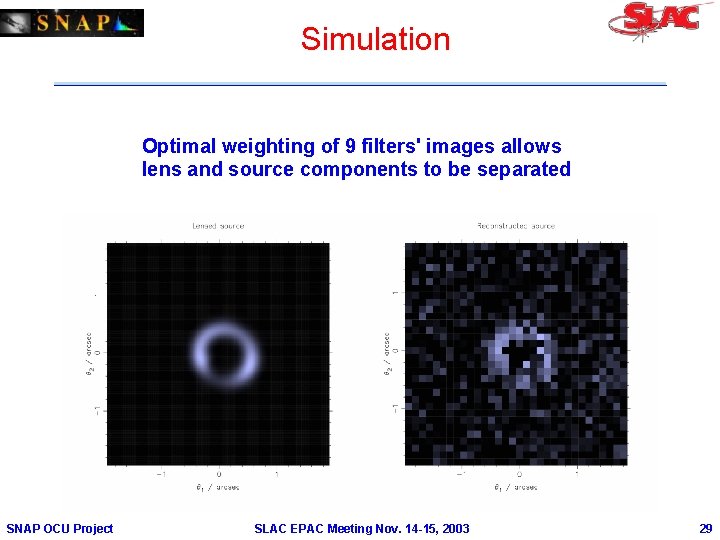
Simulation Optimal weighting of 9 filters' images allows lens and source components to be separated SNAP OCU Project SLAC EPAC Meeting Nov. 14 -15, 2003 29
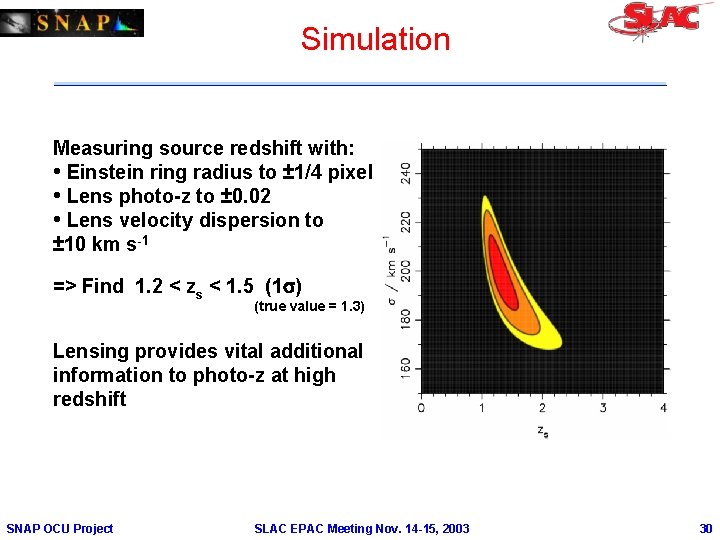
Simulation Measuring source redshift with: • Einstein ring radius to ± 1/4 pixel • Lens photo-z to ± 0. 02 • Lens velocity dispersion to ± 10 km s-1 => Find 1. 2 < zs < 1. 5 (1 ) (true value = 1. 3) Lensing provides vital additional information to photo-z at high redshift SNAP OCU Project SLAC EPAC Meeting Nov. 14 -15, 2003 30
Scientific Goals • Source Population – Study the faintest galaxies – building blocks of normal galaxies • redshift distribution • luminosities • star formation rates etc – AGN microlensing – Rare high magnification events • Lens Population – Galaxy substructure out to R ~ 10 kpc – Cluster substructure • Cosmography • Propagation Effects – Time delays => small scale dark matter distribution – Quasar absorption lines etc SNAP OCU Project SLAC EPAC Meeting Nov. 14 -15, 2003 31
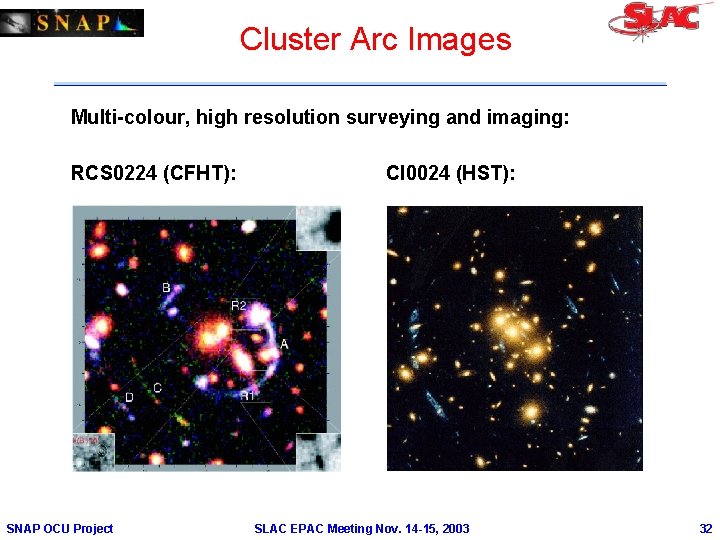
Cluster Arc Images Multi-colour, high resolution surveying and imaging: RCS 0224 (CFHT): SNAP OCU Project Cl 0024 (HST): SLAC EPAC Meeting Nov. 14 -15, 2003 32
Scientific Goals • Source Population – Study the faintest galaxies – building blocks of normal galaxies • redshift distribution • luminosities • star formation rates etc – AGN microlensing – Rare high magnification events • Lens Population – Galaxy substructure out to R ~ 10 kpc – Cluster substructure • Cosmography • Propagation Effects – Time delays => small scale dark matter distribution – Quasar absorption lines etc SNAP OCU Project SLAC EPAC Meeting Nov. 14 -15, 2003 33
Time delays • Lens time delays measure the Hubble constant, age of universe – Accuracy limited by lens model • Currently lens determinations are competitive with traditional astronomical methods • By the time SNAP is launched this will probably be settled • Small scale structure along the line of sight causes deviation from apparent pure Hubble expansion • Can measure statistically and check CDM predictions SNAP OCU Project SLAC EPAC Meeting Nov. 14 -15, 2003 34
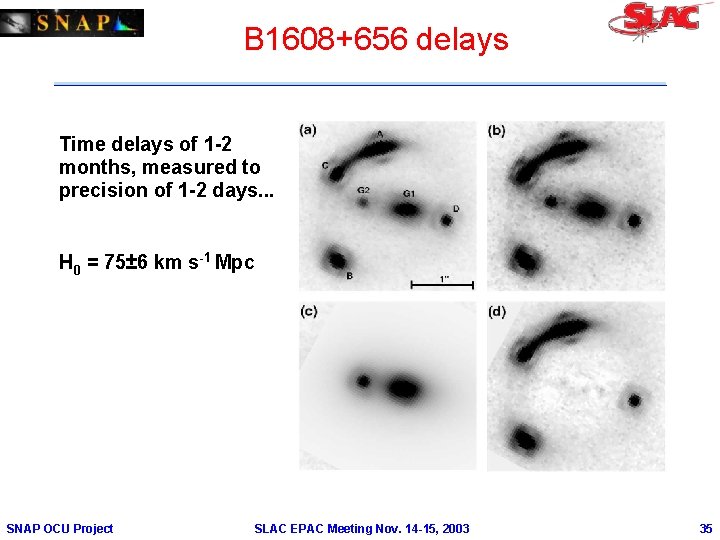
B 1608+656 delays Time delays of 1 -2 months, measured to precision of 1 -2 days. . . H 0 = 75± 6 km s-1 Mpc SNAP OCU Project SLAC EPAC Meeting Nov. 14 -15, 2003 35
Research underway and planned • Simulations using Hubble images and projected SNAP resolution (including dithering) and sky/detector noise (Marshall) – Establish procedure for data analysis pipeline to find clean and dirty lenses – Establish procedure for refining elliptical potentials – Use Hubble Ultradeep Field to describe source population – Estimate accuracy for determining source properties • Work with weak lensing group to develop strategy to combine strong and weak lensing studies of galaxy structure (Koopmans) • Study rare, higher order catastrophes as (Baltz): – highly magnifying telescopes – probes of granularity of dark matter – surveying instruments SNAP OCU Project SLAC EPAC Meeting Nov. 14 -15, 2003 36
What instrument deliverable does SLAC propose? • The Observatory Control Unit (OCU) • Both a hardware (electronics) and software system • Supervises and manages (on-station) observatory operation SNAP OCU Project SLAC EPAC Meeting Nov. 14 -15, 2003 37
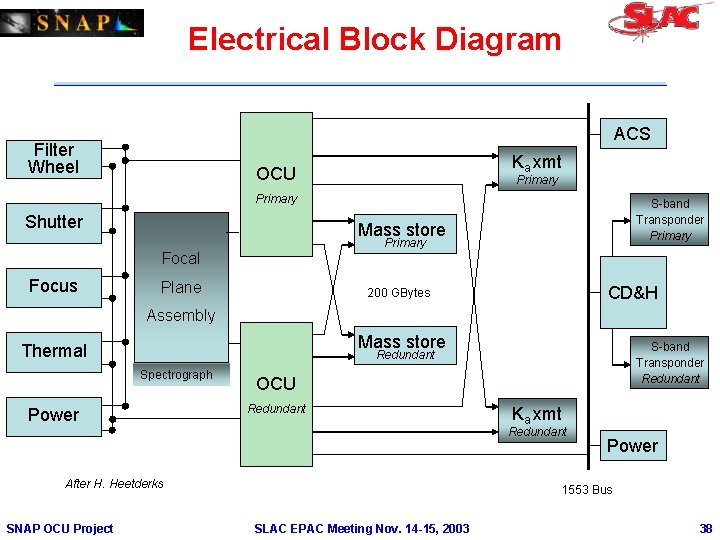
Electrical Block Diagram ACS Filter Wheel Ka xmt OCU Primary Shutter Mass store Primary Focal Focus S-band Transponder Primary Plane CD&H 200 GBytes Assembly Mass store Thermal Spectrograph Power OCU Redundant Ka xmt Redundant After H. Heetderks SNAP OCU Project S-band Transponder Redundant Power 1553 Bus SLAC EPAC Meeting Nov. 14 -15, 2003 38
Functional requirements • Executes instrument’s observation plan – Transfer pointing requests to ACS – Controls CCD array parameterization and readout • Science data management – Manage mass store – Route real-time and stored data to downlink transmitters • Mechanism management, control, and operation – Telescope cover, optical shutter, stepper coils, etc… • Power distribution and management SNAP OCU Project SLAC EPAC Meeting Nov. 14 -15, 2003 39
Functional requirements… • Thermal management – Manage heater elements • Primary, Secondary mirrors, telescope structure, etc… – Survival heaters – Monitor and trend temperatures – Housekeeping » Monitor instrument environment » Packetize and route as telemetry • Data (Event) readout and acquisition • Command processing and distribution – Command database definition and maintenance – Decoding, distribution, and execution SNAP OCU Project SLAC EPAC Meeting Nov. 14 -15, 2003 40
What is the scope of the OCU within the observatory? • OCU performs electronic supervision of entire instrument • Encompasses design, specification and implementation of… – The bulk of instrument’s digital electronics – A modest amount of analog electronics – The entire Flight Software System • Executes the science mission … • Natural consequence is significant role in defining…. – instrument architecture – translation of science objectives to operational program SNAP OCU Project SLAC EPAC Meeting Nov. 14 -15, 2003 41
How does it fit within SLAC’s current program? • OCU development requires a unique blend of skills… – Data Acquisition – Detector Monitoring and Control • SLAC has extensive experience in these areas… – Successful, lead role within 2 major HEP experiments: • SLD • Ba. Bar • SLAC has space heritage… – Lead role in both Electronics and Flight Software for GLAST – Demonstrated collaboration with NASA based labs • SLAC has long history of successful collaboration with LBL – We enjoy a physical proximity… • Phases well with GLAST and Ba. Bar program – Ba. Bar no longer in development – GLAST moving out of design/development stage SNAP OCU Project SLAC EPAC Meeting Nov. 14 -15, 2003 42
Concluding Comments • In October 2003, NASA and DOE announced the results of a year-long discussion regarding the possibility for cooperation in a space-based mission devoted to exploring the nature of dark energy. • The plan involves the development of a Joint Dark Energy Mission (JDEM). • NASA/DOE will issue a single AO soliciting a dark energy science investigation requiring a space-based observatory. The science investigation will be PI-led and will be selected via open competition. • The present schedule shows selection of the science investigation one year after the onset of new funding, leading to launch of the mission eight years later. SNAP OCU Project SLAC EPAC Meeting Nov. 14 -15, 2003 43
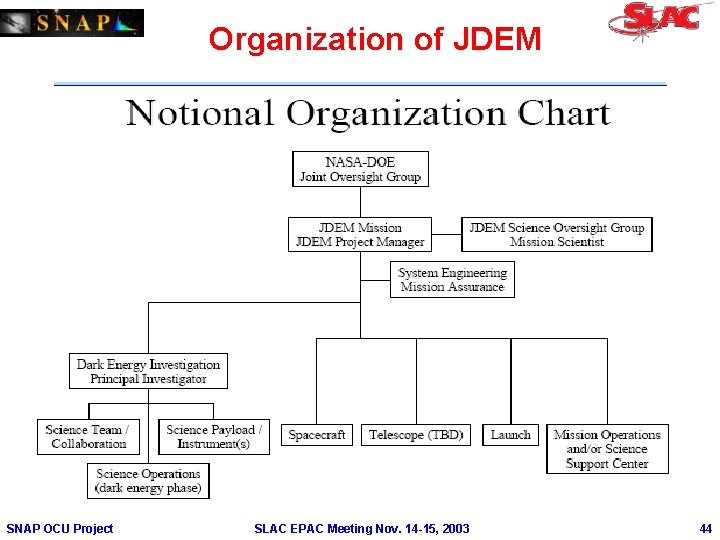
Organization of JDEM SNAP OCU Project SLAC EPAC Meeting Nov. 14 -15, 2003 44
Concluding Comments • The proposed plan is for the SLAC team to participate in an LBNL-led proposal for a JDEM science investigation based on the SNAP concept. • SLAC and LBNL have a long history of close cooperation in high energy physics experiments. • The differences in culture between the NASA and DOE communities will introduce some challenges in making the JDEM concept work. • SLAC’s extensive experience working with both agencies in the GLAST program should prove to be a key asset to the SNAP collaboration. SNAP OCU Project SLAC EPAC Meeting Nov. 14 -15, 2003 45
- Slides: 45