
The Sun and the Stars Dr Matt Burleigh
The Sun and the Stars Dr Matt Burleigh
Stellar Lifecycle Dr Matt Burleigh
Starbirth Dr Matt Burleigh
Young Stars Dr Matt Burleigh
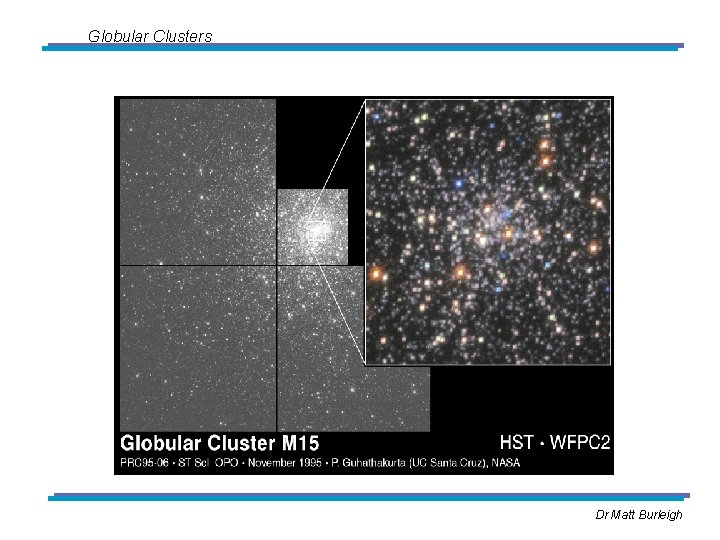
Globular Clusters Dr Matt Burleigh
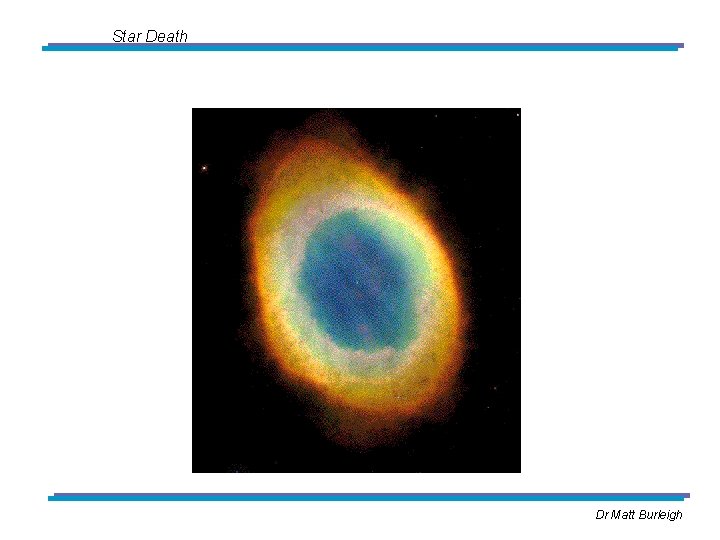
Star Death Dr Matt Burleigh
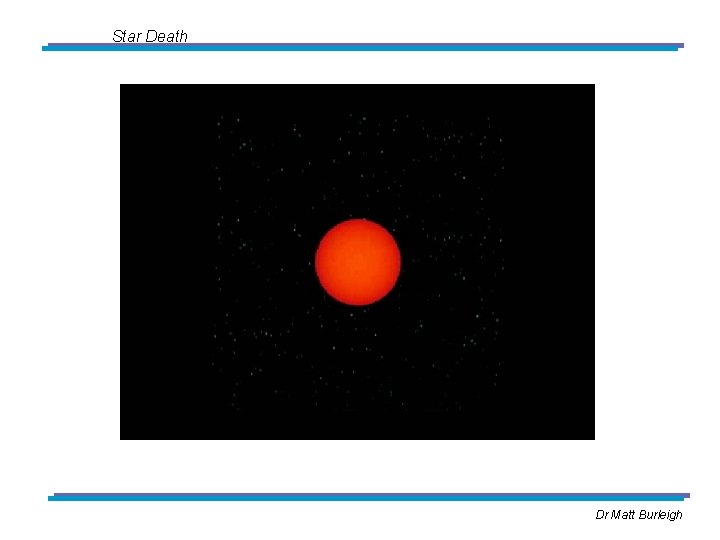
Star Death Dr Matt Burleigh
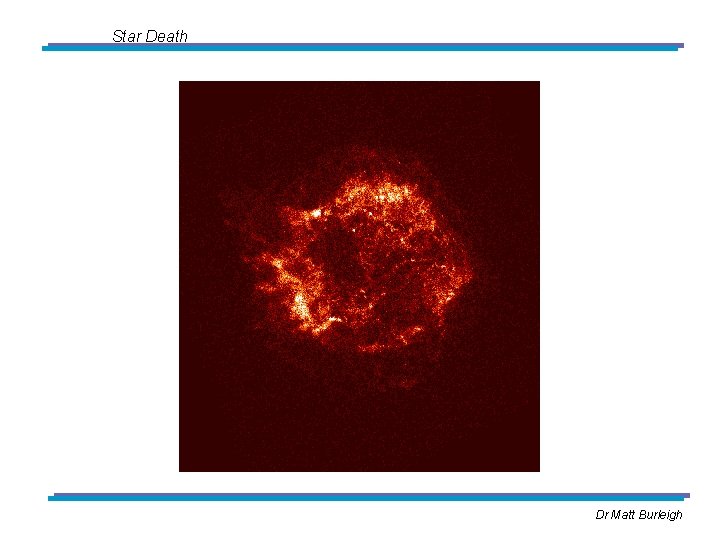
Star Death Dr Matt Burleigh
Star Death Dr Matt Burleigh
Aims and Objectives To introduce you to the properties of the Sun and the stars, and their evolution This will be fairly descriptive: in the second and third year you will learn the detailed physics underlying our understanding Dr Matt Burleigh
Lifecycles of Stars § Unit 1 – The Sun § Structure, limb darkening, magnetic field & solar cycle § Unit 2 – Stars § Classification from spectra, measuring distances, masses and radii, the Hertzsprung-Russell diagram § Unit 3 – Stellar evolution § The life cycles of stars of different masses § Unit 4 - Stellar Structure § Energy generation, hydrostatic equilibrium § Unit 5 – Stars of special interest § Binary stars, pulsating stars, stellar remnants Dr Matt Burleigh
The Sun and the Stars Reference material • Astronomy and Astrophysics (Zeilik and Gregory), 4 th edition Dr Matt Burleigh
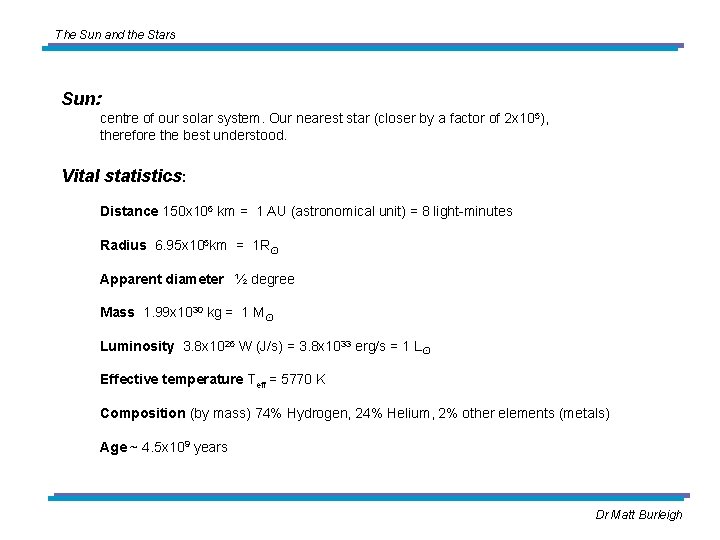
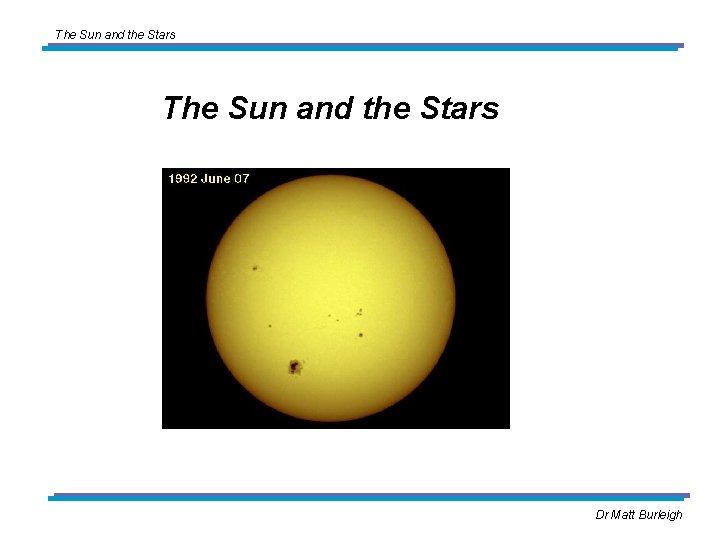
The Sun and the Stars Sun: centre of our solar system. Our nearest star (closer by a factor of 2 x 10 5), therefore the best understood. Vital statistics: Distance 150 x 106 km = 1 AU (astronomical unit) = 8 light-minutes Radius 6. 95 x 105 km = 1 R⊙ Apparent diameter ½ degree Mass 1. 99 x 1030 kg = 1 M⊙ Luminosity 3. 8 x 1026 W (J/s) = 3. 8 x 1033 erg/s = 1 L⊙ Effective temperature Teff = 5770 K Composition (by mass) 74% Hydrogen, 24% Helium, 2% other elements (metals) Age ~ 4. 5 x 10⁹ years Dr Matt Burleigh
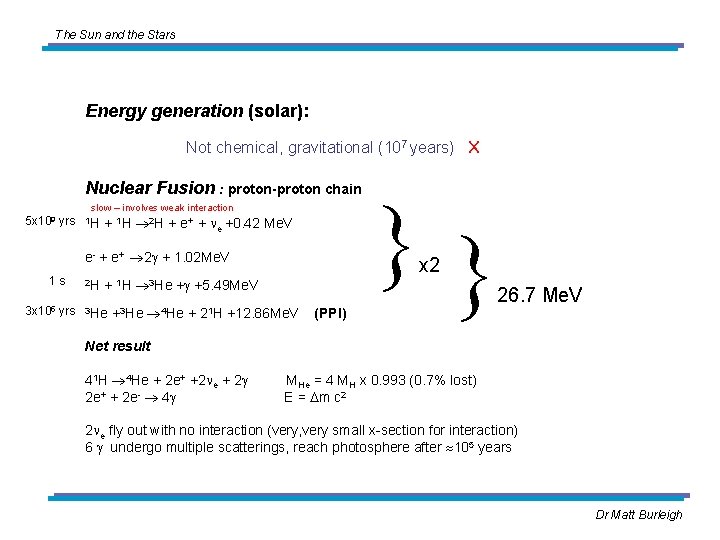
The Sun and the Stars Energy generation (solar): Not chemical, gravitational (107 years) X Nuclear Fusion : proton-proton chain slow – involves weak interaction 5 x 10⁹ yrs 1 H + 1 H 2 H + e+ + e +0. 42 Me. V e- + e+ 2 + 1. 02 Me. V 1 s 3 x 10⁵ yrs 2 H + 3 He 1 H 3 He +3 He x 2 + +5. 49 Me. V 4 He + 21 H +12. 86 Me. V (PPI) 26. 7 Me. V Net result 41 H 4 He + 2 e+ +2 e + 2 2 e+ + 2 e- 4 MHe = 4 MH x 0. 993 (0. 7% lost) E = m c 2 2 e fly out with no interaction (very, very small x-section for interaction) 6 undergo multiple scatterings, reach photosphere after 105 years Dr Matt Burleigh
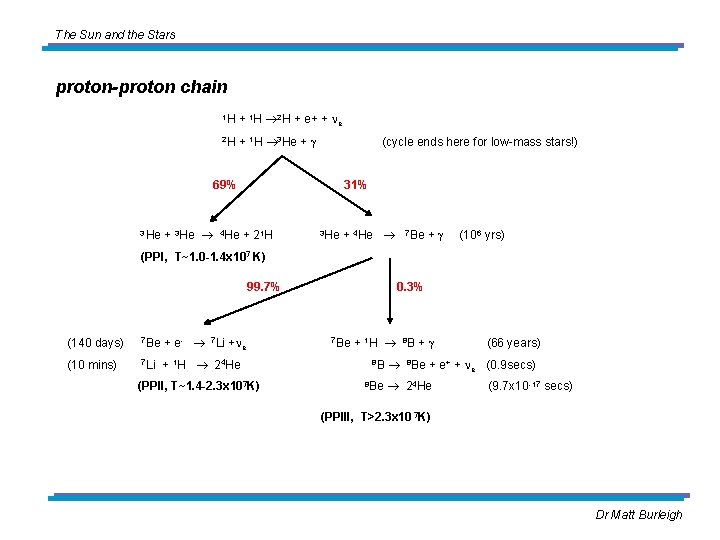
The Sun and the Stars proton-proton chain 1 H + 1 H 2 H + e+ + e 2 H + 1 H 3 He + (cycle ends here for low-mass stars!) 69% 3 He 31% + 3 He 4 He + 21 H 3 He + 4 He 7 Be + (106 yrs) (PPI, T~1. 0 -1. 4 x 10⁷ K) 99. 7% (140 days) 7 Be + e- 7 Li + e (10 mins) 7 Li + 1 H 24 He (PPII, T~1. 4 -2. 3 x 10⁷ K) 0. 3% 7 Be + 1 H 8 B + 8 B 8 Be (66 years) 8 Be + e+ + e (0. 9 secs) 24 He (9. 7 x 10 -17 secs) (PPIII, T>2. 3 x 10 7 K) Dr Matt Burleigh
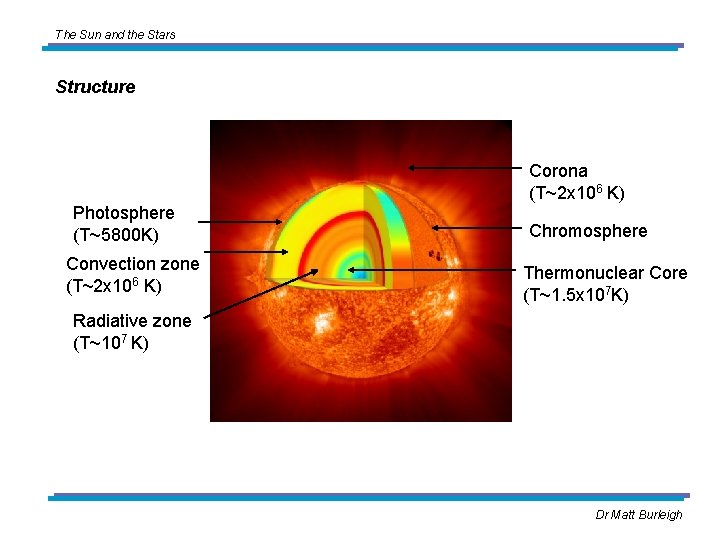
The Sun and the Stars Structure Corona (T~2 x 10⁶ K) Photosphere (T~5800 K) Convection zone (T~2 x 10⁶ K) Chromosphere Thermonuclear Core (T~1. 5 x 10⁷ K) Radiative zone (T~107 K) Dr Matt Burleigh
The Sun and the Stars Core : Sight of thermonuclear reactions, extends out to 0. 25 R⊙ T~1. 5 x 10⁷ K, ~150 g/cm 3 ( 10 x gold). Nuclear burning almost completely shut off beyond 0. 25 R⊙ Radiative zone : Extends from 0. 25 -0. 7 R⊙ (the tachocline or interface layer). Energy transported by radiation. Photons scatter many times, take approx 105 years to reach interface layer. Density falls from 20 g/cm 3 to 0. 2 g/cm 3, T falls from 7 x 10⁶ K to 2 x 10⁶ K over same distance. Tachocline (interface layer) : Lies between radiative zone and convection zone. Thought to be site of magnetic field generation. Shearing (ie. changes in fluid velocities) in this layer can stretch and enhance magnetic field lines. Dr Matt Burleigh
Convection zone: 0. 7 R⊙ – to photosphere (visible surface). At base, T~2 x 10⁶ K , cool enough for heavier elements (e. g. C, N, O, Ca, Fe) to hang onto some of their electrons. Increased opacity, makes it harder for photons to get through. Trapped heat makes the fluid unstable and it starts to convect (boil). Convection carries heat rapidly to surface. Material expands and cools as it rises. Temperature at surface (photosphere) ~ 5770 K, ~2 x 10 -7 g/cm 3. Dr Matt Burleigh
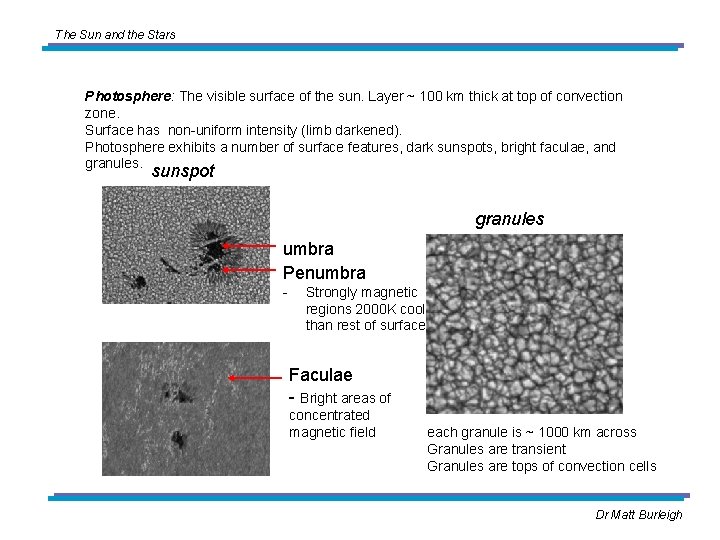
The Sun and the Stars Photosphere: The visible surface of the sun. Layer ~ 100 km thick at top of convection zone. Surface has non-uniform intensity (limb darkened). Photosphere exhibits a number of surface features, dark sunspots, bright faculae, and granules. sunspot granules umbra Penumbra - Strongly magnetic regions 2000 K cooler than rest of surface. Faculae - Bright areas of concentrated magnetic field each granule is ~ 1000 km across Granules are transient Granules are tops of convection cells Dr Matt Burleigh
Dr Matt Burleigh
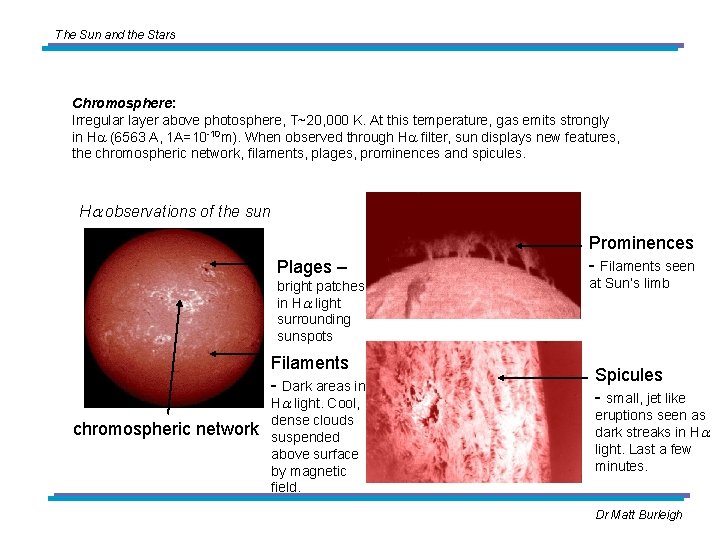
The Sun and the Stars Chromosphere: Irregular layer above photosphere, T~20, 000 K. At this temperature, gas emits strongly in H (6563 A, 1 A=10 -10 m). When observed through H filter, sun displays new features, the chromospheric network, filaments, plages, prominences and spicules. H observations of the sun Plages – bright patches in H light surrounding sunspots Filaments - Dark areas in chromospheric network H light. Cool, dense clouds suspended above surface by magnetic field. Prominences - Filaments seen at Sun’s limb Spicules - small, jet like eruptions seen as dark streaks in H light. Last a few minutes. Dr Matt Burleigh
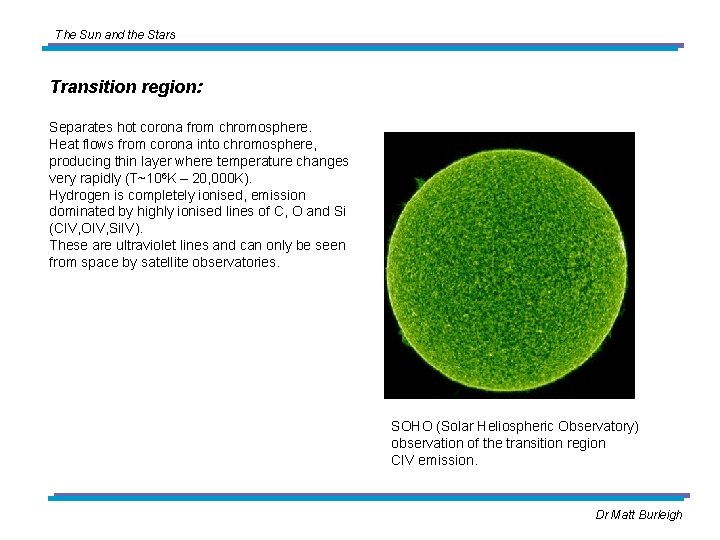
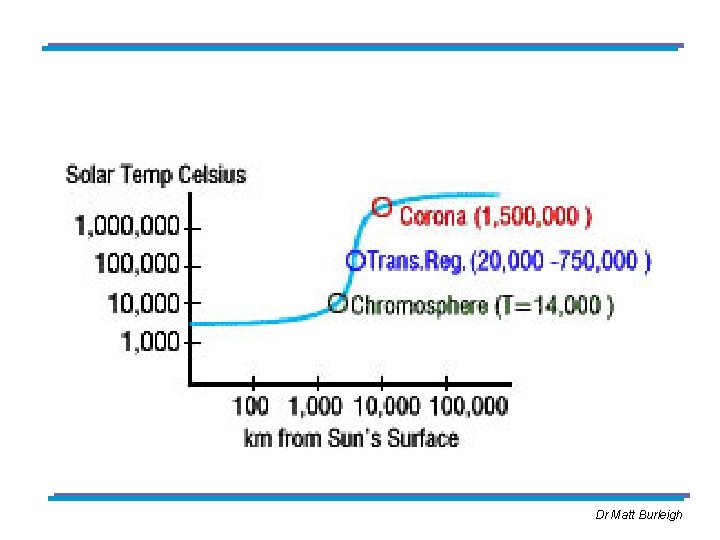
The Sun and the Stars Transition region: Separates hot corona from chromosphere. Heat flows from corona into chromosphere, producing thin layer where temperature changes very rapidly (T~106 K – 20, 000 K). Hydrogen is completely ionised, emission dominated by highly ionised lines of C, O and Si (CIV, OIV, Si. IV). These are ultraviolet lines and can only be seen from space by satellite observatories. SOHO (Solar Heliospheric Observatory) observation of the transition region CIV emission. Dr Matt Burleigh
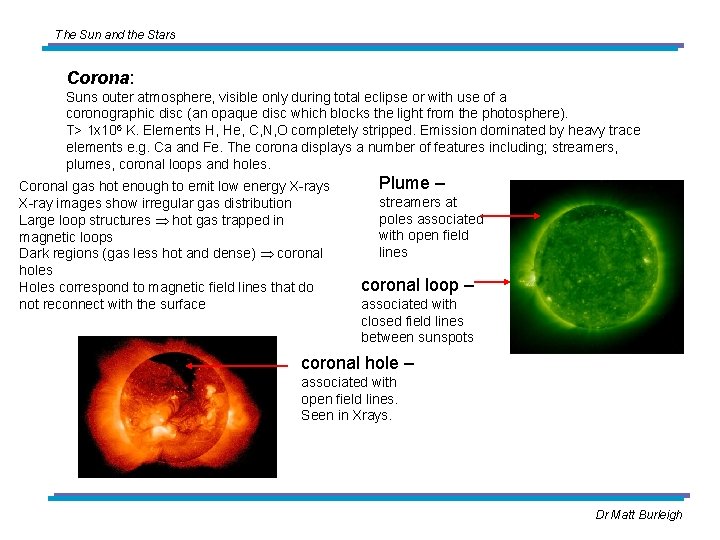
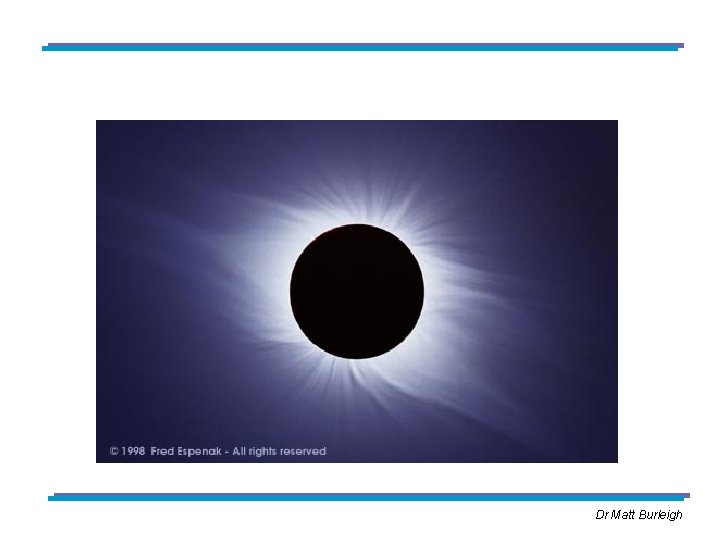
The Sun and the Stars Corona: Suns outer atmosphere, visible only during total eclipse or with use of a coronographic disc (an opaque disc which blocks the light from the photosphere). T> 1 x 10⁶ K. Elements H, He, C, N, O completely stripped. Emission dominated by heavy trace elements e. g. Ca and Fe. The corona displays a number of features including; streamers, plumes, coronal loops and holes. Coronal gas hot enough to emit low energy X-rays X-ray images show irregular gas distribution Large loop structures hot gas trapped in magnetic loops Dark regions (gas less hot and dense) coronal holes Holes correspond to magnetic field lines that do not reconnect with the surface Plume – streamers at poles associated with open field lines coronal loop – associated with closed field lines between sunspots coronal hole – associated with open field lines. Seen in Xrays. Dr Matt Burleigh
Dr Matt Burleigh
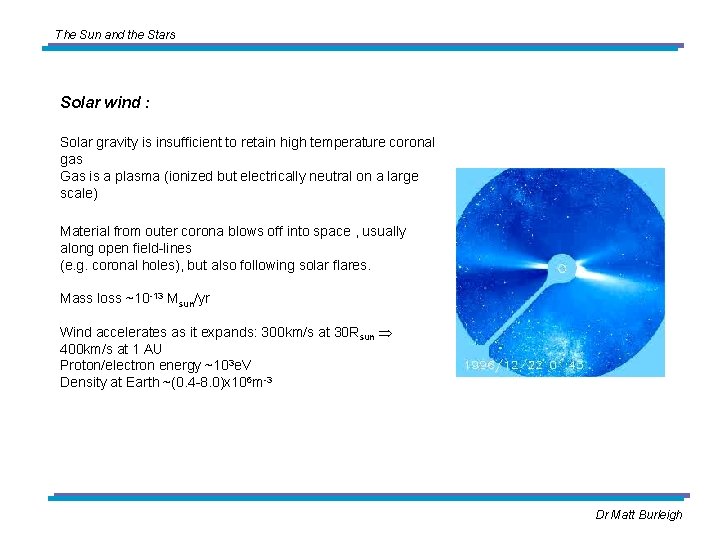
The Sun and the Stars Solar wind : Solar gravity is insufficient to retain high temperature coronal gas Gas is a plasma (ionized but electrically neutral on a large scale) Material from outer corona blows off into space , usually along open field-lines (e. g. coronal holes), but also following solar flares. Mass loss ~10 -13 Msun/yr Wind accelerates as it expands: 300 km/s at 30 Rsun 400 km/s at 1 AU Proton/electron energy ~103 e. V Density at Earth ~(0. 4 -8. 0)x 106 m-3 Dr Matt Burleigh
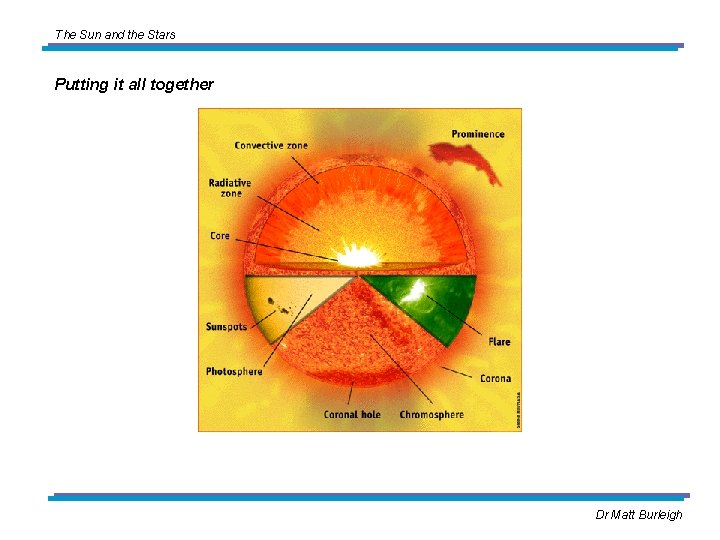
The Sun and the Stars Putting it all together Dr Matt Burleigh
- Slides: 26