
The Sumerians Chapter 4 Lesson 1 The First
- Slides: 23
The Sumerians Chapter 4, Lesson 1
The First Civilizations in Mesopotamia River Valley Civilizations: Mesopotamia, Egypt, India and China. ► What do they have in common? § Drinking water and crops. § Social classes based on occupations (jobs). § Governments to pass laws, defend land, and building projects. § Religions to bring meaning to their lives.
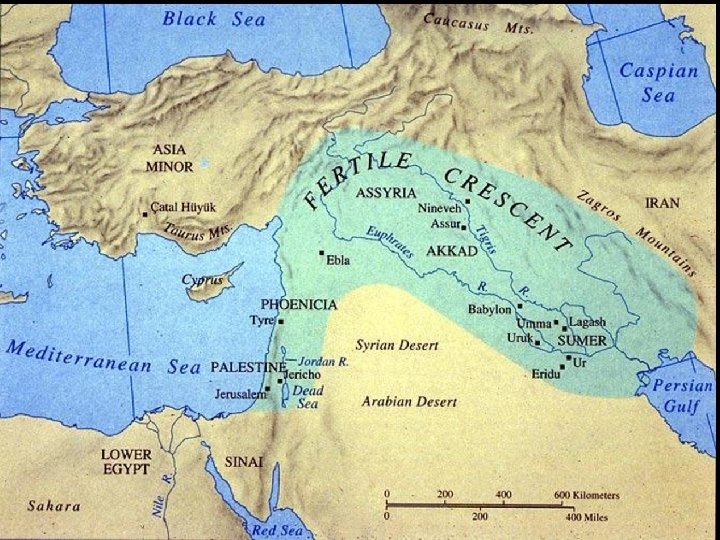
The Two Rivers ► Mesopotamia is located in what is now southern Iraq. § Earliest known civilization. § Name means “the land between the rivers. ” in Greek. ► It was between the Tigris and Euphrates river. § These rivers ran nearly parallel to each other. ► Located at the Fertile Crescent.
Early Valley Dwellers ► Mesopotamia’s history was hidden away in rubble. ► In the 1800’s archaeologist begin to dig up artifacts that reveal some information. § Began being settled around 7000 B. C. § First settlers were hunters and herders § By 4000 B. C. built farming villages along the two rivers.
Taming the Rivers ► Mesopotamian farmers used water from both rivers to water their fields. ► Could not always rely on rivers because summers produced little rain. ► During the spring harvest, snow would melt from the mountains sometimes causing floods. ► Floods were good because silt (particles of fine soil) would be deposited in the soil making it good for farming.
Taming the Rivers ► Eventually they learned to build dams and canals to control floods. § Canals let water flow into the fields. This was known as irrigation (supply dry land with water. ) ► Irrigation allowed farmers to grow surpluses (extra amounts) of food. § Extra food stored for later use. ► Plentiful food meant not everyone had to farm so others were able to become artisans. ► By 3000 B. C. these small farming villages became cities.
Sumer’s Civilization ► Sumer’s people were known as Sumerians. ► The first cities were Ur, Uruk, and Eridu in Southwest Asia.
City-States Arise ► Sumer’s cities rarely interacted due to how difficult it was to travel. ► Because of this, they grew their own food and controlled the lands around the cities. § These were City-States. The population was anywhere from 5, 000 – 20, 000 people. ► There are theories that these cities were protected by giant walls surrounding the city. § Ruins and artifacts support these theories. ► The ruler’s palace and other public buildings were located in the center of the city.
City-States Arise ► Sometimes these city-states went to war. § Wanted glory or to gain more territory. § Sometimes fought over resources too. ► During times of peace they would trade with each other. ► Also, formed alliances to protect common interest.
Gods, Priest, and Kings ► Polytheism – a belief in more than one god. § Each god played a different role in Sumerian life. § Some controlled actions and some controlled nature. § They honored gods that helped them achieve their tasks and goals. § Even though they honored all the gods, each city state claimed one as its own. ► Ziggurat – A pyramid-shaped structure with a temple at the top.
Gods, Priest, and Kings ► Ziggurat – A pyramid-shaped structure with a temple at the top. § Ziggurat means “to rise high” in the ancient Akkadian language. § The top was a God’s home. § Only special Priest could enter. § These priest usually ruled the city-states. ► Important men sometimes helped rule. ► Eventually they would become monarchies.
Gods, Priest, and Kings ► Sumerian kings claimed they were given the right to rule from the gods. § More than likely were war heroes. § Sons would take over once the king died. § Wives had no political power but some controlled their own lands.
Social Groups ► Upper Class – Kings, Warriors, Priest and government officials. ► Middle Class – Merchants, farmers, fishers, and artisans. § Largest group of the social classes. ► Lowest class – Enslaved people, criminals, and people who owed debt. § Probably captured from wars.
Social Groups ► The family was the basic unit of society. ► Men – Head of the house. ► Boys – went to school and were trained for a specific job. ► Women – ran the home, taught their daughters to do the same, and raise children. ► Sumerian law required parents to care for children. § Adult children also had to take care of the parents when needed.
Farmers and Traders ► If you lived in Sumer you were most likely a farmer. § Each farmer had a plot of land located in areas around the city-state. § They grew wheat, barley, dates, and other major crops. § Also raised sheep, goats, and pigs. ► Trade was a normal part of life. ► Even though some were skilled metalworkers, they needed to trade for those metals.
Farmers and Traders ► Trade routes would take them as far as India and Egypt. § Traded wheat, barley, and tools for timber, minerals and metals. § Minerals and metals were used for jewelry and tools. § India’s Indus Valley – carnelian. § Afghanistan – lapis lazuli § Present-day Turkey – iron and silver.
Sumerian Contributions ► Sumerians created the first civilization that had a great influence on history. . § Later civilizations copied and improved on their ideas and inventions that began in Sumer. ► Mesopotamia has earned the nickname “cradle of civilization. § Beginning of organized human society. ”
Writing ► This is probably the most important contribution to the world. § Earliest known a system of writing. ► Used to keep records and pass on information. ► Cuneiform – a system of writing developed by the Sumerians that used wedge-shaped marks made in soft clay. § 1, 200 different characters for names, physical objects, and numbers. § Wrote on clay because they had no paper.
Writing ► Scribes – official record keepers. § boys of wealthy families were usually scribes. ► Tasked with recording everyday life from, court records, marriage contracts, business dealings, and important events. Some scribes were judges and government officials. ► Told stories orally for centuries. § Stories would finally be recorded on tablets. § Stories usually praised gods and warriors for doing great deeds.
Writing ► The oldest known story in the world is from Sumer. ► Written more than 4, 000 years ago. ► The story is called the Epic of Gilgamesh. ► Epic – long poem that tells the story of a hero.
Technology and Mathematics ► Sumerians were the first to use the wheel. ► Built the first carts pulled by donkeys. We know this because of illustrations from 3500 B. C. ► Introduced vehicles into military use with the invention of the chariot. ► Invented sailboats, potter’s wheel, bronze, weapons and jewelry.
Technology and Mathematics ► They studied mathematics and astronomy. ► Used geometry to measure fields and to plan buildings. ► They made a place value system using 60. § 60 -minute hours, 60 -second minute, and 360 degree circle was created by them. ► Watched the position of the stars to know when to plant crops and hold religious ceremonies. ► They also made a 12 month calendar based on the cycles of the moon.