
The Sudanese Electricity Distribution Company Ltd SEDC Toward
The Sudanese Electricity Distribution Company Ltd (SEDC) Toward (The Smart Grid) Engineer/ Sami Omar Abdel Rahim Nov 2015
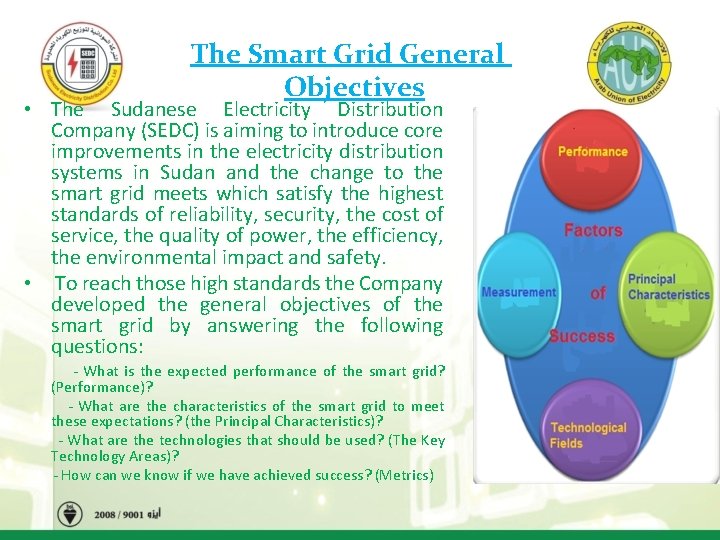
The Smart Grid General Objectives • The Sudanese Electricity Distribution Company (SEDC) is aiming to introduce core improvements in the electricity distribution systems in Sudan and the change to the smart grid meets which satisfy the highest standards of reliability, security, the cost of service, the quality of power, the efficiency, the environmental impact and safety. • To reach those high standards the Company developed the general objectives of the smart grid by answering the following questions: - What is the expected performance of the smart grid? (Performance)? - What are the characteristics of the smart grid to meet these expectations? (the Principal Characteristics)? - What are the technologies that should be used? (The Key Technology Areas)? - How can we know if we have achieved success? (Metrics)
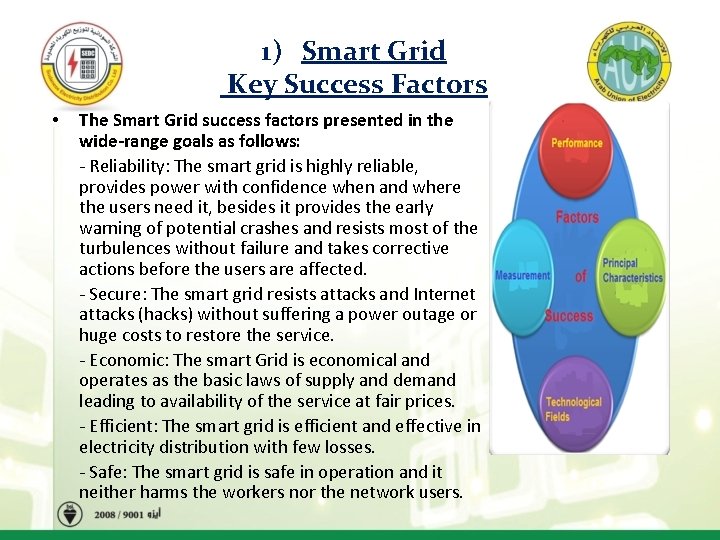
1) Smart Grid Key Success Factors • The Smart Grid success factors presented in the wide-range goals as follows: - Reliability: The smart grid is highly reliable, provides power with confidence when and where the users need it, besides it provides the early warning of potential crashes and resists most of the turbulences without failure and takes corrective actions before the users are affected. - Secure: The smart grid resists attacks and Internet attacks (hacks) without suffering a power outage or huge costs to restore the service. - Economic: The smart Grid is economical and operates as the basic laws of supply and demand leading to availability of the service at fair prices. - Efficient: The smart grid is efficient and effective in electricity distribution with few losses. - Safe: The smart grid is safe in operation and it neither harms the workers nor the network users.
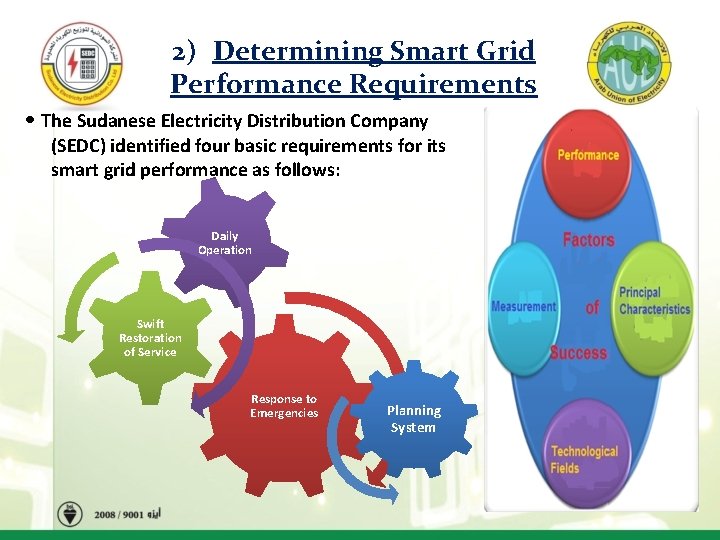
2) Determining Smart Grid Performance Requirements • The Sudanese Electricity Distribution Company (SEDC) identified four basic requirements for its smart grid performance as follows: Daily Operation Swift Restoration of Service Response to Emergencies Planning System
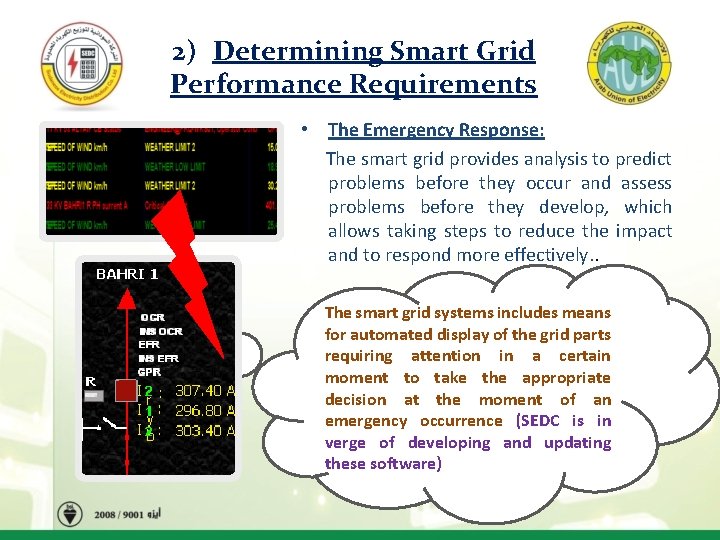
2) Determining Smart Grid Performance Requirements • The Emergency Response: The smart grid provides analysis to predict problems before they occur and assess problems before they develop, which allows taking steps to reduce the impact and to respond more effectively. . The smart grid systems includes means for automated display of the grid parts requiring attention in a certain moment to take the appropriate decision at the moment of an emergency occurrence (SEDC is in verge of developing and updating these software)
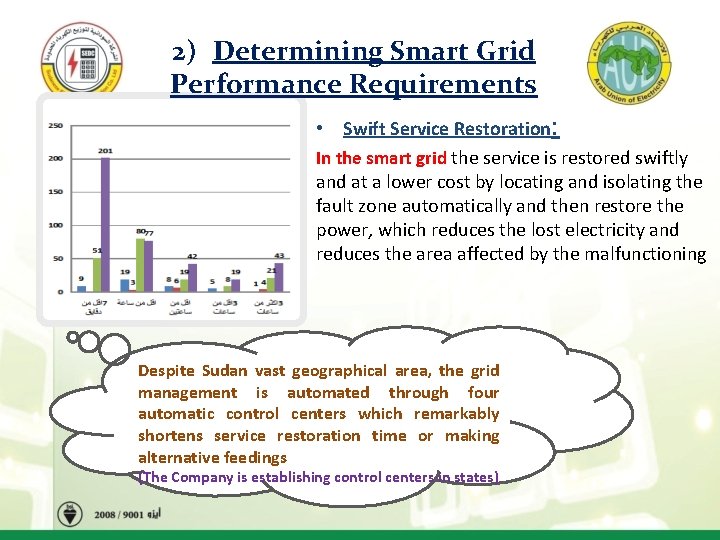
2) Determining Smart Grid Performance Requirements • Swift Service Restoration: In the smart grid the service is restored swiftly and at a lower cost by locating and isolating the fault zone automatically and then restore the power, which reduces the lost electricity and reduces the area affected by the malfunctioning Despite Sudan vast geographical area, the grid management is automated through four automatic control centers which remarkably shortens service restoration time or making alternative feedings (The Company is establishing control centers in states)
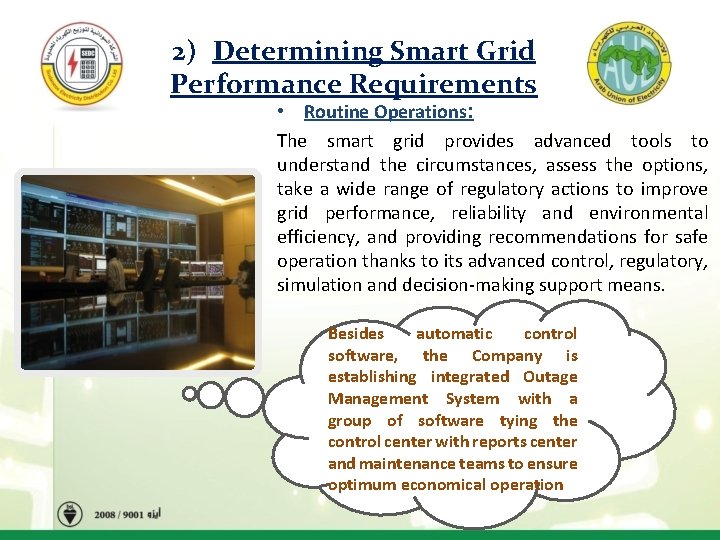
2) Determining Smart Grid Performance Requirements • Routine Operations: The smart grid provides advanced tools to understand the circumstances, assess the options, take a wide range of regulatory actions to improve grid performance, reliability and environmental efficiency, and providing recommendations for safe operation thanks to its advanced control, regulatory, simulation and decision-making support means. Besides automatic control software, the Company is establishing integrated Outage Management System with a group of software tying the control center with reports center and maintenance teams to ensure optimum economical operation
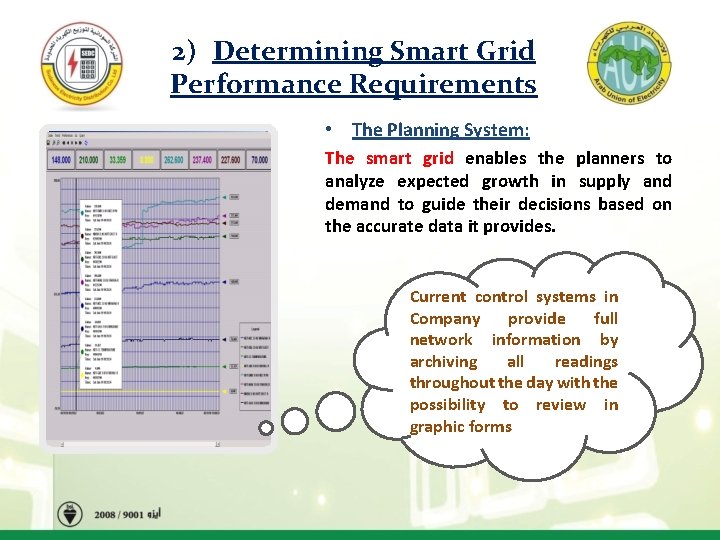
2) Determining Smart Grid Performance Requirements • The Planning System: The smart grid enables the planners to analyze expected growth in supply and demand to guide their decisions based on the accurate data it provides. Current control systems in Company provide full network information by archiving all readings throughout the day with the possibility to review in graphic forms
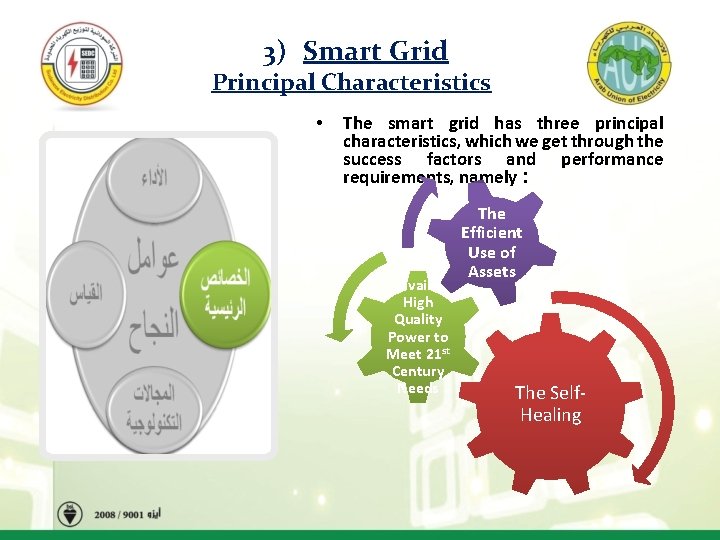
3) Smart Grid Principal Characteristics • The smart grid has three principal characteristics, which we get through the success factors and performance requirements, namely : Avails High Quality Power to Meet 21 st Century Needs The Efficient Use of Assets The Self. Healing
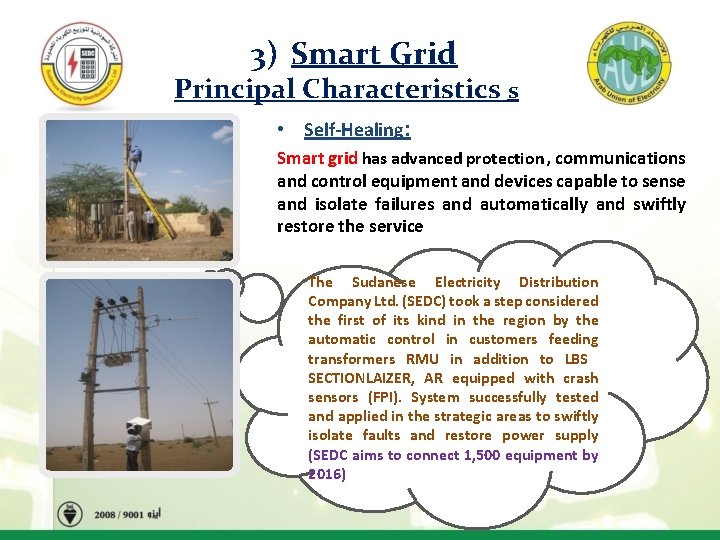
3) Smart Grid Principal Characteristics s • Self-Healing: Smart grid has advanced protection , communications and control equipment and devices capable to sense and isolate failures and automatically and swiftly restore the service The Sudanese Electricity Distribution Company Ltd. (SEDC) took a step considered the first of its kind in the region by the automatic control in customers feeding transformers RMU in addition to LBS SECTIONLAIZER, AR equipped with crash sensors (FPI). System successfully tested and applied in the strategic areas to swiftly isolate faults and restore power supply (SEDC aims to connect 1, 500 equipment by 2016)
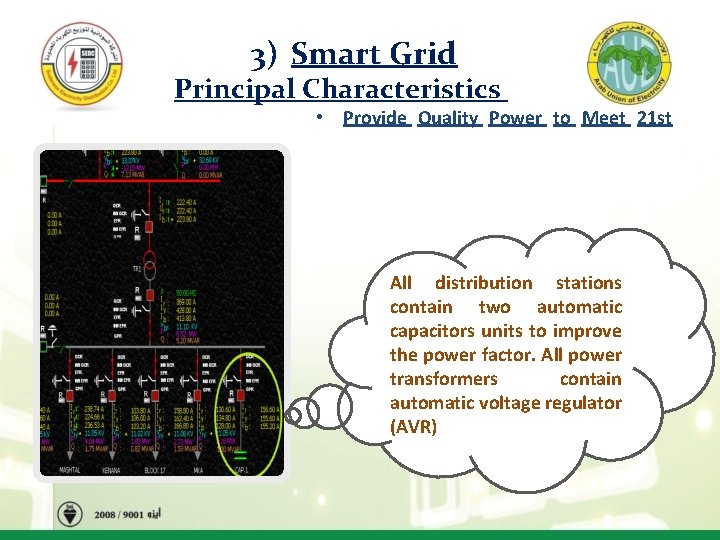
3) Smart Grid Principal Characteristics • Provide Quality Power to Meet 21 st All distribution stations contain two automatic capacitors units to improve the power factor. All power transformers contain automatic voltage regulator (AVR)
3) Smart Grid Principal Characteristics The company opened an advanced customer service center in the context of computing operations and providing better service to its customers and monitor performance (4848) Distribution network witnessed biggest maintenance operations and ending bottlenecks since its inception with significant impact on electricity supply stability, more revenue and customers satisfaction The Effective Use of Assets: In smart grid all assets are managed with a unified vision to provide the required service at the lowest cost and the highest quality, through the following: • Creating software to meet Company actual requirements and monitors the performance of the equipment and systems (low chances of human error). • Bringing smart operation equipment and electronic devices to achieve required operation specifications (transition from data collection stage to new ideas introduction stage). • Developing new maintenance operations and ways to curb the risk of overload and eliminate bottlenecks in distribution lines.
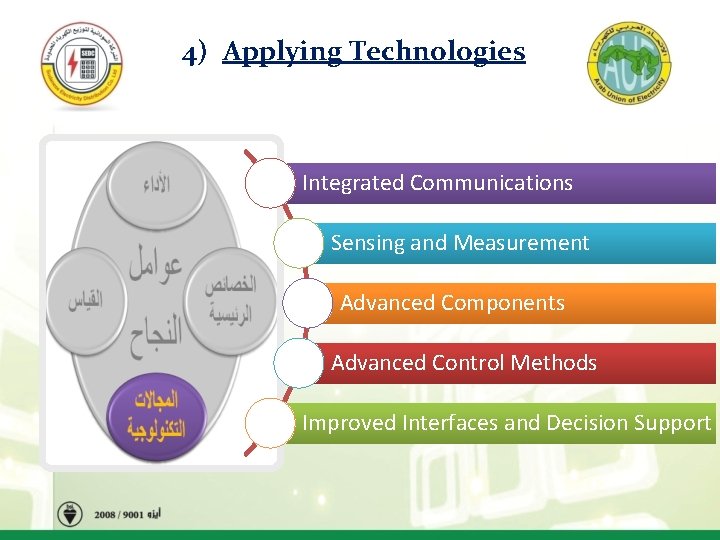
4) Applying Technologies Integrated Communications Sensing and Measurement Advanced Components Advanced Control Methods Improved Interfaces and Decision Support
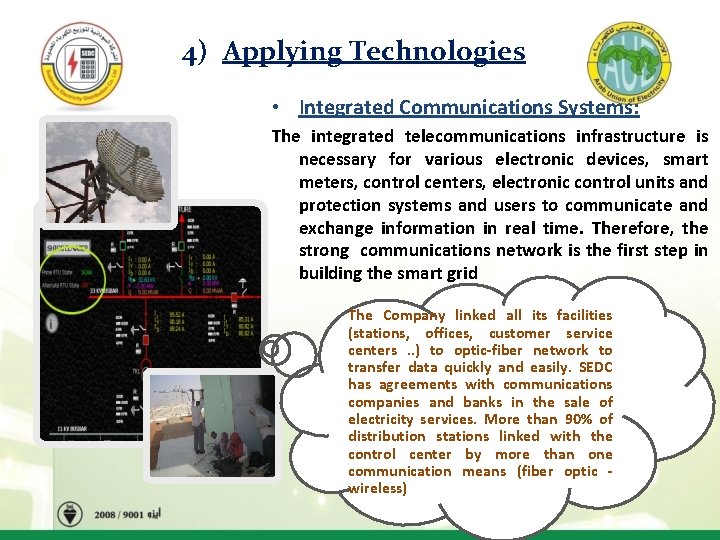
4) Applying Technologies • Integrated Communications Systems: The integrated telecommunications infrastructure is necessary for various electronic devices, smart meters, control centers, electronic control units and protection systems and users to communicate and exchange information in real time. Therefore, the strong communications network is the first step in building the smart grid The Company linked all its facilities (stations, offices, customer service centers. . ) to optic-fiber network to transfer data quickly and easily. SEDC has agreements with communications companies and banks in the sale of electricity services. More than 90% of distribution stations linked with the control center by more than one communication means (fiber optic wireless)
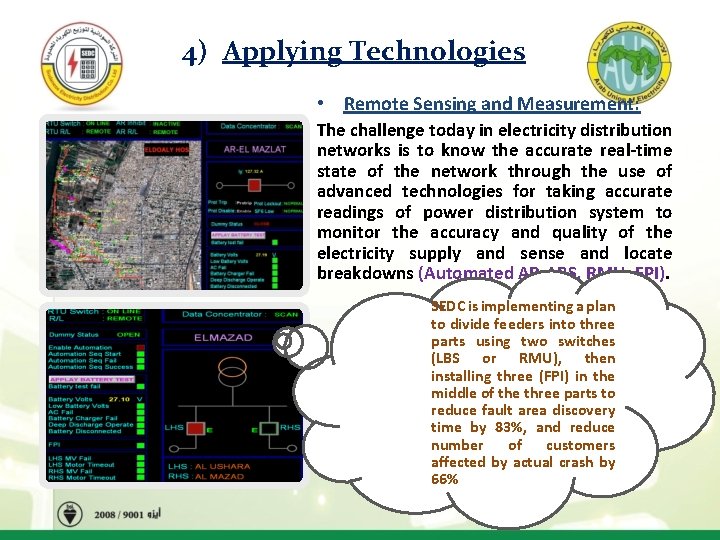
4) Applying Technologies • Remote Sensing and Measurement: The challenge today in electricity distribution networks is to know the accurate real-time state of the network through the use of advanced technologies for taking accurate readings of power distribution system to monitor the accuracy and quality of the electricity supply and sense and locate breakdowns (Automated AR, LBS, RMU, FPI). SEDC is implementing a plan to divide feeders into three parts using two switches (LBS or RMU), then installing three (FPI) in the middle of the three parts to reduce fault area discovery time by 83%, and reduce number of customers affected by actual crash by 66%
4) Applying Technologies • SEDC signed contract for updating Control Center software to include all applications of forecaster DMS expected to finish Q 1 2016 Using Advanced Control Methods: – The Software: is the core of advanced control methods, it monitors the basic components of the smart grid (SCADA) then the proper response at the right time (Fault Isolation Service Restoration Voltage / Var Dispatch. . . ), it also enables routine analysis of potential hazards to determine the level of risk when disconnecting the equipment from the service for repair (Contingency Analyses), and supports decision-making by modeling and simulating different scenarios that enable the operators to determine safe operational options (State Estimators- Security Dispatch), in addition to the improvement in load forecasting software which gives very accurate forecasts that help study meeting the growth in power demand.
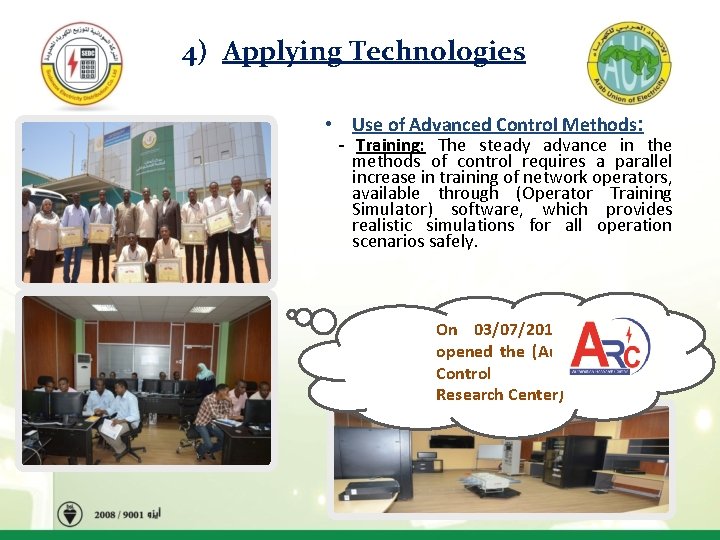
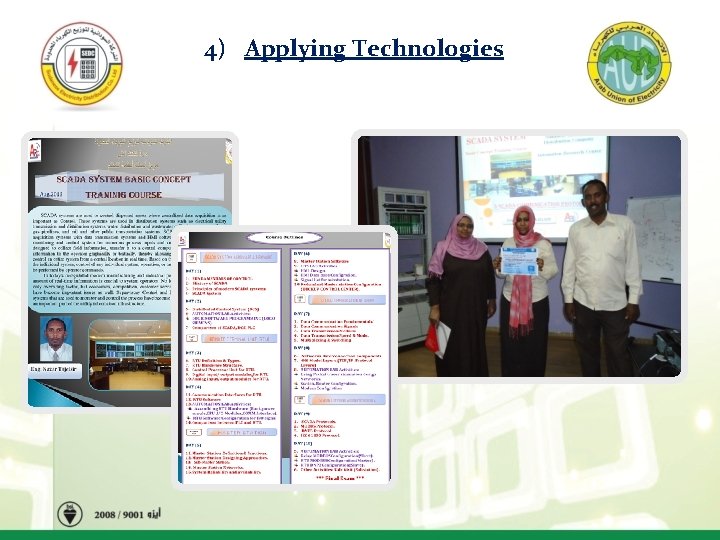
4) Applying Technologies • Use of Advanced Control Methods: - Training: The steady advance in the methods of control requires a parallel increase in training of network operators, available through (Operator Training Simulator) software, which provides realistic simulations for all operation scenarios safely. On 03/07/2013 SEDC opened the (Automatic Control Systems Research Center)
4) Applying Technologies
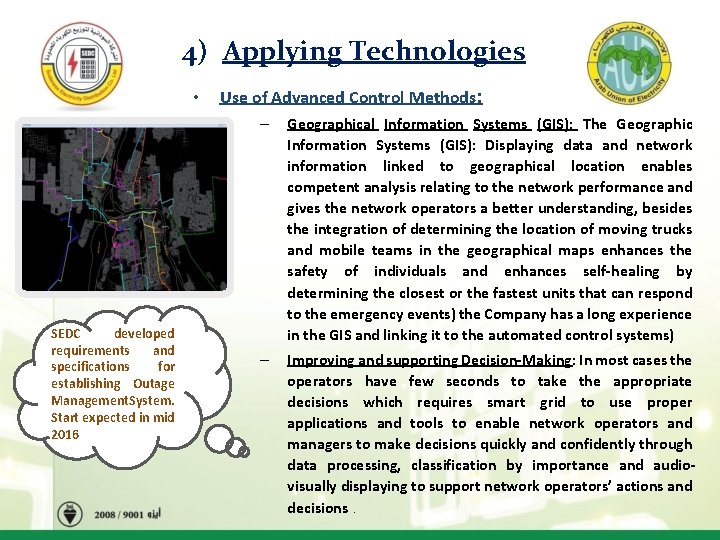
4) Applying Technologies • SEDC developed requirements and specifications for establishing Outage Management. System. Start expected in mid 2016 Use of Advanced Control Methods: – Geographical Information Systems (GIS): The Geographic Information Systems (GIS): Displaying data and network information linked to geographical location enables competent analysis relating to the network performance and gives the network operators a better understanding, besides the integration of determining the location of moving trucks and mobile teams in the geographical maps enhances the safety of individuals and enhances self-healing by determining the closest or the fastest units that can respond to the emergency events) the Company has a long experience in the GIS and linking it to the automated control systems) – Improving and supporting Decision-Making: In most cases the operators have few seconds to take the appropriate decisions which requires smart grid to use proper applications and tools to enable network operators and managers to make decisions quickly and confidently through data processing, classification by importance and audiovisually displaying to support network operators’ actions and decisions.
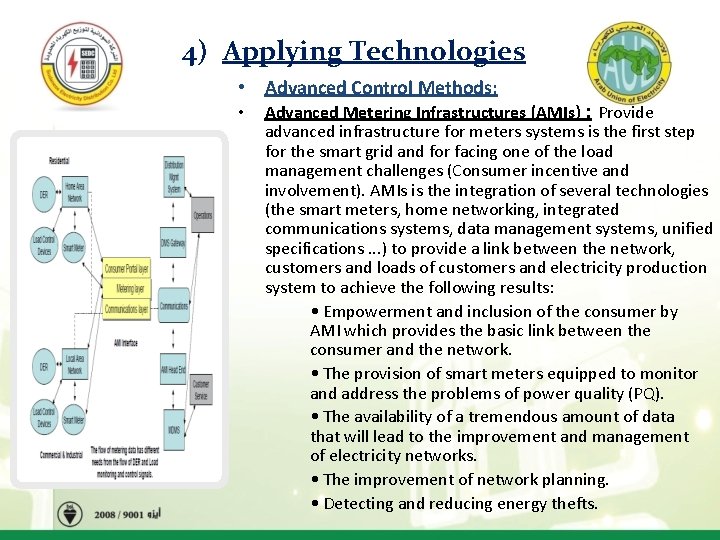
4) Applying Technologies • Advanced Control Methods: • Advanced Metering Infrastructures (AMIs) : Provide advanced infrastructure for meters systems is the first step for the smart grid and for facing one of the load management challenges (Consumer incentive and involvement). AMIs is the integration of several technologies (the smart meters, home networking, integrated communications systems, data management systems, unified specifications. . . ) to provide a link between the network, customers and loads of customers and electricity production system to achieve the following results: • Empowerment and inclusion of the consumer by AMI which provides the basic link between the consumer and the network. • The provision of smart meters equipped to monitor and address the problems of power quality (PQ). • The availability of a tremendous amount of data that will lead to the improvement and management of electricity networks. • The improvement of network planning. • Detecting and reducing energy thefts.
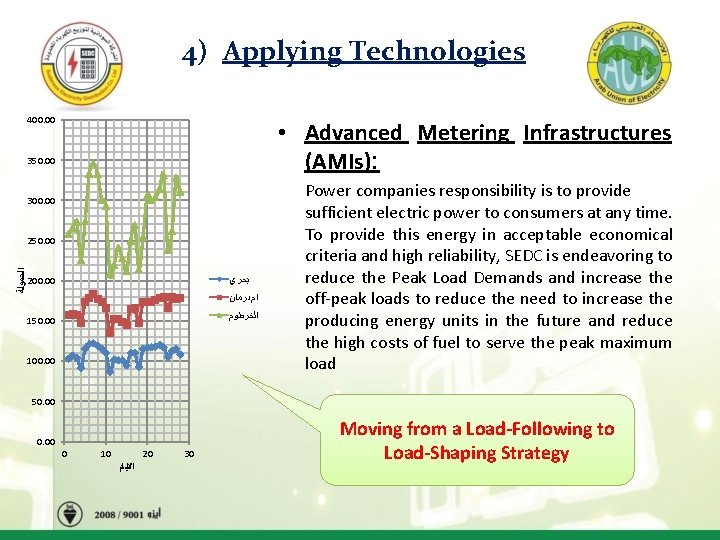
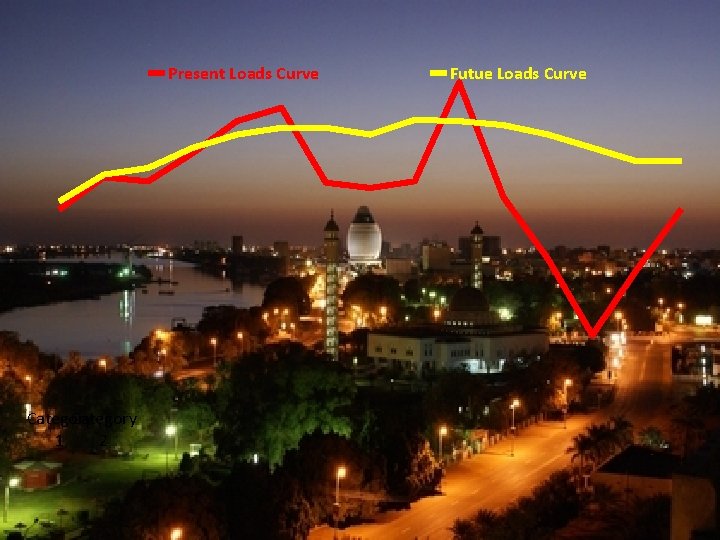
4) Applying Technologies 400. 00 • Advanced Metering Infrastructures (AMIs): 350. 00 300. 00 ﺍﻟﺤﻤﻮﻟﺔ 250. 00 ﺑﺤﺮﻱ 200. 00 ﺍﻡ ﺩﺭﻣﺎﻥ ﺍﻟﺨﺮﻃﻮﻡ 150. 00 100. 00 Power companies responsibility is to provide sufficient electric power to consumers at any time. To provide this energy in acceptable economical criteria and high reliability, SEDC is endeavoring to reduce the Peak Load Demands and increase the off-peak loads to reduce the need to increase the producing energy units in the future and reduce the high costs of fuel to serve the peak maximum load 50. 00 0 10 20 ﺍﻻﻳﺎﻡ 30 Moving from a Load-Following to Load-Shaping Strategy
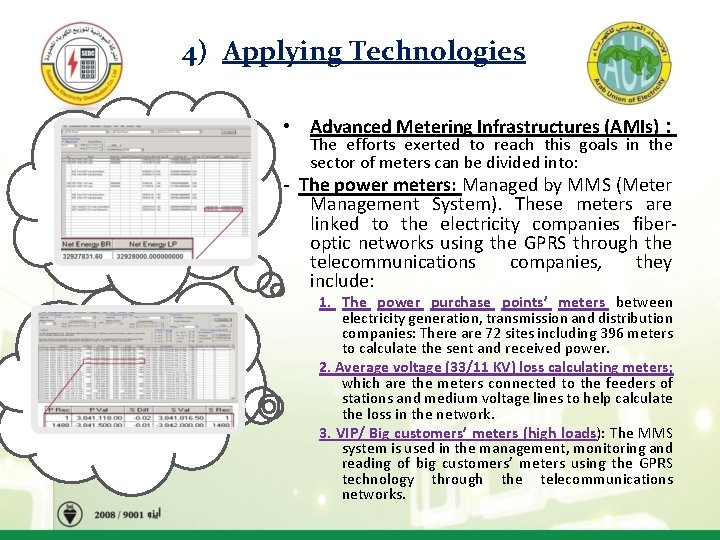
4) Applying Technologies • Advanced Metering Infrastructures (AMIs) : The efforts exerted to reach this goals in the sector of meters can be divided into: - The power meters: Managed by MMS (Meter Management System). These meters are linked to the electricity companies fiberoptic networks using the GPRS through the telecommunications companies, they include: 1. The power purchase points’ meters between electricity generation, transmission and distribution companies: There are 72 sites including 396 meters to calculate the sent and received power. 2. Average voltage (33/11 KV) loss calculating meters; which are the meters connected to the feeders of stations and medium voltage lines to help calculate the loss in the network. 3. VIP/ Big customers’ meters (high loads): The MMS system is used in the management, monitoring and reading of big customers’ meters using the GPRS technology through the telecommunications networks.
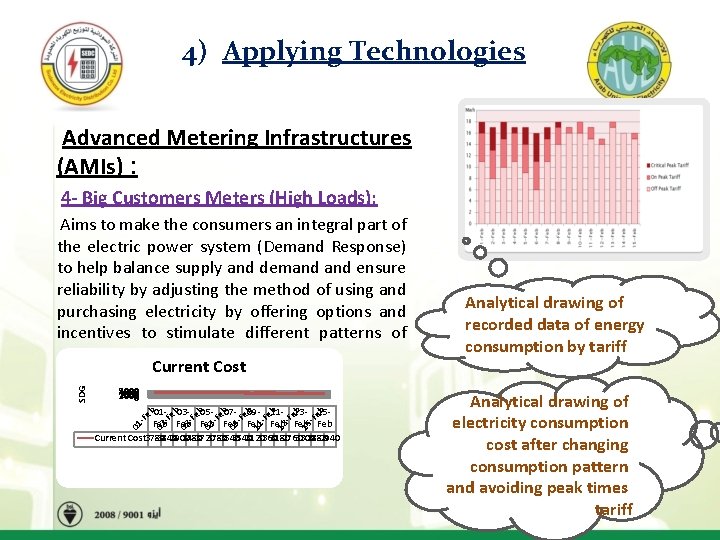
4) Applying Technologies Advanced Metering Infrastructures (AMIs) : 4 - Big Customers Meters (High Loads): 5000 4000 30000 2000 1000 b -F e 15 -F e b b 13 11 -F e b b -F e 09 b -F e 07 -F e b 05 -F e 03 -F e b 01 - 03 - 05 - 07 - 09 - 11 - 13 - 15 Feb Feb Current Cost 3780 3840 3900 3480 3720 3780 3540 3120 3360 3180 2760 3300 2880 2940 01 SDG Aims to make the consumers an integral part of the electric power system (Demand Response) to help balance supply and demand ensure reliability by adjusting the method of using and purchasing electricity by offering options and incentives to stimulate different patterns of consumption behaviors Current Cost Analytical drawing of recorded data of energy consumption by tariff Analytical drawing of electricity consumption cost after changing consumption pattern and avoiding peak times tariff
4) Applying Technologies • Advanced Metering Infrastructures (AMIs) : 5 - Big Customers Meters (High Loads): • Allow the consumer to: • Use prices indices and economic incentives to decide when to consume electricity. • Buy smart devices (smart loading) consuming power wisely which has become an integral part of the smart grid concept. • 95% of big customers meters linked to MMS system There a number of major challenges numerous options to consumer and link him to electric power networks activities: ) • Available reliable and easy to use and tamper-resistant (DR) software. • Communications infrastructure that supports flow of information between consumer and electricity companies. • Updating electricity pricing systems to provide consumer stimulating options and achieve acceptable profits for the electricity companies. • Consumer education to promote acceptance of the idea.
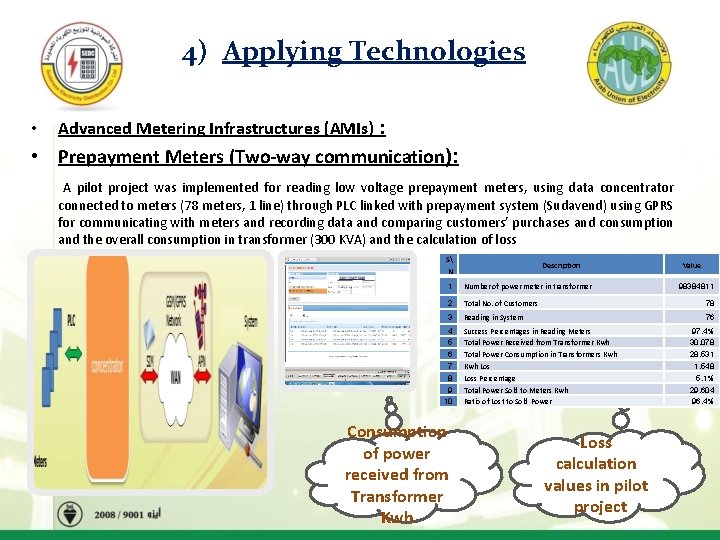
4) Applying Technologies • Advanced Metering Infrastructures (AMIs) : • Prepayment Meters (Two-way communication): A pilot project was implemented for reading low voltage prepayment meters, using data concentrator connected to meters (78 meters, 1 line) through PLC linked with prepayment system (Sudavend) using GPRS for communicating with meters and recording data and comparing customers’ purchases and consumption and the overall consumption in transformer (300 KVA) and the calculation of loss S N Description 1 Number of power meter in transformer 2 Total No. of Customers 3 Reading in System 4 5 6 7 8 9 10 Consumption of power received from Transformer Kwh Value 98384811 78 76 Success Percentages in Reading Meters Total Power Received from Transformer Kwh Total Power Consumption in Transformers Kwh Loss Percentage Total Power Sold to Meters Kwh Ratio of Lost to Sold Power Loss calculation values in pilot project 97. 4% 30, 078 28, 531 1, 548 5. 1% 29, 604 96. 4%
Present Loads Curve Category 1 2 Futue Loads Curve
4) Applying Technologies • Advanced Metering Infrastructures (AMIs) : : ( ﺗﺘﻤﺜﻞ ﻓﻲ ﺍﻟﺘﺎﻟﻲ AMIs) ﺍﻟﺘﺤﺪﻳﺎﺕ ﺍﻟﺘﻲ ﺗﻘﺎﺑﻞ ﺍﻻﻧﺘﻘﺎﻝ ﺍﻟﻰ ﻧﻈﻢ • § Few published integrated practical experiments § Fear of assets value depreciation by calculating the values of meters to be replaced by smart meters. § Despite the rapid development of AMIs systems, there is a constant need to make sure of their work based on standard specifications to ensure harmonization and the exchange of AIMs systems data among several developers. § Difficulty to replace existing meters and systems while maintaining current sustainability
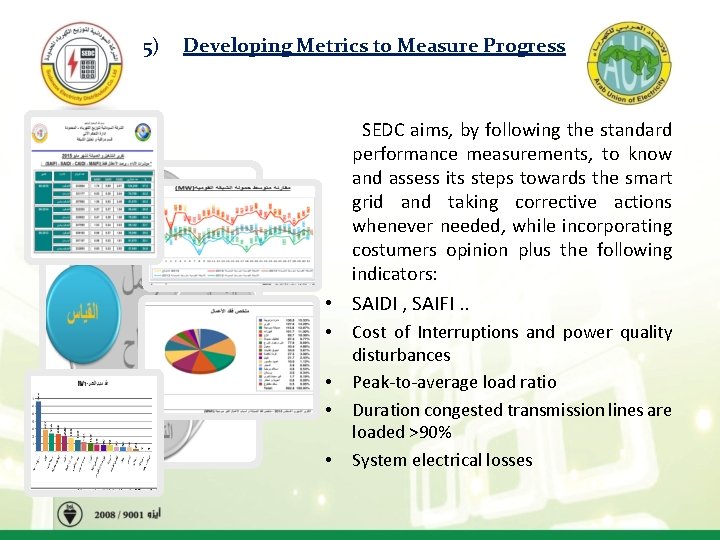
5) Developing Metrics to Measure Progress SEDC aims, by following the standard performance measurements, to know and assess its steps towards the smart grid and taking corrective actions whenever needed, while incorporating costumers opinion plus the following indicators: • SAIDI , SAIFI. . • • Cost of Interruptions and power quality disturbances Peak-to-average load ratio Duration congested transmission lines are loaded >90% System electrical losses
- Slides: 28