
The Sudan Key characteristics About 35 million people
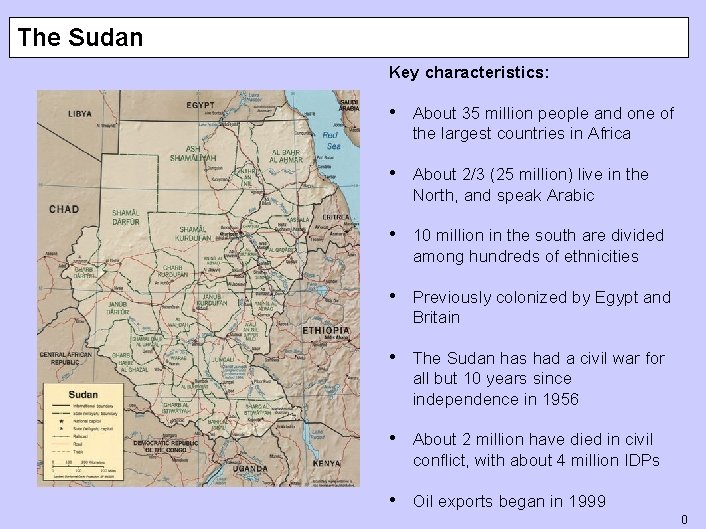
The Sudan Key characteristics: • About 35 million people and one of the largest countries in Africa • About 2/3 (25 million) live in the North, and speak Arabic • 10 million in the south are divided among hundreds of ethnicities • Previously colonized by Egypt and Britain • The Sudan has had a civil war for all but 10 years since independence in 1956 • About 2 million have died in civil conflict, with about 4 million IDPs • Oil exports began in 1999 0
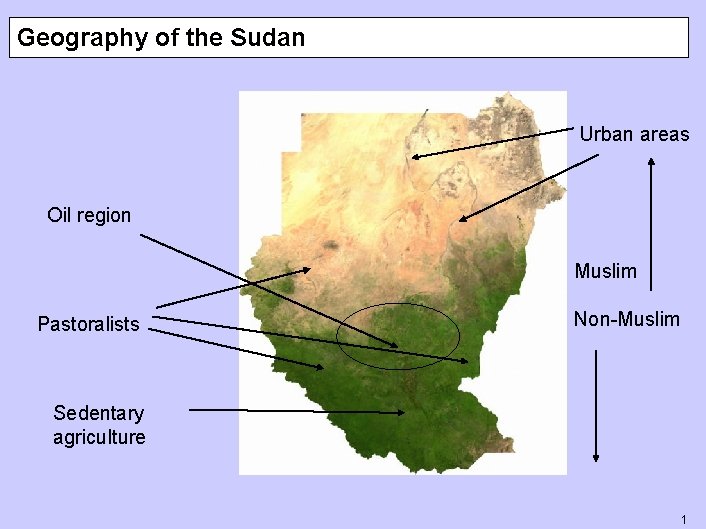
Geography of the Sudan Urban areas Oil region Muslim Pastoralists Non-Muslim Sedentary agriculture 1
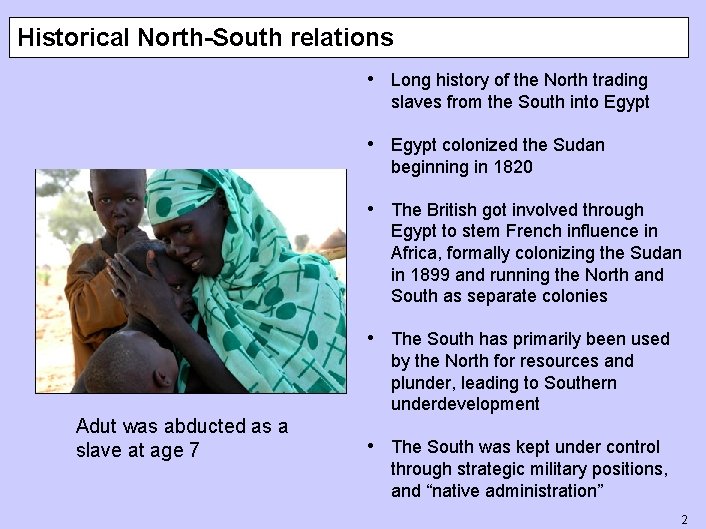
Historical North-South relations • Long history of the North trading slaves from the South into Egypt • Egypt colonized the Sudan beginning in 1820 • The British got involved through Egypt to stem French influence in Africa, formally colonizing the Sudan in 1899 and running the North and South as separate colonies • The South has primarily been used by the North for resources and plunder, leading to Southern underdevelopment Adut was abducted as a slave at age 7 • The South was kept under control through strategic military positions, and “native administration” 2

The beginnings of the first Sudanese war (1955 -1972) • The British consolidated the North and South The beginning • • beginning in 1946 The South feared Northern dominance in an independent Sudan and were poorly represented in Khartoum (no credible commitments to selfgovernment or federalism) Began with the Torit Mutiny just before independence (1955) • Two big issues remained unresolved: – Federalism Failure to agree on – Religion of state a Constitution • Electoral politics ended in 1958 with a military takeover (General Abbud) that initiated Islamicization of the South • Exiled rebels coalesced in 1960 and called A rebel movement develops • • themselves Anyanya (SANU) Largely formed by Equatorians Platform of “self-determination” 3

The conclusion of the first Sudanese war (1955 -1972) • The military government falls in 1965 and rebels The rebels split • are invited to talks on the future of the South Some worked inside the government for a federal solution, while others remained exiled to press for self-determination • The South was denied real participation in the new Southern exclusion • • government (1965) but was repressed The Southern rebels fought hard during a period of government instability Active Islamizication driven by internal Northern politics • Military takeover in 1969 (Nimairi) sought resolution The road to peace • • to the Southern problem, but was divided on the solution Revolutionary council kept fighting in the South and Nimairi’s coalition was vulnerable The rebels consolidated themselves and had a series of big wins 4
The Addis Ababa agreement and regional government Addis Ababa Agreement (1972) Challenges with Regional Government (1972 -1983) • Negotiations had a precondition • Elections were regularly influenced of a United Sudan • Allowed for a regional assembly and regional taxation • Southern Command to have equal numbers of Northern and Southern troops • South had little power over economic planning by Nimeiri • Only ¼ of the allocated development budget reached the South (Jonglei) • Disputes over regional borders • Disputes over exploitation of newly discovered oil fields • Insecurity of the rebels in the new National Army • Internal rivalry over Dinka domination 5
The beginnings of the second Sudanese war (1983 -) • Jafar Nimairi had been president from 1971, but Nimairi’s shift • • • made a sharp turn towards Islamism in 1981 Enacted a conservative brand of Islamic law (shari’a) throughout Sudan Dissolved the Southern Regional Government in 1983, violating the Addis Ababa accords Nimairi was overthown in 1985, and replaced with an elected government (Sadiq al-Mahdi) • Began with army mutinies in 1983, after Southern Rise of the SPLA • • soldiers were being transferred North Sudan People’s Liberation Army grew out of former Anyanya rebels, led by John Garang Dominantly Southern, led by Dinka, but wanted a unified new Sudan Started as a Marxist movement, and morphed into a minority rights movement Supported first by Ethiopia, and then by Uganda and Eritrea 6
How the second Sudanese war played out State sponsorship of militias Northern priorities Southern priorities • The state gave arms and support to tribal and other • • • rebel groups to fight the SPLA (Nuer, Equatorians, and Anyanya 2) Support pastoralist cattle raiding in SPLA areas Allowed the government to fight through proxies and to demonstrate internal Southern fighting Create a unified Islamic state Protect and exploit oil resources Create a cheap labor pool for big investment schemes Maintain political dominance (Umma vs. DUP vs. NIF) • Keep the SPLA unified • Prevent civilian defections through indiscriminate • • violence in contested areas Revolution or independence? Big rebel gains in the late 80 s and early 90 s 7
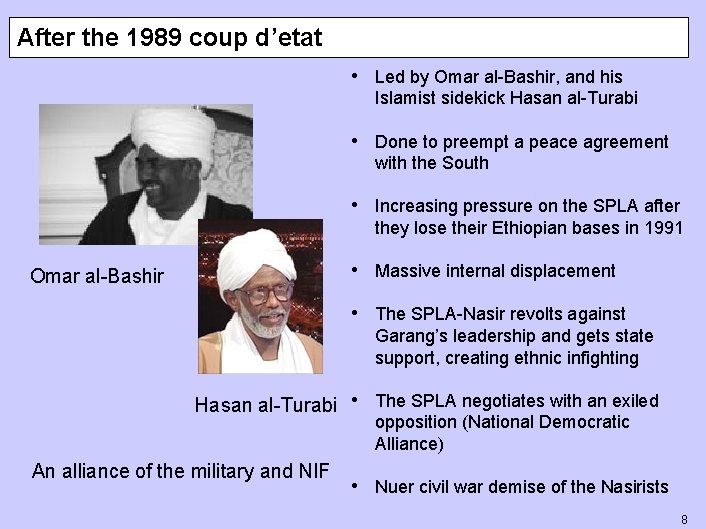
After the 1989 coup d’etat • Led by Omar al-Bashir, and his Islamist sidekick Hasan al-Turabi • Done to preempt a peace agreement with the South • Increasing pressure on the SPLA after they lose their Ethiopian bases in 1991 • Massive internal displacement Omar al-Bashir • The SPLA-Nasir revolts against Garang’s leadership and gets state support, creating ethnic infighting Hasan al-Turabi • The SPLA negotiates with an exiled opposition (National Democratic Alliance) An alliance of the military and NIF • Nuer civil war demise of the Nasirists 8
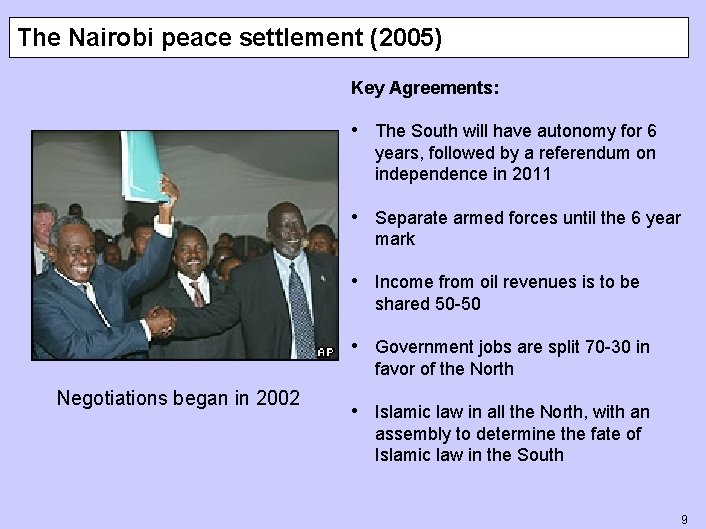
The Nairobi peace settlement (2005) Key Agreements: • The South will have autonomy for 6 years, followed by a referendum on independence in 2011 • Separate armed forces until the 6 year mark • Income from oil revenues is to be shared 50 -50 • Government jobs are split 70 -30 in favor of the North Negotiations began in 2002 • Islamic law in all the North, with an assembly to determine the fate of Islamic law in the South 9
Darfur and other civil wars Marginalized Muslim wars Darfur • Nuba mountains campaign on religious grounds • Northern proxy wars against marginalized Muslims to • • acquire land for Arabs Displacement of marginalized peoples in the East Allowed the government to fight through proxies and to demonstrate internal Southern fighting • Long history of autonomy from Khartoum • Extended drought has led Arabs to displace settled Fur tribes and the Fur revolted • Arab “janjaweed” raids have been supported by the state to: – Islamize Darfur – Support allied Arab groups – Demonstrate that rebellion will not be tolerated 10
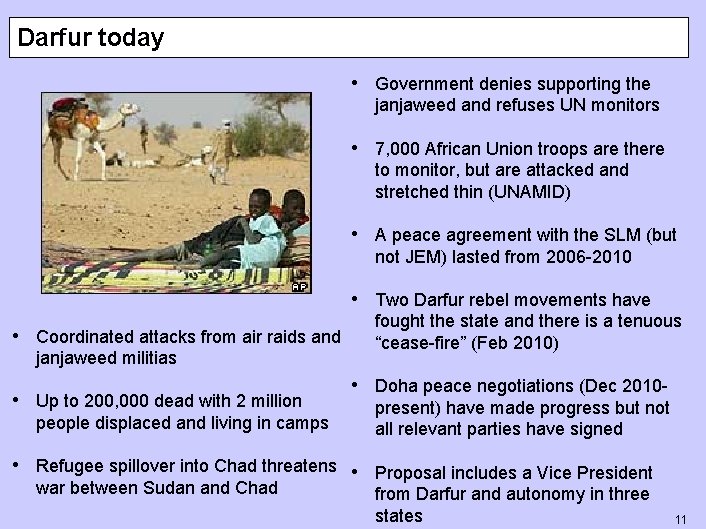
Darfur today • Government denies supporting the janjaweed and refuses UN monitors • 7, 000 African Union troops are there to monitor, but are attacked and stretched thin (UNAMID) • A peace agreement with the SLM (but not JEM) lasted from 2006 -2010 • Two Darfur rebel movements have • Coordinated attacks from air raids and janjaweed militias • Up to 200, 000 dead with 2 million people displaced and living in camps fought the state and there is a tenuous “cease-fire” (Feb 2010) • Doha peace negotiations (Dec 2010 present) have made progress but not all relevant parties have signed • Refugee spillover into Chad threatens • Proposal includes a Vice President war between Sudan and Chad from Darfur and autonomy in three states 11
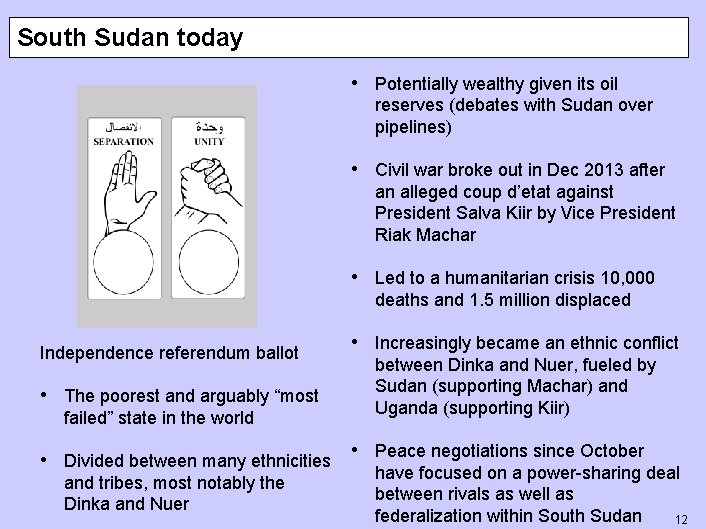
South Sudan today • Potentially wealthy given its oil reserves (debates with Sudan over pipelines) • Civil war broke out in Dec 2013 after an alleged coup d’etat against President Salva Kiir by Vice President Riak Machar • Led to a humanitarian crisis 10, 000 deaths and 1. 5 million displaced Independence referendum ballot • The poorest and arguably “most failed” state in the world • Increasingly became an ethnic conflict between Dinka and Nuer, fueled by Sudan (supporting Machar) and Uganda (supporting Kiir) • Divided between many ethnicities • Peace negotiations since October and tribes, most notably the Dinka and Nuer have focused on a power-sharing deal between rivals as well as federalization within South Sudan 12
- Slides: 13