
The Successful Job Interview Topics to be Discussed
The Successful Job Interview
Topics to be Discussed Purpose of the Interview Attire Types/Stages of Interviews First Impressions Preparing for the Interview Phases of the Interview: Introduction Interview Questions an Employer Can’t Ask Formulating Your Answers Tell Me About Yourself Phases of the Interview: Body Phases of the Interview: Conclusion After the Interview
Purpose of the Interview Collaborative Exchange of Information From the business aspect: Your knowledge, skills, and abilities as applicable to the position with the employer; Your experiences and behavioral temperament ; Fill in any gaps from your resume From the jobseeker aspect: The interview is two-way; you are learning about the company: Culture; Expectations of you as a potential employee; Career growth and development
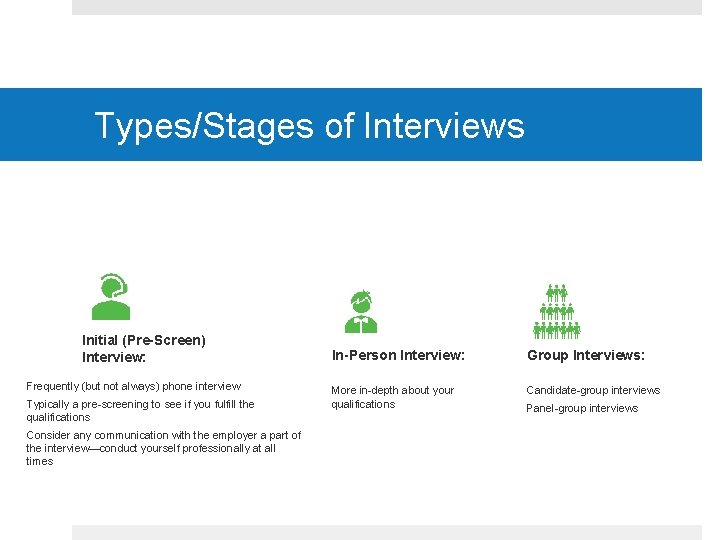
Types/Stages of Interviews Initial (Pre-Screen) Interview: Frequently (but not always) phone interview Typically a pre-screening to see if you fulfill the qualifications Consider any communication with the employer a part of the interview—conduct yourself professionally at all times In-Person Interview: Group Interviews: More in-depth about your qualifications Candidate-group interviews Panel-group interviews
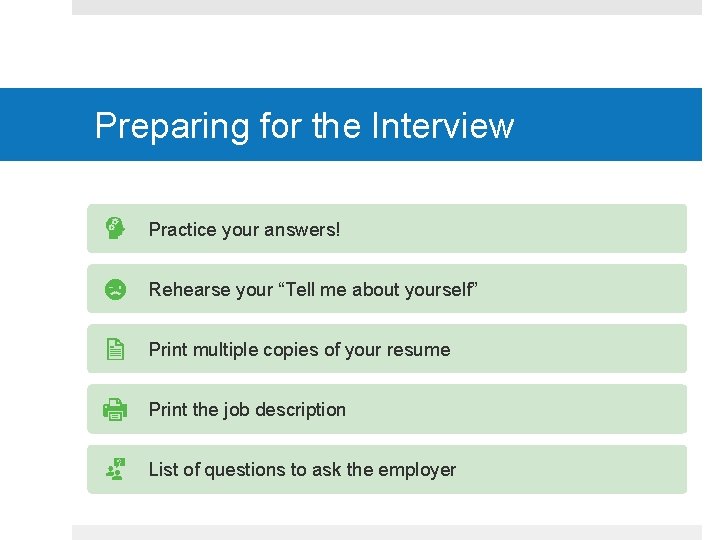
Preparing for the Interview Practice your answers! Rehearse your “Tell me about yourself” Print multiple copies of your resume Print the job description List of questions to ask the employer
Interview Questions SHRM classifies interview questions into 3 main types: 1. Behavioral 2. Situational 3. General (Competencies)
Behavioral Questions Behavioral. An interview technique that focuses on a candidate's past experiences, behaviors, knowledge, skills and abilities by asking the candidate to provide specific examples of when he or she has demonstrated certain behaviors or skills as a means of predicting future behavior and performance. When asked a behavioral question, candidates are expected to provide information, in the form of a short story, not just on what tasks and activities they have accomplished, but how they accomplished them.
Situational Questions Situational. An interview technique that gives the interviewee a hypothetical scenario and focuses on a candidate's past experiences, behaviors, knowledge, skills and abilities by asking the candidate to provide specific examples of how the candidate would respond given the situation described. This type of interview reveals how an applicant thinks and how he or she would react in a particular situation.
General/Competency Questions Competency-based interviewing can give the interviewer a sense of an applicant's job performance and attitude toward work. Competencies: Business Acumen Communication Consultation Critical Evaluation Ethical Practice Flexibility Global & Cultural Effectiveness HR Expertise Leadership & Navigation Learning Orientation Relationship Management Stress Management/Composure
Questions Employers CANNOT Ask It is illegal to ask a candidate questions about their: Age or genetic information Birthplace, country of origin or citizenship Disability Gender, sex or sexual orientation Marital status, family, or pregnancy Race, color, or ethnicity Religion Visit www. eeoc. gov for more information
Sample Illegal Job Interview Questions What arrangements are you able to make for childcare while you work? How old are your children? When did you graduate from high school? Are you a U. S. citizen? What does your spouse do for a living? Will you need personal time off for religious holidays? Are you comfortable working for a female boss? There is a disparity between your age and that of the position’s coworkers- is that a problem for you? How long do you plan to work until you retire?
Sample Illegal Job Interview Questions: Military Specific What type of discharge did you receive from the military? Will you be deployed anytime soon? RE: potential disabilities: Are you physically or mentally disabled? Do you have PTSD? Do you have any brain injuries? Do you see a psychiatrist? Did you get hurt in combat?
Answering the Question Analyze the position. What skills are required? Analyze your own background. What skills and qualities have you demonstrated that relate to the positive? Identify examples from your experience where you demonstrated the skills. Develop and rehearse brief “ stories” about how you used these skills using the STAR formula. Use numbers to quantify your results and to help illustrate the scope of your responsibility. Identify three to five top selling points and convey them during the interview. Examples can come from a variety of your experiences : part-time jobs, internships, class projects, volunteer experience, activities, student leadership, life experiences etc. —PICK EXAMPLES THAT SUPPORT THE JOB DESCRIPTION
Formulate Your Response STAR Technique Situation or Task: Describe the situation that you were in or the task that you needed to accomplish. Be specific and provide details. Paint a vivid picture for you interviewer to create clear understanding. Action: Describe the action you took. Don’t tell what you would do, tell what you did. Focus on your contributions – use “I” statements, not “we” statements. Result: Explain the results of your action. Focus on positive outcomes and accomplishments. Share what you learned or feedback you received. Quantify your results if applicable.
“Tell Me About Yourself” Be brief! Review the job description, qualifications, and desired skills and align your experiences to the specific job. Remember, ‘tell me about yourself’ doesn’t mean they want your life story. Summarize your skills and experience in a way that make you stand out and show why you are the best person for the job.
Sample Answer (Retrieved from Hire Heroes) “Hello, my name is Brian Murphy. I am a law enforcement professional with a degree in criminal justice and active Top Secret security clearance. My qualifications include fifteen years of experience in international and homeland security and outstanding leadership capability managing large security teams. My experience also includes knowledge of patrol, search and rescue and investigative and criminal procedures. I am a sharpshooter with expert marksman qualifications as well. I would like to discuss how I can bring these skills and experience to your company. ”
Questions to Ask the Employer Compose a list of at least 5 relevant questions Think of questions that are not readily available/easily found online “Based on what we’ve talked about today, is there anything that is leaving you with hesitancy with hiring me for the position? ”
Interview Attire DRESS FOR THE ROLE YOU WANT AND THE PERSON THAT YOU ARE Try on your outfit beforehand: Sit down test (for skirt-length) Shake hands with your jacket on Be able to “skip” in your shoes Overdressed is better than underdressed; when in doubt dress one-step higher Dress for the interview even when it’s virtual
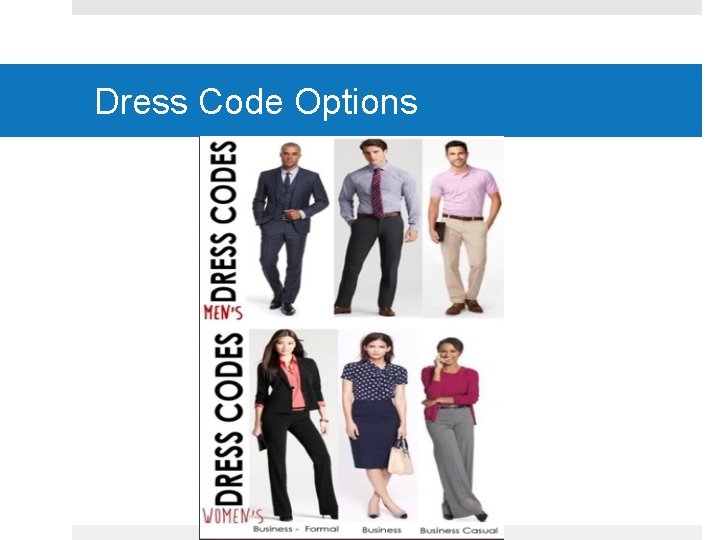
Dress Code Options
First Impressions The interview starts when you answer the phone/pull onto the premises Treat ALL individuals that you encounter with respect Be on time— 10 minutes early is on time, on time is late Do not sit on your phone, act annoyed, etc. while waiting—this is the perfect time to review the job description, your questions for the employer, and any notes you have regarding your possible answers
Phases of the Interview: Introduction Professional presentation- poised, polite, firm handshake, good eye contact, being positive and upbeat, etc. Wait for the interviewer to offer you a seat “Open” posture- don’t cross your arms or slouch—that mirrors the interviewer; meet the needs of the interviewer This is your opportunity to gain composure, set yourself up, and take out anything you’ve brought with you Small talk, overview of the company/position
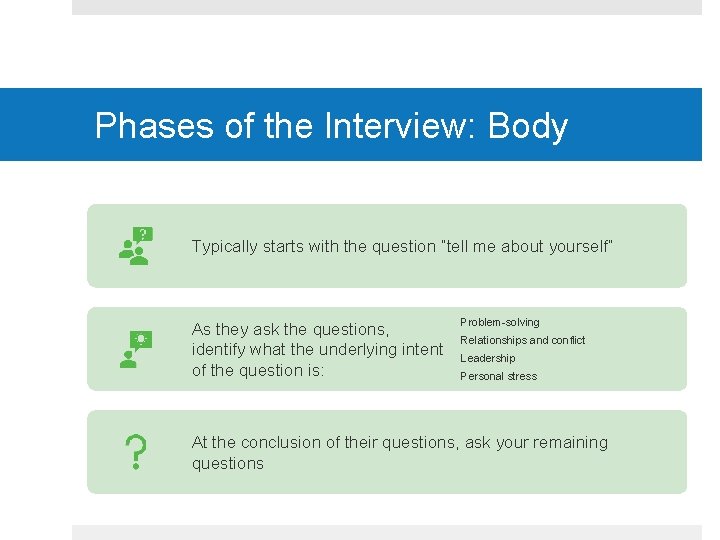
Phases of the Interview: Body Typically starts with the question “tell me about yourself” As they ask the questions, identify what the underlying intent of the question is: Problem-solving Relationships and conflict Leadership Personal stress At the conclusion of their questions, ask your remaining questions
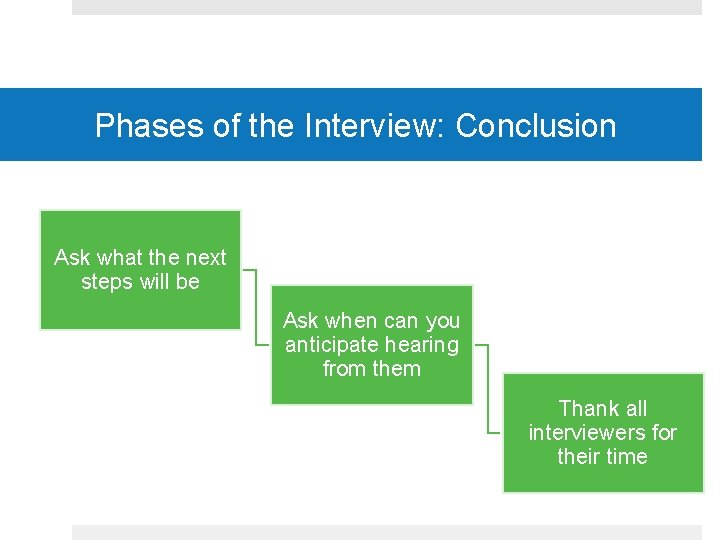
Phases of the Interview: Conclusion Ask what the next steps will be Ask when can you anticipate hearing from them Thank all interviewers for their time
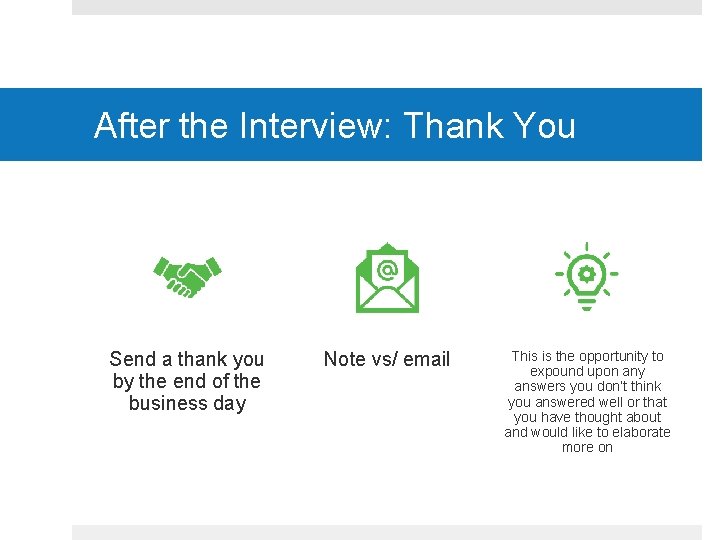
After the Interview: Thank You Send a thank you by the end of the business day Note vs/ email This is the opportunity to expound upon any answers you don’t think you answered well or that you have thought about and would like to elaborate more on
Resources/Additional Questions 10 Important Areas of Project Management Interview Questions and Answers: https: //www. simplilearn. com/projectmanagement-interview-questions-and-answers-article 17 Must-Ask Tech Interview Questions: https: //www. roberthalf. com/blog/how-to-interview-candidates/7 must-ask-tech-interview-questions Types of Job Interview Questions: https: //www. thebalancecareers. com/types-of-interviewquestions-2061365
- Slides: 25