
The Subjunctive Spanish Thanks to FL Teach members
The Subjunctive Spanish (Thanks to FL Teach members for this Power Point, which I have edited for use by Timberline students. )
The Subjunctive • In this slide show, we are going to look at a verb form that has all but disappeared from English – the subjunctive!
A few examples • I want you to give me $5. • Tom would like us to arrive before 5: 00 am. • I order you to stop! • • In these three examples, one person is trying to get another person to perform an action.
I want you to give me $5. • One person (I) wants another person (you) to do something (give $5). • However, there is no guarantee that you will give me $5 just because I want you to.
Tom would like us to arrive before 5: 00 am. am • Likewise, one person (Tom) wants someone else (us) to do something (arrive before 5: 00 am). • There is no guarantee that we will do so just because Tom would like that.
I order you to stop! • This sentence is more forceful: one person (I) is telling another person (you) to do something (stop). • Again, we don’t know if you will stop despite the admonition.
The subjunctive • In Spanish, we use a special verb form to show that the completion of these actions – give, arrive, stop – may or may not occur. This form is called the subjunctive (like the word “subjective” – influenced by opinions).
Examples in Spanish • I want you to give me $5 >> • Quiero que me des $5. • Tom would like us to arrive before 5: 00 am >> • Tom quiere que lleguemos antes de las 5: 00. • I order you to stop >> • Te mando que pares.
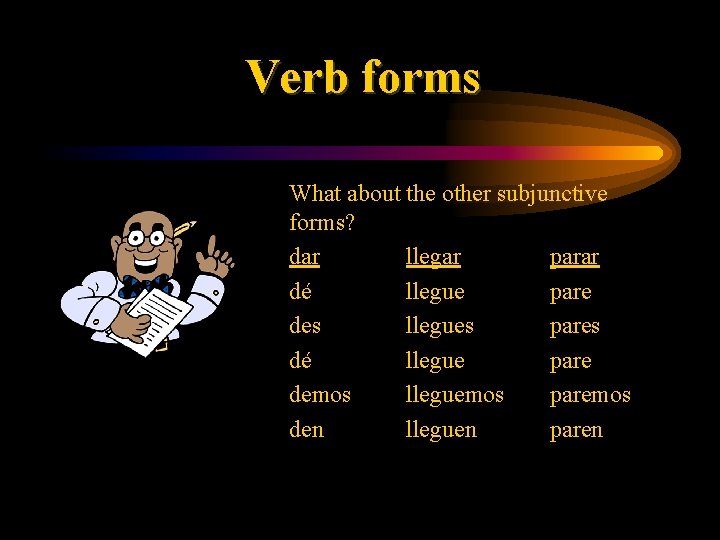
Verb forms • What about the other subjunctive forms? • dar llegar parar • dé llegue pare • des llegues pares • dé llegue pare • demos lleguemos paremos • den lleguen paren
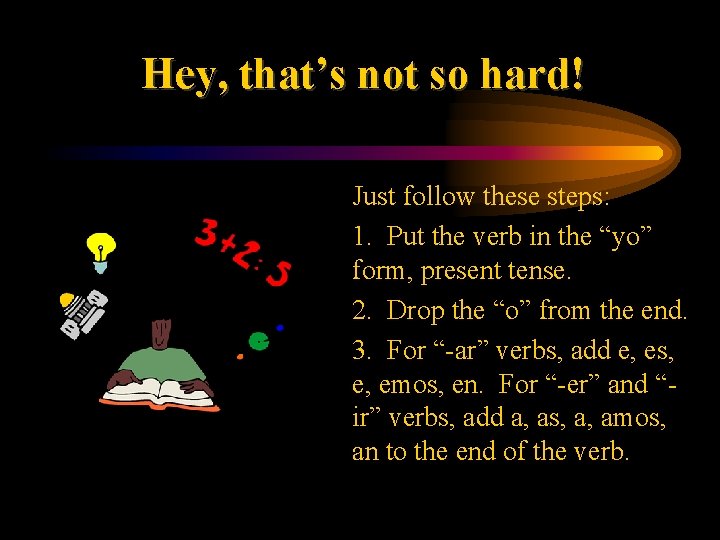
Hey, that’s not so hard! • Just follow these steps: • 1. Put the verb in the “yo” form, present tense. • 2. Drop the “o” from the end. • 3. For “-ar” verbs, add e, es, e, emos, en. For “-er” and “ir” verbs, add a, as, a, amos, an to the end of the verb.
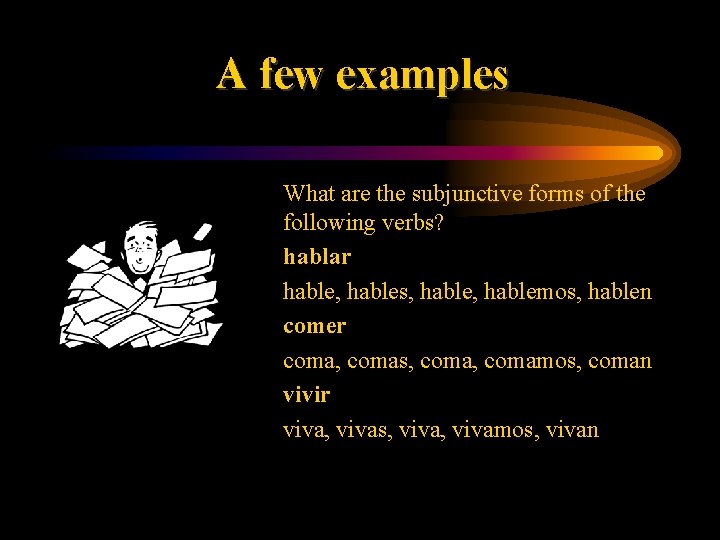
A few examples • What are the subjunctive forms of the following verbs? • hablar • hable, hables, hablemos, hablen • comer • coma, comas, comamos, coman • vivir • viva, vivas, vivamos, vivan
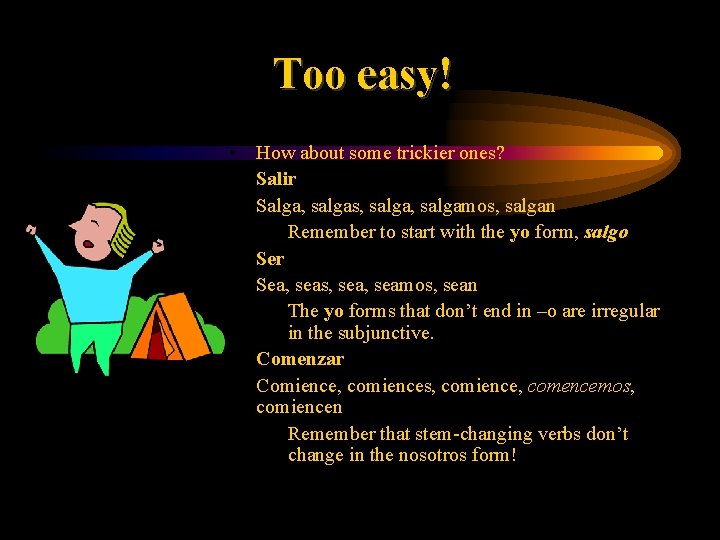
Too easy! • How about some trickier ones? • Salir • Salga, salgas, salgamos, salgan – Remember to start with the yo form, salgo • Ser • Sea, seas, seamos, sean – The yo forms that don’t end in –o are irregular in the subjunctive. • Comenzar • Comience, comiences, comience, comencemos, comiencen – Remember that stem-changing verbs don’t change in the nosotros form!
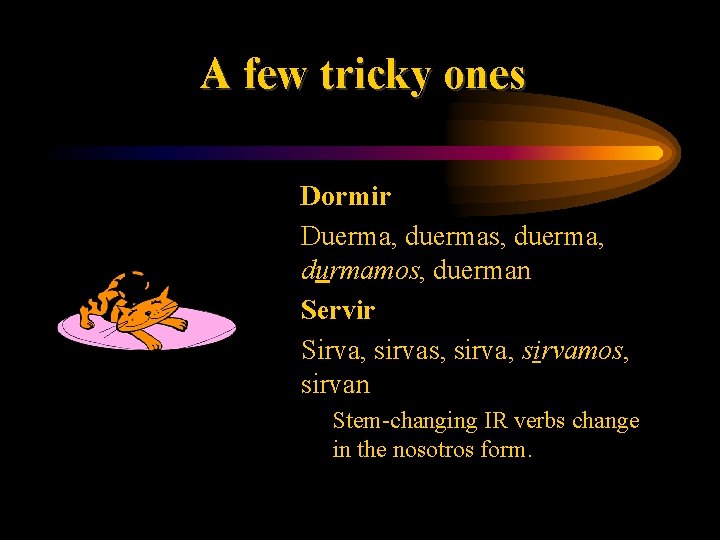
A few tricky ones • Dormir • Duerma, duermas, duerma, durmamos, duerman • Servir • Sirva, sirvas, sirvamos, sirvan – Stem-changing IR verbs change in the nosotros form.
Now let’s put this all together. • Quiero que me des $5. • Tom quiere que lleguemos antes de las 5: 00. • Te mando que pares. • Tom quiere que lleguemos antes de las 5: 00.
Tom quiere | que | lleguemos antes de las 5: 00. • The sentence structure in Spanish is a bit different from that of English. A wordfor-word translation is “Tom wants that we arrive before 5: 00. ” • The word que is used to divide the sentence into two halves – the expression of wish or desire (Tom quiere) and the action that may or may not occur (lleguemos). • The verb in the first half uses the “normal” (“indicative”) form, while the verb in the second half uses the subjunctive.
Notice… • … that the subject in the first half is always different from the subject in the second half: – -Quiero que me des $5. – -Tom quiere que lleguemos. . . – -Te mando que pares. • The first subject is trying to spur the second subject into action, and we don’t know if the action will ever happen.
Compare this… • … to sentences where there is no change in subject: – -Quiero salir ahora. – -Tom quiere llegar a las 5. – -Me gustaría comer pizza. • When the subject is the same, there is higher probability that the second action will take place. We use the infinitive (-r form of the verb) after verbs that express wishes, wants, and desires.
Let’s practice! • What are the appropriate subjunctive forms of the verbs in parentheses? • Quiero que tú _____ (venir) a las 3: 00 en punto. • Quiero que tú vengas a las 3: 00 en punto. – We use the subjunctive because there is a change in subject after a verb of desire (quiero).
¡Quiero que me des otro! • ¿Quieres que nosotros ______ (ir) al cine o a la playa esta tarde? • Pues, quiero que ______ (quedarse = stay) en casa porque hace frío. • ¿Quieres que nosotros vayamos al cine o a la playa esta tarde? • Pues, quiero que nos quedemos en casa porque hace frío.
![Uno más… • Espero [I hope] que tu hermana ____ (hacer) bien en sus](http://slidetodoc.com/presentation_image_h/b0fc21ceb670a807671e5780574141d5/image-20.jpg "Uno más… • Espero [I hope] que tu hermana ____ (hacer) bien en sus")
Uno más… • Espero [I hope] que tu hermana ____ (hacer) bien en sus exámenes. • Espero que tu hermana haga bien en sus exámenes. – We use the subjunctive after different types of verbs – wishes, wants, and orders. Here is another type: hopes. – We use the subjunctive because we aren’t sure whether the second action will occur (Will your sister do well on her exams? That remains to be seen!).
Más ejemplos • Mi mamá quiere que yo ____ (ser) doctor, y mi papá espera que _____ (estudiar) para ser ingeniero, pero yo quiero ____ (ser) actor. • Mi mamá quiere que yo sea doctor, y mi papá espera que estudie para ser ingeniero, pero yo quiero ser actor – There is no change in subject in the third expression (“yo quiero”), so we don’t use the subjunctive!
![Otro uso • Lo siento [I’m sorry] que tu abuela ____ (estar) enferma. Espero](http://slidetodoc.com/presentation_image_h/b0fc21ceb670a807671e5780574141d5/image-22.jpg "Otro uso • Lo siento [I’m sorry] que tu abuela ____ (estar) enferma. Espero")
Otro uso • Lo siento [I’m sorry] que tu abuela ____ (estar) enferma. Espero que ___ (mejorarse = to get better) pronto. • Lo siento que tu abuela esté enferma. Espero que se mejore pronto. – Another use of the subjunctive is with verbs of “emotion, ” such as saying “I’m sorry. ” This is a little different from the other uses in that the second action has actually happened (i. e. , your grandmother really is sick), but the subject in the first half is expressing an opinion and is therefore ‘influencing’ the second verb.
Let’s review the uses • We started by looking at one basic use of the subjunctive: it is used with verbs that express desires and wants. • We then saw how the subjunctive is also used with verbs that express hope and emotion. • Are there any others?
You bet! W. E. I. R. D. O. • Here’s an acronym to help you organize the major uses of the subjunctive: • W. E. I. R. D. O.
W. E. I. R. D. O. • Wishes / Willing • Quiero que tú puedas visitarme durante las vacaciones.
W. E. I. R. D. O. • Emotion • Me alegro que hayas recibido una “A” en la clase de historia. • Me enfada [it angers me] que Juan no trabaje más en este proyecto.
W. E. I. R. D. O. • Impersonal expressions • Es ridículo que Gloria sea la presidenta del club de alemán – ella recibió una “D-” en su clase el semestre pasado. – Impersonal expressions don’t have a “human” subject. – Some impersonal expressions in Spanish include: es bueno, es malo, es necesario, es difícil, es imposible, es triste…
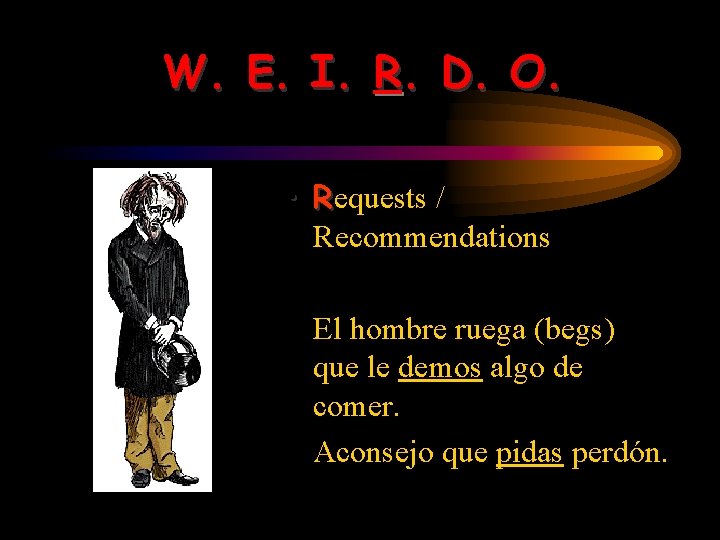
W. E. I. R. D. O. • Requests / Recommendations • El hombre ruega (begs) que le demos algo de comer. • Aconsejo que pidas perdón.
W. E. I. R. D. O. • Doubt • Dudo que alguien sea capaz de sacar un 100% en el examen final de física – ¡es un curso muy difícil!
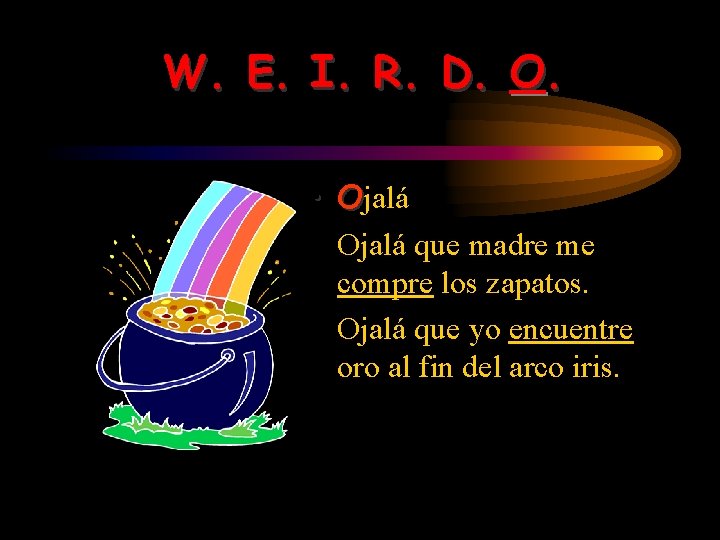
W. E. I. R. D. O. • Ojalá que madre me compre los zapatos. • Ojalá que yo encuentre oro al fin del arco iris.
Wow! • That’s a lot!! • If you continue your studies in Spanish, you will be certain to see these uses and many others.

- Slides: 32