
The Subjunctive Mood in Spanish What is it
The Subjunctive Mood in Spanish What is it? When is it used?
Subjunctive vs. Indicative in Spanish The subjunctive is one of three moods in Spanish. The other two Spanish moods are the indicative and the imperative (used to give commands). The subjunctive mood is used to talk about desires, doubts, wishes, conjectures, and possibilities. The indicative mood is used to talk about facts and other statements that are believed to be true and concrete.
Mood vs. Tense Grammatical mood reflects a speaker’s attitude toward a statement. Spanish has three moods: the subjunctive, the indicative, and the imperative. Grammatical tense refers to when an action takes place. Spanish has three tenses: the past, the present, and the future.
General Rules for Differentiating Between the Indicative and the Subjunctive The indicative mood is used to talk about things that are objective and/or certain. For example: facts, descriptions, and scheduled events. The subjunctive mood is used to talk about things that are subjective and/or possible, but not certain. This includes things like doubts, wishes, recommendations, unknowns, and opinions about the likelihood of other events occurring.
Subjunctive Mood is not so common anymore in English, but difficult to avoid using in Spanish! It is important that you learn it! (That was subjunctive because it is highly recommended. ) How do we know when to use the subjunctive? There are certain verbs or expressions that trigger it’s use. Learn this mnemonic device to help you remember these triggers…….
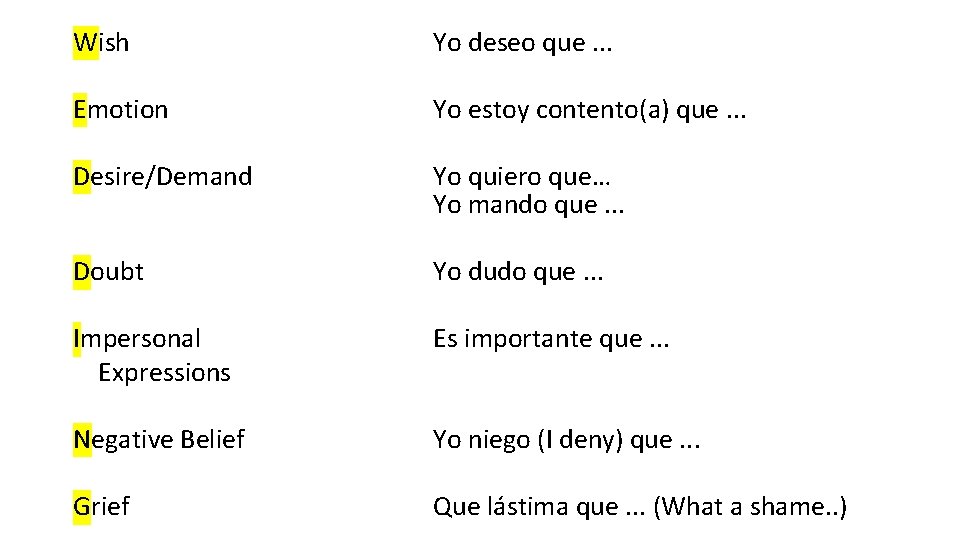
Wish Yo deseo que. . . Emotion Yo estoy contento(a) que. . . Desire/Demand Yo quiero que… Yo mando que. . . Doubt Yo dudo que. . . Impersonal Expressions Es importante que. . . Negative Belief Yo niego (I deny) que. . . Grief Que lástima que. . . (What a shame. . )
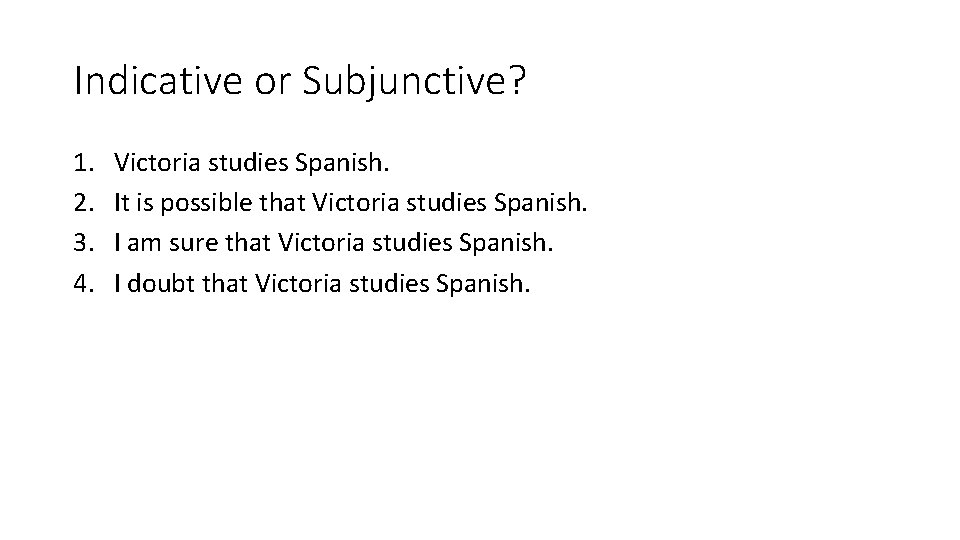
Indicative or Subjunctive? 1. 2. 3. 4. Victoria studies Spanish. It is possible that Victoria studies Spanish. I am sure that Victoria studies Spanish. I doubt that Victoria studies Spanish.
Did you notice the repetition of the phrase “from the speaker’s viewpoint” on the previous slides? This is KEY to understanding a very important point: “indicative” does NOT mean “TRUE. ” As long as a speaker FEELS that what they’re saying is true, the indicative can be used. This does not, however, mean that what they’re saying is ACTUALLY true. I’m sure that human beings have wings.
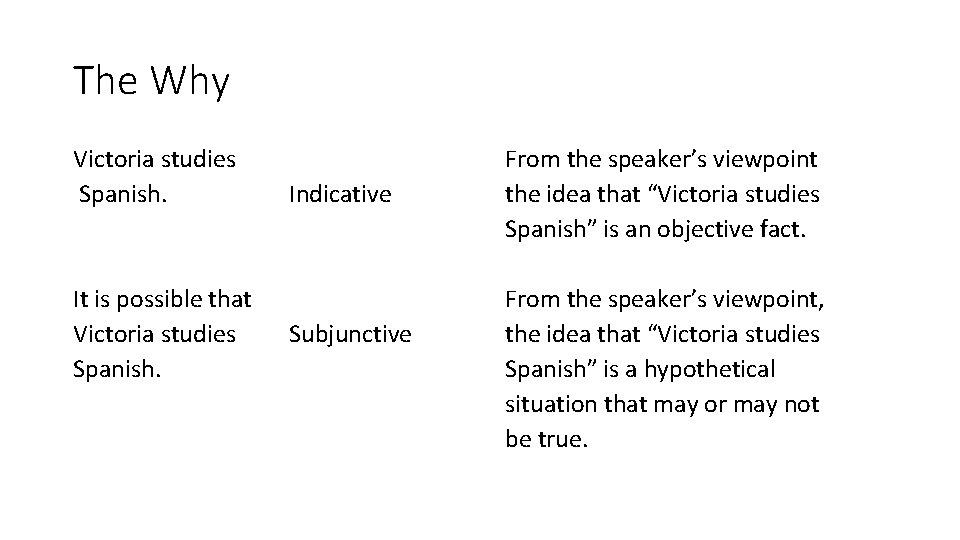
The Why Victoria studies Spanish. It is possible that Victoria studies Spanish. Indicative Subjunctive From the speaker’s viewpoint the idea that “Victoria studies Spanish” is an objective fact. From the speaker’s viewpoint, the idea that “Victoria studies Spanish” is a hypothetical situation that may or may not be true.
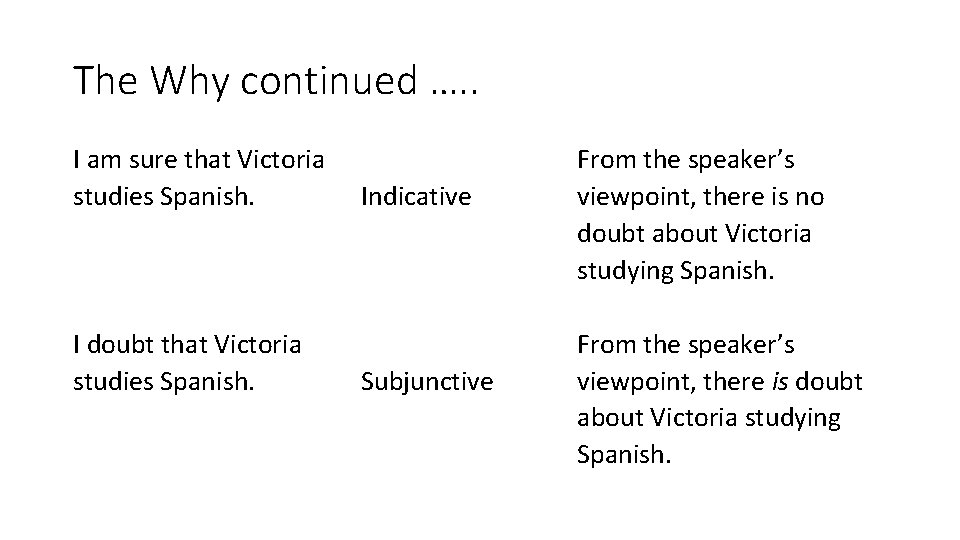
The Why continued …. . I am sure that Victoria studies Spanish. I doubt that Victoria studies Spanish. Indicative Subjunctive From the speaker’s viewpoint, there is no doubt about Victoria studying Spanish. From the speaker’s viewpoint, there is doubt about Victoria studying Spanish.
https: //www. spanishdict. com/guide/subjunctivevs-indicative-in-spanish Para practicar: escuchen a la profesora leer unas frases en ingles y adivinen (guess) si necesitan el presente del subjuntivo (present subjunctive) o el presente indicativo (present indicative)
- Slides: 11