
THE SUBJUNCTIVE An intuitive guide into the realm
THE SUBJUNCTIVE An intuitive guide into the realm of the hopefully-not-so-much unknown… Presented by: Andy Carluccio, JD Smeallie, and Jackson Mote TB Sections 3. 3 -5. 1
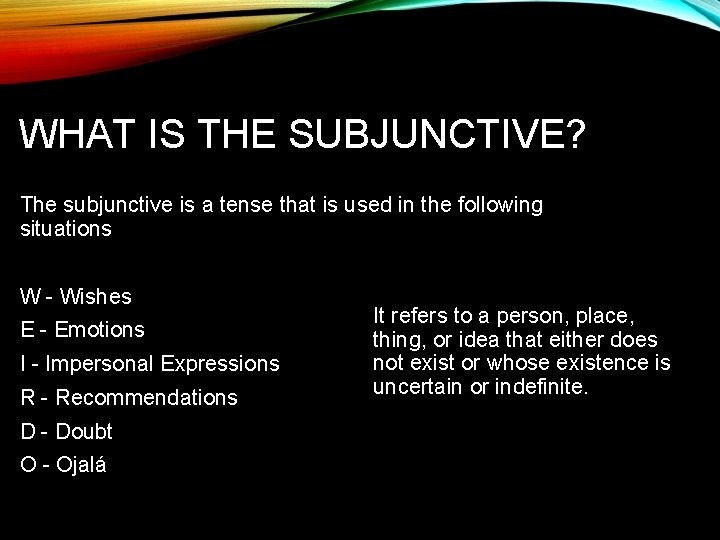
WHAT IS THE SUBJUNCTIVE? The subjunctive is a tense that is used in the following situations W - Wishes E - Emotions I - Impersonal Expressions R - Recommendations D - Doubt O - Ojalá It refers to a person, place, thing, or idea that either does not exist or whose existence is uncertain or indefinite.
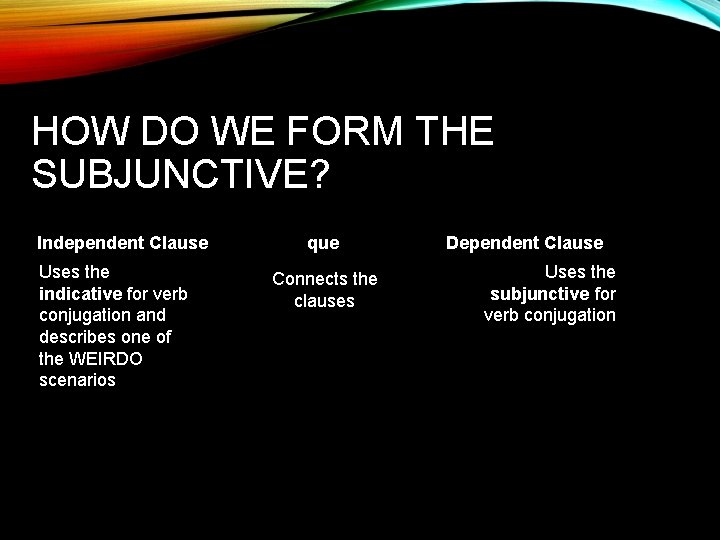
HOW DO WE FORM THE SUBJUNCTIVE? Independent Clause Uses the indicative for verb conjugation and describes one of the WEIRDO scenarios que Connects the clauses Dependent Clause Uses the subjunctive for verb conjugation
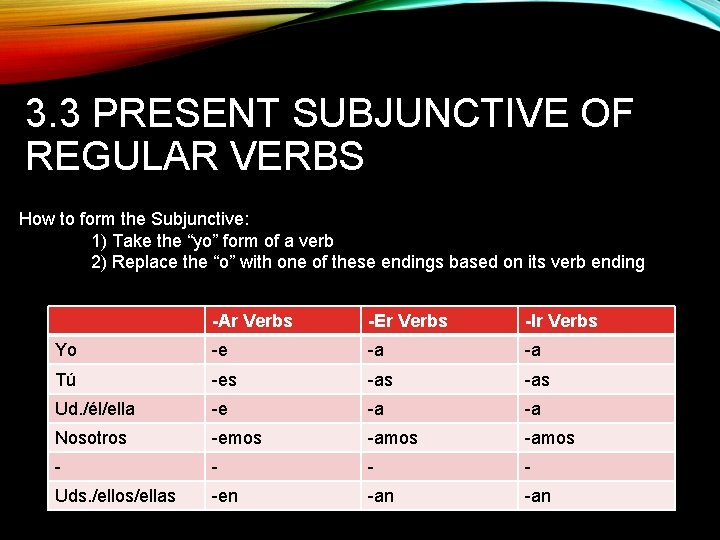
3. 3 PRESENT SUBJUNCTIVE OF REGULAR VERBS How to form the Subjunctive: 1) Take the “yo” form of a verb 2) Replace the “o” with one of these endings based on its verb ending -Ar Verbs -Er Verbs -Ir Verbs Yo -e -a -a Tú -es -as Ud. /él/ella -e -a -a Nosotros -emos -amos - - Uds. /ellos/ellas -en -an
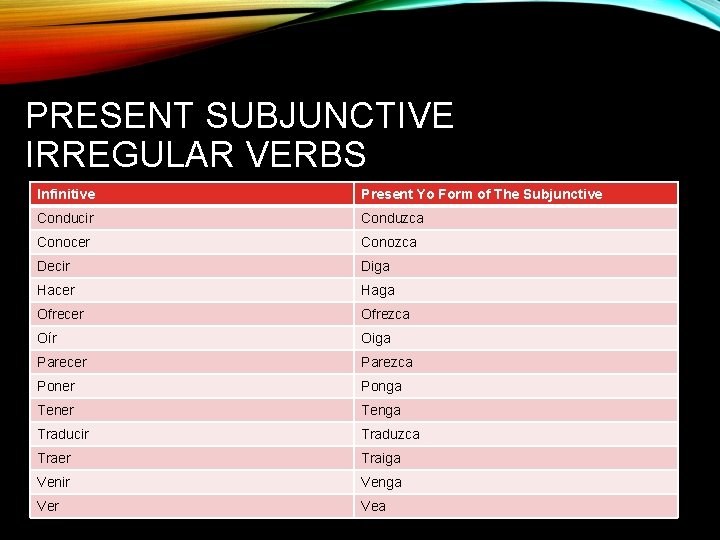
PRESENT SUBJUNCTIVE IRREGULAR VERBS Infinitive Present Yo Form of The Subjunctive Conducir Conduzca Conocer Conozca Decir Diga Hacer Haga Ofrecer Ofrezca Oír Oiga Parecer Parezca Poner Ponga Tener Tenga Traducir Traduzca Traer Traiga Venir Venga Ver Vea
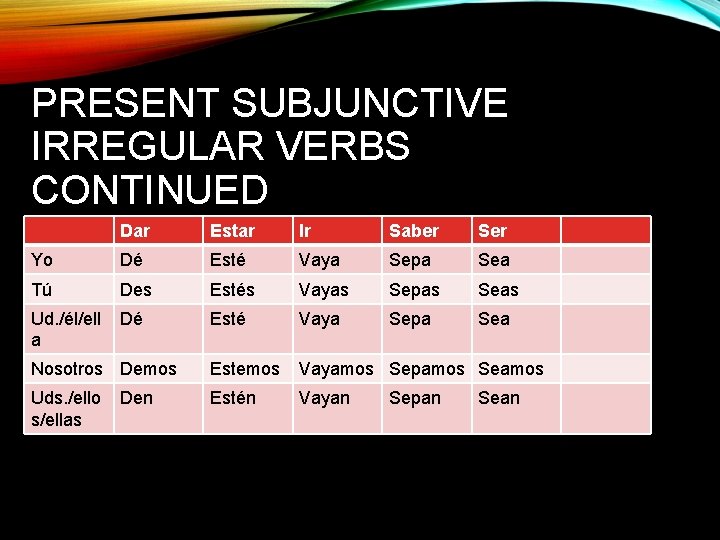
PRESENT SUBJUNCTIVE IRREGULAR VERBS CONTINUED Dar Estar Ir Saber Ser Yo Dé Esté Vaya Sepa Sea Tú Des Estés Vayas Sepas Seas Ud. /él/ell a Dé Esté Vaya Sepa Sea Nosotros Demos Estemos Vayamos Sepamos Seamos Uds. /ello s/ellas Estén Vayan Den Sepan Sean
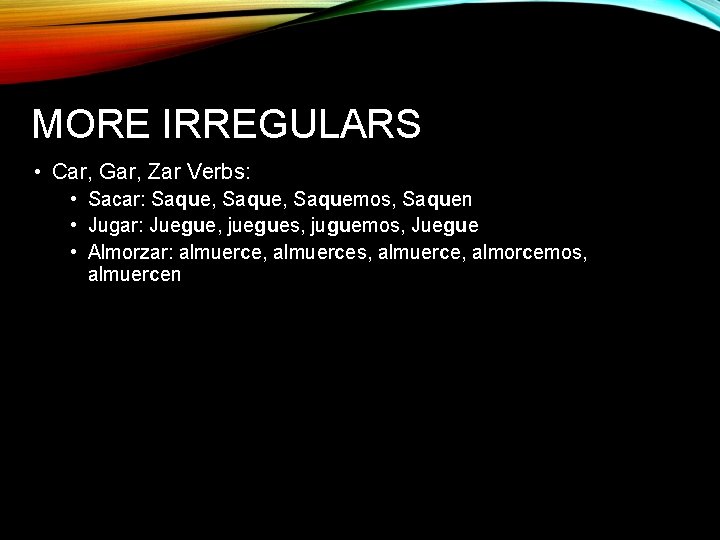
MORE IRREGULARS • Car, Gar, Zar Verbs: • Sacar: Saque, Saquemos, Saquen • Jugar: Juegue, juegues, juguemos, Juegue • Almorzar: almuerce, almuerces, almuerce, almorcemos, almuercen
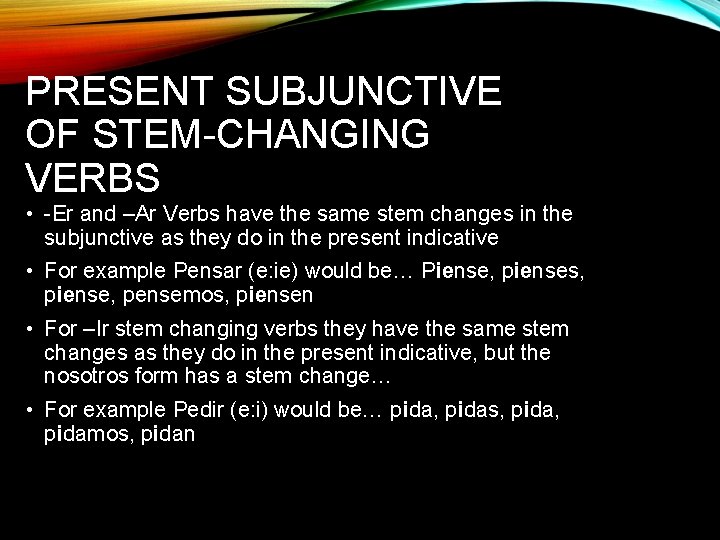
PRESENT SUBJUNCTIVE OF STEM-CHANGING VERBS • -Er and –Ar Verbs have the same stem changes in the subjunctive as they do in the present indicative • For example Pensar (e: ie) would be… Piense, pienses, piense, pensemos, piensen • For –Ir stem changing verbs they have the same stem changes as they do in the present indicative, but the nosotros form has a stem change… • For example Pedir (e: i) would be… pida, pidas, pidamos, pidan
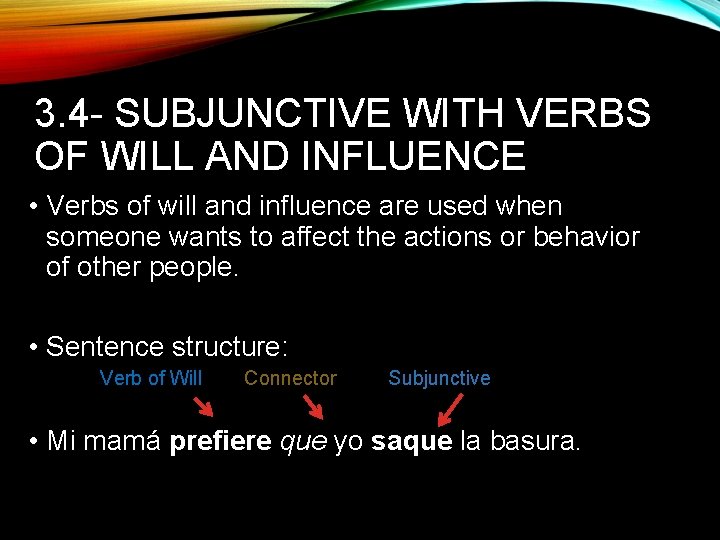
3. 4 - SUBJUNCTIVE WITH VERBS OF WILL AND INFLUENCE • Verbs of will and influence are used when someone wants to affect the actions or behavior of other people. • Sentence structure: Verb of Will Connector Subjunctive • Mi mamá prefiere que yo saque la basura.
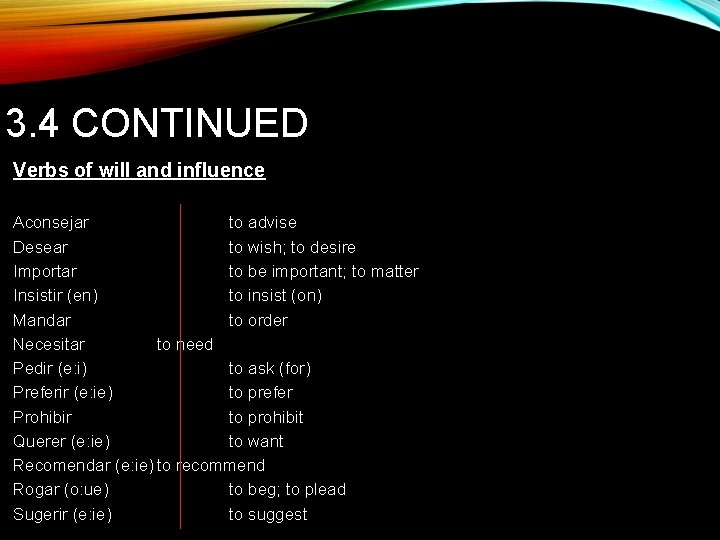
3. 4 CONTINUED Verbs of will and influence Aconsejar to advise Desear to wish; to desire Importar to be important; to matter Insistir (en) to insist (on) Mandar to order Necesitar to need Pedir (e: i) to ask (for) Preferir (e: ie) to prefer Prohibir to prohibit Querer (e: ie) to want Recomendar (e: ie) to recommend Rogar (o: ue) to beg; to plead Sugerir (e: ie) to suggest
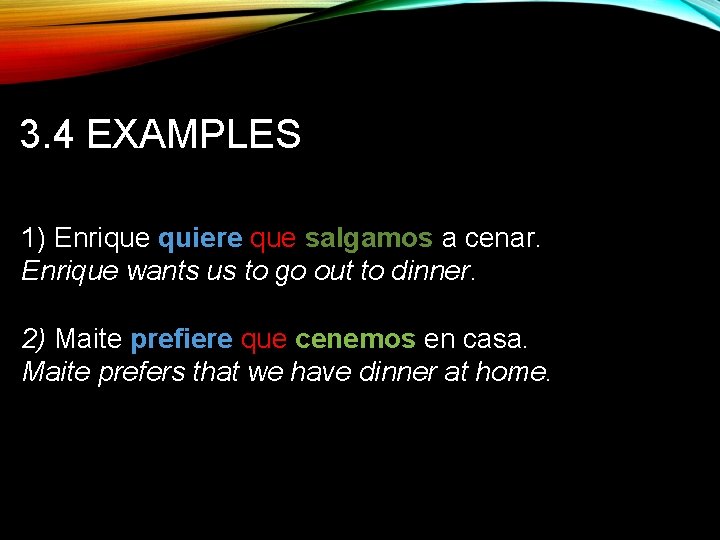
3. 4 EXAMPLES 1) Enrique quiere que salgamos a cenar. Enrique wants us to go out to dinner. 2) Maite prefiere que cenemos en casa. Maite prefers that we have dinner at home.

PRACTICE PROBLEMS 1. Te sugiero que ______(ir) con ella al supermercado. 2. No queremos que ella _______(hacer) nada especial para nosotros 3. Mi madre quiere que yo _______(limpiar) mi cuarto 4. Recomiendo que ustedes ____(pasar) la aspiradora 5. Mi amigo necesita que yo le _____ (prestar) dinero
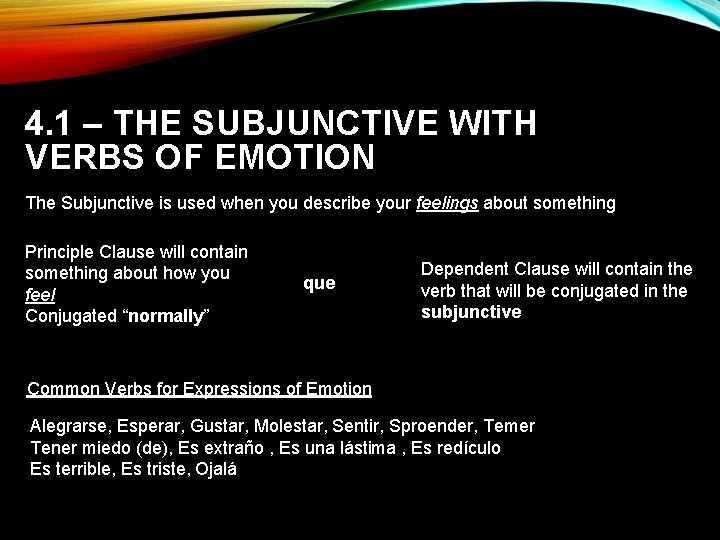
4. 1 – THE SUBJUNCTIVE WITH VERBS OF EMOTION The Subjunctive is used when you describe your feelings about something Principle Clause will contain something about how you feel Conjugated “normally” que Dependent Clause will contain the verb that will be conjugated in the subjunctive Common Verbs for Expressions of Emotion Alegrarse, Esperar, Gustar, Molestar, Sentir, Sproender, Temer Tener miedo (de), Es extraño , Es una lástima , Es redículo Es terrible, Es triste, Ojalá
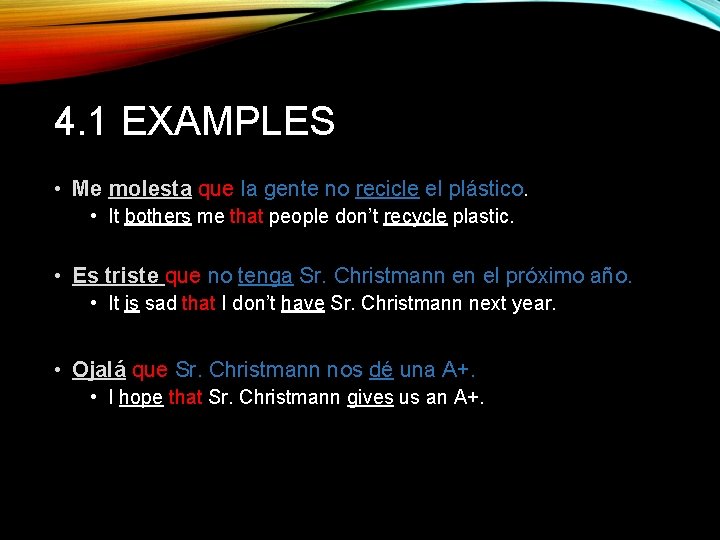
4. 1 EXAMPLES • Me molesta que la gente no recicle el plástico. • It bothers me that people don’t recycle plastic. • Es triste que no tenga Sr. Christmann en el próximo año. • It is sad that I don’t have Sr. Christmann next year. • Ojalá que Sr. Christmann nos dé una A+. • I hope that Sr. Christmann gives us an A+.
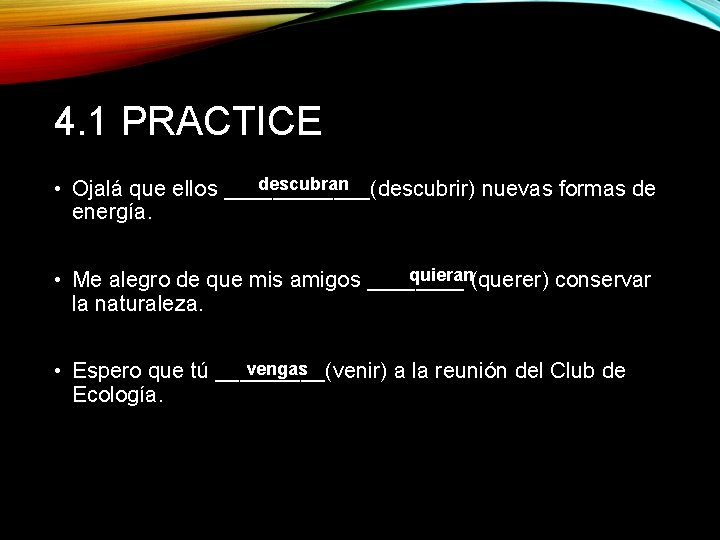
4. 1 PRACTICE descubran • Ojalá que ellos ______(descubrir) nuevas formas de energía. quieran(querer) conservar • Me alegro de que mis amigos ____ la naturaleza. vengas • Espero que tú _____(venir) a la reunión del Club de Ecología.
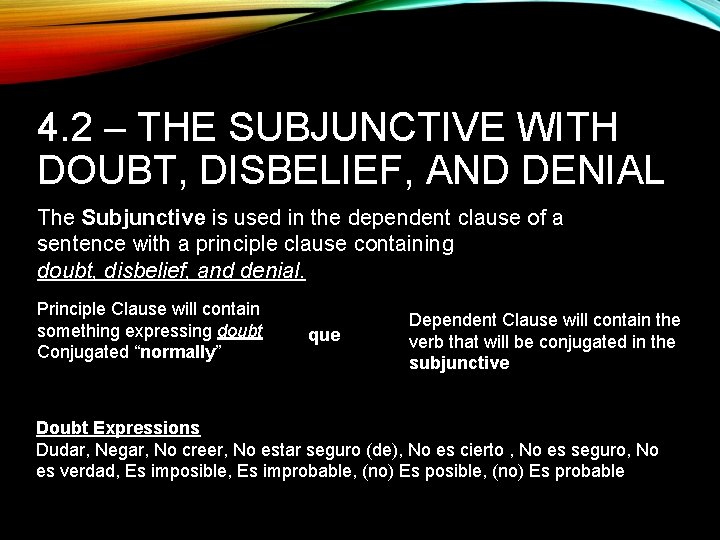
4. 2 – THE SUBJUNCTIVE WITH DOUBT, DISBELIEF, AND DENIAL The Subjunctive is used in the dependent clause of a sentence with a principle clause containing doubt, disbelief, and denial. Principle Clause will contain something expressing doubt Conjugated “normally” que Dependent Clause will contain the verb that will be conjugated in the subjunctive Doubt Expressions Dudar, Negar, No creer, No estar seguro (de), No es cierto , No es seguro, No es verdad, Es imposible, Es improbable, (no) Es posible, (no) Es probable
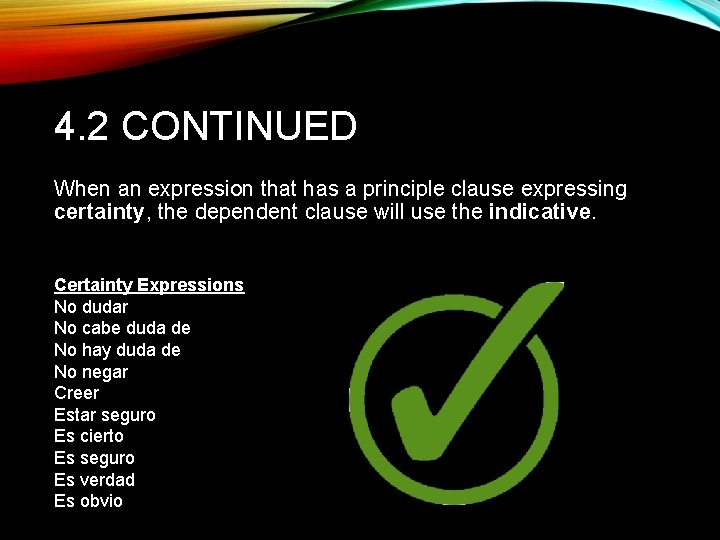
4. 2 CONTINUED When an expression that has a principle clause expressing certainty, the dependent clause will use the indicative. Certainty Expressions No dudar No cabe duda de No hay duda de No negar Creer Estar seguro Es cierto Es seguro Es verdad Es obvio
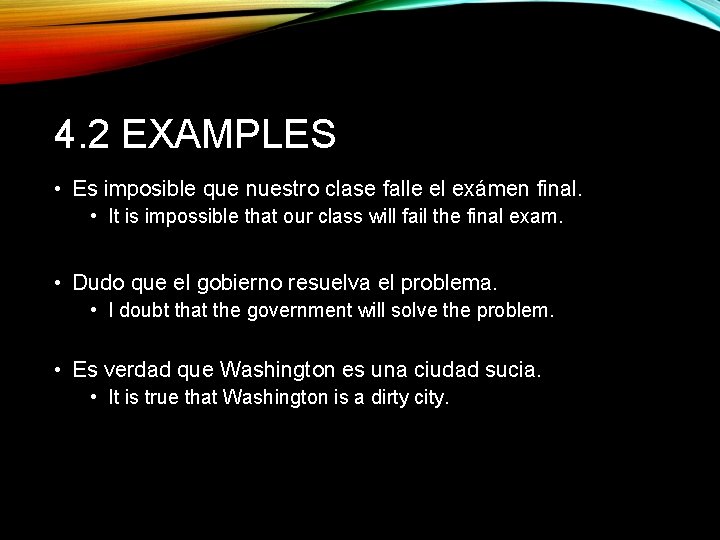
4. 2 EXAMPLES • Es imposible que nuestro clase falle el exámen final. • It is impossible that our class will fail the final exam. • Dudo que el gobierno resuelva el problema. • I doubt that the government will solve the problem. • Es verdad que Washington es una ciudad sucia. • It is true that Washington is a dirty city.
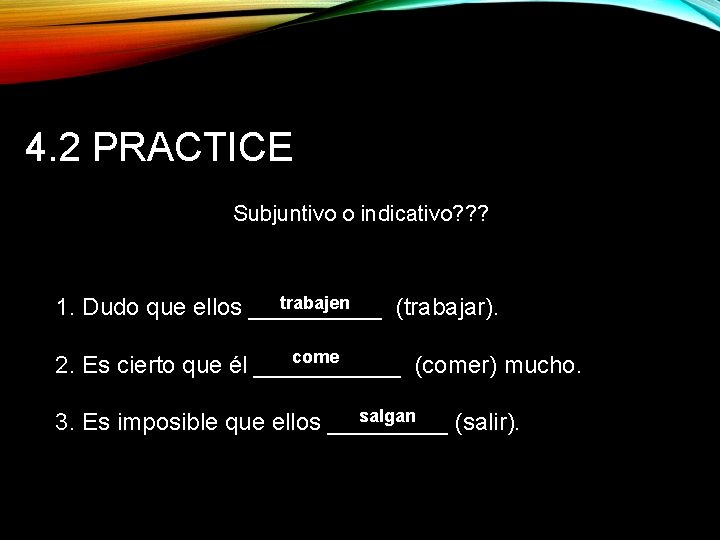
4. 2 PRACTICE Subjuntivo o indicativo? ? ? trabajen 1. Dudo que ellos _____ (trabajar). come 2. Es cierto que él ______ (comer) mucho. salgan 3. Es imposible que ellos _____ (salir).
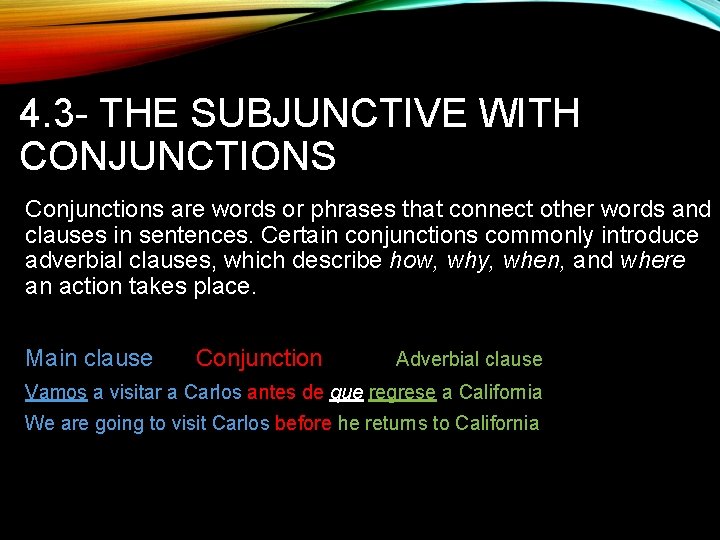
4. 3 - THE SUBJUNCTIVE WITH CONJUNCTIONS Conjunctions are words or phrases that connect other words and clauses in sentences. Certain conjunctions commonly introduce adverbial clauses, which describe how, why, when, and where an action takes place. Main clause Conjunction Adverbial clause Vamos a visitar a Carlos antes de que regrese a California We are going to visit Carlos before he returns to California
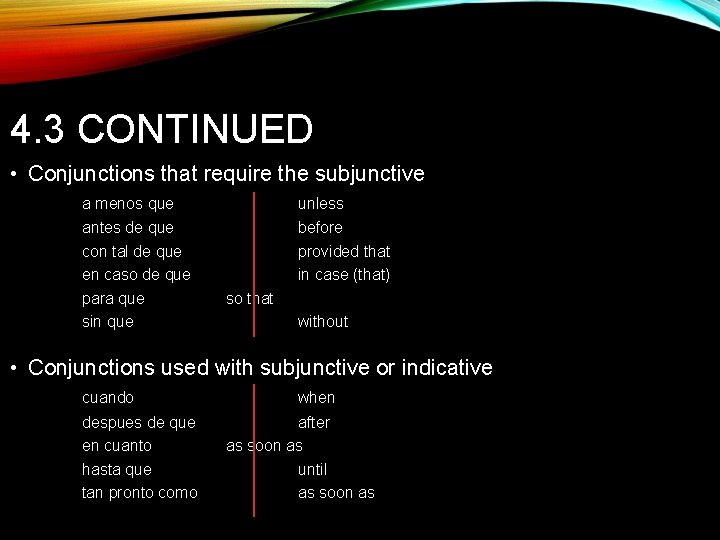
4. 3 CONTINUED • Conjunctions that require the subjunctive a menos que unless antes de que con tal de que en caso de que para que sin que before provided that in case (that) so that without • Conjunctions used with subjunctive or indicative cuando despues de que en cuanto hasta que tan pronto como when after as soon as until as soon as
4. 3 EXAMPLES 1) Voy a dejar un recado en caso de que Gustavo me llame. I’m going to leave a message in case Gustavo calls me. 2) Voy al supermercado para que tengas algo de comer. I’m going to the store so that you’ll have something to eat.
PRACTICE PROBLEMS 1. Voy a estudiar ecologia cuando ____(ir) a la universidad. 2. No podemos evitar la lluvia acida a menos que todos ______ (trabajar) juntos. 3. Siempre recogemos mucha basura cuando ____(ir) al parque. 4. El gobierno debe crear mas parques nacionales antes de que los bosques y rios _______(estar) completamente contaminados. 5. La gente recicla con tal de que no _______(ser) dificil.
5. 1 THE SUBJUNCTIVE IN ADJECTIVE CLAUSES • The Subjunctive is a tense that refers to a person, place, thing, or idea that either does not exist or whose existence is uncertain or indefinite.
WHEN TO USE THE INDICATIVE • When The adjective clause refers to a person. Place, thing, or idea that is clearly known, certain, or definite, the indicative is used • Examples: • Quiero ir al supermercado que vende productos venezolanos • I want to go to the supermarket that sells venezuelan products • Busco al profesor que enseña japonés • Im looking for the professor who teaches Japanese
WHEN TO USE THE SUBJUNCTIVE • The subjunctive is commonly used in questions with adjective clauses when the speaker is trying to find out information about which he or she is uncertain • Example: • Hay un parque esté cerca de nuestro hotel? Is there a park that’s near our hotel? Si, hay un parque está muy cerca del hotel yes, there’s a park that’s very near the hotel
WORDS THAT ARE COMMONLY USED WITH THE SUBJUNCTIVE • Buscar • Haber • No Encontrar • Conocer • Haber • Necesitar • Querer
PRACTICE PROBLEMS • Dudamos que tú______(saber) esgirmir, Mentirosa! • No dudo que tú ____(ser) Diferentes pero no menos difciles.
- Slides: 28