
The structure System distinction Syntagmatic Paradigmatic relationship Lecture
- Slides: 21
The structure/ System distinction, Syntagmatic & Paradigmatic relationship Lecture # 11
Review of Lecture # 10 � Language made of signs � Linguistic sign has two parts – Signifier & Signified � That which signifies (the word) – Signifier � That which is signified (the concept) – Signified � Sign – composite of both, it consists of the relationship between signifier & signified � Saussure’s contribution
Structure/system distinction � By now we can say that language is structured � It’s a system of system � It is structured in such a way that it’s elements are inter-related to form a system at each level of it’s structure i. e. � sounds inter-related to form the phonological system � words inter-related to form the morphological system
Structure/ system distinction � Word-classes inter-related to form syntactic system � Robins compares the structure to that of an orchestra � The members of an orchestra related to each other by their specific roles as orchestra players in the orchestra as a whole and as smaller groups within the orchestra (e. g. group of violinists, group of bass players)
The Structure/system distinction � Each player performs his function by virtue of his place in relation to others. � Players can’t be added to or taken away from an orchestra without changing its quality. � Meaning of structure: An ordered composition of many parts, each part being related to the whole, and also related to other elements within it.
Structure/system distinction � Each part, by inter-relationship of elements in it, constitutes a system � Within each system elements are selected and combined in building up the structure � Example: We wish to build up a word such as ‘take’ We will take some sounds – out of several sounds possible
Structure/system distinction � We select /t/, /ei//k/ & combine them in particular order � We decide which one is to occur first & which later � Selection based on certain rules: We can select one element at a time from among a class of similar elements, e. g. a particular consonant from a class of similar consonents
Structure/system distinction � We choose a noun from a class of nouns, a verb from a class of verbs etc. � Taking the above example, we choose the consonant /t/ instead of /k/ or /b/, and so on, which we could have chosen because they are all similar- they are plosives (they belong to the same category of sounds)
Structure/system distinction � The relationship between the similar elements (because they belong to the same class/category) is called a Paradigmatic relationship � The relationship holds between elements that belong to the same class within a system e. g. the relationship between plosive consonants in phonological system, or between nouns in syntactic system
Structure/system distinction � In the process of combination of these elements, we combine chosen elements in a particular order or sequence. � There are certain rules. � We can combine /t/ + /ei/ + /k/ in this order, but not in the order /ei/ + /t/ + /k/. � There is a particular order or sequence
Structure/system distinction � The three elements that follow one another in a particular sequence are related in relationship called Syntagmatic relationship. � One follows the other in a linear order. � By following this order , the structure of a word or sentence is built up. � Paradigmatic relationship = between elements in a class or system, only one can operate at a time
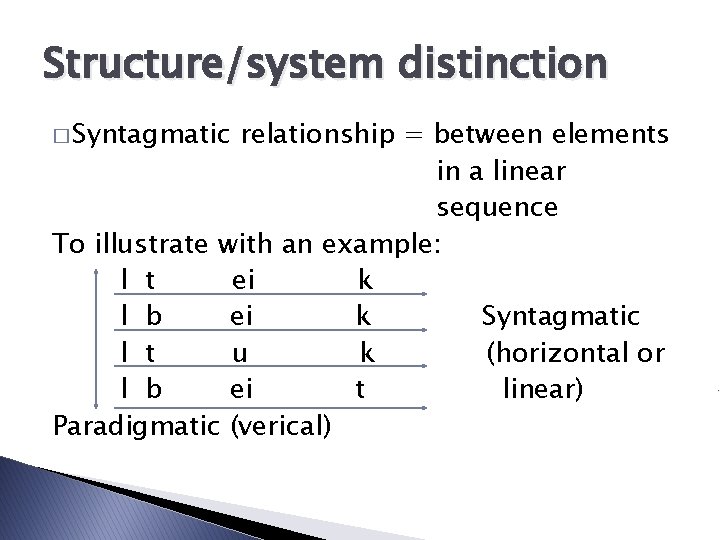
Structure/system distinction � Syntagmatic relationship = between elements in a linear sequence To illustrate with an example: l t ei k l b ei k Syntagmatic l t u k (horizontal or l b ei t linear) Paradigmatic (verical)
Structure/system distinction � In paradigmatic relationship , /t/ /b/, /ei/ can be replaced by /u/, /k/ can be replaced by /t/. � Each can be replaced by another element from within the same system and class. � In the above example, we cannot put a consonant in place of vowel but we can replace one vowel by another.
Structure/system distinction � In syntagmatic relationship, the elements have to be combined in the proper sequence. � We � On cannot violate sequential order. the basis of paradigmatic & syntagmatic relationships, rules of selection and combination operate, and taken together – they constitute the structure of language
Structure/system distinction � Two intersecting threads build up fabric of language. � Language has duality of structure. � At one level we select the elements out of many, at another level, we combine these elements to form a structural unit � With a limited number of elements, we can construct a large number of combinations
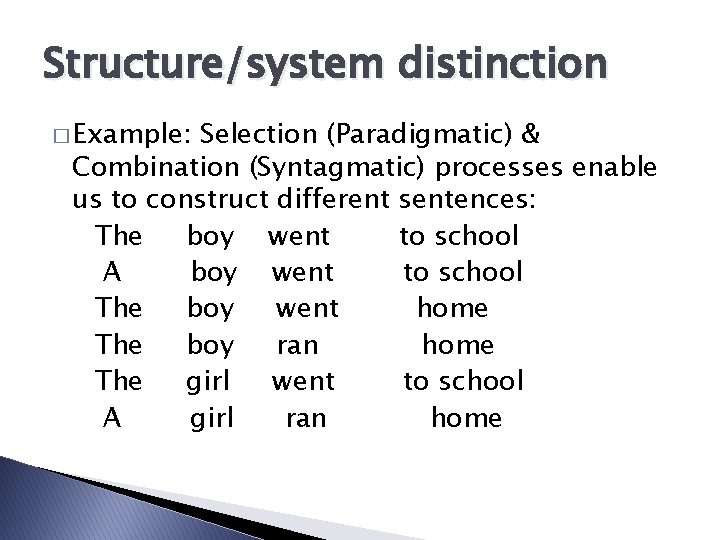
Structure/system distinction � Example: Selection (Paradigmatic) & Combination (Syntagmatic) processes enable us to construct different sentences: The boy went to school A boy went to school The boy went home The boy ran home The girl went to school A girl ran home
Structure/system distinction � Other variation possible depending on choice of elements from each category at paradigmatic level. � Elements in each category are discrete and separable from elements in another category. � This gives us a lot of flexibility or choice of the elements
Structure/system distinction � Variations possible also at syntagmatic level but there are rules. � In the above example: We can substitute ‘home’ for ‘to school’ because both can function in adjunct position at the end of the sentence; but we can’t have ‘to school the boy went’ or ‘went home the girl’ - they violate syntagmatic relationship
Structure/system distinction � Sometimes violate this relationship: e. g. ‘Home is the sailor, home from the sea/And the hunter Home from the hill’ – done for emphasis and a particular rhythm
Structure/system distinction (Summary) � System – set of paradigmatic relationships between elements � Structure – set of syntagmatic relationships between elements at each level in the language � At level of sounds – phonological system (vowels & consonants) & phonological structure ( determining combination of vowels & consonants)
Structure/system distinction (Summary) � At level of sentence- formation, we have syntactic system (word classes such as noun, verb, adjective, adverb) & syntactic structure (determining combination of these word classes) to enable formation of sentences