
The Structure of Urban Residential Housing Submarkets of
The Structure of Urban Residential Housing Sub-markets of Hong Kong Presented by Daniel LO, Ph. D The University of Hong Kong Email: daniello@hku. hk

Introduction � Widely acknowledged that housing submarkets should be adopted as a working hypothesis. � Objective: ◦ Using geo-referenced property transaction data to define the housing submarket structure of Hong Kong. � Hypothesis: ◦ Submarkets defined by geo-referenced property transaction data can improve forecasting accuracy of housing prices, compared with prevailing submarket structure.
� How did we define housing submarkets? ◦ Physically �e. g. structural types (Adair et al. 1996), number of rooms (Schnare and Struyk, 1976), floor areas (Bajic 1985) ◦ Socioeconomically �e. g. income (Strazheim 1975), race and ethnic groups (Palm 1978), religious parishes (Adair et al. 2000) ◦ Spatially/geographically �e. g. natural boundaries (Munro 1986), political boundaries (Adair et al. 1996), school catchment areas (Goodman and Thibodeau 1998), neighborhood characteristics (Galster 1987; Schnare 1980) ◦ Using expert knowledge �Defined by real estate professionals (Michael and Smith 1990) ◦ Hybrid
� Problems with previous definitions of housing submarket. ◦ Imposed rather than derived. ◦ No. of submarkets defined, shape and size of the submarkets are fixed. ◦ Cannot capture the dynamics of economic activities involved. ◦ Some neighborhood information are incomplete/unquantifiable/unobservable. ◦ No rule to know that the submarket structure is defined in an optimal way.
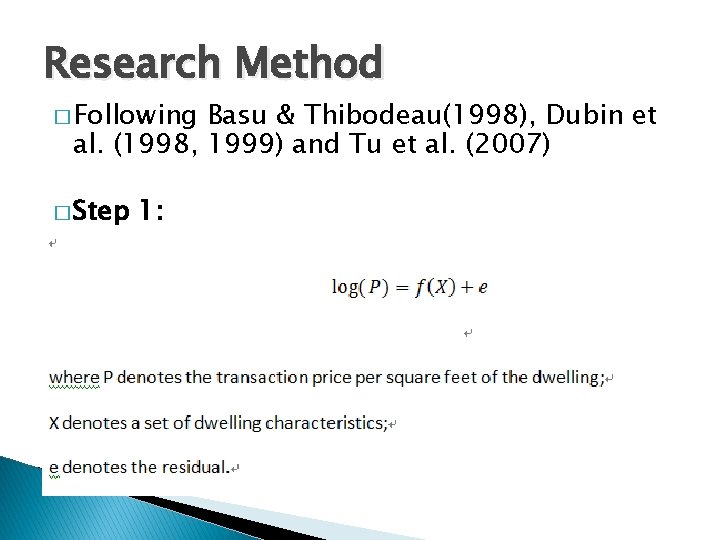
Research Method � Following Basu & Thibodeau(1998), Dubin et al. (1998, 1999) and Tu et al. (2007) � Step 1:
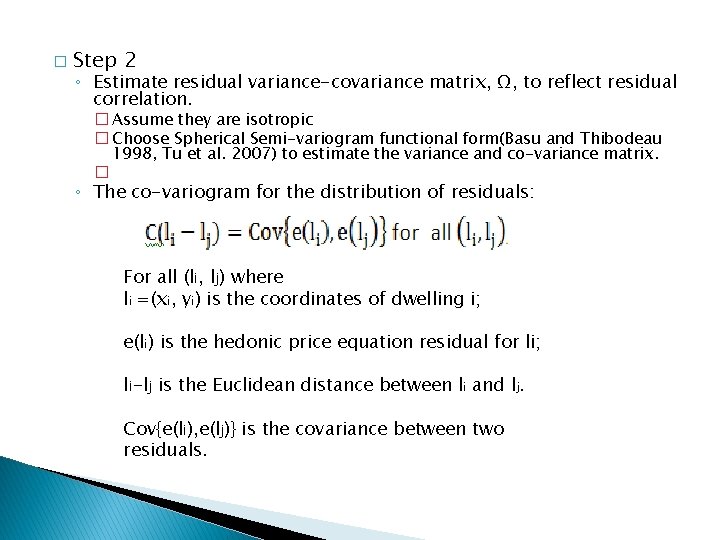
� Step 2 ◦ Estimate residual variance-covariance matrix, Ω, to reflect residual correlation. � Assume they are isotropic � Choose Spherical Semi-variogram functional form(Basu and Thibodeau 1998, Tu et al. 2007) to estimate the variance and co-variance matrix. � ◦ The co-variogram for the distribution of residuals: For all (li, lj) where li =(xi, yi) is the coordinates of dwelling i; e(li) is the hedonic price equation residual for li; li-lj is the Euclidean distance between li and lj. Cov{e(li), e(lj)} is the covariance between two residuals.
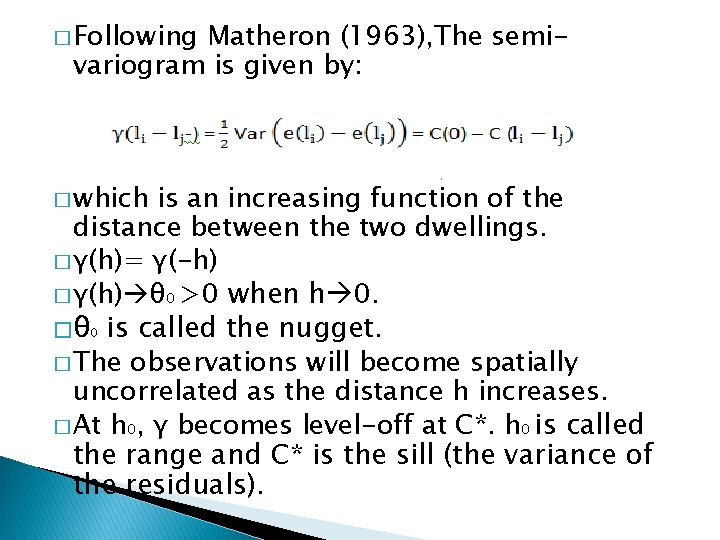
� Following Matheron (1963), The semivariogram is given by: � which is an increasing function of the distance between the two dwellings. � γ(h)= γ(-h) � γ(h) θ 0 >0 when h 0. � θ 0 is called the nugget. � The observations will become spatially uncorrelated as the distance h increases. � At h 0, γ becomes level-off at C*. h 0 is called the range and C* is the sill (the variance of the residuals).
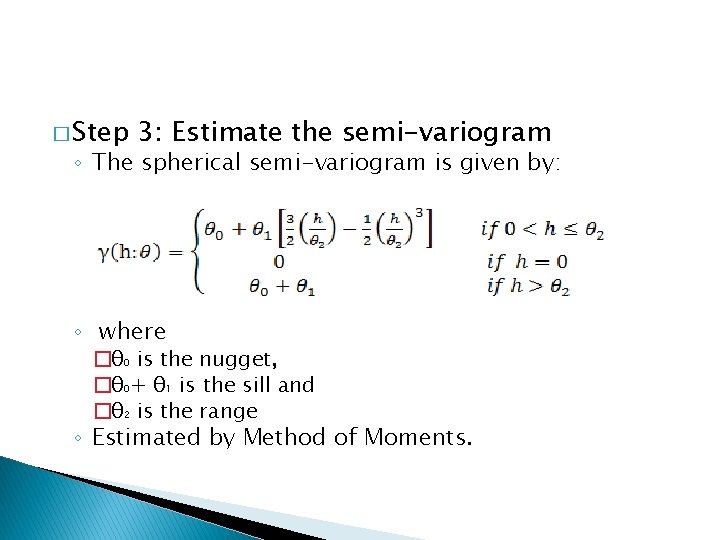
� Step 3: Estimate the semi-variogram ◦ The spherical semi-variogram is given by: ◦ where �θ 0 is the nugget, �θ 0+ θ 1 is the sill and �θ 2 is the range ◦ Estimated by Method of Moments.
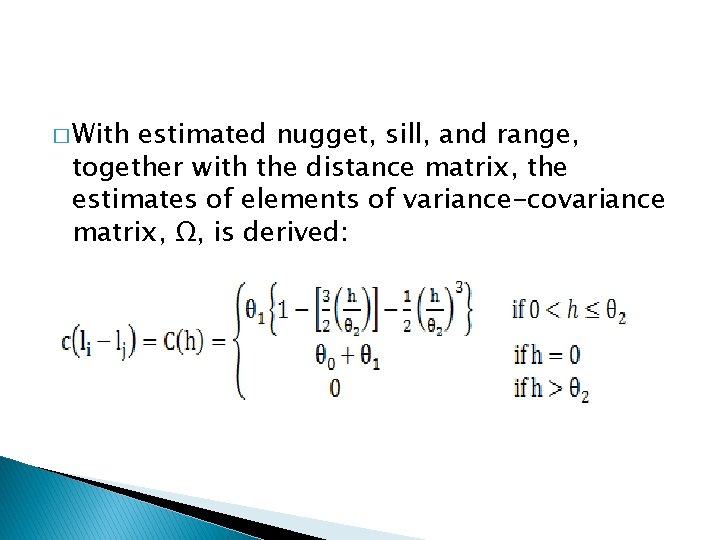
� With estimated nugget, sill, and range, together with the distance matrix, the estimates of elements of variance-covariance matrix, Ω, is derived:
� Step 4: Clustering the dwellings ◦ Begin with l 1 , if the distance between l 1 and l 2 is shorter than the estimated range, then they are grouped into one cluster, say cluster 1. ◦ If the distance from l 3 tol 2 is greater than the estimated range, but the distance from l 3 to l 1 is shorter than the estimated range, we still group into cluster 1. ◦ Repeat the above processes for all observations. ◦ We then can obtain many different clusters based on the spatial autocorrelation structure of the residuals.
� Step 5: Forming housing submarkets ◦ Applied a standard submarket test, Chow (F) test, to each pair of clusters defined. � Step 6: ◦ Adopt weighted mean square test to calculate the forecasting accuracy of the derived submarket structure. ◦ Compare it with that of the prevailing submarket structure.
Our data � Urban housing market of Hong Kong, i. e. Hong Kong Island (pop: approx. 1, 250, 000) � All data are geo-coded � January 1, 2006 to December 31, 2006 � 13700 transaction data � Source of data: A database from a local real estate agent
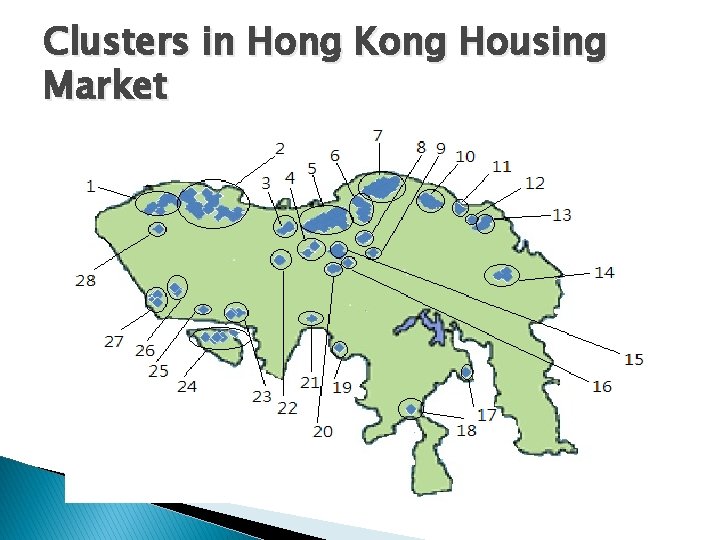
Clusters in Hong Kong Housing Market
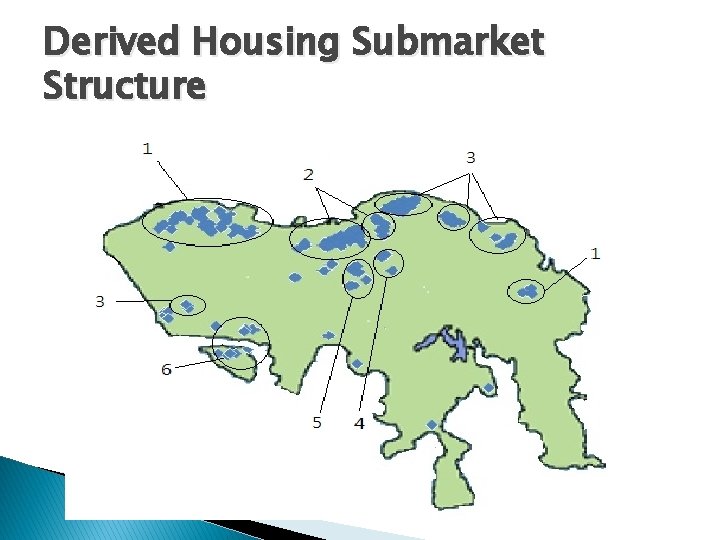
Derived Housing Submarket Structure
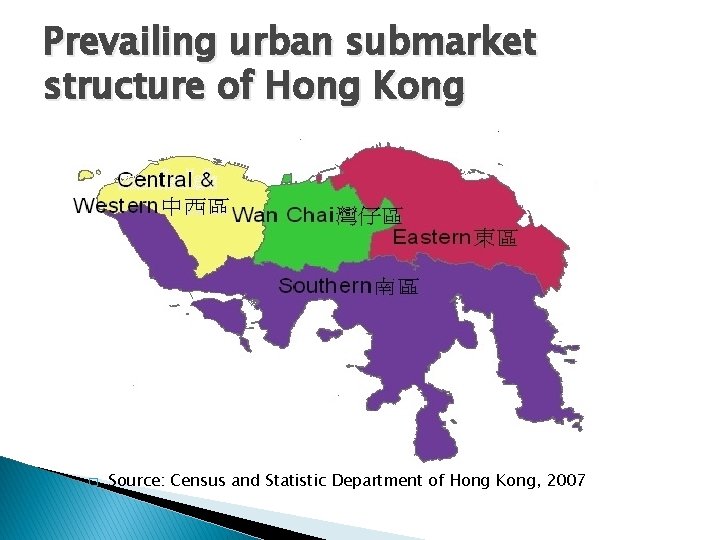
Prevailing urban submarket structure of Hong Kong � Source: Census and Statistic Department of Hong Kong, 2007
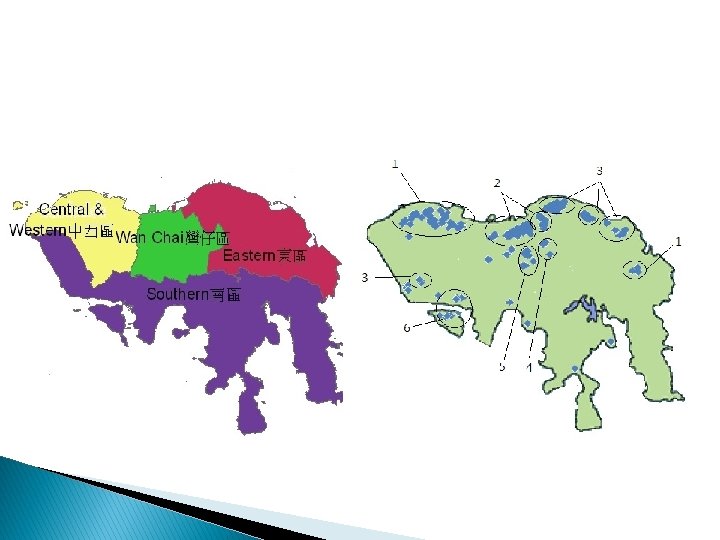
Results � More submarkets are defined. � The patterns are dissimilar. � Submarkets need not be geographically adjacent to each other. � Some clusters are unclassified. � Physical boundaries can not delineate submarkets. � R-squared of Hedonic regression increases from 18% to 59% when compared with the prediction against the whole market. � The submarket structure significantly improves forecasting power by 46% if compare with the prediction against whole market, or by 23% if compared with the prediction against prevailing submarkets.
Interpretation and Implication � The prevailing submarket is administratively or politically imposed. ◦ As a result of history, or for the sake of administrative convenience. � Verify that spatial autocorrelation is crucial in modeling housing prices. � Practical applications ◦ Property valuation, housing analysis, government urban planning, etc.
Future Studies � 1 Compare with more submarket structures. � 2 Temporal stability of the submarket structure. � 3 Anisotropic rather than isotropic. � 4 Delineation of submarkets in terms of housing price changes.

Thank you! If you have any comments, please send email to daniello@hku. hk
- Slides: 20