
The structure of the proton NLO QCD fits

- Slides: 29
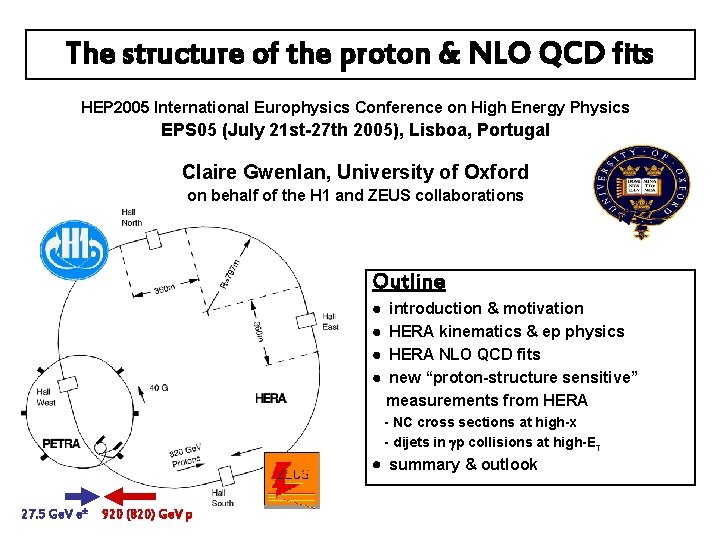
The structure of the proton & NLO QCD fits HEP 2005 International Europhysics Conference on High Energy Physics EPS 05 (July 21 st-27 th 2005), Lisboa, Portugal Claire Gwenlan, University of Oxford on behalf of the H 1 and ZEUS collaborations Outline introduction & motivation HERA kinematics & ep physics HERA NLO QCD fits new “proton-structure sensitive” measurements from HERA - NC cross sections at high-x - dijets in p collisions at high-ET summary & outlook 27. 5 Ge. V e± 920 (820) Ge. V p
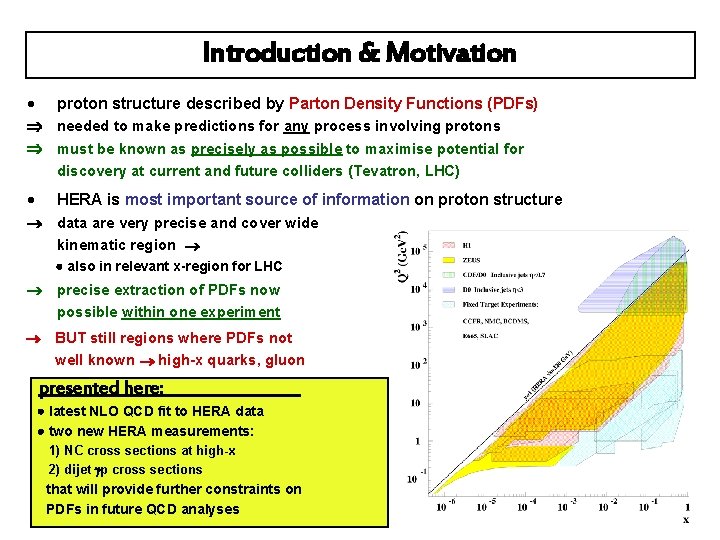
Introduction & Motivation proton structure described by Parton Density Functions (PDFs) needed to make predictions for any process involving protons must be known as precisely as possible to maximise potential for discovery at current and future colliders (Tevatron, LHC) HERA is most important source of information on proton structure data are very precise and cover wide kinematic region also in relevant x-region for LHC precise extraction of PDFs now possible within one experiment BUT still regions where PDFs not well known high-x quarks, gluon presented here: latest NLO QCD fit to HERA data two new HERA measurements: 1) NC cross sections at high-x 2) dijet p cross sections that will provide further constraints on PDFs in future QCD analyses
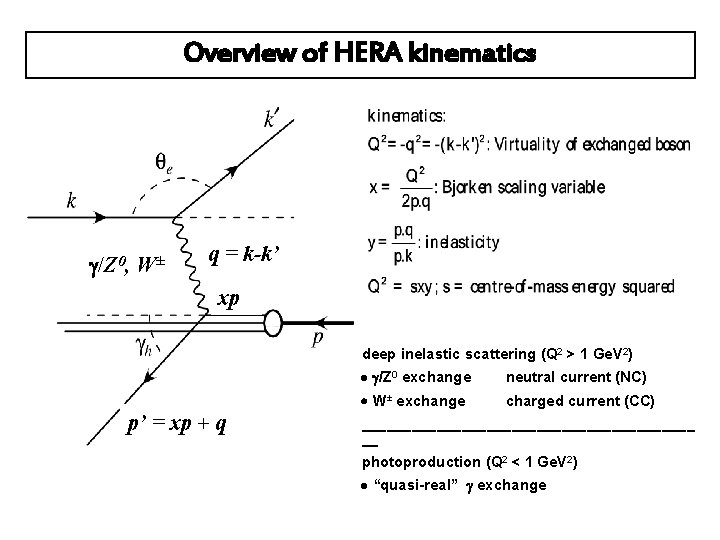
Overview of HERA kinematics /Z 0, W± q = k-k’ xp deep inelastic scattering (Q 2 > 1 Ge. V 2) p’ = xp + q /Z 0 exchange neutral current (NC) W± exchange charged current (CC) ____________________ __ photoproduction (Q 2 < 1 Ge. V 2) “quasi-real” exchange
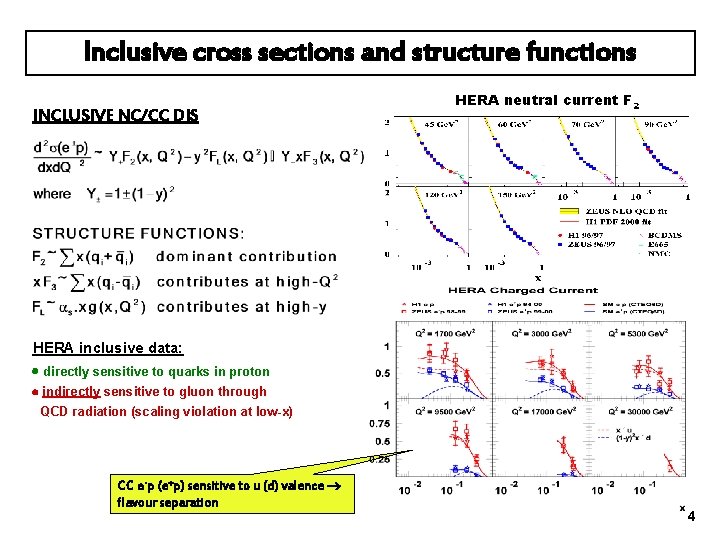
Inclusive cross sections and structure functions INCLUSIVE NC/CC DIS HERA neutral current F 2 HERA inclusive data: directly sensitive to quarks in proton indirectly sensitive to gluon through QCD radiation (scaling violation at low-x) CC e-p (e+p) sensitive to u (d) valence flavour separation 4
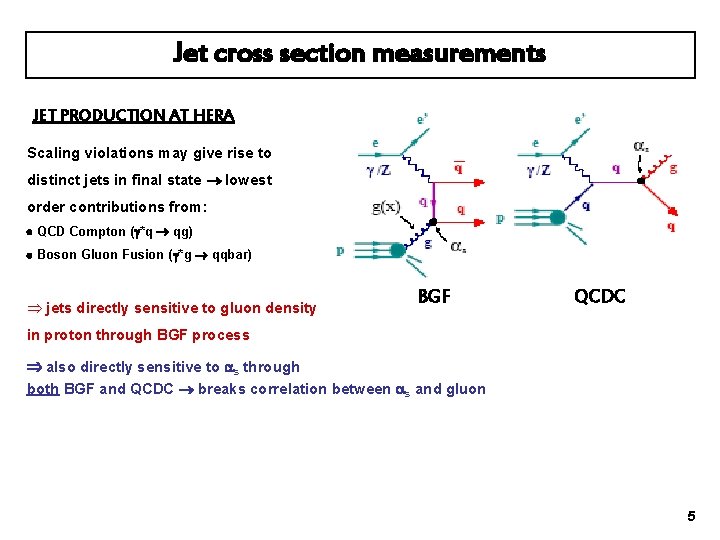
Jet cross section measurements JET PRODUCTION AT HERA Scaling violations may give rise to distinct jets in final state lowest order contributions from: QCD Compton ( *q qg) Boson Gluon Fusion ( *g qqbar) Þ jets directly sensitive to gluon density BGF QCDC in proton through BGF process also directly sensitive to s through both BGF and QCDC breaks correlation between s and gluon 5
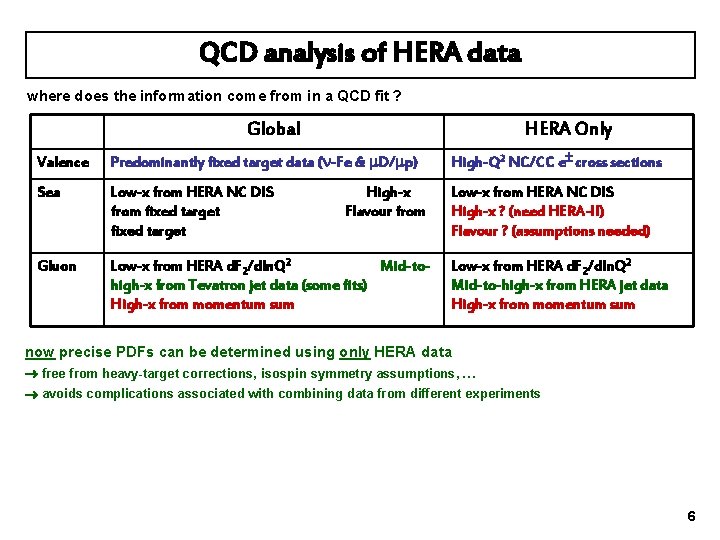
QCD analysis of HERA data where does the information come from in a QCD fit ? Global HERA Only Valence Predominantly fixed target data ( -Fe & D/ p) High-Q 2 NC/CC e cross sections Sea Low-x from HERA NC DIS from fixed target Low-x from HERA NC DIS High-x ? (need HERA-II) Flavour ? (assumptions needed) Gluon Low-x from HERA d. F 2/dln. Q 2 Mid-tohigh-x from Tevatron jet data (some fits) High-x from momentum sum High-x Flavour from Low-x from HERA d. F 2/dln. Q 2 Mid-to-high-x from HERA jet data High-x from momentum sum now precise PDFs can be determined using only HERA data free from heavy-target corrections, isospin symmetry assumptions, … avoids complications associated with combining data from different experiments 6
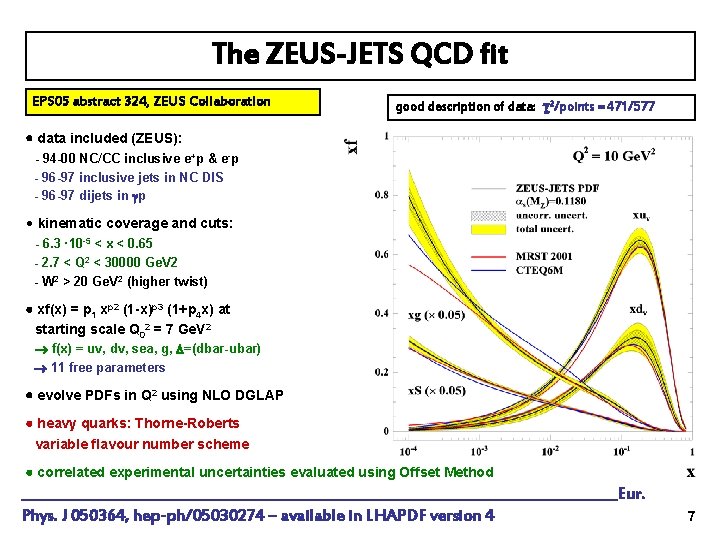
The ZEUS-JETS QCD fit EPS 05 abstract 324, ZEUS Collaboration good description of data: 2/points = 471/577 data included (ZEUS): - 94 -00 NC/CC inclusive e+p & e-p - 96 -97 inclusive jets in NC DIS - 96 -97 dijets in p kinematic coverage and cuts: - 6. 3 · 10 -5 < x < 0. 65 - 2. 7 < Q 2 < 30000 Ge. V 2 - W 2 > 20 Ge. V 2 (higher twist) xf(x) = p 1 xp 2 (1 -x)p 3 (1+p 4 x) at starting scale Q 02 = 7 Ge. V 2 f(x) = uv, dv, sea, g, =(dbar-ubar) 11 free parameters evolve PDFs in Q 2 using NLO DGLAP heavy quarks: Thorne-Roberts variable flavour number scheme correlated experimental uncertainties evaluated using Offset Method ___________________________________________Eur. Phys. J 050364, hep-ph/05030274 – available in LHAPDF version 4 7
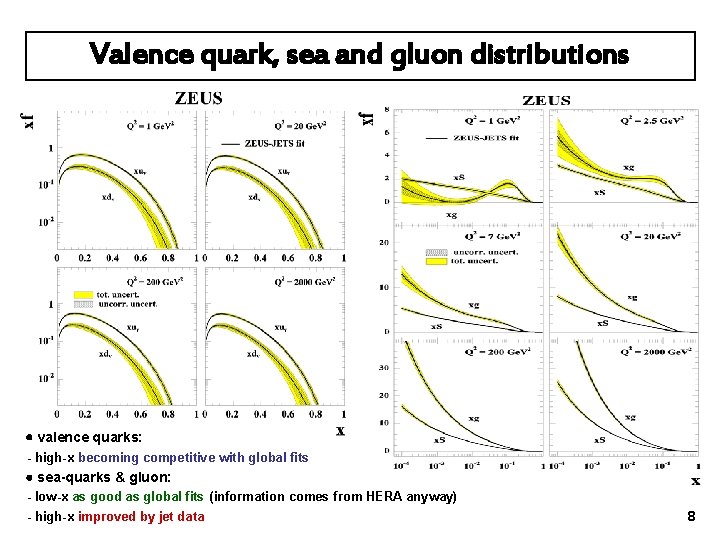
Valence quark, sea and gluon distributions valence quarks: - high-x becoming competitive with global fits sea-quarks & gluon: - low-x as good as global fits (information comes from HERA anyway) - high-x improved by jet data 8
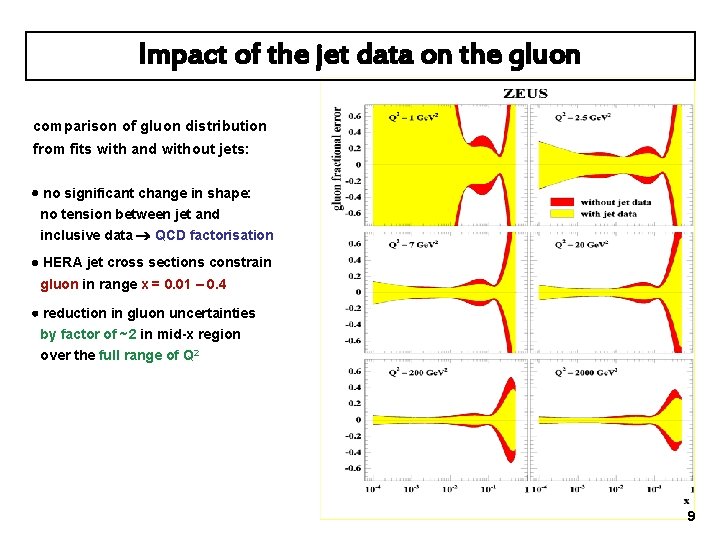
Impact of the jet data on the gluon comparison of gluon distribution from fits with and without jets: no significant change in shape: no tension between jet and inclusive data QCD factorisation HERA jet cross sections constrain gluon in range x = 0. 01 – 0. 4 reduction in gluon uncertainties by factor of ~2 in mid-x region over the full range of Q 2 9
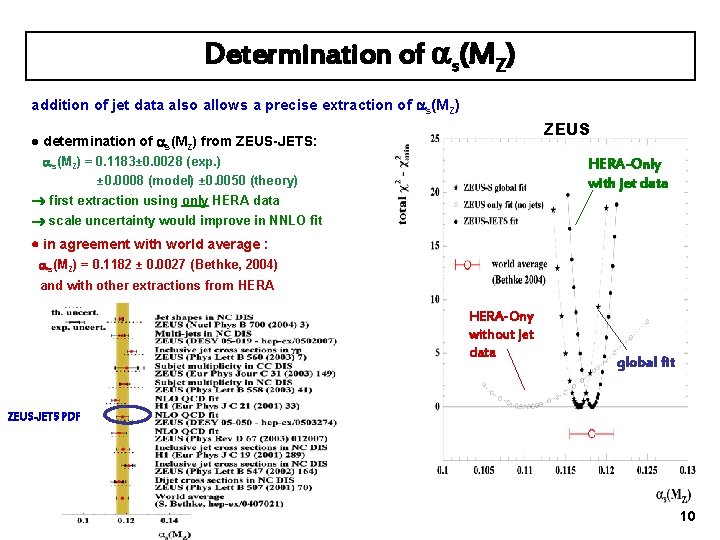
Determination of s(MZ) addition of jet data also allows a precise extraction of s(MZ) ZEUS determination of s(MZ) from ZEUS-JETS: s(MZ) = 0. 1183± 0. 0028 (exp. ) ± 0. 0008 (model) ± 0. 0050 (theory) HERA-Only with jet data first extraction using only HERA data scale uncertainty would improve in NNLO fit in agreement with world average : s(MZ) = 0. 1182 ± 0. 0027 (Bethke, 2004) and with other extractions from HERA-Ony without jet data global fit ZEUS-JETS PDF 10
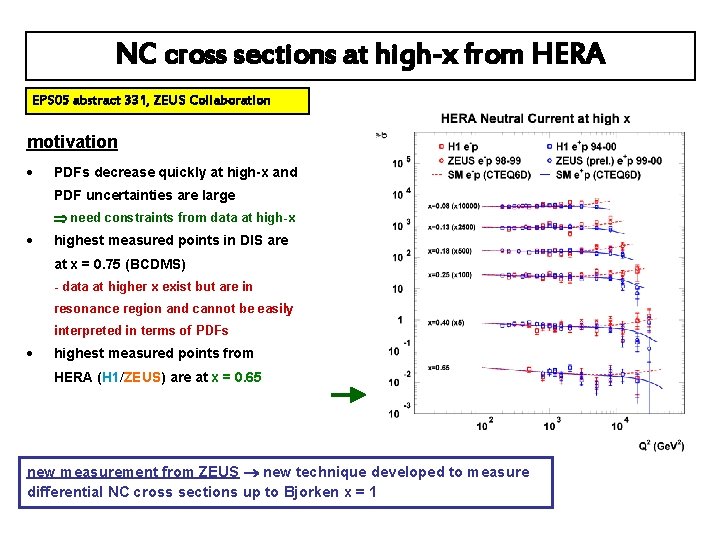
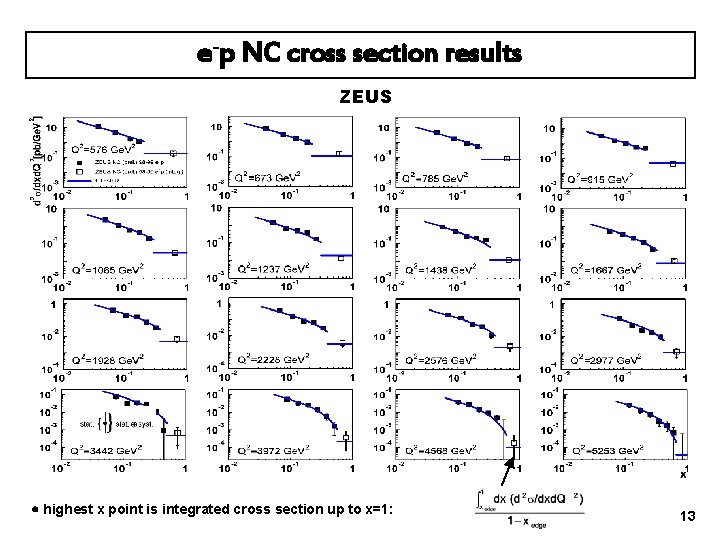
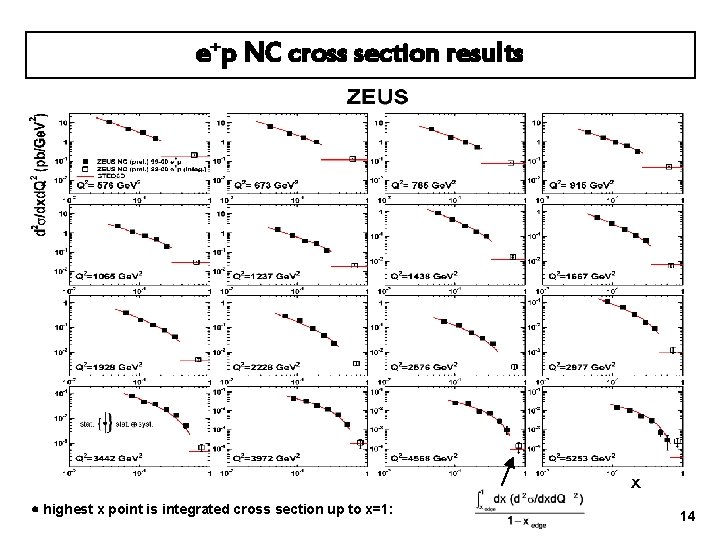
NC cross sections at high-x from HERA EPS 05 abstract 331, ZEUS Collaboration motivation PDFs decrease quickly at high-x and PDF uncertainties are large need constraints from data at high-x highest measured points in DIS are at x = 0. 75 (BCDMS) - data at higher x exist but are in resonance region and cannot be easily interpreted in terms of PDFs highest measured points from HERA (H 1/ZEUS) are at x = 0. 65 new measurement from ZEUS new technique developed to measure differential NC cross sections up to Bjorken x = 1
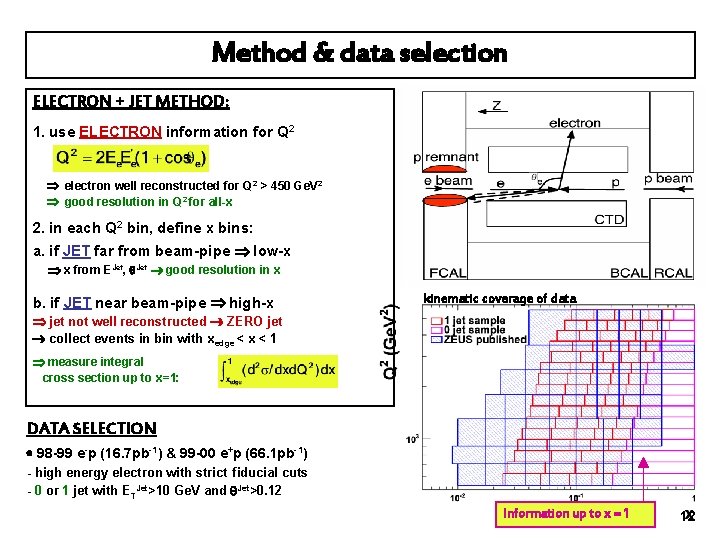
Method & data selection ELECTRON + JET METHOD: 1. use ELECTRON information for Q 2 electron well reconstructed for Q 2 > 450 Ge. V 2 good resolution in Q 2 for all-x 2. in each Q 2 bin, define x bins: a. if JET far from beam-pipe low-x x from EJet, Jet good resolution in x b. if JET near beam-pipe high-x kinematic coverage of data jet not well reconstructed ZERO jet collect events in bin with xedge < x < 1 measure integral cross section up to x=1: DATA SELECTION 98 -99 e-p (16. 7 pb-1) & 99 -00 e+p (66. 1 pb-1) - high energy electron with strict fiducial cuts - 0 or 1 jet with ETJet>10 Ge. V and Jet>0. 12 Information up to x = 1 12
e-p NC cross section results ZEUS highest x point is integrated cross section up to x=1: 13
e+p NC cross section results highest x point is integrated cross section up to x=1: 14
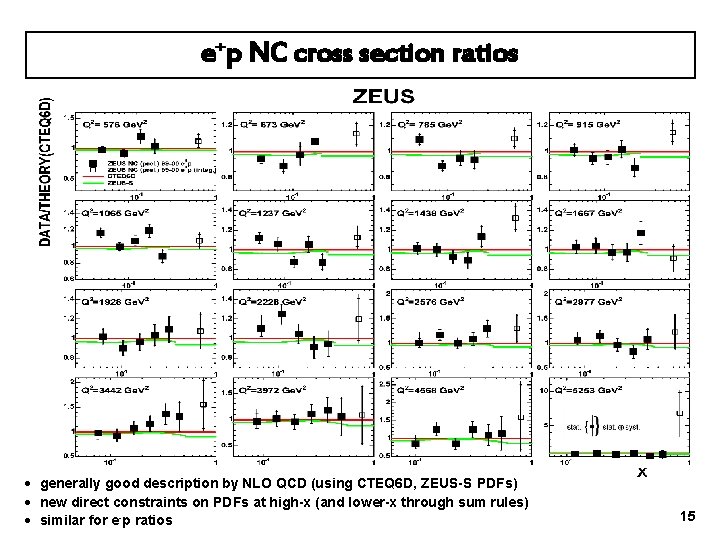
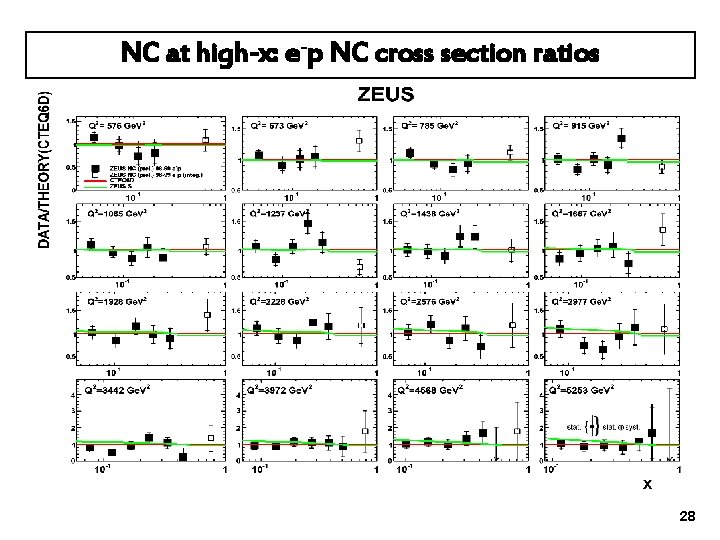
e+p NC cross section ratios generally good description by NLO QCD (using CTEQ 6 D, ZEUS-S PDFs) new direct constraints on PDFs at high-x (and lower-x through sum rules) similar for e-p ratios 15
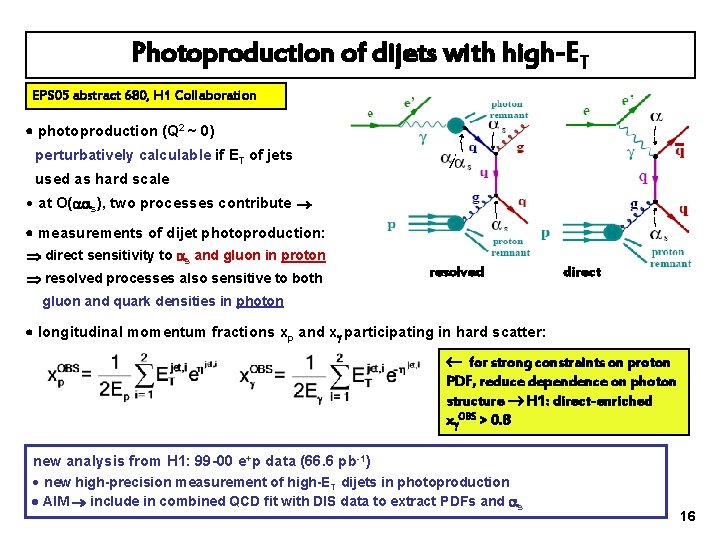
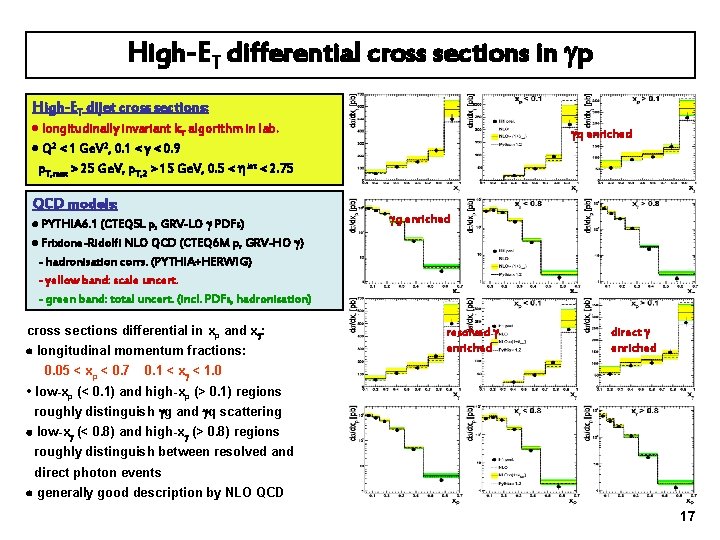
Photoproduction of dijets with high-ET EPS 05 abstract 680, H 1 Collaboration photoproduction (Q 2 ~ 0) perturbatively calculable if ET of jets used as hard scale at O( s), two processes contribute measurements of dijet photoproduction: direct sensitivity to s and gluon in proton resolved processes also sensitive to both resolved direct gluon and quark densities in photon longitudinal momentum fractions xp and x participating in hard scatter: for strong constraints on proton PDF, reduce dependence on photon structure H 1: direct-enriched x OBS > 0. 8 new analysis from H 1: 99 -00 e+p data (66. 6 pb-1) new high-precision measurement of high-ET dijets in photoproduction AIM include in combined QCD fit with DIS data to extract PDFs and s 16
High-ET differential cross sections in p High-ET dijet cross sections: longitudinally invariant k. T algorithm in lab. Q 2 < 1 Ge. V 2, 0. 1 < y < 0. 9 p. T, max > 25 Ge. V, p. T, 2 > 15 Ge. V, 0. 5 < Jet < 2. 75 QCD models: PYTHIA 6. 1 (CTEQ 5 L p, GRV-LO PDFs) Frixione-Ridolfi NLO QCD (CTEQ 6 M p, GRV-HO ) - hadronisation corrs. (PYTHIA+HERWIG) - yellow band: scale uncert. - green band: total uncert. (incl. PDFs, hadronisation) cross sections differential in xp and x : longitudinal momentum fractions: 0. 05 < xp < 0. 7 q enriched g enriched resolved enriched direct enriched 0. 1 < x < 1. 0 • low-xp (< 0. 1) and high-xp (> 0. 1) regions roughly distinguish g and q scattering low-x (< 0. 8) and high-x (> 0. 8) regions roughly distinguish between resolved and direct photon events generally good description by NLO QCD 17
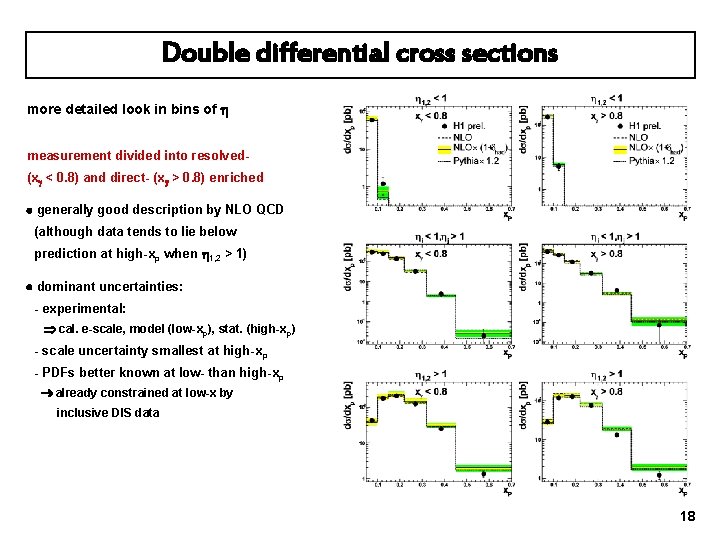
Double differential cross sections more detailed look in bins of measurement divided into resolved(x < 0. 8) and direct- (x > 0. 8) enriched generally good description by NLO QCD (although data tends to lie below prediction at high-xp when 1, 2 > 1) dominant uncertainties: - experimental: cal. e-scale, model (low-xp), stat. (high-xp) - scale uncertainty smallest at high-xp - PDFs better known at low- than high-xp already constrained at low-x by inclusive DIS data 18
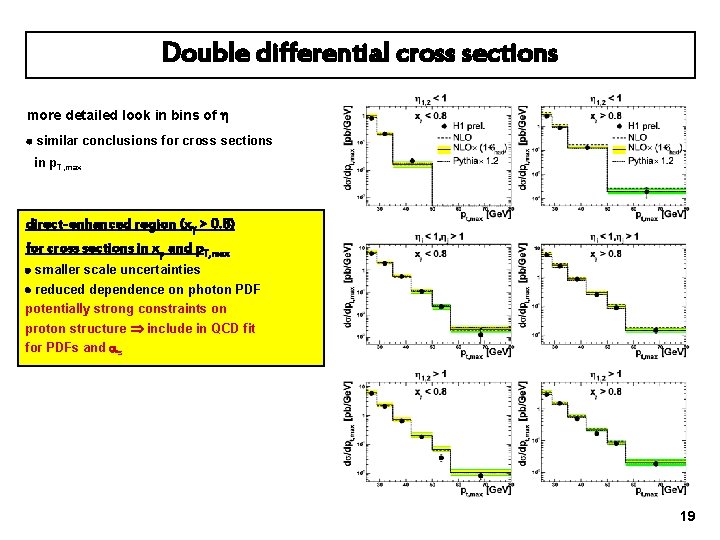
Double differential cross sections more detailed look in bins of similar conclusions for cross sections in p. T, max direct-enhanced region (x > 0. 8) for cross sections in xp and p. T, max smaller scale uncertainties reduced dependence on photon PDF potentially strong constraints on proton structure include in QCD fit for PDFs and s 19
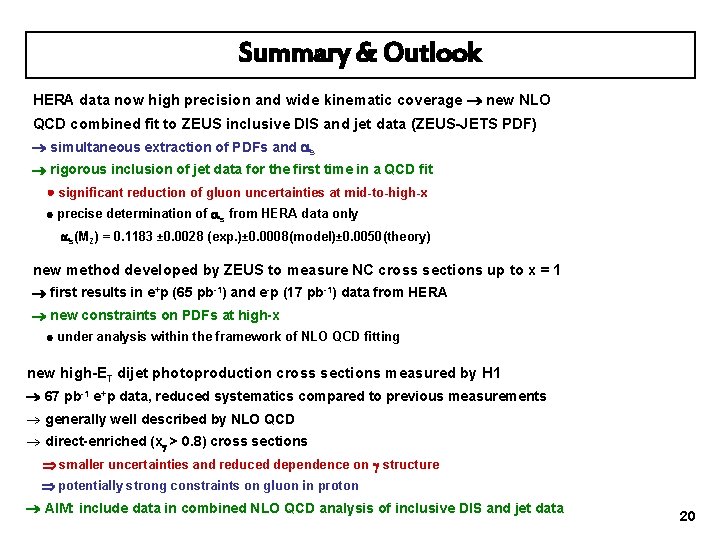
Summary & Outlook HERA data now high precision and wide kinematic coverage new NLO QCD combined fit to ZEUS inclusive DIS and jet data (ZEUS-JETS PDF) simultaneous extraction of PDFs and s rigorous inclusion of jet data for the first time in a QCD fit significant reduction of gluon uncertainties at mid-to-high-x precise determination of s from HERA data only s(MZ) = 0. 1183 ± 0. 0028 (exp. )± 0. 0008(model)± 0. 0050(theory) new method developed by ZEUS to measure NC cross sections up to x = 1 first results in e+p (65 pb-1) and e-p (17 pb-1) data from HERA new constraints on PDFs at high-x under analysis within the framework of NLO QCD fitting new high-ET dijet photoproduction cross sections measured by H 1 67 pb-1 e+p data, reduced systematics compared to previous measurements ® generally well described by NLO QCD ® direct-enriched (x > 0. 8) cross sections smaller uncertainties and reduced dependence on structure potentially strong constraints on gluon in proton AIM: include data in combined NLO QCD analysis of inclusive DIS and jet data 20
Extras … 21
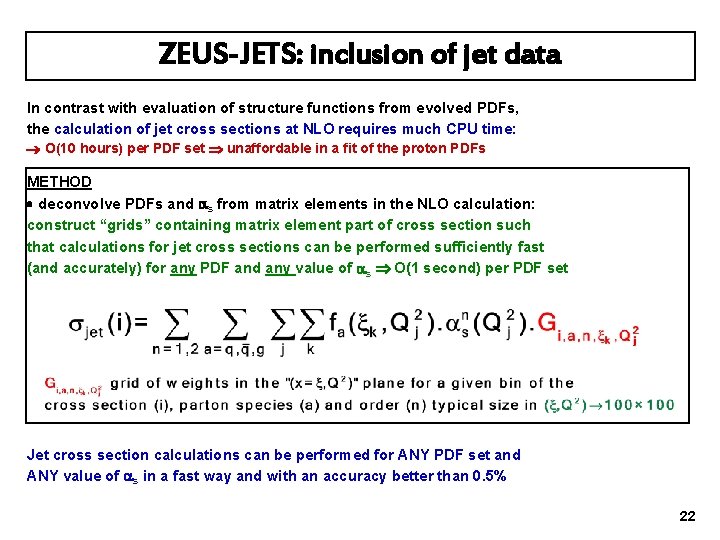
ZEUS-JETS: inclusion of jet data In contrast with evaluation of structure functions from evolved PDFs, the calculation of jet cross sections at NLO requires much CPU time: O(10 hours) per PDF set unaffordable in a fit of the proton PDFs METHOD deconvolve PDFs and s from matrix elements in the NLO calculation: construct “grids” containing matrix element part of cross section such that calculations for jet cross sections can be performed sufficiently fast (and accurately) for any PDF and any value of s O(1 second) per PDF set Jet cross section calculations can be performed for ANY PDF set and ANY value of s in a fast way and with an accuracy better than 0. 5% 22
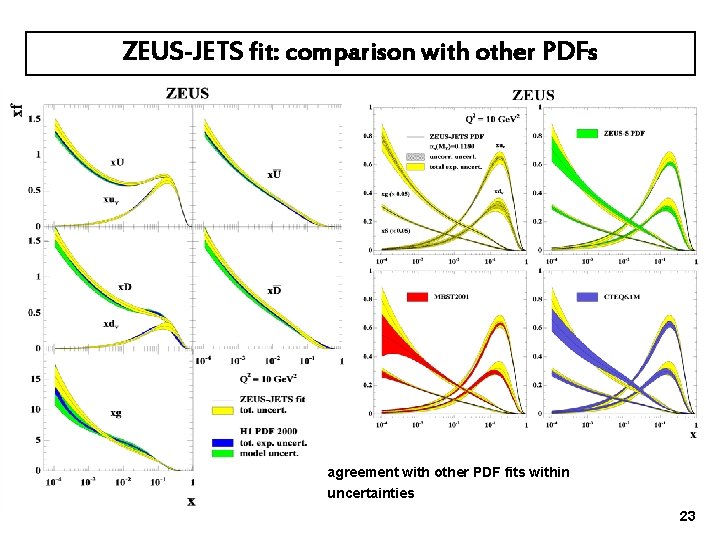
ZEUS-JETS fit: comparison with other PDFs agreement with other PDF fits within uncertainties 23
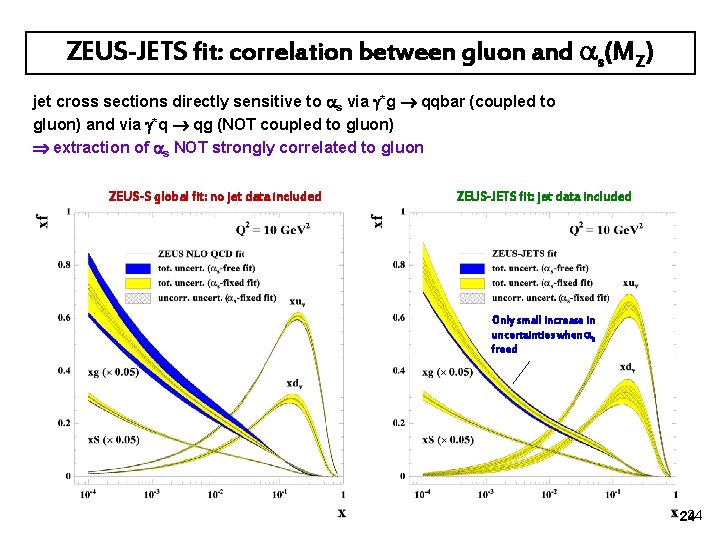
ZEUS-JETS fit: correlation between gluon and s(MZ) jet cross sections directly sensitive to s via *g qqbar (coupled to gluon) and via *q qg (NOT coupled to gluon) extraction of s NOT strongly correlated to gluon ZEUS-S global fit: no jet data included ZEUS-JETS fit: jet data included Only small increase in uncertainties when s freed 24 24
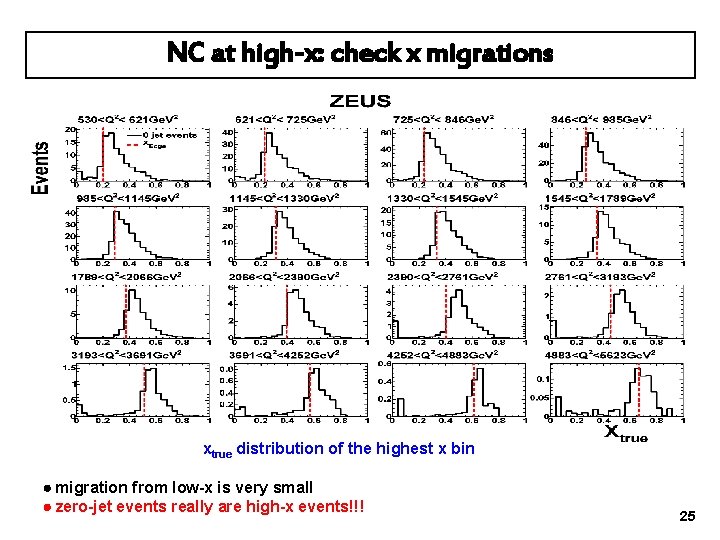
NC at high-x: check x migrations xtrue distribution of the highest x bin migration from low-x is very small zero-jet events really are high-x events!!! 25
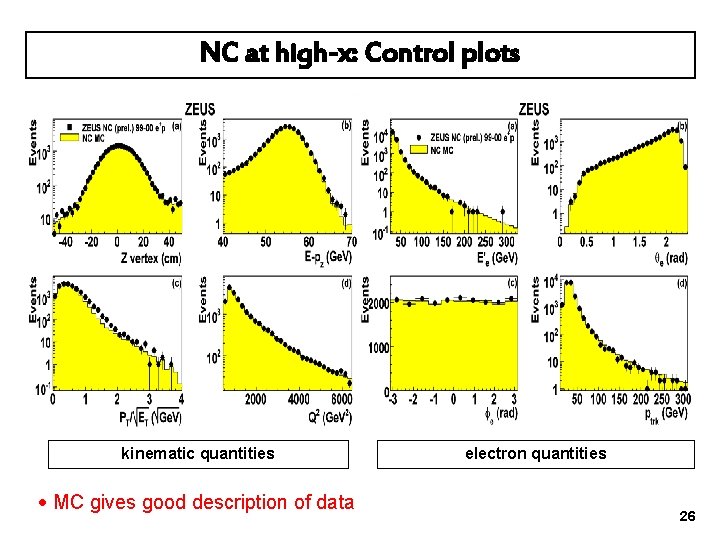
NC at high-x: Control plots kinematic quantities MC gives good description of data electron quantities 26
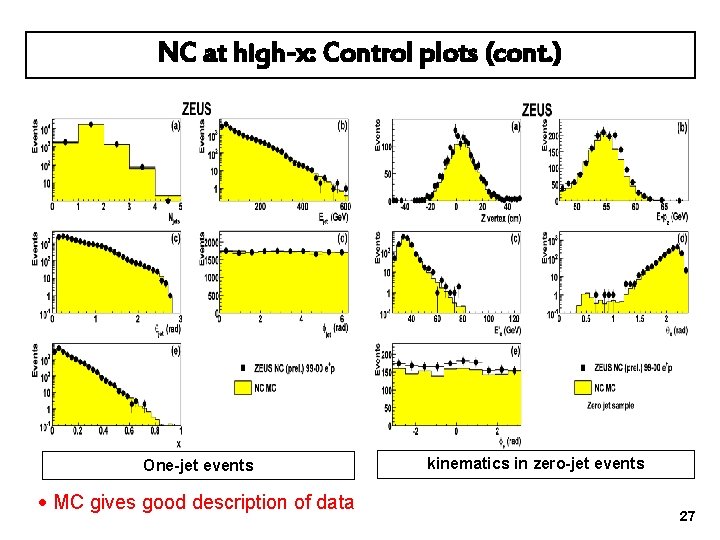
NC at high-x: Control plots (cont. ) One-jet events MC gives good description of data kinematics in zero-jet events 27
NC at high-x: e-p NC cross section ratios 28
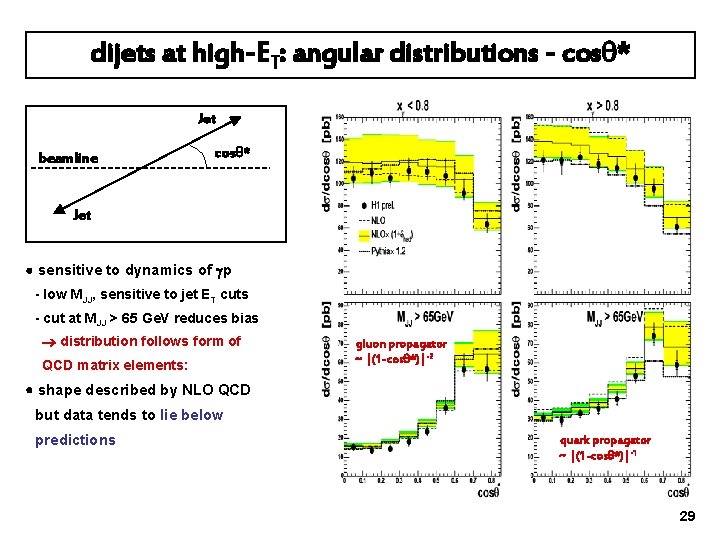
dijets at high-ET: angular distributions - cos * Jet beamline cos * Jet sensitive to dynamics of p - low MJJ, sensitive to jet ET cuts - cut at MJJ > 65 Ge. V reduces bias distribution follows form of QCD matrix elements: gluon propagator ~ |(1 -cos *)|-2 shape described by NLO QCD but data tends to lie below predictions quark propagator ~ |(1 -cos *)|-1 29