
The Structure of the Nucleus Checker Board Model
The Structure of the Nucleus Checker Board Model Theodore M. Lach II http: //checkerboard. dnsalias. net/ APS April Meeting Jan 29, 2017 Washington D. C. 2 PM L 1. 00009 1
The Structure of the Nucleus Assumptions of this model: The Nucleus is flat. The apparent Spherical shape is due to a flat structure viewed from all possible angles. The structure of the nucleus must be simple Only the two quarks with like charge rotate in nucleons Same frequency of rotation for proton and neutron APS April Meeting Jan 29, 2017 Washington D. C. 2 PM L 1. 00009 2
The Structure of the Nucleus Requirements: The structure must agree with the stability of known nuclei. The structures must predict all discovered nuclei. The theory must be able to explain the neutron skin effect. A nucleus may have more than one structure (isomer). The structure must be able to logically explain alpha, beta, and gamma decay. APS April Meeting Jan 29, 2017 Washington D. C. 2 PM L 1. 00009 3
The Structure of the Nucleus Given: PDG 2000 MAGNETIC MOMENTS: Proton = 1. 41060761(47) X 10 -26 Joules/Tesla 2. 7928473(37) + 29 Bohr Magnetons (PDG 2000) Neutron = - 0. 96623707(40) X 10 -26 Joules/Tesla - 1. 913042(7) + 5 Bohr Magnetons (PDG 2000) APS April Meeting Jan 29, 2017 Washington D. C. 2 PM L 1. 00009 4
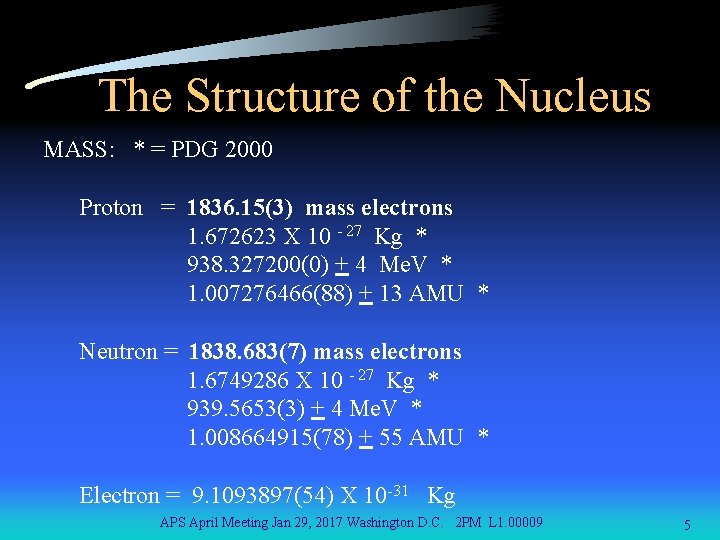
The Structure of the Nucleus MASS: * = PDG 2000 Proton = 1836. 15(3) mass electrons 1. 672623 X 10 - 27 Kg * 938. 327200(0) + 4 Me. V * 1. 007276466(88) + 13 AMU * Neutron = 1838. 683(7) mass electrons 1. 6749286 X 10 - 27 Kg * 939. 5653(3) + 4 Me. V * 1. 008664915(78) + 55 AMU * Electron = 9. 1093897(54) X 10 -31 Kg APS April Meeting Jan 29, 2017 Washington D. C. 2 PM L 1. 00009 5
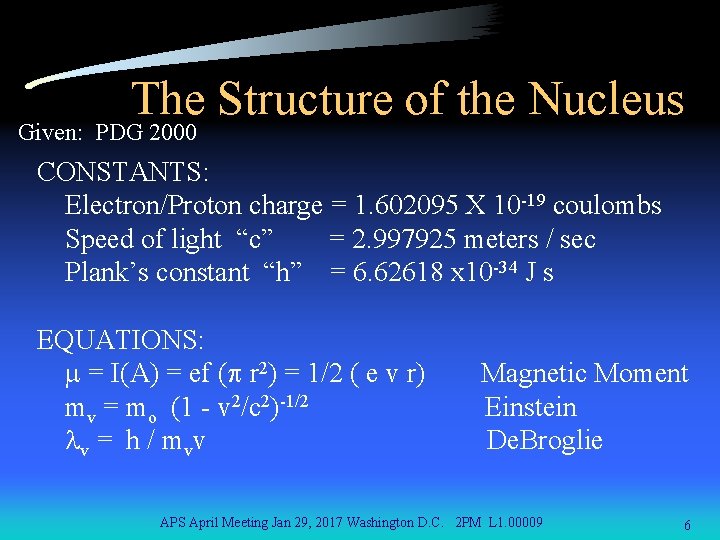
The Structure of the Nucleus Given: PDG 2000 CONSTANTS: Electron/Proton charge = 1. 602095 X 10 -19 coulombs Speed of light “c” = 2. 997925 meters / sec Plank’s constant “h” = 6. 62618 x 10 -34 J s EQUATIONS: m = I(A) = ef (p r 2) = 1/2 ( e v r) mv = mo (1 - v 2/c 2)-1/2 l v = h / m vv Magnetic Moment Einstein De. Broglie APS April Meeting Jan 29, 2017 Washington D. C. 2 PM L 1. 00009 6
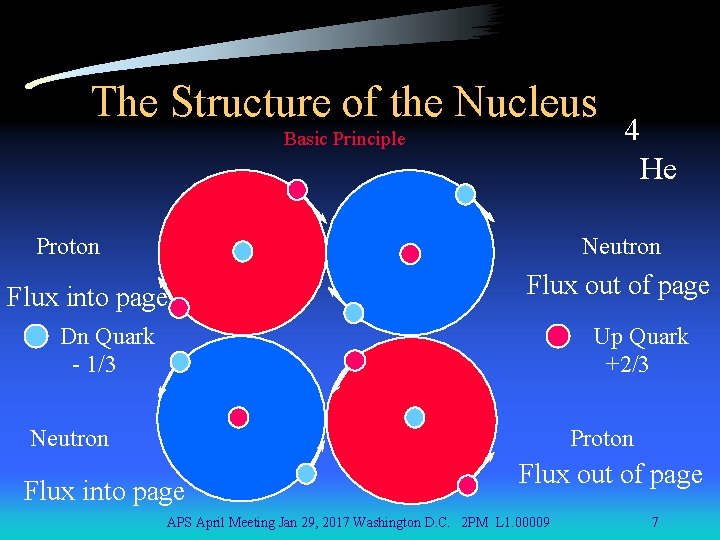
The Structure of the Nucleus Basic Principle 4 He Proton Neutron Flux into page Flux out of page Dn Quark - 1/3 Up Quark +2/3 Neutron Proton Flux into page Flux out of page APS April Meeting Jan 29, 2017 Washington D. C. 2 PM L 1. 00009 7
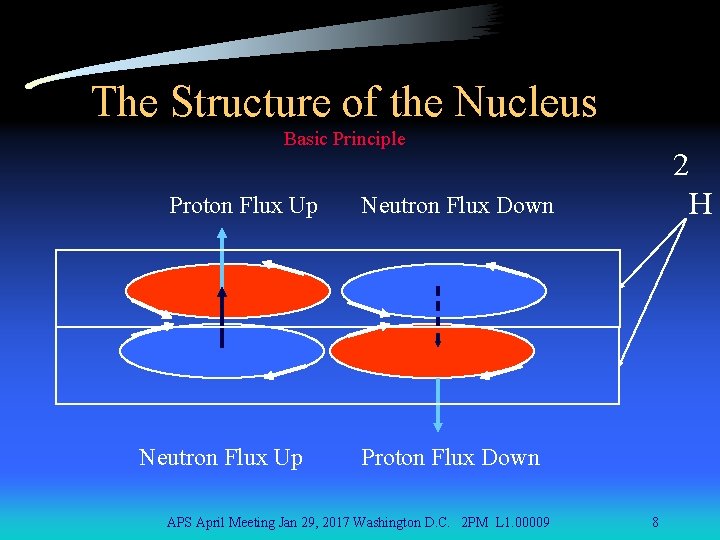
The Structure of the Nucleus Basic Principle Proton Flux Up Neutron Flux Up 2 H Neutron Flux Down Proton Flux Down APS April Meeting Jan 29, 2017 Washington D. C. 2 PM L 1. 00009 8
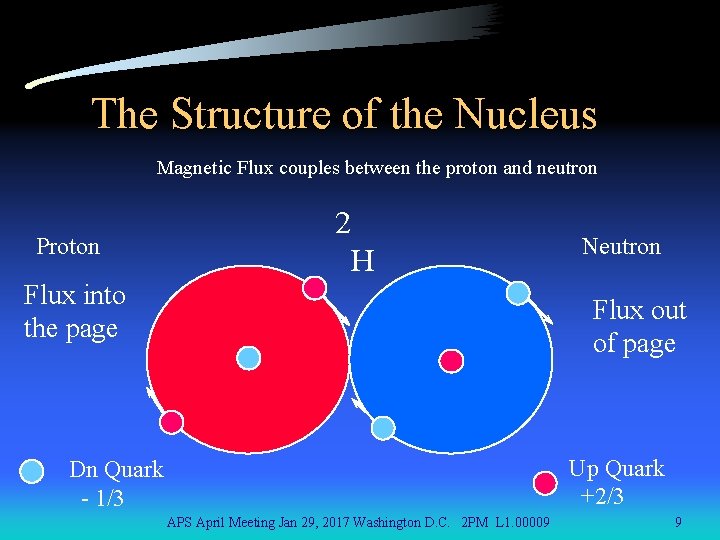
The Structure of the Nucleus Magnetic Flux couples between the proton and neutron Proton 2 H Flux into the page Neutron Flux out of page Up Quark +2/3 Dn Quark - 1/3 APS April Meeting Jan 29, 2017 Washington D. C. 2 PM L 1. 00009 9
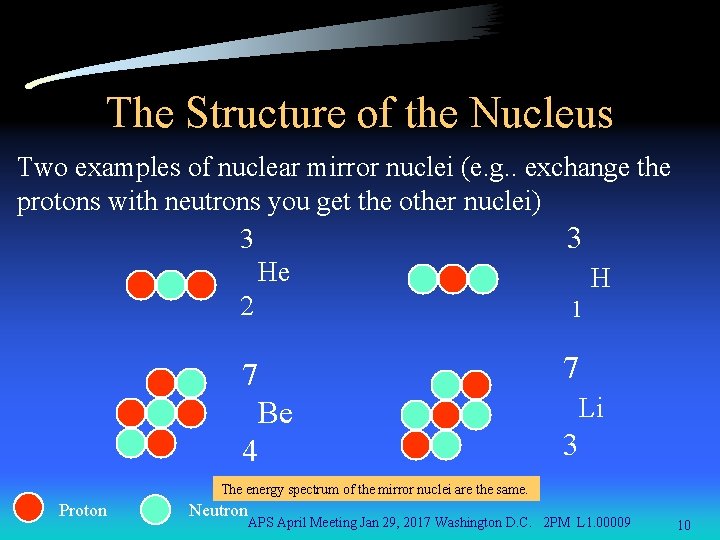
The Structure of the Nucleus Two examples of nuclear mirror nuclei (e. g. . exchange the protons with neutrons you get the other nuclei) 3 3 He H 2 1 7 7 Be 4 Li 3 The energy spectrum of the mirror nuclei are the same. Proton Neutron APS April Meeting Jan 29, 2017 Washington D. C. 2 PM L 1. 00009 10
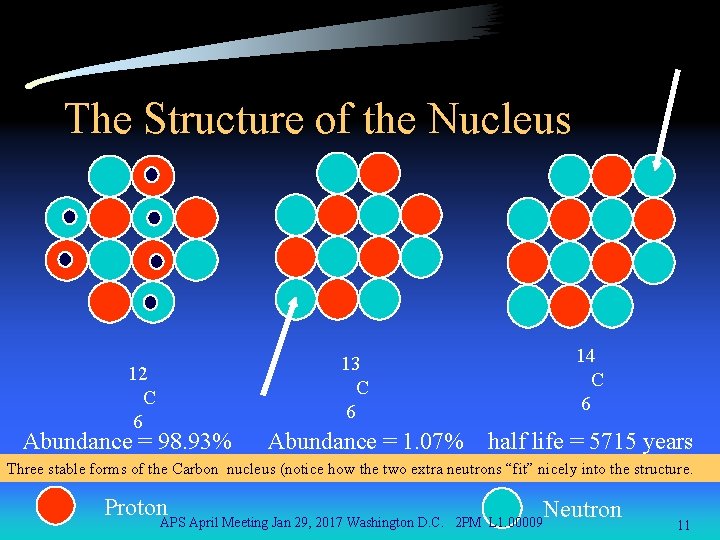
The Structure of the Nucleus 14 C 6 13 C 6 12 C 6 Abundance = 98. 93% Abundance = 1. 07% half life = 5715 years Three stable forms of the Carbon nucleus (notice how the two extra neutrons “fit” nicely into the structure. Proton APS April Meeting Jan 29, 2017 Washington D. C. 2 PM L 1. 00009 Neutron 11
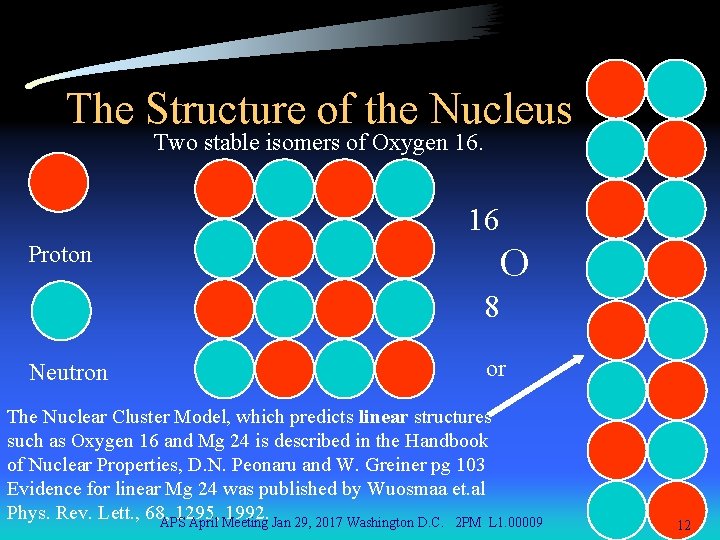
The Structure of the Nucleus Two stable isomers of Oxygen 16. 16 Proton O 8 Neutron or The Nuclear Cluster Model, which predicts linear structures such as Oxygen 16 and Mg 24 is described in the Handbook of Nuclear Properties, D. N. Peonaru and W. Greiner pg 103 Evidence for linear Mg 24 was published by Wuosmaa et. al Phys. Rev. Lett. , 68, 1295, 1992. APS April Meeting Jan 29, 2017 Washington D. C. 2 PM L 1. 00009 12
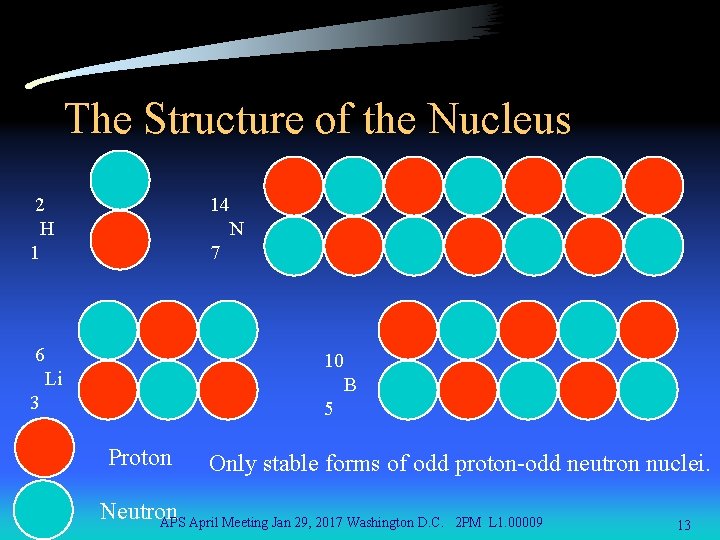
The Structure of the Nucleus 2 H 1 14 N 7 6 10 Li B 3 5 Proton Only stable forms of odd proton-odd neutron nuclei. Neutron APS April Meeting Jan 29, 2017 Washington D. C. 2 PM L 1. 00009 13
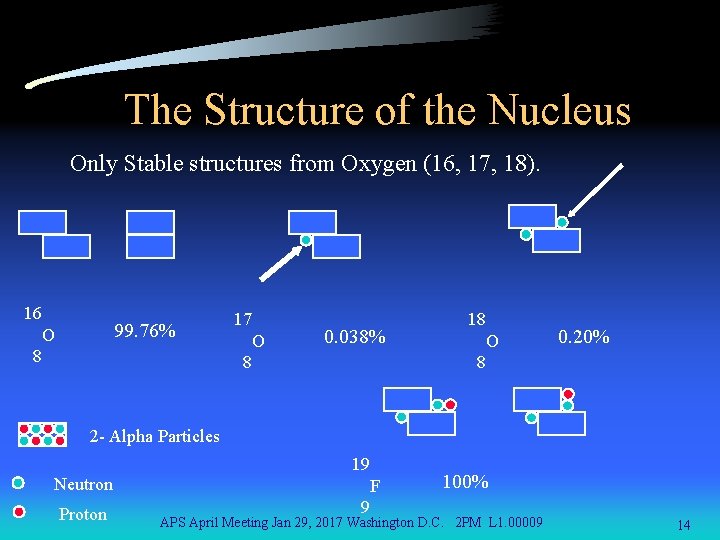
The Structure of the Nucleus Only Stable structures from Oxygen (16, 17, 18). 16 99. 76% O 8 17 O 0. 038% 8 18 O 0. 20% 8 2 - Alpha Particles Neutron Proton 19 F 9 100% APS April Meeting Jan 29, 2017 Washington D. C. 2 PM L 1. 00009 14
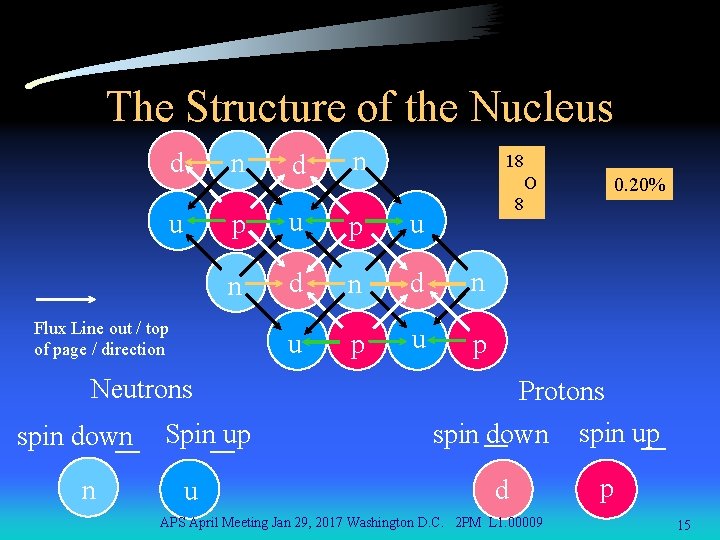
The Structure of the Nucleus d n u O 0. 20% 8 p u n d n u p Spin up u 18 u Neutrons n n p Flux Line out / top of page / direction spin down d Protons spin down spin up d APS April Meeting Jan 29, 2017 Washington D. C. 2 PM L 1. 00009 p 15
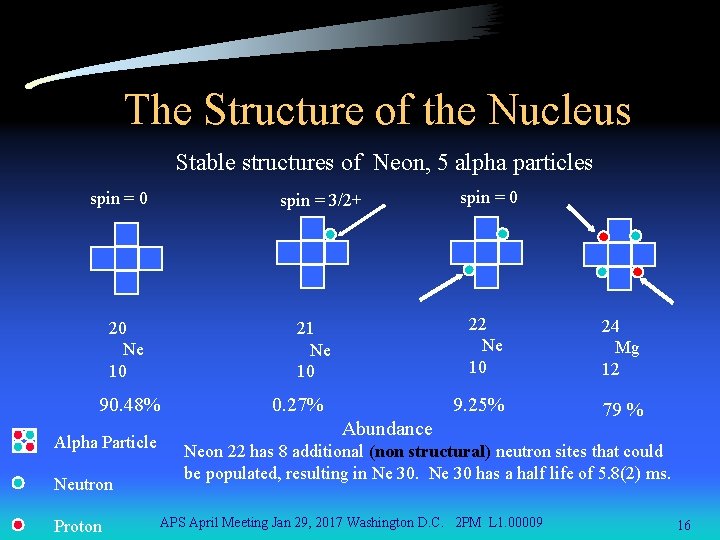
The Structure of the Nucleus Stable structures of Neon, 5 alpha particles spin = 0 spin = 3/2+ 20 Ne 10 21 Ne 10 90. 48% Alpha Particle Neutron Proton 0. 27% spin = 0 22 Ne 10 24 Mg 12 9. 25% 79 % Abundance Neon 22 has 8 additional (non structural) neutron sites that could be populated, resulting in Ne 30 has a half life of 5. 8(2) ms. APS April Meeting Jan 29, 2017 Washington D. C. 2 PM L 1. 00009 16
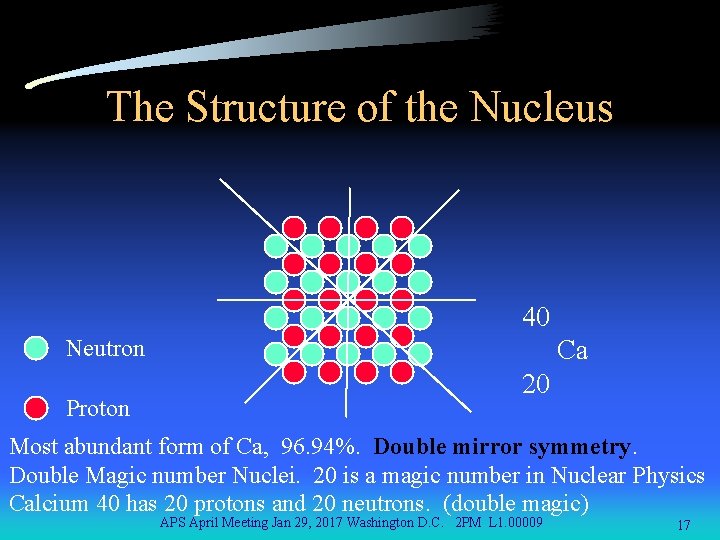
The Structure of the Nucleus 40 Neutron Proton Ca 20 Most abundant form of Ca, 96. 94%. Double mirror symmetry. Double Magic number Nuclei. 20 is a magic number in Nuclear Physics Calcium 40 has 20 protons and 20 neutrons. (double magic) APS April Meeting Jan 29, 2017 Washington D. C. 2 PM L 1. 00009 17
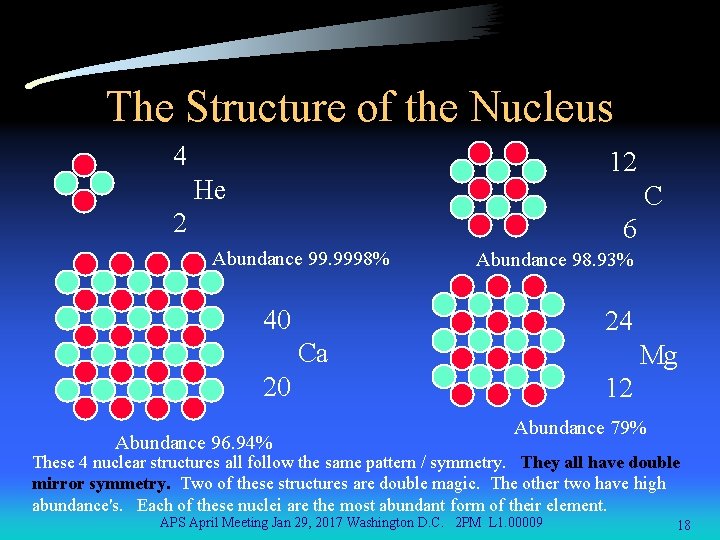
The Structure of the Nucleus 4 12 He C 2 6 Abundance 99. 9998% Abundance 98. 93% 40 24 Ca Mg 20 Abundance 96. 94% 12 Abundance 79% These 4 nuclear structures all follow the same pattern / symmetry. They all have double mirror symmetry. Two of these structures are double magic. The other two have high abundance's. Each of these nuclei are the most abundant form of their element. APS April Meeting Jan 29, 2017 Washington D. C. 2 PM L 1. 00009 18
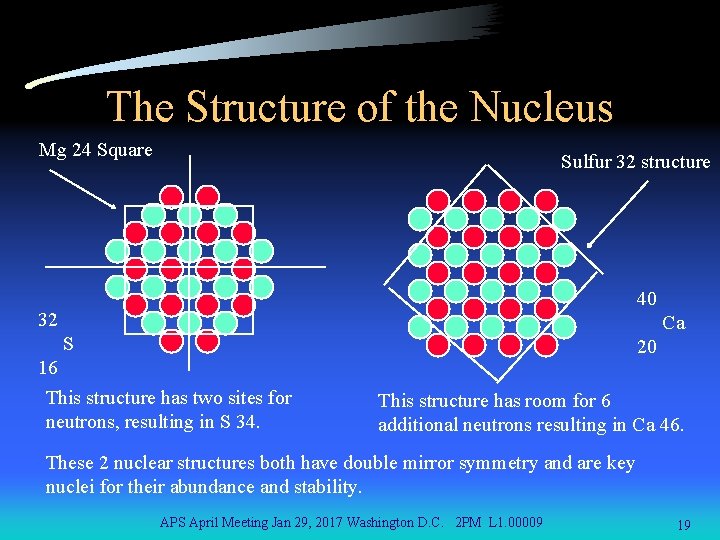
The Structure of the Nucleus Mg 24 Square Sulfur 32 structure 40 32 Ca S 16 This structure has two sites for neutrons, resulting in S 34. 20 This structure has room for 6 additional neutrons resulting in Ca 46. These 2 nuclear structures both have double mirror symmetry and are key nuclei for their abundance and stability. APS April Meeting Jan 29, 2017 Washington D. C. 2 PM L 1. 00009 19
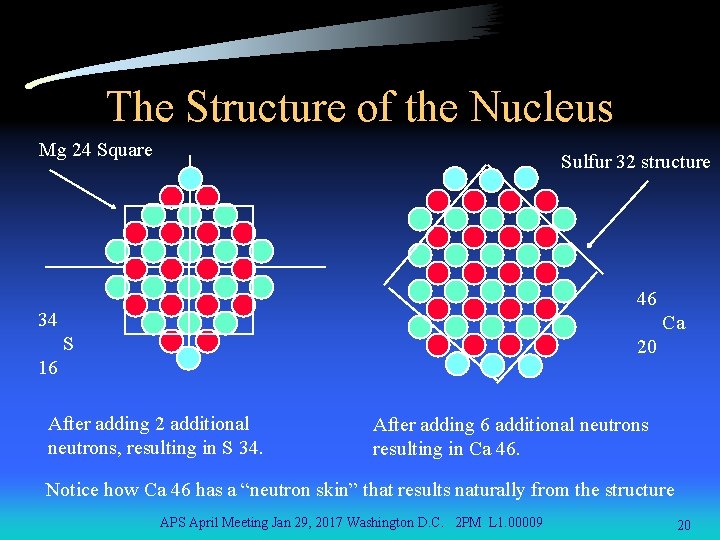
The Structure of the Nucleus Mg 24 Square Sulfur 32 structure 46 34 Ca S 20 16 After adding 2 additional neutrons, resulting in S 34. After adding 6 additional neutrons resulting in Ca 46. Notice how Ca 46 has a “neutron skin” that results naturally from the structure APS April Meeting Jan 29, 2017 Washington D. C. 2 PM L 1. 00009 20
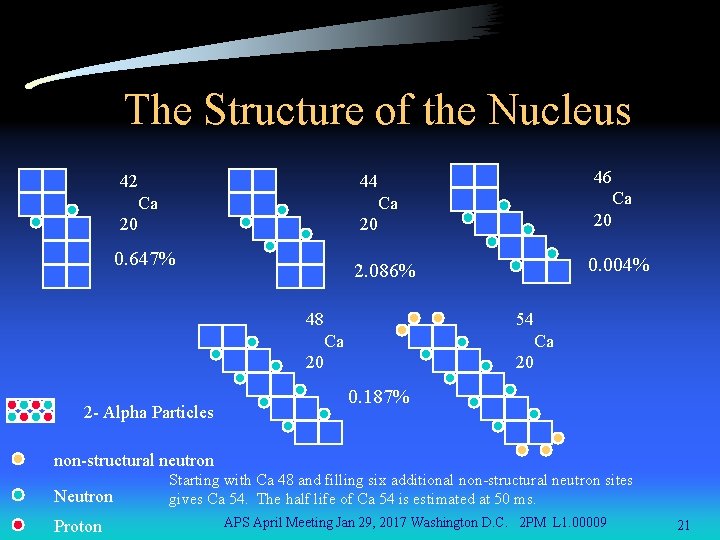
The Structure of the Nucleus 42 46 44 Ca Ca Ca 20 20 20 0. 647% 0. 004% 2. 086% 48 54 Ca Ca 20 2 - Alpha Particles 20 0. 187% non-structural neutron Neutron Proton Starting with Ca 48 and filling six additional non-structural neutron sites gives Ca 54. The half life of Ca 54 is estimated at 50 ms. APS April Meeting Jan 29, 2017 Washington D. C. 2 PM L 1. 00009 21
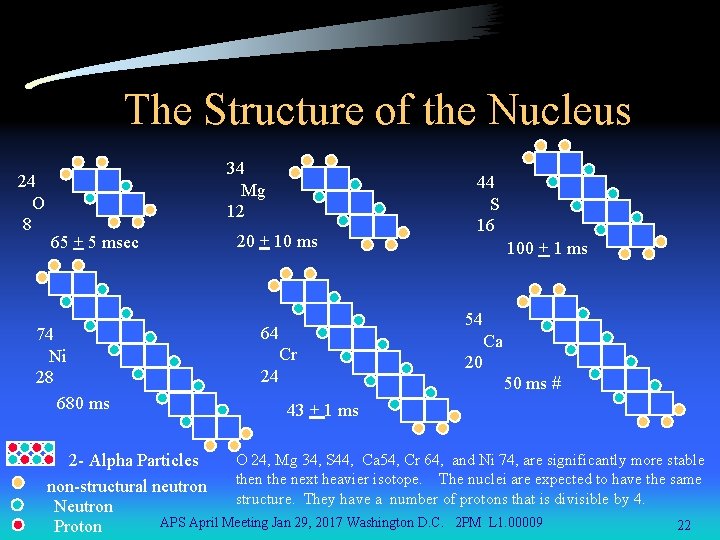
The Structure of the Nucleus 24 O 8 34 Mg 12 65 + 5 msec 74 Ni 28 680 ms 20 + 10 ms 44 S 16 100 + 1 ms 54 64 Cr 24 Ca 20 50 ms # 43 + 1 ms O 24, Mg 34, S 44, Ca 54, Cr 64, and Ni 74, are significantly more stable 2 - Alpha Particles then the next heavier isotope. The nuclei are expected to have the same non-structural neutron structure. They have a number of protons that is divisible by 4. Neutron APS April Meeting Jan 29, 2017 Washington D. C. 2 PM L 1. 00009 22 Proton
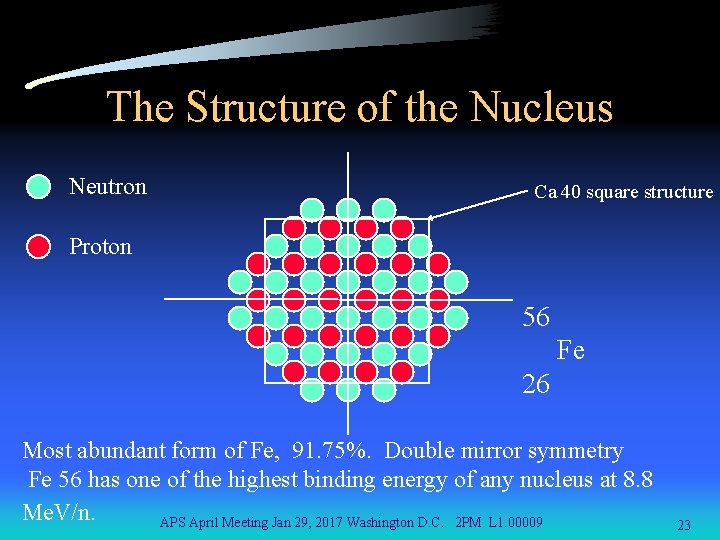
The Structure of the Nucleus Neutron Ca 40 square structure Proton 56 Fe 26 Most abundant form of Fe, 91. 75%. Double mirror symmetry Fe 56 has one of the highest binding energy of any nucleus at 8. 8 Me. V/n. APS April Meeting Jan 29, 2017 Washington D. C. 2 PM L 1. 00009 23
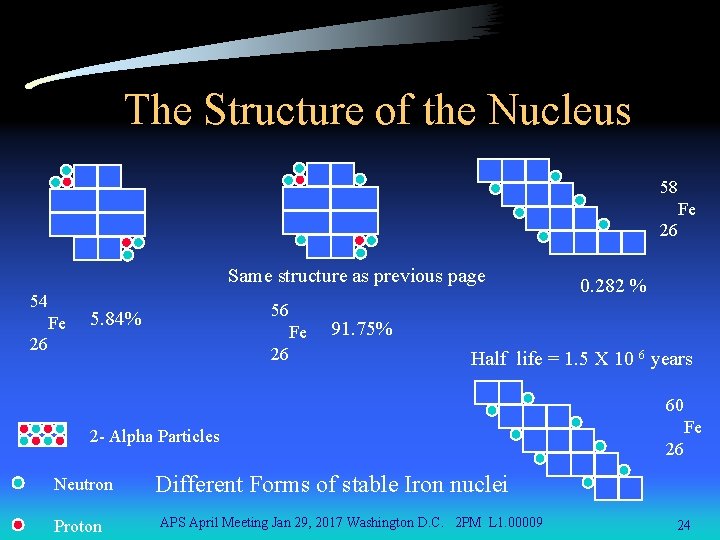
The Structure of the Nucleus 58 Fe 26 Same structure as previous page 54 Fe 56 5. 84% Fe 26 26 0. 282 % 91. 75% Half life = 1. 5 X 10 6 years 60 2 - Alpha Particles Neutron Proton Fe 26 Different Forms of stable Iron nuclei APS April Meeting Jan 29, 2017 Washington D. C. 2 PM L 1. 00009 24
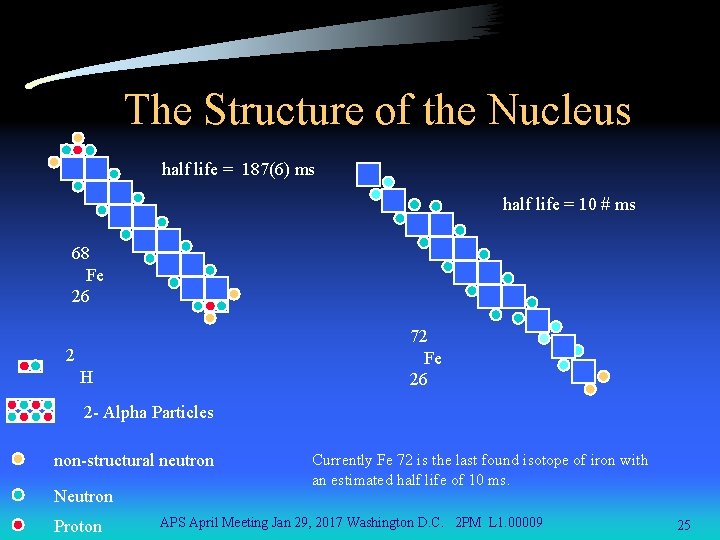
The Structure of the Nucleus half life = 187(6) ms half life = 10 # ms 68 Fe 26 72 Fe 26 2 H 2 - Alpha Particles non-structural neutron Neutron Proton Currently Fe 72 is the last found isotope of iron with an estimated half life of 10 ms. APS April Meeting Jan 29, 2017 Washington D. C. 2 PM L 1. 00009 25
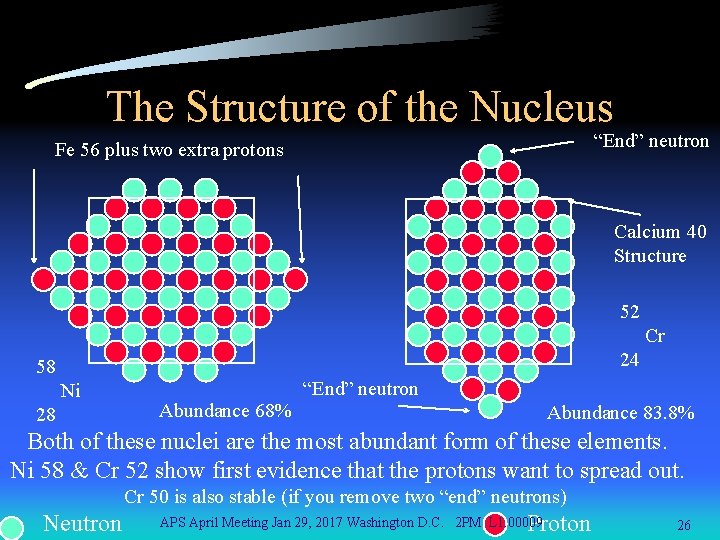
The Structure of the Nucleus “End” neutron Fe 56 plus two extra protons Calcium 40 Structure 52 Cr 24 58 Ni 28 Abundance 68% “End” neutron Abundance 83. 8% Both of these nuclei are the most abundant form of these elements. Ni 58 & Cr 52 show first evidence that the protons want to spread out. Cr 50 is also stable (if you remove two “end” neutrons) Neutron Proton APS April Meeting Jan 29, 2017 Washington D. C. 2 PM L 1. 00009 26
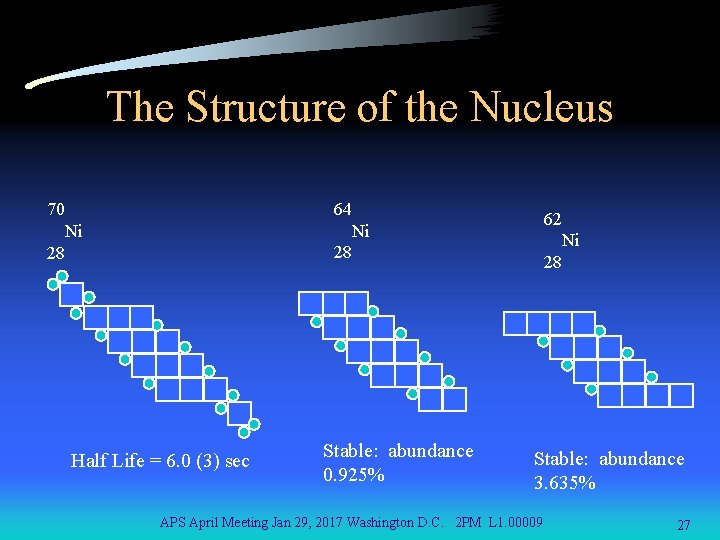
The Structure of the Nucleus 64 70 62 Ni Ni Ni 28 28 Half Life = 6. 0 (3) sec Stable: abundance 0. 925% 28 Stable: abundance 3. 635% APS April Meeting Jan 29, 2017 Washington D. C. 2 PM L 1. 00009 27
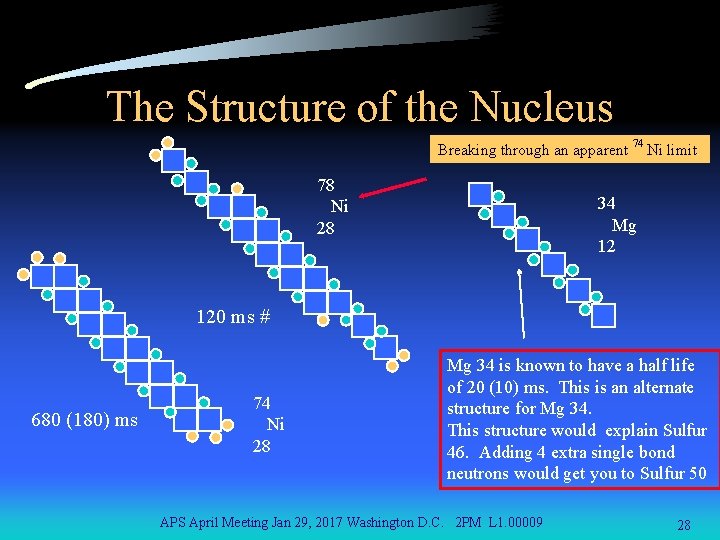
The Structure of the Nucleus Breaking through an apparent 74 Ni limit. 78 Ni 28 34 Mg 12 120 ms # 680 (180) ms 74 Ni 28 Mg 34 is known to have a half life of 20 (10) ms. This is an alternate structure for Mg 34. This structure would explain Sulfur 46. Adding 4 extra single bond neutrons would get you to Sulfur 50 APS April Meeting Jan 29, 2017 Washington D. C. 2 PM L 1. 00009 28
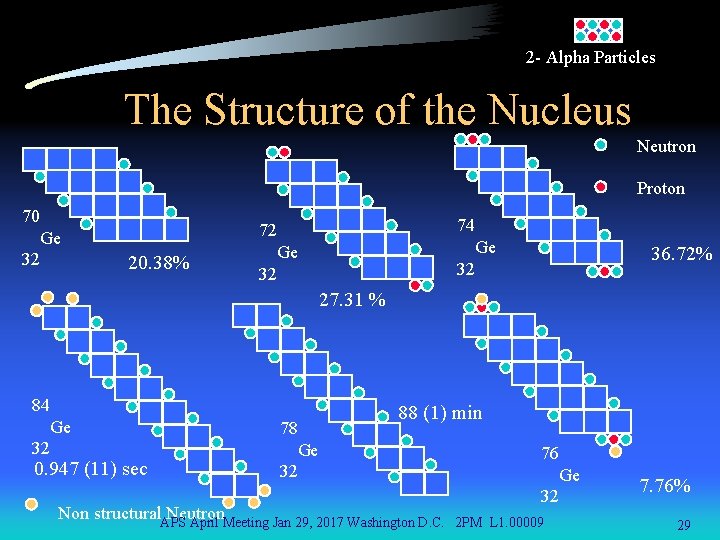
2 - Alpha Particles The Structure of the Nucleus Neutron Proton 70 32 74 72 Ge 20. 38% Ge Ge 36. 72% 32 32 27. 31 % 84 Ge 88 (1) min 78 32 0. 947 (11) sec Ge 32 Non structural. APS Neutron April Meeting Jan 29, 2017 Washington D. C. 76 Ge 32 2 PM L 1. 00009 7. 76% 29
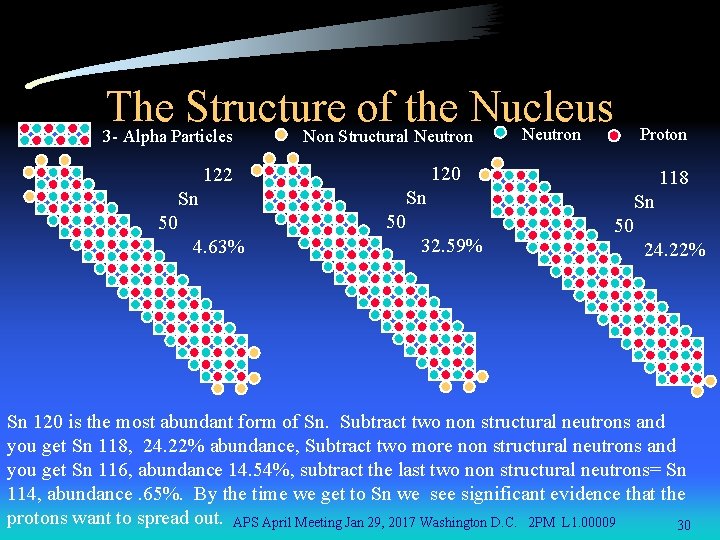
The Structure of the Nucleus Neutron 3 - Alpha Particles Non Structural Neutron 120 122 50 4. 63% 118 Sn Sn 50 Proton 32. 59% Sn 50 24. 22% Sn 120 is the most abundant form of Sn. Subtract two non structural neutrons and you get Sn 118, 24. 22% abundance, Subtract two more non structural neutrons and you get Sn 116, abundance 14. 54%, subtract the last two non structural neutrons= Sn 114, abundance. 65%. By the time we get to Sn we see significant evidence that the protons want to spread out. APS April Meeting Jan 29, 2017 Washington D. C. 2 PM L 1. 00009 30
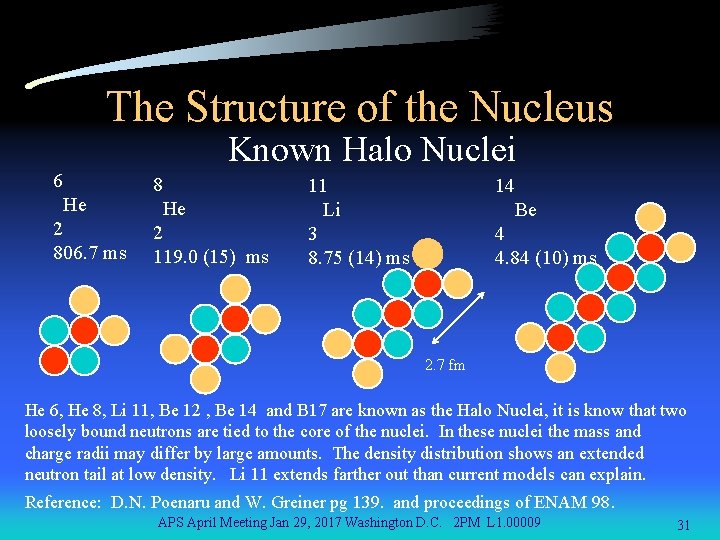
The Structure of the Nucleus Known Halo Nuclei 6 He 2 806. 7 ms 8 He 2 119. 0 (15) ms 11 Li 3 8. 75 (14) ms 14 Be 4 4. 84 (10) ms 2. 7 fm He 6, He 8, Li 11, Be 12 , Be 14 and B 17 are known as the Halo Nuclei, it is know that two loosely bound neutrons are tied to the core of the nuclei. In these nuclei the mass and charge radii may differ by large amounts. The density distribution shows an extended neutron tail at low density. Li 11 extends farther out than current models can explain. Reference: D. N. Poenaru and W. Greiner pg 139. and proceedings of ENAM 98. APS April Meeting Jan 29, 2017 Washington D. C. 2 PM L 1. 00009 31
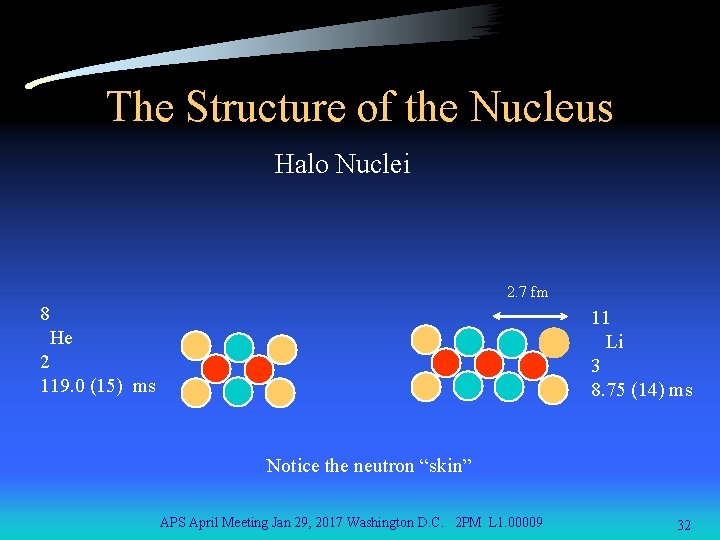
The Structure of the Nucleus Halo Nuclei 2. 7 fm 8 11 Li 3 8. 75 (14) ms He 2 119. 0 (15) ms Notice the neutron “skin” APS April Meeting Jan 29, 2017 Washington D. C. 2 PM L 1. 00009 32
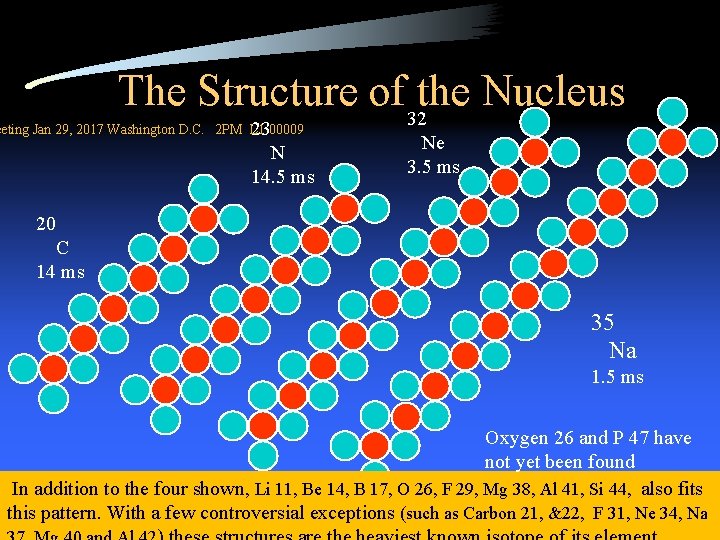
The Structure of 32 the Nucleus eeting Jan 29, 2017 Washington D. C. 2 PM L 1. 00009 23 N 14. 5 ms Ne 3. 5 ms 20 C 14 ms 35 Na 1. 5 ms Oxygen 26 and P 47 have not yet been found In addition to the four shown, Li 11, Be 14, B 17, O 26, F 29, Mg 38, Al 41, Si 44, also fits this pattern. With a few controversial exceptions (such as Carbon 21, &22, F 31, Ne 34, Na
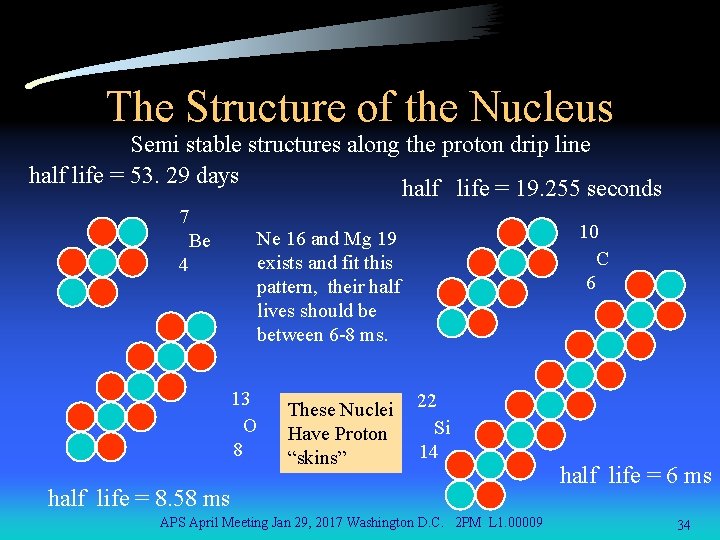
The Structure of the Nucleus Semi stable structures along the proton drip line half life = 53. 29 days half life = 19. 255 seconds 7 Be 4 10 C 6 Ne 16 and Mg 19 exists and fit this pattern, their half lives should be between 6 -8 ms. 13 O 8 These Nuclei Have Proton “skins” 22 Si 14 half life = 8. 58 ms APS April Meeting Jan 29, 2017 Washington D. C. 2 PM L 1. 00009 half life = 6 ms 34
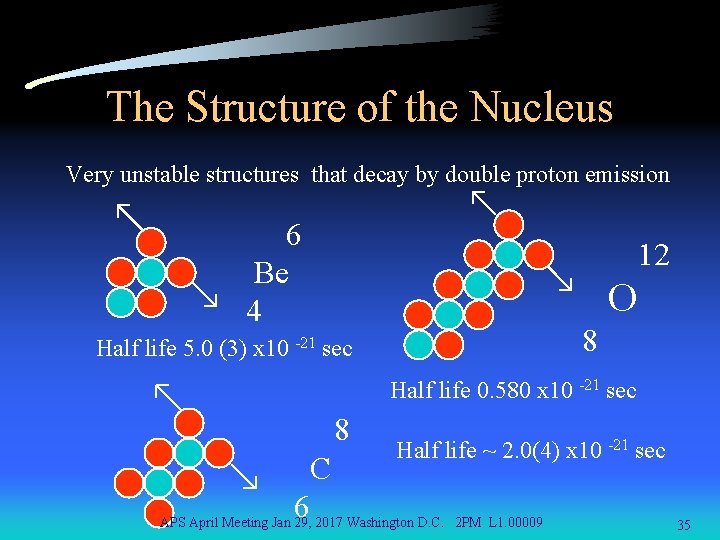
The Structure of the Nucleus Very unstable structures that decay by double proton emission 6 Be 4 12 O 8 Half life 5. 0 (3) x 10 -21 sec Half life 0. 580 x 10 -21 sec 8 C 6 Half life ~ 2. 0(4) x 10 -21 sec APS April Meeting Jan 29, 2017 Washington D. C. 2 PM L 1. 00009 35
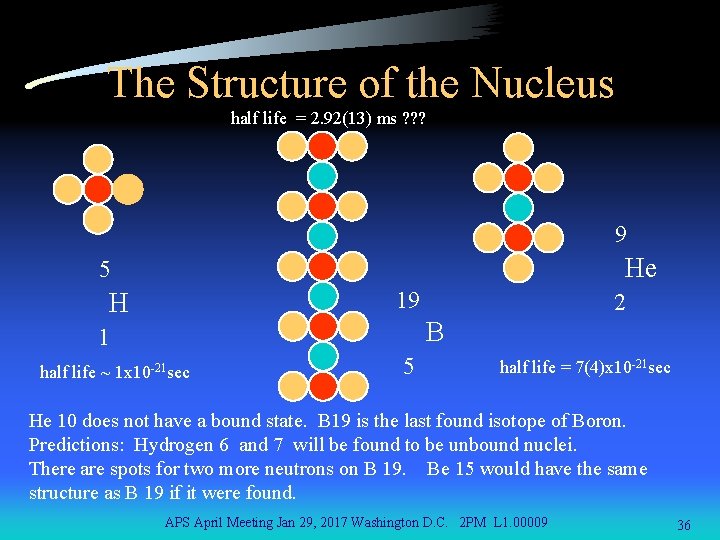
The Structure of the Nucleus half life = 2. 92(13) ms ? ? ? 9 He 5 H 19 2 B 1 half life ~ 1 x 10 -21 sec 5 half life = 7(4)x 10 -21 sec He 10 does not have a bound state. B 19 is the last found isotope of Boron. Predictions: Hydrogen 6 and 7 will be found to be unbound nuclei. There are spots for two more neutrons on B 19. Be 15 would have the same structure as B 19 if it were found. APS April Meeting Jan 29, 2017 Washington D. C. 2 PM L 1. 00009 36
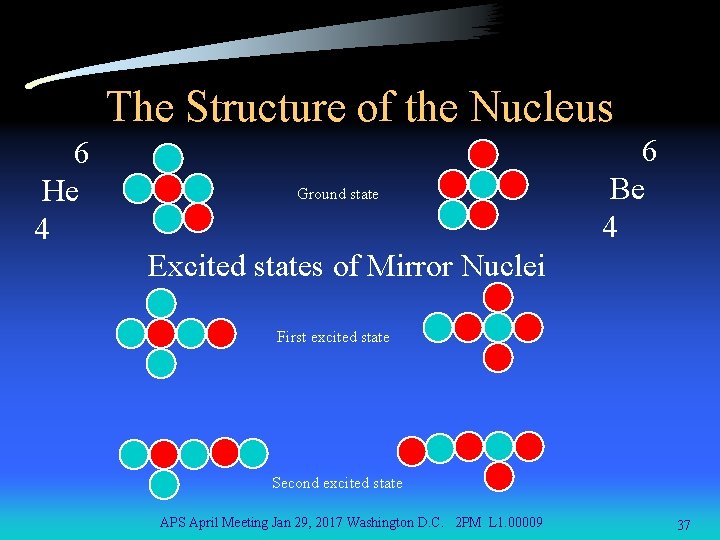
The Structure of the Nucleus 6 He 4 Ground state 6 Be 4 Excited states of Mirror Nuclei First excited state Second excited state APS April Meeting Jan 29, 2017 Washington D. C. 2 PM L 1. 00009 37
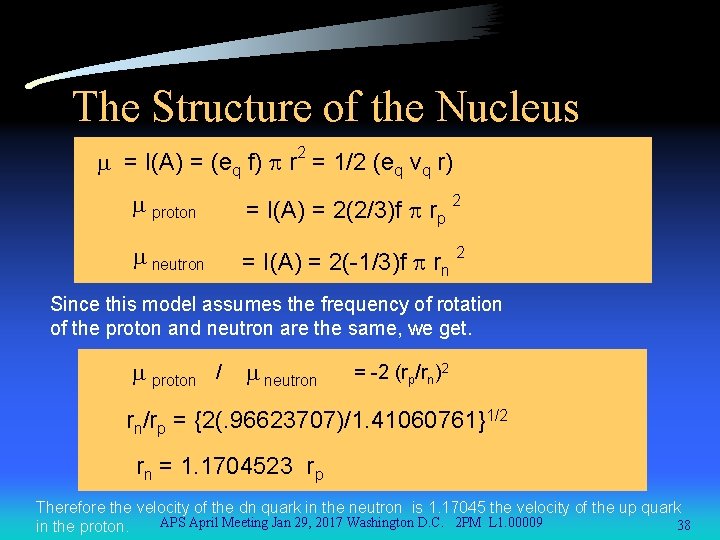
The Structure of the Nucleus m = I(A) = (eq f) p r 2 = 1/2 (eq vq r) m proton = I(A) = 2(2/3)f p rp 2 m neutron = I(A) = 2(-1/3)f p rn 2 Since this model assumes the frequency of rotation of the proton and neutron are the same, we get. m proton / m neutron = -2 (rp/rn)2 rn/rp = {2(. 96623707)/1. 41060761}1/2 rn = 1. 1704523 rp Therefore the velocity of the dn quark in the neutron is 1. 17045 the velocity of the up quark APS April Meeting Jan 29, 2017 Washington D. C. 2 PM L 1. 00009 38 in the proton.
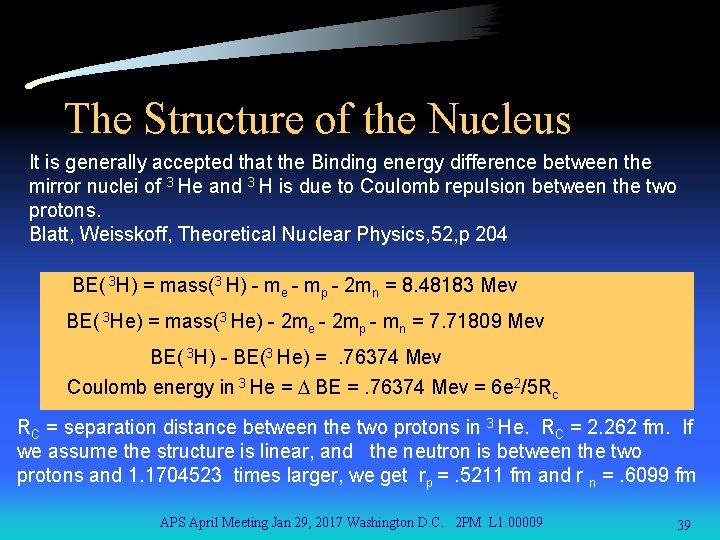
The Structure of the Nucleus It is generally accepted that the Binding energy difference between the mirror nuclei of 3 He and 3 H is due to Coulomb repulsion between the two protons. Blatt, Weisskoff, Theoretical Nuclear Physics, 52, p 204 BE( 3 H) = mass(3 H) - me - mp - 2 mn = 8. 48183 Mev BE( 3 He) = mass(3 He) - 2 me - 2 mp - mn = 7. 71809 Mev BE( 3 H) - BE(3 He) =. 76374 Mev Coulomb energy in 3 He = D BE =. 76374 Mev = 6 e 2/5 Rc RC = separation distance between the two protons in 3 He. RC = 2. 262 fm. If we assume the structure is linear, and the neutron is between the two protons and 1. 1704523 times larger, we get rp =. 5211 fm and r n =. 6099 fm APS April Meeting Jan 29, 2017 Washington D. C. 2 PM L 1. 00009 39
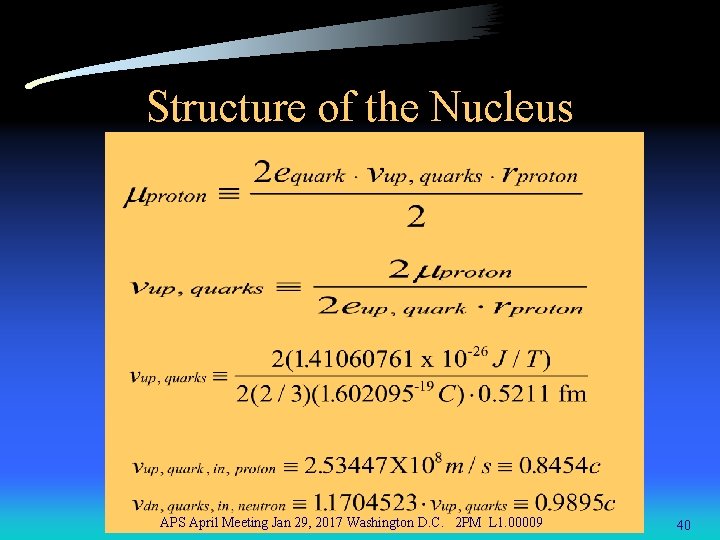
Structure of the Nucleus APS April Meeting Jan 29, 2017 Washington D. C. 2 PM L 1. 00009 40
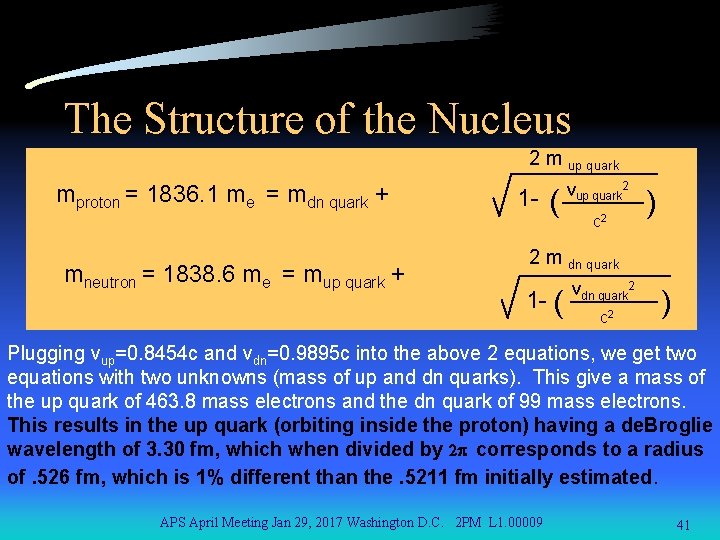
The Structure of the Nucleus 2 m up quark mproton = 1836. 1 me = mdn quark + mneutron = 1838. 6 me = mup quark + 1 - ( vup quark 2 c 2 ) 2 m dn quark 1 - ( vdn quark 2 c 2 ) Plugging vup=0. 8454 c and vdn=0. 9895 c into the above 2 equations, we get two equations with two unknowns (mass of up and dn quarks). This give a mass of the up quark of 463. 8 mass electrons and the dn quark of 99 mass electrons. This results in the up quark (orbiting inside the proton) having a de. Broglie wavelength of 3. 30 fm, which when divided by 2 p corresponds to a radius of. 526 fm, which is 1% different than the. 5211 fm initially estimated. APS April Meeting Jan 29, 2017 Washington D. C. 2 PM L 1. 00009 41
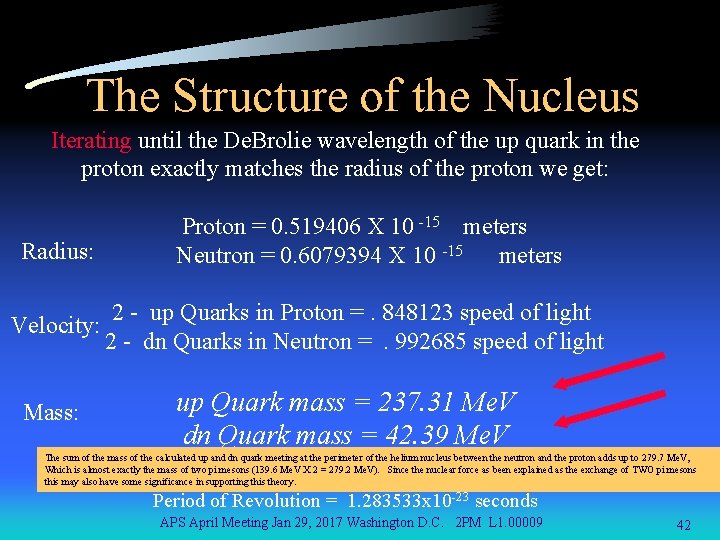
The Structure of the Nucleus Iterating until the De. Brolie wavelength of the up quark in the proton exactly matches the radius of the proton we get: Radius: Velocity: Mass: Proton = 0. 519406 X 10 -15 meters Neutron = 0. 6079394 X 10 -15 meters 2 - up Quarks in Proton =. 848123 speed of light 2 - dn Quarks in Neutron =. 992685 speed of light up Quark mass = 237. 31 Me. V dn Quark mass = 42. 39 Me. V The sum of the mass of the calculated up and dn quark meeting at the perimeter of the helium nucleus between the neutron and the proton adds up to 279. 7 Me. V, Which is almost exactly the mass of two pi mesons (139. 6 Me. V X 2 = 279. 2 Me. V). Since the nuclear force as been explained as the exchange of TWO pi mesons this may also have some significance in supporting this theory. Period of Revolution = 1. 283533 x 10 -23 seconds APS April Meeting Jan 29, 2017 Washington D. C. 2 PM L 1. 00009 42
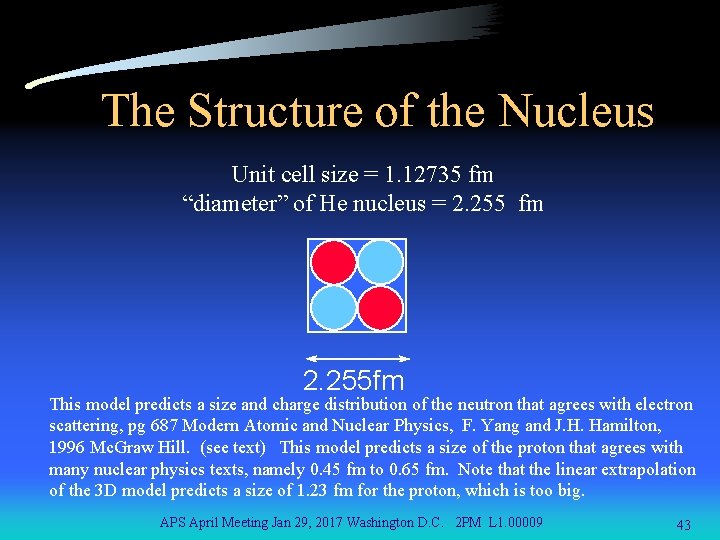
The Structure of the Nucleus Unit cell size = 1. 12735 fm “diameter” of He nucleus = 2. 255 fm 2. 255 fm This model predicts a size and charge distribution of the neutron that agrees with electron scattering, pg 687 Modern Atomic and Nuclear Physics, F. Yang and J. H. Hamilton, 1996 Mc. Graw Hill. (see text) This model predicts a size of the proton that agrees with many nuclear physics texts, namely 0. 45 fm to 0. 65 fm. Note that the linear extrapolation of the 3 D model predicts a size of 1. 23 fm for the proton, which is too big. APS April Meeting Jan 29, 2017 Washington D. C. 2 PM L 1. 00009 43
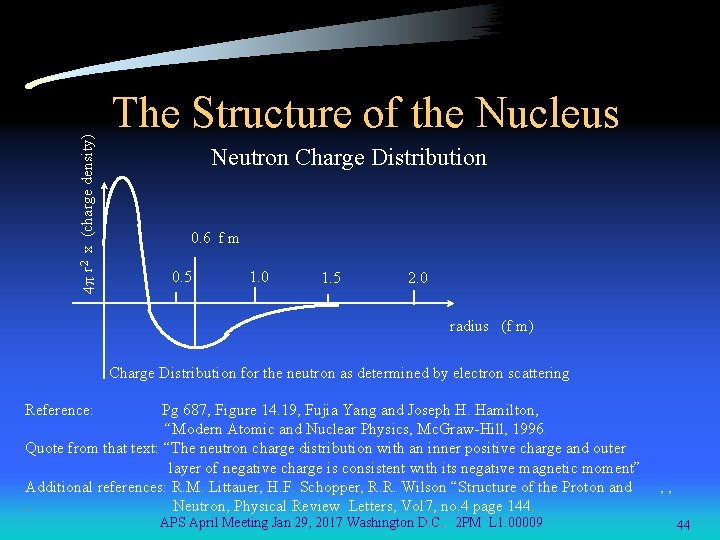
4 p r 2 x (charge density) The Structure of the Nucleus Neutron Charge Distribution 0. 6 f m 0. 5 1. 0 1. 5 2. 0 radius (f m) Charge Distribution for the neutron as determined by electron scattering Reference: Pg 687, Figure 14. 19, Fujia Yang and Joseph H. Hamilton, “Modern Atomic and Nuclear Physics, Mc. Graw-Hill, 1996. Quote from that text: “The neutron charge distribution with an inner positive charge and outer layer of negative charge is consistent with its negative magnetic moment” Additional references: R. M. Littauer, H. F. Schopper, R. R. Wilson “Structure of the Proton and. Neutron, Physical Review Letters, Vol 7, no. 4 page 144. APS April Meeting Jan 29, 2017 Washington D. C. 2 PM L 1. 00009 , , 44
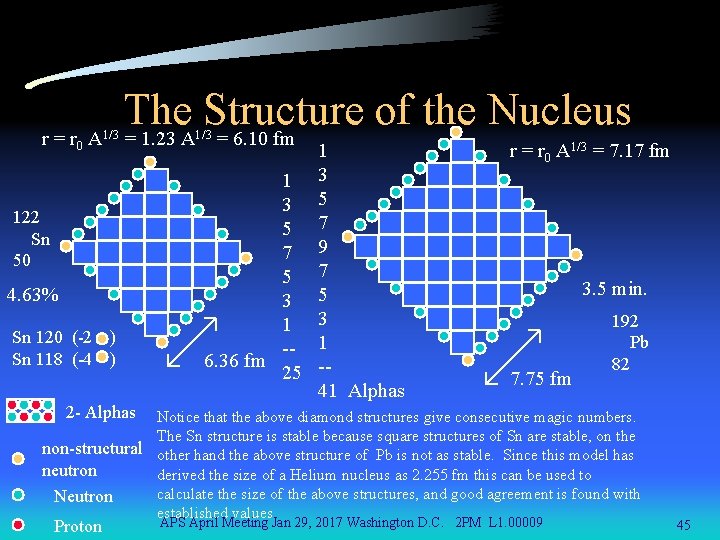
r = r 0 A 1/3 The Structure of the Nucleus = 1. 23 A = 6. 10 fm 122 Sn 50 4. 63% Sn 120 (-2 Sn 118 (-4 ) ) 1/3 1 1 3 3 5 5 7 7 9 5 7 3 5 1 3 -- 1 6. 36 fm 25 -41 Alphas r = r 0 A 1/3 = 7. 17 fm 3. 5 min. 7. 75 fm 192 Pb 82 2 - Alphas Notice that the above diamond structures give consecutive magic numbers. The Sn structure is stable because square structures of Sn are stable, on the non-structural other hand the above structure of Pb is not as stable. Since this model has neutron derived the size of a Helium nucleus as 2. 255 fm this can be used to calculate the size of the above structures, and good agreement is found with Neutron established values. Proton APS April Meeting Jan 29, 2017 Washington D. C. 2 PM L 1. 00009 45
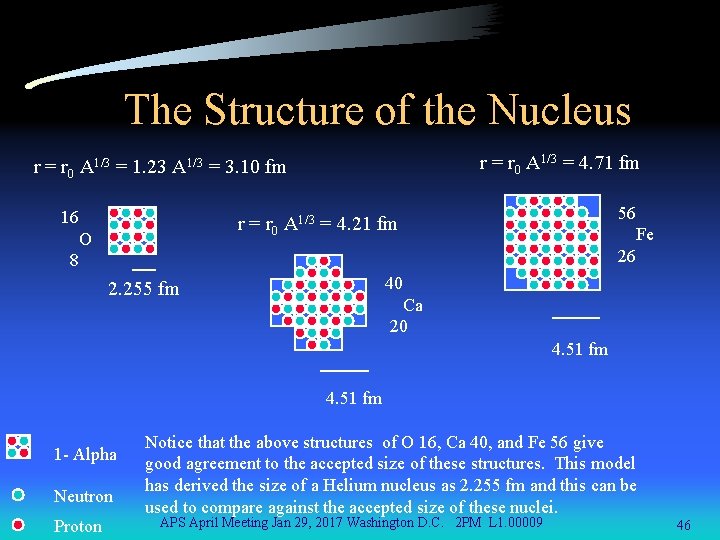
The Structure of the Nucleus r = r 0 A 1/3 = 4. 71 fm r = r 0 A 1/3 = 1. 23 A 1/3 = 3. 10 fm 16 56 r = r 0 A 1/3 = 4. 21 fm O Fe 26 8 40 2. 255 fm Ca 20 4. 51 fm 1 - Alpha Neutron Proton Notice that the above structures of O 16, Ca 40, and Fe 56 give good agreement to the accepted size of these structures. This model has derived the size of a Helium nucleus as 2. 255 fm and this can be used to compare against the accepted size of these nuclei. APS April Meeting Jan 29, 2017 Washington D. C. 2 PM L 1. 00009 46
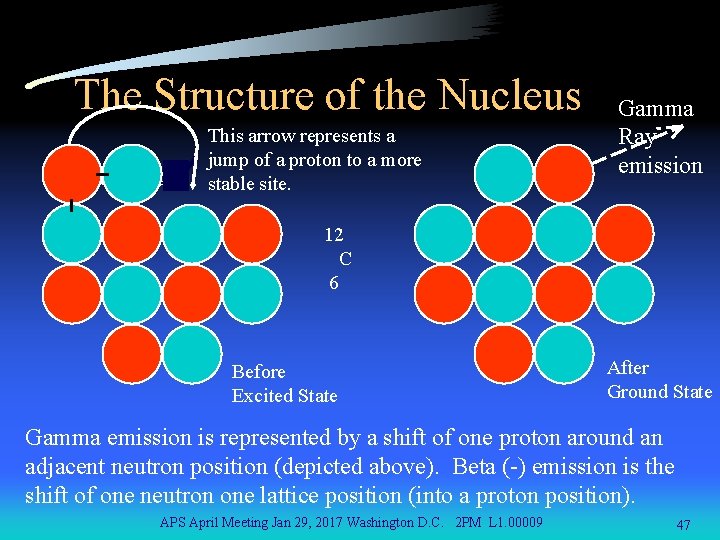
The Structure of the Nucleus This arrow represents a jump of a proton to a more stable site. Gamma Ray emission 12 C 6 Before Excited State After Ground State Gamma emission is represented by a shift of one proton around an adjacent neutron position (depicted above). Beta (-) emission is the shift of one neutron one lattice position (into a proton position). APS April Meeting Jan 29, 2017 Washington D. C. 2 PM L 1. 00009 47
Structure of the Nucleus What reasons can account for the different structures above and below Pb? If the Uranium nuclei are really linear, then they are shorter by a factor of the square root of 2 than they would be if they were diagonal. This would mean that the structure has extra stored up potential energy in the form of repulsion of all those protons. Because the structure has just as many bonds (4) at any point along the structure, it should be just as strong a structure as Pb, just that it contain that potential energy of all the repelling protons. Therefore it is like a compressed spring waiting for an alpha decay to make the structure unstable resulting in it expanding to the diagonal size of the Pb nuclei. It would be expected that this would explain the back bending the of I vs w for the yrast states of Dy 156 and other such nuclei. Also it would explain why each emission is the same in energy and why the number of steps in these spectrum is approximately the same number as the number of steps in this model. APS April Meeting Jan 29, 2017 Washington D. C. 2 PM L 1. 00009 48
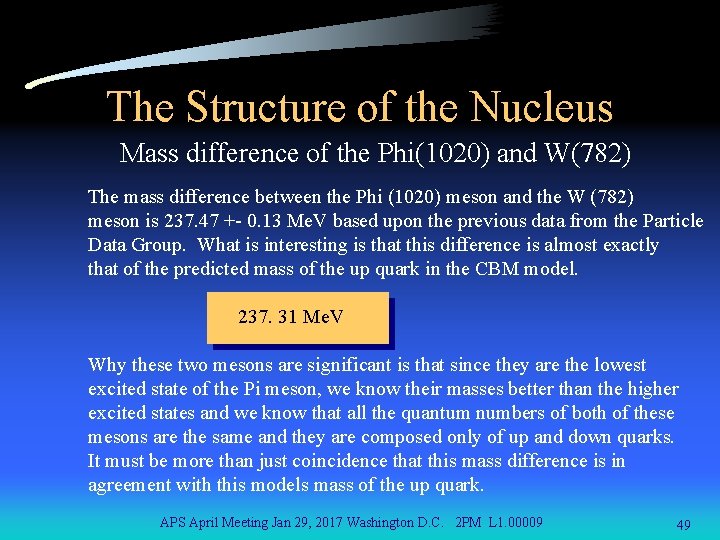
The Structure of the Nucleus Mass difference of the Phi(1020) and W(782) The mass difference between the Phi (1020) meson and the W (782) meson is 237. 47 +- 0. 13 Me. V based upon the previous data from the Particle Data Group. What is interesting is that this difference is almost exactly that of the predicted mass of the up quark in the CBM model. 237. 31 Me. V Why these two mesons are significant is that since they are the lowest excited state of the Pi meson, we know their masses better than the higher excited states and we know that all the quantum numbers of both of these mesons are the same and they are composed only of up and down quarks. It must be more than just coincidence that this mass difference is in agreement with this models mass of the up quark. APS April Meeting Jan 29, 2017 Washington D. C. 2 PM L 1. 00009 49
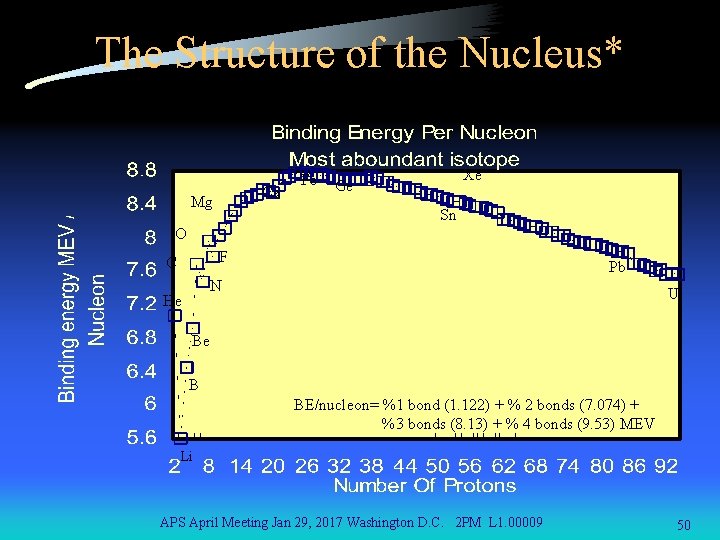
The Structure of the Nucleus* Ca Mg Fe Xe Ge Sn O F C Pb N He U Be B BE/nucleon= %1 bond (1. 122) + % 2 bonds (7. 074) + %3 bonds (8. 13) + % 4 bonds (9. 53) MEV Li APS April Meeting Jan 29, 2017 Washington D. C. 2 PM L 1. 00009 50
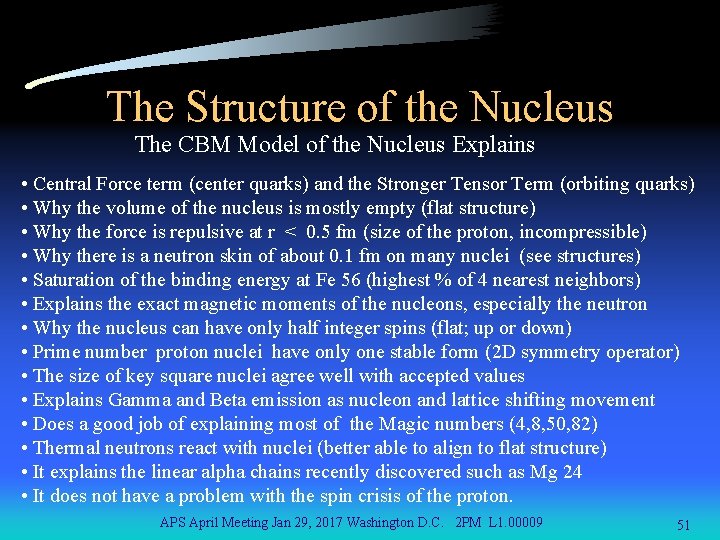
The Structure of the Nucleus The CBM Model of the Nucleus Explains • Central Force term (center quarks) and the Stronger Tensor Term (orbiting quarks) • Why the volume of the nucleus is mostly empty (flat structure) • Why the force is repulsive at r < 0. 5 fm (size of the proton, incompressible) • Why there is a neutron skin of about 0. 1 fm on many nuclei (see structures) • Saturation of the binding energy at Fe 56 (highest % of 4 nearest neighbors) • Explains the exact magnetic moments of the nucleons, especially the neutron • Why the nucleus can have only half integer spins (flat; up or down) • Prime number proton nuclei have only one stable form (2 D symmetry operator) • The size of key square nuclei agree well with accepted values • Explains Gamma and Beta emission as nucleon and lattice shifting movement • Does a good job of explaining most of the Magic numbers (4, 8, 50, 82) • Thermal neutrons react with nuclei (better able to align to flat structure) • It explains the linear alpha chains recently discovered such as Mg 24 • It does not have a problem with the spin crisis of the proton. APS April Meeting Jan 29, 2017 Washington D. C. 2 PM L 1. 00009 51
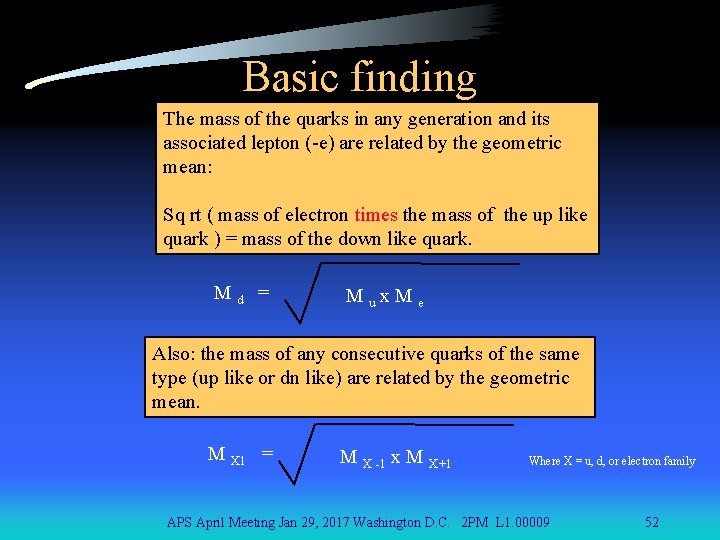
Basic finding The mass of the quarks in any generation and its associated lepton (-e) are related by the geometric mean: Sq rt ( mass of electron times the mass of the up like quark ) = mass of the down like quark. Md = Mux. Me Also: the mass of any consecutive quarks of the same type (up like or dn like) are related by the geometric mean. M X 1 = M X -1 x M X+1 Where X = u, d, or electron family APS April Meeting Jan 29, 2017 Washington D. C. 2 PM L 1. 00009 52
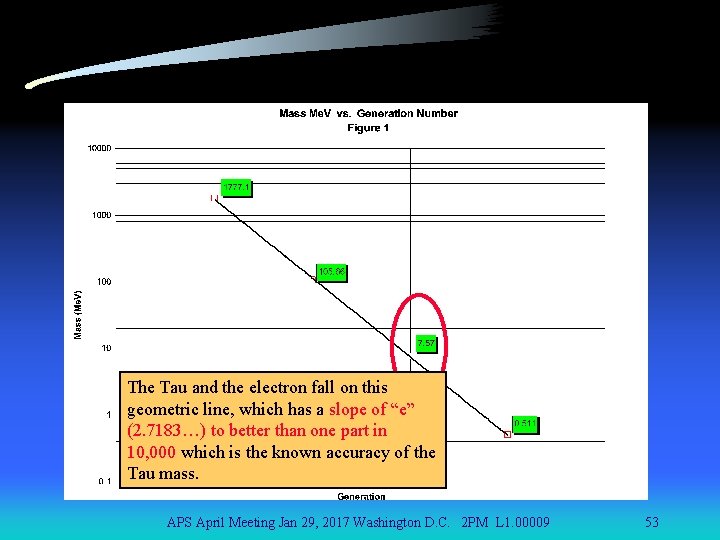
The Tau and the electron fall on this geometric line, which has a slope of “e” (2. 7183…) to better than one part in 10, 000 which is the known accuracy of the Tau mass. APS April Meeting Jan 29, 2017 Washington D. C. 2 PM L 1. 00009 53
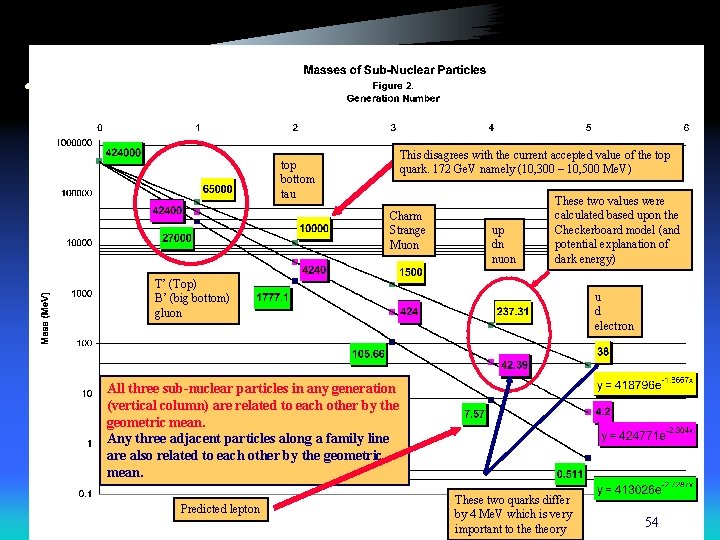
This disagrees with the current accepted value of the top quark. 172 Ge. V namely (10, 300 – 10, 500 Me. V) top bottom tau Charm Strange Muon up dn nuon These two values were calculated based upon the Checkerboard model (and potential explanation of dark energy) T’ (Top) B’ (big bottom) gluon u d electron All three sub-nuclear particles in any generation (vertical column) are related to each other by the geometric mean. Any three adjacent particles along a family line are also related to each other by the geometric mean. Predicted lepton These two quarks differ by 4 Me. V which is very important to theory 54
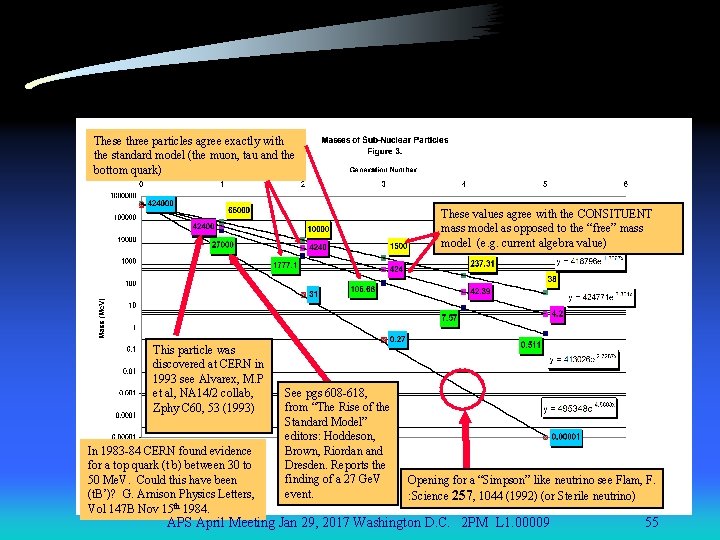
These three particles agree exactly with the standard model (the muon, tau and the bottom quark) These values agree with the CONSITUENT mass model as opposed to the “free” mass model (e. g. current algebra value) This particle was discovered at CERN in 1993 see Alvarex, M. P et al, NA 14/2 collab, Zphy C 60, 53 (1993) In 1983 -84 CERN found evidence for a top quark (t b) between 30 to 50 Me. V. Could this have been (t. B’)? G. Arnison Physics Letters, Vol 147 B Nov 15 th 1984. See pgs 608 -618, from “The Rise of the Standard Model” editors: Hoddeson, Brown, Riordan and Dresden. Reports the finding of a 27 Ge. V event. Opening for a “Simpson” like neutrino see Flam, F. : Science 257, 1044 (1992) (or Sterile neutrino) APS April Meeting Jan 29, 2017 Washington D. C. 2 PM L 1. 00009 55
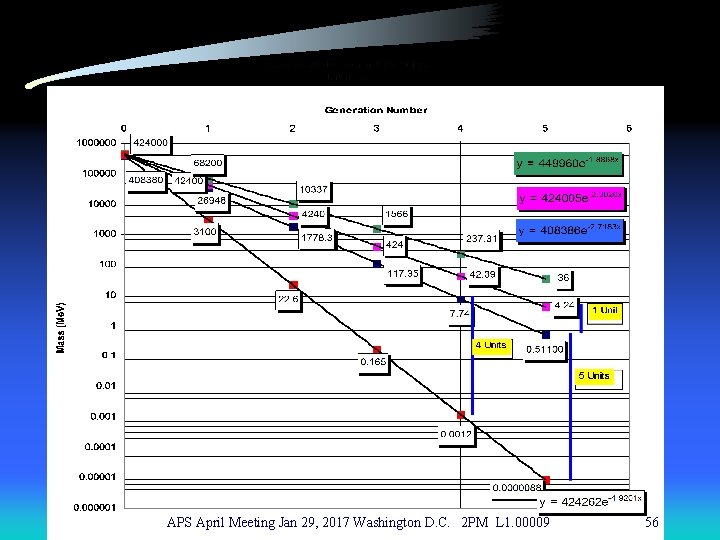
APS April Meeting Jan 29, 2017 Washington D. C. 2 PM L 1. 00009 56
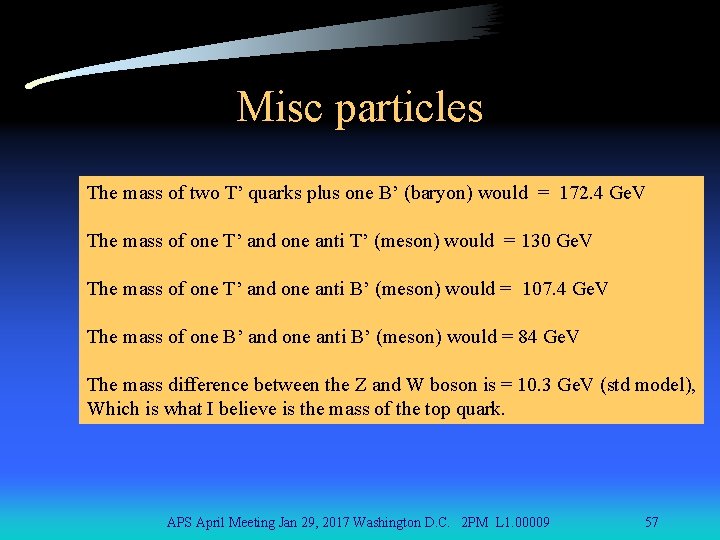
Misc particles The mass of two T’ quarks plus one B’ (baryon) would = 172. 4 Ge. V The mass of one T’ and one anti T’ (meson) would = 130 Ge. V The mass of one T’ and one anti B’ (meson) would = 107. 4 Ge. V The mass of one B’ and one anti B’ (meson) would = 84 Ge. V The mass difference between the Z and W boson is = 10. 3 Ge. V (std model), Which is what I believe is the mass of the top quark. APS April Meeting Jan 29, 2017 Washington D. C. 2 PM L 1. 00009 57
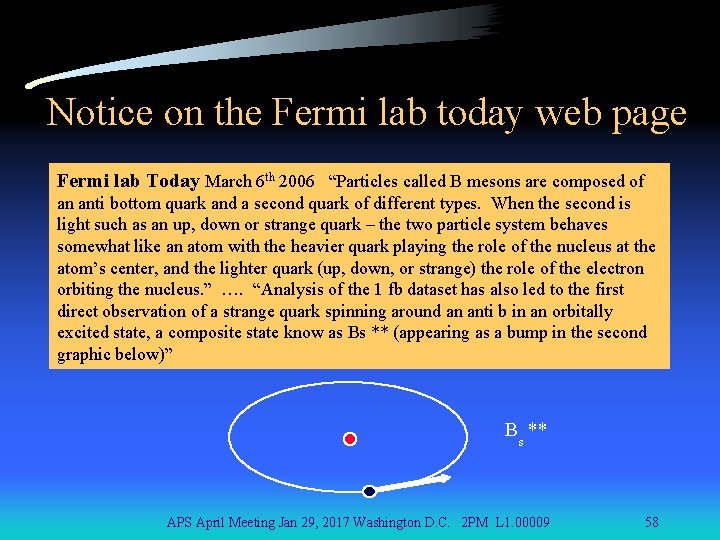
Notice on the Fermi lab today web page Fermi lab Today March 6 th 2006 “Particles called B mesons are composed of an anti bottom quark and a second quark of different types. When the second is light such as an up, down or strange quark – the two particle system behaves somewhat like an atom with the heavier quark playing the role of the nucleus at the atom’s center, and the lighter quark (up, down, or strange) the role of the electron orbiting the nucleus. ” …. “Analysis of the 1 fb dataset has also led to the first direct observation of a strange quark spinning around an anti b in an orbitally excited state, a composite state know as Bs ** (appearing as a bump in the second graphic below)” Bs ** APS April Meeting Jan 29, 2017 Washington D. C. 2 PM L 1. 00009 58
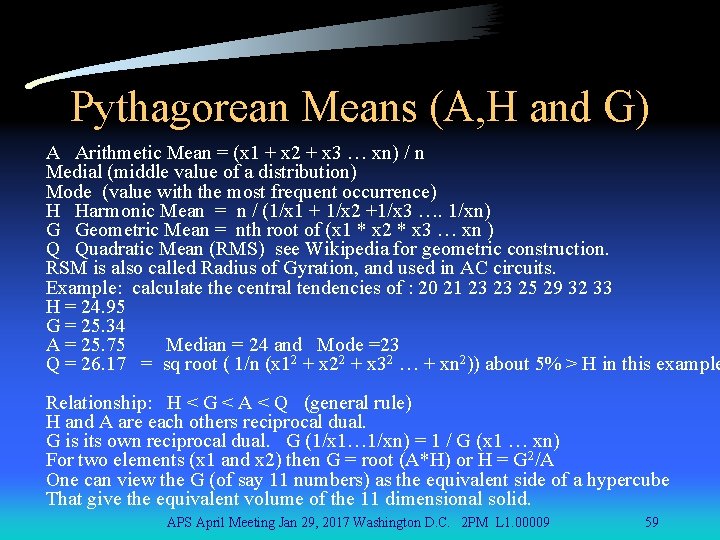
Pythagorean Means (A, H and G) A Arithmetic Mean = (x 1 + x 2 + x 3 … xn) / n Medial (middle value of a distribution) Mode (value with the most frequent occurrence) H Harmonic Mean = n / (1/x 1 + 1/x 2 +1/x 3 …. 1/xn) G Geometric Mean = nth root of (x 1 * x 2 * x 3 … xn ) Q Quadratic Mean (RMS) see Wikipedia for geometric construction. RSM is also called Radius of Gyration, and used in AC circuits. Example: calculate the central tendencies of : 20 21 23 23 25 29 32 33 H = 24. 95 G = 25. 34 A = 25. 75 Median = 24 and Mode =23 Q = 26. 17 = sq root ( 1/n (x 12 + x 22 + x 32 … + xn 2)) about 5% > H in this example Relationship: H < G < A < Q (general rule) H and A are each others reciprocal dual. G is its own reciprocal dual. G (1/x 1… 1/xn) = 1 / G (x 1 … xn) For two elements (x 1 and x 2) then G = root (A*H) or H = G 2/A One can view the G (of say 11 numbers) as the equivalent side of a hypercube That give the equivalent volume of the 11 dimensional solid. APS April Meeting Jan 29, 2017 Washington D. C. 2 PM L 1. 00009 59
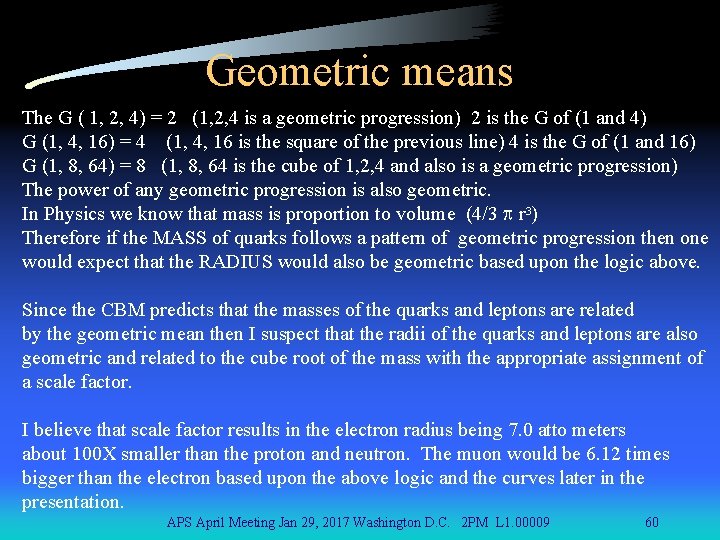
Geometric means The G ( 1, 2, 4) = 2 (1, 2, 4 is a geometric progression) 2 is the G of (1 and 4) G (1, 4, 16) = 4 (1, 4, 16 is the square of the previous line) 4 is the G of (1 and 16) G (1, 8, 64) = 8 (1, 8, 64 is the cube of 1, 2, 4 and also is a geometric progression) The power of any geometric progression is also geometric. In Physics we know that mass is proportion to volume (4/3 p r 3) Therefore if the MASS of quarks follows a pattern of geometric progression then one would expect that the RADIUS would also be geometric based upon the logic above. Since the CBM predicts that the masses of the quarks and leptons are related by the geometric mean then I suspect that the radii of the quarks and leptons are also geometric and related to the cube root of the mass with the appropriate assignment of a scale factor. I believe that scale factor results in the electron radius being 7. 0 atto meters about 100 X smaller than the proton and neutron. The muon would be 6. 12 times bigger than the electron based upon the above logic and the curves later in the presentation. APS April Meeting Jan 29, 2017 Washington D. C. 2 PM L 1. 00009 60
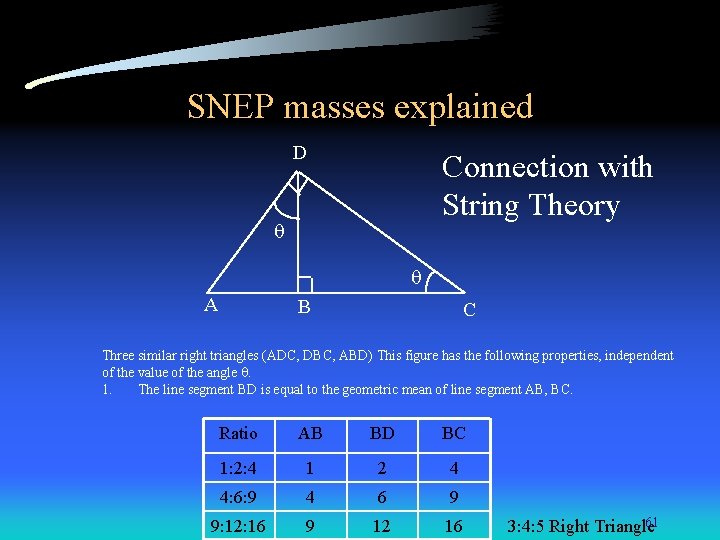
SNEP masses explained D Connection with String Theory q q A B C Three similar right triangles (ADC, DBC, ABD) This figure has the following properties, independent of the value of the angle q. 1. The line segment BD is equal to the geometric mean of line segment AB, BC. Ratio AB BD BC 1: 2: 4 1 2 4 4: 6: 9 4 6 9 9: 12: 16 9 12 16 61 3: 4: 5 Right Triangle
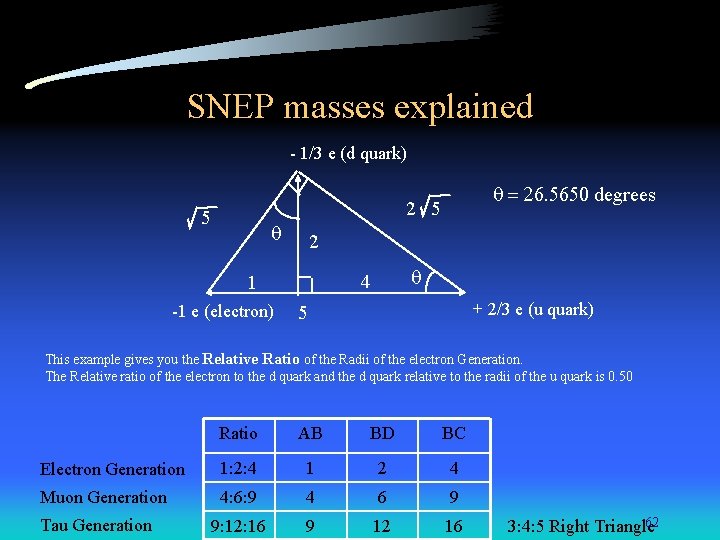
SNEP masses explained - 1/3 e (d quark) q = 26. 5650 degrees 2 5 5 q 2 -1 e (electron) q 4 1 + 2/3 e (u quark) 5 This example gives you the Relative Ratio of the Radii of the electron Generation. The Relative ratio of the electron to the d quark and the d quark relative to the radii of the u quark is 0. 50 Ratio AB BD BC Electron Generation 1: 2: 4 1 2 4 Muon Generation 4: 6: 9 4 6 9 9: 12: 16 9 12 16 Tau Generation 62 3: 4: 5 Right Triangle
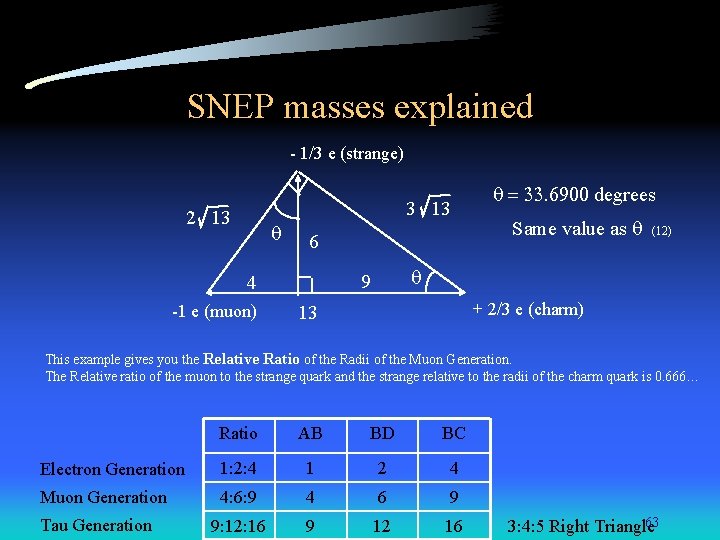
SNEP masses explained - 1/3 e (strange) 3 13 2 13 q 6 -1 e (muon) Same value as q (12) q 9 4 q = 33. 6900 degrees + 2/3 e (charm) 13 This example gives you the Relative Ratio of the Radii of the Muon Generation. The Relative ratio of the muon to the strange quark and the strange relative to the radii of the charm quark is 0. 666… Ratio AB BD BC Electron Generation 1: 2: 4 1 2 4 Muon Generation 4: 6: 9 4 6 9 9: 12: 16 9 12 16 Tau Generation 63 3: 4: 5 Right Triangle
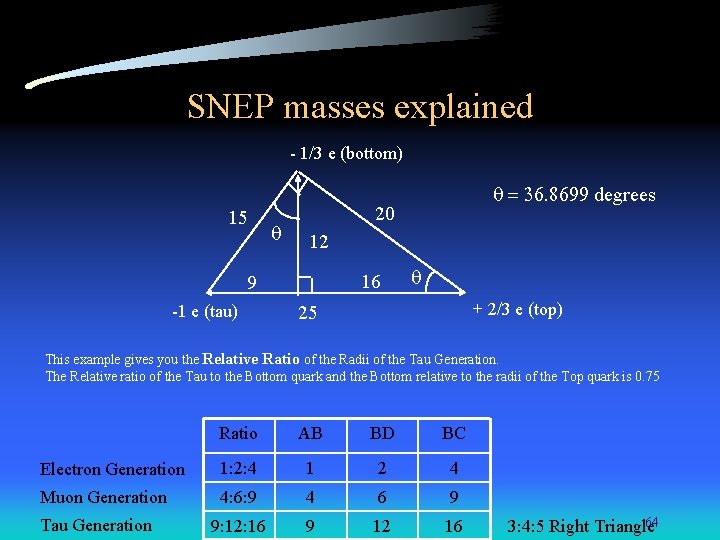
SNEP masses explained - 1/3 e (bottom) 15 q 20 12 16 9 -1 e (tau) q = 36. 8699 degrees q + 2/3 e (top) 25 This example gives you the Relative Ratio of the Radii of the Tau Generation. The Relative ratio of the Tau to the Bottom quark and the Bottom relative to the radii of the Top quark is 0. 75 Ratio AB BD BC Electron Generation 1: 2: 4 1 2 4 Muon Generation 4: 6: 9 4 6 9 9: 12: 16 9 12 16 Tau Generation 64 3: 4: 5 Right Triangle
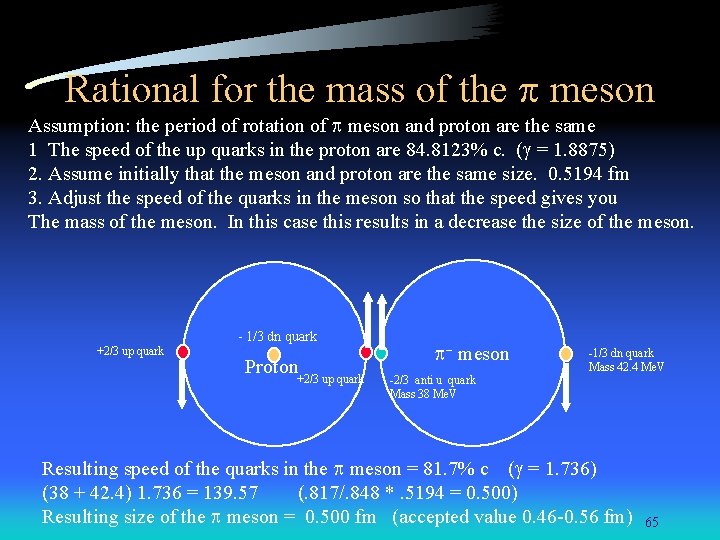
Rational for the mass of the p meson Assumption: the period of rotation of p meson and proton are the same 1 The speed of the up quarks in the proton are 84. 8123% c. (g = 1. 8875) 2. Assume initially that the meson and proton are the same size. 0. 5194 fm 3. Adjust the speed of the quarks in the meson so that the speed gives you The mass of the meson. In this case this results in a decrease the size of the meson. - 1/3 dn quark +2/3 up quark Proton+2/3 up quark p- meson -2/3 anti u quark Mass 38 Me. V -1/3 dn quark Mass 42. 4 Me. V Resulting speed of the quarks in the p meson = 81. 7% c (g = 1. 736) (38 + 42. 4) 1. 736 = 139. 57 (. 817/. 848 *. 5194 = 0. 500) Resulting size of the p meson = 0. 500 fm (accepted value 0. 46 -0. 56 fm) 65
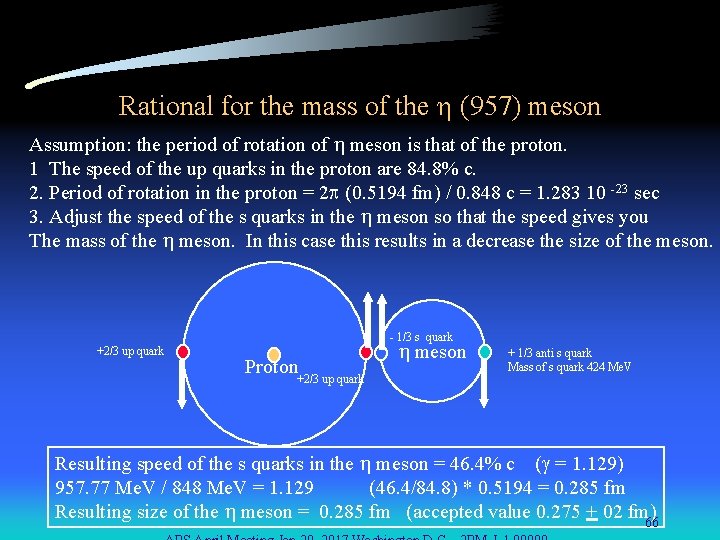
Rational for the mass of the h (957) meson Assumption: the period of rotation of h meson is that of the proton. 1 The speed of the up quarks in the proton are 84. 8% c. 2. Period of rotation in the proton = 2 p (0. 5194 fm) / 0. 848 c = 1. 283 10 -23 sec 3. Adjust the speed of the s quarks in the h meson so that the speed gives you The mass of the h meson. In this case this results in a decrease the size of the meson. - 1/3 s quark +2/3 up quark Proton+2/3 up quark h meson + 1/3 anti s quark Mass of s quark 424 Me. V Resulting speed of the s quarks in the h meson = 46. 4% c (g = 1. 129) 957. 77 Me. V / 848 Me. V = 1. 129 (46. 4/84. 8) * 0. 5194 = 0. 285 fm Resulting size of the h meson = 0. 285 fm (accepted value 0. 275 + 02 fm) 66
New Revelation • Some speculate the size of an electron is about 7. 0 atto meters. 7 X 10 meters (about 100 x smaller than proton) • My speculation: The density of the electron (& all quarks) is about one Te. V per fm 3 • My speculation: All the Quarks have the same density, different radii. • My speculation: Black holes have the same density as quarks/electrons. If this is true then: -18 – The radius of BH in the Milky Way is 90 miles – The radius of the BH in Andromeda is 1000 miles. – (black holes are not singularities) APS April Meeting Jan 29, 2017 Washington D. C. 2 PM L 1. 00009 67
Relative size of the proton and neutron Recently I learned from work done by J. A. Nolen, J. P. Schiffer, and N. Williams in the late 60’s “The neutron radius of 208 Pb” 1968. that they determined that the radius of the neutron was larger than the proton by 0. 07 + 0. 03 fm. Since my theory predicts the radius of the neutron as 0. 607939 fm and The size of the proton as 0. 519406 fm rn /rp 1. 170452 That difference is 0. 0885 fm Well within the range of 0. 04 to 0. 10 fm. The accepted RMS value of the proton is 0. 8779 + 0. 0094 fm One of the reasons that Nuclear Physicist have problems with this model is because The RMS radius is significantly larger than what the Checkerboard theory predicts. Why is the RMS value of the proton so large? What does an RMS value represent? Why does the muon RMS value = 0. 84184 + 0. 00067 ? Is the proton a perfect sphere or is it oblate or even bagel shaped as indicated in 2003. APS April Meeting Jan 29, 2017 Washington D. C. 2 PM L 1. 00009 68
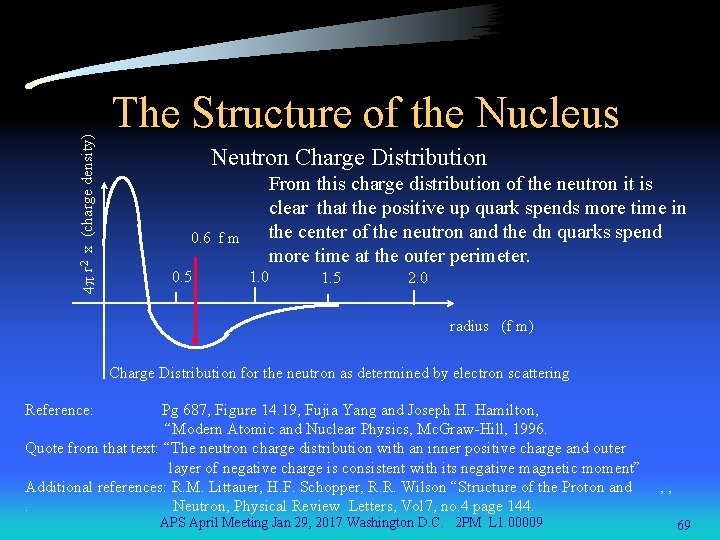
4 p r 2 x (charge density) The Structure of the Nucleus Neutron Charge Distribution 0. 6 f m 0. 5 From this charge distribution of the neutron it is clear that the positive up quark spends more time in the center of the neutron and the dn quarks spend more time at the outer perimeter. 1. 0 1. 5 2. 0 radius (f m) Charge Distribution for the neutron as determined by electron scattering Reference: Pg 687, Figure 14. 19, Fujia Yang and Joseph H. Hamilton, “Modern Atomic and Nuclear Physics, Mc. Graw-Hill, 1996. Quote from that text: “The neutron charge distribution with an inner positive charge and outer layer of negative charge is consistent with its negative magnetic moment” Additional references: R. M. Littauer, H. F. Schopper, R. R. Wilson “Structure of the Proton and. Neutron, Physical Review Letters, Vol 7, no. 4 page 144. APS April Meeting Jan 29, 2017 Washington D. C. 2 PM L 1. 00009 , , 69
Who is Theodore M. Lach B. S. Physics 1968 U of I M. S. Physics 1969 U of I 1969 Sept Joined AT&T as Dev Engineer in Thin Film Hybrids. Hawthorne Works, Chicago Clean Room design, D. I. Water system design Eng. Hybrid IC manufacturing 4 ESS FA packs 1975 MS Material Sc. Northwestern Thesis under direction of D. L. Johnson Ceramic material specialist 1976 Registered Prof. Eng of Ill. 1978 R&D Member of Technical Staff AT&T Teletype (IC packaging) 1980 R&D MTS mask making and ULSI fab room design. 1982 Senior R&D MTS (IC wafer fabrication, mask making, projection exposers and steppers) 1985 5 ESS component Reliability MTS 1987 5 ESS circuit pack and system Reliability 1995 Distinguished MTS 5 ESS Reliability 2000 Consulting MTS Switching Division and core Enterprise 2001 Home Land Security NRIC -6 Lucent Representative for Hardware 2002 Bell Labs Fellow 2006 Alcatel-Lucent Fellow and Life member of ALU Technical Academy 2007 ATCAv 2 and other core Enterprise products such as Telica servers and wireless Packet switches. 2012 Retired after 42. 5 years in AT&T, Western Electric, Teletype, Bell Labs, Lucent, Alcatel-Lucent APS April Meeting Jan 29, 2017 Washington D. C. 2 PM L 1. 00009 70
Ted’s areas of Reliability IC reliability, bipolar, CMOS, Ga. N, memory, integrated Circuits, FPGA … JEDEC representative to 14. 1, 14. 2, and 14. 3 ) Resistors, Capacitors, inductors, and all other passives (IEC representative) Connector Reliability, gold thickness effects, socket reliability, constriction resistance Power modules, RF power amplifiers, high voltage IC’s, … Disk Drives, Tape drives, toggle switches, … Circuit pack level reliability, over 30, 000 packs in the field many over 25 yr. ESD expert: Human Body Model, Charge Device Model, Machine Model, … Tin Whiskers, mediation techniques. PWB failure modes: Solder joint fatigue, Hygroscopic dust, pad cratering… Corrosion failure modes. High sulfur content environments. IC failure modes: Electromigration, TDDB, hot carriers, NBTI, Moisture Sensitivity Fire Resistance, Fire initiation, Earthquake resistance, Temp and Humidity stds. System Reliability, fault tolerant, redundancy, RAID, Hamming … Hybrid metallization failures (TC bond failures), Al 2 O 3 micro pore clusters. Noise in Thin Film resistors. Step coverage, Alignment and Overlap allowances. APS April Meeting Jan 29, 2017 Washington D. C. 2 PM L 1. 00009 71
Disclaimer AT&T/ Lucent / Bell Labs / ALU does not endorse nor encourage this paper. This paper is solely the ideals and responsibility of the author. The material in this paper was not created during company time. The material was not checked nor reviewed by Bell Labs Physicists. APS April Meeting Jan 29, 2017 Washington D. C. 2 PM L 1. 00009 72
- Slides: 72