
The Structure of the Nucleon Introduction Meson cloud
- Slides: 45
The Structure of the Nucleon • Introduction • Meson cloud effects: two-component model • Strange form factors • Results • Summary and conclusions Roelof Bijker ICN-UNAM
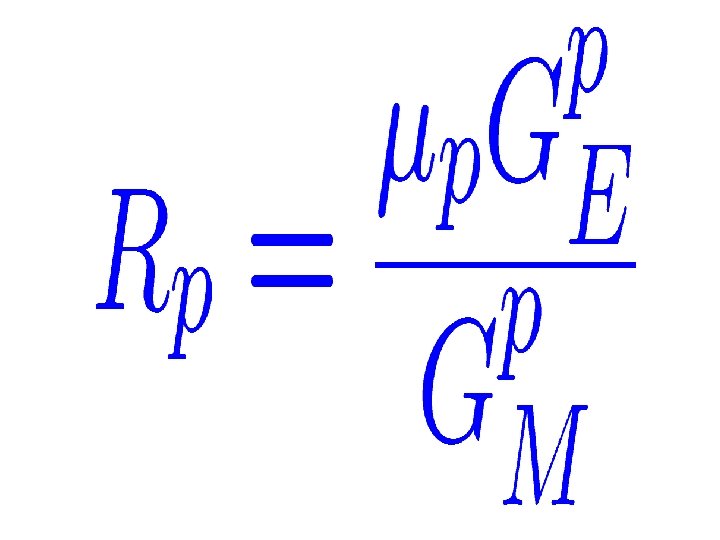
Internal Structure of the Proton • Anomalous magnetic moment of the proton (Stern, 1930’s) • Spatial structure of the proton (Hofstadter, 1950’s) • Scaling: quark structure of the proton (Friedman, Kendall, Taylor, 1960’s) • EMC effect, spin crisis (1988) • Form factor ratio (2000) • Investigate the structure of the nucleon through the electromagnetic and weak form factors in the spaceand time-like regions
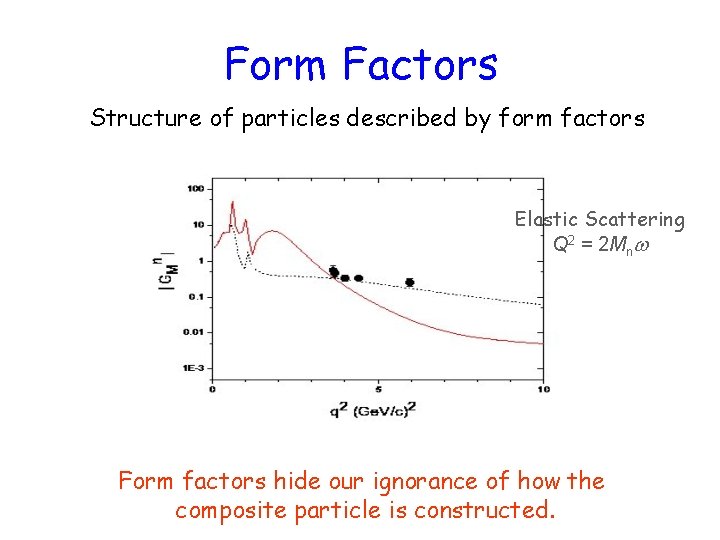
Form Factors Structure of particles described by form factors Elastic Scattering Q 2 = 2 Mnw Form factors hide our ignorance of how the composite particle is constructed.
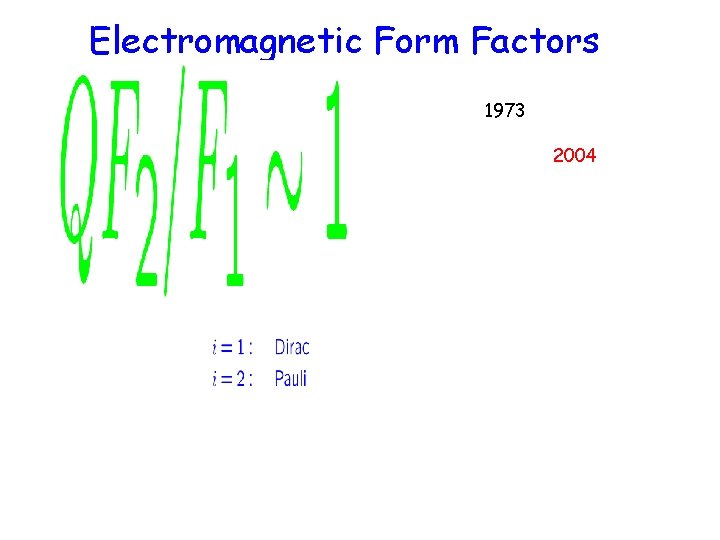
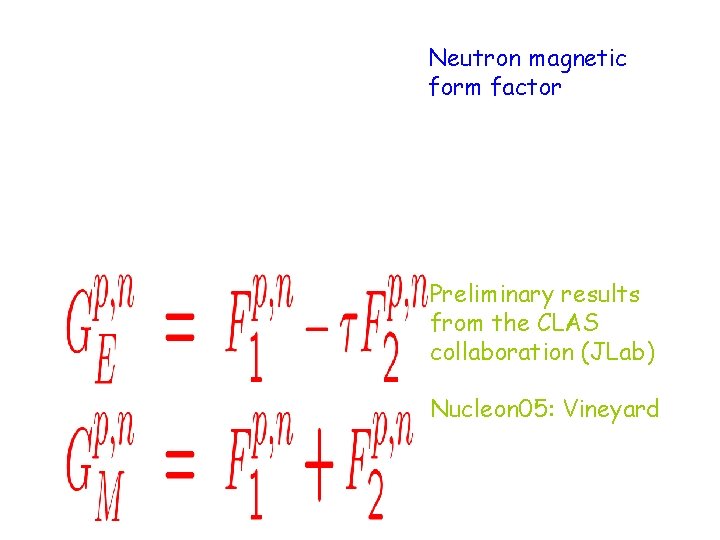
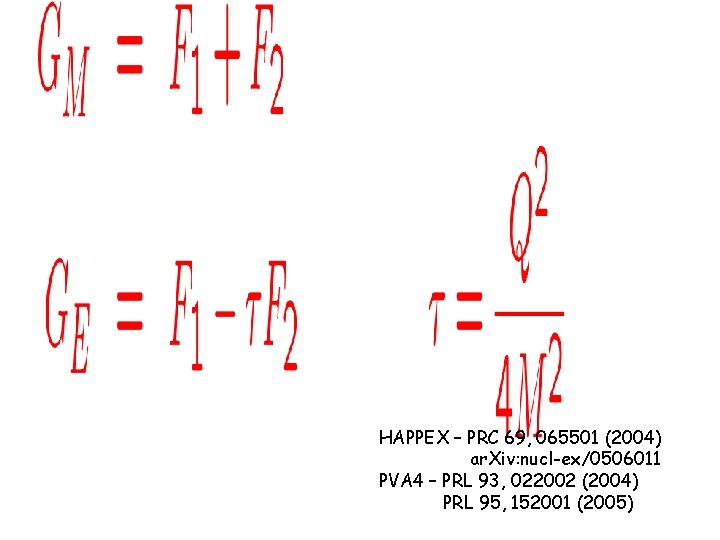
Nucleon Electromagnetic Current Dirac and Pauli form factors Sachs form factors
The Structure of the Nucleon • Introduction • Meson cloud effects: two-component model • Strange form factors • Results • Summary and conclusions
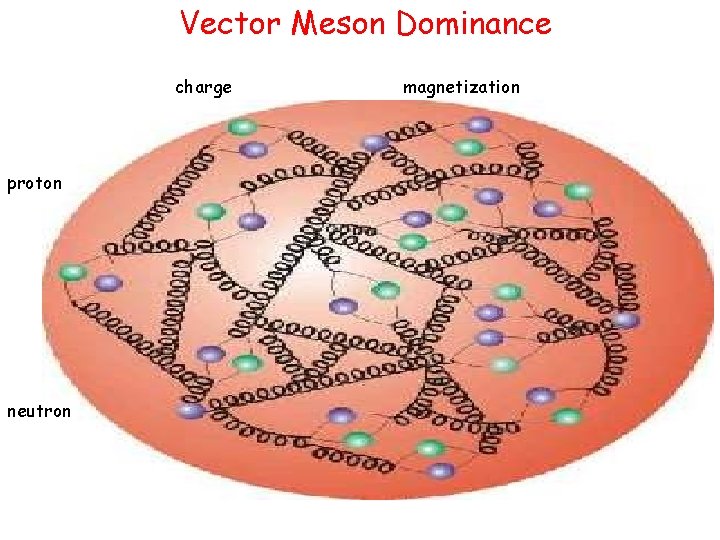
Vector Meson Dominance Photon couples to nucleon via vector meson ( , , ) Adjust high Q 2 behaviour to p. QCD scaling Include the finite width of meson Two-component model: Intrinsic structure (valence quarks) Meson cloud (quark-antiquark pairs)
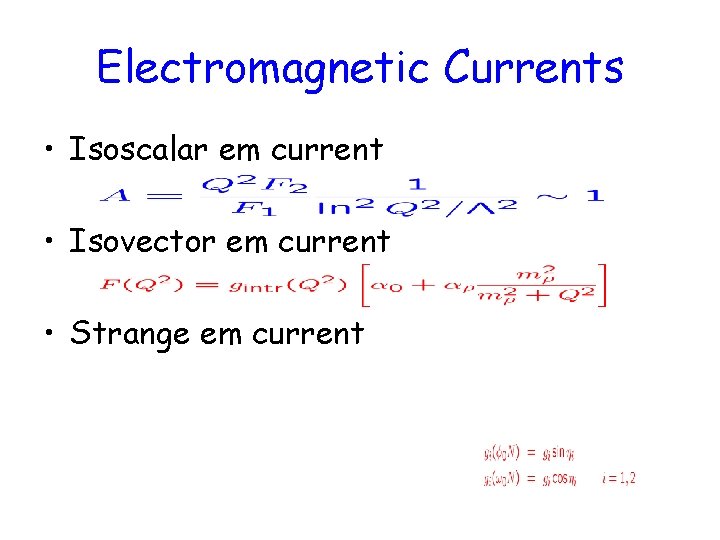
Electromagnetic Currents • Isoscalar em current • Isovector em current • Strange em current
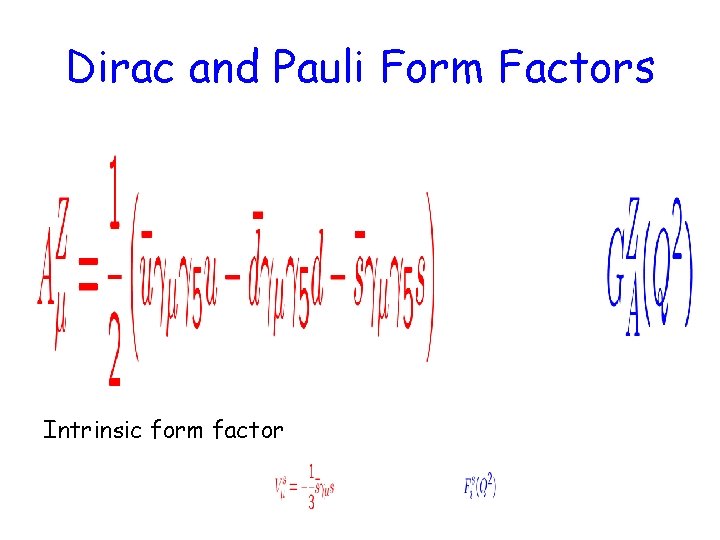
Dirac and Pauli Form Factors Intrinsic form factor
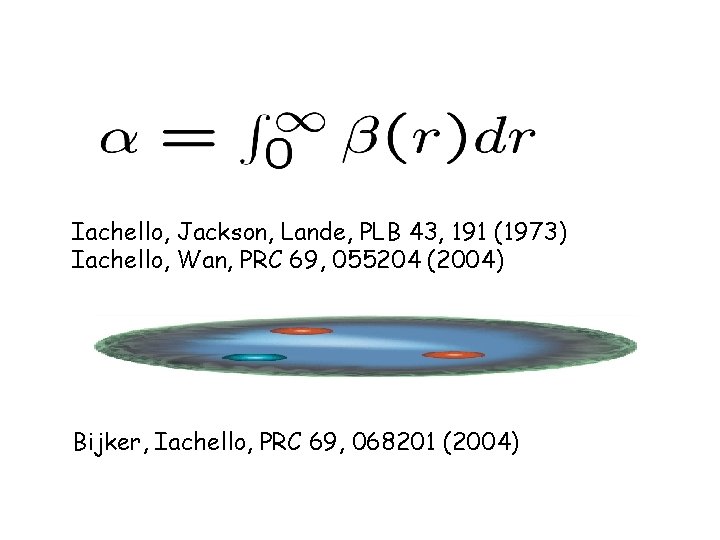
Iachello, Jackson, Lande, PLB 43, 191 (1973) Iachello, Wan, PRC 69, 055204 (2004) Bijker, Iachello, PRC 69, 068201 (2004)
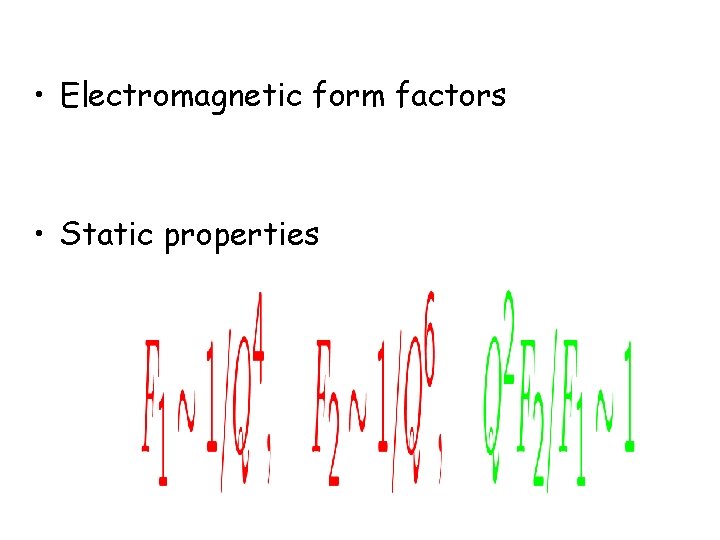
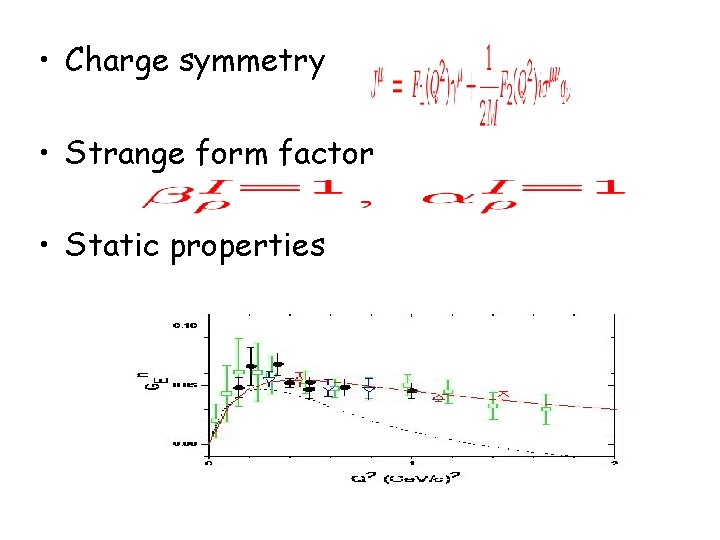
• Electromagnetic form factors • Static properties
The Structure of the Nucleon • Introduction • Meson cloud effects: two-component model • Strange form factors • Results • Summary and conclusions
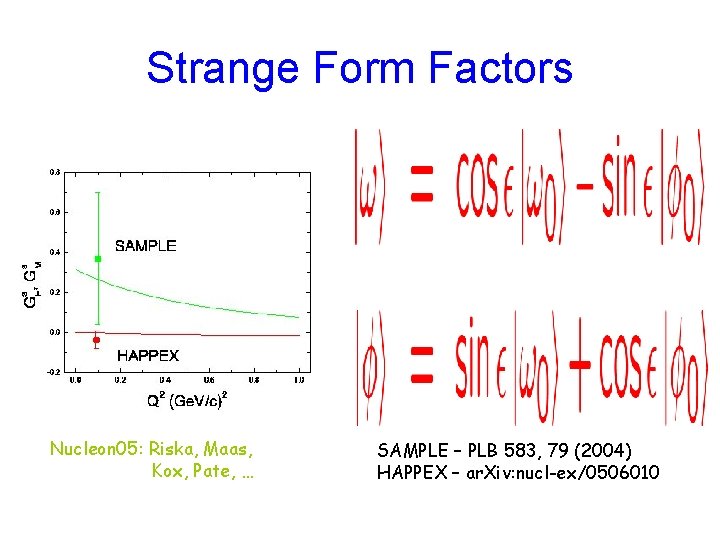
Strange Form Factors • The strangeness distribution is a very sensitive probe of the nucleon’s properties • The strange (anti)quarks come uniquely from the sea: there is no contamination from up or down valence quarks • New data from SAMPLE, HAPPEX, PVA 4 and G 0 Collaborations • meson mostly strange quarks
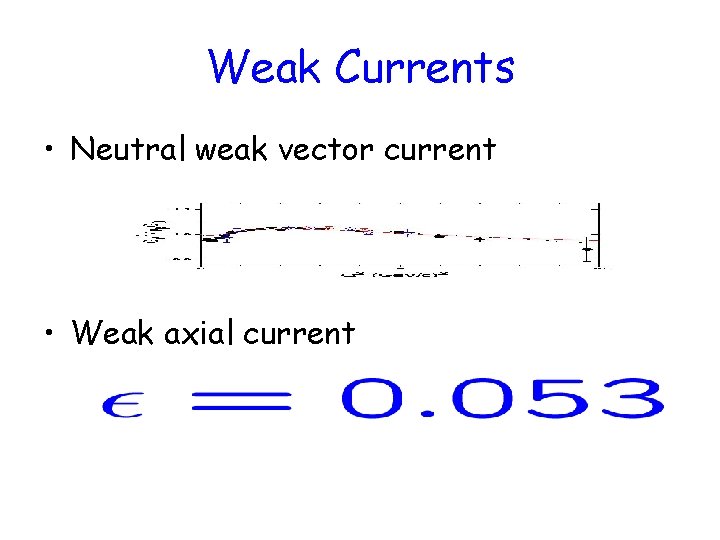
Weak Currents • Neutral weak vector current • Weak axial current
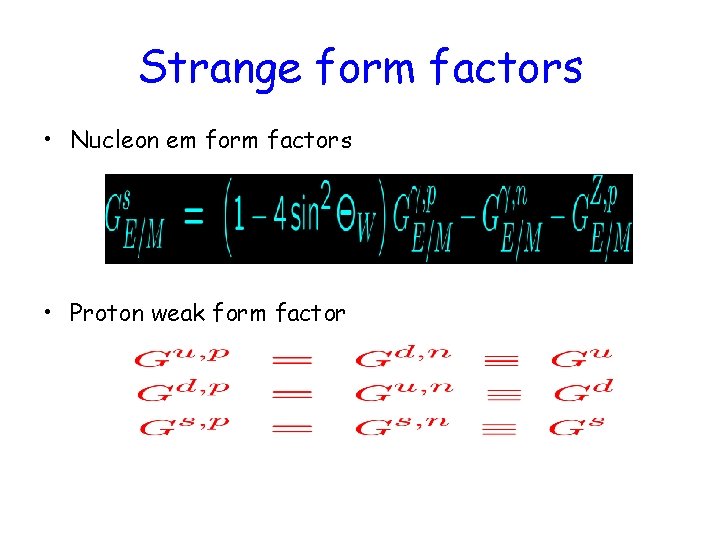
Strange form factors • Nucleon em form factors • Proton weak form factor
• Charge symmetry • Strange form factor • Static properties
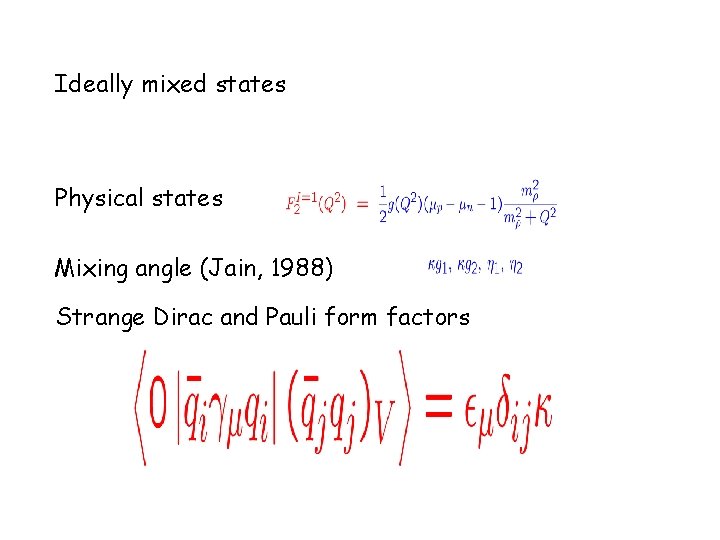
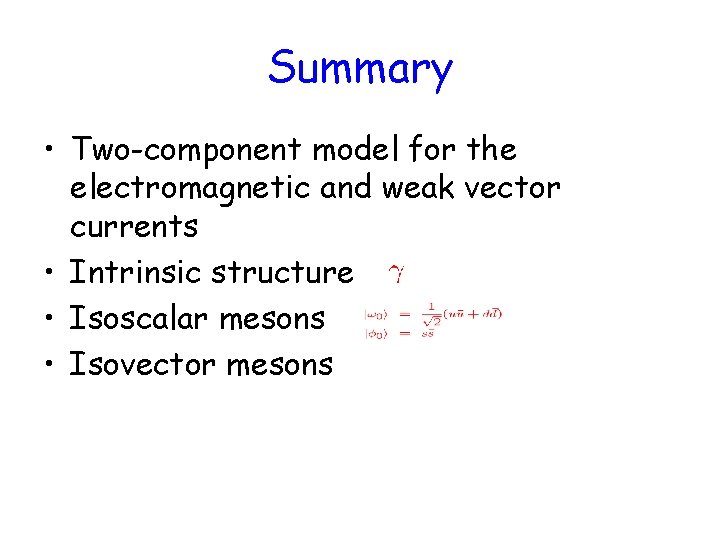
Ideally mixed states Physical states Mixing angle (Jain, 1988) Strange Dirac and Pauli form factors
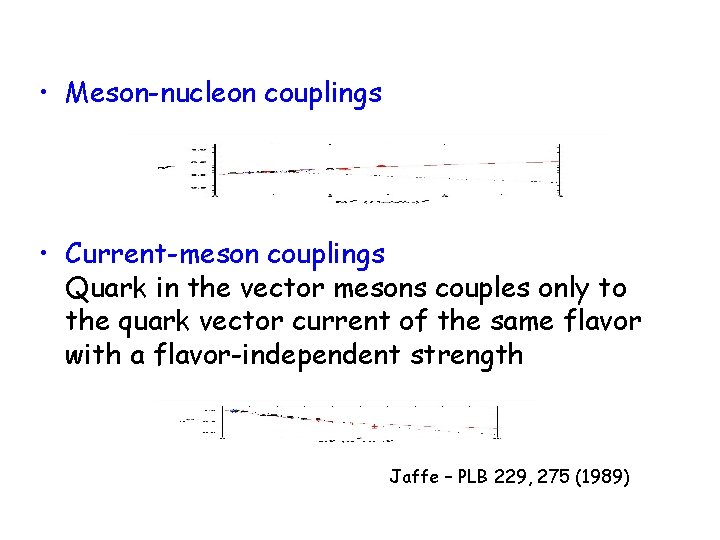
• Meson-nucleon couplings • Current-meson couplings Quark in the vector mesons couples only to the quark vector current of the same flavor with a flavor-independent strength Jaffe – PLB 229, 275 (1989)
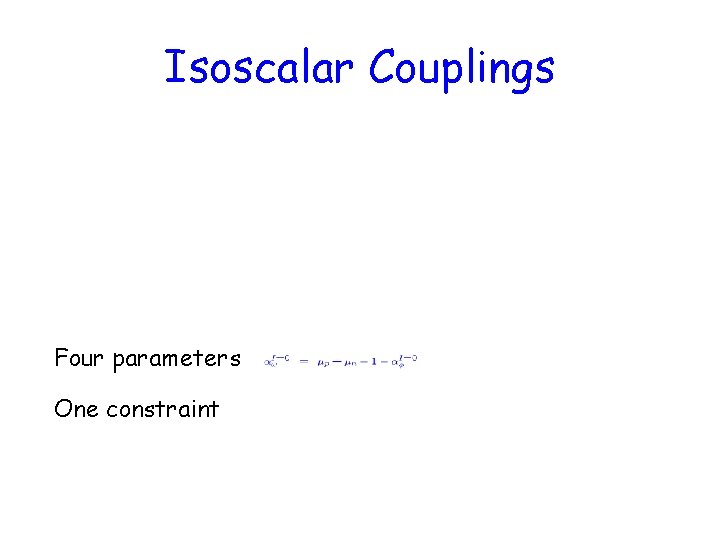
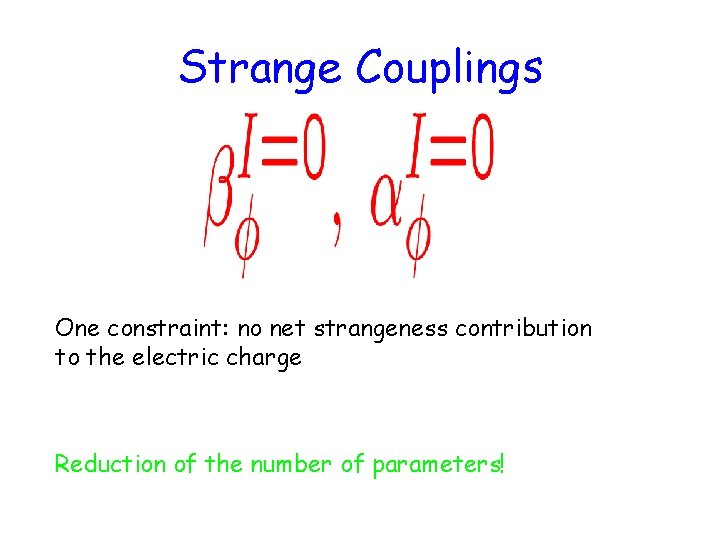
Isoscalar Couplings Four parameters One constraint
Strange Couplings One constraint: no net strangeness contribution to the electric charge Reduction of the number of parameters!
Summary • Two-component model for the electromagnetic and weak vector currents • Intrinsic structure • Isoscalar mesons • Isovector mesons
The Structure of the Nucleon • Introduction • Meson cloud effects: two-component model • Strange form factors • Results • Summary and conclusions
Electromagnetic Form Factors 1973 2004
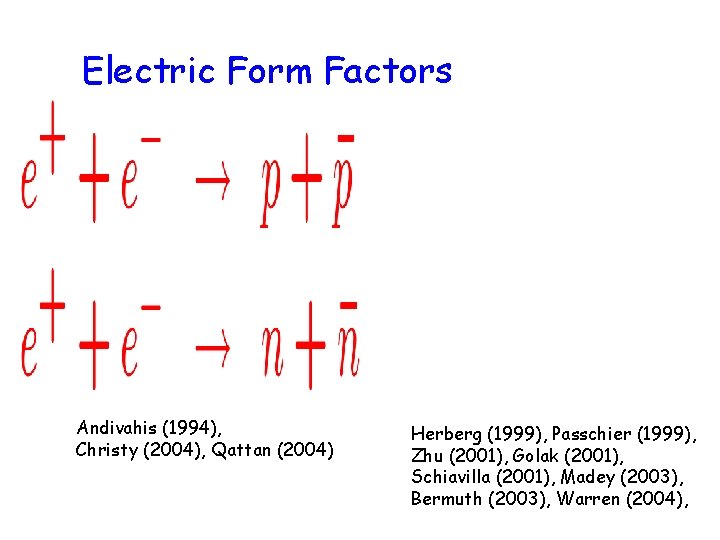
Electric Form Factors Andivahis (1994), Christy (2004), Qattan (2004) Herberg (1999), Passchier (1999), Zhu (2001), Golak (2001), Schiavilla (2001), Madey (2003), Bermuth (2003), Warren (2004),
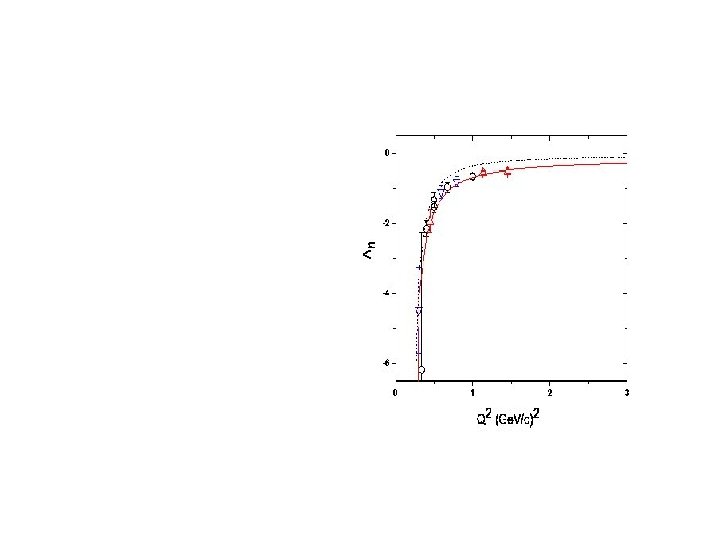
Neutron magnetic form factor Preliminary results from the CLAS collaboration (JLab) Nucleon 05: Vineyard
Scaling Behavior • Dimensional analysis (Brodsky, Farrar), p. QCD (Brodsky, Lepage) • Polarization transfer data • Quark orbital angular momentum (Miller, Ralston) • Valid in VMD in an intermediate Q 2 region, but not in the asymptotic region (Iachello)
p. QCD (Belitsky)
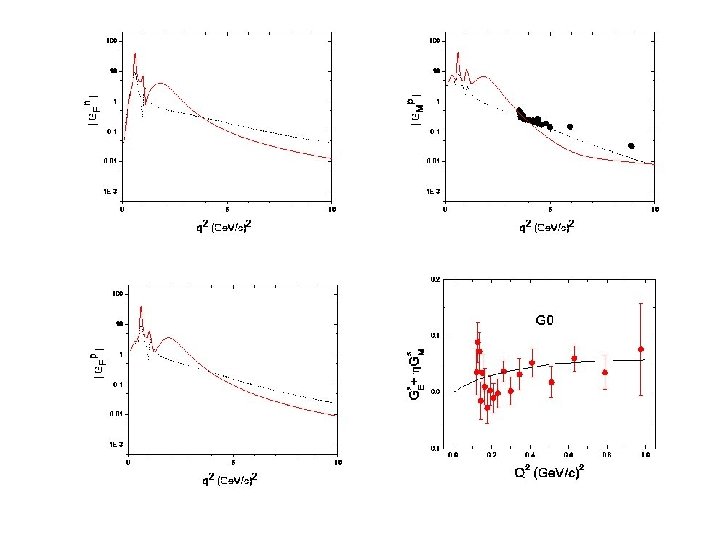
Strange Form Factors Nucleon 05: Riska, Maas, Kox, Pate, … SAMPLE – PLB 583, 79 (2004) HAPPEX – ar. Xiv: nucl-ex/0506010
HAPPEX – PRC 69, 065501 (2004) ar. Xiv: nucl-ex/0506011 PVA 4 – PRL 93, 022002 (2004) PRL 95, 152001 (2005)
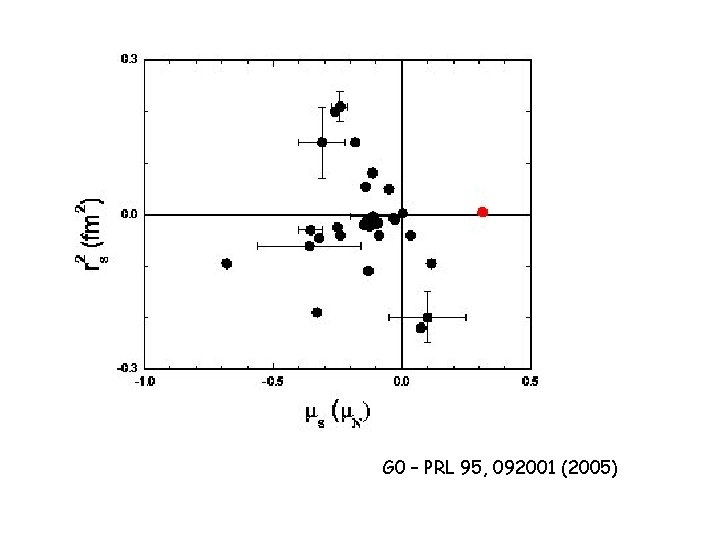
G 0 – PRL 95, 092001 (2005)
Time-like form factors: Q 2<0 Experimentally, the time-like form factors can be probed through (Frascati) or the inverse reaction (CERN, FNAL) Theoretically, the space- and time-like form factors are related by analytic continuation
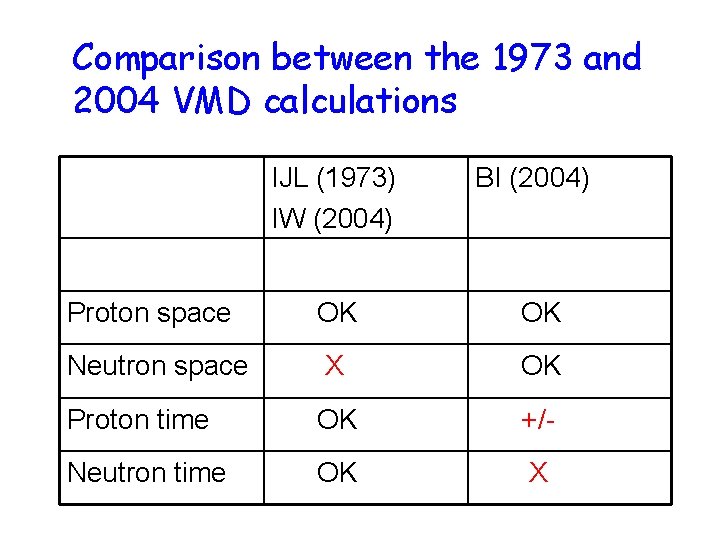
Comparison between the 1973 and 2004 VMD calculations IJL (1973) IW (2004) BI (2004) Proton space OK OK Neutron space X OK Proton time OK +/- Neutron time OK X
The Structure of the Nucleon • Introduction • Meson cloud effects: two-component model • Strange form factors • Results • Summary and conclusions
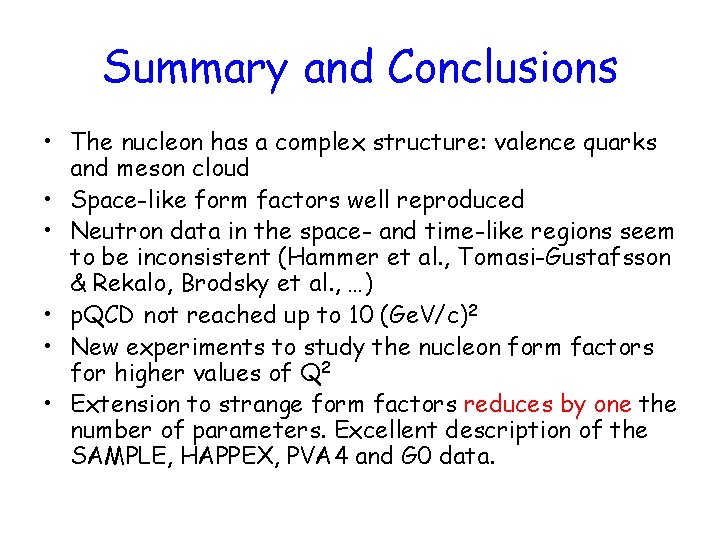
Summary and Conclusions • The nucleon has a complex structure: valence quarks and meson cloud • Space-like form factors well reproduced • Neutron data in the space- and time-like regions seem to be inconsistent (Hammer et al. , Tomasi-Gustafsson & Rekalo, Brodsky et al. , …) • p. QCD not reached up to 10 (Ge. V/c)2 • New experiments to study the nucleon form factors for higher values of Q 2 • Extension to strange form factors reduces by one the number of parameters. Excellent description of the SAMPLE, HAPPEX, PVA 4 and G 0 data.
Outlook • Extend two-component model to baryon resonances • Strange form factors • Axial form factors
N- Transition From Factors • Two-componet model (Iachello & Wan, IJMPA 20, 1846 (2005)) • Generic structure • Intrinsic form factors from previous study of baryon resonances (Bijker, Iachello, Leviatan, AP 236, 69 (1994)) • Isovector meson:
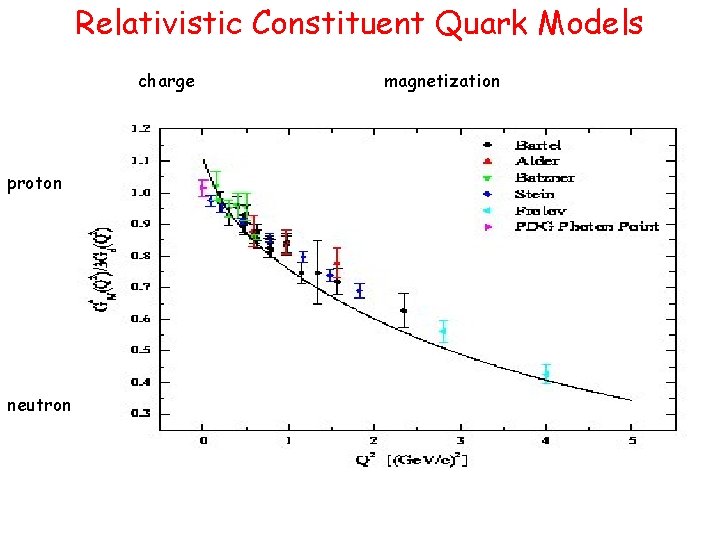
Other theoretical calculations Vector meson dominance Lomon, Iachello, Hammer Relativistic chiral soliton model Goeke, Holzwarth Lattice QCD Schierholz Relativistic constituent quark model Miller, Simula, Giannini, Plessas, Metsch
Vector Meson Dominance charge proton neutron magnetization
Relativistic Constituent Quark Models charge proton neutron magnetization