
THE STRUCTURE OF THE ATOM CHAPTER 4 EARLY

- Slides: 40
THE STRUCTURE OF THE ATOM CHAPTER 4
EARLY IDEAS ABOUT MATTER SECTION 1
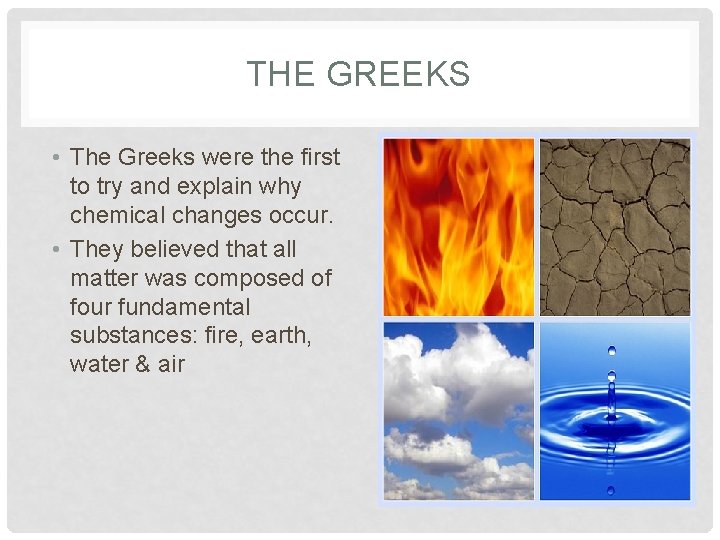
THE GREEKS • The Greeks were the first to try and explain why chemical changes occur. • They believed that all matter was composed of four fundamental substances: fire, earth, water & air
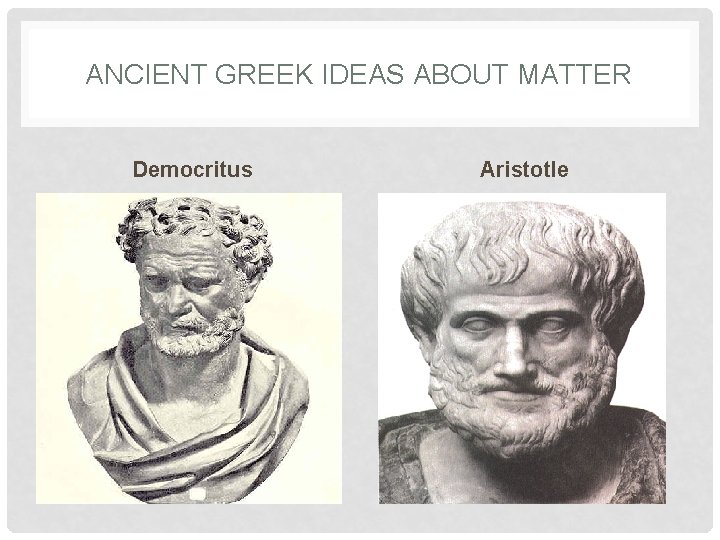
ANCIENT GREEK IDEAS ABOUT MATTER Democritus Aristotle • Matter is composed of atoms, which move through empty space. • Atoms are solid, homogenous, indestructible, & indivisible. • Different kinds of atoms have different sizes & shapes • Size, shape, & movement of atoms determine the properties of matter. • Empty space cannot exist. • Matter is made of earth, fire, air, & water.
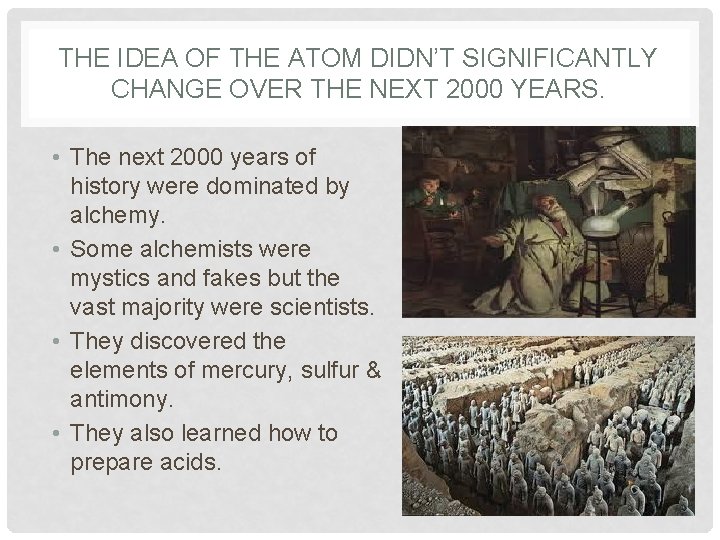
THE IDEA OF THE ATOM DIDN’T SIGNIFICANTLY CHANGE OVER THE NEXT 2000 YEARS. • The next 2000 years of history were dominated by alchemy. • Some alchemists were mystics and fakes but the vast majority were scientists. • They discovered the elements of mercury, sulfur & antimony. • They also learned how to prepare acids.
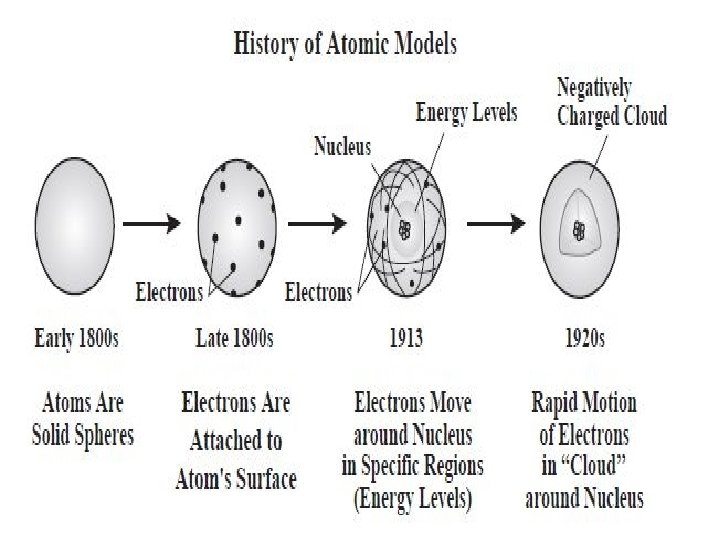
DALTON’S ATOMIC THEORY 1. Matter is composed of extremely small particles called atoms. 2. Atoms are indivisible and indestructible. 3. All atoms of a given element are identical in size, mass, & chemical properties. 4. The atoms of a given element are different from those of any other element. 5. Different atoms combine in simple whole-number ratios to form compounds. 6. In a chemical reaction, atoms are separated, combined or rearranged.
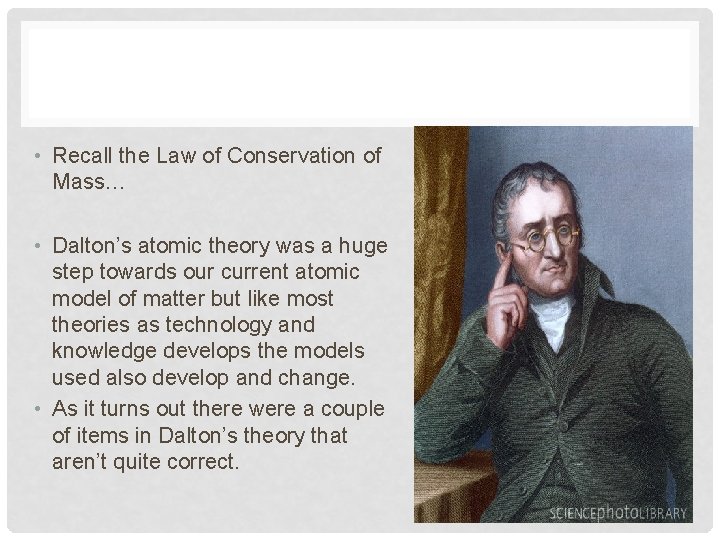
• Recall the Law of Conservation of Mass… • Dalton’s atomic theory was a huge step towards our current atomic model of matter but like most theories as technology and knowledge develops the models used also develop and change. • As it turns out there were a couple of items in Dalton’s theory that aren’t quite correct.
DALTON’S ATOMIC THEORY REVISED 1. Matter is composed of extremely small particles called atoms. 2. Atoms are indivisible and indestructible. 3. All atoms of a given element are identical in size, mass, & chemical properties.
DEFINING THE ATOM SECTION 2
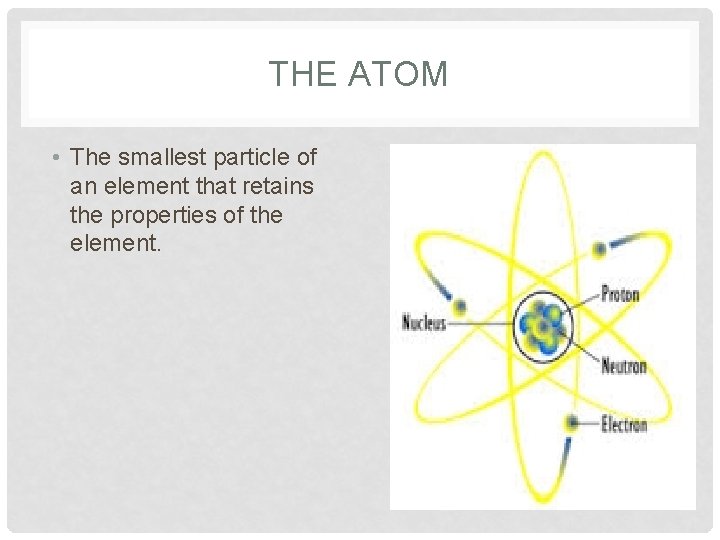
THE ATOM • The smallest particle of an element that retains the properties of the element.
THE STRUCTURE OF THE ATOM • Dalton’s atomic theory provided such a convincing explanation for the composition of compounds that it became generally accepted. • Dalton’s theory lead to many new questions • Why do atoms stick together? • What does an atom look like?
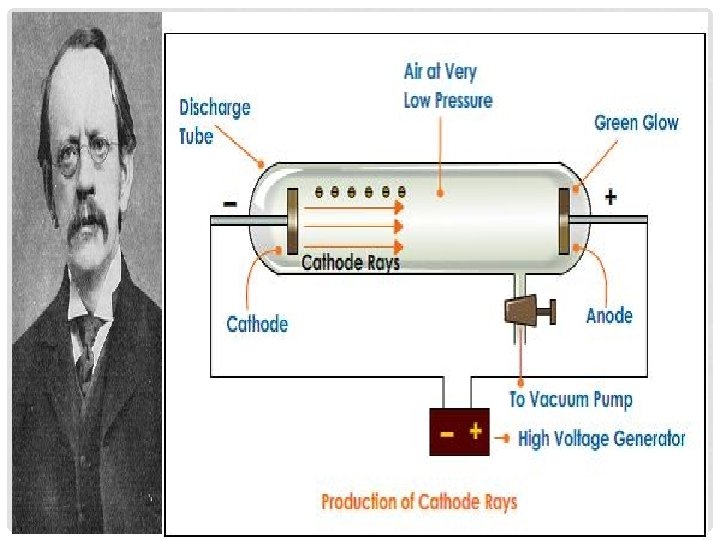
THOMSON’S EXPERIMENT • J. J. Thomson • British, physicist • In the late 1890’s he used a cathode ray tube to show that the atoms of any element can be made to emit tiny negative particles • He knew that they had a negative charge because they were repelled by the negative part of an magnetic field
• From this experiment, Thompson concluded that all types of atoms must contain these negative particles. • Electron's –Negatively charged particles that are part of all forms of matter.
NEW IDEA’S ON THE ATOM… • Thomson had discovered these negatively charged particles, called electrons. • But he also knew that whole atoms are not negatively or positively charged. • He concluded that the atom must also contain positive particles that balance the negative charge
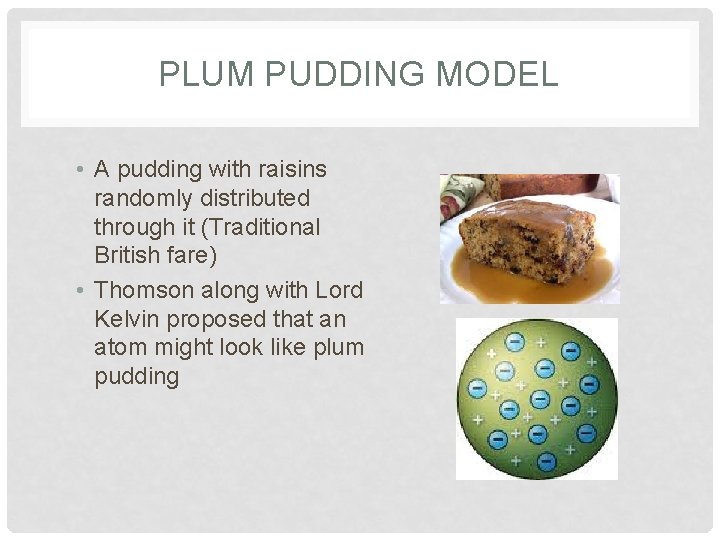
PLUM PUDDING MODEL • A pudding with raisins randomly distributed through it (Traditional British fare) • Thomson along with Lord Kelvin proposed that an atom might look like plum pudding
• They reasoned that the atom might be thought of as a uniform “pudding” of positive charge with enough negative electrons scattered within to counterbalance the positive charge.
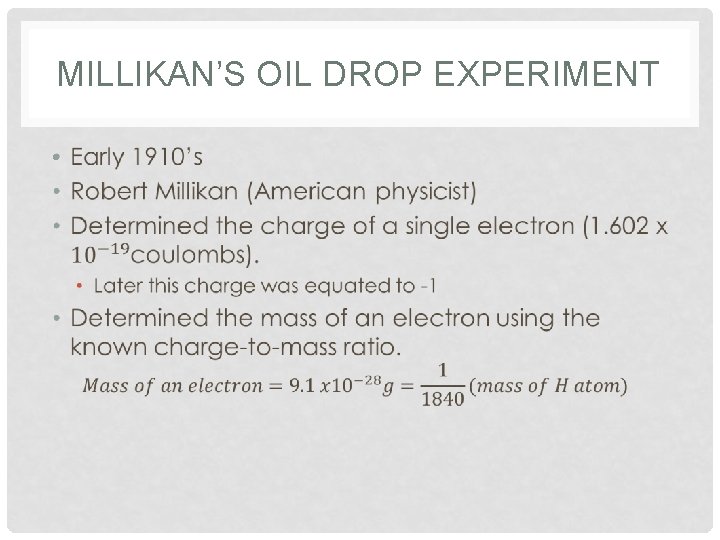
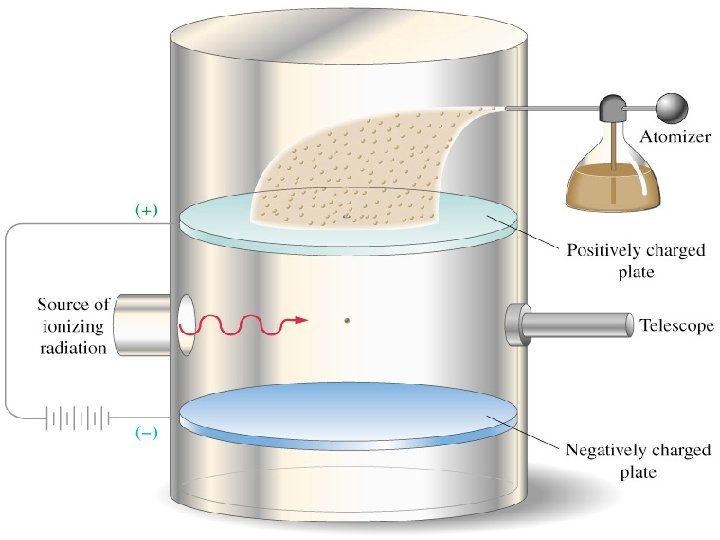
MILLIKAN’S OIL DROP EXPERIMENT •
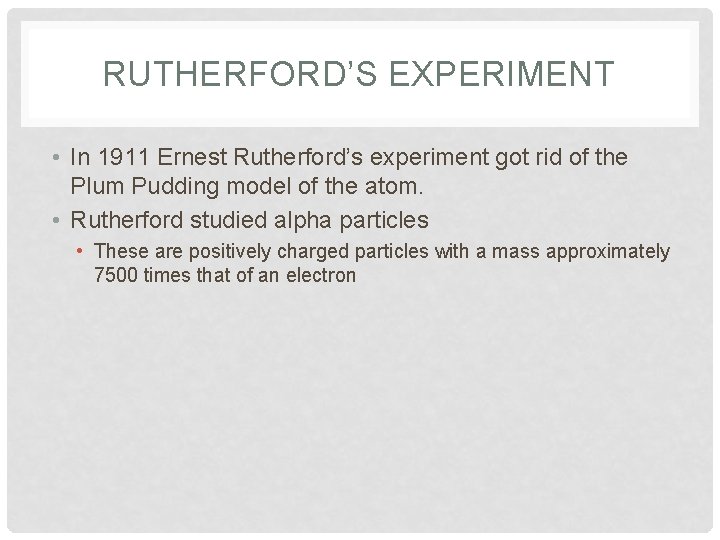
RUTHERFORD’S EXPERIMENT • In 1911 Ernest Rutherford’s experiment got rid of the Plum Pudding model of the atom. • Rutherford studied alpha particles • These are positively charged particles with a mass approximately 7500 times that of an electron
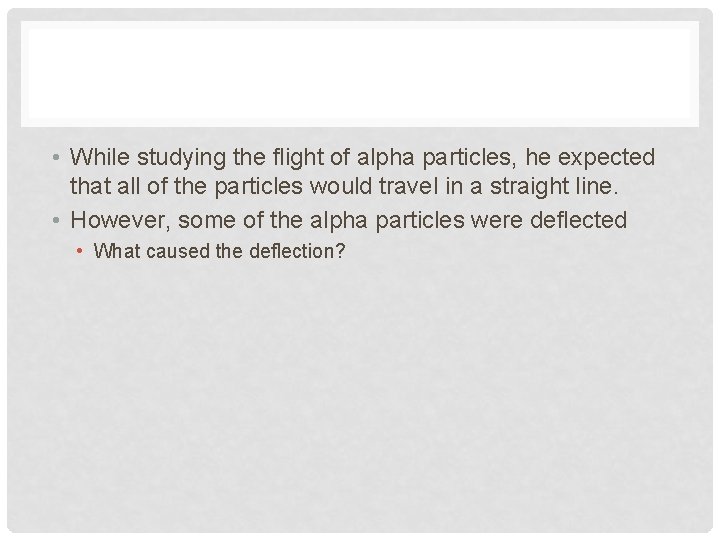
• While studying the flight of alpha particles, he expected that all of the particles would travel in a straight line. • However, some of the alpha particles were deflected • What caused the deflection?
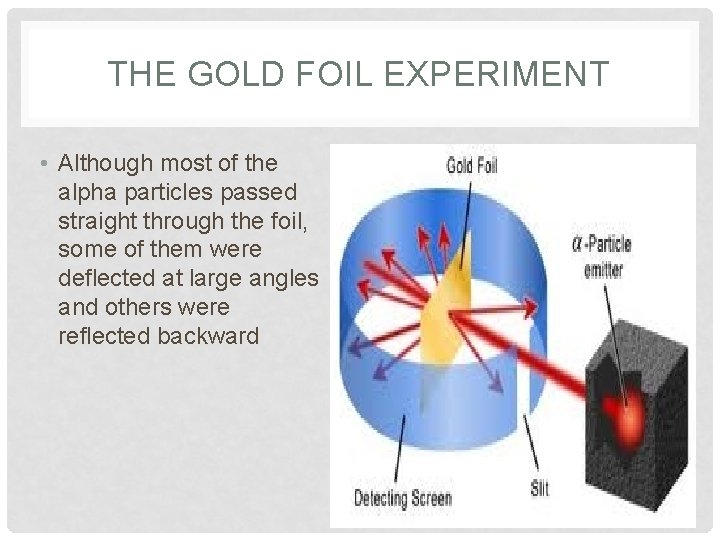
• Puzzled by this observation • Rutherford designed an experiment that involved directing alpha particles towards a piece of thin gold foil • The results from the experiment were very different from what Rutherford had expected.
THE GOLD FOIL EXPERIMENT • Although most of the alpha particles passed straight through the foil, some of them were deflected at large angles and others were reflected backward
• This experiment showed that the Plum Pudding Model of the atom couldn’t be correct • The large deflection of the alpha particles showed that center of the atom must have a positive charge.
RUTHERFORD’S MODEL OF THE ATOM • Rutherford concluded that almost all of the atom’s positive charge and almost all of its mass were contained in a tiny dense region in the center of the atom. • He called this area the nucleus. • Because the nucleus occupies such a small space & contains most of an atom’s mass, it is incredibly dense.
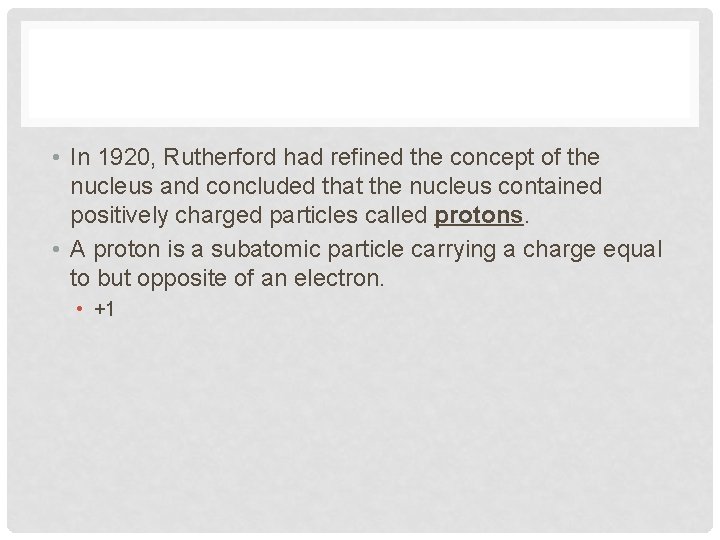
• In 1920, Rutherford had refined the concept of the nucleus and concluded that the nucleus contained positively charged particles called protons. • A proton is a subatomic particle carrying a charge equal to but opposite of an electron. • +1
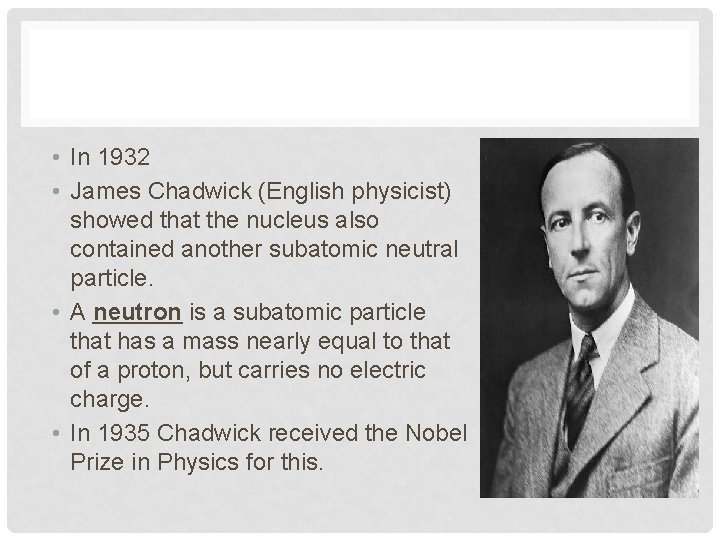
• In 1932 • James Chadwick (English physicist) showed that the nucleus also contained another subatomic neutral particle. • A neutron is a subatomic particle that has a mass nearly equal to that of a proton, but carries no electric charge. • In 1935 Chadwick received the Nobel Prize in Physics for this.
HOW ATOMS DIFFER SECTION 3
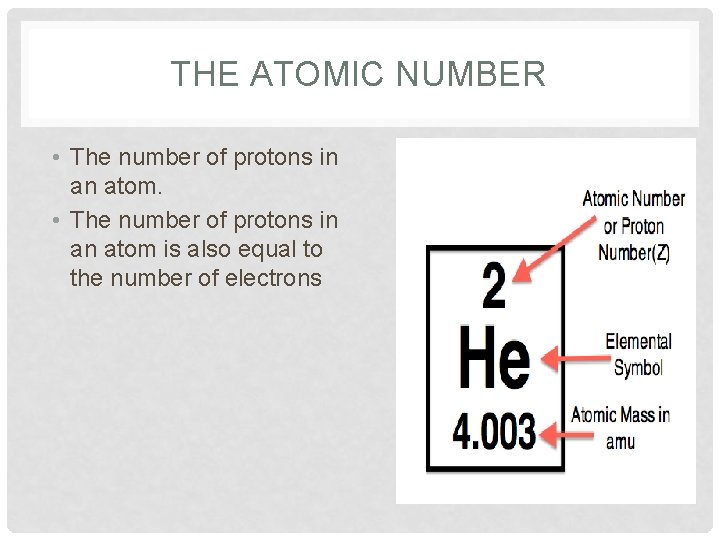
THE ATOMIC NUMBER • The number of protons in an atom is also equal to the number of electrons
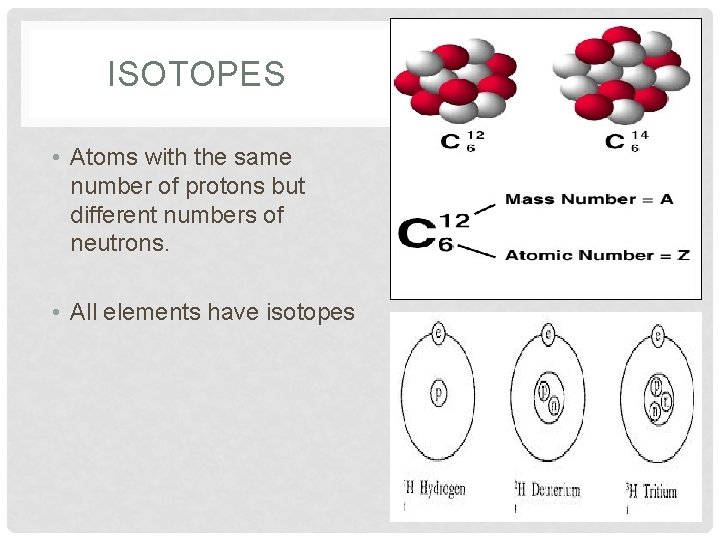
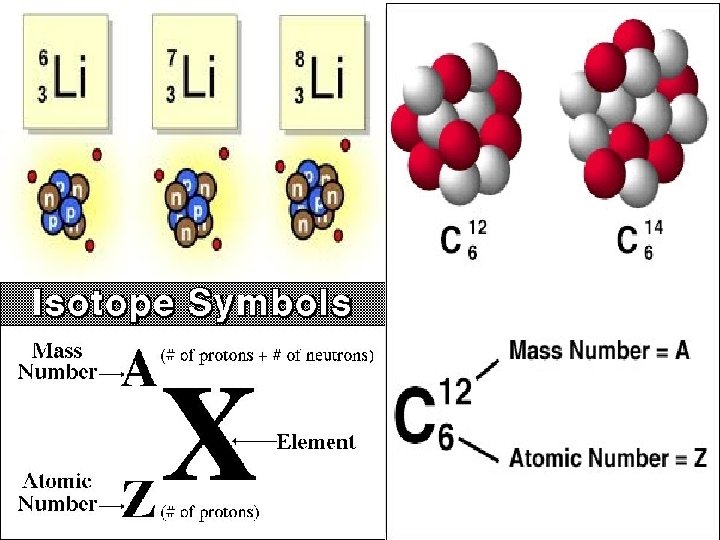
ISOTOPES • Atoms with the same number of protons but different numbers of neutrons. • All elements have isotopes
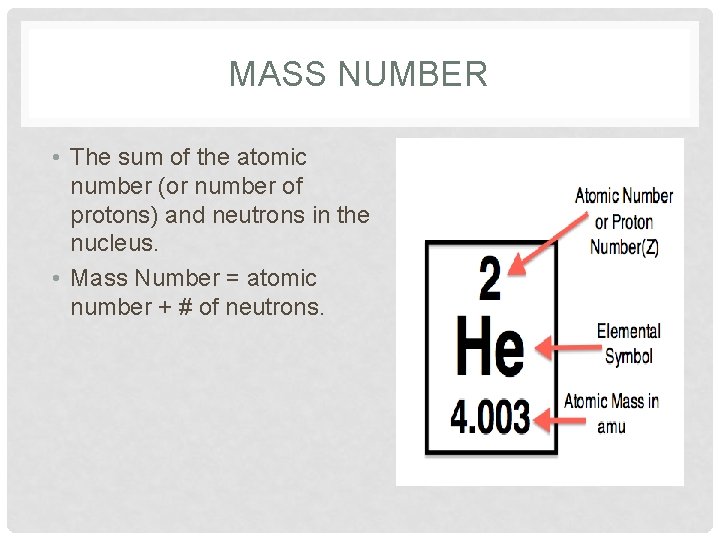
MASS NUMBER • The sum of the atomic number (or number of protons) and neutrons in the nucleus. • Mass Number = atomic number + # of neutrons.
MASS OF ATOMS • When dealing with the masses of atoms, we are dealing with extremely small numbers. • Because of these extremely small masses are very difficult to deal with chemists have developed a method of measuring the mass of an atom relative to the mass of a specific standard. • Atomic Mass Unit (amu) – defined as one-twelfth the mass of carbon-12 atom. • 1 amu is ~ equal to the mass of a single proton or a single neutron, but these values are slightly different from each other.
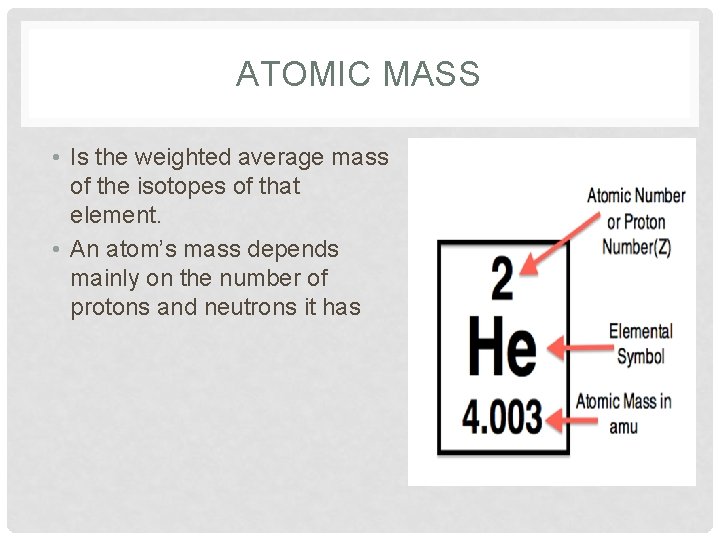
ATOMIC MASS • Is the weighted average mass of the isotopes of that element. • An atom’s mass depends mainly on the number of protons and neutrons it has
UNSTABLE NUCLEI & RADIOACTIVE DECAY SECTION 4
• Chemical reactions involve changes in the electrons surrounding an atom. • Nuclear reactions involve changes in the nucleus of an atom. • Radioactive atoms emit radiation because their nuclei are unstable. Unstable nuclei lose energy by emitting radiation in a spontaneous process called radioactive decay.
NUCLEAR EQUATION • Shows the atomic numbers and mass numbers of the particles involved.
ALPHA • α • Contains 2 protons & 2 neutrons. BETA • β • Each beta particle is an electron with -1 charge.
GAMMA • γ • High energy radiation that posses no mass • Because they are neutral, gamma rays are not deflected by electric or magnetic fields.