
The structure of taxonomies Facets and hierarchy Dagobert

The structure of taxonomies: Facets and hierarchy Dagobert Soergel College of Information Studies University of Maryland
Objectives • Understand the full range of functions served by taxonomies. • Understand the principles of meaningful conceptual structure. • Be able to apply these principles to develop a meaningful structure of a domain.
Method • Present many examples from which attendees can construct their own understanding. • Example slides are meant to be read by the audience. • Ask questions.
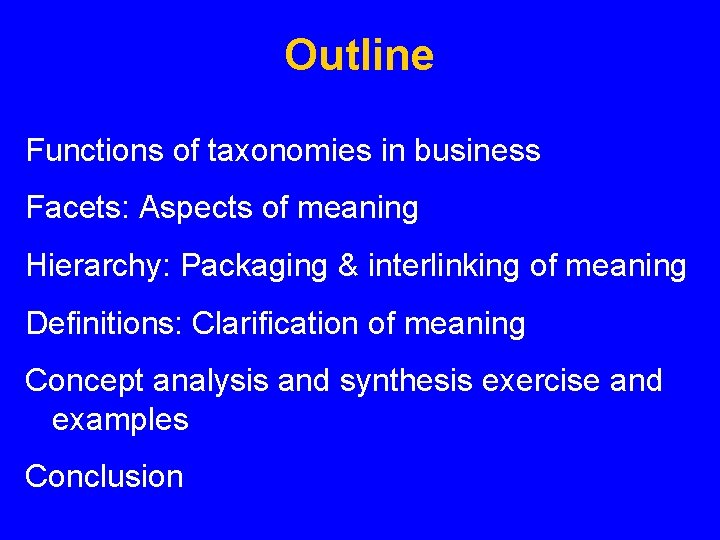
Outline Functions of taxonomies in business Facets: Aspects of meaning Hierarchy: Packaging & interlinking of meaning Definitions: Clarification of meaning Concept analysis and synthesis exercise and examples Conclusion
Functions of taxonomies in business Design for multiple functions to maximize return on investment
Functions of taxonomies in business 1 Support intellectual work in the organization • Support learning in training applications • Help decision makers to sort out the dimensions of a problem • Support shared conceptual models in collaborative work • Help authors to write well structured documents
Functions of taxonomies in business 2 Support information organization and search • Organize intranets for query based retrieval and browsing • Support user-centered indexing • Support query formulation, elicit user needs (applies equally to controlled vocabulary and free test search) • Support organized display of retrieval results • Support search for external information • Organize data dictionaries
User centered indexing 1 Also called request- or problem-oriented indexing Principles • Construct a taxonomy based on user queries and interests. • Thus provide a conceptual framework that organizes user interests and communicates them to indexers. • Index materials from users' perspective: Add need based retrieval clues beyond those available in the document. • Increase probability that needed retrieval clues are available. • Indexing = judging relevance against user concepts. Relevance rather than aboutness
Request oriented index terms Competitors’ technologies Technological developments that might put us out of business Ideas for improving our products New uses for our products
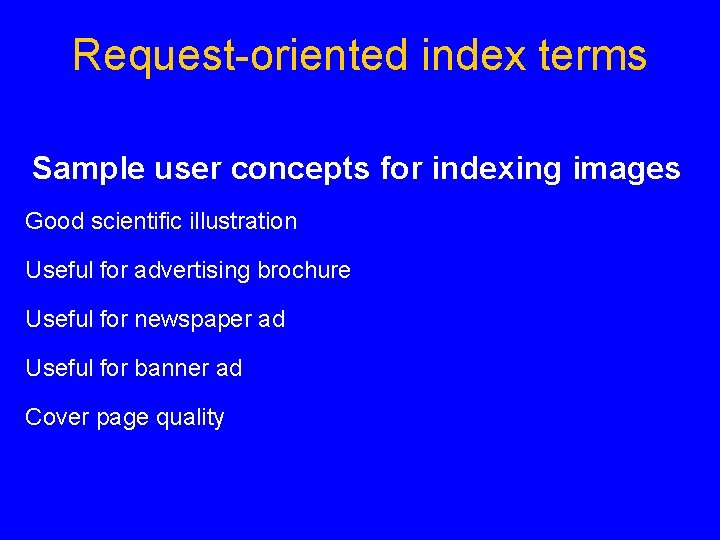
Request oriented index terms Sample user concepts for indexing images Good scientific illustration Useful for advertising brochure Useful for newspaper ad Useful for banner ad Cover page quality
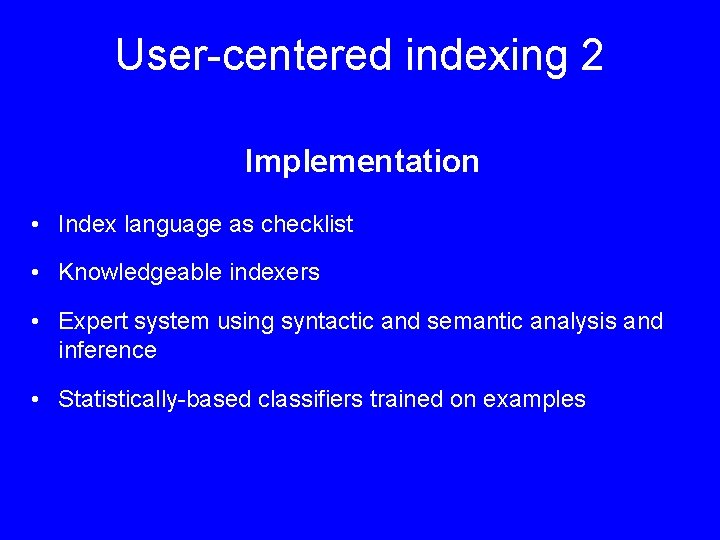
User centered indexing 2 Implementation • Index language as checklist • Knowledgeable indexers • Expert system using syntactic and semantic analysis and inference • Statistically based classifiers trained on examples
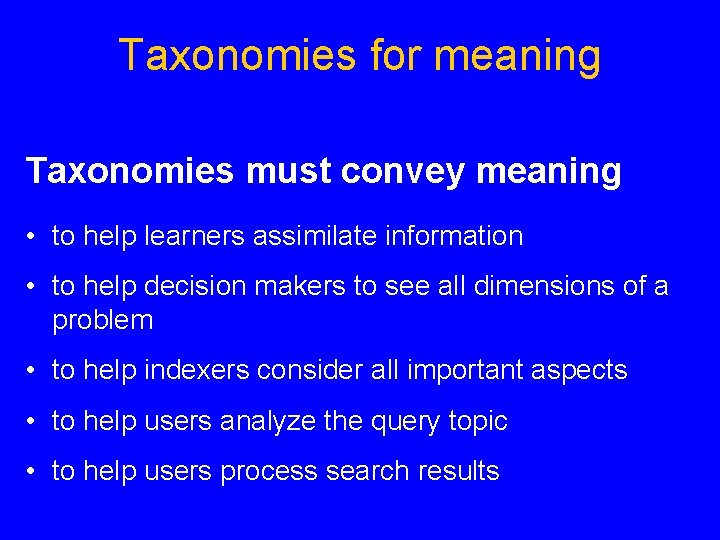
Taxonomies for meaning Taxonomies must convey meaning • to help learners assimilate information • to help decision makers to see all dimensions of a problem • to help indexers consider all important aspects • to help users analyze the query topic • to help users process search results

Facets: Aspects of meaning
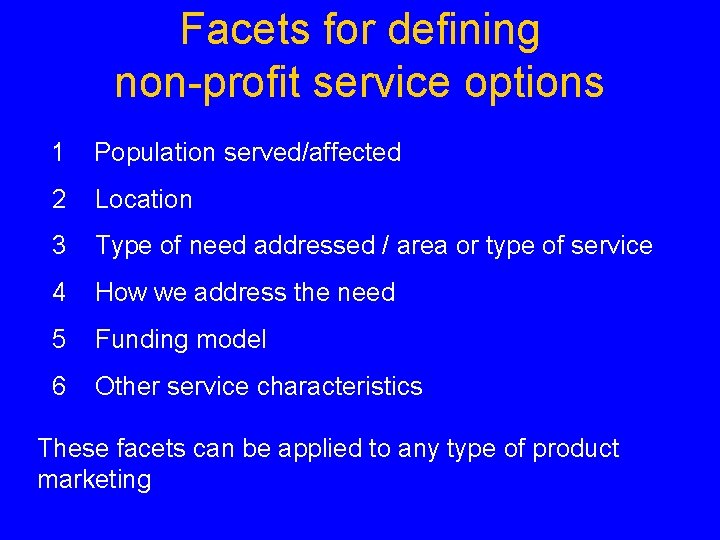
Facets for defining non profit service options 1 Population served/affected 2 Location 3 Type of need addressed / area or type of service 4 How we address the need 5 Funding model 6 Other service characteristics These facets can be applied to any type of product marketing
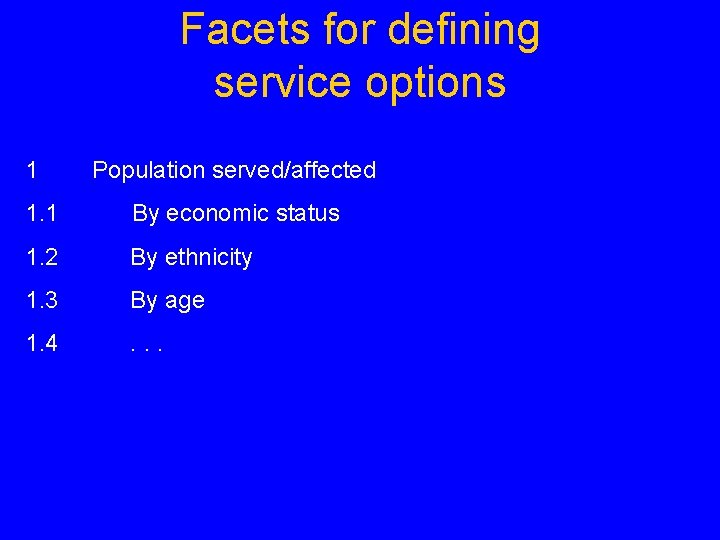
Facets for defining service options 1 Population served/affected 1. 1 By economic status 1. 2 By ethnicity 1. 3 By age 1. 4 . . .
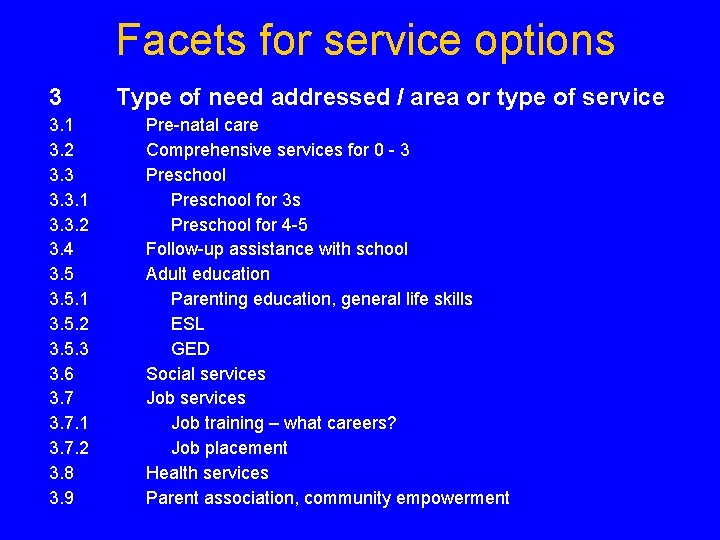
Facets for service options 3 3. 1 3. 2 3. 3. 1 3. 3. 2 3. 4 3. 5. 1 3. 5. 2 3. 5. 3 3. 6 3. 7. 1 3. 7. 2 3. 8 3. 9 Type of need addressed / area or type of service Pre natal care Comprehensive services for 0 3 Preschool for 3 s Preschool for 4 5 Follow up assistance with school Adult education Parenting education, general life skills ESL GED Social services Job training – what careers? Job placement Health services Parent association, community empowerment
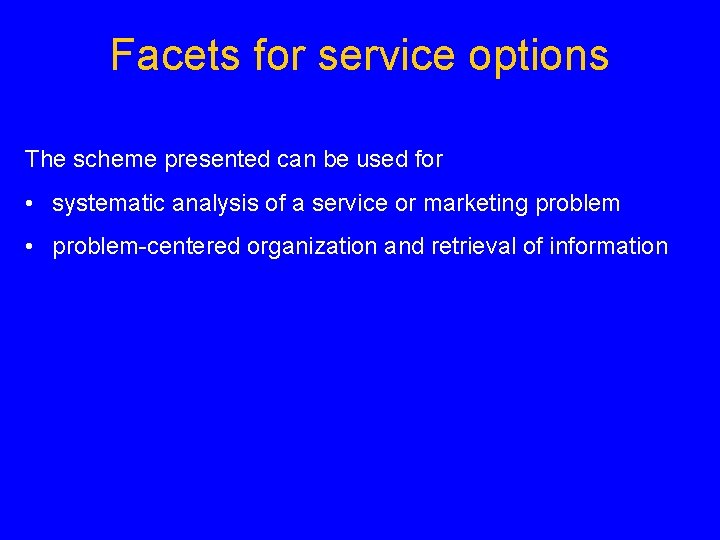
Facets for service options The scheme presented can be used for • systematic analysis of a service or marketing problem • problem centered organization and retrieval of information
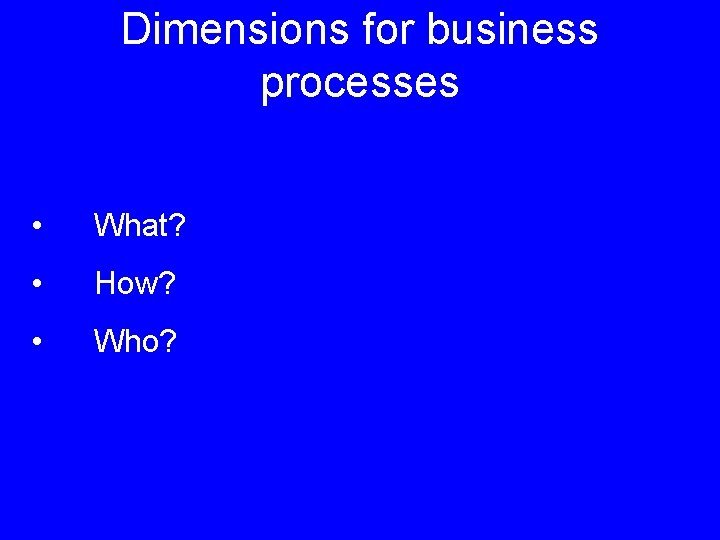
Dimensions for business processes • What? • How? • Who?
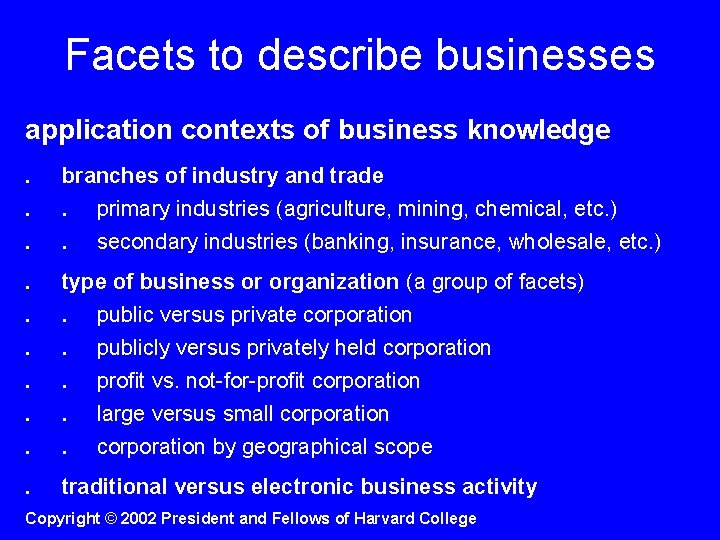
Facets to describe businesses application contexts of business knowledge. branches of industry and trade . . primary industries (agriculture, mining, chemical, etc. ) . . secondary industries (banking, insurance, wholesale, etc. ) . . . type of business or organization (a group of facets). public versus private corporation. publicly versus privately held corporation. profit vs. not for profit corporation. large versus small corporation by geographical scope . traditional versus electronic business activity Copyright © 2002 President and Fellows of Harvard College
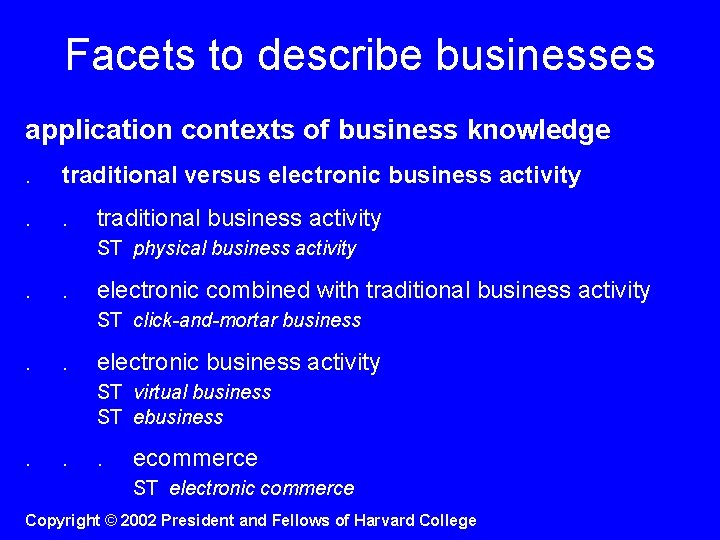
Facets to describe businesses application contexts of business knowledge. traditional versus electronic business activity . . traditional business activity ST physical business activity . . electronic combined with traditional business activity ST click-and-mortar business . . electronic business activity ST virtual business ST ebusiness . . . ecommerce ST electronic commerce Copyright © 2002 President and Fellows of Harvard College
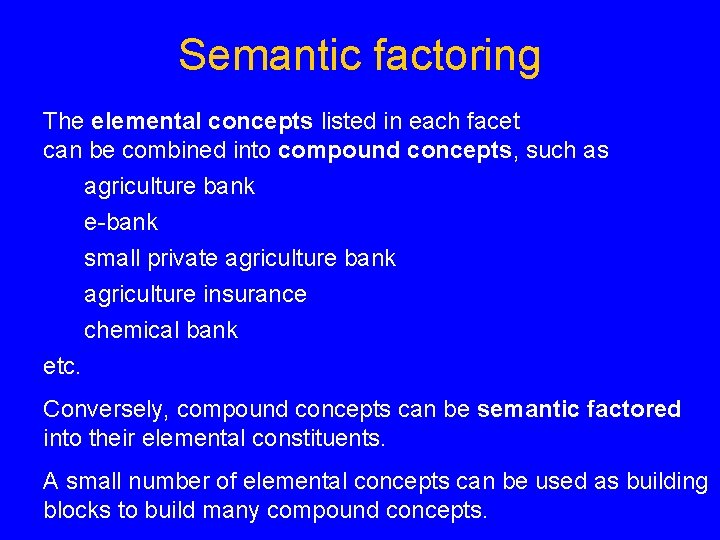
Semantic factoring The elemental concepts listed in each facet can be combined into compound concepts, such as agriculture bank small private agriculture bank agriculture insurance chemical bank etc. Conversely, compound concepts can be semantic factored into their elemental constituents. A small number of elemental concepts can be used as building blocks to build many compound concepts.

Facet principles • A facet groups concepts that fall under the same aspect or feature in the definition of more complex concepts; it groups all concepts that can be answers to a given question. : Each facet is a slot in a frame, e. g. , a type of business frame; a facet groups all concepts that can serve as fillers in one slot. • Using elemental concepts as building blocks for constructing compound concepts drastically reduces the number of concepts in the taxonomy and thus leads to conceptual economy. It also facilitates the search for general concepts, such as searching for the concept small business, which occurs in many combinations.
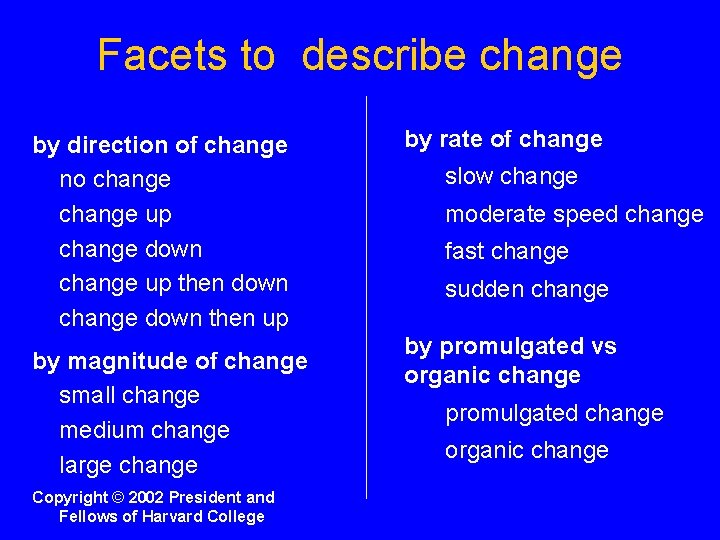
Facets to describe change by direction of change no change up change down change up then down change down then up by magnitude of change small change medium change large change Copyright © 2002 President and Fellows of Harvard College by rate of change slow change moderate speed change fast change sudden change by promulgated vs organic change promulgated change organic change
Hierarchy: Packaging & interlinking meaning Ordered arrangement to convey meaning Examples
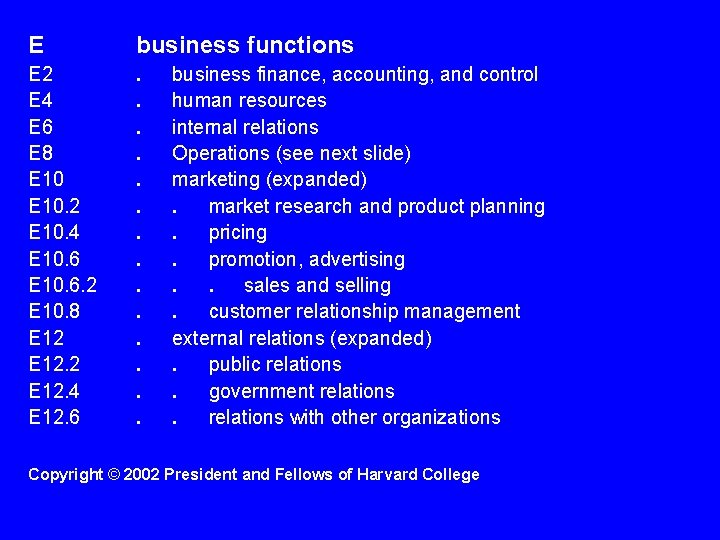
E business functions E 2 E 4 E 6 E 8 E 10. 2 E 10. 4 E 10. 6. 2 E 10. 8 E 12. 2 E 12. 4 E 12. 6 . . . business finance, accounting, and control human resources internal relations Operations (see next slide) marketing (expanded). market research and product planning. pricing. promotion, advertising. . sales and selling. customer relationship management external relations (expanded). public relations. government relations with other organizations Copyright © 2002 President and Fellows of Harvard College
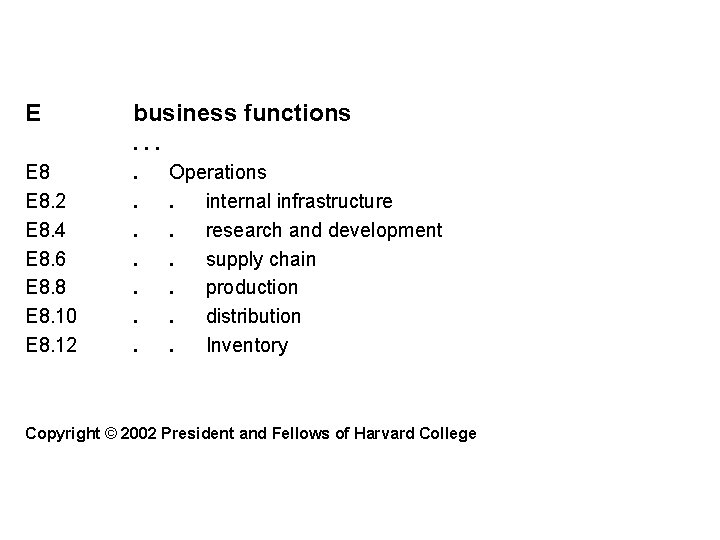
E business functions E 8. 2 E 8. 4 E 8. 6 E 8. 8 E 8. 10 E 8. 12 . . Operations. internal infrastructure. research and development. supply chain. production. distribution. Inventory Copyright © 2002 President and Fellows of Harvard College

Polyhierarchy themes cutting across business functions (internal) labor and work Economics (external) human resources part time work labor economics part time employees Copyright © 2002 President and Fellows of Harvard College part time labor market
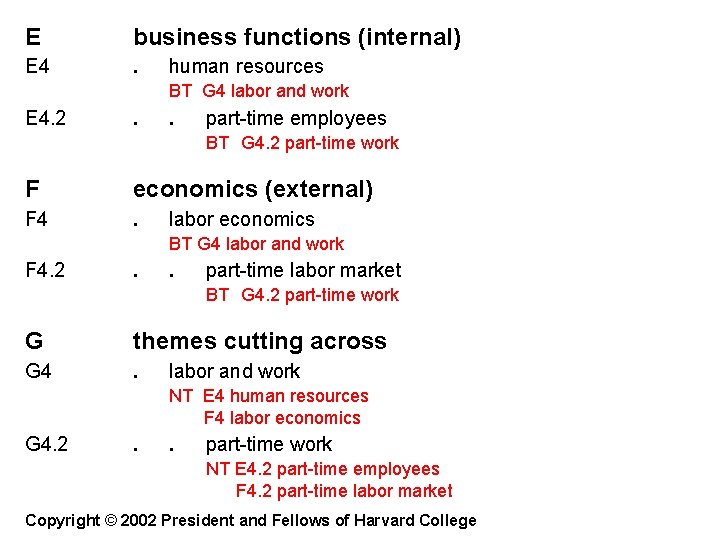
E business functions (internal) E 4 . human resources BT G 4 labor and work E 4. 2 . . part time employees BT G 4. 2 part time work F economics (external) F 4 . labor economics BT G 4 labor and work F 4. 2 . . part time labor market BT G 4. 2 part time work G themes cutting across G 4 . labor and work NT E 4 human resources F 4 labor economics G 4. 2 . . part time work NT E 4. 2 part time employees F 4. 2 part time labor market Copyright © 2002 President and Fellows of Harvard College
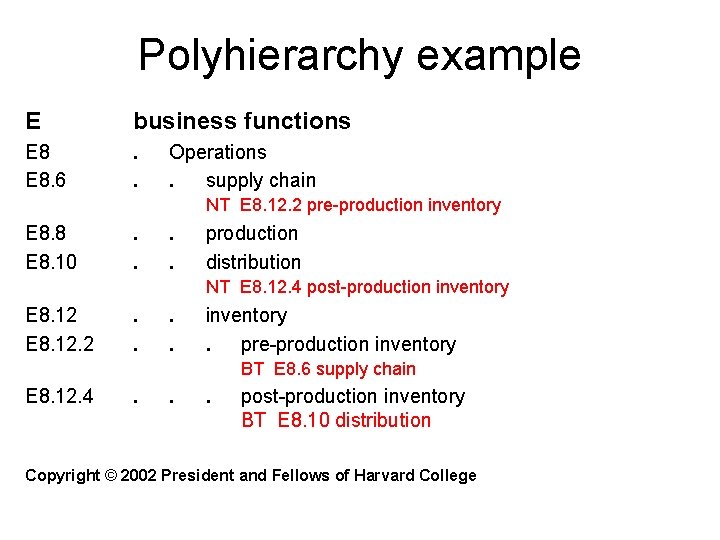
Polyhierarchy example E business functions E 8. 6 . . Operations. supply chain NT E 8. 12. 2 pre production inventory E 8. 8 E 8. 10 . . production distribution NT E 8. 12. 4 post production inventory E 8. 12. 2 . . inventory. pre production inventory BT E 8. 6 supply chain E 8. 12. 4 . . . post production inventory BT E 8. 10 distribution Copyright © 2002 President and Fellows of Harvard College
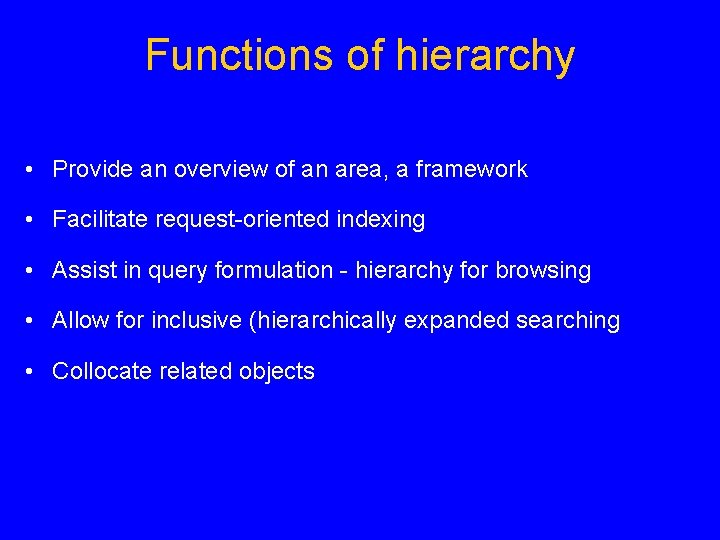
Functions of hierarchy • Provide an overview of an area, a framework • Facilitate request oriented indexing • Assist in query formulation hierarchy for browsing • Allow for inclusive (hierarchically expanded searching • Collocate related objects
Definitions: Clarification of meaning
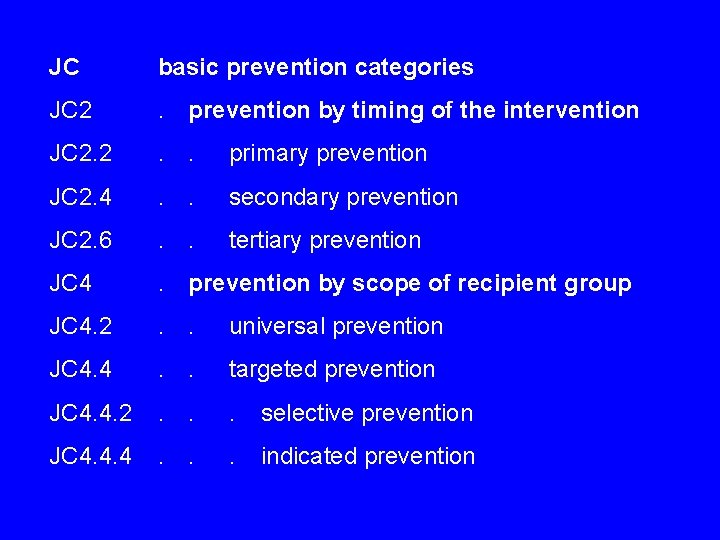
JC basic prevention categories JC 2 . prevention by timing of the intervention JC 2. 2 . . primary prevention JC 2. 4 . . secondary prevention JC 2. 6 . . tertiary prevention JC 4 . prevention by scope of recipient group JC 4. 2 . . universal prevention JC 4. 4 . . targeted prevention JC 4. 4. 2 . . . selective prevention JC 4. 4. 4 . . . indicated prevention
JC 4 Prevention by scope of recipient group SN This scheme is based on the intended recipients and the cost benefit analysis of preventive interventions as it relates to universal or limited recipient groups. An intervention that has a low per capita cost can be applied to a large recipient group which statistically has a small percentage of members who are at risk and still have a good ROI. Contrariwise, an intervention that has a high per capita cost is worthwhile only if it is targeted at a smaller group which has a high percentage who are at risk. Note: For prevention you can read advertising and marketing
JC 4. 2 universal prevention SN Directed at the general public or a population group that has not been identified on the basis of individual risk. The intervention is desirable for everyone in that group and has a low per capita cost. JC 4. 4 targeted prevention SN Targeted at subgroups of the population or at individuals who are at high or very high risk. There are two subordinate categories which are distinguished by the specificity of targeting (the precision of selection into the recipient group), the degree of risk, and the warranted cost per recipient.
JC 4. 4. 2 selective prevention SN A measure that is desirable only when the individual is a member of a subgroup of the population whose risk of developing the disorder is above average. The subgroups may be distinguished by age, gender, occupation, family history, place of residence or travel, or other evident characteristics (as opposed to characteristics whose determination requires individual examination). JC 4. 4. 4 indicated prevention SN Targeted to high risk individuals who are identified, through individual examination, as (1) having biological markers indicating predisposition for a disorder or (2) having minimal but detectable signs or symptoms foreshadowing a disorder whose symptoms are still early and are not sufficiently severe to merit a diagnosis of the disorder.
Concept analysis and synthesis Exercise and examples
securities market securities trading aggressive portfolio online securities trading stock redemption futures market insured bonds high risk derivatives stock issuance stock options pricing regional stocks futures trading
Concept analysis and concept discovery Consider the following list of terms parking garage bus station train station harbor airport What is the common semantic factor (a more abstract concept in common to all of them)?
Concept analysis 2 Consider wage price/cost interest rent fees (insurance) premium Common concept payment in exchange for some consideration (the “consideration” is different in each case)
Concept analysis 3 Consider transactional analysis, dream analysis, insight therapy, Gestalt therapy, reality therapy, cognitive therapy Umbrella concept for structuring the hierarchy and for retrieval: analytic psychotherapy (methods that seek to assist patients in a personality reconstruction through insight into their inner selves)
Conclusion Systematic discovery and structuring of meaning through facet analysis and hierarchy building empowers users to • orient themselves and move in a concept space • analyze the dimensions of a problem and determine what information is needed; • formulate a query that will find that information or browse productively – move at ease in an information space For an example see the Alcohol and Other Drug Thesaurus (search Google for AOD Thesaurus)
- Slides: 41