
The Structure of Metallic Glasses David Poerschke Materials

- Slides: 11
The Structure of Metallic Glasses David Poerschke Materials 286 g Final Presentation May 19, 2010
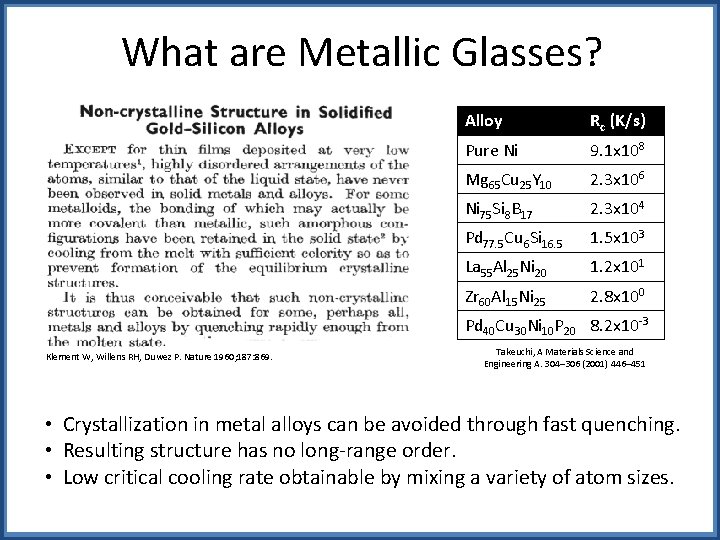
What are Metallic Glasses? Alloy Rc (K/s) Pure Ni 9. 1 x 10⁸ Mg 65 Cu 25 Y 10 2. 3 x 10⁶ Ni 75 Si 8 B 17 2. 3 x 10⁴ Pd 77. 5 Cu 6 Si 16. 5 1. 5 x 10³ La 55 Al 25 Ni 20 1. 2 x 101 Zr 60 Al 15 Ni 25 2. 8 x 100 Pd 40 Cu 30 Ni 10 P 20 8. 2 x 10 -3 Klement W, Willens RH, Duwez P. Nature 1960; 187: 869. Takeuchi, A Materials Science and Engineering A. 304– 306 (2001) 446– 451 • Crystallization in metal alloys can be avoided through fast quenching. • Resulting structure has no long-range order. • Low critical cooling rate obtainable by mixing a variety of atom sizes.
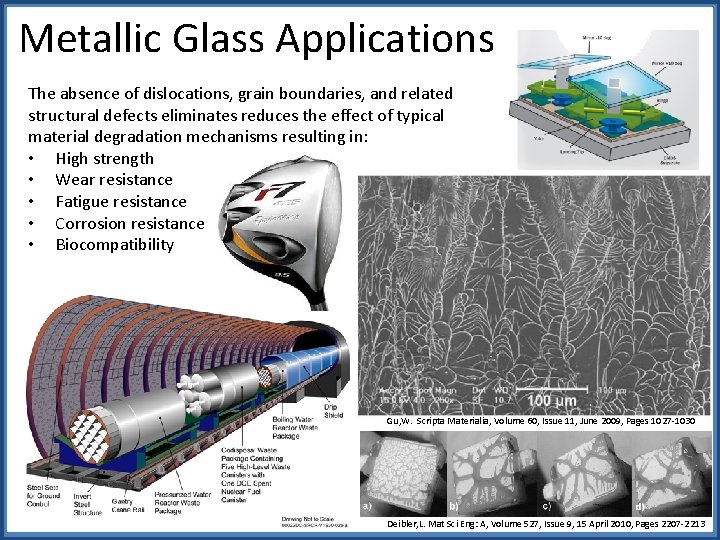
Metallic Glass Applications The absence of dislocations, grain boundaries, and related structural defects eliminates reduces the effect of typical material degradation mechanisms resulting in: • High strength • Wear resistance • Fatigue resistance • Corrosion resistance • Biocompatibility Gu, W. Scripta Materialia, Volume 60, Issue 11, June 2009, Pages 1027 -1030 Deibler, L. Mat Sci Eng: A, Volume 527, Issue 9, 15 April 2010, Pages 2207 -2213
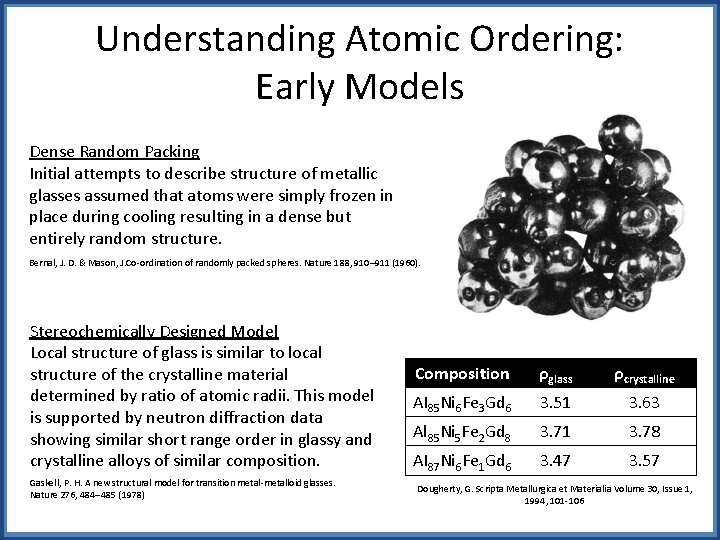
Understanding Atomic Ordering: Early Models Dense Random Packing Initial attempts to describe structure of metallic glasses assumed that atoms were simply frozen in place during cooling resulting in a dense but entirely random structure. Bernal, J. D. & Mason, J. Co-ordination of randomly packed spheres. Nature 188, 910– 911 (1960). Stereochemically Designed Model Local structure of glass is similar to local structure of the crystalline material determined by ratio of atomic radii. This model is supported by neutron diffraction data showing similar short range order in glassy and crystalline alloys of similar composition. Gaskell, P. H. A new structural model for transition metal-metalloid glasses. Nature 276, 484– 485 (1978) Composition ρglass ρcrystalline AI 85 Ni 6 Fe 3 Gd 6 3. 51 3. 63 Al 85 Ni 5 Fe 2 Gd 8 3. 71 3. 78 AI 87 Ni 6 Fe 1 Gd 6 3. 47 3. 57 Dougherty, G. Scripta Metallurgica et Materialia Volume 30, Issue 1, 1994, 101 -106
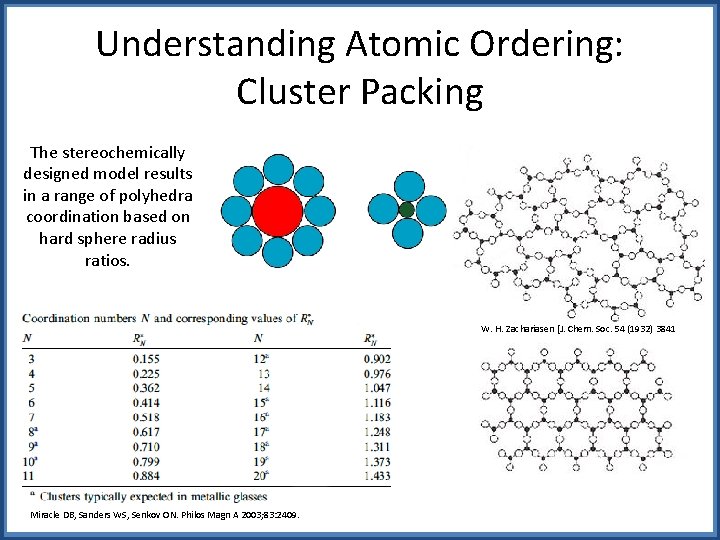
Understanding Atomic Ordering: Cluster Packing The stereochemically designed model results in a range of polyhedra coordination based on hard sphere radius ratios. W. H. Zachariasen [J. Chem. Soc. 54 (1932) 3841 Miracle DB, Sanders WS, Senkov ON. Philos Magn A 2003; 83: 2409.
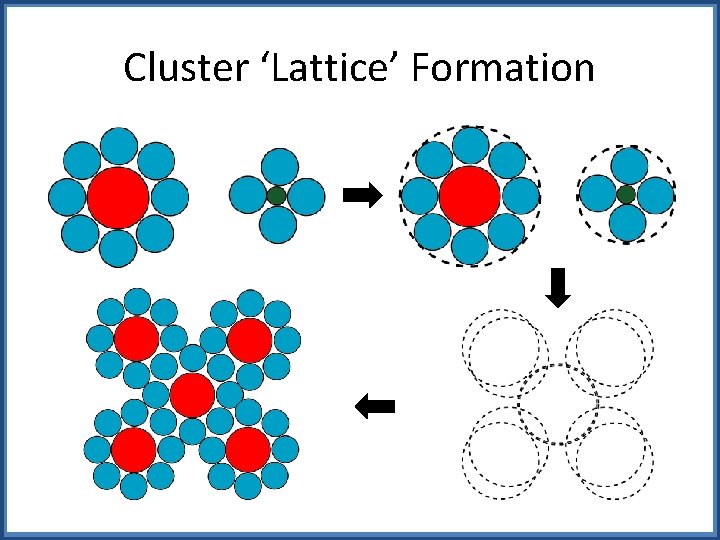
Cluster ‘Lattice’ Formation
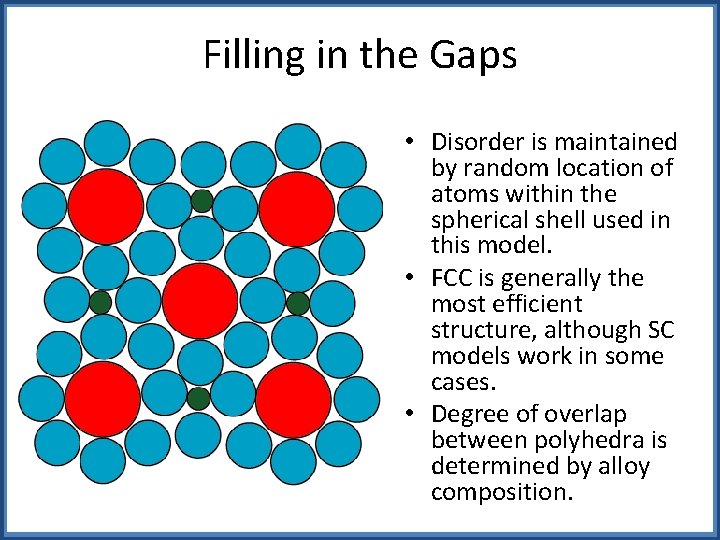
Filling in the Gaps • Disorder is maintained by random location of atoms within the spherical shell used in this model. • FCC is generally the most efficient structure, although SC models work in some cases. • Degree of overlap between polyhedra is determined by alloy composition.
Efficient Cluster Packing Model • Extending fcc cluster lattice in 3 D creates tetrahedral and octahedral lattice sites which can be filled by lower coordinate polyhedra. • Model allows placement of atoms with four different atomic radii resulting in 3 radius ratios with respect to solvent. • Atoms grouped based on approximate atomic radius. Zr 41. 2 Ti 13. 8 Cu 12. 5 Ni 10. 0 Be 22. 5 = Zr 41. 2 Ti 13. 8(Cu, Ni)22. 5 Be 22. 5 Zr-(Al, Ti)-(Cu, Ni)-Be <12, 10, 9>fcc D. B. Miracle / Acta Materialia 54 (2006) 4317– 4336
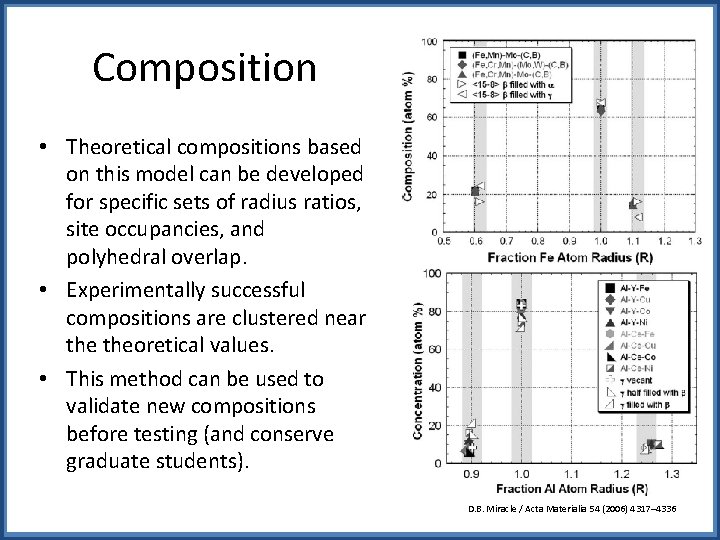
Composition • Theoretical compositions based on this model can be developed for specific sets of radius ratios, site occupancies, and polyhedral overlap. • Experimentally successful compositions are clustered near theoretical values. • This method can be used to validate new compositions before testing (and conserve graduate students). D. B. Miracle / Acta Materialia 54 (2006) 4317– 4336
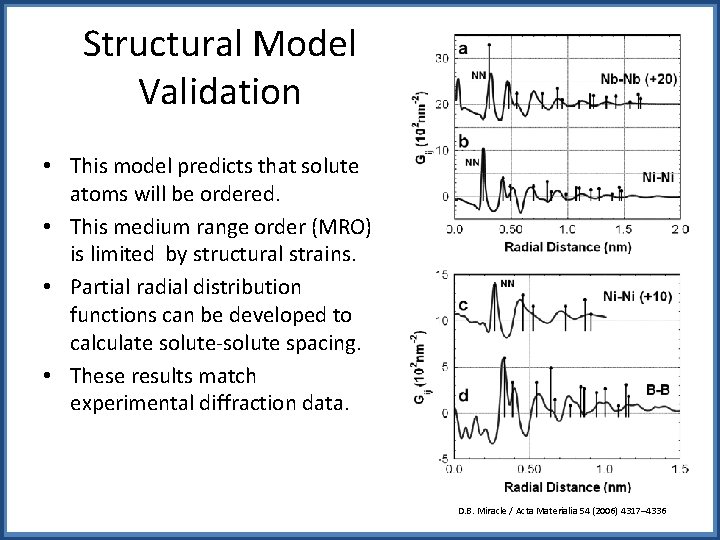
Structural Model Validation • This model predicts that solute atoms will be ordered. • This medium range order (MRO) is limited by structural strains. • Partial radial distribution functions can be developed to calculate solute-solute spacing. • These results match experimental diffraction data. D. B. Miracle / Acta Materialia 54 (2006) 4317– 4336
Chemistry This model is based on topology without considering chemistry assuming the following conditions are met: • Esolute-solute bond is low • Esolute-solvent bond is high • Large negative enthalpy of mixing Topologically similar but chemically dissimilar glasses exhibit different stability indicating the importance of chemistry.