
The Structure of DNA James Watson and Francis
- Slides: 15
The Structure of DNA
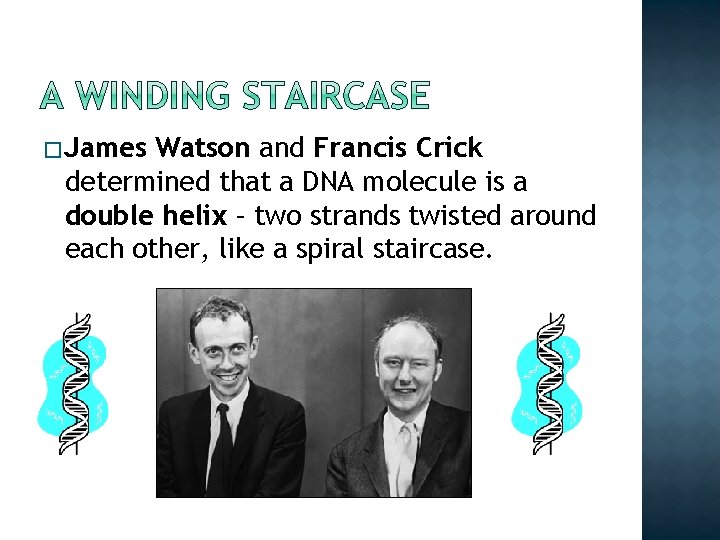
� James Watson and Francis Crick determined that a DNA molecule is a double helix – two strands twisted around each other, like a spiral staircase.
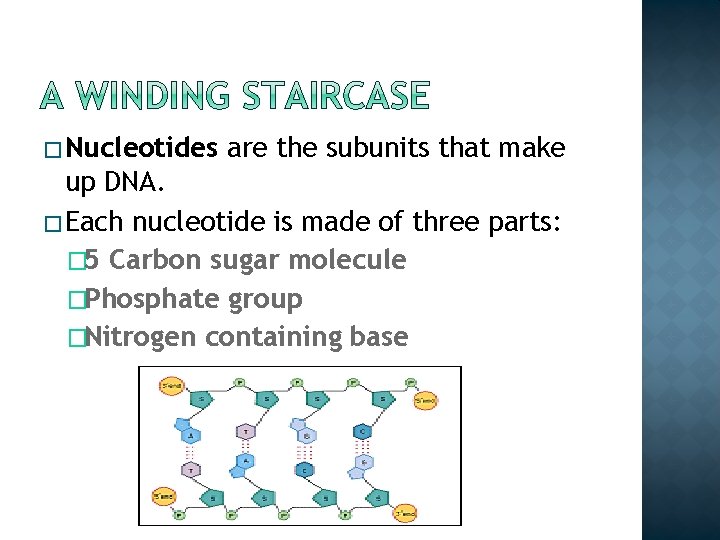
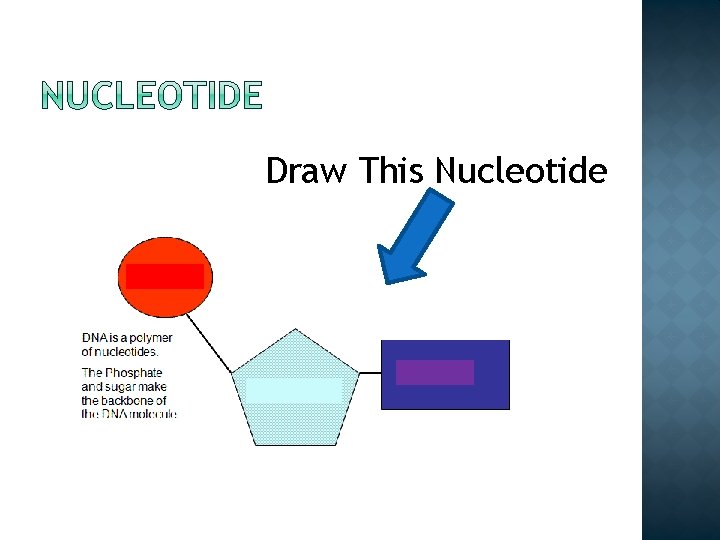
� Nucleotides are the subunits that make up DNA. � Each nucleotide is made of three parts: � 5 Carbon sugar molecule �Phosphate group �Nitrogen containing base
Draw This Nucleotide
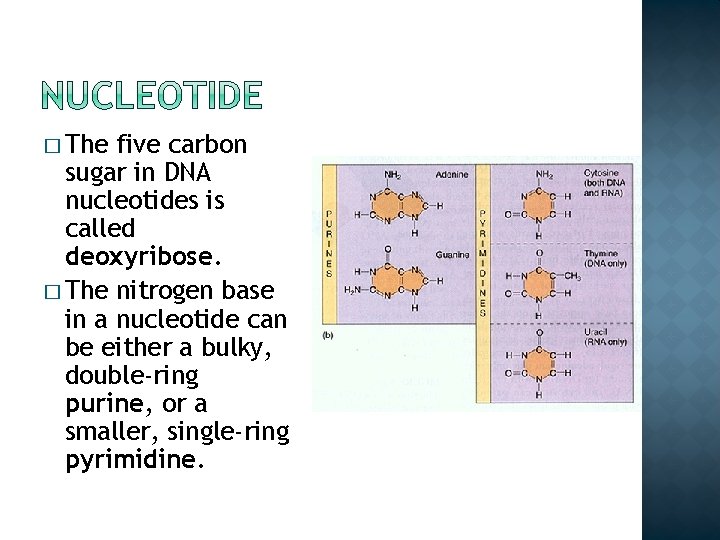
� The five carbon sugar in DNA nucleotides is called deoxyribose. � The nitrogen base in a nucleotide can be either a bulky, double-ring purine, or a smaller, single-ring pyrimidine.
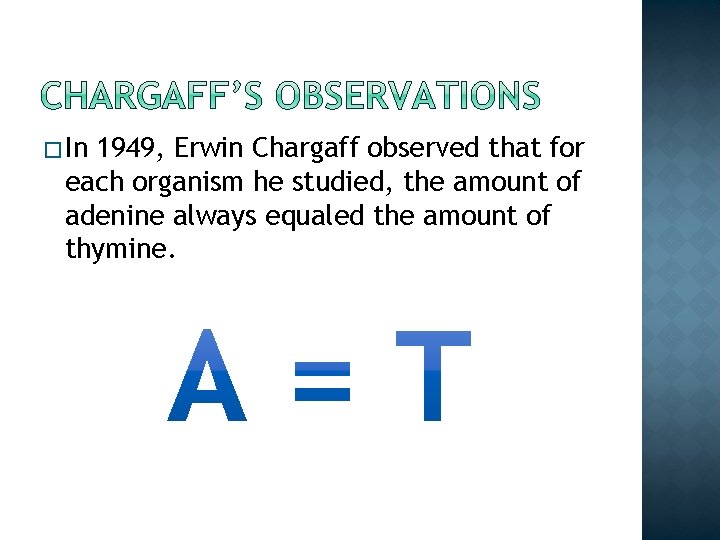
� In 1949, Erwin Chargaff observed that for each organism he studied, the amount of adenine always equaled the amount of thymine.
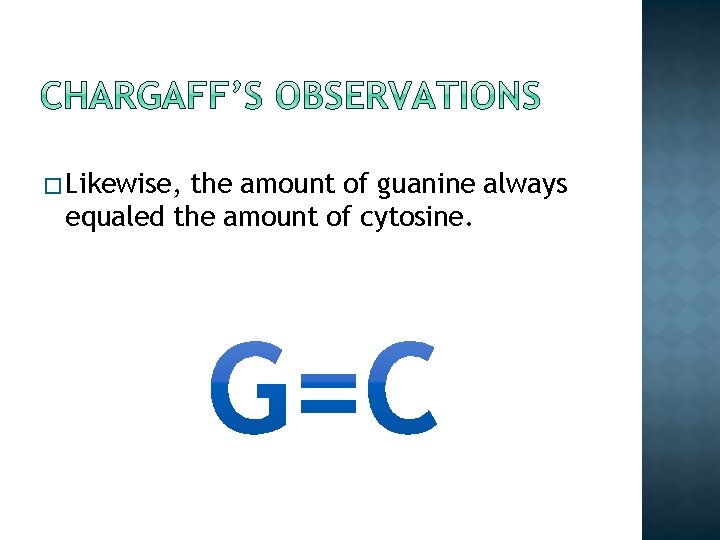
� Likewise, the amount of guanine always equaled the amount of cytosine.
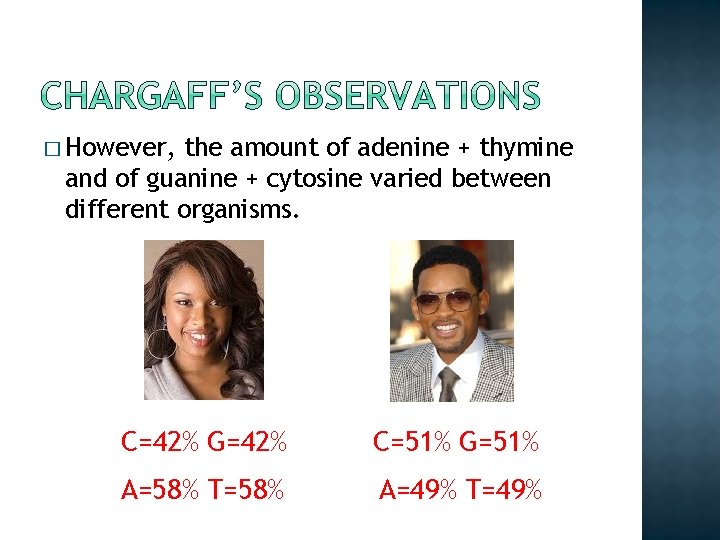
� However, the amount of adenine + thymine and of guanine + cytosine varied between different organisms. C=42% G=42% C=51% G=51% A=58% T=58% A=49% T=49%
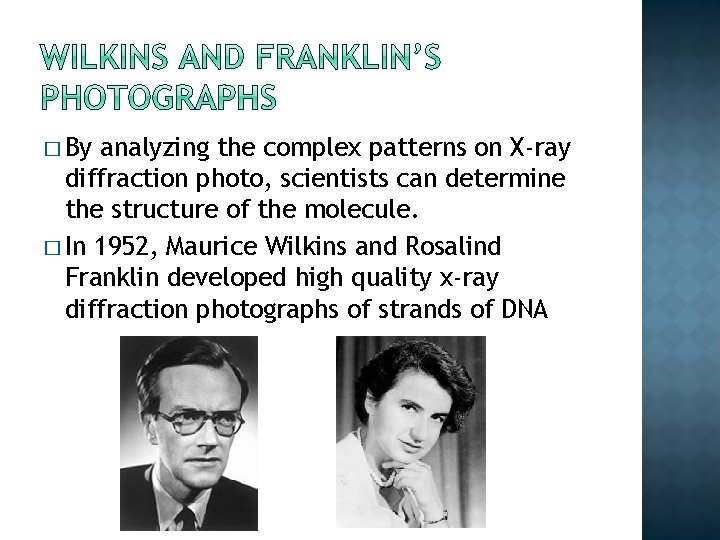
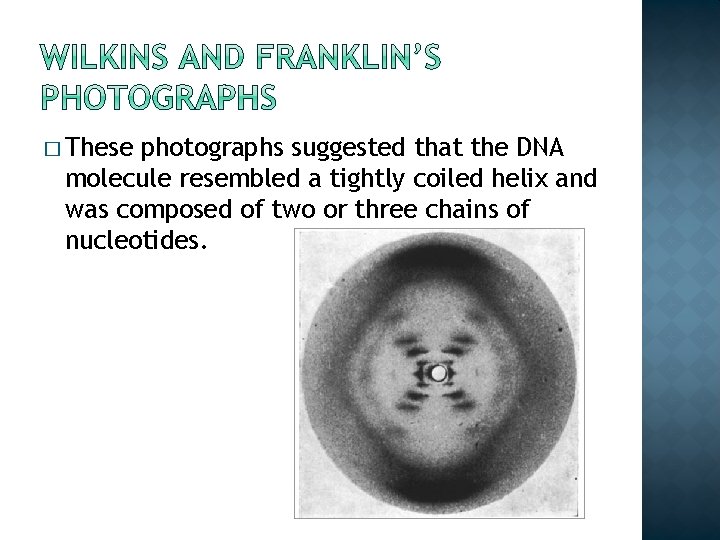
� By analyzing the complex patterns on X-ray diffraction photo, scientists can determine the structure of the molecule. � In 1952, Maurice Wilkins and Rosalind Franklin developed high quality x-ray diffraction photographs of strands of DNA
� These photographs suggested that the DNA molecule resembled a tightly coiled helix and was composed of two or three chains of nucleotides.
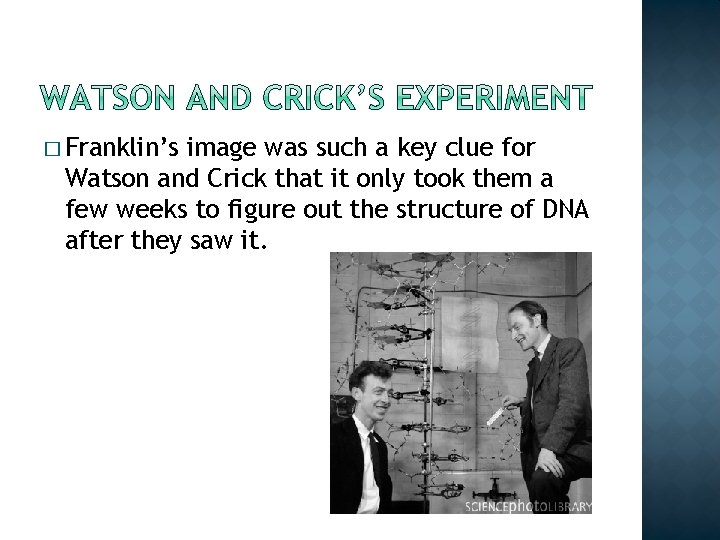
� Franklin’s image was such a key clue for Watson and Crick that it only took them a few weeks to figure out the structure of DNA after they saw it.
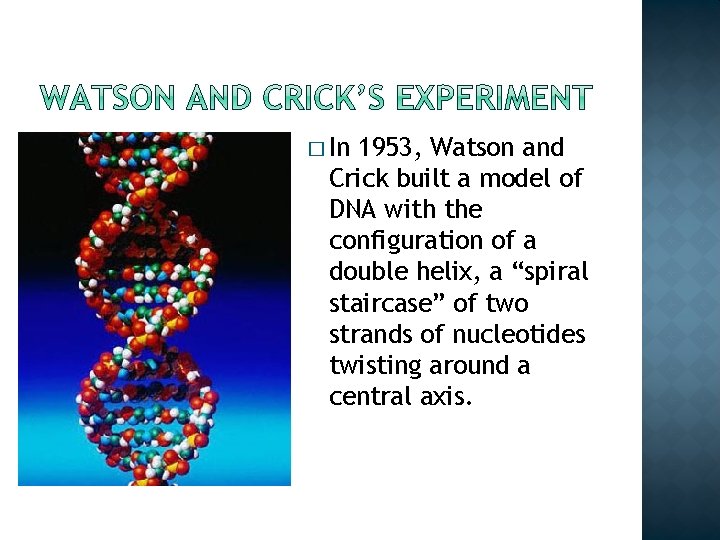
� In 1953, Watson and Crick built a model of DNA with the configuration of a double helix, a “spiral staircase” of two strands of nucleotides twisting around a central axis.
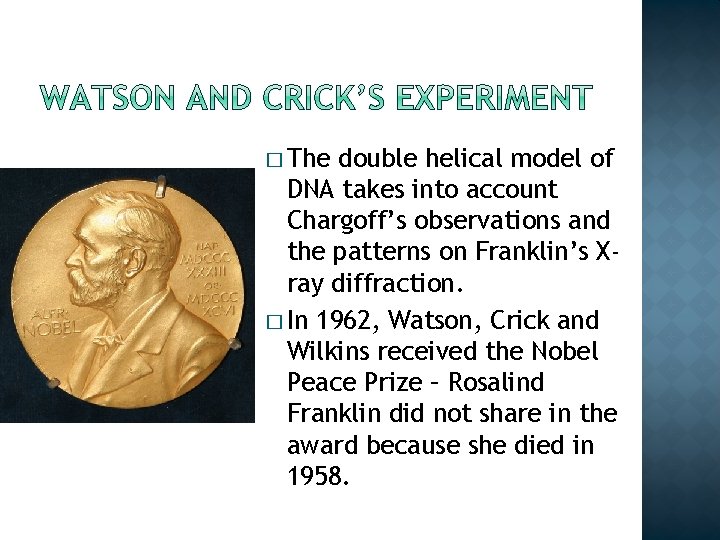
� The double helical model of DNA takes into account Chargoff’s observations and the patterns on Franklin’s Xray diffraction. � In 1962, Watson, Crick and Wilkins received the Nobel Peace Prize – Rosalind Franklin did not share in the award because she died in 1958.
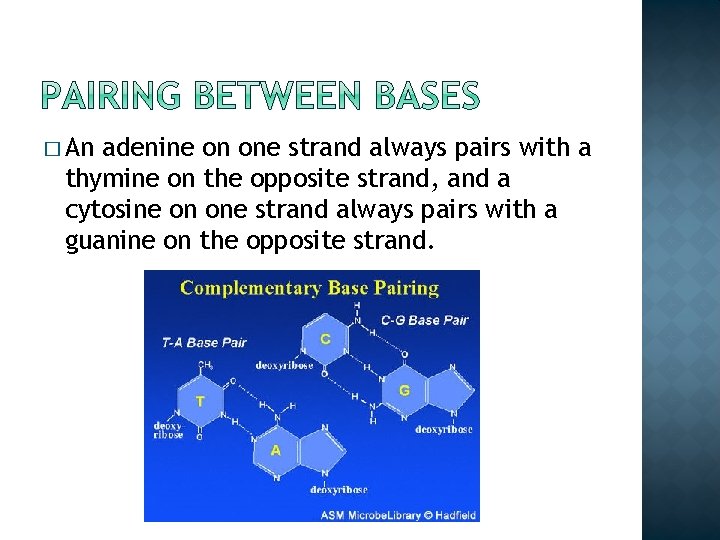
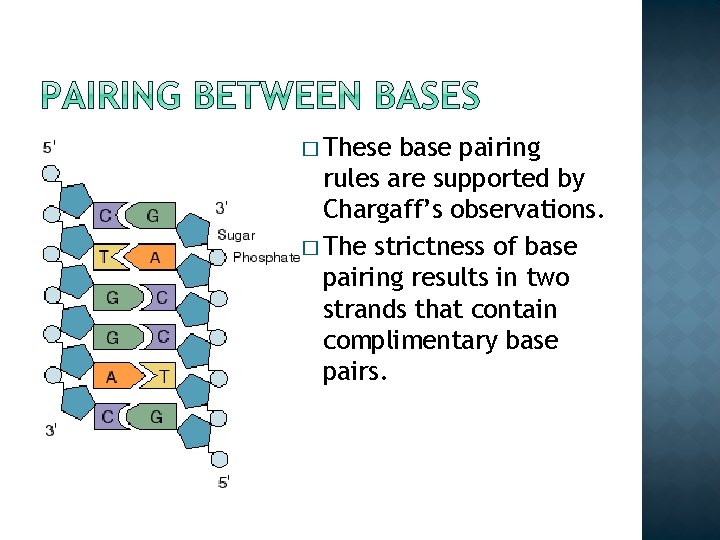
� An adenine on one strand always pairs with a thymine on the opposite strand, and a cytosine on one strand always pairs with a guanine on the opposite strand.
� These base pairing rules are supported by Chargaff’s observations. � The strictness of base pairing results in two strands that contain complimentary base pairs.