
The Structure of DNA Deoxyribonucleic Acid DNA Video
The Structure of DNA (Deoxyribonucleic Acid) DNA Video
Bell Ringer • What biomolecule holds genetic information? • Where do organisms get genetic information from? • Why is it important to pass on genetic information? • What four characteristics do all cells have in common?
BELL RINGER • What are the four nucleotides in DNA? • How are the traits of an organism determined? • What is the difference between the DNA of yeast and the DNA of humans?

ALL living organisms have DNA! Remember…all living organisms are made up cells. ALL cells have 4 characteristics in common: 1. 2. 3. 4. Cell membrane Genetic material (DNA) Ribosomes Cytoplasm
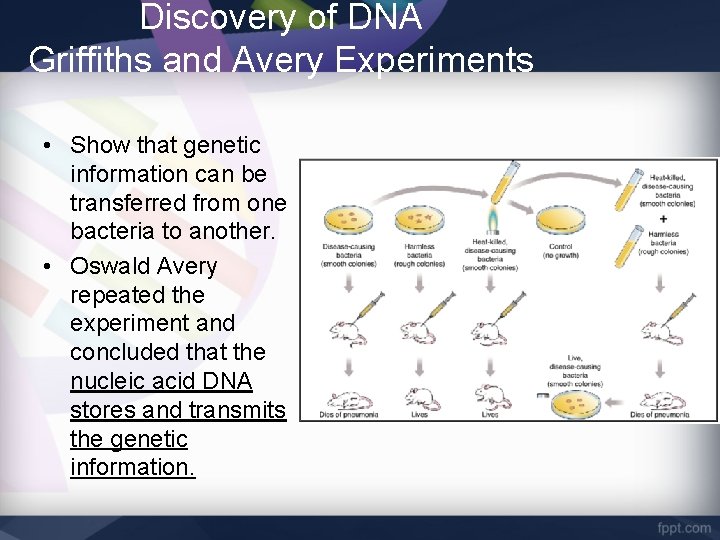
Discovery of DNA Griffiths and Avery Experiments • Show that genetic information can be transferred from one bacteria to another. • Oswald Avery repeated the experiment and concluded that the nucleic acid DNA stores and transmits the genetic information.
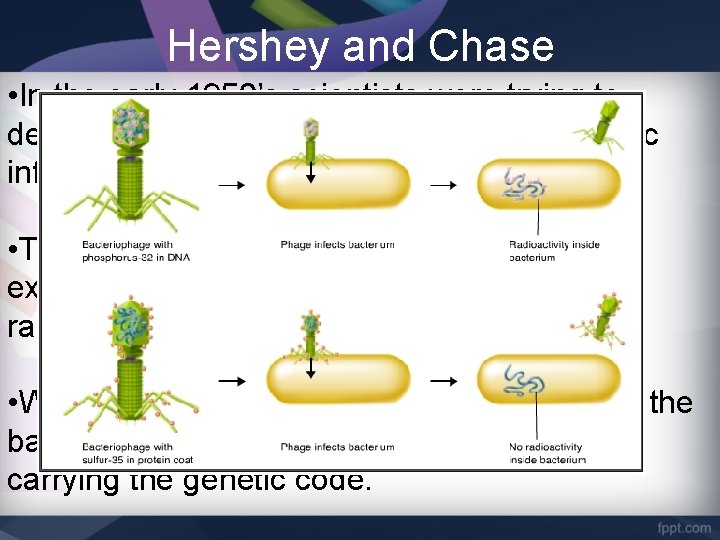
Hershey and Chase • In the early 1950’s scientists were trying to determine what structure was carrying genetic information • Two Scientists, Hershey and Chase, experimented by infecting bacteria with radioactively labeled viruses • When the radioactive markers showed up in the bacteria, they realized it was DNA that was carrying the genetic code.
DNA (deoxyribonucleic acid) • DNA is often referred to as the “instructions” for ALL life • In simple terms, DNA contains the instructions to synthesize proteins within the cell
DNA and Proteins • DNA holds instructions for proteins. • Protein found in hair, skin, bones, and muscles • Proteins called enzymes control the chemical reactions needed for life.

Where is DNA found in the following cells? Prokaryote Cytoplasm Eukaryote Nucleus Nuclear Membrane Where is DNA found in an Eukaryote Cell?
DNA is a Nucleic Acid • The monomer of nucleic acids are nucleotides. • A nucleotides have 3 parts: – Deoxyribose (sugar CHO) – Phosphate group (P) – Nitrogen Base (N) (4 possibilities) • • Adenine Thymine Cytosine Guanine
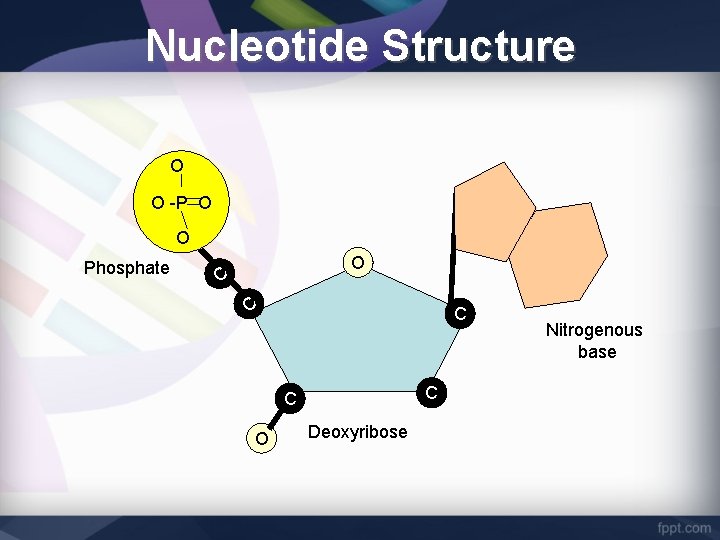
Nucleotide Structure O O -P O O Phosphate O C C C O Deoxyribose Nitrogenous base
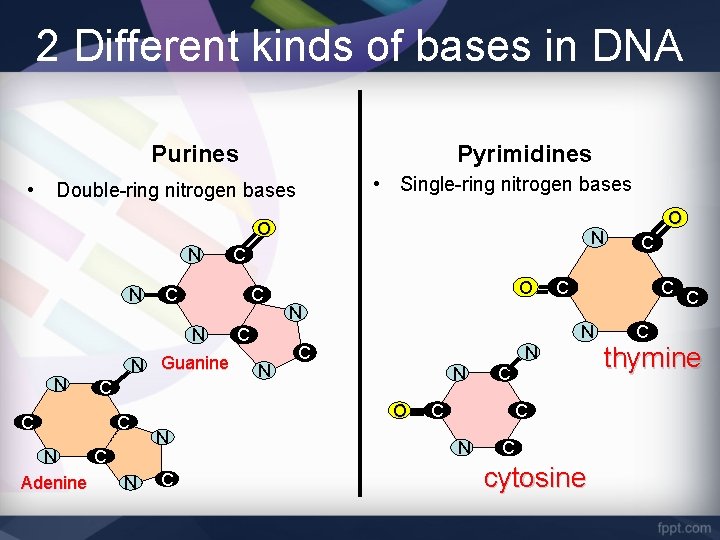
2 Different kinds of bases in DNA Purines • Pyrimidines • Single-ring nitrogen bases Double-ring nitrogen bases O N N N C C N Guanine C C N C Adenine N C C N N C N O N C C N N C C C N C O C cytosine C C thymine
Watson & Crick- 1953 • Proposed that DNA is made of 2 strands of nucleotides held together by nitrogen bases • The complementary nitrogen base pairs were held together by hydrogen bonds • The idea of the double helix shape was aided through the work of Rosalind Franklin • Franklin was taking X-rays of DNA, and one picture showed an “X” shape, a characteristic of a helix • Watson and Crick “borrowed” from Franklin, got their worked published, and went on to earn the Nobel Prize for their work. Franklin received no recognition
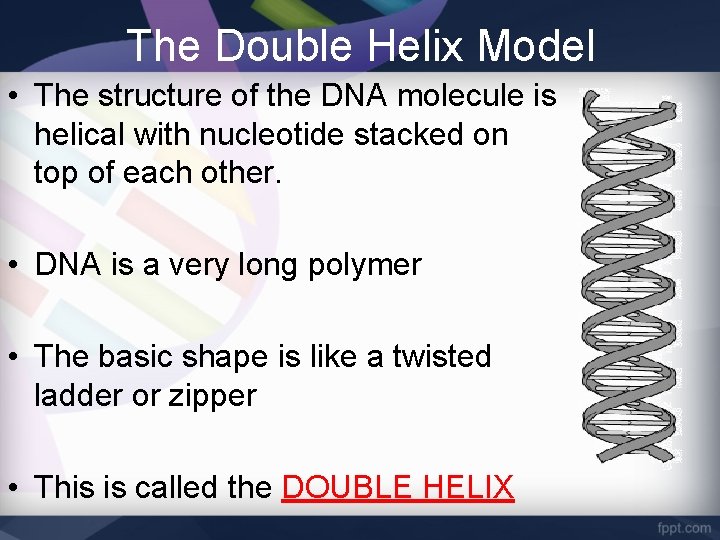
The Double Helix Model • The structure of the DNA molecule is helical with nucleotide stacked on top of each other. • DNA is a very long polymer • The basic shape is like a twisted ladder or zipper • This is called the DOUBLE HELIX
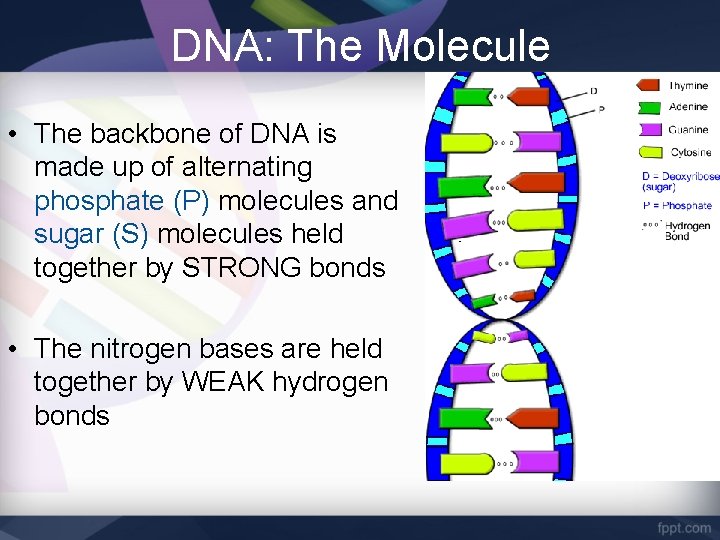
DNA: The Molecule • The backbone of DNA is made up of alternating phosphate (P) molecules and sugar (S) molecules held together by STRONG bonds • The nitrogen bases are held together by WEAK hydrogen bonds
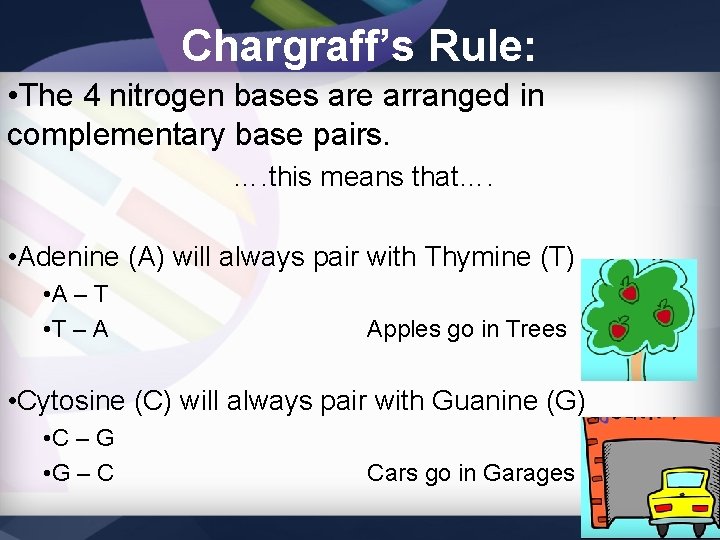
Chargraff’s Rule: • The 4 nitrogen bases are arranged in complementary base pairs. …. this means that…. • Adenine (A) will always pair with Thymine (T) • A – T • T – A Apples go in Trees • Cytosine (C) will always pair with Guanine (G) • C – G • G – C Cars go in Garages
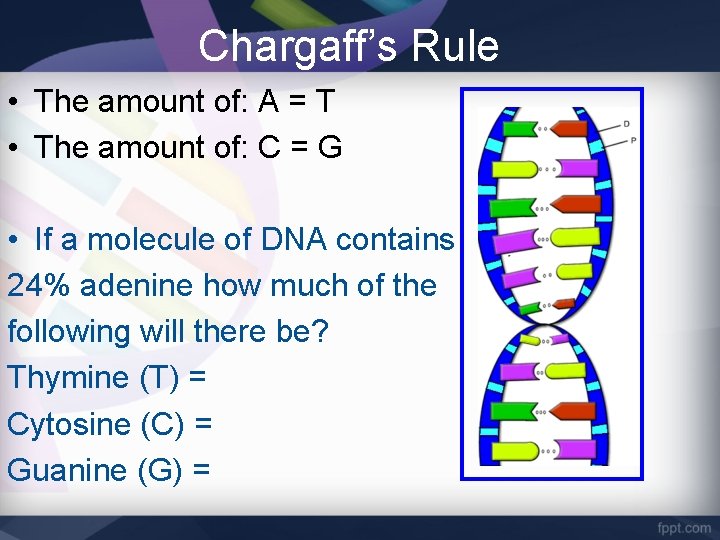
Chargaff’s Rule • The amount of: A = T • The amount of: C = G • If a molecule of DNA contains 24% adenine how much of the following will there be? Thymine (T) = Cytosine (C) = Guanine (G) =
DNA, DAN, AND • What makes the 3 words above different from each other? • All living organisms from bacteria to you have the same DNA alphabet (A, T, C, G) • The only difference is the SEQUENCE (order) of the nucleotides (nitrogen bases) • It is the SEQUENCE of nitrogen bases that will determine what proteins are built. •
Importance of nucleotide sequence – Differences in sequences = differences in organisms – More similar sequences mean closer relationship between organisms – Nucleotide sequences are used to: • Determine evolutionary relationships • Determine familial relationships • Identify the bodies of crime victims

Summary: DNA Structure • DNA is a nucleic acid • The monomer of DNA is a nucleotide • Nucleotides have 3 parts (phosphate, sugar, nitrogen base) • There are 4 nitrogen bases (A, T, C, G) • A pairs with T; C pairs with G • The shape of DNA is described as a double helix • DNA is found in all living organisms • The sequence of nucleotides determines the type of organism
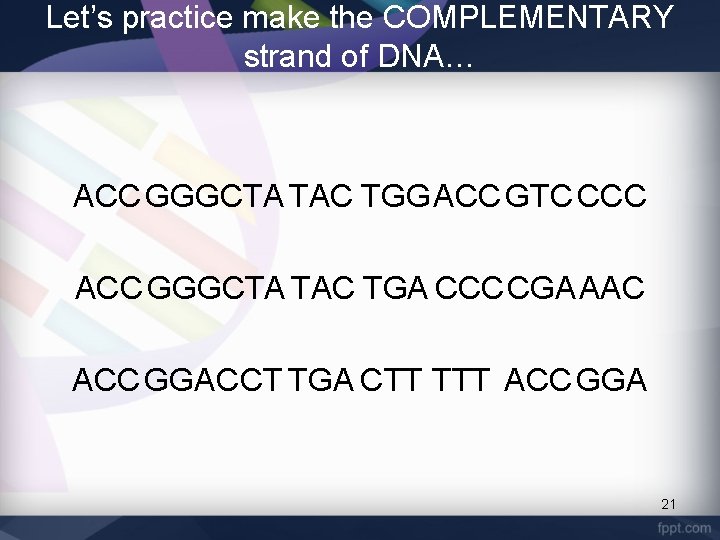
Let’s practice make the COMPLEMENTARY strand of DNA… ACC GGGCTA TAC TGGACC GTC CCC ACC GGGCTA TAC TGA CCCCGAAAC ACC GGACCT TGA CTT TTT ACC GGA 21
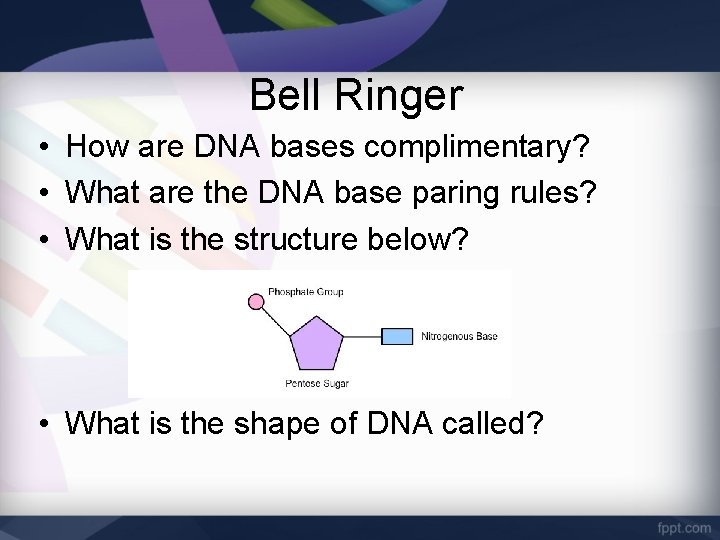
Bell Ringer • How are DNA bases complimentary? • What are the DNA base paring rules? • What is the structure below? • What is the shape of DNA called?
DNA Replication
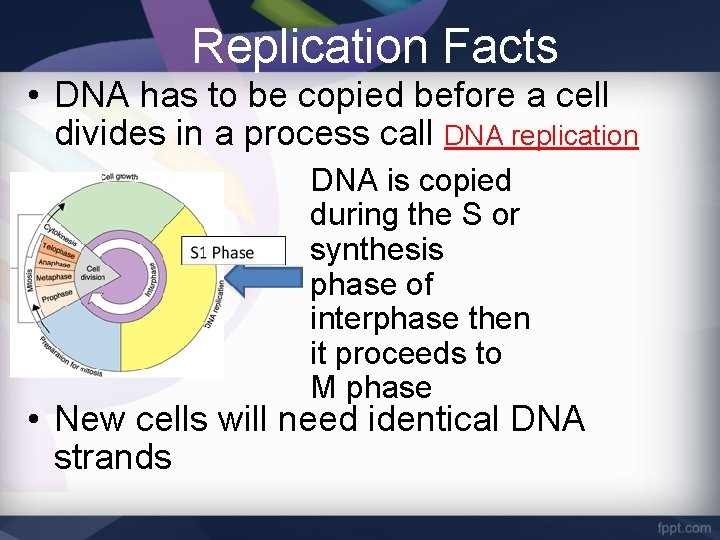
Replication Facts • DNA has to be copied before a cell divides in a process call DNA replication DNA is copied during the S or synthesis phase of interphase then it proceeds to M phase • New cells will need identical DNA strands
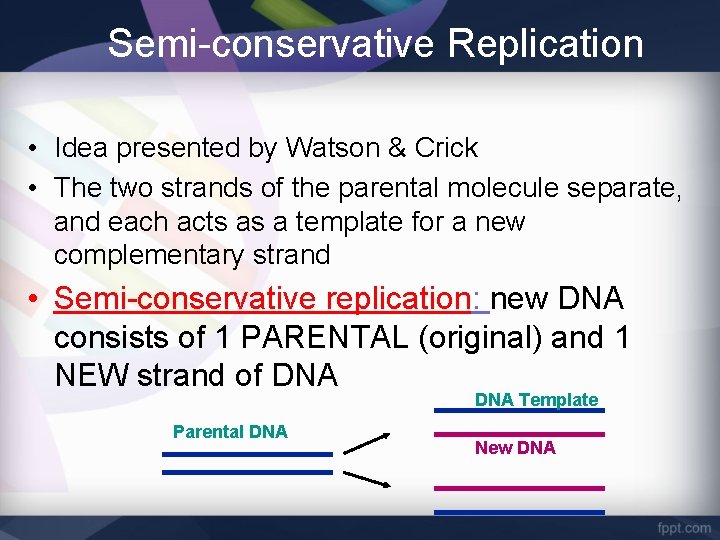
Semi-conservative Replication • Idea presented by Watson & Crick • The two strands of the parental molecule separate, and each acts as a template for a new complementary strand • Semi-conservative replication: new DNA consists of 1 PARENTAL (original) and 1 NEW strand of DNA Template Parental DNA New DNA

Parent Strand DNA Unzips Each original strand is completed by have new complementary base pairs replaced
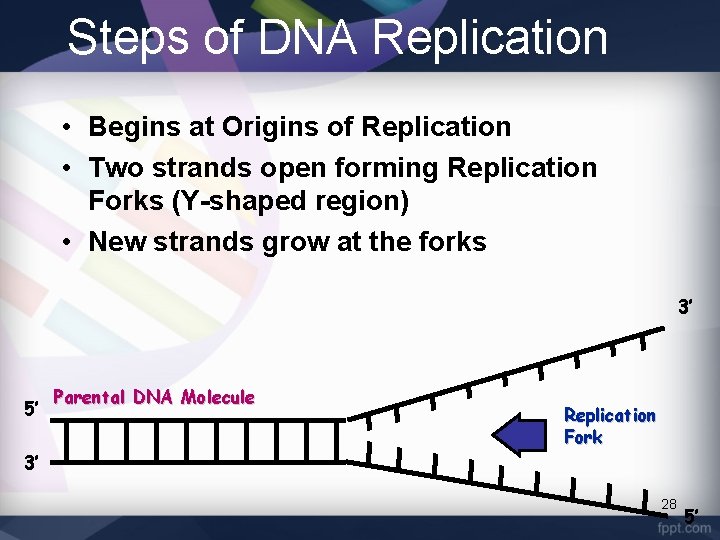
Steps of DNA Replication • Begins at Origins of Replication • Two strands open forming Replication Forks (Y-shaped region) • New strands grow at the forks 3’ 5’ Parental DNA Molecule Replication Fork 3’ 28 5’

DNA Replication • Enzyme helicase unwinds and separates the 2 DNA strands by breaking the weak hydrogen bonds • This process is called unzipping • Single-strand binding proteins attach and keep the 2 DNA strands separated and untwisted

DNA Replication • DNA separates and unwinds • Enzyme topoisomerase attaches to the 2 forks of the bubble to relieve stress on the DNA molecule as it separates Enzyme DNA Enzyme
DNA Replication • • • Before new DNA strands can form, there must be RNA primers present to start the addition of new nucleotides Primase is the enzyme that synthesizes the RNA Primer DNA polymerase can then acts as a catalyst to add the new nucleotides
• Hydrogen bonds form to create new strands of DNA • The 2 new DNA strands are identical to each other and identical to the parent strand

DNA Strands are Anti-parallel 5 3 O 5’ pairs with 3’ O 3 P 5 O C G 1 4 3 2 4 5 O 2 O T 3 A O P 3 P 5 1 3 P P 5 P
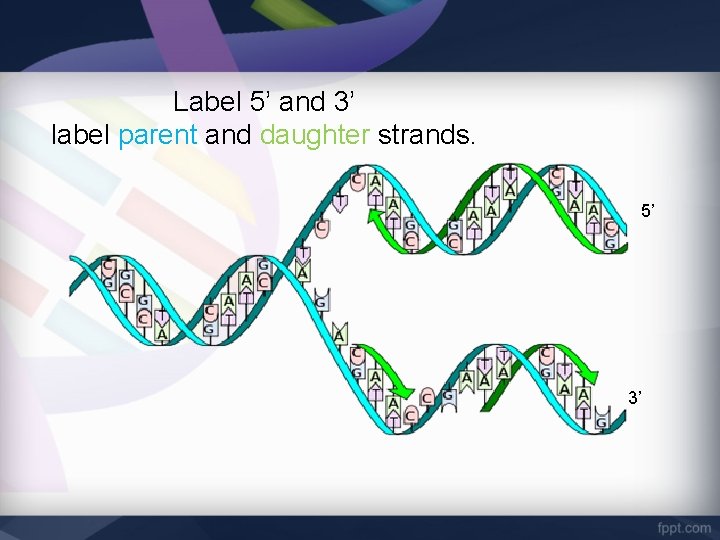
Label 5’ and 3’ label parent and daughter strands. 5’ 3’
Proofreading New DNA • DNA polymerase initially makes about 1 in 10, 000 base pairing errors • Enzymes proofread and correct these mistakes • The new error rate for DNA that has been proofread is 1 in 1 billion base pairing errors
Question • What would be the complementary DNA strand for the following DNA sequence? DNA 5’-CGCTATG-3’ DNA 3’-GCGATAC-5’
DNA Damage & Repair • Chemicals & ultraviolet radiation damage the DNA in our body cells • Cells must continuously repair DAMAGED DNA • Excision repair occurs when any of over 50 repair enzymes remove damaged parts of DNA • DNA polymerase and DNA ligase replace and bond the new nucleotides together
Replication Steps…quick version • DNA is double stranded • The base order on one strand predicts the base order on the other strand (They are complementary) • Enzymes break hydrogen bonds between the two strands of DNA • Complementary bases then pair up (base pairing) and two identical molecules of DNA are made
• IN A EUKARYOTE WHERE DOES REPLICATION TAKE PLACE!! (WHAT ORGANELLE) NUCLEUS!!
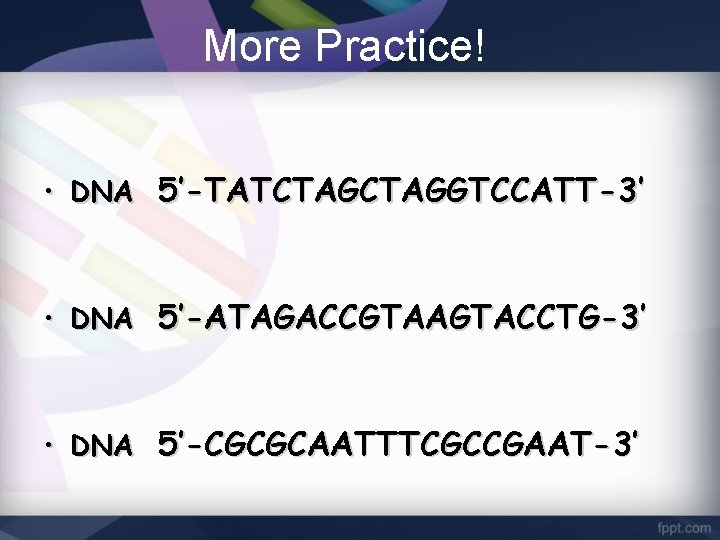
More Practice! • DNA 5’-TATCTAGGTCCATT-3’ • DNA 5’-ATAGACCGTAAGTACCTG-3’ • DNA 5’-CGCGCAATTTCGCCGAAT-3’
BELL RINGER • What would happen!! • If mitosis occurred before replication of the DNA? The new cells wouldn’t have DNA! When does replication of DNA take place? S phase! What enzyme adds back the new complimentary nucleotides? DNA Polymerase
- Slides: 41