
The Structure of DNA Ag Biology What is
The Structure of DNA Ag Biology
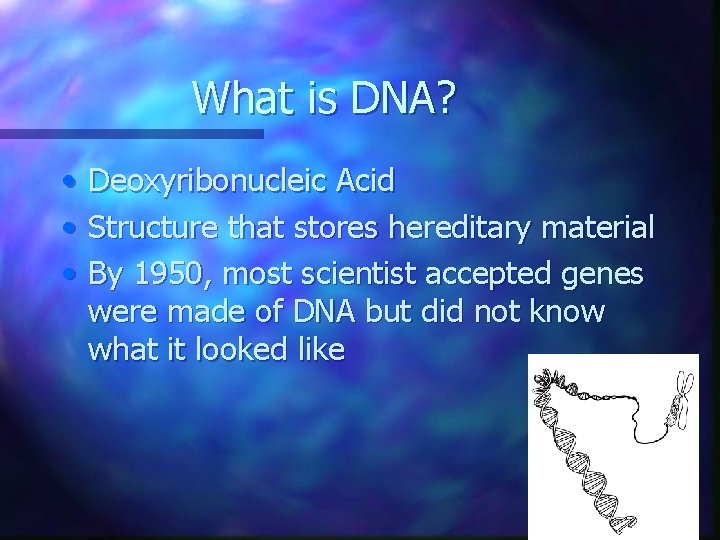
What is DNA? • • • Deoxyribonucleic Acid Structure that stores hereditary material By 1950, most scientist accepted genes were made of DNA but did not know what it looked like
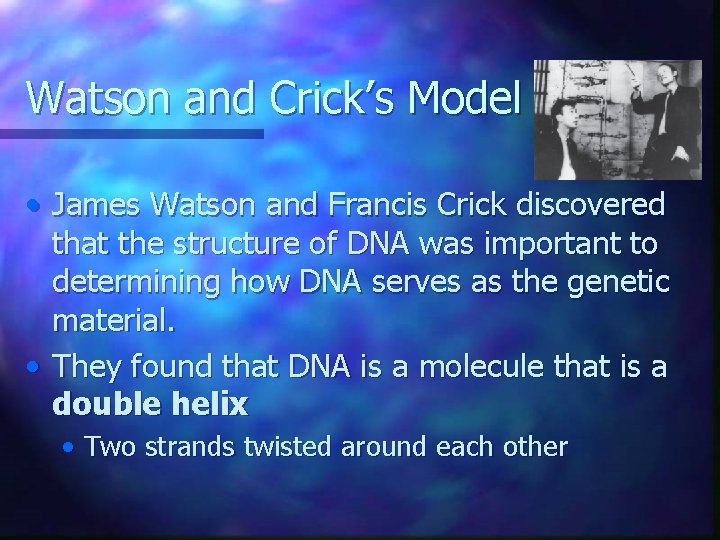
Watson and Crick’s Model • James Watson and Francis Crick discovered that the structure of DNA was important to determining how DNA serves as the genetic material. • They found that DNA is a molecule that is a double helix • Two strands twisted around each other
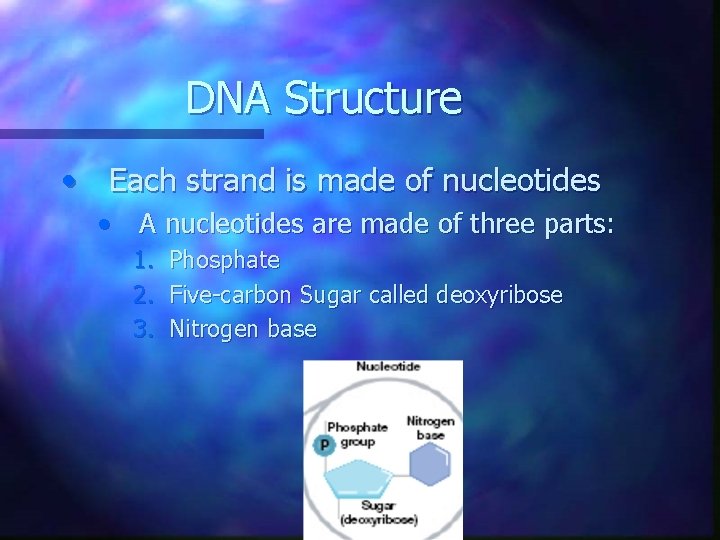
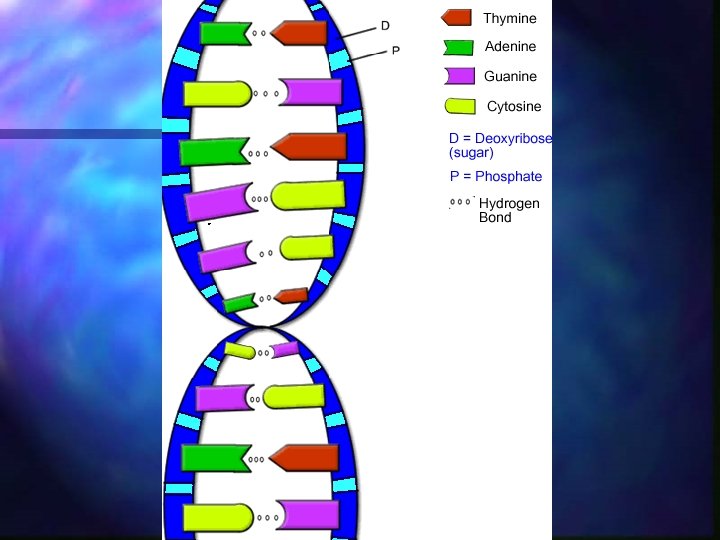
DNA Structure • Each strand is made of nucleotides • A nucleotides are made of three parts: 1. 2. 3. Phosphate Five-carbon Sugar called deoxyribose Nitrogen base
Nitrogen Bases • There are four different kinds nitrogen bases that make up DNA: 1. Adenine (A) 2. Guanine (G) 3. Thymine (T) 4. Cytosine (C)
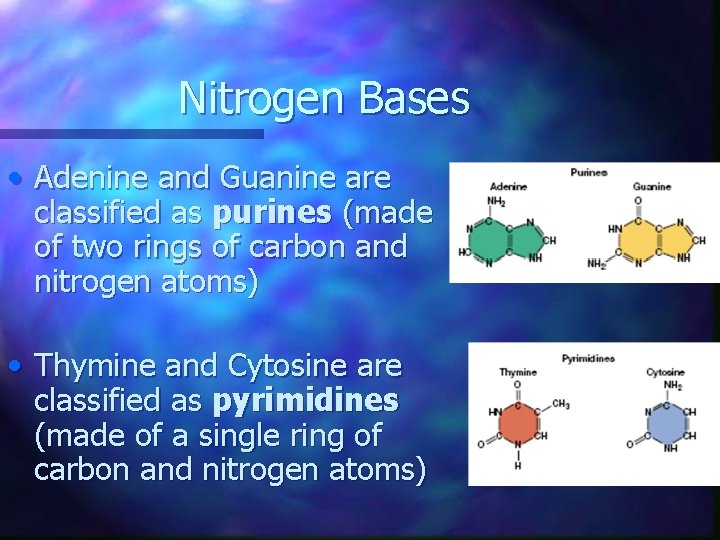
Nitrogen Bases • Adenine and Guanine are classified as purines (made of two rings of carbon and nitrogen atoms) • Thymine and Cytosine are classified as pyrimidines (made of a single ring of carbon and nitrogen atoms)
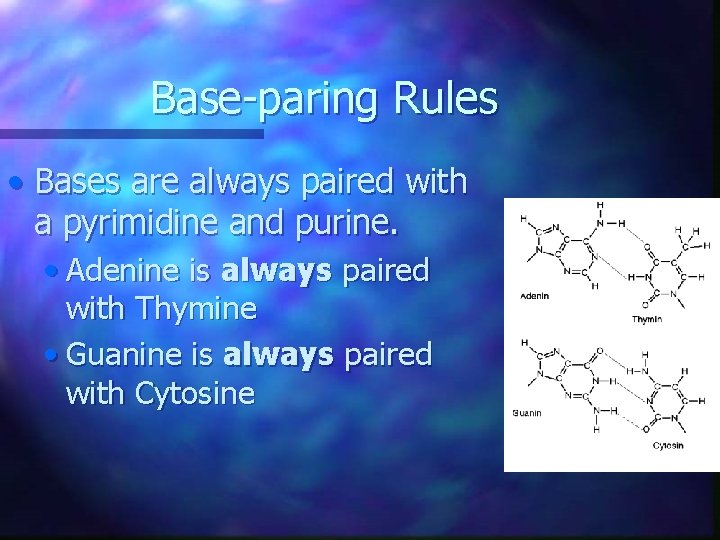
Base-paring Rules • Bases are always paired with a pyrimidine and purine. • Adenine is always paired with Thymine • Guanine is always paired with Cytosine
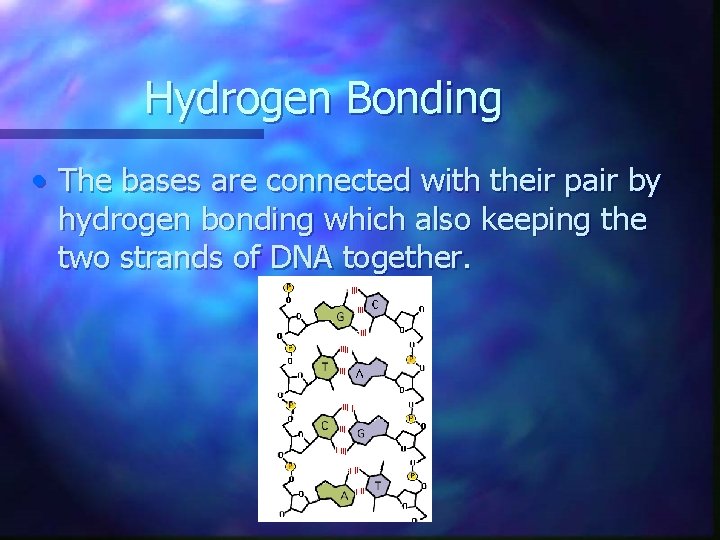
Hydrogen Bonding • The bases are connected with their pair by hydrogen bonding which also keeping the two strands of DNA together.
How did this model come to be? • Erwin Chargaff • Biochemist • In 1949, he observed that the amount of adenine (A) always equaled the amount of thymine (T) and the amount of guanine (G) always equaled the amount of cytosine (C). • However, the numbers of each varied between organisms
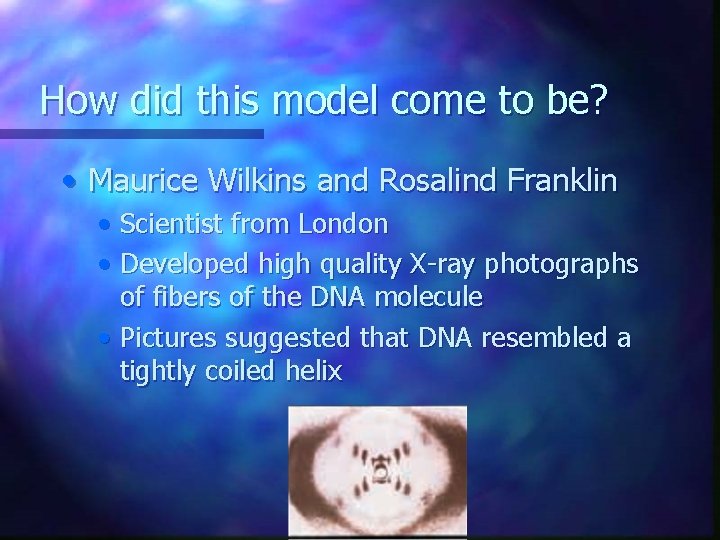
How did this model come to be? • Maurice Wilkins and Rosalind Franklin • Scientist from London • Developed high quality X-ray photographs of fibers of the DNA molecule • Pictures suggested that DNA resembled a tightly coiled helix
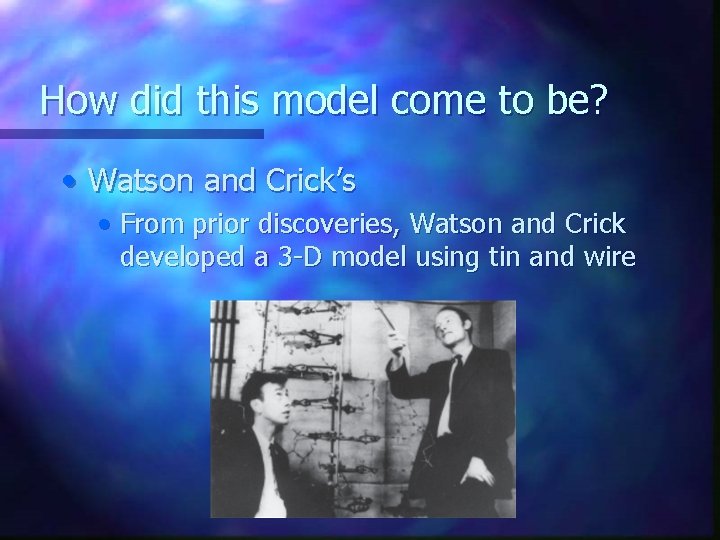
How did this model come to be? • Watson and Crick’s • From prior discoveries, Watson and Crick developed a 3 -D model using tin and wire
The Replication of DNA
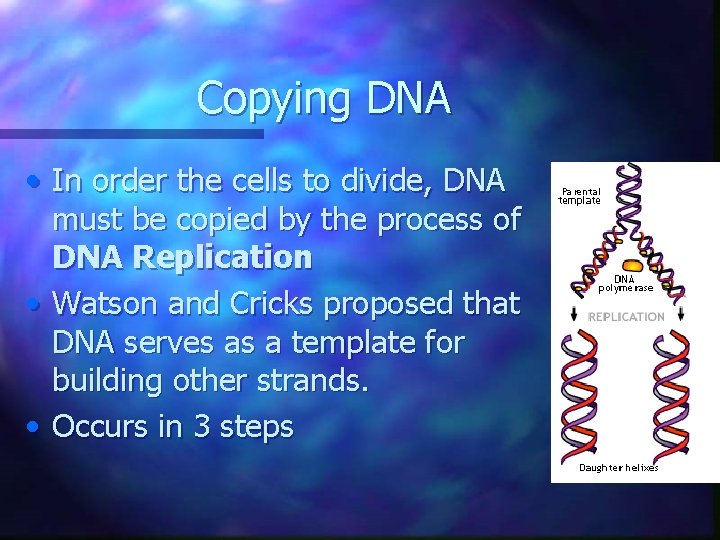
Copying DNA • In order the cells to divide, DNA must be copied by the process of DNA Replication • Watson and Cricks proposed that DNA serves as a template for building other strands. • Occurs in 3 steps
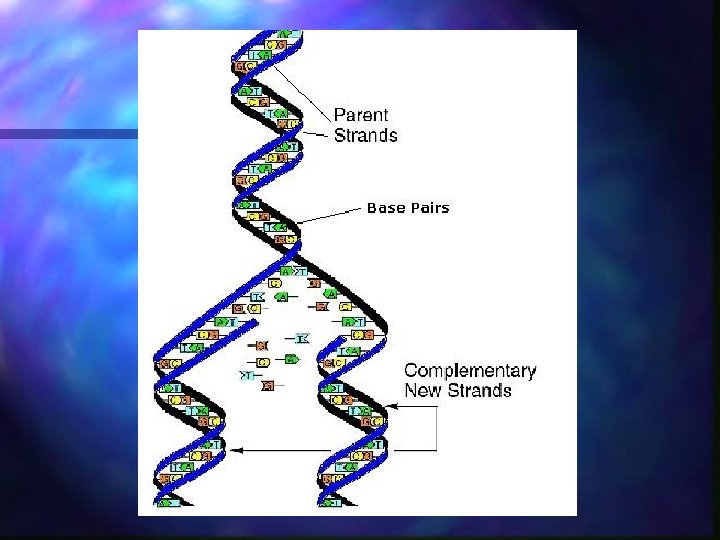
DNA Replication Step 1 • Double helix unwinds with the help of the DNA helicases • DNA helicases are enzymes that break the hydrogen bonds that link the nitrogen bases. • Additional proteins are attached to each strand to keep the strands apart and from recoiling • The two ends where the DNA separates are called replication forks
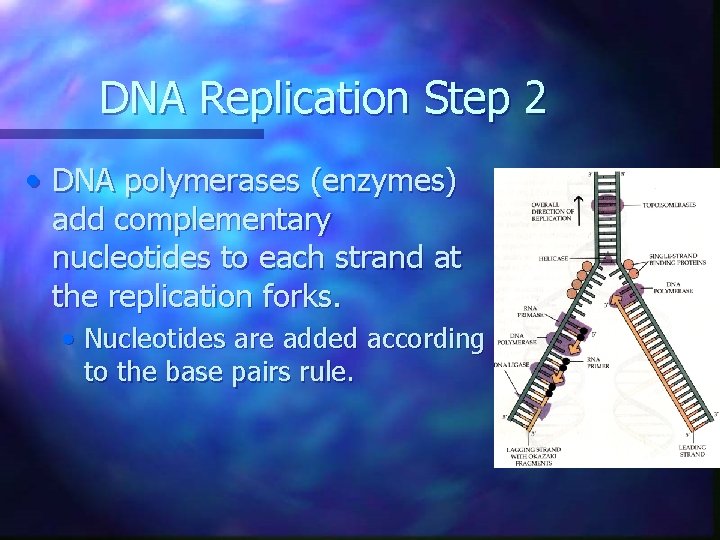
DNA Replication Step 2 • DNA polymerases (enzymes) add complementary nucleotides to each strand at the replication forks. • Nucleotides are added according to the base pairs rule.
DNA Replication Step 3 • Polymerase remain attached until the DNA is completely copied and the signal for detach is given. • Two DNA molecules form that are identical to the original DNA. • Each is composed of an original and a new stand. • The nucleotide pattern is identical to the original strands.
Checking for Errors • Sometimes errors occur during this process when the wrong nucleotides are added to the strand. • DNA polymmerases “proofread” by: • Only being able to add nucleotides when the previous nucleotide is correctly paired with its base • Backtracking and removing incorrect nucleotides and inserting correct ones • This prevents most errors– only 1 error occurs in a billion nucleotides. This is called a mutation.
Multiple Replication Forks • Replication does not begin at one end of the DNA strand end at the other. • Since most eukaryotic cells have one long DNA strands in each chromosome, it would take too long to go from one end to the other. • Human DNA is replicated in about 100 sections • Each sections has a starting point • Since multiple forks work at the same time, the entire chromosome can be replicated in 8 hours.
- Slides: 20