
The Structure of Canadas Government Law 12 2018
- Slides: 26
The Structure of Canada’s Government Law 12 2018
n In Canada we have a system of representative democracy that provides an efficient and effective mechanism for running the country n The government in Canada protects individual rights and freedoms, maintains infrastructure, and deals with other countries.
The Purpose of Government n The government makes laws and carries them out. It allows people to maintain their sense of individual freedom.
The Constitution of Canada n Our set of rules for various levels of government to follow in decision making. n Our Constitution contains a written and unwritten part. n The unwritten constitution is based on traditions from the past. Most of these traditions are based on the British pattern of parliamentary government.
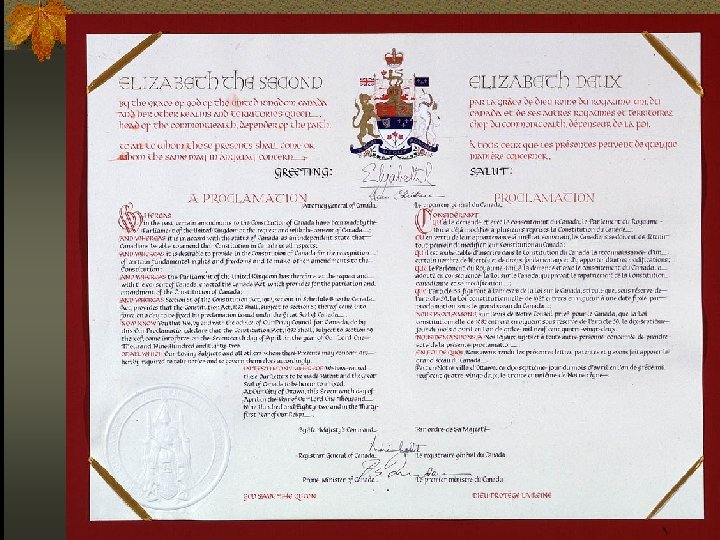
Our Constitution n There are 3 main parts to the written component of our constitution. 1. The Constitution Act 1867. This describes the authority, parts, and functions of parliament. 2. The Charter of Rights and Freedoms. This describes the basic rights and freedoms all Canadians have. 3. The Amending Formula. This sets out ways that the constitution can be changed.
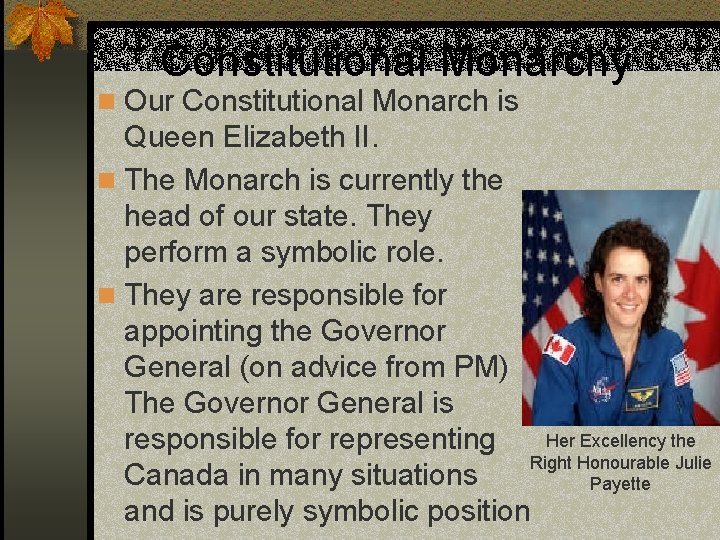
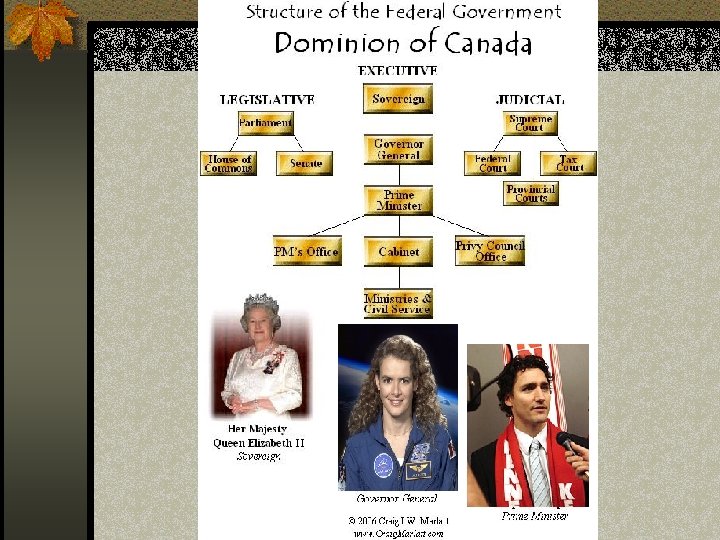
Constitutional Monarchy n Our Constitutional Monarch is Queen Elizabeth II. n The Monarch is currently the head of our state. They perform a symbolic role. n They are responsible for appointing the Governor General (on advice from PM) The Governor General is Her Excellency the responsible for representing Right Honourable Julie Canada in many situations Payette and is purely symbolic position
Representative Democracy n Canada is a Democracy. This means that the people govern the nation. n Individual citizens give their power to an elected representative who acts on their behalf. n By voting we choose who will best represent our beliefs and interests. The elected representative is accountable to the voter.
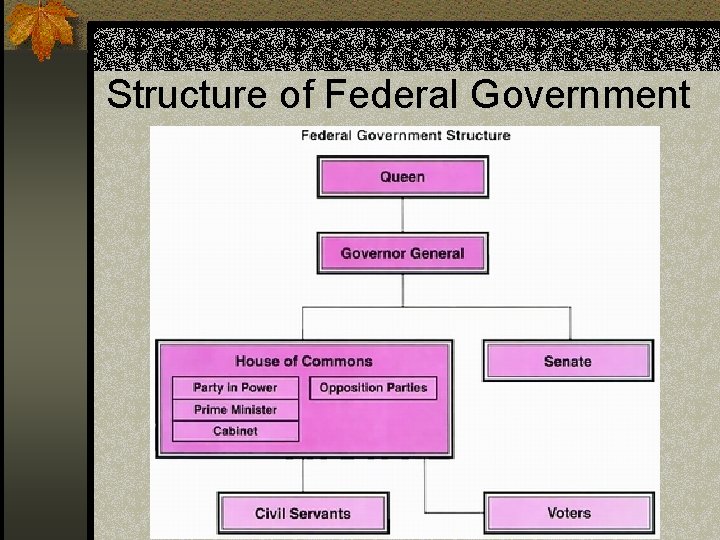
Structure of Federal Government
The Executive Branch n The executive branch of Canada is composed of three elements - the symbolic, political, and permanent - that work together as the government. n The symbolic executive is composed of the Queen, who is the legal head of state of Canada, and her representatives, who fulfill the monarch's daily duties in Canada.
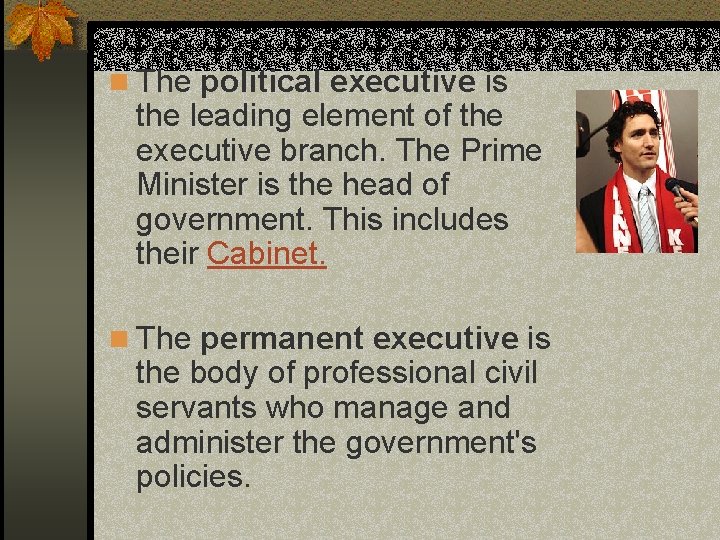
n The political executive is the leading element of the executive branch. The Prime Minister is the head of government. This includes their Cabinet. n The permanent executive is the body of professional civil servants who manage and administer the government's policies.
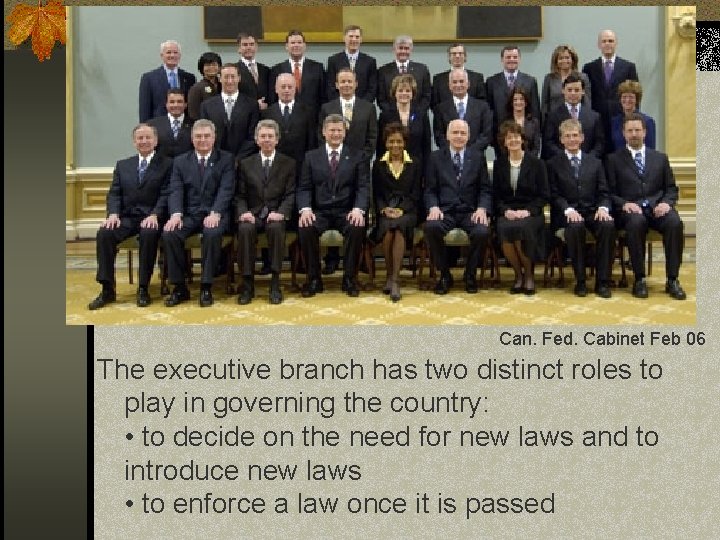
Can. Fed. Cabinet Feb 06 The executive branch has two distinct roles to play in governing the country: • to decide on the need for new laws and to introduce new laws • to enforce a law once it is passed
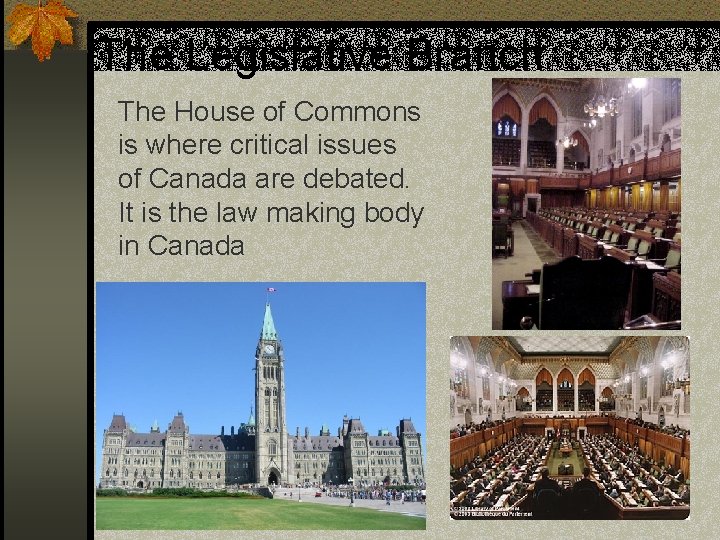
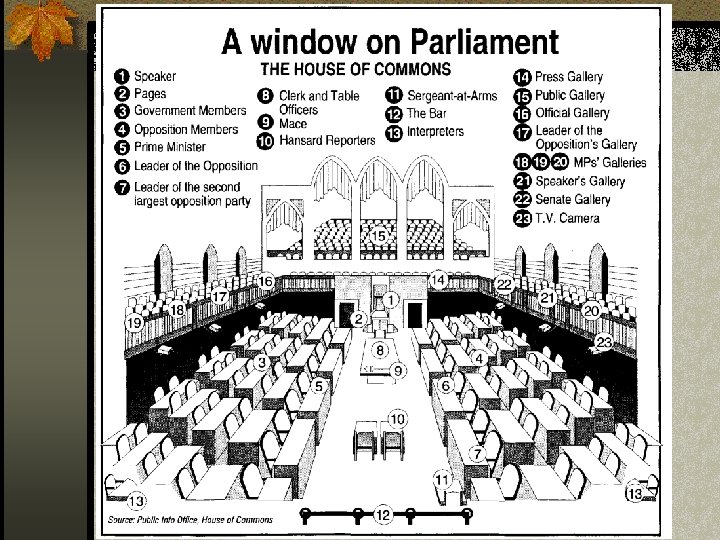
The Legislative Branch The House of Commons is where critical issues of Canada are debated. It is the law making body in Canada
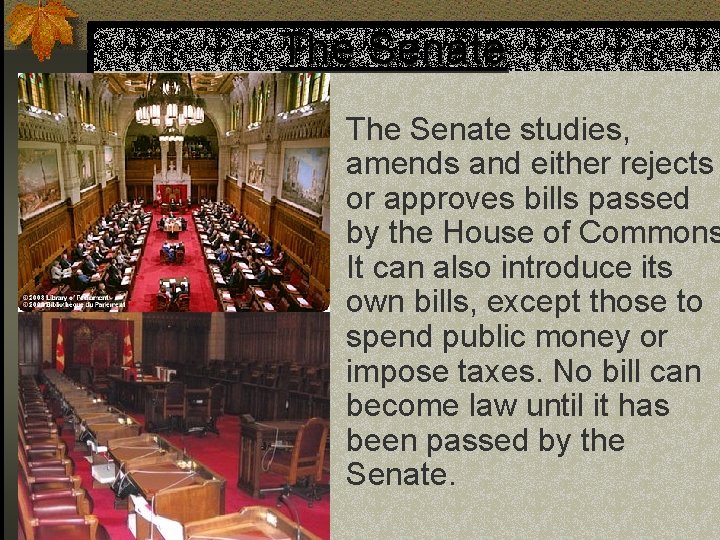
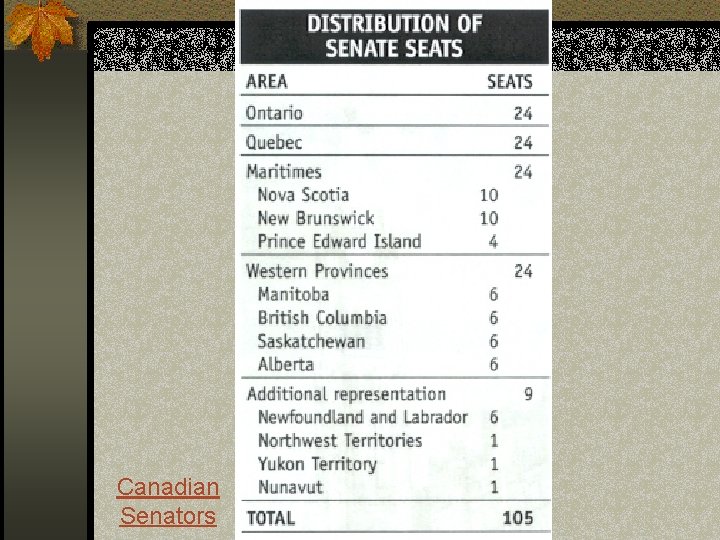
The Senate studies, amends and either rejects or approves bills passed by the House of Commons It can also introduce its own bills, except those to spend public money or impose taxes. No bill can become law until it has been passed by the Senate.
Canadian Senators
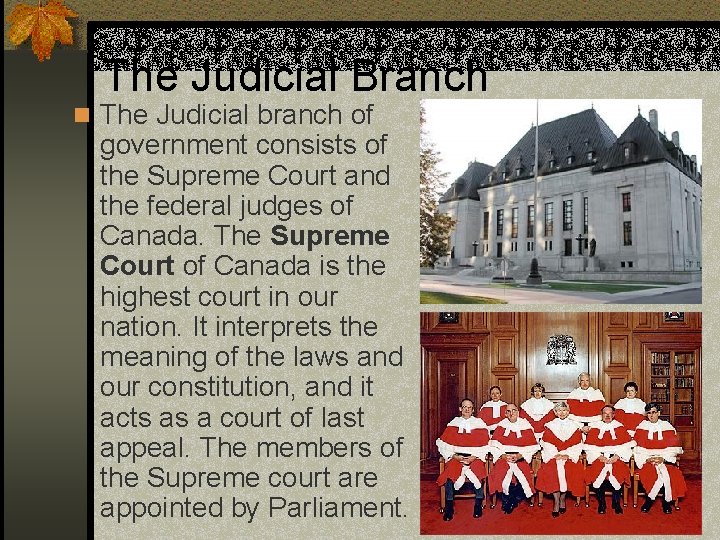
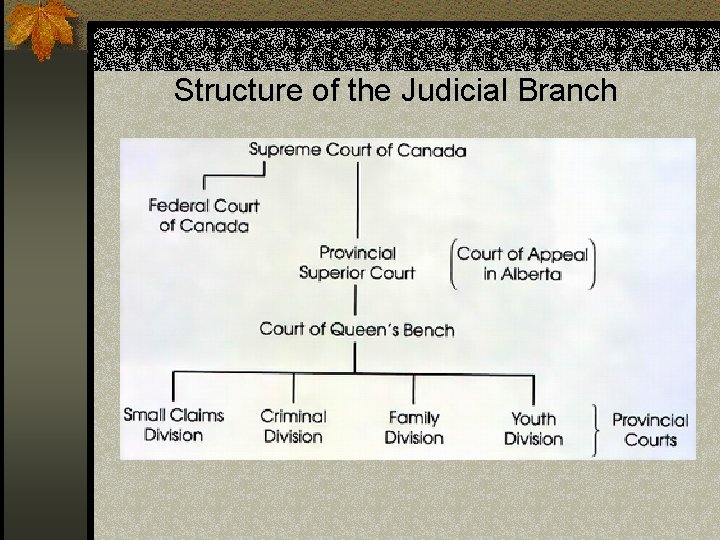
The Judicial Branch n The Judicial branch of government consists of the Supreme Court and the federal judges of Canada. The Supreme Court of Canada is the highest court in our nation. It interprets the meaning of the laws and our constitution, and it acts as a court of last appeal. The members of the Supreme court are appointed by Parliament.
Structure of the Judicial Branch
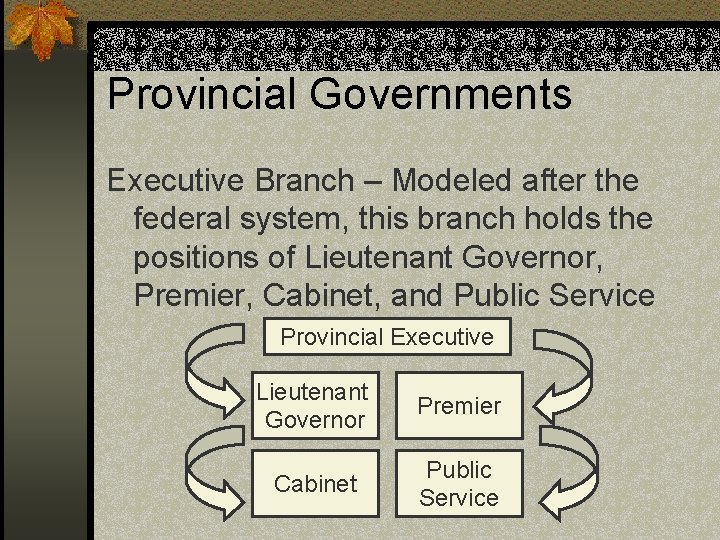
Provincial Governments Executive Branch – Modeled after the federal system, this branch holds the positions of Lieutenant Governor, Premier, Cabinet, and Public Service Provincial Executive Lieutenant Governor Premier Cabinet Public Service
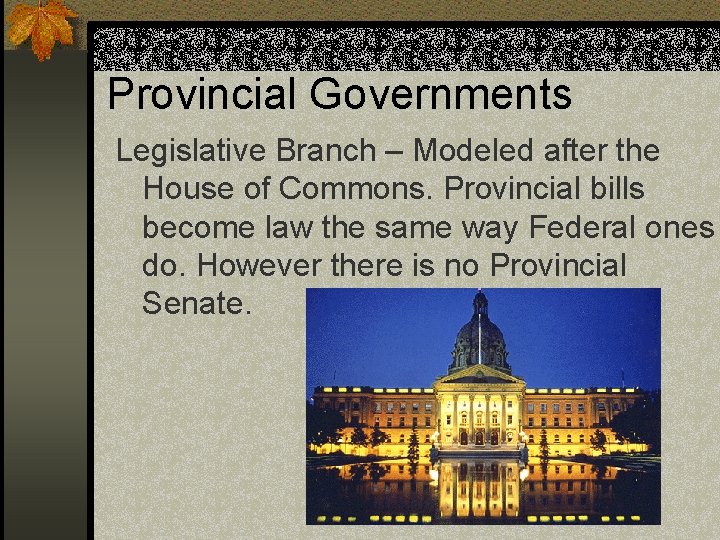
Provincial Governments Legislative Branch – Modeled after the House of Commons. Provincial bills become law the same way Federal ones do. However there is no Provincial Senate.
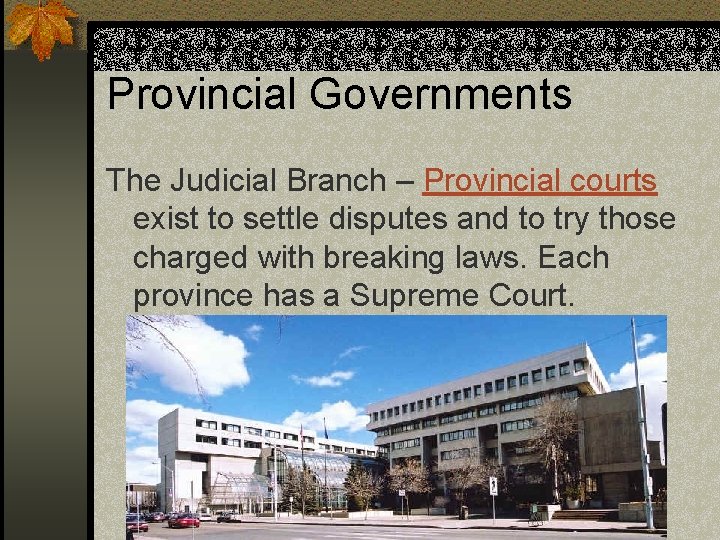
Provincial Governments The Judicial Branch – Provincial courts exist to settle disputes and to try those charged with breaking laws. Each province has a Supreme Court.
Local Government n Like the provincial and federal governments the municipalities are broken into executive and legislative branches of government. n Local governments do not have a judicial branch. n The mayor, councilors, and alderpersons are all elected representatives and are accountable to those who elect them. Stephen Mandel Mayor City of Edmonton
DIVISION OF POWERS: FEDERAL, PROVINCIAL, AND MUNICIPAL Federal Powers n Defence n Regulation of trade and commerce n Citizenship n Taxation n Currency and coins n Native peoples and Native reserves n Postal service n Patents and copyrights n Marriage and divorce n Navigation and shipping n Fisheries n Criminal law and federal penitentiaries
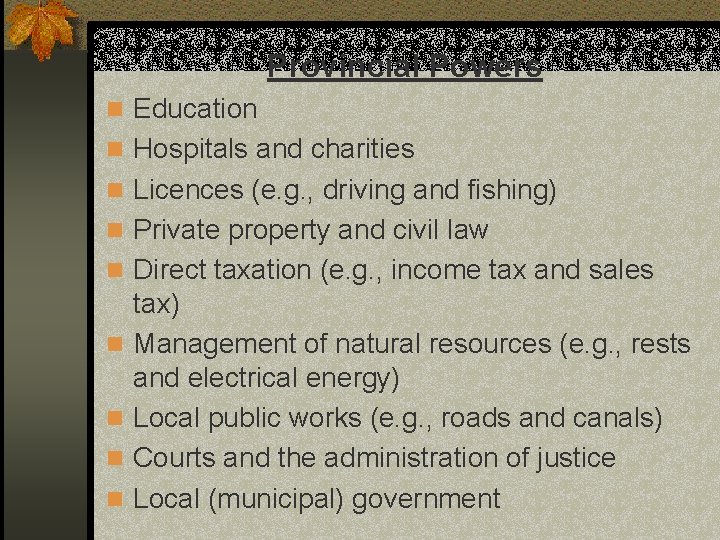
Provincial Powers n Education n Hospitals and charities n Licences (e. g. , driving and fishing) n Private property and civil law n Direct taxation (e. g. , income tax and sales n n tax) Management of natural resources (e. g. , rests and electrical energy) Local public works (e. g. , roads and canals) Courts and the administration of justice Local (municipal) government
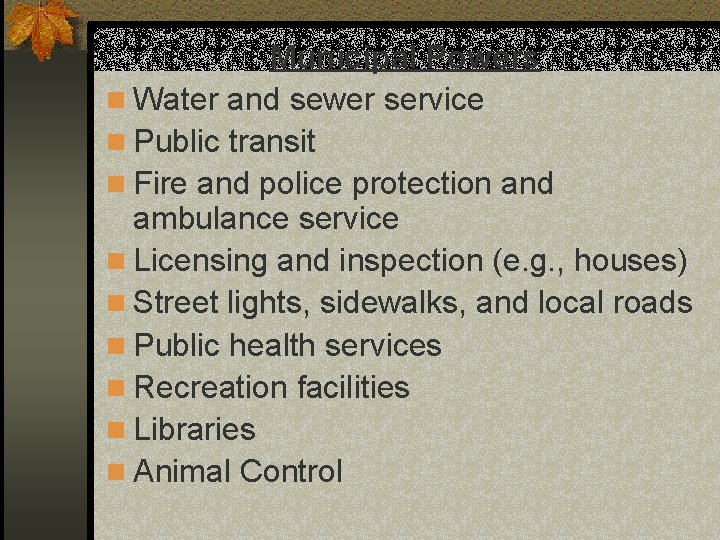
Municipal Powers n Water and sewer service n Public transit n Fire and police protection and ambulance service n Licensing and inspection (e. g. , houses) n Street lights, sidewalks, and local roads n Public health services n Recreation facilities n Libraries n Animal Control