
The Structure of a Case Report Abstract Introduction







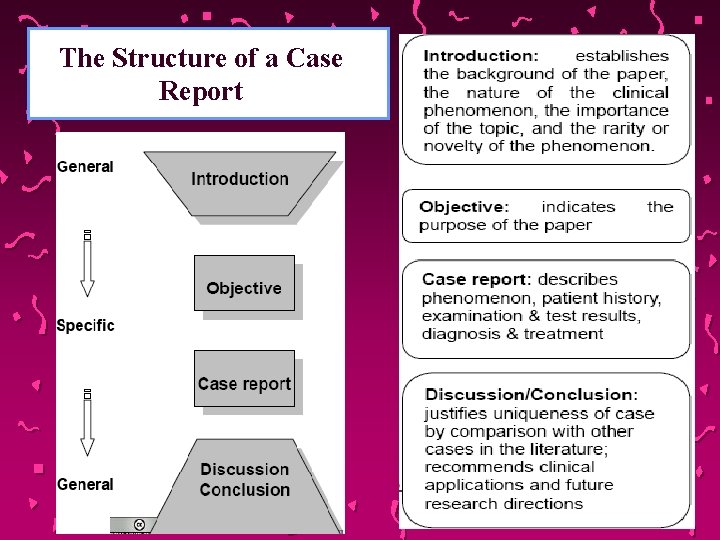
The Structure of a Case Report

Abstract Introduction and objective. Case report. Discussion. Conclusion.



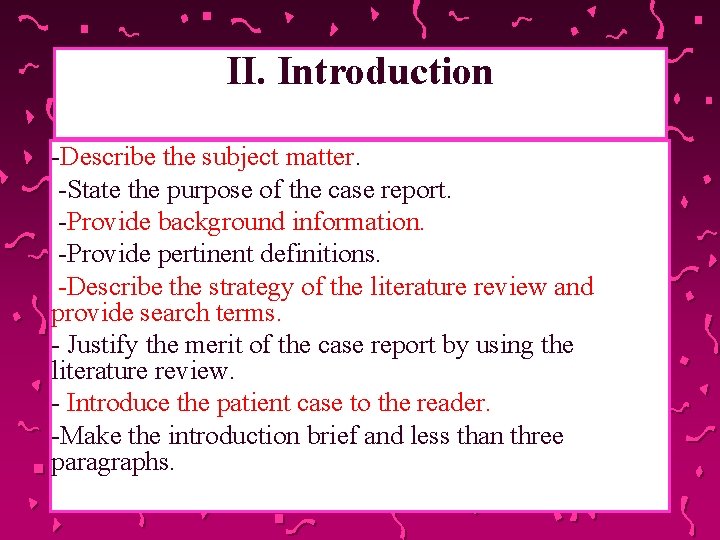
II. Introduction -Describe the subject matter. -State the purpose of the case report. -Provide background information. -Provide pertinent definitions. -Describe the strategy of the literature review and provide search terms. - Justify the merit of the case report by using the literature review. - Introduce the patient case to the reader. -Make the introduction brief and less than three paragraphs.




Patient case presentation Describe the case in a narrative form. § Provide patient demographics (age, sex, height, weight, race, occupation). • Avoid patient identifiers (date of birth, initials). • Describe the patient’s complaint. • List the patient’s present illness. • List the patient’s medical history. • List the patient’s family history. • List the patient’s social history. • List the patient’s medication history before admission and throughout the case report. Ensure that the medication history includes herbals, vaccines, depot injections, and nonprescription medications, and state that the patient was asked for this history. List each drug’s name, strength, dosage form, route, and dates of administration.
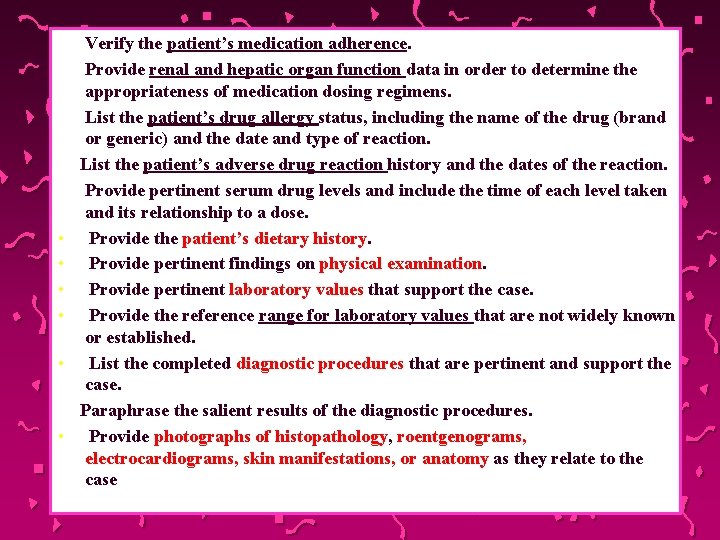
• • • Verify the patient’s medication adherence. Provide renal and hepatic organ function data in order to determine the appropriateness of medication dosing regimens. List the patient’s drug allergy status, including the name of the drug (brand or generic) and the date and type of reaction. List the patient’s adverse drug reaction history and the dates of the reaction. Provide pertinent serum drug levels and include the time of each level taken and its relationship to a dose. Provide the patient’s dietary history. Provide pertinent findings on physical examination. Provide pertinent laboratory values that support the case. Provide the reference range for laboratory values that are not widely known or established. List the completed diagnostic procedures that are pertinent and support the case. Paraphrase the salient results of the diagnostic procedures. Provide photographs of histopathology, roentgenograms, electrocardiograms, skin manifestations, or anatomy as they relate to the case
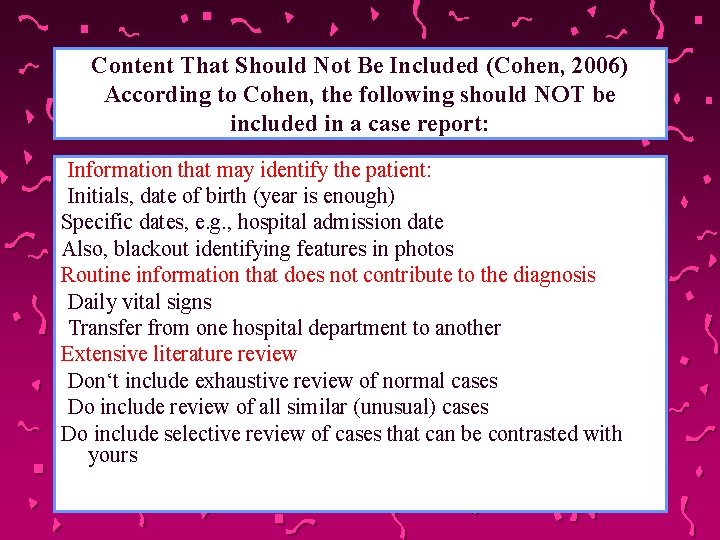
Content That Should Not Be Included (Cohen, 2006) According to Cohen, the following should NOT be included in a case report: Information that may identify the patient: Initials, date of birth (year is enough) Specific dates, e. g. , hospital admission date Also, blackout identifying features in photos Routine information that does not contribute to the diagnosis Daily vital signs Transfer from one hospital department to another Extensive literature review Don‘t include exhaustive review of normal cases Do include review of all similar (unusual) cases Do include selective review of cases that can be contrasted with yours


Discussion q. Compare and contrast the nuances of the case report with the literature review. q Explain or justify the similarities and differences between the case report and the literature. q List the limitations of the case report and describe their relevance.



Conclusion q. Provide a justified conclusion. q Provide evidence-based recommendations. q Describe how the information learned applies to one’s own practice. q List opportunities for research. q Ensure that this section is brief and does not exceed one paragraph.





Steps to publishing a case report (adapted from Brodell, 2000) 1. A patient with an interesting condition presents to your practice. 2. Identify a "take-home" message or teaching point from the case. Why is this case important? 3. Choose a journal appropriate for publishing the case report. 4. Obtain the journal's "guidelines for authors. " 5. Enlist a colleague to help share the workload. 6. Perform a literature search of journals, textbooks, and electronic media. 7. Compile all source articles in a file. 8. Write up the case and discussion in the required format using citations to identify sources of information. 9. Email or upload your manuscript with cover letter to the journal. 10. Obtain reviewers' comments and advice for revision. 11. Revise paper using reviewers' comments. 12. If the article is not accepted by the journal, submit article to a second journal.


- Slides: 33