
The Structure Composition of The Earth Earths Components
- Slides: 13
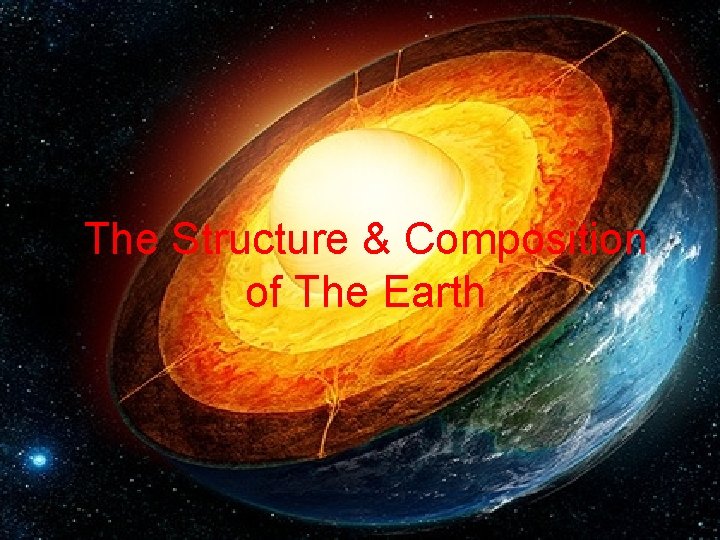
The Structure & Composition of The Earth
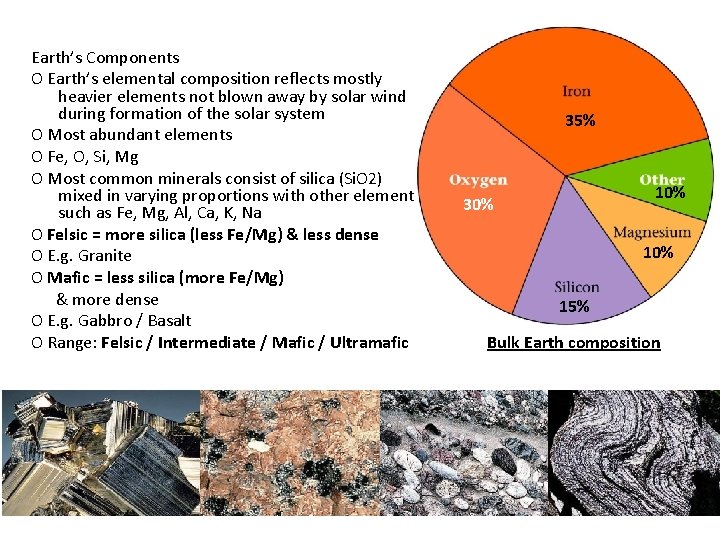
Earth’s Components O Earth’s elemental composition reflects mostly heavier elements not blown away by solar wind during formation of the solar system O Most abundant elements O Fe, O, Si, Mg O Most common minerals consist of silica (Si. O 2) mixed in varying proportions with other elements such as Fe, Mg, Al, Ca, K, Na O Felsic = more silica (less Fe/Mg) & less dense O E. g. Granite O Mafic = less silica (more Fe/Mg) & more dense O E. g. Gabbro / Basalt O Range: Felsic / Intermediate / Mafic / Ultramafic 35% 10% 30% 15% Bulk Earth composition
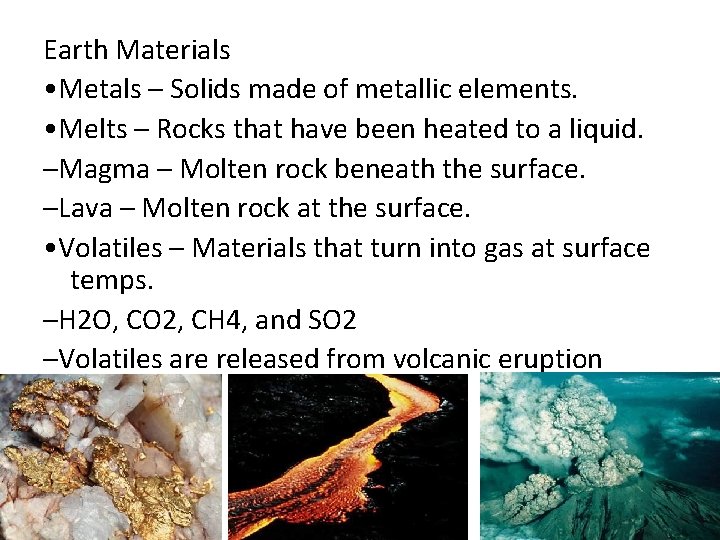
Earth Materials • Metals – Solids made of metallic elements. • Melts – Rocks that have been heated to a liquid. –Magma – Molten rock beneath the surface. –Lava – Molten rock at the surface. • Volatiles – Materials that turn into gas at surface temps. –H 2 O, CO 2, CH 4, and SO 2 –Volatiles are released from volcanic eruption
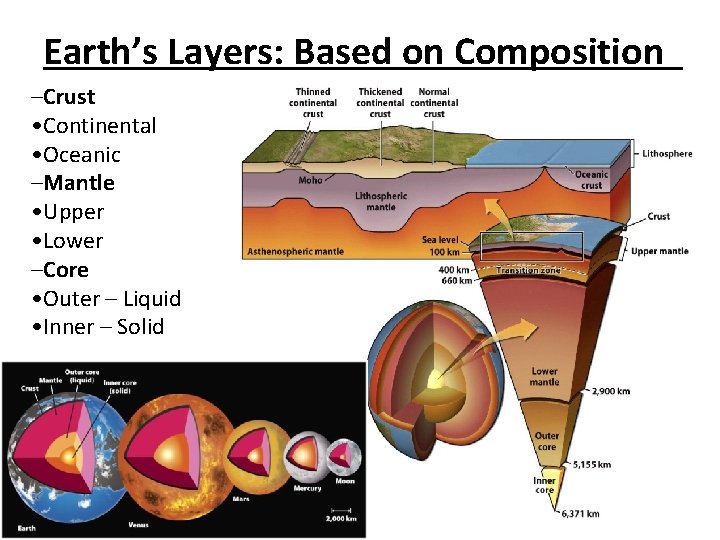
Earth’s Layers: Based on Composition –Crust • Continental • Oceanic –Mantle • Upper • Lower –Core • Outer – Liquid • Inner – Solid
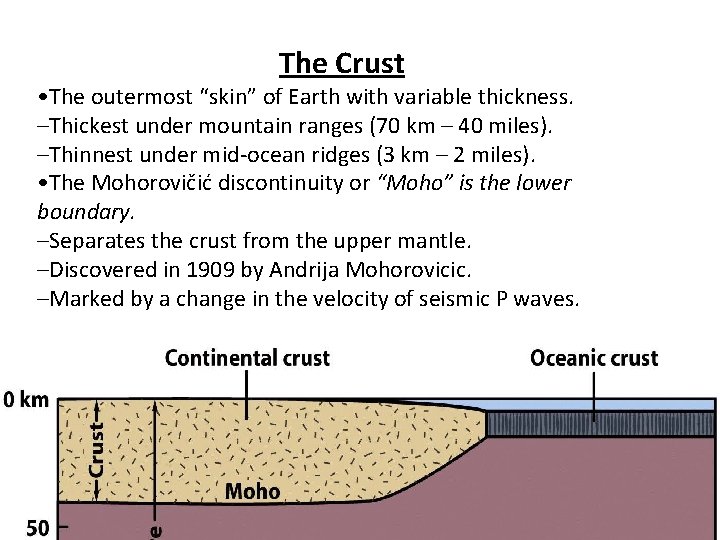
The Crust • The outermost “skin” of Earth with variable thickness. –Thickest under mountain ranges (70 km – 40 miles). –Thinnest under mid-ocean ridges (3 km – 2 miles). • The Mohorovičić discontinuity or “Moho” is the lower boundary. –Separates the crust from the upper mantle. –Discovered in 1909 by Andrija Mohorovicic. –Marked by a change in the velocity of seismic P waves.
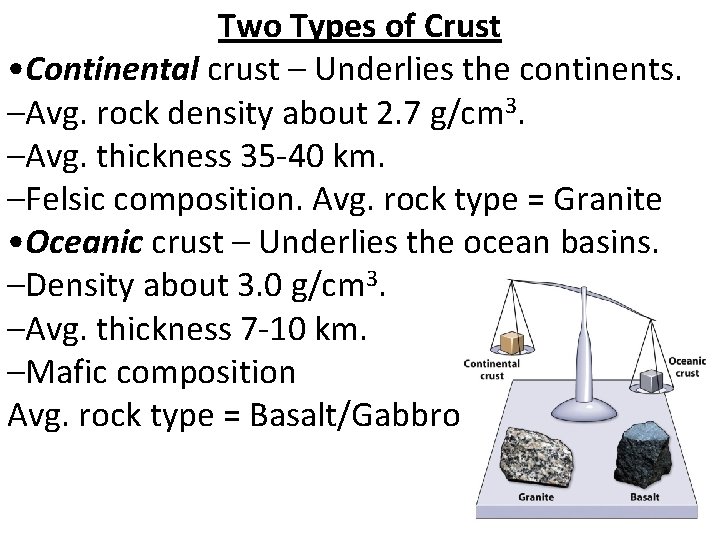
Two Types of Crust • Continental crust – Underlies the continents. –Avg. rock density about 2. 7 g/cm 3. –Avg. thickness 35 -40 km. –Felsic composition. Avg. rock type = Granite • Oceanic crust – Underlies the ocean basins. –Density about 3. 0 g/cm 3. –Avg. thickness 7 -10 km. –Mafic composition Avg. rock type = Basalt/Gabbro
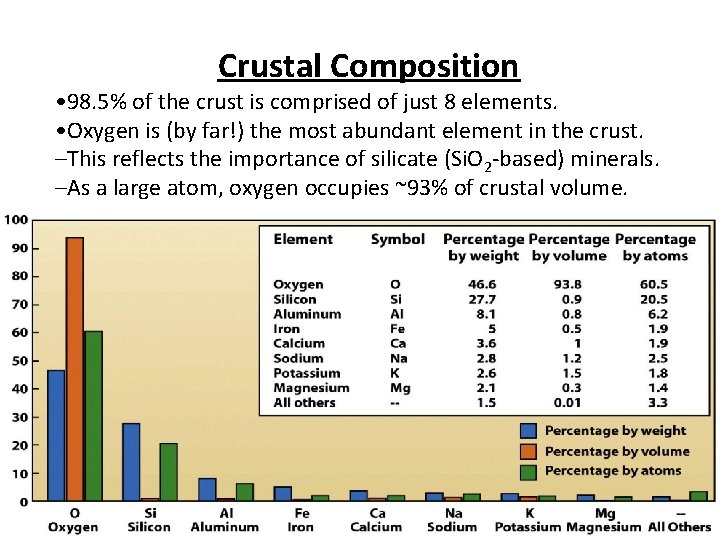
Crustal Composition • 98. 5% of the crust is comprised of just 8 elements. • Oxygen is (by far!) the most abundant element in the crust. –This reflects the importance of silicate (Si. O 2 -based) minerals. –As a large atom, oxygen occupies ~93% of crustal volume.
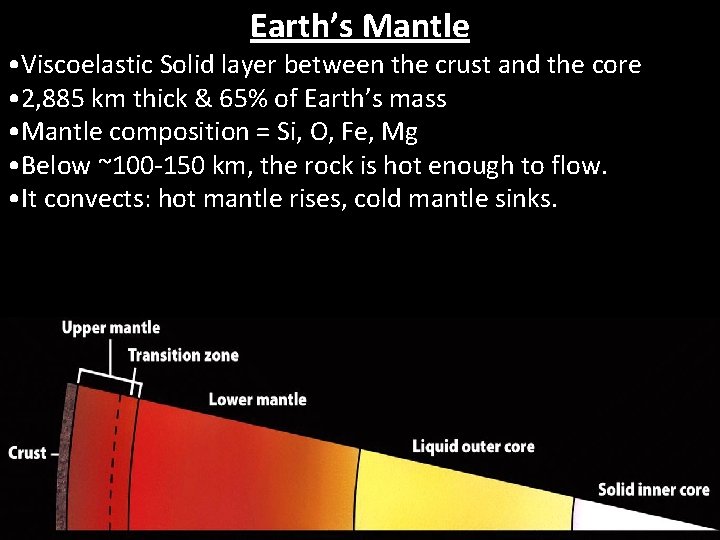
Earth’s Mantle • Viscoelastic Solid layer between the crust and the core • 2, 885 km thick & 65% of Earth’s mass • Mantle composition = Si, O, Fe, Mg • Below ~100 -150 km, the rock is hot enough to flow. • It convects: hot mantle rises, cold mantle sinks.
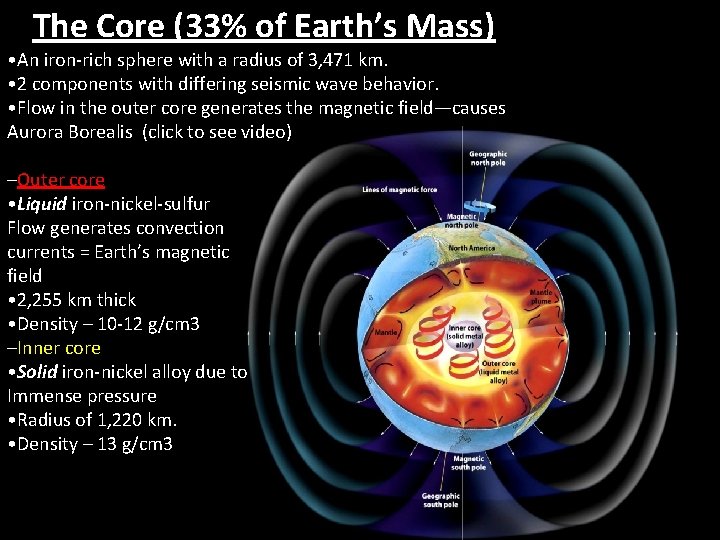
The Core (33% of Earth’s Mass) • An iron-rich sphere with a radius of 3, 471 km. • 2 components with differing seismic wave behavior. • Flow in the outer core generates the magnetic field—causes Aurora Borealis (click to see video) –Outer core • Liquid iron-nickel-sulfur Flow generates convection currents = Earth’s magnetic field • 2, 255 km thick • Density – 10 -12 g/cm 3 –Inner core • Solid iron-nickel alloy due to Immense pressure • Radius of 1, 220 km. • Density – 13 g/cm 3
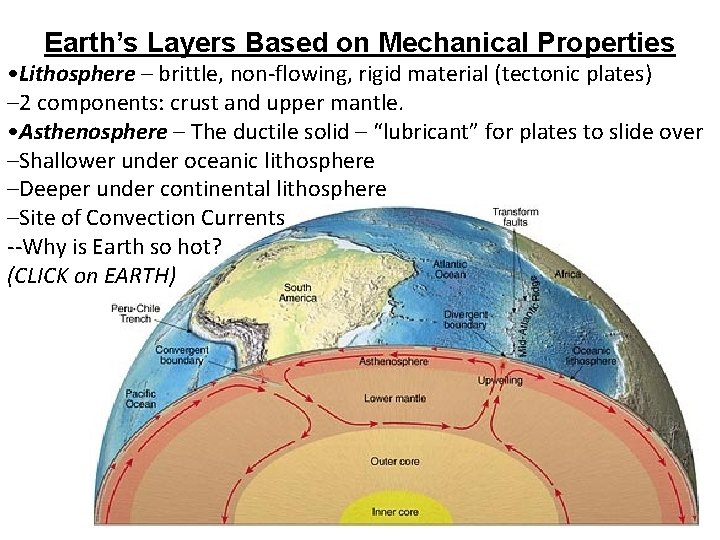
Earth’s Layers Based on Mechanical Properties • Lithosphere – brittle, non-flowing, rigid material (tectonic plates) – 2 components: crust and upper mantle. • Asthenosphere – The ductile solid – “lubricant” for plates to slide over –Shallower under oceanic lithosphere –Deeper under continental lithosphere –Site of Convection Currents --Why is Earth so hot? (CLICK on EARTH)
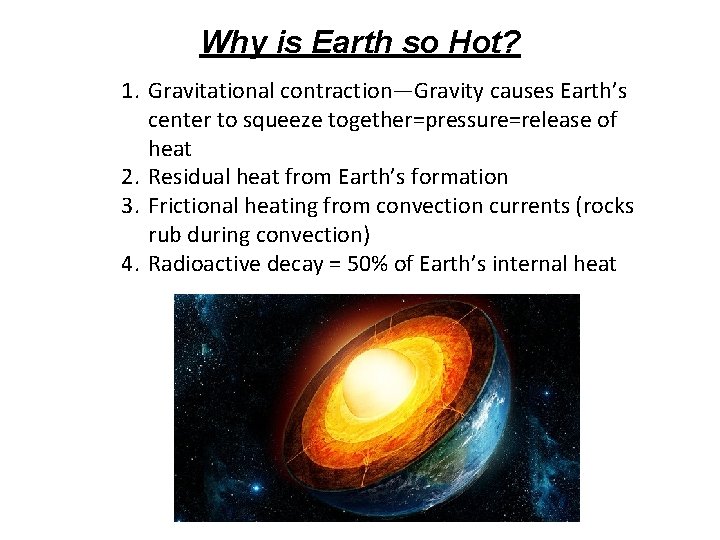
Why is Earth so Hot? 1. Gravitational contraction—Gravity causes Earth’s center to squeeze together=pressure=release of heat 2. Residual heat from Earth’s formation 3. Frictional heating from convection currents (rocks rub during convection) 4. Radioactive decay = 50% of Earth’s internal heat
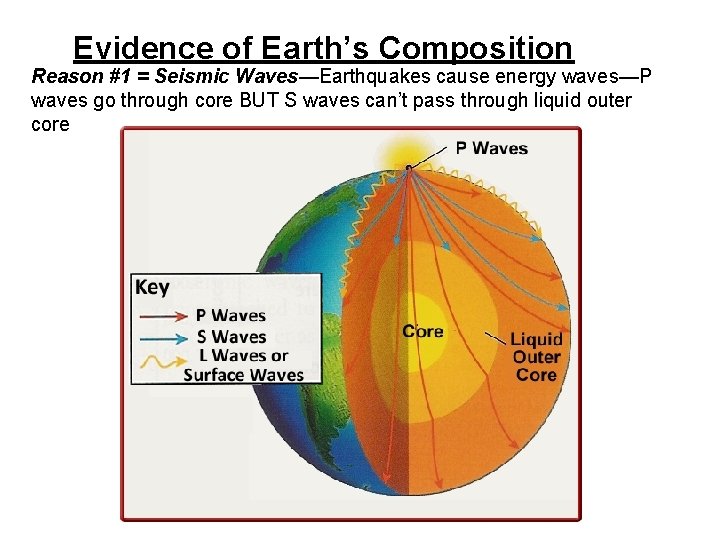
Evidence of Earth’s Composition Reason #1 = Seismic Waves—Earthquakes cause energy waves—P waves go through core BUT S waves can’t pass through liquid outer core
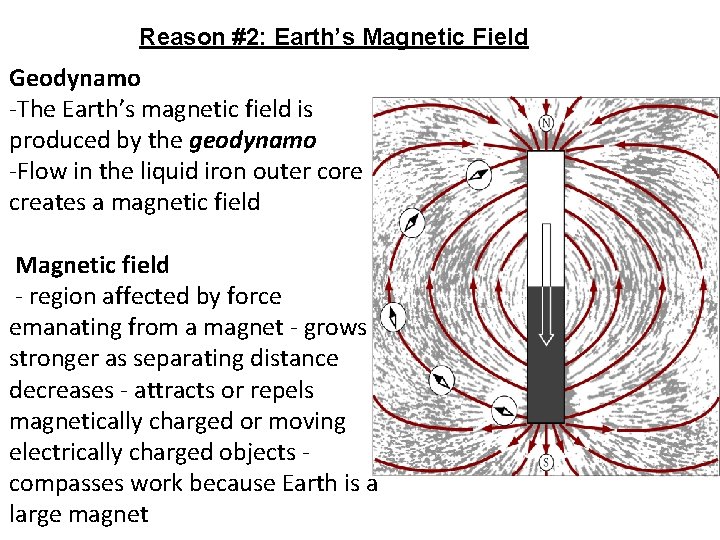
Reason #2: Earth’s Magnetic Field Geodynamo -The Earth’s magnetic field is produced by the geodynamo -Flow in the liquid iron outer core creates a magnetic field Magnetic field - region affected by force emanating from a magnet - grows stronger as separating distance decreases - attracts or repels magnetically charged or moving electrically charged objects compasses work because Earth is a large magnet